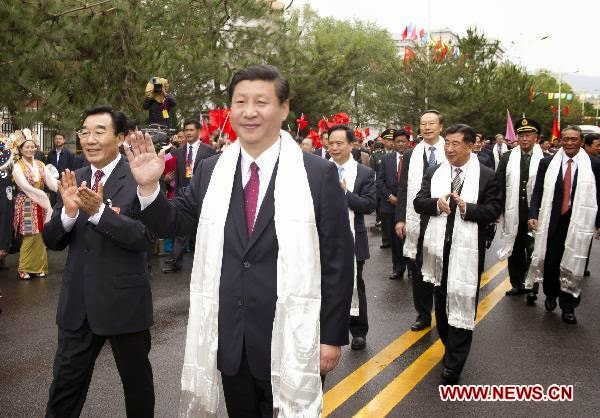
This month, India and Bhutan are celebrating the 50th anniversary of their diplomatic relations.
On this occasion, I post a note written by Jawaharlal Nehru, the Prime Minister of India on January 20, 1954 after a dinner with the King of Bhutan.
Jigme Dorji Wangchuck (2 May 1929 – 21 July 1972) was the Third Druk Gyalpo. He is credited with opening Bhutan (or Druk, the Land of the Dragon) to the outside world, to have started the modernization process and have taken the first steps toward the democratization of his country.
In September 1958, Nehru would visit him in Paro, crossing over the Chumbi Valley.
See my post of the subject.
The Dinner
At one point during the dinner in 1954, Nehru said that India was “friendly with China and there was no reason to think that between India and China there would be any conflict.”
This was of course a serious misjudgment.
Nehru however rightly pointed out that the foreign affairs of Bhutan “was a vital matter for India.”
Though Bhutan is now a fully independent nation, what is happening in Bhutan remains ‘vital’ to India.
Later in the evening, Nehru spoke of a survey of the Manas river for a hydro-power project; the Gyalpo was not fully convinced. Nehru added: “As for a survey, he [the Gyapo] said that permission had been given within a limited area. I [Nehru] said that this was not good enough and that the survey should have to take into consideration broad areas. He said he would consider this matter further.”
This would eventually lead to the survey of the trijunction between Tibet, Bhutan and Sikkim (Batang-la area) two years later by TS Murty, an officer of the Indian Frontier Administrative Service (with a team of the Survey of India).
It would then be realized that the trijunction was Batang-la, not Gyemochen (or Gipmochi).
A large collections of documents on the relations between Bhutan and India are available on my website.
Here is the link...
Here is Nehru’s Note dated January 30, 1954:
I had a long talk with the Maharaja of Bhutan after dinner to-night. The Maharani was asked to join us after some time at the instance of the Maharaja. According to him this was desirable as he did not always understand what I said and the Maharani's knowledge of English would help.
2. I expressed my pleasure at their visit to India which had enabled us to know each other better and also given them an opportunity of seeing a bit of India. I was sure that this would lead to greater understanding and fuller co-operation.
3. The Maharaja entirely agreed and thanked me for all the friendliness shown to him here. He said that Bhutan's relations had been friendly with India even in British times, and now they were friendlier.
4. I then mentioned very briefly the difficulties and tensions of the world and the possibility of even distant countries being affected by them. Bhutan had kept an isolated existence in the past and, for my part, I thought that this was a wise policy then, otherwise the British Government would have interfered a great deal. But conditions were very different now because of various happenings. The world was a much tighter place to live in, and the Tibet-Bhutan-India frontier was much more important now. We had, therefore, to take a broader view of the present as well as the future and it would become progressively more difficult for Bhutan to remain isolated. We had no desire to interfere in the internal government of Bhutan, though we were, of course, interested in Bhutan's progress and the well-being of her people. But, we were very greatly concerned with anything affecting foreign affairs and defence of Bhutan. It was for this reason that in our last Treaty [of 1949] it had been mentioned that the foreign affairs of Bhutan should be conducted with the guidance of India. Foreign affairs were intimately connected with defence. A wrong step by Bhutan in either of these matters might land us in difficulties. Therefore, there has to be the fullest co-ordination between Bhutan and India in regard to foreign affairs and defence.
5. In so far as Bhutan was concerned, the only two countries that affected her were India and China (or Tibet). We were friendly with China and there was no reason to think that between India and China there would be any conflict. Nevertheless, one must not leave things to chance and it was in the interest of India and Bhutan both to co-ordinate their defence and foreign policy. I mentioned that, even in the case of Nepal, this was our understanding. Indeed, India's real defence lay in the Himalayas. Any intruder coming into Nepal or Bhutan would weaken that defence and we could not tolerate it.
6. I developed this point rather fully. The Maharaja said that they quite understood that in regard to foreign policy India should be interested and they would give every consideration to what India said in this matter. I again pointed out that this was a vital matter for India.
7. I referred to our previous suggestion about having an Agent in Bhutan and said that this would help greatly in furthering our co-operation. It would be helpful to Bhutan in many ways and, in any event, we would be in direct contact which was so necessary. The Maharaja referred to past history and said that his National Assembly had not viewed this with favour but he was prepared to consult them again. He said that he was in constant touch with Mr. [BK] Kapur [the Political Officer in Sikkim]. I said that this was right, but, it would be advantageous to have an Indian Agent in Bhutan. I had no desire to press this against the will of the Maharaja and the Bhutan Government. But I did not understand why the Maharaja or his Government should be apprehensive in this matter. That showed a certain lack of confidence in us. We should proceed on a basis of accepting each other's bona fides and having confidence in each other. I left it at that.
8. I discussed internal conditions in Bhutan, the land system, the Nepalese there etc. The Maharaja said that there were no big zamindars there and land was owned by peasant proprietors who were happy and prosperous. There was no trouble with them. There was also no trouble with the resident Nepalese in the valleys, though two or three outsiders had come and tried to create some trouble.
9. I referred to the survey of the Manas river. He said that this matter had been raised in his father's time who thought that if a dam was constructed, the backwash of it would be injurious to Bhutan. I pointed out that the first step was a survey. Nobody could say now whether this survey would lead to the construction of a dam, and, in any event, no such decision could be taken without the consent of the Bhutan Government. As for a survey, he said that permission had been given within a limited area. I said that this was not good enough and that the survey should have to take into consideration broad areas. He said he would consider this matter further.
10. I then referred to the foreign exchange question and said that we had to be very careful about this so as not to waste it. Generally speaking, Bhutan should be able to get her requirements from India. Where this was not possible and something was specially wanted from abroad, there would be no difficulty in our arranging for foreign exchange. I suggested that we might have a minimum figure (I did not mention the figure) for foreign exchange. Any addition to this, if necessity arose, we would consider favourably.
11. The Maharaja referred to the necessity for free trade between Bhutan and India. He said that this had been more or less agreed to by Mr Harishwar Dayal [previous Political officer] at the time last Treaty was framed [1949]. It was then said that this might be left out of the Treaty but would nevertheless hold good. As a matter of fact, there were tell gates right near the frontier with West Bengal, and each truck was charged at the rate of Rs. 5 for round trip. This affected contractors on the Bhutan side. I told him that I knew nothing about this and no mention of this had been made previously. This question had better be discussed with our officers.
12. This was the substance of my conversation. Towards the end, the Maharaja again expressed his happiness at having come here and established personal contacts.
Copies were sent to the Secretary General of the MEA, the Foreign Secretary and the Joint Secretary.
Showing posts with label Harishwar Dayal. Show all posts
Sunday, May 13, 2018
Friday, July 28, 2017
The Doka La Confrontation
My article on the Doka La Confrontation appeared in Hindi on the BBC website
Here is the link...
After independence, India chose to be represented in Lhasa by a British ICS officer, Hugh Richardson; the Scot was Indian Mission-in-Charge from 1947 to 1950. On June 15, 1949, in a communication addressed to the Ministry of External Affairs in Delhi, he suggested that India might consider occupying Chumbi Valley up to Phari ‘in an extreme emergency.’ The Chumbi Valley is the highly strategic ‘finger’ sandwiched between Bhutan and Sikkim.
Sixteen months later, Chinese troops invaded Eastern Tibet and Harishwar Dayal, who had replaced another Britisher as the Political Officer in Sikkim, made again the same suggestion: “[Richardon’s] suggestion was NOT favoured by Government of India at the time. It was however proposed as a purely defensive measure and with NO aggressive intention. An attack on Sikkim or Bhutan would call for defensive military operations by the Government of India,” he wrote to Nehru.
The proposal was again rejected by the Indian Government, though many in India thought that Delhi should be more proactive to support the Dalai Lama.
On June 16, 2017, when the Chinese troops entered a disputed stretch at the southern tip of the same Chumbi Valley, India did what it had not done in 1950, it came to the rescue of a friendly neighbor; this time it was Bhutan.
Beijing’s sharp response, via its spokesperson and State media, is probably due to the surprise; China did not expect Delhi to militarily defend Thimphu. It is also true that the trijunction is a strategic hotspot for Delhi, and by occupying it, the Chinese would have a ‘view’ not only on the Chumbi Valley but also on the Siliguri corridor, which is India’s main strategic weakness in case of a military conflict.
Beijing bases its action on the 1890 Convention between the British and the Manchus, which was never recognized by the Tibetans, as they (and the Bhutanese) had not been consulted by the 'Great Imperial Powers'. Tsepon WD Shakabpa, the Tibetan historian explained: “The British were aware that China exercised no real power in Tibet at that time.”
The need to bring the Tibetans onboard eventually resulted in the Younghusband’s military expedition in 1904 and ten years later, the Tripartite Simla Conference.
Further, the 1890 Convention mainly dealt with Northern Sikkim, where two years earlier, an armed conflict had taken between the British and the Tibetans. Though Article 1 mentions “The line commences at Mount Gipmochi on the Bhutan frontier,” the area had never been surveyed. The first survey of northern Sikkim dates 1895; some maps published more than a decade later did not show a defined border.
On June 30, 2017, the Ministry of External Affairs in Delhi clarified that, in 2012, it had been decided with China that the status quo would be maintained: “The two Governments had in 2012 reached an agreement that the tri-junction boundary points between India, China and third countries will be finalised in consultation with the concerned countries.”
Probably getting upset with the delay in finding a solution, Beijing decided to take the matter in its own hand, as it had done earlier in the South China Sea. Beijing has a tendency to believe in the principle that it is better to first be ‘in possession’ and then start talking.
While recently addressing the foreign diplomats in Delhi, Foreign Secretary S Jaishankar stated that China has been ‘unusually aggressive and articulate’.
He told Indian MPs that India’s position has been clearly outlined on the border, though the Chinese have a differing position.
An interesting (and reassuring) feature of the present standoff is that both the Indian and Chinese troops, facing each other in the 7 km gap between the different ‘perceptions’ of the trijunction, are unarmed. Braving the high altitude, two chains of soldiers stand opposite each other preventing a move of the opponent.
As long as no weapon is used, there is still hope to find a diplomatic solution, though the Chinese have gone rather far in their propaganda campaign; this has made a win-win solution, without ‘loss of face’, more difficult to find.
In a recent interview, Former National Security Advisor Shyam Saran said there was no need of acrimonious exchanges: “I don’t think we should look for tit-for-tat kind of exchanges. This is serious business. Would welcome the fact that the Indian side has rather been restrained and mature in its reaction.” It should remain so.
One can only hope that reason will prevail, but a solution is bound to take time, certainly not before the Chinese leadership change during the Communist Party’s 19th Congress at the end of the year.
Before this, the People’s Liberation Army (PLA) will celebrate its 90th Anniversary on August 1. In April, President Xi Jinping, who has introduced in-depth reforms of the PLA, asked all military units to prepare themselves for combat and give priority to building ‘new-type’ fighting capabilities in electronic, information and space warfare. He was probably not expecting that India would jump so quickly to Bhutan’s defence.
All these factors make it more difficult to find a quick solution, which lies in the return of the status quo and eventually the creation of a demilitarized zone.
Sunday, July 23, 2017
India, China, Tibet and the curious case of the missing Sikkim Papers
![]() |
| Harishwar Dayal in front of The Residency in Gangtok |
Here is the link...
The present standoff at the trijunction between Sikkim, Tibet and Bhutan, on the southern tip of the Chumbi, is a worrying development. While recently addressing the foreign diplomats in Delhi, Foreign Secretary S Jaishankar rightly stated that China has been ‘unusually aggressive and articulate’.
Beijing seems to have only one argument, i.e. the 1890 Convention between the British and the Manchus, conveniently forgetting several other agreements, particularly the 1893 Trade Regulations (1890 twin accord) which allowed India to open a trade mart in Yatung in the Chumbi Valley.
Treasure
There is also general amnesia on the fact that the Tibetans never recognized the 1890 Convention as Lhasa and Paro were not consulted by the 'Great Imperial Powers'. Tsepon WD Shakabpa, the Tibetan historian explained: “In 1890 a convention was drawn up …without consulting the government of Tibet …and since [Tibet] was not represented at the Convention, those articles were not allowed to be put into practice by the Tibetans. The British were aware that China exercised no real power in Tibet at that time.”
To come back to the present day, Jaishankar told a panel of MPs that India has clearly outlined its position on the border though the Chinese have a differing position, “but they are misinterpreting it and so India was trying to clarify it. He said that India has been maintaining the same position since 1895 as per an Anglo-Chinese agreement.”
One can only hope that reason will prevail in Beijing, but a solution is bound to take time, certainly not before the leadership change in November during the Communist Party’s 19th Congress.
In this context, an anecdote came back to mind. A few years ago, an acquaintance who, as a young diplomat, was posted in Gangtok in the Political Officer’s office told me that in 1975-76, soon after the merger of the Himalayan State with India, he spent months going through all the historical records kept in Gangtok between 1889 to 1975; Delhi’s orders were to dispatch them to Delhi for safe custody. Once his work was over; the diplomat sent six truck-loads of old files to Delhi under CRPF escort. Since then, nobody seems to know where these Sikkim Papers are and if this archival treasure still exists.
It would have an immense historical value today to show that India and Tibet had a different relation than the one portrayed by China; further Beijing would be unable to bluff its way through with incorrect historical information.
The Political Officer (PO) was the Government of India’s eye over the entire Himalayan region. From the seasonal Indian Trade Agency (ITA) in Gartok in Western Tibet, to the ITA in Gyantse and Yatung, the Indian Mission (and later Consulate General) in Lhasa, all correspondence passed through Gangtok. It included the relations with Sikkim and Bhutan; the PO even overlooked the NEFA area in coordination with the Governor of Assam.
Gangtok has seen many remarkable personages serving as POs.
The first was Claude White, a British engineer who was send to Sikkim in 1887 to tackle the tense situation on the Sikkim–Tibet border in the north. A year later, White came back to Sikkim as an Assistant Political Officer of a British Expeditionary Force which defeated the Tibetans a year later; this resulted in the 1890 Convention. In the meantime, a post of Political Officer in Sikkim had been created, making Claude White, the Administrative head of the entire Himalayan region.
Tragedy
In his book Sikkim and Bhutan: 21 Years on the North East Frontier 1887-1908, the first PO wrote, “one of the first things to be done after his arrival in Sikkim was to build a house, the site for which was found in the midst of the jungles around Gangtok”; then called the Residency, it is today’s the Raj Bhavan. White also ordered a survey of the borders with Tibet, including the 1895 one.
Though South Block probably has copies of some of the Sikkim Papers, the entire set is not traceable (it is at least what I was told). It is a tragedy for researchers and it would undoubtedly help strengthen India’s case in the present circumstances.
History
Interesting officers occupied the Residency in Gangtok.
Amongst them, Sir Charles Bell who had developed a deep friendship with the Thirteenth Dalai Lama, when the latter was living in exile in Kalimpong, but also Frederick Bailey who was instrumental in mapping the North-East, what became the McMahon Line in 1914; and Sir Basil Gould, who in the 1930s, travelled to Tibet to establish diplomatic relations with a then Independent Tibet or Arthur Hopkinson, the religious-minded ICS officer, who was asked by the Government of India to continue for a year after Independence as the First ‘Indian’ PO.
Harishwar Dayal took over from Hopkinson and was officiating when Tibet was invaded by the Chinese troops in October 1950.
Once in a cable to the Prime Minister, Dayal dared quoting a dispatch sent from Hugh Richardson, the Scottish-born ‘Indian’ representative in Lhasa; on June 15, 1949, he suggested that India might consider occupying Chumbi Valley up to Phari ‘in an extreme emergency’.
This did not go well with Nehru, but in November 1950, Dayal wrote: “This suggestion was NOT favoured by Government of India at the time. It was however proposed as a purely defensive measure and with NO aggressive intention. An attack on Sikkim or Bhutan would call for defensive military operations by the Government of India.”
Though it is history now, it is what China’s PLA strategists would today call ‘active defence’. Let us hope that the Sikkim Papers could soon be traced, they contain the history of Modern Himalaya.
Thursday, April 14, 2016
The day Indian and Chinese officials met in Lhasa
![]() |
| Dekyilingka, the Indian Mission in Lhasa |
At that time General Zhang was the Representative in Tibet of the Central Committee of the Communist Party of China; he later became First Secretary of the Tibet Work Committee, overseeing the administration of Tibet.
Sumul Sinha, an IFS officer, was the head of the Indian Mission in Tibet; a year earlier, he had replaced Hugh Richardson, who had served at this post between August 1947 and August 1950 (he had earlier served the British).
During their first meeting, the Chinese general followed the diplomatic etiquette and appeared even enjoying his visit to Dekyilingka, the Indian Mission.
He is accompanied by a controversial Tibetan Alo Chonzed, then a leader of the Tibetan People’s Association.
Interestingly, Zhang told Sinha that “his Government would be agreeable to the establishment of an Indian Consulate General at Lhasa.”
It would happen at the end of 1952 when the Indian Mission would be downgraded into a Consulate General; practically, it meant that Tibet had lost the right to have direct foreign relations with India: Tibet was no more an independent country.
Copy of a Memorandum dated September 23, 1951
from Sumul Sinha, Officer in Charge, Indian Mission in Lhasa (Tibet)
to Harishwar Dayal, the Political Officer in Sikkim, Gangtok.
In our telegram No. 60, dated 21st September, 1951, we briefly reported General Chang Ching-wu’s [Zhang Jingwu] visit to our Mission with his staff on Thursday the 20th September. He was due to arrive at our Mission at 10 (Tibetan time), but was late by 30 minutes or so, not having made, as he said, any allowance for the distance between Trimon house and the Indian Mission at Dekyilingka.
![]() |
| General Zhang Jingwu |
I thanked him cordially for the offer, and told him that as I was on the road to recovery o hoped it would not be necessary to trouble his doctor. Chang then formally presented me with 3 copies of a booklet regarding ‘Deliberations and Agreement between the Central People’s Government and the local Government of Tibet on methods for the peaceful liberation of Tibet’ [known as the 17-Point Agreement].
Two copies in ordinary coarse paper were, he said, for general use. The other bound in red silk with printed characters in golden types was specially inscribed to me in Chang’s own calligraphy. The paper need in this copy is of a superior quality and the printing is excellent.
I am sending you herewith one of the two ordinary copies we have received from Chang for ‘general use’.
Along with it, I am sending you a copy of the People’s Daily dated 28th May 1951, which Chang also left with us, and Chang’s calligraphy declaring eternal friendship between China and India.
While the Chinese officers were entertained to lunch and tea upstairs, separate arrangements were made below to feed their guards. We put on a cinema show for the entire party and the following films were shown:
1. Glimpses of Mahatma Gandhi.
2. No. 22 and 26.
3. Shantiniketan
4. Festival Time
![]() |
| General Zhang Jingwu distributing alms |
They thoroughly enjoyed the show, and said that they hoped soon to invite us to a show of Chinese films.
During the 7 odd hours Chang Ching-wu remained with us, he was in an emotional mood, at lunch, he was several times on his feet, toasting our Prime Minister [Jawaharlal Nehru] and eternal friendship between China and India.
Twice he went into flights of oratory in Chinese, denouncing war and declaring that he had sacrificed 26 years of his life for the younger generation, referring in particular to our wireless operator and to my Stenographer.
Although Chang had no further desire to carry arms, he was prepared at all times to take up the challenge of Imperialist bounds, particularly the Americans. He told us that he could discard his reserve and be frank and free with us because he was not a diplomat but a rough and rude soldier. He extended an invitation to me to visit his home in Peking and stay with him as his guest.
Confidentially, he announced to me that his Government would be agreeable to the establishment of an Indian Consulate General at Lhasa.
Chang and Alo have promised to repeat their visits to our Mission, and have asked us to allow them to join us at tennis whenever we play.
Chang was also in a mood to flatter himself.
He said General Yuan Chong-hsien, [Yuan Zhongxian] Chinese Ambassador in New Delhi, was his comrade, while the Chinese Ambassador in Rangoon was his departmental assistant.
Chang left early at 5 P.M. because he had arranged a meeting with General Wang Ching-ming [Wang Qimei] at 2:30 PM at Trimon house.
Wang Ching-ming sent a messenger with a note to remind Chang of the appointment, but Chang was persuaded to remain with us a little longer. But for his secretaries who were constantly pressing him to return, he would have stayed on till late in the evening.
Friday, March 25, 2016
Tibet's Invasion: the Last Warning
![]() |
| Harishwar Dayal (left) with Lovell Thomas, the American journalist in front of the Residence in Gangtok |
The full-fledged invasion will take place 2 months later on October 7, when the PLA crossed the Upper Yangtze.
In August, Dayal asks/tells his Government:
- To urgently decide a line to be taken "on Tibetan question and how and when India will act."
- That India has promised to provide diplomatic support when the Tibetan question is raised
- Friendly representations have so far been ineffective
- India is not doing charitably in assisting Tibet
- The domination of Tibet would cause nervousness and unrest among border peoples in NEFA and from Ladakh to Assam
- The policing of the northern frontier has so far required negligible military effort. It would assume immediate practical importance.
- India should not condone the Chinese aggression on Tibet
- There is no Anglo-American activity in Tibet as the Chinese propaganda pretends.
- Dayal gives the example of Eastern Europe which makes it clear that the autonomy offered by the Communists is meaningless.
- He suggests that friendly, but positive representation might avert aggression while maintenance of an attitude of indifference would
certainly encourage it.
The latter option would eventually be chosen by Delhi.
From the Political Officer in Sikkim, Gangtok.
To Foreign (Ministry of External Affairs), New Delhi.
Repeated to the (Indian) Mission (in) Lhasa.
TOP SECRET telegram dated August 17, 1950
Lhasa telegram [from Sumul Sinha] of 14th August and 16th August [1950] make it urgent for Government of India to decide definitely what line they are going to take on Tibetan question and how and when they will act. Message conveyed in your [previous] telegram assured Tibet of diplomatic support when Tibetan question was raised. It is evident that satisfactory solution must largely depend on existence of friendship between India and China. But it is equally evident that friendly representations made after invasion has begun must be ineffective (repeat ineffective).
2. Question is not (repeat not) simply one of charitably assisting Tibet. Communist domination of Tibet would cause nervousness and unrest among border peoples along whole of India’s Northern frontier from Ladakh to Assam and policing of that frontier which has hither - to required negligible military effort and expenditure would assume immediate practical importance. Moreover in Korea Government of India have opposed aggression even though the party attacked is a reactionary regime dominating one part of a country whose people wish for UNIFICATION. They could not (repeat not) in the circumstances condone aggression on Tibet from Chinese side of the De FACTO border.
3. Recent statements by Chinese spokesmen that their forces will enter Tibet only to free her from Anglo-American influences and that Tibetan way of life and autonomy will be left undisturbed are clearly insincere. There is now no (repeat no) Anglo-American activity in Tibet and Chinese have already attacked the established religious and political Order by CHAMPIONING the PANCHEN LAMA candidate. The example of Eastern Europe makes it quite clear that establishment of Communist autonomy meaningless.
4. In these circumstances it appears necessary that Chinese Government should immediately be informed of Government of India’s views on Tibet and of their concern at reports of military concentrations on Tibetan border. They could be told that India is keenly interested in maintenance of full Tibetan autonomy and integrity for reasons of her own security. Any military activity against Tibet would worsen the already present International situation besides causing alarm in India.
5. Friendly but positive representation on these lines might possibly avert aggression while maintenance of an attitude of indifference would certainly encourage it. Communist countries have evidently accepted India’s stand on Korea with understanding. If Chinese Government are genuinely anxious to cultivate India’s friendship they should be ready to appreciate India’s concern for her own security.
6. I did NOT hear All India Radio announcement of statement said to have been made by Indian High Commissioner in London. Grateful for details.
A day later, Nehru replied that the pressure tactics suggested by Dayal are unlikely "to succeed because, ultimately, we have no effective sanctions."
One could ask, in which case "why to intervene in the Korean crisis"?
Just for the glory?
Here is Nehru's reaction to Dayal's telegram. Dayal and Sinha were rightly getting nervous!
PRIME MINISTER’S SECRETARIAT
To the Secretary General, MEA (G.S. Bajpai)
and Foreign Secretary (K.P.S. Menon)
Date: August 18, 1950
Our Representative at Gangtok in Sikkim is evidently getting very nervous about the situation in Tibet. His telegram displays this nervousness and advise us to go on bringing pressure on the Chinese Government to refrain from invading Tibet. Our Representative in Lhasa also feels that way. I do not think any such attempt at pressure tactics is likely to succeed because, ultimately, we have no effective sanctions. We are reminded that we promised diplomatic support to Tibet. We have been giving such diplomatic support in so far as it is feasible. We can do little more.
I am however sending you a draft telegram which I wish to send personally to our Ambassador in Peking.
(J. Nehru)
[Prime Minister]
From Foreign (Ministry of External Affairs), New Delhi.
To the Political Officer in Sikkim, Gangtok
Repeated to the Indian Mission in Lhasa.
Reference your telegram. Threatened invasion of Tibet by China.
On July 16th, we instructed our Ambassador at Peking to emphasise to Chinese Government the desirability of settling Sino-Tibetan affairs by friendly negotiations. On receiving the text of General Liu Po-Cheng’s [Liu Bosheng] proclamation to Tibetans from our Embassy at Peking [General Liu had announced that Tibet would soon be 'liberated'], we instructed him in our telegram dated 5th August to make a representation to the Chinese Government that Sino-Tibetan relations should be settled by means of negotiations and that the projected military march should be stayed. The Ambassador made the representation on 13th August to the Vice Minister who promised to refer it to the Foreign Minister, Chou En Lai who was ill. The reply of the Chinese Government is still awaited. In a telegram sent by us on the 17th August we instructed our ambassador to repeat our earnest hope that the problem of Tibet will be peacefully settled by friendly negotiations.
2. We regret that by oversight this information was not conveyed to you earlier.
3. Press report of Krishna Menon’s statement will be sent to you by bag [V.K. Krishna Menon, the Indian High Commissioner in London had defended Communist China].
The Indian ambassador, K.M. Panikkar's appeal was so weak that the Chinese took it as a green light to go ahead. It will be mentioned two months later in a telegram from Mao to the Southwestern Bureau in Chengdu, responsible for the military operations.
Panikkar believed that in any case Tibet has always belonged to China.
Such a tragedy for Tibet and for India.
Retrospectively, Dayal's warnings were absolutely accurate.
Wednesday, March 2, 2016
War and Peace: the Invasion of Tibet, an unequal combat
As Tibetans prepare to elect a new Prime Minister (Sikyong), it is necessary to look
back at a time when Tibet was still a free country, not yet ‘liberated’ by
China.
But, let us be honest, during the first weeks of October 1950, Tibet was invaded by China, not ‘liberated’ of anything.
Nehru and Tibet
As the PLA makes lightning advances in Kham province, the Indian Prime Minister talks of Peace.
On November 19, 1950, Nehru writes a note to the Foreign Secretary; he is deeply upset with the notes/cables received from Harishwar Day, the Political Officer in Sikkim and Sumul Sinha, the head of the Indian Mission in Lhasa.
Why?
Nehru explains: “I am a little tired of reading the telegrams that come to us from our Mission in Lhasa and our Representative in Sikkim.”
While a drama unfolds on India’s borders, the Prime Minister (who is also Foreign Minister) is ‘tired’ of these two remarkable diplomats: “They are full of their advice to us as to what we should do and criticism of us for what we may have done. I think that it is about time that we reminded these representatives of ours what their functions are and what they are supposed, and what not, to do," remarks Nehru.
The note, addressed to K.P.S. Menon, the then Foreign Secretary, continues: “We want from them full information and appraisals of the situation. We want also their own recommendations. But, it seems to me that their messages go beyond this and indicate a lack of confidence in the Government of India and an apprehension that we might do the wrong thing unless they stop us from doing it. They live in remote parts, cut off from the rest of the world, and judge all world events from their own immediate environments. They appear to have hardly any conception of broad policies in terms of what is happening in the world.”
Dayal and Sinha are probably unable to 'understand' the implications of what is happening in the Korean peninsula and the ‘mediator’ role that Nehru wants to play in the crisis, but these two officers are witnessing of one of the greatest tragedies of the 20th century, a peaceful independent nation is engulfed by a bully neighbour in the name of ‘liberation’.
Nehru further observes that the last paragraph in a telegram from Lhasa (from Sinha) is ‘extraordinary’: “Our representative in Lhasa says that he would be grateful if the Government of India do not adopt a certain policy. Exactly whom does he represent there and on whose behalf is he going to be grateful? This is not a personal concern of his.”
The Prime Minister finally requests the Foreign Secretary to send some message to both Lhasa and Sikkim, “pointing out the functions of our representatives there.”
A Note from Harishwar Dayal
Two days later, on November 21, not knowing that the Prime Minister is ‘tired’ of his comments, Harishwar Dayal sends a long legal note to the Ministry of External Affairs on the importance of Tibet for India.
His points are deeply relevant to the situation on India's borders.
In the last paragraph of his communication, Dayal ‘dares’ to quote the letter from Hugh Richardson sent on June 15, 1949 addressed to South Block.
The British-born first ‘Indian’ representative in Lhasa (he will be replaced by Sinha in August 1950) had suggested that India might consider occupying Chumbi Valley up to Phari ‘in an extreme emergency.’
Take the control of the Chumbi Valley
More than a year later, Dayal brings again the same suggestion: “This suggestion was NOT favoured by Government of India at the time. It was however proposed as a purely defensive measure and with NO aggressive intention. An attack on Sikkim or Bhutan would call for defensive military operations by the Government of India,” he writes.
It is what China’s PLA theorists today call ‘active defence’.
Dayal explains his reasoning: “In such a situation occupation of the Chumbi Valley might be a vital factor in defence. In former times it formed part of the territories of the rulers of Sikkim from whom it was wrested by the Tibetans by force. It is now a thin wedge between Sikkim and Bhutan and through it lie important routes to both these territories. Control of this region means control of both Jelep La and Nathu La routes between Sikkim and Tibet as well as of the easiest routes into Western Bhutan both from our side and from Tibetan side. It is a trough with high mountains to both east and west and thus offers good defensive possibilities. I would therefore suggest that possibility of occupying the Chumbi Valley be included in any defensive military plans though this step would NOT of course be taken unless we became involved in military operations in defence of our borders.”
The Political Officer probably does not realize that China is a ‘friend’!
The Battle of Chamdo
I am posting below the Detailed Report on Battle of Chamdo by the 52nd Division of the 18th Army of the People’s Liberation Army.
The source of this text in Chinese is The Liberation of Chamdo, compiled by Office of Editing and Research, Political Department, Chengdu Military Area Command and Tibet Military Area Command (Chengdu, 1991).
It has been translated by two independent researchers Jianglin Li and Matthew Akester and the entire text in English is available on their blog.
Of course, it reflects the views of Mao Zedong and the Communist Party of China, but it shows that the Battle of Chamdo was a military operation conducted in a professional manner by the 18th Army, as well as other supporting forces coming from the North (Qinghai, then Amdo province of Tibet).
There was no question of ‘peace’ or ‘negotiations’ for Mao (Nehru was banking on 'talks' to peacefully solve the issue)).
Further, it is clear for the Great Helmsman that it is only the first stage before an advance towards Lhasa during the next season.
What is surprising is the elaborate planning of this military operation. Comparatively, the leaderless Tibetans are novices and stand no chance in front of the calculated tactical moves of the PLA.
It should also be noted that the Chinese learned a lot during the Chamdo operations; this is apparent in the Summary.
Did they learn for another operation, 12 years later, on the other side of the Himalayan slopes?
Probably. Look at their slogans:
India learned nothing during these 12 years. This is another tragedy.
India is still suffering of the crushing defeat of 1962. Stigmas of the rout are still visible in the Indian psyche.
Here is the Chinese narrative of The Battle of Chamdo.
(November, 1950)
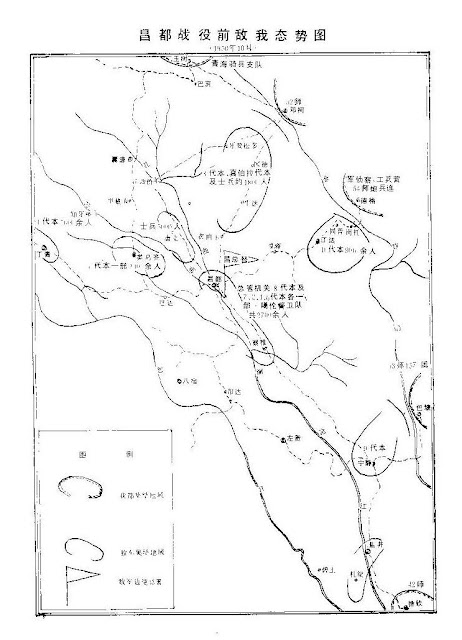
After crossing the Jinsha river [Tib: Drichu or Upper Yantze] from October 6th to 9th, troops reached the vast plateau of a thousand li [1000 li, c. 500 km] in length and width and in coordination with brother troops, units of this division were divided into three wings, left, middle and right, forming the assault on Chamdo, a powerful pincer attack targetting the 1500-li-long position of the Tibetan army commanded by Chamdo Governor Lhalu.
During the fourteen days of rapid advance and fighting, all units were moving across the unfamiliar plateau without accurate maps.
Soldiers carried loads of 60 or 70 jin,[ c. 30 to 35 kg] climbed more than 50 high mountains and crossed rivers over 60 times.
On average, foot soldiers cover 72 li , [36 km] cavalry 80 li [40 km] a day, those who had to march day and night moved up to 34 hours continuously without enough food. However, (all units) answered the call by party committees of both the army and the division and endured extreme hardship, annihilated all the defending enemies in Chamdo on schedule, and successfully completed the capture of Chamdo.
The success of this battle, …annihilated five Dapons [commander of a regiment], the main force of the Tibetan army, and over 2000 militia, liberated the region north to Qinghai, south to Yunnan, east to Jinsha river, west to Luolong [Lhorong Dzong] and Leiwuqi [Riwoche], a vast area more than one thousand square li. The success further strengthened our unity with Tibetans west of the Jinsha river, laid the foundation for advancing next year (1951), struck blows directly and indirectly at the British and American imperialist invaders, inspired people in the near east and repaid the people of the whole country who had warmly supported us.
…Tibetans have warmly supported us (taking in and escorting individual stragglers, delivering information, guiding the way, providing transportation, building bridges, preparing firewood and fodder, etc.), all of this shows that we had good influence by carrying out the policies conscientiously before the attack and shows the tangible benefits brought to Tibetans during our westward march. This is a small accomplishment we achieved in the past, and it is also a major pointer for the future in the liberation and construction of Tibet.
In this battle, troops advanced rapidly for 15 days with heavy loads across the high plateau a thousand kilometers in length and width, wrapping up…entire (enemy?) position 1500 li [750 km] in length and accomplished the task on schedule, completely annihilated the third (two Dapons), the seventh, the eighth, the fifth and the tenth Dapon, altogether five Dapons (averaging small regiments) under Tibetan Frontier Envoy Commissioner General,[The Chamdo governor was the ‘Domey Chikyap’ or ‘Eastern Governor’] captured…over 3000 men. This victory is fundamentally due to correct leadership by leading officers of the Military Area Command and the Army Party Committee, strong support from the people of the whole country, coordination from brother troops (particularly engineer corps), favourable influence created by advanced detachment through their hard work and carrying out policies conscientiously, and the eight-month long preparation. All of these contributed to the successful conclusion of this battle.
Review of the battle process is as follows:
I. Process
Performance of troops in this wing is the key to success or failure in annihilating more than three Dapons of the enemy force. The middle wing cut into the heart of the enemy position by way of Shengda [Jomda county in today’s Chamdo prefecture], Yayaosongduo [Yayu Sumdo], Yiquka, Dongdong Zhuka, Duozhiduo, etc, cutting into the heart of the enemy position, penetrating, separating, surrounding and annihilating the enemy within the entire enemy position and advancing straight to Chamdo.
If the enemy did not rest, we wouldn’t rest; when the enemy took rest, we annihilate them. The left wing force crossed the river at Gangtuo [Kamtok], marching slowly by way of Tongpu, Jiangda [Jomda] and Jueyong to draw in the enemy. They seized the Damala Pass and controlled Sichuan bridge. Our slogans were “not to worry about breaking up Tibetan army’s positions, but to worry whether we can surround them. Surround more, annihilate more; surround less, annihilate less.”
II. Review of the Battle [not available]
III. A few experiences from the battle
But, let us be honest, during the first weeks of October 1950, Tibet was invaded by China, not ‘liberated’ of anything.
Nehru and Tibet
As the PLA makes lightning advances in Kham province, the Indian Prime Minister talks of Peace.
On November 19, 1950, Nehru writes a note to the Foreign Secretary; he is deeply upset with the notes/cables received from Harishwar Day, the Political Officer in Sikkim and Sumul Sinha, the head of the Indian Mission in Lhasa.
Why?
Nehru explains: “I am a little tired of reading the telegrams that come to us from our Mission in Lhasa and our Representative in Sikkim.”
While a drama unfolds on India’s borders, the Prime Minister (who is also Foreign Minister) is ‘tired’ of these two remarkable diplomats: “They are full of their advice to us as to what we should do and criticism of us for what we may have done. I think that it is about time that we reminded these representatives of ours what their functions are and what they are supposed, and what not, to do," remarks Nehru.
The note, addressed to K.P.S. Menon, the then Foreign Secretary, continues: “We want from them full information and appraisals of the situation. We want also their own recommendations. But, it seems to me that their messages go beyond this and indicate a lack of confidence in the Government of India and an apprehension that we might do the wrong thing unless they stop us from doing it. They live in remote parts, cut off from the rest of the world, and judge all world events from their own immediate environments. They appear to have hardly any conception of broad policies in terms of what is happening in the world.”
Dayal and Sinha are probably unable to 'understand' the implications of what is happening in the Korean peninsula and the ‘mediator’ role that Nehru wants to play in the crisis, but these two officers are witnessing of one of the greatest tragedies of the 20th century, a peaceful independent nation is engulfed by a bully neighbour in the name of ‘liberation’.
Nehru further observes that the last paragraph in a telegram from Lhasa (from Sinha) is ‘extraordinary’: “Our representative in Lhasa says that he would be grateful if the Government of India do not adopt a certain policy. Exactly whom does he represent there and on whose behalf is he going to be grateful? This is not a personal concern of his.”
The Prime Minister finally requests the Foreign Secretary to send some message to both Lhasa and Sikkim, “pointing out the functions of our representatives there.”
A Note from Harishwar Dayal
Two days later, on November 21, not knowing that the Prime Minister is ‘tired’ of his comments, Harishwar Dayal sends a long legal note to the Ministry of External Affairs on the importance of Tibet for India.
His points are deeply relevant to the situation on India's borders.
In the last paragraph of his communication, Dayal ‘dares’ to quote the letter from Hugh Richardson sent on June 15, 1949 addressed to South Block.
The British-born first ‘Indian’ representative in Lhasa (he will be replaced by Sinha in August 1950) had suggested that India might consider occupying Chumbi Valley up to Phari ‘in an extreme emergency.’
Take the control of the Chumbi Valley
More than a year later, Dayal brings again the same suggestion: “This suggestion was NOT favoured by Government of India at the time. It was however proposed as a purely defensive measure and with NO aggressive intention. An attack on Sikkim or Bhutan would call for defensive military operations by the Government of India,” he writes.
It is what China’s PLA theorists today call ‘active defence’.
Dayal explains his reasoning: “In such a situation occupation of the Chumbi Valley might be a vital factor in defence. In former times it formed part of the territories of the rulers of Sikkim from whom it was wrested by the Tibetans by force. It is now a thin wedge between Sikkim and Bhutan and through it lie important routes to both these territories. Control of this region means control of both Jelep La and Nathu La routes between Sikkim and Tibet as well as of the easiest routes into Western Bhutan both from our side and from Tibetan side. It is a trough with high mountains to both east and west and thus offers good defensive possibilities. I would therefore suggest that possibility of occupying the Chumbi Valley be included in any defensive military plans though this step would NOT of course be taken unless we became involved in military operations in defence of our borders.”
The Political Officer probably does not realize that China is a ‘friend’!
And he has not yet been informed that the Prime Minister was tired of his comments!
What may have prompted Dayal to write this letter is probably a meeting with members of the Himmatsinghji Committee, who are preparing a contingency plan to defend India’s borders. They may have asked him to put his views in writing in order to put some pressure on the pacifists in South Block which could only see the ‘wider perspectives’.
Retrospectively, only a solution such as the one suggested by Harishwar Dayal, could have stopped the advance of the Chinese troops.
But India's official political thinking was elsewhere. A few days earlier, Nehru explained to K.M. Panikkar, his ambassador in Beiing: “Our present policy is primarily based on avoidance of world war; and secondly on maintenance of honourable and peaceful relations with China.”
Well, China had other objectives.
I am posting below the Detailed Report on Battle of Chamdo by the 52nd Division of the 18th Army of the People’s Liberation Army.
The source of this text in Chinese is The Liberation of Chamdo, compiled by Office of Editing and Research, Political Department, Chengdu Military Area Command and Tibet Military Area Command (Chengdu, 1991).It has been translated by two independent researchers Jianglin Li and Matthew Akester and the entire text in English is available on their blog.
Of course, it reflects the views of Mao Zedong and the Communist Party of China, but it shows that the Battle of Chamdo was a military operation conducted in a professional manner by the 18th Army, as well as other supporting forces coming from the North (Qinghai, then Amdo province of Tibet).
There was no question of ‘peace’ or ‘negotiations’ for Mao (Nehru was banking on 'talks' to peacefully solve the issue)).
Further, it is clear for the Great Helmsman that it is only the first stage before an advance towards Lhasa during the next season.
What is surprising is the elaborate planning of this military operation. Comparatively, the leaderless Tibetans are novices and stand no chance in front of the calculated tactical moves of the PLA.
It should also be noted that the Chinese learned a lot during the Chamdo operations; this is apparent in the Summary.
Did they learn for another operation, 12 years later, on the other side of the Himalayan slopes?
Probably. Look at their slogans:
Surround more, annihilate more; surround less, annihilate less
Cutting into the heart of the enemy position, penetrating, separating, surrounding and annihilating the enemy
India learned nothing during these 12 years. This is another tragedy.
India is still suffering of the crushing defeat of 1962. Stigmas of the rout are still visible in the Indian psyche.
Here is the Chinese narrative of The Battle of Chamdo.
(November, 1950)
After crossing the Jinsha river [Tib: Drichu or Upper Yantze] from October 6th to 9th, troops reached the vast plateau of a thousand li [1000 li, c. 500 km] in length and width and in coordination with brother troops, units of this division were divided into three wings, left, middle and right, forming the assault on Chamdo, a powerful pincer attack targetting the 1500-li-long position of the Tibetan army commanded by Chamdo Governor Lhalu.
During the fourteen days of rapid advance and fighting, all units were moving across the unfamiliar plateau without accurate maps.
Soldiers carried loads of 60 or 70 jin,[ c. 30 to 35 kg] climbed more than 50 high mountains and crossed rivers over 60 times.
On average, foot soldiers cover 72 li , [36 km] cavalry 80 li [40 km] a day, those who had to march day and night moved up to 34 hours continuously without enough food. However, (all units) answered the call by party committees of both the army and the division and endured extreme hardship, annihilated all the defending enemies in Chamdo on schedule, and successfully completed the capture of Chamdo.
The success of this battle, …annihilated five Dapons [commander of a regiment], the main force of the Tibetan army, and over 2000 militia, liberated the region north to Qinghai, south to Yunnan, east to Jinsha river, west to Luolong [Lhorong Dzong] and Leiwuqi [Riwoche], a vast area more than one thousand square li. The success further strengthened our unity with Tibetans west of the Jinsha river, laid the foundation for advancing next year (1951), struck blows directly and indirectly at the British and American imperialist invaders, inspired people in the near east and repaid the people of the whole country who had warmly supported us.
…Tibetans have warmly supported us (taking in and escorting individual stragglers, delivering information, guiding the way, providing transportation, building bridges, preparing firewood and fodder, etc.), all of this shows that we had good influence by carrying out the policies conscientiously before the attack and shows the tangible benefits brought to Tibetans during our westward march. This is a small accomplishment we achieved in the past, and it is also a major pointer for the future in the liberation and construction of Tibet.
In this battle, troops advanced rapidly for 15 days with heavy loads across the high plateau a thousand kilometers in length and width, wrapping up…entire (enemy?) position 1500 li [750 km] in length and accomplished the task on schedule, completely annihilated the third (two Dapons), the seventh, the eighth, the fifth and the tenth Dapon, altogether five Dapons (averaging small regiments) under Tibetan Frontier Envoy Commissioner General,[The Chamdo governor was the ‘Domey Chikyap’ or ‘Eastern Governor’] captured…over 3000 men. This victory is fundamentally due to correct leadership by leading officers of the Military Area Command and the Army Party Committee, strong support from the people of the whole country, coordination from brother troops (particularly engineer corps), favourable influence created by advanced detachment through their hard work and carrying out policies conscientiously, and the eight-month long preparation. All of these contributed to the successful conclusion of this battle.
Review of the battle process is as follows:
![]() |
| Surround more, annihilate more; surround less, annihilate less |
I. Process
(I) Judgement of enemy situation:
- Based on information obtained by the advanced detachment and by our own battle experience, in terms of the arrangement of their position, the enemy had no focus, no depth and attached no importance to flanks.
- Enemy lacks systematic strategic planning and command, they fought wherever they were attacked and were easily misled by us. After we crossed the river from Dengke [Dengo or Denkok on the Yangtze river], it was quite possible that the enemy might mistakenly believe, based on historical experience, that we were going to take Lhasa by way of Yushu [today’s Yushu prefecture, Qinghai] and Heihe [Nagchu].
- The enemy had never experienced large scale battle, had no knowledge of modern military science and was equipped with few heavy weapons. Their combat capability was not strong. After our powerful military forces crossed the Jinsha river, it was estimated that the following three changes may appear:
- Retreat without fighting and escape without hesitation. If this happened, it would definitely make it more difficult for us to annihilate the enemy.
- Scatter at the first contact, and the possibility of scattering everywhere in the mountains and wilderness to entangle us also existed. This would make it even more difficult for us to annihilate the enemy.
- Concentrate forces and put up strong resistance in strategic locations. This was exactly what we were hoping for, for we were absolutely sure that we would annihilate them thoroughly, straightforwardly and completely.
- In the Dengke battle, (we) did not seize the moment of strength to strike the enemy a fatal blow. The enemy might mistakenly have thought that our combat capability was not strong, getting arrogant and inattentive enough to confront us.
(II) Determination and DeploymentLiberating Chamdo, annihilating the main force of the Tibetan army in the area east of Lanchang river [Upper Mekong], Enda and Leiwuqi [Riwochey] lays the foundation for advance into Lhasa next year (1951) and liberate the entire Tibet. (We) decided to deploy a powerful right-flank encircling force composed of infantry and cavalry, providing strong points to offset each other’s weaknesses, making a detour via Batang and Nanqian [Nangchen] and pushing forward vigorously and precipitately. Troops should not be blocked by small numbers of enemy, doing everything possible to clear away obstacles and circle bravely…the entire field, cutting off the enemy’s retreats from Enda to Taizhao [Gyamda Dzong in Kongpo] and from Leiwuqi to Heihe, the two main escape routes, making it impossible for enemies to escape even if they intended to slip away without fighting.
Performance of troops in this wing is the key to success or failure in annihilating more than three Dapons of the enemy force. The middle wing cut into the heart of the enemy position by way of Shengda [Jomda county in today’s Chamdo prefecture], Yayaosongduo [Yayu Sumdo], Yiquka, Dongdong Zhuka, Duozhiduo, etc, cutting into the heart of the enemy position, penetrating, separating, surrounding and annihilating the enemy within the entire enemy position and advancing straight to Chamdo.
If the enemy did not rest, we wouldn’t rest; when the enemy took rest, we annihilate them. The left wing force crossed the river at Gangtuo [Kamtok], marching slowly by way of Tongpu, Jiangda [Jomda] and Jueyong to draw in the enemy. They seized the Damala Pass and controlled Sichuan bridge. Our slogans were “not to worry about breaking up Tibetan army’s positions, but to worry whether we can surround them. Surround more, annihilate more; surround less, annihilate less.”
II. Review of the Battle [not available]
III. A few experiences from the battle
(I) Experiences of fighting the Tibetan army
- All Tibetan troops were organized in a comparatively primitive way. Troops have neither (commanding) offices nor maps. Everything was handled by one single officer-in-charge. Special reconnaissance troops and communication tools were very outdated. Everything relied on wula, and as a result the upper and lower could not communicate during the battle. For example, during the battle when Gaqionba, the third Dapon, retreated in defeat from Jiangda to Chamdo, he was surprised to meet Moxia [Mucha] Dapon, and only at that time did he come to know that the Liberation Army had passed Dengke [Dengo] and that Moxia [Mucha] had been defeated too.
- They did not fight aggressively and lacked counter attack ability. In several battles we did not find the enemy launching strong counter attacks.
- Lack of systematic strategic thinking, as expressed by:
- No attention paid to protect flank and rear while deploying the forces. As seen from the deployment of this battle, three Dapons positioned in the front had fallen into our horseshoe-shape encirclement, 200 men were still deployed in the Leiwuqi flank.
- No knowledge of using the terrain to block our advance. While chasing and attacking the enemy, none of the bridges and passes in the route were destroyed, particularly the Sichuan bridge (this bridge is like the gateway to Chamdo). The 156th regiment was half a day’s distance from the enemy, when they advanced and seized the bridge, it was left intact.
- No night combat experience. Falling into disorder as soon as fighting began, each man escaping on his own. This was how the enemy behaved in the battle of Jueyong.
- No guards posted at encampments. In Jueyong one squad of our reconnaissance battalion sneaked into the enemy’s tents at night, and only then did they find out and began screaming and running about in disorder.
- Enemies were slow in climbing mountains: the 156th regiment was one day’s distance away, the reconnaissance battalion was two days’ distance away from the enemy, but they both caught up the enemy within 100 to 200 li. Their speed was nearly one third faster than the speed of the enemy.
- In terms of tactics: (enemy) was good at riding horses, highly skillful at shooting and utilizing terrain and landforms, but not good at operation. For example: in the battle of Shengda [Sipda in today’s Jomda county], the 155th regiment confronted the enemy across the river for more than ten hours, and over ten men were wounded. The distance in between was about 300 meters, but hardly any enemy could be seen (they were all hiding behind rocks and in dense forest). According to our observations in the battle field, beside Jazhangka and Shengda where a few fortifications were made, the other places had no fortifications. The fortifications were very poorly built, mostly piled up stones in the shape of a pigsty, which could be pushed over by hand.
(II) Tactics to be used against Tibetan army
- To deal with the weak Tibetan army with our current equipment, the key is to encircle the enemy (that is, the more encircled, the more will be annihilated; less encircled, less will be annihilated). No need to worry about breaking through Tibetan army’s positions, the only worry is not being able to encircle them. Since supplies are scarce in Kham-Zang Plateau, once the supply line is cut, enemy will retreat in disorder without fighting.
- Based on special conditions of the plateau cavalry is the key to annihilate the enemy, and the guarantee of success. Because the loads foot soldiers have to carry are too heavy, they don’t have enough physical strength to walk long distances to encircle the enemy. As is shown in this battle, the cavalry detachment was able to complete its task on time (to block the enemy), based on the distance, it was impossible for the infantry to complete it.
III. Coordination of Infantry and ArtilleryDue to weather conditions on the plateau and our equipment, vigorous activities and rapid charge are not favourable to the troops. Therefore, during combat firepower must be well organized so as to coordinate with foot soldiers continuously and effectively. In arranging firepower, the focal points should be the flank and rear, for enemy fears our artillery attack more than anything.
IV. ReconnaissanceSince there are no accurate maps available and no accountable mileage for roads, plus there are lots of rivers, forests and mountain ranges in Kang-Zang area, knowledge of enemy situation and terrain through reconnaissance prior to battle is highly important. The method is to inquire from Tibetans familiar with (the area) in various ways, and estimate how far it is based on how many days he covers certain distance. As long as we are nice to him, he would give us such information honestly.
V. ArtilleryHow to use artillery in plateau combat should be well studied, particularly how to measure distance. Observation is not easy since too many objects block the view, and as a result, distances are often misjudged as closer (than they actually are). Because the air is thin, the speed of the shells is faster.
VI. Suggestions on army structure and equipment
- Branches of army: a division should have a cavalry regiment to fulfill the task of circling and surrounding (the enemy). A regiment should have a mounted reconnaissance company to facilitate communication and reconnaissance. When the regiment engages in individual combat, (mounted reconnaissance company) can perform tasks of circling and surrounding in small actions. In addition, one engineers platoon should be allocated (can be attached to guard company) to take on tasks such as building bridges, handling boats, and clearing away obstacles so as to reduce the trouble of crossing rivers and increase advancing speed.
- Weaponry: reduce mountain artillery, increase recoilless guns, high-angle guns, dynamite, detonator, fuse and explosive.
- Tools: Quality and style of current field tools needs to be improved. Both the shovels and picks the troops are currently equipped with are not practical in combat. Besides being pointed at one end, the other end of the pick should be changed to something that can be used mainly in hacking. Shovel should be changed into American style with removable head, and can be used to dig, scratch and shovel off grass. Besides, since the plateau weather is cold, canteen should be changed into thermal canteen, and more cowhide boats, and bridge-building tools such as saws, hatchets, ropes, etc.
- Uniform: There are thorns and gravel everywhere on the plateau and clothes are easily torn, the current style of uniform must be changed and quality must be improved, otherwise it will not be able to last the season (until the next uniform issue).
It is better to make the uniform with strong and durable cloth, shoulders, backsides and knees should be reinforced. It is better that the cuffs are tightened and trousseaus in the style of jodhpurs. Weight of coat should be reduced. Comforter should be changed into soft, warm, damp-resistant, lightweight, larger size wool blanket which can be used as mattress pad as well as comforter. Raincoat and damp-resistant canvas should be combined into one, based on current raincoat size and shape, adding more rubber to make it thicker so it can be used to wear and to spread as bedding. Quality of shoes should be improved, soles should be softer and the upper should be higher, water-proof and damp-resistant. Headgear should better be helmet (the type used by pilots) with goggles fixed on. Goggle lenses should be made of plastic (at the moment two thirds of the goggles the troops were equipped with have been damaged). - Communication tools: Office at regiment and above level should be equipped with larger radio of 50 watt or more. Current radios cannot function at 11. p.m. because signals are too weak.
- Supply: Since the current transportation condition is rather difficult, all food should be high quality, low quantity, long-lasting and easy to carry, otherwise it increases soldiers’ burden, reduces their physical strength, slows down marching speed and has negative impact on accomplishing tasks. For example, the powdered food distributed this time was heavy and the quality was poor. Grain powder was not well cooked, ration was not enough to eat, and hard to digest, causing stomach pain, abdominal bloating and diarrhea. As a result, medical patients sharply increased, and a considerable number of soldiers lagged behind. According to initial statistics, of all the stragglers in the whole division, 80% were because of the food powder.
Saturday, December 12, 2015
Occupy Chumbi Valley: a cable from Harishwar Dayal
![]() |
| Should the Chumbi Valley be occupied? |
It could be said that some parts of Dayal's assessment were prophetic.
But who was ready to listen to him in Delhi?
Dayal analyzed: "Occupation by China of the whole of Tibet or of portions of Tibetan territory bordering India, Nepal and Bhutan, or establishment of a Chinese-inspired regime at Lhasa, will create a variety of problems which are doubt engaging Government of India's attention."
It is very unfortunate that Nehru's government did not pay attention to this basic fact.
The cable contains an interesting suggestion from the strategic point of view: India should occupy Chumbi Valley. Dayal writes: "it was suggested that we might consider occupation of the Chumbi Valley up to Phari in an extreme emergency. This suggestion was NOT favoured by Government of India at the time. It was however proposed as a purely defensive measure and with NO aggressive intention. An attack on Sikkim or Bhutan would call for defensive military operations by the Government of India. In such a situation occupation of the Chumbi Valley might be a vital factor in defence."
It was obviously not favoured by the Government of India.
Another interesting point is that soon after India's independence, Lhasa claimed large portions of the Indian territory in the Himalaya.
Such a foolishness!
Telegram from: Political, Sikkim to Foreign, New Delhi
November 21, 1950
No. 456 P. TOP SECRET
2. As Government of India are aware, Tibetans have in the recent past asserted a claim to Ladakh, Darjeeling, Sikkim, Bhutan and portions of Assam Tribal Areas; large sections of the India-Tibet border in the western Himalaya are undefined and there have been border disputes between the Tibetans and Kashmir and Tehri Garhwal. The Chinese have a claim to suzerainty over Nepal and disputes with Burma over the northern frontier of Burma. India's own frontier with Burma in this area is in part undemarcated and in part undefined. We must therefore be prepared for the aggressive assertion of a variety of claims, either directly by the Chinese or through Chinese-sponsored Governments in Tibet and elsewhere. Indeed it was already rumoured, at a time when it seemed doubtful whether Tibet could expect any assistance from India in the preservation of her autonomy, that some Tibetans felt that their country's best course would be to come to a settlement with the Chinese and then with Chinese assistance make various territorial demands on India. Border disputes and intrigue necessitated negotiation of Anglo-Chinese Convention of 1890 and fixation of McMohan [McMahon] line as northern boundary of Assam Tribal Areas in 1914. When they occupied Lhasa in 1910 Chinese simultaneously exerted pressure on Bhutan; this move was defeated by the staunchness of the Maharaja of Bhutan and by negotiation of the 1910 Treaty between Great Britain and Bhutan which virtually gave Government of India control over Bhutan's external relations.
3. The position is further complicated by the present disturbed conditions in Nepal.
4. Government of India are reported already to have warned the Chinese against violation of Indian frontiers in operations against Tibet. They are also understood to have accepted the view that any threat to border territories namely Nepal, Sikkim and Bhutan must be resisted if necessary with force. In view of the manifest dangers of the situation and of the lessons of history it will probably soon be necessary to warn the Chinese against interference in these territories as well.
5. At the same time a state of military preparedness is also evidently desirable. Military authorities are NO doubt considering measures for strengthening border establishments both for maintenance of internal security where this is likely to be threatened and for security against external dangers. In so doing they must take account of problems of communication and transport. On this border National Highway No.31-A, which has been heavily damaged by natural calamities this year, is of vital importance and it is essential that it should be maintained in motorable condition throughout its length. Improvement and maintenance of important internal roads in Sikkim is also of great importance. National Highway ends in Gangtok and the frontiers as well as important areas inside Sikkim can be reached only by pack transport. Strategic roads in Northern Sikkim are at present in poor condition because fund s have NOT been forthcoming for the extensive repairs required to keep them open for pack transport in all seasons. It is necessary that these roads be put in order without delay. Work on them should begin at once because it can only be carried out in the dry months of the winter season.
6. I understand that NO Animal Transport Companies are located in this region and unless transport arrangements are made in advance movement might be seriously hampered in an emergency. Local and Tibetan animals are most suitable for local conditions. Best course would be for military authorities to establish without delay an 'irregular', transport corps by requisitioning pack animals through local agencies. Animals could be kept under supervision, in the care of the muleteers themselves who could be paid for their maintenance and assisted when necessary in procurement of feeding-stuffs. This arrangement would be cheaper than immediate purchase of a large number of animals.
7. In Lhasa express letter No.3 (3)-L/49 dated 15th June 1949 it was suggested that we might consider occupation of the Chumbi Valley up to Phari in an extreme emergency. This suggestion was NOT favoured by Government of India at the time. It was however proposed as a purely defensive measure and with NO aggressive intention. An attack on Sikkim or Bhutan would call for defensive military operations by the Government of India. In such a situation occupation of the Chumbi Valley might be a vital factor in defence. In former times it formed part of the territories of the rulers of Sikkim from whom it was wrested by the Tibetans by force. It is now a thin wedge between Sikkim and Bhutan and through it lie important routes to both these territories. Control of this region means control of both Jelep La and Nathu La routes between Sikkim and Tibet as well as of the easiest routes into Western Bhutan both from our side and from Tibetan side. It is a trough with high mountains to both east and west and thus offers good defensive possibilities. I would therefore suggest that possibility of occupying the Chumbi Valley be included in any defensive military plans though this step would NOT of course be taken unless we became involved in military operations in defence of our borders.
Saturday, September 20, 2014
Xi Jinping must engage Dalai Lama on Tibet
![]() |
| Xi Jinping (then Vice-President) in Tibet in 2011 |
The same publication also quoted me in another article.
Dalai Lama on Xi Jinping – Open-Minded and realistic
While Prime Minister Narendra Modi and Chinese President Xi Jinping are still discussing and writing the script for India-China ties ahead, exiled Tibetan spiritual leader the Dalai Lama, hailing Xi Jinping as “open-minded” and “realistic”, advised him:
India is a vast country with a huge population. Different parts of the country speak different languages, yet there is a sense of oneness among Indians. Democracy is practised strongly in the country and there is a free media. The Chinese president should learn these values from Indians.The 79-year-old Buddhist monk, who has been living in exile since 1959, further added:
Actually the Tibetan problem (is) also (a) problem of India. Before 1950, you see the whole northern border, really peaceful, no single soldier. So India’s problem.Author of several books on Tibet and Sino-Indian relations, Claude Arpi, in his article ‘Xi Jinping must engage Dalai Lama on Tibet’, opines:
India can’t contemplate with indifference what is happening in Tibet. If the Tibet issue is not solved to the satisfaction of all, it is doubtful if the India-China relations can one day be normal. One solution could be that a senior trusted member of Xi’s entourage meets the Dalai Lama and starts earnest negotiations for a genuine autonomy of the Roof of the World.Earlier this month, the 14th Dalai Lama told a German newspaper that he should be the last Tibetan spiritual leader, ending a centuries-old religious tradition from his Himalayan homeland. In conversation with Niti Central, Claude Arpi explains why Dalai Lama doesn’t want a successor:
Panchen Lama is the highest ranking Lama after the Dalai Lama. China asserts it is Gyancain Norbu, while the 14th Dalai Lama asserted it was Gedhun Choekyi Nyima. So, there are two Panchen Lama in Tibet. Dalai Lama is worried that China might do the same with the spiritual post of Dalai Lama and use it for their political interest in Tibet. So Dalai Lama wants to abdicate this tradition and instead wants democracy for the people of Tibet. This is a wise decision and it might put Chinese Government in a difficult situation because China doesn’t believe in democracy.
While China sees Dalai Lama as a separatist seeking an independent Tibet, the Dalai Lama says he only seeks more autonomy for Tibet.
Here is the article Xi Jinping must engage Dalai Lama on Tibet
Beijing is not ready to recognise the basic historical fact that Tibet was independent before its so-called liberation.
President Xi Jinping of China will land on Wednesday in Ahmedabad, the first leg of his stay in India. Both India and China take the visit seriously. The Modi Sarkar did its homework by sending India’s National Security Adviser, Ajit Doval to Beijing.
Designated ‘Special Envoy of Prime Minister Narendra Modi’, Doval briefly met the Chinese President who told him: “Our cooperation not only helps each other’s development but also benefits Asia and the world at large.”
A larger issue however remains unsolved between China and India — Tibet. Let us not forget that Tibet represents nearly 25 per cent of the land mass of the People’s Republic of China. For centuries, the Roof of the World has been a physical and political buffer between India and China.
It changed when Tibet was invaded (‘liberated’ according to Mao) in the Fall of 1950. India lost a good peaceful neighbour and thereafter has had to deal with an aggressive and ‘expansionist’ one — Communist China.
Over the years, Marxist dogmatism has slowly disappeared from the Middle Kingdom, though Beijing continues to be allergic to what it terms ‘Western values’, such as democracy or rule of law. But even in the new situation, Tibet remains a tangibly prickly issue between the two giant Asian nations.
It is visible when one looks at a map of the Himalayas: China still claims more than 80,000 square kilometres of Indian Territory in the North-East alone. Why this claim? Just because Beijing refuses to acknowledge the McMahon line which separates India and Tibet, and this, simply because the 1914 Agreement delineating the border was signed by the then Government of independent Tibet with India’s Foreign Secretary (Sir Henry McMahon). Beijing is not ready to recognise the basic historical fact that Tibet was independent before its so-called liberation.
Last month, a group of SAARC journalists, invited to Tibet, came back pleading Beijing’s cause. They argued that Beijing had started negotiating with the Dalai Lama for his future status. This was immediately denied by the Dalai Lama’s exiled administration, which clarified that the Tibetan leader was not interested to talk about his personal status, but was only preoccupied by the fate of 6 million of his countrymen.
Today, the situation in Tibet is very serious.
Wu Yingjie, the Tibetan Autonomous Region’s Deputy Secretary who received the Indian journalists in Lhasa, spent several months in Nagchu prefecture last year for a mass-line campaign, a scheme dear to Xi Jinping. ‘Mass-line’ means that senior cadres should spend months with the ‘masses’ and convince them of the greatness of the Party and its deep love for the masses.
Wu was however unable to convert the Tibetans.
Radio Free Asia (RFA), quoting a local source, recently reported:
“Chinese police have doubled the number of checkpoints on a road leading to Tibet’s restive Driru county—where residents have resisted forced displays of loyalty to Beijing for about a year—and are beating travelers who show annoyance at being stopped and searched.”
One of the measures put in place after Wu’s stay in Driru was an increase in the number of checkpoints (to 8) on the 270-km stretch between Driru town and Nagchu, the headquarters of prefecture.
RFA’s source said that this has slowed travel time and added to other hardships endured by local people:
“In the past, this distance could be covered in about four hours. Now it takes about seven hours to cover the same distance.”
So much for the mass-line!
At the same time, Orwellian ‘nets in the sky and traps on the ground’ have been set up in the TAR. All phone calls and Internet traffic are closely monitored.
Even more tragic, a few weeks ago, Chinese police opened fire to disperse hundreds of Tibetans protesting the detention of a respected village leader in Sichuan province, seriously wounding nearly a dozen people and killing five.
The New York Times reported:
“The accounts described a flaring of tensions in a mountainous area of Sichuan Province that has long been in turmoil over the Chinese government’s rule.”
On the ground, the Tibetan issue is far from settled.
With the presence in India of the Dalai Lama and more than one lakh of his followers, as well as the unresolved border dispute, Tibet reminds the major ‘unsettled’ bilateral issue. And this is not new.
At the time of the Colombo Conference in January 1950, Harishwar Dayal, the Political Officer in Sikkim responsible for Tibet, Sikkim and Bhutan was asked by Nehru to give his opinion on the future relations between India and Tibet. His memorandum was in response to a note prepared by the Indian Ambassador in China, KM Panikkar’s (unfortunately for India, during the following years, a blind Nehru followed an even blinder Panikkar).
Panikkar stated:
i. China will invade Tibet. Invasion is not difficult. Tibet has no chance of successful resistance and will be overrun.
ii. We have no legal right to intervene.
iii. Political intervention would also be futile. To incite the Tibetans to resist would serve no useful purpose.
iv. The wisest course for us to take is to … be strictly neutral when the war comes and to resume diplomatic relations with China as soon as possible.
Harishwar Dayal did not agree with this position. The ICS officer explained the legal position:
“India has acted as if Tibet were a sovereign State to the extent of being capable of making treaties and entering into relations with other powers.”
He logically added:
“If, therefore, China is the unconditional suzerain of Tibet, then it follows that Tibet had no right to make treaties with India, at least without Chinese participation or consent and accordingly all our agreements with Tibet, including the Simla convention of 1914 which defined the boundary (the Mac Mahon line) are invalid.”
Dayal also explained that if there were no legal obligation on the part of India to defend Tibet, if Tibet was attacked, as there was no treaty of mutual defence, there is a moral angle to the issue.
Panikkar had also argued that India should cease to regard Tibet as a buffer State; to this, Dayal answered:
“A country is most secure when no other country can easily invade it. … But the advantages of insularity have been largely neutralized by the development of air power. The next most effective guarantee of safety is to have a belt of friendly small States between a country and its most powerful neighbours.”
His conclusion, written 10 months before the invasion of Tibet:
“The absorption of Tibet into Communist China is not, therefore, a matter which we can contemplate with indifference or even equanimity.”
Sixty-four years later, the situation remains the same. India can’t contemplate with indifference what is happening in Tibet. If the Tibet issue is not solved to the satisfaction of all, it is doubtful if the India-China relations can one day be normal.
One solution could be that a senior trusted member of Xi’s entourage meets the Dalai Lama and starts earnest negotiations for a genuine autonomy of the Roof of the World.
Can Narendra Modi suggest this approach to President Xi Jinping?
Friday, September 12, 2014
The Chinese arrive in Lhasa...
As the 1500th post on this blog, I am publishing today an exceptional historical document.It is the 'Monthly Report' of the Officer-in-Charge of the Indian Mission in Lhasa (for the month ending September 15, 1951).
The Chinese had just arrived in the Tibetan capital preceded by General Zhang Jingwu, the Representative of the Central Committee of the Communist Party of China.
A few weeks earlier (on August 17), the Dalai Lama had returned from his exile, near the Indian border (in the Chumbi Valley near Yatung). General Zhang had visited the Dalai Lama in Yatung to convince him to come back to Lhasa.
Sumul Sinha, the Indian IFS officer posted in Lhasa, reports the happenings of August-September in a tragicomic way.
For example, the 'return' to Lhasa from Ngabo Ngawang Jigme (Ngapho in the text), who had 'signed' the 17-Point Agreement with the Communist Party in Beijing in May, is being given a amusing touch. In Beijing, Ngabo had cut his hair to please the Chinese and look 'modern'. Now, he had to wait outside Lhasa for his braid to grow, (as per the Tibetan tradition, a minister had to wear braided hair). Fortunately for Ngabo, he got a special derogation (probably under Chinese pressure) and could enter the Tibetan capital (under Chinese military escort as he was not very popular amongst the Tibetans).
The description of General Zhang Jingwu is also funny; he is compared to Friar Tuck, Robin Hood's companion.
Sumul Sinha also describes the poster war on the walls of the capital.
And unfortunately, the 'Ladakhi' cinema halls had to soon close to give place to the propaganda movies of the Communist Party.
The report is addressed to Sinha's direct boss, Harishwar Dayal, the ICS officer posted as Political Officer in Sikkim. Usually copies were sent to the Ministry of External Affairs, the Prime Minister's Office, etc.
A great read!
SECRET
From: The Officer in Charge,
Indian Mission, Lhasa.
To: The Political Officer in Sikkim,
Gangtok.
Memorandum No. 3(10)-L/51.
Dated, Lhasa, Tibet, the 15th September, 1951.
Monthly Report of the Indian Mission, Lhasa for the period ending 15th September, 1951
I. EXTERNAL RELATIONS:
(a) Sino-Tibetan Relations:
(i) The Chinese in Lhasa are making determined efforts to adjust themselves to their new environment. Their immediate pre-occupation is with the problem of settling down in the weird and unfamiliar surroundings of Lhasa. So far they have not interfered with Tibetan administration. In fact no serious effort has been made on either side to establish more than formal relations.
(ii) General Chang [General Zhang Jingwu, Representative of the CPC’s Central Committee] continued to receive during the period under review a number of Tibetan visitors of high official standing, most of whom called on him, as is customary, with gifts befitting his exalted status. Being suspicious by nature, Chang is highly critical of this much honoured Tibetan custom. He dislikes receiving presents, and hardly conceals his disapproval when visitors unsuspectingly arrive at his door with servants laden with gifts. Besides he is not armed with presents which he could send in return for those he is receiving. One unfortunate visitor, Dzasa Tsarong, who called on Chang with 9 human-loads of presents was singled out for harsh treatment. Tsarong’s gifts were returned, and he was warned not to tempt the Chinese with bribes.
(iii) Chang Ching-wu is not even returning calls made on him. Sometimes, his gaunt assistant, Alo Phutang [a Communist cadre also know as Le Yuhong], pays a return call, but not Chang. The only person on whom Chang deigned to call was His Holiness. They met at Chang’s request on 22nd August in a room near the barracks of Norbu Lingka where some years back late Sir Charles Bell used to meet the XIII Dalai Lama. One important result of this meeting seems to be that Chang has temporarily acquiesced in the retention by the Dalai Lama of his body-guard of 4,000 odd men.
(iv) A rather comic feature of the Chinese in Lhasa is their air of boredom, not unmingled with a trace of disappointment in it at finding the Tibetans, unexpectedly as it were, so much below par. The austere Tibetans, and their barren mountains, have little to offer to the Chinese in the way of amusements, cuisine and sophisticated company. But already the Chinese have been quick to revive their national game of Mah-jongg, and have expressed some impatience for a dance and theatre hall, which in the form of a request has already been conveyed to the Tibetan Government for an early decision.
(v) The Chinese are entering Lhasa as if they were groups of migrant-colonists and not invaders, but this, though a matter of convenience to them, has had a soothing effect on Tibetan nerves for the latter would have gravely alarmed had the Chinese marched into Lhasa in overwhelming force. The occupation of Tibet by Chinese troops is being wisely stretched out over a period allowing the Tibetans enough time to get used to the change.
(vi) On 7th September an advance party of Chinese troops, a dozen in number, arrived in Lhasa. On 8th September 9 Chinese technicians arrived with their equipment by way of India. On the following day (9th September), a larger party of 573 men and women, headed by General Wang Ching-ming [Wang Qimei, commanding the advance troops of the Eighteenth Army Corps], entered Lhasa with the flourish of trumpets and the beat of drums. The party included a dozen women who are reported to be stage artists, and officials who will man the administrative and military committee to be set-up under the terms of the Peking agreement.
General Wang is short, rotund and merry, almost like Friar Tuck of fictional fame, and indeed is said to bear a certain resemblance to a bouncing ball.
(vii) To house the new Chinese in Lhasa, the Tibetan Government had to remove their wireless station from Maga Sapa [New Army Camp]. The duty of clearing, renovating and furnishing the main-building and attached barracks of Maga Sapa fell on the Commander-in-Chief, Dzasa Kusangtse, and the Foreign Secretary, Dzasa Liushar, who we learn did a praise-worthy job of it. On arrival, Wang Ching-ming and his party were taken Maga Sapa where they are now living as guests of the Tibetan Government. They lost no time in putting up a telephone line between Trimon House (where General Chang is staying) and Maga Sapa.
(viii) In addition to finding accommodation for the Chinese, the Tibetan Government have been favoured with a complementary request to provide food and rations for two months for the entire Chinese party, as Chinese rations will be long in reaching Lhasa. These concessions having been gained, the Chinese went on to sound the Tibetan Government whether they would have any objections if Chinese planes from Kantse air-dropped supplies in Lhasa. To this they added for propaganda effect that Chinese planes from Kantse could do the round trip to and from Lhasa in about 5 hours. Tibetan Governement are not likely to refuse the request which will transfer the burden of feeding Chinese troops, whose numbers are expected to increase, to the Chinese themselves. Indeed, the Chinese pressed home their advantage by informing the Tibetan Government that more Chinese troops are shortly expected in Lhasa from Kham. According to Tibetan sources a few Chinese commissariat officers have already been posted at Nagchuka to arrange transport and supplies for troops moving towards Lhasa via Nagchuka (the Northern route). On the main Southern route the Chinese have left garrisons at all important centers like Pemba Go, Lhariguo and Giamda. At Giamda there are at present 350 Chinese soldiers, and some of these may later drift into Lhasa.
(ix) The Chinese are taking every possible precaution to ensure the safety of roads leading from Chamdo to Lhasa. They are stationing troops in batches of 30 at all important stages on Riwoche-Nagchuka route with the avowed intention of protecting caravans bringing rations from Kham. That route has for long been infested by brigadans of the wild Golok tribes. The total number of troops being thus deployed on the Northern route is said to be 700.
(x) Meanwhile, there appears to be a concentration of about 10,000 Chinese troops in the Chamdo area. They seem to be supervising mainly the construction and repair of roads to Chamdo, and in particular they are said to be extending a cart road from Derge Gonchen to Chamdo. While communications in Kham are being rapidly improved, those in Sikang are said to be in a state of disrepair.
(xi) General Chang has also evinced a certain philanthropic interest in the beggars and monks of Lhasa. He has asked the Tibetan Government to supply him with statistics of vagrants (including monks) in Lhasa with the laudable intention of distributing alms to them. Tibetans suspect him, however, of harbouring other intentions not so laudable.
(xii) The Ladhaki proprietors of the local cinema house have been warned not to exhibit films without having them first censored by the Chinese. The purpose obviously is to make sure that there is no competitive propaganda.
(xiii) The Chinese have already made known their intentions of showing their own films and of staging dramas in Lhasa for the benefit of the Tibetans. Their intention appears to be to stage these performances first in Norbu Lingka as it is imperative that the education of His Holiness should precede that of His followers.
(xiv) The arrival of a large Chinese party under Wang Ching-ming coincided with a poster campaign in Lhasa. The city walls were pasted with bilingual (Tibetan and Chinese) propaganda leaflets and posters on 9th September. These posters which bear the red seal of the People’s Republic of China announce the terms of the Peking agreement and call on all races allied to Chinese to rise up and stand united.
(xv) The appeal is racial, ideological and in part an assurance to the Tibetans. It assures Tibetans that the men of the liberation army will conduct themselves in a manner beyond reproach and will cause no inconvenience to the people. The liberation army had entered Tibet with the noble mission of wiping out imperialist influence, and of affording protection to Tibet against rapacious imperialists. It goes on to promise respect for Tibetan institutions and way of life. Forced labour will be abolished, and people’s regime established in Tibet.
Some posters feature pictures of Mao Tse-tung and General Chu Teh, the architects of the Chinese revolution.
(xvi) One poster is exclusively devoted to a tirade against Anglo-American-KMT imperialists and their arch-agent Robert Ford, whose picture appears on the poster wherein his guilt is revealed. The poster accuses him of having disrupted Sino-Tibetan amity, of having worked for British imperialists while in the pay of Tibetan Government, and of having poisoned great Lama Getak of Kham.
(xvii) While the Chinese assiduosly paste these posters on the walls of Lhasa, the Tibetans with intrepid zeal continue to remove them as fast as they go up. the posters appear and disappear with amazing rapidity. In this battle of posters, the Tibetan Government have no part, and they show an air of supreme unconcern and disinterestedness. Why, they say, should they interfere when the Chinese did not even consult them before putting up the posters? Why should they preserve them unasked from the claws of the riff-raff? Meanwhile the disconsolate Chinese have asked their compatriots in the bazaar to keep an eye on the posters and to stop people from removing them.
(xviii) To sum-up, the Chinese have no cause yet for exultation. They have contend with an unconvinced populace about their rights to rule over Tibet. Their officers move in Lhasa protected by armed guards. A few Chinese soldiers maintain a daily patrol in Lhasa.
![]() |
| General Zhang Jingwu |
(i) In the midst of great popular rejoicing, the Dalai Lama returned to His capital on 17th August after an absence of nearly 8 months. Large enthusiastic crowds thronged the route from Norbu Lingka to far beyond Drepung for a glimpse of the yellow-silk draped dandy which bore away His august person. To the fore and rear of the dandy rode his ministers and other high dignitaries of the land. A reception was held at Kentse Lubting where officials of Lhasa had fore-gathered to pay their homage. From there, His Holiness was carried in a palanquin draped in gold by attendants dressed in the imperial yellow of the Manchus. The Dalai Lama’s return to Lhasa is not without significance; it has put heart into his staunch and unflinching followers who almost despaired of his return. Even those disgruntled sections who were consorting with the Chinese felt the nearness of His presence and became wary, if not less active in the dangerous and highly dubious cause they have chosen for themselves. But the Dalai Lama is not the same man who left his capital hastily for refuge in Yatung: his authority is much shorn. He went to Yatung with the hope of increasing his bargaining power against the Chinese; he returned with much of his authority gone.
(ii) There is much cause for regret and despair, little for hope. The problem that he is facing, young and inexperienced as he is, is not an easy one even for those of riper years. Doubtless, he shares the disappointment of many of his followers in the Government of India, of whom they expected guidance and supporting verging on the miraculous during the critical days of their exile, and in their negotiations in Peking. They went to Yatung, they say, to be near India; but at Yatung they found themselves further away from India than when they were in Lhasa.
(iii) Hope, however has not been abandoned, and it is centered on Ngapho Shape [Ngabo Ngawang Jigme] whose popularity with the Chinese is beyond dispute. Ngapho wrote from Giamda with customary humility asking for three months leave to grow his hair the full ceremonial length before he ventured to enter Lhasa. But with great show of indulgence, the Tibetan Government assured him that he could enter Lhasa sans the ornamental braid.
(iv) And so Ngapho entered Lhasa on 12th September with an armed escort and his assistants. He was received by Tibetan officials of and below the rank of Dzasa and by Wang Ching-ming and Alo Phutang. Chinese troops provided a guard of honour, and there were other Chinese who carried red banners welcoming the hero back to Lhasa and hailing him as the deliverer of Tibet. 12 Chinese women provided music for the occasion with drums and cymbals, and danced to the tune. Thus the Chinese contributed in making Ngapho’s entry into Lhasa a dramatic and musical event.
(v) Howbeit, the fact remains that Ngapho allowed Chinese troops under Wang Ching-ming to precede him to Lhasa, thereby suggesting that he is not without some fear of possible attempts on his life. Nor is he quite certain that he will be free of censure for his achievement in Peking. His colleagues at the Peking talks have disowned all responsibility for the signing of the agreement against the express orders of their Government. That responsibility is squarely laid on Ngapho’s shoulders.
(vi) Tibetans seem to realise that mutual recrimination at this stage will not help their cause. Their task is to enlist Ngapho’s help and through him seek to revise some of the unpleasant provisions in the Agreement, particularly those relating to the setting-up of an administrative and military committee and the stationing of Chinese troops in Tibet. With naive confidence, the Tibetan Government hope to reopen talks on these matters with the Chinese through Ngapho’s intercession, and have some of the obnoxious provisions of the Agreement revised. Their hope is built on Ngapho’s prestige with the Chinese.
(vii) Despite their many distractions, the Tibetan Government continue to function and observe their annual routine as though nothing had happened to disturb their peace. The Shoton [yogurt festival] dance festival was held on the lawns of Norbu Lingka for 5 days from the 2nd to the 6th September. The Chinese were invited on the 3rd September, and were represented at the festival by Alo Phutang. We were invited on the 4th September and were asked to lunch by the Chikyap Khempo. The seating arrangements were the same for the Chinese, and for members of our Mission.
III. ECONOMIC:
(i) In the first week of September the rate of exchange went up to 4 Sangs and 3 Shokangs to the rupee. In the 2nd week of September, the rate was 4 Sangs and 4 Shokangs to the rupee. This appreciation in the value of the rupee is largely due to the rapid fall in the wool price.SOCIAL & PERSONAL
(ii) A certain amount of Chinese gold has entered Lhasa market. These are being brought by traders from Sikang, Chinghai and Kham, and are sold in bars weighing 13.5 tolas each at Rs. 115/- a tola. Chinese silver dollars are being sold in Lhasa at 15 Sangs each.
(iii) Ngapho’s trading instincts are no less than those of his colleagues in the Tibetan Government. He sold 2000 Khes of grain to the Chinese from his estate at ‘Ngapho’, and charged 45 Sangs per Khe.
(iv) Dzasa Tsarong’s latest passion is to promote Sino-Tibetan trade, and have a fair share of the trade in his hands. All is fish that comes to his net. He is trying to rope in through devious methods Chinese officials in Lhasa into his trade plans.
The following officials were entertained at the Mission during the month:
Dzasa Lobzang Samten (Dalai Lama’s elder brother).We made our annual pilgramge to Drepung on 11th September and handed over Rs. 1057/- to the Abbots for distribution to the monks. The Abbots thanked us for the generous donation, reminded us that it was a long standing practice, and expressed the hope that the Government of India would not allow it to fall into disuse.
Sholkhang Jetung Kusho.
Kazi Tse Ten Tashi.
Dzasa Liushar and Sampho Dzasa.
I was unwell throughout the month and had to cancel several of my engagements.
(S. Sinha)
Officer in Charge.
Subscribe to:
Posts (Atom)