Showing posts with label Panikkar. Show all posts

Friday, April 6, 2018

How Tibet lost its independence and India its gentle neighbour

Sumul Sinha (second from left), Head of the Indian Mission in Lhasa
Extracts of my book The Last Months of a Free Nation — India Tibet Relations (1947-1962) appeared in The Asian Age

Here is the link...

It relates to the sequence of events and the role of KM Panikkar, the Indian Ambassador in China, during the weeks after the invasion of Tibet.

Claude Arpi, holding the Field Marshal KM Cariappa Chair of Excellence from the United Service Institution of India (USI), for his research on the Indian Presence in Tibet 1947-1962 (in 4 volumes), has extensively worked in the National Archives of India and well the Nehru Library (on the Nehru Papers) on the history of Tibet, the Indian frontiers and particularly the Indian Frontier Administrative Service.

The Last Months of a Free Nation — India Tibet Relations (1947-1962) is the first volume of the series, using never-accessed-before Indian archival material. Though Tibet’s system of governance had serious lacunas, the Land of Snows was a free and independent nation till October 1950, when Mao decided to “liberate”it. But “liberate” from what, was the question on many diplomats' and politicians' lips in India; they realised that it would soon be a tragedy for India too; Delhi would have to live with a new neighbor, whose ideology was the opposite of Tibet’s Buddhist values; the border would not be safe anymore.

The narrative starts soon after Independence and ends with the signing, under duress, of the 17-Point Agreement in Beijing in May 1951, whose first article says: “The Tibetan people shall unite and drive out imperialist aggressive forces from Tibet; the Tibetan people shall return to the big family of the Motherland-the People’s Republic of China.”  Tibet had lost its Independence …and India, a gentle neighbour.


Reproduced below are extracts from a chapter The View from the South Block.

It relates to the sequence of events and the role of KM Panikkar, the Indian Ambassador in China, during the weeks after the invasion of Tibet.

It is usually assumed that Sardar Patel, the Deputy Prime Minister wrote his “prophetic” letter to Jawaharlal Nehru, the Prime Minister, detailing the grave implications for India of Tibet’s invasion. In fact, he used a draft sent to him by Sir Girja Shankar Bajpai, the Secretary General of the Ministry of External Affairs and Commonwealth.

On November 7, 1950, just a month after the entry of the People’s Liberation Army in Tibet, Patel sent Bajpai’s note to Nehru under his own signature  Bajpai, the top-most Indian diplomat, was deeply upset by the turn of events; he also shared his note with President Rajendra Prasad, C. Rajagopalachari and others. Nehru ignored Patel’s letter and the views of his colleagues.


Bajpai, deeply upset by the turn of events, had also sent his note to President Rajendra Prasad and C Raja-gopalachari.

Girja Shankar Bajpai’s Note of October 31
Bajpai first noted that on July 15, 1950, the Governor of Assam had informed Delhi that, according to information received by the local Intelligence Bureau, Chinese troops, “in unknown strength, had been moving towards Tibet from three directions, namely the north, north-east and south-east.” The same day, the Indian Embassy in China reported that rumours in Beijing had been widely “prevalent during the last two days that military action against Tibet has already begun.” Though Panikkar was unable to get any confirmation, he virtually justified Beijing’s military action by writing: “in view of frustration in regard to Formosa, Tibetan move was not unlikely.”  A few days later], Bajpai remarked that the Ambassador [Panikkar] had answered [Delhi] that he did not consider the time suitable for making a representation to the Chinese Foreign Office.  Bajpai is more and more frustrated with Panikkar's surrender to Chinese interests and perhaps also by the support that the ambassador gets from the Prime Minister. The Secretary General is clearly in a difficult position. Already on July 20, Panikkar’s attention had been drawn by South Block to the fact that Beijing’s argument that the “Tibetans had been stalling the talks,” was wrong.  Panikkar had been informed by Delhi that the Tibetan Delegation should not be blamed for something they are not responsible for…

Panikkar brings in philosophical issues
India [Panikkar] attempted to change the Communist regime’s decision to “liberate” Tibet, by bringing a philosophical angle to the issue: “In the present dangerous world situation, a military move can only bring a world nearer [to a conflict], and any Government making such a move incurs the risk of accelerating the drift towards that catastrophe.”

Mao was not in the least bothered about such niceties.

Another Aide-Memoire
Delhi again repeats its “philosophical” position: it would be bad for Beijing to invade Tibet: “The Government of India would desire to point out that a military action at the present time against Tibet will give those countries in the world which are unfriendly to China a handle for anti-Chinese propaganda at a crucial and delicate juncture in inter-national affairs.” Delhi is convinced that “the position of China will be weakened” by a (Chinese) military solution.

The Chinese plans are clear
The objective of Mao and the Southwestern Bureau in Chengdu is to occupy Chamdo, it is therefore clear that the PLA is preparing to enter “Tibet proper”. …The objective remains the fall of Chamdo before the winter, ambassador or no ambassador, negotiation or no negotiations.

As Tibet is invaded, Sir Girja’s narrative continues:
On October 17, the Indian Ambassador receives the full details of the Chinese invasion of Tibet. South Block confirms that Tibet has been invaded, it was “brought to our notice at the request of the Tibetan Government in a message sent through our Mission in Lhasa,” says a cable from Delhi. The next day, Panikkar continues to argue against the invasion having happened; he says that out of the incidents to which Lhasa has drawn Delhi’s attention, only one appears to be new.

Bajpai more upset
Sir Girja Bajai is further upset when Panikkar argues: “Further I should like to emphasise that the Chinese firmly hold that Tibet is purely an internal problem and that while they are prepared in deference to our wishes to settle question peacefully they are NOT prepared to postpone matters indefinitely.”
This is written by the Ambassador of India.

[On October 22], Nehru cables the Ambassador in Beijing: “I confess I am completely unable to understand urgency behind Chinese desire to ‘liberate’ when delay CANNOT possibly change situation to her disadvantage.”

Finally on October 24, the Ambassador presents an aide-memoire to the Chinese Foreign Office. Bajpai notes “The contrast between the tone and content of the instructions sent to the Ambassador, and his feeble and apologetic ‘note’ deserves notice.” This raises a question, how could the ambassador present an aide-memoire without its content being vetted by South Block? It is a mystery.

Bajpai could only conclude that “from the foregoing narrative which I have been at some pains to document, that ever since the middle of July, at least, Peking’s objective has been to settle the problem of its relations by force.” From Mao’s cables, [one can see that] the invasion (or “liberation” for the Chinese side) did not at all depend on “negotiations” or “talks” with Tibetans. The army action had been decided since months.

Though Bajpai says that he is not interested to find “scapegoats”, he finally blames his ambassador to China: “The search for scapegoats is neither pleasant nor fruitful, and I have no desire to indulge in any such pastime. …however, I feel it my duty to observe that, in handling the Tibetan issue with the Chinese Government, our Ambassador has allowed himself to be influenced more by the Chinese point of view, by Chinese claims, by Chinese maps and by regard for Chinese susceptibilities than by his instructions or by India’s interests.” This is a strong, though late indictment of Panikkar.

Patel replies to Bajpai
…When on October 31, Sardar Patel wrote back to Bajpai: “The Chinese advance into Tibet upsets all our security calculations. …I entirely agree with you that a reconsideration of our military position and a redisposition of our forces are inescapable.” A few days later, Bajpai would write a note for Patel who sent it to Nehru, who did not even acknowledge it…  Patel passed away five weeks later.

The rest is history.

Tuesday, January 3, 2017

Nehru’s advisor and Tibet’s tragic fate

K.M. Panikkar: working for India's or China's interests?
I recently came across a telling note written on October 31, 1950 by Sir Girija Shankar Bajpai, who served as Secretary General of Ministry of External Affairs and Commonwealth Relations in the early days of Independent India.
This note is interesting for several reasons. One, it was based on this note, that Sardar Patel, the Deputy Prime Minister sent his famous prescient letter on Tibet to Jawaharlal Nehru (tragically, Patel’s letter was never answered and 5 weeks later, he passed away).
The note starts by pointing out that as early as July 15, 1950, “the Governor of Assam reported that …Chinese Communist troops, in unknown strength, had been moving towards Tibet from three directions, namely the north, north-east and south-east.”
The Indian Embassy in Beijing was aware of the fact, rumours had been widely “prevalent during the last two days that military action against Tibet has already begun,” Delhi was informed.
Bajpai then instructed the Ambassador, “a friendly enquiry should be made from the Foreign Office in Peking [Beijing] regarding these reports and the desirability of settling Sino-Tibetan relations by friendly negotiations should be emphasized.”
Things soon started going on the wrong track. K.M. Panikkar, the Indian Ambassador in China wrote that “in spite of what he himself had reported in his telegram, he did not consider the time suitable” for inquiring from the Chinese government.
His arguments were that “the Chinese had been anxious to settle the question by peaceful negotiations and had offered Tibetans autonomy, …[and] Tibet had been stalling negotiations on one excuse or another.”
Both arguments were absolutely false and during the weeks to come, South Block would remind Panikkar about it time and again.
But worse, Panikkar said: “since military action was reported to have already started, any such suggestion now will only meet with rebuff.”
The Ambassador’s conclusions were: “time for direct approach will come if Tibetan opposition is serious and there is possibility of a prolonged conflict.”
Panikkar was told that he was wrong, in fact, it was the Chinese Government which was ‘stalling negotiations; South Block added “if China had embarked on military action, such representation would be desirable,” whatever the Chinese reactions.
Unfortunately for Tibet (and for India), the Ambassador was not ready to listen to his direct bosses in the ministry, simply because he had Nehru’s ears and he could directly ‘advise’ the Prime Minister passing over the ministry’s hierarchy (this should remind us of the 1962 fiasco when a Corps Commander went above the military hierarchy to ‘advice’ Nehru?).
On August 3, Delhi was informed that General Liu Bocheng had issued a notification, he had been “assigned to liberate Tibet …The People’s Liberation Army will soon march towards Tibet with the object of driving out the British and American aggressive forces so as to make Tibetans return to the Great Family of the Peoples Republic of China.”
The fact that there was no ‘foreign’ presence in Tibet, except for the Indian Mission, did not strike Panikkar.
While Delhi was surprised about Liu’s words about the “control of the Imperialists over the Tibetan authorities”, Panikkar was not.
Delhi however told its Ambassador: “We consider it a friendly duty to draw the attention of the Chinese Government to this aspect of their proposed action and to urge [that] the proposal military march be stayed.”
The Ambassador was specifically instructed to make a representation to Zhou EnLai the Chinese Premier, on these lines.
On August 13, Panikkar met Zhang Hanfu, the Vice Foreign Minister but ‘forgot’ to mention “the inappropriateness of military operations.”
On August 15, Lhasa informed the Ambassador that the number of Chinese troops near the frontier ‘is now increasing’, but this did not change Panikkar’s view and after meeting Zhou Enlai a few days later, he reported to Delhi: “I am satisfied that the representations we have made have had two important results; they (the Chinese) will NOT now proceed to attack Tibet unless all efforts at peaceful settlement have been exhausted. …Short of giving Tibet its privileged position, China, I am convinced, would do everything to satisfy Tibetans.”
A week later, the Ambassador was instructed to hand over an aide-memoire to the Chinese Foreign Minister. In this, the Government of India repeated that “they have no political or territorial ambitions in Tibet and no desire to seek any novel privileged position for themselves or their nationals in Tibet.”
On October 7, 1950, Tibet was invaded. India lost a Buddhist neighbor and a peaceful border.
Panikkar was told to “draw the attention of the Chinese Government to our grave concern about this development.”
He was asked to inform Beijing that Tibet and India had ancient relations “owing to geographical contiguity and cultural and economic links, to point out that all that we had suggested for Tibet was autonomy within the framework of Chinese sovereignty to be attained by peaceful negotiations.”
It is here that Panikkar changed ‘sovereignty’ but ‘suzerainty’ which had a completely different legal meaning. Though it has pointed to him several times, the Ambassador refused to correct his ‘mistake’.
Moreover, Panikkar continued to deny the invasion of Tibet: “As far as can be seen from here (Peking), NO military action against Tibet has so far taken place”. He had been “unable to discover any information about new developments in regard to Tibet”.
Panikkar further argued: “Further I should like to emphasise that the Chinese firmly hold that Tibet is purely an internal problem …Chinese Government will not for a moment accept that they would be committing aggression if they were forced to take military action against Tibet, as they have all along claimed the right …NO one had claimed that it was international action.”
Even Nehru was worried. On October 25, he wrote: “It is difficult for us to understand how any intelligent person can consider Chinese security to be threatened along the Tibetan frontier, whatever might happen, including a world conflict. …If the Chinese Government distrust and disbelieve us, in spite of all that we have said and done, then there is nothing further that we can say.”
Bajpai’s conclusion was: “Peking’s objective has been to settle the problem of its relations by force. Much ingenuity has been exercised to invent unconvincing excuses for armed action.”
He then wrote: “I feel it my duty to observe that, in handling the Tibetan issue with the Chinese Government, our Ambassador has allowed himself to be influenced more by the Chinese point of view, by Chinese claims, by Chinese maps and by regard for Chinese susceptibilities than by his instructions or by India’s interests.”
Based on this Patel took the issue to the Prime Minister, but the latter never answered. Nehru had faith in his advisor in Beijing.
What a tragedy for Tibet and India!

Wednesday, March 2, 2016

War and Peace: the Invasion of Tibet, an unequal combat

As Tibetans prepare to elect a new Prime Minister (Sikyong), it is necessary to look back at a time when Tibet was still a free country, not yet ‘liberated’ by China.
But, let us be honest, during the first weeks of October 1950, Tibet was invaded by China, not ‘liberated’ of anything.

Nehru and Tibet
As the PLA makes lightning advances in Kham province, the Indian Prime Minister talks of Peace.
On November 19, 1950, Nehru writes a note to the Foreign Secretary; he is deeply upset with the notes/cables received from Harishwar Day, the Political Officer in Sikkim and Sumul Sinha, the head of the Indian Mission in Lhasa.
Why?
Nehru explains: “I am a little tired of reading the telegrams that come to us from our Mission in Lhasa and our Representative in Sikkim.”
While a drama unfolds on India’s borders, the Prime Minister (who is also Foreign Minister) is ‘tired’ of these two remarkable diplomats: “They are full of their advice to us as to what we should do and criticism of us for what we may have done. I think that it is about time that we reminded these representatives of ours what their functions are and what they are supposed, and what not, to do," remarks Nehru.
The note, addressed to K.P.S. Menon, the then Foreign Secretary, continues: “We want from them full information and appraisals of the situation. We want also their own recommendations. But, it seems to me that their messages go beyond this and indicate a lack of confidence in the Government of India and an apprehension that we might do the wrong thing unless they stop us from doing it. They live in remote parts, cut off from the rest of the world, and judge all world events from their own immediate environments. They appear to have hardly any conception of broad policies in terms of what is happening in the world.”
Dayal and Sinha are probably unable to 'understand' the implications of what is happening in the Korean peninsula and the ‘mediator’ role that Nehru wants to play in the crisis, but these two officers are witnessing of one of the greatest tragedies of the 20th century, a peaceful independent nation is engulfed by a bully neighbour in the name of ‘liberation’.
Nehru further observes that the last paragraph in a telegram from Lhasa (from Sinha) is ‘extraordinary’: “Our representative in Lhasa says that he would be grateful if the Government of India do not adopt a certain policy. Exactly whom does he represent there and on whose behalf is he going to be grateful? This is not a personal concern of his.”
The Prime Minister finally requests the Foreign Secretary to send some message to both Lhasa and Sikkim, “pointing out the functions of our representatives there.”

A Note from Harishwar Dayal
Two days later, on November 21, not knowing that the Prime Minister is ‘tired’ of his comments, Harishwar Dayal sends a long legal note to the Ministry of External Affairs on the importance of Tibet for India.
His points are deeply relevant to the situation on India's borders.
In the last paragraph of his communication, Dayal ‘dares’ to quote the letter from Hugh Richardson sent on June 15, 1949 addressed to South Block.
The British-born first ‘Indian’ representative in Lhasa (he will be replaced by Sinha in August 1950) had suggested that India might consider occupying Chumbi Valley up to Phari ‘in an extreme emergency.’

Take the control of the Chumbi Valley
More than a year later, Dayal brings again the same suggestion: “This suggestion was NOT favoured by Government of India at the time. It was however proposed as a purely defensive measure and with NO aggressive intention. An attack on Sikkim or Bhutan would call for defensive military operations by the Government of India,” he writes.
It is what China’s PLA theorists today call ‘active defence’.
Dayal explains his reasoning: “In such a situation occupation of the Chumbi Valley might be a vital factor in defence. In former times it formed part of the territories of the rulers of Sikkim from whom it was wrested by the Tibetans by force. It is now a thin wedge between Sikkim and Bhutan and through it lie important routes to both these territories. Control of this region means control of both Jelep La and Nathu La routes between Sikkim and Tibet as well as of the easiest routes into Western Bhutan both from our side and from Tibetan side. It is a trough with high mountains to both east and west and thus offers good defensive possibilities. I would therefore suggest that possibility of occupying the Chumbi Valley be included in any defensive military plans though this step would NOT of course be taken unless we became involved in military operations in defence of our borders.”

The Political Officer probably does not realize that China is a ‘friend’!
And he has not yet been informed that the Prime Minister was tired of his comments!
What may have prompted Dayal to write this letter is probably a meeting with members of the Himmatsinghji Committee, who are preparing a contingency plan to defend India’s borders. They may have asked him to put his views in writing in order to put some pressure on the pacifists in South Block which could only see the ‘wider perspectives’.
Retrospectively, only a solution such as the one suggested by Harishwar Dayal, could have stopped the advance of the Chinese troops.
But India's official political thinking was elsewhere. A few days earlier, Nehru explained to K.M. Panikkar, his ambassador in Beiing: “Our present policy is primarily based on avoidance of world war; and secondly on maintenance of honourable and peaceful relations with China.”
Well, China had other objectives.

The Battle of Chamdo
I am posting below the Detailed Report on Battle of Chamdo by the 52nd Division of the 18th Army of the People’s Liberation Army.
The source of this text in Chinese is The Liberation of Chamdo, compiled by Office of Editing and Research, Political Department, Chengdu Military Area Command and Tibet Military Area Command (Chengdu, 1991).
It has been translated by two independent researchers Jianglin Li and Matthew Akester and the entire text in English is available on their blog.
Of course, it reflects the views of Mao Zedong and the Communist Party of China, but it shows that the Battle of Chamdo was a military operation conducted in a professional manner by the 18th Army, as well as other supporting forces coming from the North (Qinghai, then Amdo province of Tibet).
There was no question of ‘peace’ or ‘negotiations’ for Mao (Nehru was banking on 'talks' to peacefully solve the issue)).
Further, it is clear for the Great Helmsman that it is only the first stage before an advance towards Lhasa during the next season.
What is surprising is the elaborate planning of this military operation. Comparatively, the leaderless Tibetans are novices and stand no chance in front of the calculated tactical moves of the PLA.
It should also be noted that the Chinese learned a lot during the Chamdo operations; this is apparent in the Summary.
Did they learn for another operation, 12 years later, on the other side of the Himalayan slopes?
Probably. Look at their slogans:
Surround more, annihilate more; surround less, annihilate less
Cutting into the heart of the enemy position, penetrating, separating, surrounding and annihilating the enemy

India learned nothing during these 12 years. This is another tragedy.
India is still suffering of the crushing defeat of 1962. Stigmas of the rout are still visible in the Indian psyche.

Here is the Chinese narrative of The Battle of Chamdo.
(November, 1950)

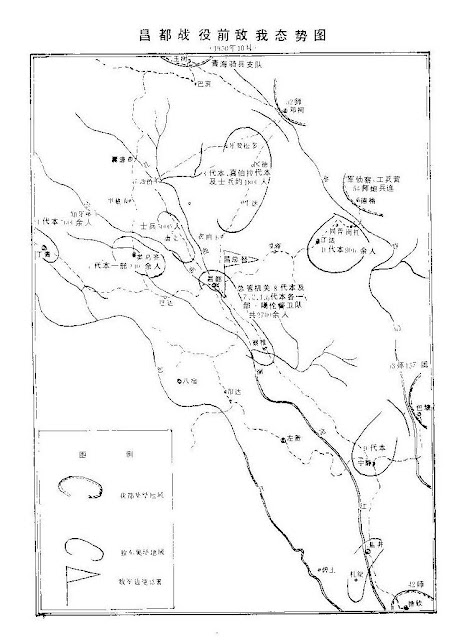
After crossing the Jinsha river [Tib: Drichu or Upper Yantze] from October 6th to 9th, troops reached the vast plateau of a thousand li [1000 li, c. 500 km] in length and width and in coordination with brother troops, units of this division were divided into three wings, left, middle and right, forming the assault on Chamdo, a powerful pincer attack targetting the 1500-li-long position of the Tibetan army commanded by Chamdo Governor Lhalu.
During the fourteen days of rapid advance and fighting, all units were moving across the unfamiliar plateau without accurate maps.
Soldiers carried loads of 60 or 70 jin,[ c. 30 to 35 kg] climbed more than 50 high mountains and crossed rivers over 60 times.
On average, foot soldiers cover 72 li , [36 km] cavalry 80 li [40 km] a day, those who had to march day and night moved up to 34 hours continuously without enough food. However, (all units) answered the call by party committees of both the army and the division and endured extreme hardship, annihilated all the defending enemies in Chamdo on schedule, and successfully completed the capture of Chamdo.
The success of this battle, …annihilated five Dapons [commander of a regiment], the main force of the Tibetan army, and over 2000 militia, liberated the region north to Qinghai, south to Yunnan, east to Jinsha river, west to Luolong [Lhorong Dzong] and Leiwuqi [Riwoche], a vast area more than one thousand square li. The success further strengthened our unity with Tibetans west of the Jinsha river, laid the foundation for advancing next year (1951), struck blows directly and indirectly at the British and American imperialist invaders, inspired people in the near east and repaid the people of the whole country who had warmly supported us.
…Tibetans have warmly supported us (taking in and escorting individual stragglers, delivering information, guiding the way, providing transportation, building bridges, preparing firewood and fodder, etc.), all of this shows that we had good influence by carrying out the policies conscientiously before the attack and shows the tangible benefits brought to Tibetans during our westward march. This is a small accomplishment we achieved in the past, and it is also a major pointer for the future in the liberation and construction of Tibet.
In this battle, troops advanced rapidly for 15 days with heavy loads across the high plateau a thousand kilometers in length and width, wrapping up…entire (enemy?) position 1500 li [750 km] in length and accomplished the task on schedule, completely annihilated the third (two Dapons), the seventh, the eighth, the fifth and the tenth Dapon, altogether five Dapons (averaging small regiments) under Tibetan Frontier Envoy Commissioner General,[The Chamdo governor was the ‘Domey Chikyap’ or ‘Eastern Governor’] captured…over 3000 men. This victory is fundamentally due to correct leadership by leading officers of the Military Area Command and the Army Party Committee, strong support from the people of the whole country, coordination from brother troops (particularly engineer corps), favourable influence created by advanced detachment through their hard work and carrying out policies conscientiously, and the eight-month long preparation. All of these contributed to the successful conclusion of this battle.
Review of the battle process is as follows:
Surround more, annihilate more; surround less, annihilate less

I. Process
(I) Judgement of enemy situation:
  1. Based on information obtained by the advanced detachment and by our own battle experience, in terms of the arrangement of their position, the enemy had no focus, no depth and attached no importance to flanks.
  2. Enemy lacks systematic strategic planning and command, they fought wherever they were attacked and were easily misled by us. After we crossed the river from Dengke [Dengo or Denkok on the Yangtze river], it was quite possible that the enemy might mistakenly believe, based on historical experience, that we were going to take Lhasa by way of Yushu [today’s Yushu prefecture, Qinghai] and Heihe [Nagchu].
  3. The enemy had never experienced large scale battle, had no knowledge of modern military science and was equipped with few heavy weapons. Their combat capability was not strong. After our powerful military forces crossed the Jinsha river, it was estimated that the following three changes may appear:
  • Retreat without fighting and escape without hesitation. If this happened, it would definitely make it more difficult for us to annihilate the enemy.
  • Scatter at the first contact, and the possibility of scattering everywhere in the mountains and wilderness to entangle us also existed. This would make it even more difficult for us to annihilate the enemy.
  • Concentrate forces and put up strong resistance in strategic locations. This was exactly what we were hoping for, for we were absolutely sure that we would annihilate them thoroughly, straightforwardly and completely.
  • In the Dengke battle, (we) did not seize the moment of strength to strike the enemy a fatal blow. The enemy might mistakenly have thought that our combat capability was not strong, getting arrogant and inattentive enough to confront us.
(II) Determination and Deployment
Liberating Chamdo, annihilating the main force of the Tibetan army in the area east of Lanchang river [Upper Mekong], Enda and Leiwuqi [Riwochey] lays the foundation for advance into Lhasa next year (1951) and liberate the entire Tibet. (We) decided to deploy a powerful right-flank encircling force composed of infantry and cavalry, providing strong points to offset each other’s weaknesses, making a detour via Batang and Nanqian [Nangchen] and pushing forward vigorously and precipitately. Troops should not be blocked by small numbers of enemy, doing everything possible to clear away obstacles and circle bravely…the entire field, cutting off the enemy’s retreats from Enda to Taizhao [Gyamda Dzong in Kongpo] and from Leiwuqi to Heihe, the two main escape routes, making it impossible for enemies to escape even if they intended to slip away without fighting.
Performance of troops in this wing is the key to success or failure in annihilating more than three Dapons of the enemy force. The middle wing cut into the heart of the enemy position by way of Shengda [Jomda county in today’s Chamdo prefecture], Yayaosongduo [Yayu Sumdo], Yiquka, Dongdong Zhuka, Duozhiduo, etc, cutting into the heart of the enemy position, penetrating, separating, surrounding and annihilating the enemy within the entire enemy position and advancing straight to Chamdo.
If the enemy did not rest, we wouldn’t rest; when the enemy took rest, we annihilate them. The left wing force crossed the river at Gangtuo [Kamtok], marching slowly by way of Tongpu, Jiangda [Jomda] and Jueyong to draw in the enemy. They seized the Damala Pass and controlled Sichuan bridge. Our slogans were “not to worry about breaking up Tibetan army’s positions, but to worry whether we can surround them. Surround more, annihilate more; surround less, annihilate less.”

II. Review of the Battle [not available]


III. A few experiences from the battle

(I) Experiences of fighting the Tibetan army
  1. All Tibetan troops were organized in a comparatively primitive way. Troops have neither (commanding) offices nor maps. Everything was handled by one single officer-in-charge. Special reconnaissance troops and communication tools were very outdated. Everything relied on wula,  and as a result the upper and lower could not communicate during the battle. For example, during the battle when Gaqionba, the third Dapon, retreated in defeat from Jiangda to Chamdo, he was surprised to meet Moxia [Mucha] Dapon, and only at that time did he come to know that the Liberation Army had passed Dengke [Dengo] and that Moxia [Mucha] had been defeated too.
  2. They did not fight aggressively and lacked counter attack ability. In several battles we did not find the enemy launching strong counter attacks.
  3. Lack of systematic strategic thinking, as expressed by:
  • No attention paid to protect flank and rear while deploying the forces. As seen from the deployment of this battle, three Dapons positioned in the front had fallen into our horseshoe-shape encirclement, 200 men were still deployed in the Leiwuqi flank.
  • No knowledge of using the terrain to block our advance. While chasing and attacking the enemy, none of the bridges and passes in the route were destroyed, particularly the Sichuan bridge (this bridge is like the gateway to Chamdo). The 156th regiment was half a day’s distance from the enemy, when they advanced and seized the bridge, it was left intact.
  • No night combat experience. Falling into disorder as soon as fighting began, each man escaping on his own. This was how the enemy behaved in the battle of Jueyong.
  • No guards posted at encampments. In Jueyong one squad of our reconnaissance battalion sneaked into the enemy’s tents at night, and only then did they find out and began screaming and running about in disorder.
  1. Enemies were slow in climbing mountains: the 156th regiment was one day’s distance away, the reconnaissance battalion was two days’ distance away from the enemy, but they both caught up the enemy within 100 to 200 li. Their speed was nearly one third faster than the speed of the enemy.
  2. In terms of tactics: (enemy) was good at riding horses, highly skillful at shooting and utilizing terrain and landforms, but not good at operation. For example: in the battle of Shengda [Sipda in today’s Jomda county], the 155th regiment confronted the enemy across the river for more than ten hours, and over ten men were wounded. The distance in between was about 300 meters, but hardly any enemy could be seen (they were all hiding behind rocks and in dense forest). According to our observations in the battle field, beside Jazhangka and Shengda where a few fortifications were made, the other places had no fortifications. The fortifications were very poorly built, mostly piled up stones in the shape of a pigsty, which could be pushed over by hand.
    (II) Tactics to be used against Tibetan army
  1. To deal with the weak Tibetan army with our current equipment, the key is to encircle the enemy (that is, the more encircled, the more will be annihilated; less encircled, less will be annihilated). No need to worry about breaking through Tibetan army’s positions, the only worry is not being able to encircle them. Since supplies are scarce in Kham-Zang Plateau, once the supply line is cut, enemy will retreat in disorder without fighting.
  2. Based on special conditions of the plateau cavalry is the key to annihilate the enemy, and the guarantee of success. Because the loads foot soldiers have to carry are too heavy, they don’t have enough physical strength to walk long distances to encircle the enemy. As is shown in this battle, the cavalry detachment was able to complete its task on time (to block the enemy), based on the distance, it was impossible for the infantry to complete it.
III. Coordination of Infantry and Artillery
Due to weather conditions on the plateau and our equipment, vigorous activities and rapid charge are not favourable to the troops. Therefore, during combat firepower must be well organized so as to coordinate with foot soldiers continuously and effectively. In arranging firepower, the focal points should be the flank and rear, for enemy fears our artillery attack more than anything.
IV. Reconnaissance
Since there are no accurate maps available and no accountable mileage for roads, plus there are lots of rivers, forests and mountain ranges in Kang-Zang area, knowledge of enemy situation and terrain through reconnaissance prior to battle is highly important. The method is to inquire from Tibetans familiar with (the area) in various ways, and estimate how far it is based on how many days he covers certain distance. As long as we are nice to him, he would give us such information honestly.   
V. Artillery
How to use artillery in plateau combat should be well studied, particularly how to measure distance. Observation is not easy since too many objects block the view, and as a result, distances are often misjudged as closer (than they actually are). Because the air is thin, the speed of the shells is faster.

VI. Suggestions on army structure and equipment
  1. Branches of army: a division should have a cavalry regiment to fulfill the task of circling and surrounding (the enemy). A regiment should have a mounted reconnaissance company to facilitate communication and reconnaissance. When the regiment engages in individual combat, (mounted reconnaissance company) can perform tasks of circling and surrounding in small actions. In addition, one engineers platoon should be allocated (can be attached to guard company) to take on tasks such as building bridges, handling boats, and clearing away obstacles so as to reduce the trouble of crossing rivers and increase advancing speed.
  2. Weaponry: reduce mountain artillery, increase recoilless guns, high-angle guns, dynamite, detonator, fuse and explosive.
  3. Tools: Quality and style of current field tools needs to be improved. Both the shovels and picks the troops are currently equipped with are not practical in combat. Besides being pointed at one end, the other end of the pick should be changed to something that can be used mainly in hacking. Shovel should be changed into American style with removable head, and can be used to dig, scratch and shovel off grass. Besides, since the plateau weather is cold, canteen should be changed into thermal canteen, and more cowhide boats, and bridge-building tools such as saws, hatchets, ropes, etc.
  4. Uniform: There are thorns and gravel everywhere on the plateau and clothes are easily torn, the current style of uniform must be changed and quality must be improved, otherwise it will not be able to last the season (until the next uniform issue).
    It is better to make the uniform with strong and durable cloth, shoulders, backsides and knees should be reinforced. It is better that the cuffs are tightened and trousseaus in the style of jodhpurs. Weight of coat should be reduced. Comforter should be changed into soft, warm, damp-resistant, lightweight, larger size wool blanket which can be used as mattress pad as well as comforter. Raincoat and damp-resistant canvas should be combined into one, based on current raincoat size and shape, adding more rubber to make it thicker so it can be used to wear and to spread as bedding. Quality of shoes should be improved, soles should be softer and the upper should be higher, water-proof and damp-resistant. Headgear should better be helmet (the type used by pilots) with goggles fixed on. Goggle lenses should be made of plastic (at the moment two thirds of the goggles the troops were equipped with have been damaged).
  5. Communication tools: Office at regiment and above level should be equipped with larger radio of 50 watt or more. Current radios cannot function at 11. p.m. because signals are too weak.
  6. Supply: Since the current transportation condition is rather difficult, all food should be high quality, low quantity, long-lasting and easy to carry, otherwise it increases soldiers’ burden, reduces their physical strength, slows down marching speed and has negative impact on accomplishing tasks. For example, the powdered food distributed this time was heavy and the quality was poor. Grain powder was not well cooked, ration was not enough to eat, and hard to digest, causing stomach pain, abdominal bloating and diarrhea. As a result, medical patients sharply increased, and a considerable number of soldiers lagged behind. According to initial statistics, of all the stragglers in the whole division, 80% were because of the food powder.

Friday, January 29, 2016

When Nehru was taken for a ride by Mao

Crossing the Upper Yangtze on October 7, 1950 (http://historicaldocs.blogspot.in)
One often-asked question is: why did India not take a stronger stand on the Tibet issue in October/November 1950, when Eastern Tibet was invaded by the Chinese People’s Liberation Army?
One of the reasons is the nefarious influence that K.M. Panikkar, the Ambassador in Communist China, played on the Indian Prime Minister and the fact that Nehru chose to follow his advice against those of senior diplomats like G.S. Bajpai or politicians like Sardar Patel of Rajaji.

Some historical facts
On August 3, 1950 General Liu Bocheng, the head of the Southwest Military Command had been ‘assigned to liberate Tibet’. In a proclamation, the great strategist affirmed:”The People’s Liberation Army will soon march towards Tibet with the object of driving out the British and American aggressive forces so as to make Tibetans return to the Great Family of the Peoples Republic of China.”
The fact that there was no American and only a couple of British nationals live on the Tibetan plateau, did not bother Panikkar and Nehru.
On August 21, the Indian ambassador met Zhou Enlai, the Chinese Foreign Minister; the latter assured him that:
it was China’s earnest desire to settle the problems by negotiations and peace, and that he [Zhou] had instructed the Chinese Ambassador to India to enter into preliminary contacts with the Tibetan Delegation in Delhi and to make arrangements for their journey to Peking.
Zhou Enlai said that he greatly appreciated the view taken by India and would do everything possible to come to a peaceful settlement “on the understanding that Tibet was an integral part of China, entitled to local autonomy and to its own institutions”.
During this meeting, Panikkar, on his own, promised that India would not move in case Tibet is forcefully liberated.
On 26 August 1950, in an aide memoire submitted to the Chinese Government, K.M. Panikkar went a step further, he changed India's policy vis-à-vis Tibet. This would trigger the most dramatic consequences for India.
In his note, Panikkar described Tibet’s status as ‘autonomy within framework or Chinese sovereignty’, and not anymore ‘suzerainty’ as it had been done during the previous decades. The two words had a very different legal meaning and Panikkar knew it.
During the following months, South Block tried to revert to ‘suzerainty’, but it was too late, the damage was done.
Three days after presenting his aide-memoire, Panikkar send a Top Secret cable to Nehru to inform him that he had met the Director of Asian Section of the Chinese Ministry of Foreign Affairs, who had called on him on behalf of Zhou Enlai to discuss India’s (more correctly Panikkar’s) aide-memoire on Tibet.
The Chinese officials were delighted; they conveyed the gratitude of their Government
for reaffirmation that India had NO political or territorial ambition in Tibet and stated that it is earnest desire of Chinese Government to settle Sino Tibetan matters amicably and by peaceful means.
Six weeks before the invasion, the fate of Tibet was sealed.
But Nehru and his Ambassador continued to foolishly think that the future of Tibet would depend on ‘negotiations’ in Delhi or Beijing.
It was absolutely wrong. A telegram sent by Mao on August 23, 1950, (2 days after Panikkar had met Zhou) is telling.
General He Long inspecting the preparations
(http://historicaldocs.blogspot.in/)
It is addressed the Southwest Bureau, repeated to the Northwest Bureau in Qinghai Province and entitled, ‘Strive to Occupy Chamdo This Year and Advance to Lhasa Next Year’.
Mao first refers to a communication received three days earlier from the Southwest Bureau suggesting the order of the battle (to ‘liberate’ Tibet). Mao writes:
The plan to push for occupying Chamdo this year and to leave three thousand men to consolidate Chamdo is good. You can actively make preparations according to this plan, and when it is ascertained by the end of this month or the beginning of next month that the road has reached Ganzi [also known as Kandze in today’s Sichuan province] without obstruction, the advance can go ahead.
It demonstrates that the east of the Upper Yangtze River, the Communists were not expecting (and they did not encounter later) any ‘obstruction’. Lhasa had then no control over these Tibetan-inhabited areas.
Mao continues:
It is expected that Chamdo will be occupied in October. That would be advantageous for pushing for political changes in Tibet, and marching into Lhasa the next year.
While Nehru believed that everything depended on ‘talks’ between the Dalai Lama’s government and the Communists, the reality was different. On the opposite, Mao asserts in his telegram: “Now India has issued a statement recognizing Tibet as China’s territory, only expressing hope that (the issue) can be settled peacefully, not by force.”
The Great Helmsman refers to the meeting between Panikkar and Zhou and admits that the earlier stalemate about visas for the Tibetan delegation had been sorted out: “Great Britain didn’t allow the Tibetan delegation to go to Beijing before, but now they have agreed.”
Though Mao knew that the hurdles for the ‘talks’ had been cleared, he was not interested in ‘negotiations’.
In order to understand Nehru’s mindset, let us look at a letter addressed by the Indian Prime Minister to C. Rajagopalachari, a Minister without Portfolio in his Cabinet on November 1. The Chinese had entered into Tibet 3 weeks earlier.
Rajaji had sent a note to Nehru complaining that the ‘Chinese are deceiving us’. Nehru answers: “Legally our position seems to be a weak one in regard to Tibet,” and adds that morally he finds it difficult to say that the Chinese Government has deliberately deceived India (i.e. Nehru) at any stage.
The Prime Minister explains: “We may have deceived ourselves, and they may have done wrong in the action they took, as I think they did.”
For him, the Chinese did ‘not deceive’ India:
For the last year they have been talking about ‘liberating’ Tibet as a part of the Chinese fatherland. From the 15th of July of this year there has been a great deal of talk on this, and even some Chinese troops’ movements were reported to us on the Tibetan border of China. Early in August the Chinese Government issued a text of a proclamation by the Head of their Southern Command [General Liu Bocheng], who was ‘assigned to liberate Tibet’.
The above lines show that the Government of India was well-informed about the decision of Communist China to forcefully enter in Tibet. Nehru writes to his colleague:
This proclamation stated that the Peoples Liberation Army will soon march towards Tibet etc. We sent a telegram to our Ambassador asking him to point out that any such move will be most unfortunate and that this should be settled by peaceful means. In this way telegrams have been exchanged repeatedly.
Nehru was regularly in touch with Panikkar (and Sumul Sinha in Lhasa) about the happenings in Tibet, in China and on the front; that is why Nehru could write, “at no stage did the Chinese Government say to us that they would not take any military steps.”
The Indian position was mainly the result of the foolishness of the Indian Ambassador who repeatedly informed Delhi that the Chinese would not use force.
The Communists were the worthy children of Sun Tzu and were adept of the Art of War, the ‘negotiations’ trick was just a dilatory tactic to gain time for the Chinese troops to be ready for the battle of Chamdo.
Nehru tells Rajaji:
They did say that they were always prepared for peaceful negotiations and that they had waited for a long time, but the Tibetan Delegation did not come. According to them, the Tibetan Delegation could not come because of imperialist manoeuvres.
None of the Chinese declassified telegrams/reports shows that the PLA was waiting for the outcome of the negotiations. In fact, it was absolutely clear for Mao and his colleagues that the 18th Army had to advance on Chamdo in 1950 itself so that Lhasa and Central Tibet could be ‘liberated’ in 1951.
Nehru admits: “When we informed them that the Tibetan Delegation was actually going to start, Chinese troops’ movement had already taken place some days before.”
This should have opened the Prime Minister’s (and his ambassador’s) mind to the true intentions and tactics of the Communists. It did not and very unfortunately, the Tibetan issue would get worse when, less than 2 months later, Patel will be gone forever.
The Indian Prime Minister was aware that the Chinese Government has decided to use force, “but I do not see how they can be accused of deception. They have been perfectly clear from the beginning.”
While understanding the rapidly-evolving situation, Nehru decided to remain passive, with tragic consequences for India.
In his letter to Rajaji, the Prime Minister tries to find excuses for the Communists:
We have to remember also that the Chinese Government and people are living in constant fear of attack by the U.S.A. That fear may not be justified but it is not wholly groundless. Prominent men in the U.S. have repeatedly state that this attack should be made.
…If we can put ourselves in China and see Chiang-Kai-shek with a powerful Army sitting nearby to attack China, supported by the U.S., and war coming over nearer and their own territories being bombed, then we can perhaps appreciate the temper and apprehension of the Chinese Government and people.
The argument has nothing to do the Chinese troops entering in Tibet, massacring hundreds of Tibetan soldiers and invading a peaceful nation. It is rather flabbergasting that the Prime Minister gives such a long justification on an unrelated topic. 
On his August telegram, Mao had stated that the Government of India has not objected to the Chinese entering into Tibet. But once again, Nehru tries to justify the Chinese actions (or his own?):
Of course, all this does not justify military operations against Tibet, but it does explain many things. Tibet for many years has been under British influence and the British Agent there was violently anti-Chinese. He tried his best to incite Tibetans against China. Previous Chinese Governments have protested against this, and indeed I have myself been told by their representatives. Tibet was thus looked upon as a place which was under British influence. That influence is now gone, but only six months ago the same British Agent was there representing us.
This is an absolutely an unfair statement against Hugh Richardson who brilliantly served the Indian interests in Tibet for 3 years (August 1947-1950). Richardson was not only a sharp-minded ICS officer, but also a great lover of Tibet and an outstanding scholar of ancient Tibetan history.
Sumul Sinha, Richardson’s successor, was himself one of the finest young Chinese-speaking diplomats; he tried to serve India as well as he could in the difficult circumstances. His services will never be appreciated by Nehru (‘Sinha does not understand our policies’). This is one of the saddest tragedies of modern India.
Nehru ends up his letter to Rajaji by saying that he just wish to point out to:
certain considerations which have to be borne in mind to understand why the Chinese Government may have developed a state of mind bordering on fear of what is going to happen, and fear leads to wrong action. I am quite sure that the Chinese Government did not intend to deceive us or to insult us deliberately.
It is necessary to come back for a moment on Mao’s cable to the Southern Bureau; Chairman Mao says: “If our army can occupy Chamdo in October, there is the possibility of pushing the Tibetan delegation to Beijing for negotiation, begging for a peaceful solution (of course there are other possibilities too). Right now we are using the strategy of urging the Tibetan delegation to come to Beijing and reducing Nehru’s fear.”
It is ironical that Nehru spoke of the Chinese fear, while Mao tries to ‘cool down Nehru’s fears’.
The second stage of the Chinese plans are explained by Mao
Map of the PLA operations
planned by Mao
When Tibetan representatives arrive in Beijing, we plan to use the Ten Points already decided as the basis for negotiation, urge the Tibetan representatives to sign it, and make the Ten Points an agreement accepted by both sides.
The Ten-Point eventually became the Seventeen-Point Agreement signed ‘under duress’ by Tibetan delegates in Beijing on May 23, 1951.
Mao concludes:
If this can be done, it will make things easier for advancing into Tibet next year. Your plan (the Southwest Bureau’s) to leave 3,000 men in Chamdo for the winter after occupying it, not to advance into Lhasa this year, and withdraw the main force back to Ganzi may be seen by the Tibetans as a gesture of good will.
This was the beginning of the Hindi-Chini Bhai Bhai policy.
In the process, India lost of ‘buffer zone’ with Communist China and a friendly and peaceful neighbour.
The duo Nehru-Panikkar had been taken for a ride by Mao and Zhou.

(The translation of Mao's telegram is available on http://historicaldocs.blogspot.in/)

Thursday, June 4, 2015

McMahon Line, more than just a border issue

The Indian flag flying over Dekilinka, the Indian Mission Lhasa
My article McMahon Line, more than just a border issue appeared today in the Edit Page of The Pioneer.

Here is the link...


India must seek to preserve the sanctity of the McMahon line because it not only demarcates its legal border with China but also marks its historical ties with Tibet, which was once an independent nation


While the Indian archives are still jealously kept in the vaults of the Ministry of External Affairs, the Chinese are slowly (and selectively) declassifying their documents. Is declassification on the agenda of Modi Sarkaar? If it is, it will be good for the country because slowly Chinese perceptions are starting to prevail among Indian ‘experts’.
Let us take an example. During the annual KF Rustamji lecture, National Security Advisor Ajit Doval (who is also the Special Representative for border talks with China), said that he was surprised that, while China agreed to the McMahon line being the Sino-Burmese border in 1960, it does not accept the same principle for India. Some Indian ‘experts’ have argued that Mr Doval was wrong to compare the Sino-Burmese and Sino-Indian border issues. The Agreement on the Question of the Boundary between China and Burma signed on January 28, 1960, slightly departed from the McMahon alignment.
Also, Burma did not call its border with China, the ‘McMahon Line’. Why so? Today, like in 1960, Beijing wants to wipe out all proof that Tibet was once an independent nation and signed bilateral treaties with other countries; therefore, China insists we forget about Sir Henry McMahon, the Indian Foreign Secretary, who signed one such agreement with Tibet in 1914. The treaty between China and Burma was based on a principle that the northern boundary would follow the traditional McMahon line, but the imperialist name would be removed. For Burma, it did not matter much if the independent status of Tibet was erased.
For India, it is different; Tibet’s status matters hugely. Not only does the Dalai Lama and many of his countrymen live in India, but for India, its deep cultural, economic and religious contacts with the Roof of the World far pre-dated the arrival of the British in the subcontinent. The border issue is not just a question of ‘demarcating’ a line between China and India; it is also about acknowledging this ancient relation between India and Tibet. For this reason, Mr Doval is absolutely right to call the Sino-Indian border the McMahon Line.
Mr Doval also reminded his audience of the existence of Arunachal Pradesh: “We are particularly concerned about the Eastern sector where [Chinese] claims have been made on Tawang which is totally in contravention of accepted principles.” He was referring to the Agreement on the Political Parameters and Guiding Principles signed on April 11, 2005, between India and China. Article VII says: “In reaching a boundary settlement, the two sides shall safeguard due interests of their settled populations in the border areas.” Beijing seems to today have forgotten about the 2005 Guidelines!
Soon after, the Chinese Foreign ministry spokesperson Hua Chunying affirmed: “The Chinese side holds a consistent and clear position on the eastern section of the China-India boundary: Arunachal Pradesh is a part of Southern Tibet.” Ms Hua explained: “The Chinese Government does not recognise the McMahon Line, which is illegal.”
What does history say? The Wilson Center in Washington, DC, recently released the translation of important documents from the Chinese Foreign Policy Database, an online resource on China’s international relations. According to one of these documents, in early 1952, the Indian Ambassador in China, KM Panikkar, speaking to a Chinese official, gave a report about “the existing conditions [in Tibet], without implying that those conditions should be preserved.” The “existing conditions” meant the existence of a full-fledged Indian mission in Lhasa.
Soon after entering the Tibetan capital in September 1951, Beijing realised that the Indian mission was proof of Tibet’s independence. Zhou Enlai met Panikkar in June 1952 and agreed that “to proceed in this manner was very proper”, ie the “existing conditions” need not to be preserved. Zhou felt that the situation was a scar left by Britain: “For all of this, the new Government of India was not at all responsible.” He went on to say that “to settle the question of Sino-Indian relationship in Tibet, time and proper steps were required. Therefore, the Chinese Government proposed that the Indian mission, previously stationed in Lhasa, be changed into an Indian Consulate General.” Zhou insisted that this “specific problem” should be solved first.
The Government of India readily (and foolishly) agreed and offered a Consulate in Mumbai to the Chinese as ‘bonus’ (though the Indian Head of the Mission in Lhasa, S Sinha,  was deeply upset about it, as he understood the far-reaching consequences for the future Indo-Tibet relations). Wanting to please Zhou Enlai, Panikkar added: “The Government of India was very anxious to remove those conditions through negotiations; for example, the 200 Indian troops stationed at Yatung [in fact in Gyantse], and the postal and telegraphic establishments of India in Lhasa.” According to the Chinese declassified documents, the Indian Ambassador continued: “The Government of India would be willing to transfer these to the Chinese Government as soon as the latter was ready to take them over.”
It was Sales Season! India was ready to offer all its Tibetan ‘privileges’ for free to China. During the following months, Prime Minister Jawaharlal Nehru was under the impression that the situation was settling down in Tibet and slowly the Tibetans were accepting the invasion of their country by the Peoples Liberation Army as fait accompli. He was wrong; the Chinese had begun interfering actively in the life of the Tibetans whose resentment was boiling.
On October 21, 1953, Beijing’s representative in Tibet, General Zhang Jingwu, sent a cable to Beijing to explain the “existing conditions” which had to be disbanded: “The Indian troops and officials should be withdrawn; postal facilities shall be taken back; Indian radio facilities shall also be withdrawn or transferred to us, all [dak bungalows] relating to posts and telecommunications shall be withdrawn; as a consulate general already exists in Lhasa, the Indian commercial representatives in Yatung and Gyantse shall be cancelled; radio stations should be given to China [in India to ‘balance’] the one of the Consulate General of India in Lhasa.”
He further suggested that trade should continue for some time and “when [the Chinese presence] becomes mature, one or two years later, relevant rules on entry and exit visas may be established.” It is what happened after the signature of the Panchsheel Agreement in April 1954. Import duties were levied on Indian goods and progressively, by the end of the 1950s, the flourishing Indo-Tibet trade and while it became impossible for Indian pilgrims to visit the holy sites in Tibet.
The McMahon Line is more than a line; it symbolises centuries of close contact between India and Tibet, which unfortunately does not exist anymore. Why should India rewrite history, and wipe out a glorious past just for the sake of Beijing’s good conscience? And what about the Indian archives?

Monday, September 8, 2014

Could Tibet be defended?

Harishwar Dayal, PO in Sikkim (here with Lowell Thomas)
I am posting here an interesting note from Harishwar Dayal, the Political Officer in Sikkim between 1948 and 1952.
The note dates from the early months of 1950.
Dayal answers some points made by K.M. Panikkar, the Indian Ambassador to China.


TIBET
SECRET

I have had the advantage of seeing Sardar Panikkar’s note on our attitude to Tibet.
The main points in the note are these.
i.    China will invade Tibet. Invasion is not difficult. Tibet has no chance of successful resistance and will be overrun.
ii.     We have no legal right to intervene. We have never regarded Tibet as independent. The contention that Chinese suzerainty should be dependent on Chinese recognition of Tibetan autonomy was never accepted by China. If China decides to make her sovereignty effective we cannot interfere as long as our treaty interests, trade rights and boundary are respected. Any intervention on our part would be regarded as aggression.
iii.    Political intervention would also be futile. To incite the Tibetans to resist would serve no useful purpose.
iv.    The Peking Government has not repudiated pre-1946 treaties. When China overruns Tibet, our political interests will go, but our trading rights may be preserved as China will not be able to develop trade with outlying provinces for some time.
v.    The wisest course for us to take is to be vigilant, to give such help to Tibet as we can now, to be strictly neutral when the war comes and to resume diplomatic relations with China as soon as possible so that we may be able to guard our interests as far as we can.
I think most of these arguments and conclusions are incontrovertible. But I should like to draw attention to certain matters which perhaps are not made very clear in Sardar Panikkar’s note.

THE LEGAL POSITION:-
Apart from the trade regulations of 1908, framed under the treaty of 1904, there is – as far as I know – no agreement signed by China, India and Tibet together. All other treaties and conventions have been either between India and China (the Chegoo Ceonvention of 1876, the convention of 1890, the Anglo-Chinese Convention of 1906) or between India and Tibet (the Treaty of 1904, the Simla Convention of 1914). At Simla in 1914 the Chinese representative initialed the agreement, but the Chinese Government repudiated it. On the other hand, Tibet has repudiated our agreements with China (Convention of 1890, Trade Regulations of 1893, the Convention of 1906).
The Chinese have always claimed at least suzerainty with no qualifications or conditions, the Tibetans have always claimed independence but have been prepared at times. To recognize Chinese suzerainty if China would recognize Tibetan autonomy and agree on a boundary (e.g. in 1914 and again in 1934) and India has generally recognized Chinese suzerainty but in 1943 declared that this was meant to be conditioned on Chinese recognition of Tibetan autonomy.
Generally, India has acted as if Tibet were a sovereign State to the extent of being capable of making treaties and entering into relations with other powers.
If, therefore, China is the unconditional suzerain of Tibet, then it follows that Tibet had no right to make treaties with India, at least without Chinese participation or consent and accordingly all our agreements with Tibet, including the Simla convention of 1914 which defined the boundary (the Mac Mahon line) are invalid, with the solitary exception of the trade agreement of 1908. China, from her own point of view, might refuse to be bound by any of these treaties. An indication of this attitude is that in 1928 the Nanking Government ignored the 1914 Convention and referred back to the Convention of 1906 in proposing a new treaty between China and India about Tibet. If, as is suggested, our recognition of communist China is unconditional and merely assumes that existing relations will continue, China may well refuse to be bound by the treaties with Tibet to which she was no party.

THE MORAL POSITION:-
There is no legal obligation on the part of India to defend Tibet, if attacked, for there is no treaty of mutual defence. There is not even a moral obligation, for in 1935 Williamson was instructed to make it clear that Tibet, in the event of trouble with China, would have only our diplomatic support so far as was justified by the merits of the case. But the Tibetan Government were given three specific assurances:-
(1)    That Tibet would be treated as an autonomous country in practice, although the theoretical suzerainty of China might be admitted;
(2)    That we should deal with Tibet direct;
(3)    That Tibet would have diplomatic support in case of trouble with China on merits.
In 1940, when the Chinese Foreign Minister told the British Ambassador that China would not interfere in the development of Tibet along her own lines, this was communicated to the Tibetans with the assurance that if the Chinese went back on the promise Tibet would have support.
There is, thus, a clear moral obligation on our part to use diplomatic means to preserve Tibetan autonomy.

THE POLITICAL POSITION:-
Sardar Panikkar thinks we should cease to regard Tibet as a buffer State.
One of the great advantages of India in the past has been not only that its land frontier is protected by almost continuous ranges of high mountains, but also that beyond lay a chain of comparatively small States, none of which was likely to be a serious danger to the peace or integrity of the country and which cushioned India from the impact of the great Powers which are beyond. It was our policy, accordingly to keep on friendly terms with these States, to help them and to preserve their internal peace and independence and to ex clued form them as far as possible rival Powers. The revival of China is now likely to bring us into immediate contact with her on the Sinkiang and Tibetan frontiers; and if Communism establishes itself in the small States of South-East Asia- (which is by no means unlikely) we shall find ourselves surrounded on land by a solid ring of Communist countries which will follow a concerted policy in foreign affairs.
A country is most secure when no other country can easily invade it. That was the position of Great Britain to a certain extent and of the United States. But the advantages of insularity have been largely neutralized by the development of air power. The next most effective guarantee of safety is to have a belt of friendly small States between a country and its most powerful neighbours. That was the position of India and of Turkey as regards Austria, Germany and Russia. The next is to have two powerful neighbours who are suspicious of each other, so that in the event of war it can have an ally and the enemy may have to fight a war on two fronts. France in the 18th century and Germany in the 20th when they became aggressive had to fight on several fronts.
If we lose our armour of friendly small States, of which Tibet is one, we shall find ourselves everywhere on land in direct contact with the two great States of Russia and China and, as a common ideology connects these two, we shall have in effect one enormously powerful State on all or nearly all our land frontiers. It is possible that it may not wish to attack us, but there is little doubt that it will wish India also to become Communist and will use all methods short of war to achieve that object.
The absorption of Tibet into Communist China is not, therefore, a matter which we can contemplate with indifference or even equanimity. If a war should break out, the enemy will be at our very doors and our friends, if any, will be far away.

OUR COURSE OF ACTION:-
At the same time it is not easy to see what effective action we can take. It would perhaps be better to discuss separately what we should do (1) immediately, (2) if and when the Chinese invades Tibet.

IMMEDIATE ACTION:-
Tibet is asking for a fresh treaty and an open recognition of her independence. Neither of these seems wise. She is also asking for arms and training for her troops. In the past, we have given arms and also training, but the arms have been small in quantity and the training largely ineffective. Even with these, it is not likely that Tibet will be able to offer successful resistance. On the other hand, if the Tibetan army has some fighting strength, it is possible that the Chinese may be content with Tibetan adhesion to the Republic and may refrain from invasion and subversion of the Tibetan Government and political system. This, of course, assumes that Tibet will be prepared to agree to these terms. Nor should it be forgotten that we have always encouraged Tibet to regard us as friends; and, if we quietly abandon her without an effort in her hour of need, it will be difficult for any of any small State to have confidence in our promises or professions of friendship. We should, therefore, give such help in arms as we can give, within reason, and use our diplomatic influence with China to get her the best terms possible.
Assuming that Tibet becomes a part of China, we have to look to our own frontiers. The independence, security and defence of Nepal become immediately a matter of primary importance to us. I find that a new treaty with Nepal is being negotiated. I haven’t seen its terms, but I think it is vital that there should be some provision for mutual defence, which does not exist in the 1923 Treaty. Next, we should effectively occupy the country south of the Mac Mahon Line. I do not know to what extent this has been done.
It should be remembered that China at least once invaded Nepal and by the peace of 1792 Nepal acknowledged Chinese suzerainty and undertook to pay tribute and not long ago China again showed a good deal of interest in Nepal. If Tibet goes the door will be wide open.

ACTION IF THERE IS INVASION:-
Active defence of or help to Tibet in the event of an invasion would be both futile and dangerous. It would develop into a war between India and China with unpredictable consequences. But we should protect diplomatically and keep a watch on the frontier.
In case Tibet proclaims her independence and China refuses to recognize it, there may be a reference to the U.N. It is difficult to see what effective action U.N. can take; and condemnation without enforcement would only discredit it. The Korea and Abyssinia cases in the old League are a warining.

GENERAL CONSIDERATIONS:-
The defence of India is now a much more difficult matter than it was fifteen or twenty years ago. Then India included Pakistan and Burma; Ceylon and Malay were also parts of the same Empire; Afghanistan and Tibet were friendly; our long and exposed sea coast was protected by the British Navy; China, our nearest large neighbor, was weak and disunited and Russia, the other, was still reorganizing herself. All this has changed. Pakistan is independent and unfriendly. Ceylon and Burma are independent. China and Russia are strong and will follow a common policy. Apart from Malay and Hong Kong, both threatened, Britain has no possessions in the Indian Ocean. Western Powers have lost control of their colonies, but the result has been civil war – in Burma, Indo-China and Indonesia – which is a fertile breeding ground for Communism - and Communism means alignment with Russia and China.
Even under the old order, the rapid progress of Japan showed how feeble were the defences against a well organized and determined foe. The present situation calls for a well-considered (not, of course, inelastic or inflexible, but not merely opportunist) policy and well planned execution.

Sunday, February 10, 2013

Two ways to behave: India's and China's

Here are two ways to rewrite history: first, the Chinese one.
It is illustrated in this article of Bill Hayton in The South China Morning Post. Hayton explains that a translation error, some 80 years ago, helped the Chinese to conquer a non-existing island, officially the southernmost point of the Middle Kingdom, the James Shoal. It lies 22 metres below sea!
Then, the Indian way. 
It was the work of K.M. Panikkar, the first Indian Ambassador to China who changed the relationship between China and Tibet from 'suzerainty' to 'sovereignty', offering Tibet, a de-facto independent nation to Communist China and changing the course of history.
I quote here from my book, Tibet, the Lost Frontier.
The following incident more than anything else demonstrates Panikkar’s character.
On 26 August 1950, in an aide-memoire, Panikkar defined India's policy vis-à-vis Tibet as "autonomy within framework of Chinese sovereignty". Following this note, discussions with the Chinese authorities were based on the same terminology which was a radical change in India’s Tibet policy. In fact, many believed that it helped China justify its military action in Tibet.
Though an Indian note of November 1, 1950 tried to rectify the ‘oversight’, it was too late and hereafter China kept on using ‘sovereignty’ for ‘suzerainty’. It went a step further when Beijing attributed the rectification (of November 1) to ‘outside influence’.
The Statesman in Calcutta reported its own version of the incident: according to them, it was the result of a careless slip in transcribing a coded message in the diplomatic communication from New Delhi to Beijing in 1950:

A corrigendum did follow after the mistake (or mischief) had been detected, and was traced to inadvertence in transmission of a coded message. It was K.M. Panikkar, then Indian Ambassador to China, who held back the correction on the ground that it would mean discomfiture for the Indian Government. As the matter stands now because of this blunder, (a permanently sad commentary on the functioning of the Foreign Service), India remains committed to ‘Chinese sovereignty’ over Tibet.
…For all that Nehru wondered from whom Tibet was being ‘liberated’, it passes understanding how his government could write ‘Chinese sovereignty’ when it meant ‘Chinese suzerainty’ in a reply to Beijing, and then not bother to inform the Chinese formally that the mistake had been spotted and corrected.  
The Statesman may have not known that a ‘correction’ was eventually sent, but the fact that more than two months passed before the Chinese received it, was translated by Beijing more as an encouragement to go ahead with their ‘liberation’ of Tibet.
But the truth is that it was certainly not an ‘oversight’.
John Lall, a former Diwan of Sikkim (1949-1954) and ex-ICS officer, wrote in his book,
Aksai Chin and the Sino-Indian Conflict that he had been told by a ‘senior member’ of the Indian Embassy in Beijing that the change to ‘sovereignty’ had been deliberately introduced by Panikkar.
A few months later, the deliberate ‘lapsus’ landed in the Indian Parliament with Nehru stating in a light vein: “Prof. Ranga  seems to have been displeased at my occasional reference to Chinese suzerainty over Tibet. Please note that I used the word suzerainty, not sovereignty. There is a slight difference, though not much.”
It is certain that Panikkar had a lot of influence on Nehru with regard to Chinese affairs.
For the Chinese, it was more than enough.

How a non-existent island became China's southernmost territory
The South China Morning Post
February 7, 2013
Bill Hayton
Bill Hayton says records show that a translation error some 80 years ago may be to blame
Where is the "southernmost point of Chinese territory"? It's a controversial question and the least controversial answer might be Hainan Island . More controversial options would be the Paracel (Xisha) islands or the Spratlys (Nansha). But officially the southernmost point is even further south - as far south as the James Shoal, about 100 kilometres from the coast of Borneo. What's more surprising is that this piece of the motherland is actually invisible. There's nothing there to see, unless you have diving equipment.
The James Shoal lies 22 metres below sea. Yet this inconvenience doesn't prevent PLA Navy ships visiting the shoal from time to time to demonstrate Chinese sovereignty over it. This ritual involves heaving a large piece of engraved stone over the side of the ship. There is now a small collection of Chinese stelae gathering organic encrustations on the sea floor, more than 1,000 kilometres from Hainan.
How did the Chinese state come to regard this obscure feature, so far from home, as its southernmost point? I've been researching the question for some time while writing a book on the South China Sea. The most likely answer seems to be that it was probably the result of a translation error.
In the 1930s, China was engulfed in waves of nationalist anxiety. The predation of the Western powers and imperial Japan, and the inability of the Republic of China to do anything meaningful to stop them, caused anger both in the streets and the corridors of power. In 1933, the republic created the "Inspection Committee for Land and Water Maps" to formally list, describe and map every part of Chinese territory. It was an attempt to assert sovereignty over the republic's vast territory.
The major problem facing the committee, at least in the South China Sea, was that it had no means of actually surveying any of the features it wanted to claim. Instead, the committee simply copied the existing British charts and changed the names of the islands to make them sound Chinese. We know they did this because the committee's map included about 20 mistakes that appeared on the British map - features that in later, better surveys were found not to actually exist.
The committee gave some of the Spratly islands Chinese names. North Danger Reef became Beixian (the Chinese translation of "north danger"), Antelope Reef became Lingyang (the Chinese word for antelope). Other names were just transliterated so, for example, Spratly Island became Sipulateli and James Shoal became Zengmu. And this seems to be where the mistakes crept in.
But how to translate "shoal"? It's a nautical word meaning an area of shallow sea where waves "shoal" up. Sailors would see a strange area of choppy water in the middle of the ocean and know the area was shallow and therefore dangerous. James Shoal is one of many similar features in the Spratlys.
But the committee didn't seem to understand this obscure English term because they translated "shoal" as " tan" - the Chinese word for beach or sandbank - a feature which is usually above water. The committee, never having visited the area, seems to have declared James Shoal/Zengmu Tan to be a piece of land and therefore a piece of China.
In 1947, the republic's cartographers revisited the question of China's ocean frontier, drawing up what would become known as the "U-shaped line". It seems that they looked at the list of Chinese names, assumed that Zengmu Tan was above water and included it within the line. A non-existent island became the country's southernmost territory.
But in a parallel process around the same time, the republic government gave new names to many of the sea features. Spratly Islands became Nanwei (the noble south), for example, and James Shoal was changed from a sandbank ( tan) into a reef ( ansha). Perhaps, by this time, the authorities had realised their mistake. Nonetheless Zengmu Ansha retained its official southernmost status.
By now, the translation error had become a fact, setting the region on course for conflict 80 years later.
This is more than a piece of historical trivia; James Shoal is a test of whether Beijing really is committed to the rule of international law in the South China Sea. Under the United Nations Convention on the Law of the Sea, no state can claim sovereignty over an underwater feature unless it lies within 12 nautical miles of its land. James Shoal is over 1,000 kilometres from undisputed Chinese territory.
Last month, the Philippines government announced it would seek a ruling from an international tribunal about whether China's claims in the sea were compatible with the UN convention. James Shoal would be a clear example of a claim that is not compatible. Perhaps this might be a good moment for Beijing to review how it came to claim this obscure piece of submarine territory in the first place.
Bill Hayton is writing a book on the South China Sea for publication later this year

Tuesday, May 29, 2012

An Indian Mission in Lhasa?

Dekyi Lingka, the Indian Mission in Lhasa
According to The Hindustan Times, India would like to reopen its consulate General in Lhasa: "India has sprung a surprise on China by seeking to re-open its consulate in Lhasa, Tibet that was closed after the 1962 war between the two countries. India’s demand came after a Chinese request to open a third consulate in Chennai. Beijing has consulates in Mumbai and Kolkata and embassy in Delhi".
One of the greatest blunders of Jawaharlal Nehru, the first Indian Prime Minister was to have downgraded the full-fledged Indian mission (equivalent to an embassy) to a Consulate General in 1952.
I quote here from my book Born in Sin: the Panchsheel Agreement 

The Downgrading of the Mission in Lhasa
One of the most astonishing aspects in the exchange of Letters and Notes between the Indian and Chinese governments after the latter’s troops entered Tibet [October 1950], is that India never insisted on the rights she had inherited from the Simla Convention.
In 1950 India still enjoyed several privileges in Tibet; apart from the full-fledged Mission in Lhasa, there were three Indian Trade Marts managed by Agents posted in Gyantse, Gartok and in Yatung. These Agents were entitled to a military escort. The Post and Telegraph Service, a chain of rest-houses and the principality of Minsar (near Mt Kailash) were also under the Indian Government’s control.
Ideologically, Nehru was not comfortable with these ‘imperialist’ sequels, though he admitted that they were useful for trade. However after the arrival of the Chinese troops, the Indian government found it increasingly difficult to retain these benefits on the ground. Even though Delhi could have protested when visitors and traders from India were harassed or put to hardship, they hardly did so.
Soon after the signing of the 17-Point Agreement, Panikkar, the Indian Ambassador to China, came to India for consultation with his government. By this time he was already fully in love with the Communist regime. Nehru, too was convinced that the future of India lay with the East. In one of his letters to the Chief Ministers, he described the situation thus: “it is important to know what the new China is and in what direction it is going… For the first time, China possesses a strong Central Government whose decrees run even to Sinkiang and Tibet. Our own relations with China are definitively friendly.”
But a few weeks after the above letter, the Indian Prime Minister admitted for the first time that there were some differences of perceptions with the Chinese government. At a press conference on 3 November 1951, when someone pointed to certain differences between India and China especially about the Indian Mission at Lhasa , he remarked that the Indian mission would continue to remain there.
A few months later, at another press conference when questioned again about the position of the Indian Mission in Lhasa, Nehru vaguely answered that the Mission was dealing “with certain trade and cultural matters more or less [sic!]”.  He added that technically the Mission never had any diplomatic status. 
During the same press conference the Indian Prime Minister declared that he was not aware of “any infiltration of Chinese troops in India.” Rumours had begun about Chinese incursions through the U.P.-Tibet  border as well as through the Ladakh-Tibet border. The first Chinese surveys for the Sinkiang-Tibet highway cutting through the Aksai Chin probably occurred during these years. Unfortunately, as we shall see later the Indo-Tibetan border in the western sector was still shown as ‘undefined’ on the Indian maps.
At this point in time, the Government of India decided to renegotiate some of the arrangements it had with Tibet.
By June 1952, the situation had further evolved. The Chinese had physical control of most parts of Tibet and the Tibetans were discovering the hardships caused by an invading army.  During another press conference in June 1952, when asked about the negotiations with China on Tibet, Nehru’s hinted at changes:
Nothing very definite has taken place yet... Obviously once it is accepted and admitted that the Chinese Government is not only the suzerain power in Tibet but is exercising the suzerainty, then something will flow from it. Then you cannot treat Tibet as an independent country with an independent representation from us. Though our Representative remains, this changes his character somewhat, and the trade mission and other things also follow.
During the following months, in direct contradiction of the Simla Convention which had been ratified by the Government of India and the Tibetan Government, the question of involving the Tibetans in negotiations would be completely ignored. In the worst colonial tradition begun by the British at the beginning of the century, India was ready to negotiate an agreement with China on Tibet without any reference to the Tibetan authorities.
Although a few months earlier Nehru had ambiguously declared that the Mission in Tibet never had a diplomatic status, in June 1952 he declared more prudently that “the status of the representative in Lhasa has never been defined for the last thirty years.”
The Prime Minister admitted that the circumstances had changed and from an independent country, Tibet had become a country under the effective suzerainty of China: “China is now exercising its suzerainty”.
Nehru announced that as Tibet was no longer an independent country, the Indian Representative in Lhasa would soon be re-designated as a Consul-General. There will be no “difficulty in fixing these and like matters up.” 
The decision had been taken to demote the diplomatic relations between Tibet and India.
In the same month, the clever Zhou Enlai told the gullible Indian Ambassador in China that he “presumed that India had no intention of claiming special rights arising from the unequal treaties of the past and was prepared to negotiate a new and permanent relationship safeguarding legitimate interests.”
It would be good to have an Indian Consulate General in Lhasa, after all India had for centuries very close cultural and trade contacts with the Land of Snows. It was a tragedy that this connection was discontinued after the 1962 War.
Whether the Chinese are happy with this 'connection' is another matter.

India wants to reopen Lhasa consulate, China not game
Jayanth Jacob,
Hindustan Times
New Delhi, May 28, 2012
India has sprung a surprise on China by seeking to re-open its consulate in Lhasa, Tibet that was closed after the 1962 war between the two countries. India’s demand came after a Chinese request to open a third consulate in Chennai. Beijing has consulates in Mumbai and Kolkata and embassy in Delhi.
Although Nepal has a consulate in Lhasa, China of late has been more wary than ever about opening up Tibet because of a series of self-immolations, which Beijing claims were done at the behest of the Dalai Lama.
China’s initial reaction wasn’t so encouraging and it preferred a consulate somewhere else. But official sources said New Delhi would like to push for Lhasa.
India holds Tibet as an integral part of China. It maintains that the Dalai Lama is its “honoured guest” and follows a stated policy of not allowing Indian soil to be used for anti-China activities. China’s dislike for the Dalai Lama is well-known.
Beijing is New Delhi's largest trade partner in goods. Officials say a consulate in Tibet would only help bilateral trade and pilgrimage, such as the Kailash Mansarovar yatra.
The consulates that come under the Indian embassy in Beijing include Hong Kong, Guangzhou and Shanghai.
Incidentally, Shivshankar Menon, India’s national security adviser and special envoy for India-China boundary talks, spent some of his childhood days in Tibet while his father was posted as India’s consul general in Lhasa in the 1950s.