Showing posts with label Sichuan. Show all posts

Monday, September 19, 2022

Earthquake and Development

On September 5 at 12:52 local time, an earthquake measuring 6.8 on the Richter scale struck Luding County in Karze Tibetan Autonomous Prefecture of Sichuan province.
According to a Chinese press release, the epicenter was located at Moxi, 226 km from Chengdu, Sichuan’s capital and 43 km southeast of Kangding, the prefecture’s headquarters.
Official figures say that some 93 people died, while were 423 injured and more than 13,000 homes and other infrastructure were damaged or destroyed. It was the most severe earthquake in the area since 2017.
Sichuan is located in an extremely complex zone of seismic faults created by the collision of the Indian Plate with the Eurasian Plate and underthrusting continues till date.

The 2022 Earthquake
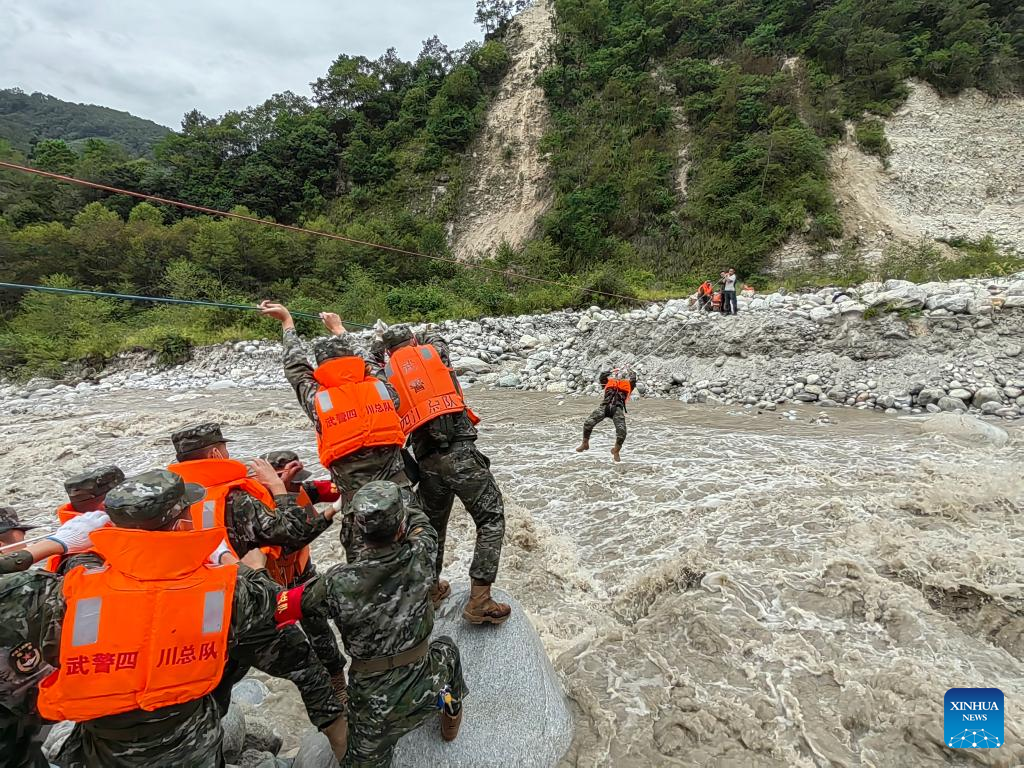
The rescue operations were very quick to reach the spot. The website China Military Online asserted that in the early afternoon on September 5, airborne troops, engineering and medical service personnel assigned to the 77th Group Army were ready: “At 18:10, a convoy of 28 vehicles and over 200 service members carrying rescue equipment …hurried to the quake-hit area. At 00:20 a.m. on September 6, they arrived at the epicenter. …At 07:40 a.m. [the same day], an engineering brigade dispatched over 200 service members and 28 vehicles loaded with tents and other living supplies to the quake-stricken area.” The arrival of military and civilian personnel continued on the war-footing during the following days.

Is the Earthquake linked to the development?
An important issue which needs to be studied by the Chinese authorities when they take stock of the disaster is the large-scale developmental activities taking place in this environmentally hyper-fragile area.
Hosts of photos published by the Chinese media show rescue teams rafting on the Dadu river, a tributary of the Yangtze River and one of the longest rivers in Sichuan. It means that the epicenter was nearby the river.
Let us remember that the  Kangding earthquake in 1786 was due to a dam whose collapse caused a landslide on the Dadu river, resulting in the flooding of 1,400 kms downstream and killing some 100,000 people on the way.

Developmental activities
Today, the Dadu is being over-developed for the sake of hydroelectric power; according to Wikipedia: “As of March 2014, a total of 26 dams are completed, under construction or planned for the river.”
The Shuangjiangkou dam on the river will soon be the tallest in the world.
Under construction nearby is the Ya'an-Yecheng Expressway (also referred as the ‘Ya-ye’ Expressway) which will link Ya'an in Sichuan to Yecheng in Xinjiang, crossing over the entire Tibetan plateau; the section near Kangding is already functional.
To this should be added National Highway 318 (G318) which runs from Shanghai to Zhangmu on the China-Nepal border. It is the longest National Highway at 5,476 kilometres and it also passes through the area affected by the earthquake.
Further, the trickiest project undertaken by China: the Sichuan–Tibet railway which will run at high-speed to connect Chengdu and Lhasa, Tibet Autonomous Region’s capital. The 1,629 km-long line will cut the travel time between the two capitals from 48 to 13 hours.
Lu Chunfang, an academician of the Chinese Academy of Engineering admitted: “The Sichuan-Tibet Railway is a strategic project with many challenges, including a complicated geological structure, which will make construct extremely difficult, and a sensitive environment in the region."
In an interview to the The China Daily, Lu affirmed: “Upon completion, the Sichuan-Tibet Railway will cross eight mountains, and more than 93 percent of the line will consist of bridges and tunnels. The line will include six tunnels stretching more than 30 kilometers, with the longest tunnel 42 km.”
That is not all: when the Tibetan plateau was created by the collision between the Eurasian plate and the Indian subcontinent “an enormous amount of heat was trapped inside the elevated crust.”
As The South China Morning Post puts it: “A significant proportion of its route involves tunnelling through rock too hot for humans or machines to bear, with ground temperatures of up to 89 degrees Celsius.”
Further, the railway line will cross some 40 major fault lines.

Has the earthquake been triggered by over-development?
Is there a link between these never-seen-before development activities and the Luding earthquake?
Only an honest scientific study will be able to determine the relation, if any, but as long as there is a doubt, the planners should think twice about what future they want for the region.
Interestingly, Li Zhanshu, member of the Standing Committee of the Politburo and Chairman of the Standing Committee of the National People's Congress visited Tibet from July 12 to 15, 2022 “for research on ecological protection legislation on the Qinghai-Tibet Plateau.”
During his visit, he stressed the need to have a legislation to protect the ecology of the Qinghai-Tibet Plateau: “The Qinghai-Tibet Plateau has a special ecological status and value, and plays an extremely important role in the national and even global ecological security," he said.
Li Zhanshu justified thus his visit on the plateau: the Qinghai-Tibet Plateau Ecological Protection Law will be a special regional protection law, but its significance and impact will reach far beyond the plateau to which the law will apply; he admitted that it is necessary “to have a big picture of the overall situation.”
But Li, who today ranks third in the Chinese Communist hierarchy and is currently on a ‘farewell’ visit to Russia, Mongolia, Nepal and South Korea, will retire in a few weeks.
Will his successor have the same determination to control the infrastructure lobbies and take the environment into consideration? It is not certain.
In the meantime, the recent events on the Dadu river have created a lot of anxiety in India which is aware of China’s plans to develop the Yarlung Tsangpo (known as Brahmaputra in India), as the proposed hydropower plants also lie on similar seismic faultlines.


Friday, October 19, 2018

Chairman Xi’s new mega project and China's internal politics

Landslide on the Yarlung Tsangpo
More on the environmental havoc in Tibet
Three days after posting the story below on the landslide on the Upper Yangtze, VTIBET.com reported a "Barrier lake forms following landslide in Nyingchi."
This time it is on the Yarlung Tsangpo/Brahmaputra
The article says: "A barrier lake has formed after a landslide struck a section of the Brahmaputra Valley near Pe Village of Mainling County of Tibet Autonomous Region. As of 3 p.m., the amount of water in the barrier lake had reached about 150 million cubic meters."
Some photos show the landslide-hit road in Mainling County, north of Arunachal Pradesh.
According to The Telegraph, China’s water resources ministry has informed the Centre of a landslide in Mainling "which might have an adverse impact downstream, particularly in the East Siang district of Arunachal Pradesh."
The official order issued by the district administration said, “As per information received from the central water commission, Government of India, ...landslides blocked the Mainling section of the mainstream of Brahmaputra/Yarlung Tsangpo ...on October 16,which will have an impact on the water situation of the lower reaches of the Yarlung Tsangpo river.”
Development has a cost.

The Landslide on the Upper Yangtze
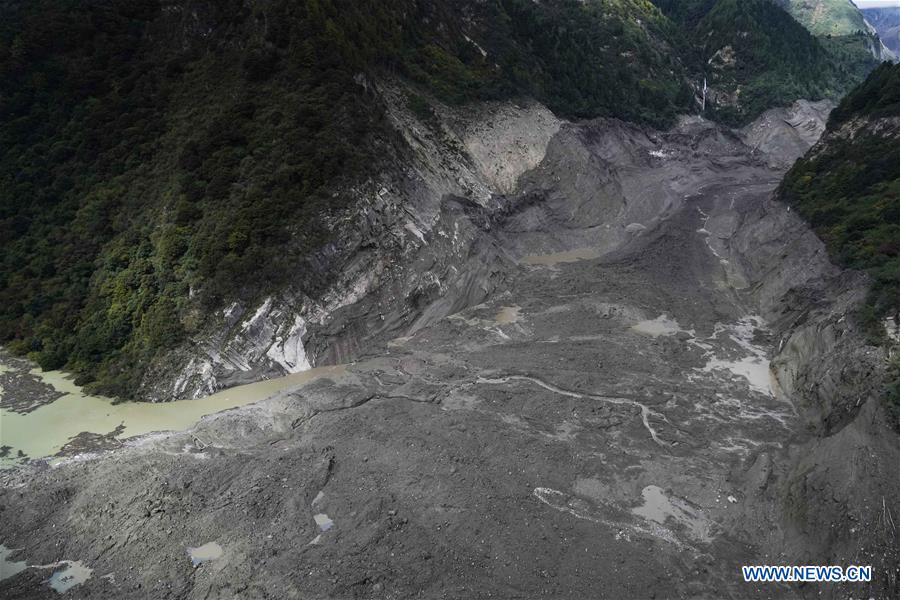
On October 11, Xinhua reported a ‘barrier lake’ which had formed due a landslide in a section of the Upper Yangtze (Jinsha River in Chinese) at the border between Sichuan Province and Tibet Autonomous Region.
The landslide struck in Bolo Township, in Jomda County of Chamdo prefecture.
Though no casualties were reported, the amount of water in the barrier lake had in a short time reached about 100 million cubic meters.
Some reports said 24,000 residents had been evacuated: “The Ministry of Emergency Management has initiated an emergency response.”
The PLA and PAP had been called to rescue the affected populations.
According to the same Ministry, some 7,000 tents, 30,000 cotton-padded coats, 50,000 quilts and 5,000 folding beds were sent to the landslide-affected area to help residents.
The local authorities in Chamdo stated that “the scale of the landslide is vast, clogging the main waterway of the Jinsha River, with several bridges, fields and villages affected.”
Bolo is located in the south of Jomda county; the Upper Yangtze separates this Tibetan area from the Sichuan province at an altitude of 2,860 meters. The county counts 8,325 residents in eight villages.
This 'natural' disaster raises seriously questions, not only environmental, but political too.

A coincidence?
Was it a coincidence that around the same time, Xi Jinping spoke at an ‘important’ meeting about the improvement of the disaster prevention while building the mega Sichuan-Tibet railway?
There is no doubt the project is so big, that it will resulted in serious ecological damage.
On October 10, Xi Jinping “called for efforts to improve the country's ability to safeguard against natural disasters, and fully launch the planning and construction of the Sichuan-Tibet railway.”
The Party's General Secretary made these remarks during the third meeting of the Central Committee for Financial and Economic Affairs: “As a stronger capability of safeguarding against natural disasters concerns the economy and people's livelihood, China will set up an efficient and scientific system and improve the capability of the whole society in a bid to protect people's lives and property and national security," said Xi.

The Sichuan-Tibet Railway
The meeting was called to discuss the Sichuan-Tibet railway, which will have “profound significance for the country's long-term stability and the development of Tibet.”
It had been rumoured earlier that there was a rift between the Chinese President and his Premier, Li Keqiang, who had visited Tibet in rather strange circumstances, probably to inspect a section of the projected mega railway line.
At the recent meeting, two more members of the all-powerful Politburo’s Standing Committee were in attendance: Wang Huning and Vice Premier Han Zheng.
Xinhua commented: “As one of the most disaster-prone countries in the world, China has attached great importance to the matter and made remarkable progress. But its overall capability to respond to such extreme conditions is still relatively weak, and more should be done.”
It was said that China would work to build a coordinated disaster-responding system, adopt a people-centered approach, give priority to the environment, try its best to minimize the aftermath, propel reforms and innovation to modernize its capability, and continue international cooperation: “A raft of major projects will be advanced, including ecological restoration of forest, grassland and rivers, coastal protection such as building ecological seawalls, housing reinforcement projects in earthquake-prone areas, flood control and drought relief, relocation of residents in disaster-hit places, construction of emergency centers, natural disaster monitoring and early warning, and the modernization of rescue technology and equipment.”

Who will pay?
All this will cost money and may increase the cost of the project many folds.
One of the questions never mentioned in the Chinese press is: can Beijing afford this mega project?
What would be the main objectives of the railway line between Sichuan and Lhasa?
Is it really necessary at this point in time?
The meeting just said that “it will promote ethnic solidarity, safeguard national unity and consolidate the stability of the frontier, as well as bolster Tibet's economic and social development.”
There is no doubt that in Xi’s mind, the ‘consolidation of the frontiers’ is crucial; let us not forget that he occupies the seat of Chairman of the Central Military Commission.
Observers have asked, why was this meeting called by Xi; after all such project should come under the State Council, in other words Premier Li, who himself held a similar meeting in August.

Another 'important' meeting
Just after the Summer holidays at Beidaihe, Li had chaired a meeting of the Leading Group on the Development of Western Regions on August 21.
It was held in Beijing; Vice Premier Han Zheng, deputy head of Leading Group was also present.
Li Keqiang stated that the Western areas should continue with reform and opening-up and vigorously innovate to achieve high-quality development.
While acknowledging the economic and social achievements in the regions, Li described the development in Western Regions (i.e. Tibet and Xinjiang) as 'a crucial and difficult point' for China to become a moderately prosperous society in all respects and achieve modernization.
Western areas should channel more energy into industrial upgrades, and make more contributions to a stable national economy, Li said.
The railway was mentioned; but a more holistic approach was stressed: “Entrepreneurship and innovation should be promoted in a practical manner, Li said, urging measures to raise industrial competitiveness in western regions and greater steps to cultivate new growth drivers and restructure traditional sectors,” said Li who adding that “The central government will pump more capital into the areas and encourage local governments to attract private investment.”
Li cited projects such as the Sichuan-Tibet railway, power grids, oil and natural gas pipelines, internet infrastructure, and water diversion projects (hopefully not the Brahmaputra!!).
Li highlighted the people-centered development, which not might be the case of the Sichuan-Tibet railway: “China will take solid, precise actions to win the tough battle against poverty and work for equality in public services. Internet technologies will be used to let remote poor regions enjoy better education and medical services, and the employment and old-age care in western regions will also be enhanced.”
It is here that there is a difference of approach between the two leaders; Li being softer.


The Pharaonic project with the longest tunnels
A month earlier, The China Daily had given some details about the project: “A preliminary study on the Kangding-Nyingchi section of the Sichuan-Tibet Railway shows the section will include at least 10 rail tunnels each longer than 10 kilometers."
He Huawu, a member of the Chinese Academy of Engineering, told the newspaper that the total length of the rail tunnels in the Kangding-Nyingchi section would be 843 kilometers - which is longer than the Beijing-Zhengzhou high-speed railway: “The longest rail tunnel, extending 42.5 km, would be the longest in China, eclipsing one 32-km-long on the Qinghai-Tibet Railway.”
There will be six rail tunnels in the Kangding-Nyingchi section longer than 30 km.
He Huawu spoke during an academic seminar on key technologies for building high-speed railways in complicated mountainous areas held in Chengdu.
China Railway had announced that design of the line was ‘not final’, but just part of preliminary research on the construction of the Kangding-Nyingchi section, and it has not been approved by the authorities.
The Sichuan-Tibet line will be the second railway line connecting the Tibet Autonomous Region with the mainland; the first one was the 1,956-km Qinghai-Tibet Railway, which opened in 2006.
The China Daily commented: “Since the new line will have to go through intricate and difficult geological conditions, and its construction will have to overcome frozen earth, landslides and rock slides, experts have dubbed the Sichuan-Tibet Railway China's most challenging rail project.”
Then recent landslide is an example of what could (will) happen to the railway line.
In fact, the construction in such difficult terrain is bound to create havoc for the environment on the marches of the Tibetan plateau. It probably explains the warning of Xi Jinping.
But a more cautious approach will also drastically increase the cost of the project; it is where Li may not fully agree with the Emperor.

Landslide on the Upper Yangtze
Can China afford it?
At the end the question is: can Beijing afford this in the midst of a trade war with the US?
It is one of the many dilemmas that the Chinese leadership will be facing in the years to come.
It could easily create a schism between the different factions in the Communist Party; between the ones promoting a more human approach and the ones vouching for gigantic schemes.
The discreet visit of the Chinese Premier to Tibet should be seen in this perspective.
The article of The China Daily concluded: “Some easier parts of the line have been built in the past few years, but construction of the Kangding-Nyingchi section has yet to start due to the difficulties involved.”
It refers to the Nyingchi-Lhasa railway line which will soon be open to traffic.
The Chinese paper added: “Previous reports have said trains on the Sichuan-Tibet line will travel at between 160 and 200 kilometers per hour. When the line is completed, the travel time by rail between Chengdu and Lhasa will be cut from 48 hours to about 13 hours.”

It is if the line is completed…
In the meantime, development projects in this ecologically fragile area are creating havoc.

To restore the traffic, a new road is being built. All this has a cost.

Jiala Village is close to the Great Band of the Yarlung Tsangpo
Landslide on the Yarlung Tsangpo near Jiala village

Landslide on the Yarlung Tsangpo near Jiala village

Landslide on the Yarlung Tsangpo near Jiala village

Landslide on the Yarlung Tsangpo near Jiala village

Wednesday, March 2, 2016

War and Peace: the Invasion of Tibet, an unequal combat

As Tibetans prepare to elect a new Prime Minister (Sikyong), it is necessary to look back at a time when Tibet was still a free country, not yet ‘liberated’ by China.
But, let us be honest, during the first weeks of October 1950, Tibet was invaded by China, not ‘liberated’ of anything.

Nehru and Tibet
As the PLA makes lightning advances in Kham province, the Indian Prime Minister talks of Peace.
On November 19, 1950, Nehru writes a note to the Foreign Secretary; he is deeply upset with the notes/cables received from Harishwar Day, the Political Officer in Sikkim and Sumul Sinha, the head of the Indian Mission in Lhasa.
Why?
Nehru explains: “I am a little tired of reading the telegrams that come to us from our Mission in Lhasa and our Representative in Sikkim.”
While a drama unfolds on India’s borders, the Prime Minister (who is also Foreign Minister) is ‘tired’ of these two remarkable diplomats: “They are full of their advice to us as to what we should do and criticism of us for what we may have done. I think that it is about time that we reminded these representatives of ours what their functions are and what they are supposed, and what not, to do," remarks Nehru.
The note, addressed to K.P.S. Menon, the then Foreign Secretary, continues: “We want from them full information and appraisals of the situation. We want also their own recommendations. But, it seems to me that their messages go beyond this and indicate a lack of confidence in the Government of India and an apprehension that we might do the wrong thing unless they stop us from doing it. They live in remote parts, cut off from the rest of the world, and judge all world events from their own immediate environments. They appear to have hardly any conception of broad policies in terms of what is happening in the world.”
Dayal and Sinha are probably unable to 'understand' the implications of what is happening in the Korean peninsula and the ‘mediator’ role that Nehru wants to play in the crisis, but these two officers are witnessing of one of the greatest tragedies of the 20th century, a peaceful independent nation is engulfed by a bully neighbour in the name of ‘liberation’.
Nehru further observes that the last paragraph in a telegram from Lhasa (from Sinha) is ‘extraordinary’: “Our representative in Lhasa says that he would be grateful if the Government of India do not adopt a certain policy. Exactly whom does he represent there and on whose behalf is he going to be grateful? This is not a personal concern of his.”
The Prime Minister finally requests the Foreign Secretary to send some message to both Lhasa and Sikkim, “pointing out the functions of our representatives there.”

A Note from Harishwar Dayal
Two days later, on November 21, not knowing that the Prime Minister is ‘tired’ of his comments, Harishwar Dayal sends a long legal note to the Ministry of External Affairs on the importance of Tibet for India.
His points are deeply relevant to the situation on India's borders.
In the last paragraph of his communication, Dayal ‘dares’ to quote the letter from Hugh Richardson sent on June 15, 1949 addressed to South Block.
The British-born first ‘Indian’ representative in Lhasa (he will be replaced by Sinha in August 1950) had suggested that India might consider occupying Chumbi Valley up to Phari ‘in an extreme emergency.’

Take the control of the Chumbi Valley
More than a year later, Dayal brings again the same suggestion: “This suggestion was NOT favoured by Government of India at the time. It was however proposed as a purely defensive measure and with NO aggressive intention. An attack on Sikkim or Bhutan would call for defensive military operations by the Government of India,” he writes.
It is what China’s PLA theorists today call ‘active defence’.
Dayal explains his reasoning: “In such a situation occupation of the Chumbi Valley might be a vital factor in defence. In former times it formed part of the territories of the rulers of Sikkim from whom it was wrested by the Tibetans by force. It is now a thin wedge between Sikkim and Bhutan and through it lie important routes to both these territories. Control of this region means control of both Jelep La and Nathu La routes between Sikkim and Tibet as well as of the easiest routes into Western Bhutan both from our side and from Tibetan side. It is a trough with high mountains to both east and west and thus offers good defensive possibilities. I would therefore suggest that possibility of occupying the Chumbi Valley be included in any defensive military plans though this step would NOT of course be taken unless we became involved in military operations in defence of our borders.”

The Political Officer probably does not realize that China is a ‘friend’!
And he has not yet been informed that the Prime Minister was tired of his comments!
What may have prompted Dayal to write this letter is probably a meeting with members of the Himmatsinghji Committee, who are preparing a contingency plan to defend India’s borders. They may have asked him to put his views in writing in order to put some pressure on the pacifists in South Block which could only see the ‘wider perspectives’.
Retrospectively, only a solution such as the one suggested by Harishwar Dayal, could have stopped the advance of the Chinese troops.
But India's official political thinking was elsewhere. A few days earlier, Nehru explained to K.M. Panikkar, his ambassador in Beiing: “Our present policy is primarily based on avoidance of world war; and secondly on maintenance of honourable and peaceful relations with China.”
Well, China had other objectives.

The Battle of Chamdo
I am posting below the Detailed Report on Battle of Chamdo by the 52nd Division of the 18th Army of the People’s Liberation Army.
The source of this text in Chinese is The Liberation of Chamdo, compiled by Office of Editing and Research, Political Department, Chengdu Military Area Command and Tibet Military Area Command (Chengdu, 1991).
It has been translated by two independent researchers Jianglin Li and Matthew Akester and the entire text in English is available on their blog.
Of course, it reflects the views of Mao Zedong and the Communist Party of China, but it shows that the Battle of Chamdo was a military operation conducted in a professional manner by the 18th Army, as well as other supporting forces coming from the North (Qinghai, then Amdo province of Tibet).
There was no question of ‘peace’ or ‘negotiations’ for Mao (Nehru was banking on 'talks' to peacefully solve the issue)).
Further, it is clear for the Great Helmsman that it is only the first stage before an advance towards Lhasa during the next season.
What is surprising is the elaborate planning of this military operation. Comparatively, the leaderless Tibetans are novices and stand no chance in front of the calculated tactical moves of the PLA.
It should also be noted that the Chinese learned a lot during the Chamdo operations; this is apparent in the Summary.
Did they learn for another operation, 12 years later, on the other side of the Himalayan slopes?
Probably. Look at their slogans:
Surround more, annihilate more; surround less, annihilate less
Cutting into the heart of the enemy position, penetrating, separating, surrounding and annihilating the enemy

India learned nothing during these 12 years. This is another tragedy.
India is still suffering of the crushing defeat of 1962. Stigmas of the rout are still visible in the Indian psyche.

Here is the Chinese narrative of The Battle of Chamdo.
(November, 1950)

After crossing the Jinsha river [Tib: Drichu or Upper Yantze] from October 6th to 9th, troops reached the vast plateau of a thousand li [1000 li, c. 500 km] in length and width and in coordination with brother troops, units of this division were divided into three wings, left, middle and right, forming the assault on Chamdo, a powerful pincer attack targetting the 1500-li-long position of the Tibetan army commanded by Chamdo Governor Lhalu.
During the fourteen days of rapid advance and fighting, all units were moving across the unfamiliar plateau without accurate maps.
Soldiers carried loads of 60 or 70 jin,[ c. 30 to 35 kg] climbed more than 50 high mountains and crossed rivers over 60 times.
On average, foot soldiers cover 72 li , [36 km] cavalry 80 li [40 km] a day, those who had to march day and night moved up to 34 hours continuously without enough food. However, (all units) answered the call by party committees of both the army and the division and endured extreme hardship, annihilated all the defending enemies in Chamdo on schedule, and successfully completed the capture of Chamdo.
The success of this battle, …annihilated five Dapons [commander of a regiment], the main force of the Tibetan army, and over 2000 militia, liberated the region north to Qinghai, south to Yunnan, east to Jinsha river, west to Luolong [Lhorong Dzong] and Leiwuqi [Riwoche], a vast area more than one thousand square li. The success further strengthened our unity with Tibetans west of the Jinsha river, laid the foundation for advancing next year (1951), struck blows directly and indirectly at the British and American imperialist invaders, inspired people in the near east and repaid the people of the whole country who had warmly supported us.
…Tibetans have warmly supported us (taking in and escorting individual stragglers, delivering information, guiding the way, providing transportation, building bridges, preparing firewood and fodder, etc.), all of this shows that we had good influence by carrying out the policies conscientiously before the attack and shows the tangible benefits brought to Tibetans during our westward march. This is a small accomplishment we achieved in the past, and it is also a major pointer for the future in the liberation and construction of Tibet.
In this battle, troops advanced rapidly for 15 days with heavy loads across the high plateau a thousand kilometers in length and width, wrapping up…entire (enemy?) position 1500 li [750 km] in length and accomplished the task on schedule, completely annihilated the third (two Dapons), the seventh, the eighth, the fifth and the tenth Dapon, altogether five Dapons (averaging small regiments) under Tibetan Frontier Envoy Commissioner General,[The Chamdo governor was the ‘Domey Chikyap’ or ‘Eastern Governor’] captured…over 3000 men. This victory is fundamentally due to correct leadership by leading officers of the Military Area Command and the Army Party Committee, strong support from the people of the whole country, coordination from brother troops (particularly engineer corps), favourable influence created by advanced detachment through their hard work and carrying out policies conscientiously, and the eight-month long preparation. All of these contributed to the successful conclusion of this battle.
Review of the battle process is as follows:
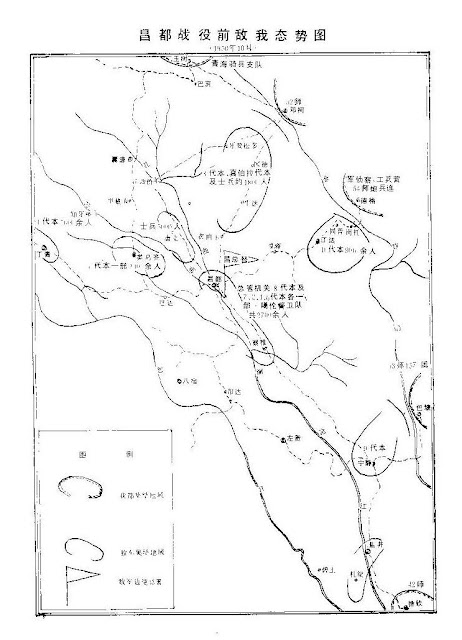
Surround more, annihilate more; surround less, annihilate less

I. Process
(I) Judgement of enemy situation:
  1. Based on information obtained by the advanced detachment and by our own battle experience, in terms of the arrangement of their position, the enemy had no focus, no depth and attached no importance to flanks.
  2. Enemy lacks systematic strategic planning and command, they fought wherever they were attacked and were easily misled by us. After we crossed the river from Dengke [Dengo or Denkok on the Yangtze river], it was quite possible that the enemy might mistakenly believe, based on historical experience, that we were going to take Lhasa by way of Yushu [today’s Yushu prefecture, Qinghai] and Heihe [Nagchu].
  3. The enemy had never experienced large scale battle, had no knowledge of modern military science and was equipped with few heavy weapons. Their combat capability was not strong. After our powerful military forces crossed the Jinsha river, it was estimated that the following three changes may appear:
  • Retreat without fighting and escape without hesitation. If this happened, it would definitely make it more difficult for us to annihilate the enemy.
  • Scatter at the first contact, and the possibility of scattering everywhere in the mountains and wilderness to entangle us also existed. This would make it even more difficult for us to annihilate the enemy.
  • Concentrate forces and put up strong resistance in strategic locations. This was exactly what we were hoping for, for we were absolutely sure that we would annihilate them thoroughly, straightforwardly and completely.
  • In the Dengke battle, (we) did not seize the moment of strength to strike the enemy a fatal blow. The enemy might mistakenly have thought that our combat capability was not strong, getting arrogant and inattentive enough to confront us.
(II) Determination and Deployment
Liberating Chamdo, annihilating the main force of the Tibetan army in the area east of Lanchang river [Upper Mekong], Enda and Leiwuqi [Riwochey] lays the foundation for advance into Lhasa next year (1951) and liberate the entire Tibet. (We) decided to deploy a powerful right-flank encircling force composed of infantry and cavalry, providing strong points to offset each other’s weaknesses, making a detour via Batang and Nanqian [Nangchen] and pushing forward vigorously and precipitately. Troops should not be blocked by small numbers of enemy, doing everything possible to clear away obstacles and circle bravely…the entire field, cutting off the enemy’s retreats from Enda to Taizhao [Gyamda Dzong in Kongpo] and from Leiwuqi to Heihe, the two main escape routes, making it impossible for enemies to escape even if they intended to slip away without fighting.
Performance of troops in this wing is the key to success or failure in annihilating more than three Dapons of the enemy force. The middle wing cut into the heart of the enemy position by way of Shengda [Jomda county in today’s Chamdo prefecture], Yayaosongduo [Yayu Sumdo], Yiquka, Dongdong Zhuka, Duozhiduo, etc, cutting into the heart of the enemy position, penetrating, separating, surrounding and annihilating the enemy within the entire enemy position and advancing straight to Chamdo.
If the enemy did not rest, we wouldn’t rest; when the enemy took rest, we annihilate them. The left wing force crossed the river at Gangtuo [Kamtok], marching slowly by way of Tongpu, Jiangda [Jomda] and Jueyong to draw in the enemy. They seized the Damala Pass and controlled Sichuan bridge. Our slogans were “not to worry about breaking up Tibetan army’s positions, but to worry whether we can surround them. Surround more, annihilate more; surround less, annihilate less.”

II. Review of the Battle [not available]


III. A few experiences from the battle

(I) Experiences of fighting the Tibetan army
  1. All Tibetan troops were organized in a comparatively primitive way. Troops have neither (commanding) offices nor maps. Everything was handled by one single officer-in-charge. Special reconnaissance troops and communication tools were very outdated. Everything relied on wula,  and as a result the upper and lower could not communicate during the battle. For example, during the battle when Gaqionba, the third Dapon, retreated in defeat from Jiangda to Chamdo, he was surprised to meet Moxia [Mucha] Dapon, and only at that time did he come to know that the Liberation Army had passed Dengke [Dengo] and that Moxia [Mucha] had been defeated too.
  2. They did not fight aggressively and lacked counter attack ability. In several battles we did not find the enemy launching strong counter attacks.
  3. Lack of systematic strategic thinking, as expressed by:
  • No attention paid to protect flank and rear while deploying the forces. As seen from the deployment of this battle, three Dapons positioned in the front had fallen into our horseshoe-shape encirclement, 200 men were still deployed in the Leiwuqi flank.
  • No knowledge of using the terrain to block our advance. While chasing and attacking the enemy, none of the bridges and passes in the route were destroyed, particularly the Sichuan bridge (this bridge is like the gateway to Chamdo). The 156th regiment was half a day’s distance from the enemy, when they advanced and seized the bridge, it was left intact.
  • No night combat experience. Falling into disorder as soon as fighting began, each man escaping on his own. This was how the enemy behaved in the battle of Jueyong.
  • No guards posted at encampments. In Jueyong one squad of our reconnaissance battalion sneaked into the enemy’s tents at night, and only then did they find out and began screaming and running about in disorder.
  1. Enemies were slow in climbing mountains: the 156th regiment was one day’s distance away, the reconnaissance battalion was two days’ distance away from the enemy, but they both caught up the enemy within 100 to 200 li. Their speed was nearly one third faster than the speed of the enemy.
  2. In terms of tactics: (enemy) was good at riding horses, highly skillful at shooting and utilizing terrain and landforms, but not good at operation. For example: in the battle of Shengda [Sipda in today’s Jomda county], the 155th regiment confronted the enemy across the river for more than ten hours, and over ten men were wounded. The distance in between was about 300 meters, but hardly any enemy could be seen (they were all hiding behind rocks and in dense forest). According to our observations in the battle field, beside Jazhangka and Shengda where a few fortifications were made, the other places had no fortifications. The fortifications were very poorly built, mostly piled up stones in the shape of a pigsty, which could be pushed over by hand.
    (II) Tactics to be used against Tibetan army
  1. To deal with the weak Tibetan army with our current equipment, the key is to encircle the enemy (that is, the more encircled, the more will be annihilated; less encircled, less will be annihilated). No need to worry about breaking through Tibetan army’s positions, the only worry is not being able to encircle them. Since supplies are scarce in Kham-Zang Plateau, once the supply line is cut, enemy will retreat in disorder without fighting.
  2. Based on special conditions of the plateau cavalry is the key to annihilate the enemy, and the guarantee of success. Because the loads foot soldiers have to carry are too heavy, they don’t have enough physical strength to walk long distances to encircle the enemy. As is shown in this battle, the cavalry detachment was able to complete its task on time (to block the enemy), based on the distance, it was impossible for the infantry to complete it.
III. Coordination of Infantry and Artillery
Due to weather conditions on the plateau and our equipment, vigorous activities and rapid charge are not favourable to the troops. Therefore, during combat firepower must be well organized so as to coordinate with foot soldiers continuously and effectively. In arranging firepower, the focal points should be the flank and rear, for enemy fears our artillery attack more than anything.
IV. Reconnaissance
Since there are no accurate maps available and no accountable mileage for roads, plus there are lots of rivers, forests and mountain ranges in Kang-Zang area, knowledge of enemy situation and terrain through reconnaissance prior to battle is highly important. The method is to inquire from Tibetans familiar with (the area) in various ways, and estimate how far it is based on how many days he covers certain distance. As long as we are nice to him, he would give us such information honestly.   
V. Artillery
How to use artillery in plateau combat should be well studied, particularly how to measure distance. Observation is not easy since too many objects block the view, and as a result, distances are often misjudged as closer (than they actually are). Because the air is thin, the speed of the shells is faster.

VI. Suggestions on army structure and equipment
  1. Branches of army: a division should have a cavalry regiment to fulfill the task of circling and surrounding (the enemy). A regiment should have a mounted reconnaissance company to facilitate communication and reconnaissance. When the regiment engages in individual combat, (mounted reconnaissance company) can perform tasks of circling and surrounding in small actions. In addition, one engineers platoon should be allocated (can be attached to guard company) to take on tasks such as building bridges, handling boats, and clearing away obstacles so as to reduce the trouble of crossing rivers and increase advancing speed.
  2. Weaponry: reduce mountain artillery, increase recoilless guns, high-angle guns, dynamite, detonator, fuse and explosive.
  3. Tools: Quality and style of current field tools needs to be improved. Both the shovels and picks the troops are currently equipped with are not practical in combat. Besides being pointed at one end, the other end of the pick should be changed to something that can be used mainly in hacking. Shovel should be changed into American style with removable head, and can be used to dig, scratch and shovel off grass. Besides, since the plateau weather is cold, canteen should be changed into thermal canteen, and more cowhide boats, and bridge-building tools such as saws, hatchets, ropes, etc.
  4. Uniform: There are thorns and gravel everywhere on the plateau and clothes are easily torn, the current style of uniform must be changed and quality must be improved, otherwise it will not be able to last the season (until the next uniform issue).
    It is better to make the uniform with strong and durable cloth, shoulders, backsides and knees should be reinforced. It is better that the cuffs are tightened and trousseaus in the style of jodhpurs. Weight of coat should be reduced. Comforter should be changed into soft, warm, damp-resistant, lightweight, larger size wool blanket which can be used as mattress pad as well as comforter. Raincoat and damp-resistant canvas should be combined into one, based on current raincoat size and shape, adding more rubber to make it thicker so it can be used to wear and to spread as bedding. Quality of shoes should be improved, soles should be softer and the upper should be higher, water-proof and damp-resistant. Headgear should better be helmet (the type used by pilots) with goggles fixed on. Goggle lenses should be made of plastic (at the moment two thirds of the goggles the troops were equipped with have been damaged).
  5. Communication tools: Office at regiment and above level should be equipped with larger radio of 50 watt or more. Current radios cannot function at 11. p.m. because signals are too weak.
  6. Supply: Since the current transportation condition is rather difficult, all food should be high quality, low quantity, long-lasting and easy to carry, otherwise it increases soldiers’ burden, reduces their physical strength, slows down marching speed and has negative impact on accomplishing tasks. For example, the powdered food distributed this time was heavy and the quality was poor. Grain powder was not well cooked, ration was not enough to eat, and hard to digest, causing stomach pain, abdominal bloating and diarrhea. As a result, medical patients sharply increased, and a considerable number of soldiers lagged behind. According to initial statistics, of all the stragglers in the whole division, 80% were because of the food powder.

Monday, February 16, 2015

Dreadful Cascade on the Yalong River

Cascade of dams on the Yalong
A couple of days ago, Xinhua reported that a ‘New hydropower station in SW China gets hefty loans'.
This is ominous.
It appears that after a few years recess period, the ‘cascade’ frenzy of large hydropower plants on Tibetan river is on track again.
Xinhua says: “A hydropower station planned for southwest China's Sichuan Province received 53 billion yuan (about 8.5 billion U.S. dollars) in loans from seven domestic financial institutions.”
According to the Chinese news agency: “The planned hydropower station, in the middle reaches of the Yalong River in Sichuan's Garze Tibetan autonomous prefecture, will have an installed generating capacity of 3 million kilowatts with a total reservoir capacity of 10.8 billion cubic meters.”
It is a big, very big dam at a time mega-dams are decommissioned elsewhere in the world.
Chen Yunhua, president of Yalong River Hydropower Development Co. Ltd, the project's developer, explained: “Construction will cost about 66.5 billion yuan and the loan agreement, signed in Chengdu; [it] covers about 80 percent of the total. …The seven lenders are China Construction Bank, Industrial and Commercial Bank of China, Postal Savings Bank of China, Agricultural Bank of China, China Development Bank, Bank of China and Bank of Communications. They will provide long term, low-interest loans to support the project.”
It will be the largest powerplant on the Tibetan plateau; it is expected to start producing electricity by the end of 2021 and it should be completed in 2023 (Chinese companies usually complete their tasks on time, not like in India).
Chen affirmed that the project will “transform the river's hydropower resources into a new driving force for the regional economy and generate clean energy to fuel southwestern and eastern China.”
But it will probably destroy the Yalong river forever.
Though the name of the dam is not mentioned in the Xinhua release, it is clear that it refers to the Lianghekou Dam ("mouth of two rivers"), a concrete-face rock-fill dam on the Yalong River.
The Yalong originates in Qinghai Province, passes through Sichuan, and
joins the Jinsha (Yangtze) River.
  • Length: 1,571km
  • Natural head: 3,830m
  • Catchment area: 136,000km2
  • Annual runoff: 61 billion m3

The Lianghekou Dam is located at the confluence of the Yalong, Xianshui and Qingda Rivers. With its 295 m height, it will be the highest embankment dam in China and the power station should produce 3,000 MW.
Studies for the dam were completed between 2005 and 2009 with preliminary construction beginning soon after. However the ‘official’ construction only started in October 2014.
According to Chen, 21 cascade projects are planned on the Yalong river; their ‘technical developable capacity’ is 30,000 MW, (representing 24% of the capacity of Sichuan or 5% of China).
It will rank 3rd among China’s 13 ‘hydropower bases’.
Chen made the following points:
•    Hydropower development of the Yalong River is already in an expedited stage.
•    Key technical issues have been basically resolved.
•    An optimized pattern for joint operation of multiple stations is gradually taking shape.
•    Design and control of high earth-core rockfill dams will become the focus of further research.
Does it mean that the researches have not been completed?
The local populations have of course not been consulted ('Only' 4,900 people will be forcefully displaced).
Today, the Editorial of The South China Morning Post is consecrated to China's new environment chief, Chen Jining.
The Hong Kong daily says: “It is easy to assume that if no one - be it a high or low official - is beyond the reach of mainland graft-busters, then serial polluters should not present too much of a problem to environmental authorities. Sadly, nothing could be further from the truth. The latter may have the law on their side and, supposedly, the clout of a fully fledged ministry in recent years. But the mainland is almost as well-known for potentially calamitous degradation of its environment as for the breakneck pace of economic growth responsible for it. This is because serious air, water and soil pollution has accrued over decades, economic growth still gets higher priority and responsibility for protecting the environment is divided among various government departments.”
Don’t you think that the ‘cascade of dams’ is also a ‘serial killer’?

Monday, December 8, 2014

One more railway on the Tibetan Plateau

According to Xinhua, the construction of a new railway line has started on the Tibetan plateau: "Construction begins on Chengdu-Ya'an section of Sichuan-Tibet railway," titled Xinhua.
The Chinese news agency announced that the work has begun on the rail line from Chengdu, capital of southwest Sichuan Province to Ya'an, a city located west of the capital.
Xinhua says: "The 42-km Chengdu-Ya'an section is an important part of the Sichuan-Tibet railway, and will have a journey time of about eight hours from Chengdu to Lhasa, capitals of Sichuan the Tibet," adding the usual rationale: "Transport is a bottleneck for tourism in Tibet and currently, there is no direct railway service between the two cities. After completion, the Sichuan-Tibet railway will connect with the Qinghai-Tibet railway."
It has, of course, important strategic implications for India as the new railway will run north of the McMahon Line (Arunachal Pradesh).
Once the first segment is completed, the next stage will probably be Ya'an-Dartsedo (or Kangding), the seat of Garze Tibetan Autonomous Prefecture in western Sichuan.
The town, which is administratively part of Kangding County, has a population of more than 100,000 inhabitants.
It is also one of the most restive parts of Kham.
The Chinese planners certainly believe that the railway will greatly help to 'stabilize' (Chinese euphemism) the volatile political situation in Eastern Tibet.

Friday, November 21, 2014

Power from the mainland to Roof of the World

Xinhua has just announced that the Tibet-Sichuan grid is now functional.
The launching ceremony was chaired by Yu Zhengsheng, Chairman of the Chinese People's Political Consultative Conference (CPPCC), who declared operational the power lines linking the Tibet Autonomous Region (TAR) to Sichuan Province.
The function was held  in Beijing.
Xinhua reported that the opening of the 1.08 billion U.S. dollar project linking Chamdo in the TAR and the Tibetan Autonomous Prefecture of Garze in Sichuan Province, aims at "putting an end to the electricity shortages of the 500,000 residents of the Chamdo region and ease power strain in Tibet as a whole".
The news agency further explained: "The complex interconnection circuits stretch 1,521 kilometers across the plateau at an average altitude of 3,850 meters and its construction involved more than 20,000 staff over eight months, according to the State Grid Corporation of China."
Before the official launch, Yu inspected the power 'dispatching center' at the State Grid's headquarters where he met workers and engineers involved in a grid construction.
He was accompanied by Chen Quanglo, the TAR's Party Secretary.
The billion-yuan question is: will this investment still be used to send electricity from Tibet to Sichuan or vice-versa, once the dams on the Brahmaputra are complete.

According to China Environment Forum of the Wilson Centre in the US:
The West - East Electricity Transfer Project, initiated in the Tenth Five-Year Plan (2000-2005), was designed to bring investment and development to China’s lagging west while satisfying the growing electricity needs of the country’s eastern provinces. The project’s first phase has been and is continuing to expand the western provinces’ electricity-generating capacity, primarily through the construction of new coal bases and hydroelectric dams.The project’s second, ongoing component is the construction of three electricity-transmission corridors, which are essentially three vast networks of electrical transmission lines that connect newly built generation capacity in the North, Central and South to China’s electricity-hungry coast (see arrows on map). Each of the corridors is expected to exceed 40 gigawatts (GW) in capacity by 2020—a combined capacity equivalent to 60 Hoover Dams. The seven recipient provinces — Beijing, Tianjin, Hebei, Shanghai, Zhejiang, Jiangsu, and Guangdong — together consume nearly 40 percent of China’s electricity.
A few pictures of the grid and the function.


Wednesday, April 16, 2014

New Infrastructure Links on the Tibetan Plateau

New Tunnel on the Golmund-Xining railway line
While India is busy with the legislative elections, China continues to frantically develop its infrastructure on the Tibetan plateau and at its periphery.
A couple of days ago, Xinhua announced, 'world's longest plateau rail tunnel completed'.
The Chinese news agency reported that the Xinguanjiao Tunnel, the world's longest plateau rail tunnel on the Qinghai-Tibet Railway, had been completed last week.
According to Zhi Changying, an official with the China Railway Tunnel Co. Ltd. (CRTC), a partner in the project, the 33 km tunnel is the longest rail tunnel in China.
It is a part of the Qinghai-Tibet Railway. It is located between Golmud in northwestern Qinghai province and the capital, Xining.
Except for the tunnel, the 763-km-long line was opened to traffic in November 2010.
It took some 7 years to the CRTC and the China Railway 16th Bureau Group Co., Ltd. (CRBGC) to built the tunnel which was the main 'bottleneck' on the Golmund-Xining railway line.
Liu Hairong, a CRBGC official admitted that the project posed several challenges for engineers due to high altitude, complicated geological conditions and tight budgets [sic].
Zhi Changying said that the tunnel will be opened to traffic at the end of 2014: "It will give a much-needed boost to the transportation capabilities of the high-profile Qinghai-Tibet Railway, which connects the northwestern Qinghai Province and Lhasa, capital of southwest China's Tibet Autonomous Region", stated the official who added that it will allow to better connect Qinghai and Tibet.
But that is not all.
The China Daily announced that the construction of a new road between Xichang (in Sichuan province) – Shangrila (in Yunnan province).
Te highway is expected to be started soon, 'with a planned construction period of five years'.
And when the Chinese say 5 years, it is usually 5 years.
The new highway will connect the Xichang-Panzhihua Highway with the Shangrila-Lijiang segment of the Xining-Chamdo–Dali highway.
It will start from the city of Xichang.
Let us not forget that the Xichang Satellite Launch Center (XSLC) is one of the main Chinese space vehicle launch facilities The launching pads are located some 64 kilometres, northwest of Xichang, Liangshan Yi Autonomous Prefecture in Sichuan.
Xichang Satellite Launch Center
According to Wikipedia: "The facility became operational in 1984 and is primarily used to launch powerful thrust rockets and geostationary communications and weather satellites. It is notable as the site of Sino-European space cooperation, with the launch of the first of two Double Star scientific satellites in December 2003. Chinese officials have indicated interest in conducting additional international satellite launches from XSLC. In 1996, a fatal accident occurred when the rocket carrying the Intelsat 708 satellite failed on launch from the Xichang Satellite Launch Center. Also, a 2007 test of an anti-satellite missile occurred from the center."
Is the new road linked with the satellite launch? Difficult to say!

China National Highway 318
The new highway will be 320 kilometers long. It will run through Yanyuan county in Sichuan province and the touristic Lugu Lake. More than half of the highway is located in Sichuan province.
The highway will have 97 super large, large and medium bridges and 24 tunnels; it will have four lanes all along; it is designed for a speed of 80 kilometers per hour.
This will be a new route linking Chengdu to Yunnan and Central Tibet (via Highway 318).
Once opened to traffic, it will only take two hours from Xichang to Lugu Lake. Chengdu, Sichuan's capital is 7 hours away from the picturesque lake.
The highway will connect National Highway 108 to National Highways 214 and 318.

China's National Highway 318 (G318) runs from Shanghai to Zhangmu on the China-Nepal border. It is the longest of China's National Highway with 5,476 kilometres. From Shanghai it crosses Zhejiang, Anhui, Hubei, Chongqing, Sichuan, and ends in Tibet.

China National Highway 214 (G214) runs from Xining in Qinghai province to Yunnan. It is 3,256 kilometres long. From Xining it goes southwards to southeastern Tibet (Yunnan province).

China National Highway 108 (G108) connects Beijing to Kunming via Chengdu. In Beijing it is known as Jingyuan Road. It is 3,338 km long. Xichang is located approximatively half way between Chengdu and Kunming.

Monday, January 13, 2014

New Tibet is Burning


First, we heard of a huge fire breaking out at the Serthar Tibetan Buddhist Institute (known Seda Larung Wuming in China) in the Kartse (Garzi) Tibetan Autonomous Prefecture of Sichuan Province.
The fire was reported at 7.30 pm on January 10. 

Serthar, is said to be the largest Buddhist institute in the world with 10,000 nuns and monks (in an earlier posting on Serthar, A 'spiritual' revival in China or another gimmick? I quote some sources speaking of 40,000 monks and nuns).
Then, images of a new fire, also in Tibet (but in the neighbouring Yunnan province) appeared in the media; the fire is said to have engulfed 200 'traditional' houses in Dechen county.
Fire at Serthar
About the first one, The South China Morning Post  reported: "The blaze destroyed more than a dozen buildings, which some reports said were living quarters for student monks or nuns. No casualties have been reported as yet. Authorities are still investigating the cause of the fire, according to initial reports on microblogging platform Sina Weibo."
It is said that some 450 people joined the rescue operations. Weibo showed people in uniforms as well as monks walking through the debris with the fire raging in the background.

New Tibet?
These 2 fires have something in common. They represent 'New Tibet' (or Tibet with Chinese characteristics). 
In a posting earlier this month, I speak of the 'spiritualization' of the Chinese society (see The Year of the Horse: a Prediction).
The Serthar Institute is the main example of this 'spiritual' search, with thousands of Chinese joining Larung Gar as a monks or nuns. 

The other aspect of 'New Tibet' is what I have called the Disneyfication of the Land of Snows: 14 millions Han tourists in the Tibetan Autonomous alone!
A couple of days before the Yunnan fire broke out and engulfed the town of Dukezong, China Tibet Online invited Chinese tourists to visit the spot:
Shangri-la before the fire
Shangri-la, a place where the majority people believe in Tibetan Buddhism, is full of religious atmosphere amid the sutra streamers everywhere.Shangri-la has an area of 11,613 square kilometers populated with near 130,000 people who are mainly Tibetans.
The prevalent religion is Tibetan Buddhism believed by not only Tibetans but also people of the Naxi, Yi and Bai ethnic groups
.
Shangri-la is one of the main sites on the plateau for 'Tibet tourism' where hundreds of thousands of Chinese visitors rush every year in search of some exoticism.
A touch of spirituality was even added with the very name 'Shangri-la'. Why should these two symbolic sites of 'New Tibet' burn at the same time?
Probably a coincidence!
Incidentally, a Communist cadre who served in the two 'burning' places in Eastern Tibet (in Kartse in 1995-96 and Aba in 1996-2000) has been sacked. He was close to the former security tsar Zhou Yongkang.
Li has got the boot after being suspected of corruption, according to the Chinese media. It is the latest move against people close to Zhou, himself under graft investigation.
Xinhua has announced that Li had been removed from his post as head of an advisory body to the legislature in the southwestern province of Sichuan for suspected severe violations of discipline: "Authorities are investigating his case according to procedure,” Xinhua added, citing a statement from the Communist Party’s powerful Organization Department.
Li Chongxi was the chairman of the provincial committee of the Chinese People's Political Consultative Conference. He is the third senior Sichuan official to fall under suspicion in 2013.
This has no connection with the fires.
One more story about 'fire'. The great Indian Guru Padmasambhava is said to have been able to set on fire the robe of the Chinese Emperor, just by reciting powerful mantras.
Again no connection with the Serthar and Shangri-la fires, though both these mishaps have been 'miraculous', in the sense that there was no casualty.

Blaze in Tibetan town of Dukezong unlikely arson, authorities say
South China Morning Post
January, 2014
Adrian Wan
Authorities in Dukezong, the Tibetan town in Yunnan province that was largely destroyed in a fire over the weekend, said it was unlikely the blaze was started deliberately.
The possibility of arson has been mostly ruled out but an investigation was still under way, Xinhua reported.
Some people living in the town in Shangri-la county, which is about 1,300 years old, have questioned the speed of the response of emergency services.
A 30-year-old woman, who gave her surname as Wang, said that when she arrived at the scene of the blaze at 3am on Saturday, more than an hour after the fire had started, there were only two fire engines in the area. They had not begun spraying water on the flames, she said.
Other residents said firefighters arrived 30 minutes after the blaze broke out.
Chen Tianchang, a fire captain, told Xinhua that firefighters were at the scene in five minutes but that there were delays in tackling the blaze.
He said the old town did not have any firefighting equipment until several years ago and that water pipes were built above ground so as not to damage the town's historic character.
"To avoid water in the pipes freezing and breaking them, no water was stored in them. So it took time to fill them with water," he said.
Wang said: "I'm not sure why, but they only began hosing the fire about 15 minutes after I arrived, that's about 11/2 hours after the fire had broken out … Nothing is left. Luckily nobody was hurt. The old town will never be the same again."
A building she owned, which had been let out as a cafe and bar, was destroyed in the blaze.
She said her losses could well run into millions of yuan.
No injuries were reported in the blaze, but at least 2,600 people were evacuated from three neighbourhoods of the town with cobbled streets.
At least 240 buildings burned down, affecting 335 households. Cultural relics and Tibetan art works were destroyed. The cost of the damage was initially put at more than 100 million yuan (HK$128 million).
The fire broke out at 1.30am on Saturday morning and took just under 10 hours to bring under control, Xinhua reported.
Most of the houses were made of wood and the windy weather made the fire spread quickly, Zhang Zhijun, deputy chief of Deqen Tibetan autonomous prefecture, was quoted by Xinhua as saying.
"About 2,000 professionals were deployed to fight the fire, which was burning wildly and causing chaos," he said. "The fact that nobody was hurt shows the way it's handled was scientific."
Chen Limei, who works at a hotel 500 metres from the blaze, said that because tourists would probably avoid the area, some hostels were allowing homeless residents to stay for free.
"It's really cold out there so people need help," she said.