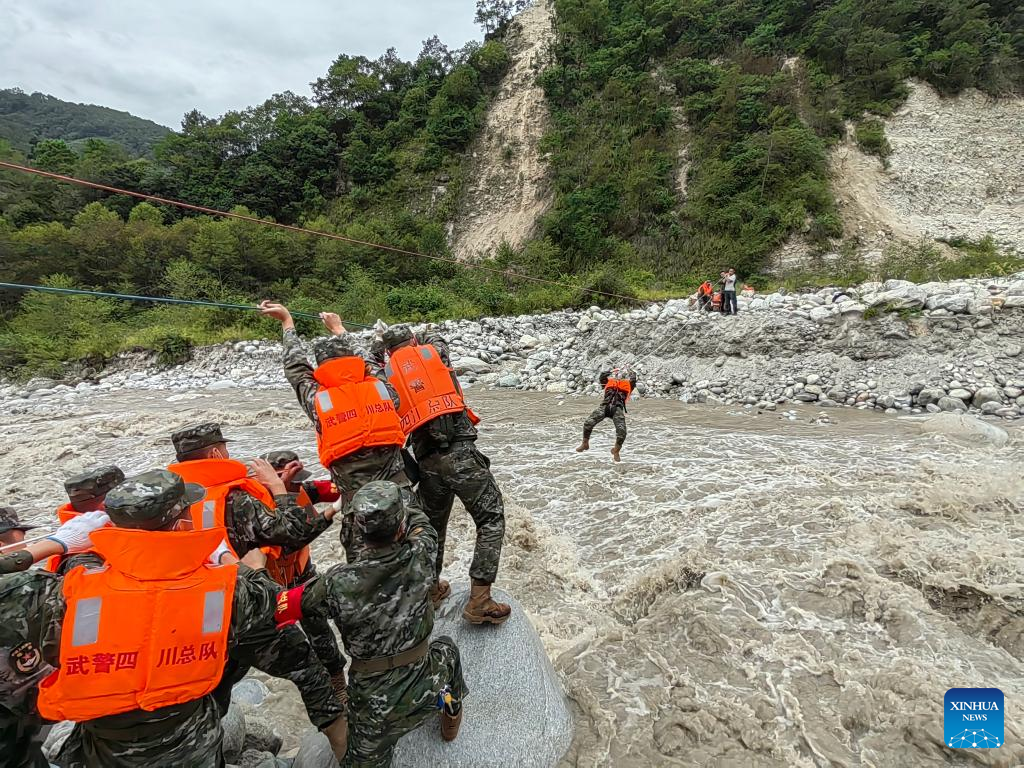
On September 5 at 12:52 local time, an earthquake measuring 6.8 on the Richter scale struck Luding County in Karze Tibetan Autonomous Prefecture of Sichuan province.
According to a Chinese press release, the epicenter was located at Moxi, 226 km from Chengdu, Sichuan’s capital and 43 km southeast of Kangding, the prefecture’s headquarters.
Official figures say that some 93 people died, while were 423 injured and more than 13,000 homes and other infrastructure were damaged or destroyed. It was the most severe earthquake in the area since 2017.
Sichuan is located in an extremely complex zone of seismic faults created by the collision of the Indian Plate with the Eurasian Plate and underthrusting continues till date.
The 2022 Earthquake
The rescue operations were very quick to reach the spot. The website China Military Online asserted that in the early afternoon on September 5, airborne troops, engineering and medical service personnel assigned to the 77th Group Army were ready: “At 18:10, a convoy of 28 vehicles and over 200 service members carrying rescue equipment …hurried to the quake-hit area. At 00:20 a.m. on September 6, they arrived at the epicenter. …At 07:40 a.m. [the same day], an engineering brigade dispatched over 200 service members and 28 vehicles loaded with tents and other living supplies to the quake-stricken area.” The arrival of military and civilian personnel continued on the war-footing during the following days.
Is the Earthquake linked to the development?
An important issue which needs to be studied by the Chinese authorities when they take stock of the disaster is the large-scale developmental activities taking place in this environmentally hyper-fragile area.
Hosts of photos published by the Chinese media show rescue teams rafting on the Dadu river, a tributary of the Yangtze River and one of the longest rivers in Sichuan. It means that the epicenter was nearby the river.
Let us remember that the Kangding earthquake in 1786 was due to a dam whose collapse caused a landslide on the Dadu river, resulting in the flooding of 1,400 kms downstream and killing some 100,000 people on the way.
Developmental activities
Today, the Dadu is being over-developed for the sake of hydroelectric power; according to Wikipedia: “As of March 2014, a total of 26 dams are completed, under construction or planned for the river.”
The Shuangjiangkou dam on the river will soon be the tallest in the world.
Under construction nearby is the Ya'an-Yecheng Expressway (also referred as the ‘Ya-ye’ Expressway) which will link Ya'an in Sichuan to Yecheng in Xinjiang, crossing over the entire Tibetan plateau; the section near Kangding is already functional.
To this should be added National Highway 318 (G318) which runs from Shanghai to Zhangmu on the China-Nepal border. It is the longest National Highway at 5,476 kilometres and it also passes through the area affected by the earthquake.
Further, the trickiest project undertaken by China: the Sichuan–Tibet railway which will run at high-speed to connect Chengdu and Lhasa, Tibet Autonomous Region’s capital. The 1,629 km-long line will cut the travel time between the two capitals from 48 to 13 hours.
Lu Chunfang, an academician of the Chinese Academy of Engineering admitted: “The Sichuan-Tibet Railway is a strategic project with many challenges, including a complicated geological structure, which will make construct extremely difficult, and a sensitive environment in the region."
In an interview to the The China Daily, Lu affirmed: “Upon completion, the Sichuan-Tibet Railway will cross eight mountains, and more than 93 percent of the line will consist of bridges and tunnels. The line will include six tunnels stretching more than 30 kilometers, with the longest tunnel 42 km.”
That is not all: when the Tibetan plateau was created by the collision between the Eurasian plate and the Indian subcontinent “an enormous amount of heat was trapped inside the elevated crust.”
As The South China Morning Post puts it: “A significant proportion of its route involves tunnelling through rock too hot for humans or machines to bear, with ground temperatures of up to 89 degrees Celsius.”
Further, the railway line will cross some 40 major fault lines.

Is there a link between these never-seen-before development activities and the Luding earthquake?
Only an honest scientific study will be able to determine the relation, if any, but as long as there is a doubt, the planners should think twice about what future they want for the region.
Interestingly, Li Zhanshu, member of the Standing Committee of the Politburo and Chairman of the Standing Committee of the National People's Congress visited Tibet from July 12 to 15, 2022 “for research on ecological protection legislation on the Qinghai-Tibet Plateau.”
During his visit, he stressed the need to have a legislation to protect the ecology of the Qinghai-Tibet Plateau: “The Qinghai-Tibet Plateau has a special ecological status and value, and plays an extremely important role in the national and even global ecological security," he said.
Li Zhanshu justified thus his visit on the plateau: the Qinghai-Tibet Plateau Ecological Protection Law will be a special regional protection law, but its significance and impact will reach far beyond the plateau to which the law will apply; he admitted that it is necessary “to have a big picture of the overall situation.”
But Li, who today ranks third in the Chinese Communist hierarchy and is currently on a ‘farewell’ visit to Russia, Mongolia, Nepal and South Korea, will retire in a few weeks.
Will his successor have the same determination to control the infrastructure lobbies and take the environment into consideration? It is not certain.
In the meantime, the recent events on the Dadu river have created a lot of anxiety in India which is aware of China’s plans to develop the Yarlung Tsangpo (known as Brahmaputra in India), as the proposed hydropower plants also lie on similar seismic faultlines.