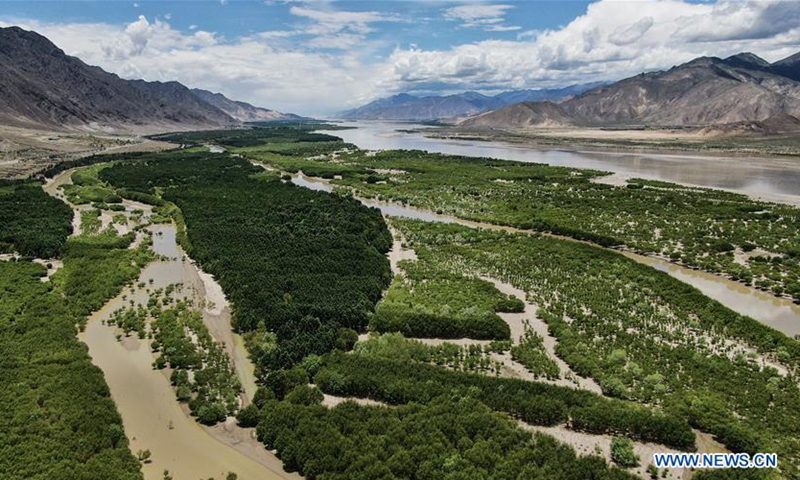
Showing posts with label Dams. Show all posts

Wednesday, December 2, 2020

The New Road and Hydropower Plant in Metok

Map of the new road to Metok and the possible route for the HHP
On October 13, an article appeared in the Chinese press which made me think that there was something big in the offing.
China Tibet News (in Chinese) reported that the Pai-Mo (Pe-Metok or Pai-Metok) Highway from Nyingchi to Metok would be opened on July 1, 2021. The travel time to Metok County would be shortened to 4.5 hours.
The Chinese website said: “On October 12, our reporter learned from the Huaneng Linzhi Hydropower Project Preparation Office that in order to effectively improve the current status of the transportation from Linzhi (Nyingchi) to Metok and to effectively improve the livelihood of the villages and towns along the route, the Pai-Metok Highway, planned to be completed on July 1, 2021.”
This immediately raised the question as to why a hydropower plant (HPP) company should build this road. One understands better now, that the construction of the HPP has been announced.

The mega hydropower project

Less than two months later, The Global Times announced China’s plan to build a large hydropower project on the Yarlung Tsangpo River, which becomes the Siang  and later the Brahmaputra in India.
The tabloid admitted that “it has raised concerns in India over potential political and ecological threats as the river passes through Southwest China, India and Bangladesh”, it however asserted that Chinese experts “refuted the claim that Chinese hydropower project have political aims, and said the project could help alleviate power shortage problem in northern India and boost regional economy.”
It is obviously propaganda.
The Metok County government confirmed that the project would be built in the County north of the McMahon Line. Other sources told The Global Time that “the project will be designed by the Chengdu Engineering Corp under the Power Construction Corp of China, or POWERCHINA. The Chengdu company is helping Metok to build the second highway entering the remote county, according to the company's official website.”
It is highway project mentioned above.
The mouthpiece of the Party added: “The head of POWERCHINA suggested the planned hydropower station - which is expected to have three times as much generating capacity as the world-leading Three Gorges power station - aims to maintain water resources and domestic security.”
The new road is clearly linked with the mega HPP. 

Entrance of the Doshong-la tunnel near Pai

The New Road
As for the new highway, the article quoted earlier spoke of total investment of about 2.015 billion yuan (US $ 330 millions): “The project will be completed by the end of September 2022. After the completion of the Pai-Metok Highway, the length of the road from Nyingchi City, through Bomi County to Metok County will be shortened from 346 kilometers to 180 kilometers and it will go through Jingpai Town; the driving time will be shortened from 11 hours to 4.5 hours. The traffic bottleneck in Metok will be greatly eased as well as the problem of difficulty in entering and leaving Metok.”
I mentioned the first route opening Metok to the world in 2013 on this blog.

The Pai-Metok Highway

Pai-Metok Highway will be constructed in four sections
The Highway starts in Pai Town in Mailing County and uses an extra-long tunnel to pass through the Doshong-la Mountain to a place called Songlinkou along the Doshong River, proceeding to Khanmi, Laohuzui and ending at the Jiefang Bridge in Metok County, a total length of 66.9 kilometers. It is difficult to locate these places, though Doshong-la is a well known pass in the area.
The construction is divided into four stages.
According to a responsible of the Huaneng Linzhi Hydropower Project Preparation Office, the Pai-Metok Highway is a major project sponsored by the Huaneng Group and a key livelihood project in Tibet.
The website of the China Huaneng company says that the company “is committed to building itself into a large enterprise group with international competitiveness. By the end of 2016, the Company had total installed capacity of 165GW, with assets distributed all over China and overseas. The Company is also engaged in sectors of coal, finance, technology R&D, and transportation etc. that support the core business of power. The Company was the first Chinese power producer to join the ranks of Fortune 500 Companies, ranking 217th in 2016.”
Though very few have heard about the second route to Metok, it appears that the construction of the project started on August 29, 2014.
The China Tibet News article explained: “This road passes through the Yarlung Tsangpo Grand Canyon and is built on the hiking route from Pai Township in Mailing County to Beibeng Township in Metok County. The road mainly follows uninhabited areas at “an altitude difference of more than 2,890 meters. The Pai-Metok is constructed in four sections: the first section starts at Pai Town and passes through the Doshong-la Mountain; the second section is from the exit of the Doshongla Tunnel and it proceeds to Gamajia; the third section is from Gamajia to Niqiao (Ani Bridge); the fourth section from Ani Bridge to Jiefang Bridge.”
The terminus is clearly Baibeng County (known as Drepung in Tibetan), close to the Indian border (Bishing in Upper Siang district of Arunachal Pradesh).
There is no doubt that the highway will be used for the construction.
China Tibet News gave some details: “During the construction process, only after the first and fourth sections are completed, will the second and third sections starts, depending of the construction conditions; the Pai-Metok Highway will constructed from Pai Town to Beibeng Township in Medog County.”
According to one of the persons responsible for the construction, the first section starting from Pai town is 13.615 kilometers long. The construction was started in August 2014. The 4,789-meter-long Doshungla Tunnel is the key project of this section. The construction started in December 2017, using a double-shield full-face hard rock tunneling machine (TBM).
The construction of the tunnel was completed at the end of 2018.

The second section
It runs from the exit of the Doshong-la Tunnel to Gamajia and it is 28.785 kilometers long; the construction started on November 10, 2018; on August 13, 2020, this section was finally completed. What remains to be finished are the drainage ditches, the culverts and the guard-rails;  this is scheduled to be completed by the end of December 2020.

The Third Section
The Gamajia Bridge-Ani Bridge section is 13.520 kilometers long. The construction started on October 15, 2019. It takes some 7.9 kilometers in the direction of Metok to reach the Laohuzui Tunnel which is being excavated. The tunnel itself with a length of 2,116 meters has started on May 1, 2020: “This section of the road passes through the Laohuzui cliffs and frequent geological disasters in the Grand Canyon, and the two-way construction conditions will be available after the second section is opened to traffic."
The Laohuzui Tunnel is the main difficulty of this section: “Strive to complete the Laohuzui Tunnel in July 2021 and complete the project in April 2022,” said the website.

The Forth Section

The section of the highway between the Ani Bridge and the Jiefang Bridge has a total length of 10.82 kilometers. The construction started on May 28, 2016: “After being affected by many unfavorable factors such as heavy rainfall, mudslides, slope collapse, the road was opened on October 29, 2018, and completed by the end of June 2019.”

Using double shield TBM construction technology
The main construction projects of Pai-Metok Highway are the Doshongla Tunnel (completed) and Laohuzui Tunnel (under construction). The website admits: “The construction of this highway is difficult and takes a long time. It is mainly affected by geological disasters such as heavy rain during the flood season, ice and snow in winter, landslides, mudslides, and avalanches.”
We could ask here, what about the mega hydropower plant, planned by the new Emperor of China? It is bound to be far more difficult, if it is to produce thrice the power of the Three Gorges Dam.
According to the road contractor: “Compared with other road construction projects, this road is difficult to build, with many people participating in the construction, and it takes longer. Since the construction started on August 29, 2014, more than 500 builders have struggled on this road for more than 6 years. It is necessary to overcome the impact of weather and natural disasters, and to reduce the problems due to the natural environment. The construction of the project has also adopted many new technologies and techniques.”
As mentioned, the Doshong-la tunnel sued a double shield tunnel boring machine (TBM). This technology was used for the first time in domestic road construction.

A Cascade of Hydropower Stations?
One can only presume, but the project will probably consist of a cascade of huge HPPs, each one evacuating the power produced towards the plateau ...and the Mainland (if it is not used to push the waters of the Yarlung Tsangpo towards Qinghai province and the Yellow River). This alternative has been worked into great details by Chinese engineer.

Present Conclusions
The article concluded by saying: “After completion, the Pai-Metok Highway will effectively increase the tourism promotion for the Grand Canyon and high-quality agricultural products (tea, matsutake [a highly sought mycorrhizal mushroom], [further] fully promote the rapid development of local tourism, commerce, agriculture and animal husbandry, and help Tibet to eliminate poverty and realize the self-sufficient economy. [The road] will make a positive contribution.”
It forgets to mention the mega hydropower station(s), with its tunnel(s) running parallel to the new highway. It seems sheared madness, in view of the fragility of the terrain and its high seismicity of the area.
The Emperor seems to have lost his mind.

For India, the first thing to do is to ask all the technical details of the HPP project to Beijing.

Highly Seismic Area

You may like to read this:

The Hidden Kingdom of Pemako ...hidden no more

or this 10 year-old article: 

A Giant Step towards the Mega-dam?

Saturday, February 22, 2020

No Losar in Tibet, but...

On February 11, Xinhua announced that the Tibetan New Year activities had been called off ‘amid virus outbreak’.
The news agency said: “Large-scale traditional religious activities during the Tibetan New Year, which falls on February 24 this year, will be suspended this year in Lhasa, capital of southwest China's Tibet Autonomous Region (TAR).”
The ‘Communist’ Buddhist Association of Lhasa explained that the decision had been proposed “by monasteries in the city and aimed to protect people's health and avoid the risk of cross-infection caused by gatherings.”
A small mercy: “Other religious activities such as praying for the Tibetan New Year will be held inside monasteries in Lhasa, but the time should be shortened and the scale downsized.”
Xinhua quoted Tsering, a resident in Lhasa: “We all know the novel coronavirus is highly infectious, and we understand the anti-virus measures.”
Who is this Tsering, nobody will ever know.
Incidentally, there was one confirmed case of novel coronavirus pneumonia in TAR and the patient has now been discharged with fanfare from a hospital in Lhasa; his face was blurred in the images published.

Dagu Dam in Lhoka

Double Standards
The decision to cancel Losar seems to be more a political choice, probably to avoid possible disturbances from the restive Tibetan population; it is worth noting that at the same time, China Tibet News, a website run by the Chinese Government announced that the construction of the Dagu Hydropower Station have started again.
Why double standards?
Located in Sangri County, Shanan (Lhoka) City, the Dagu Hydropower Station has an installed capacity of 660 Mw. The total investment is said to be 12.22 billion yuan (2 billion US $): “It is a major project supported by the central government for Tibet's economic and social development. At present, 5.6 billion yuan has been invested and 51% of the main body has been completed.”
China Tibet News said that “During the Spring Festival [Chinese New Year], 300 workers on duty on [near?] the site, have successfully returned to construction recently. …The construction site in the valley is busy; a large hydropower station begins to take shape.”
Dagu will be the third large hydropower station on the Yarlung Tsangpo (Brahmaputra in India) after Zangmu (510 Mws) and Gyatsa (360 Mws) in Lhoka area.
This obviously can’t wait for the stabilization of the virus epidemic.
But it is not all, the construction Lhasa-Nyingchi Railway continued in an orderly manner, said a Chinese website.
A photo of the “front-line workers speeding up the construction process in the deepest part of Mainling Tunnel,” appeared yesterday in Chinese media: “With a total length of 11,560m, Mainling tunnel of Lhasa-Nyingchi (nyintri in Tibetan) Railway is one of the key and difficult parts of the railway, and one of the tunnels with the most complicated geological conditions. According to a responsible person of the project, Mainling Tunnel is scheduled to be completed by the end of March, 2020. In order to ensure constructing process, currently, the construction workers are digging the last 60m of the tunnel.”
Mainling is located a few kilometers north of Arunachal Pradesh.
It appears that this project too can’t wait.
Xinhua also indicated that work will continue on other infrastructure projects in Tibet: “In the county of Sakya, a water project is in progress. With the biggest investment ever in Tibet's water project history, the project will help with irrigation, supply water, generate power and prevent flooding.”
The news agency continues: “Meanwhile, 1,881 workers in Tibet are doing their best to construct the Lhasa-Nyingchi railway. With a designed speed of 160 km/h, it will be the first electrified railway in Tibet.”
While there will be no New Year Celebration for the Tibetans for the Mouse-Year, work has resumed for the most important of the 179 projects (with an expected investment of 187.2 billion yuan – 30 billlon US $) planned in the Five-Year Plan.

Monday, June 12, 2017

Damming the Indus: 'hordes' of Chinese tourists will pour in to visit the 'last paradise on earth'

My article Damming the Indus: 'hordes' of Chinese tourists will pour in to visit the 'last paradise on earth' appeared in Mail Today/Mail Online

Here is the link...

On the occasion of the opening of the One Belt One Road (OBOR) forum in Beijing, President Xi Jinping urged countries across the globe to join hands with China in pursuit of globalisation: 'We have no intention to form a small group detrimental to stability. What we hope to create is a big family of harmonious co-existence.'
India has some doubts about the 'big family'. Take the example of the China- Pakistan Economic Corridor (CPEC), an OBOR's offshoot; it crosses Gilgit- Baltistan (GB), considered by India an integral part of Jammu & Kashmir.
Not only has China pushed Islamabad to make GB a fifth province of Pakistan, but according to CNN-News18.com, 'Information and interviews exclusively accessed by CNN-News18 showed that the land was procured mostly by force by Pakistani generals for the CPEC and those resisting are either killed off or incarcerated without a trial.'
Pakistan's Prime Minister Nawaz Sharif (L) shakes hands with China's President Xi Jinping, ahead of the Belt and Road Forum, in Beijing on May 13, 2017
Wajahat Hasan, chairman of the Gilgit-Baltistan Thinkers Forum, told the same channel: 'Thousands had their land snatched and occupied by the military authorities and their agencies.
'Under this black draconian rule, nobody can raise their voices against the CPEC.'

Issue
Another worrying issue: when Prime Minister Nawaz Sharif visited China to attend the forum, a memorandum of understanding (MoU) was signed to fund and build five mega hydroelectric power (HEP) projects.
The Pakistani press spoke of an Indus cascade of dams, two of them costing $27 billion (`17,000 crore), being located in GB.
The Pakistani newspaper, The Express Tribune, had earlier claimed that Pakistan and China would develop the North Indus River Cascade with an investment of $50 billion (`32,000 crore) to generate up to 40,000 MW hydro power.
According to Pakistan's Water and Power Development Authority (WAPDA), the Indus cascade will start from GB to reach the existing Tarbela dam downstream, not far from Islamabad.
At the MoU-signing ceremony, Nawaz Sharif affirmed: 'Development of the North Indus Cascade is a major focus of my government and the construction of Diamer-Basha Dam is the single most important initiative in this regard.'
He added, 'Water and food security are of paramount importance for Pakistan keeping in view the challenges posed by climate change.'
A 7,100 MW HEP project will be built at Bunji on the way to Skardu, the capital of Baltistan.
Though described by WAPDA as a run-of-the-river (RoR) project, it is clearly not one, as it will have a 22- km-long reservoir which will inundate 12- km of the road between Gilgit and Skardu.
The next dam is the Diamer-Basha HEP with a potential of 4,500 MW. The Diamer-Basha reservoir will submerge some 104 km of the Karakoram Highway and displace about 30,000 people, admits the WAPDA.
It will cost $15 billion(`965 crore). Both projects follow the Karakoram Highway in GB. Joydeep Gupta, a water expert, explained in a news portal: 'The Diamer- Basha dam is being promoted by WAPDA as a sediment trap and therefore good for downstream hydropower projects. But the same sediment — mainly silt — rejuvenates the soil downstream every year and has been the main reason why agriculture has been sustained in the Indus valley for millennia.'
But this does not bother the Pakistan politicians.

Projects
The other projects (the 4,320 MW Dasu HEP, the 2,200 MW Patan HEP, the 4,000 MW Thakot HEP using four headrace tunnels to divert waters and generate electricity) are located in Khyber Pakhtunkhwa province.
A 'lost' Saraswati river in the making? It has now been scientifically proved that big dams are not sustainable for several reasons; the first one being the amount of silt retained behind the dam, which stops nourishing downstream areas.
Interestingly, there is a movement in the United States to progressively decommission all large dams, which 'kills' the river, with many species of fishes unable to migrate upstream.
Another important factor is the strong 'dam lobby' in China which smells the billion dollars; it has been active since the time of Premier Li Peng and his mega Three Gorges dam.
Nepal too seems to have fallen prey to this lobby. Nepal's ministry of energy recently signed an MoU with China Gezhouba Group Corporation (CGGC) for the development of a 1,200 MW Budhigandaki HEP, which will be the biggest hydro project in Nepal.
The agreement was signed at the prime minister's residence, with the Chinese Ambassador to Nepal in attendance.
The dam will be built under the 'engineering, procurement, construction and finance' model. It means that CGGC will help arrange soft or commercial loans from China.

Warning
Already in August 2010, warning bells have been ringing in the corridors of South Block in Delhi.
The well-informed journalist, Selig Harrison, then wrote in The New York Times that according to 'a variety of foreign intelligence sources, Pakistani journalists and Pakistani human rights workers', two important new developments in Gilgit-Baltistan were taking place: 'a simmering rebellion against Pakistani rule and the influx of an estimated 7,000 to 11,000 soldiers of the People's Liberation Army'.
Tomorrow, tens of thousands of Chinese workers (17,000 for the Daimer-Basha HEP only) will come to GB; a decade or so later, when the work is completed, many will 'buy' land from Pakistan and settle for good in the area.
Further, China is bound to develop GB as a 'special' tourist destination (once the basic infrastructure is in place for the dams) and ultimately hordes of Chinese tourists will pour in to visit the 'last paradise on earth'.
How will India react? The time has perhaps come to think about this. Does Delhi want a China Town in Skardu or Gilgit? One of the solutions is to renegotiate the Indus-Water Treaty, signed in 1960 between India and Pakistan. With the latest developments, it seems completely outdated today.

Read more: http://www.dailymail.co.uk/indiahome/indianews/article-4591970/Damming-Indus-hordes-Chinese-tourists-visit.html#ixzz4jkNB4trV
Follow us: @MailOnline on Twitter | DailyMail on Facebook

Thursday, December 22, 2016

A new dam on the Brahmaputra

First picture of the construction of the Gyatsa hydropower plant
The construction of a second large dam on the Yarlung Tsangpo (which becomes the Siang and later the Brahmaputra in India) is well under way.
The dam is coming up at Gyatsa (Chinese Gyaca), a few kilometers downstream from the first dam at Zangmu.
In November 2014, the Indian Press mentioned the launching of the first unit of the run-of-river hydropower plant at Zangmu.
Xinhua then affirmed: “Tibet’s largest hydropower station became partly operational, harnessing the rich water resources of the Yarlung Zangbo (Tsangpo) River to develop the electricity-strapped region.”
The Zangmu hydropower plant, located at 3,300 meters above sea level, has a height of 116 metres for a length of 390 meter; it is 19 meter wide at the top and 76 meter wide at the bottom. The project is said to cost US $ 1.5 billion.
In 2014, Xinhua asserted that the entire project, which “straddles the middle reaches of the roaring Yarlung Tsangpo River, will have a total installed capacity of 510 megawatts upon completion”.
Liu Xiaoming, an official of the State Grid’s Tibet Electric Power Co said: “The hydropower station will solve Tibet’s power shortage, especially in the winter,” while Lobsang Gyaltsen, the head of the Tibetan Government in Lhasa affirmed: “The region has strived to protect the environment throughout construction. The hydro-plant is a good example of clean energy development.”
I then wrote: "Zangmu, the only hydro-power plant on the Yarlung Tsangpo, once completed, would probably be acceptable to India, but China plans to have a cascade of five other dams along the river at Jia Cha [Gyatsa], Lengda, Zhongda, Jie Xu and Lang Chen."

The Gyatsa Dam
The second large dam on the Yarlung Tsnagpo, has progressed very fast according the picture posted above.
According to Tibet Online: "The construction of hydropower energy is closely related to the overall development and will benefit the masses to a great extent. Tibet is rich in hydropower resources and has enormous development potential."
The Beijing-run website adds: "The construction of hydropower projects cannot only solve Tibet’s electricity problem, but also let the Qinghai-Tibet power network play a much great role as well as spare space for the local industrial development."
The website gives another piece of information: "In accordance with the water resources development plan of Sanjiangyuan region, by the end of the 13th Five Year Plan, the energy continuous base of 'West-East power transmission project' will be basically built in Tibet."
The Sanjiangyuan National Nature Reserve (SNNR) or Three Rivers Nature Reserve, is the area on the Tibetan Plateau where the Yellow River, the Yangtze River, and the Mekong Rivern have their sources. The SNNR has been established to 'protect' the headwaters of these three rivers. The reserve consists of 18 subareas, each containing three zones which are managed with differing degrees of strictness.
Does it mean, 'no more dams after 2020'?
It is very doubtful as in any case, the SNNR and the Yarlung Tsangpo basin are not located in the same area of the plateau.
However the power grid will probably be completed.
In all probability, the Gyatsa dam is of run-of-river dam with more or less the power-generating same capacity than the Zangmu dam.

Tuesday, August 9, 2016

The sorry state of affairs in Arunachal - A deadly cocktail

Two months ago, I wrote on this blog "The sorry state of affairs in Tawang - A deadly cocktail".
Today, I changed the title "The sorry state of affairs in Arunachal - A deadly cocktail."
The news just came in that Kalikho Pul, former Arunachal Chief Minister, was found dead at his residence in Itanagar.
It is a tragedy for the border State.
It is a tragedy for India,
One should not forget that the entire State of Arunachal Pradesh is today claimed by China.
Though Beijing claims part of Ladakh (J&K), Himachal Pradesh (near Shipki-la), Uttarakhand (Barahoti, etc), in the case of Arunachal, it is the entire State which is called 'Southern Tibet' by Beijing.
Dirty politics is happening everywhere, but when it happens in Arunachal, it has more serious implications for India.
In February, Pul had led a group of dissident MLAs from Congress against Chief Minister Nabam Tuki and after President’s Rule was revoked on February 19, Pul was sworn in as Chief Minister.
On July 13, a Constitution Bench of the Supreme Court quashed Arunachal Pradesh Governor J.P. Rajkhowa's decision to advance the Assembly session from January 14, 2016 to December 16, 2015, a move which had culminated in the declaration of President's rule on January 26. 
Subsequently, Pul had to resign as Chief Minister.

My article of June 2016
In March 2014, Arunachal Pradesh could have entered the Guinness Book of Records: eleven Congress candidates, including the chief Minister Nabam Tuki, were elected unopposed to the local 60-member Assembly.
Even some local BJP leaders ‘paved’ the way for the Congress candidates; for example Chief Minister Nabam Tuki was left without a rival in the Sagalee seat after his lone BJP rival Nabam Tade withdrew his nomination.
Among other Congress candidates elected unopposed were Rural Development Minister Tanga Byaling (Nacho) Tourism Minister Pema Khandu (Mukto in Tawang district), Parliamentary Secretary Nabam Rebia (Doimukh), former Minister Lombo Tayeng (Mebo), sitting MLAs Phurpa Tsering (Dirang), Punji Mara (Taliha), Bamang Felix (Nyapin) and Takam Pario (Palin), besides first-timer Mama Natung from Seppa West.
Was it a coincidence that ten out of eleven of these assembly seats were located in Arunachal West parliamentary constituency?
When one knows that the State is still claimed by China, this created quite an extraordinary situation, a deeply worrying one.
At that time, two words were whispered in the social media circles: ‘Dam Money’.
This came back to mind when early last month, two people, including a Buddhist monk, were killed after the police opened fire in Tawang district of Arunachal. Officially, the police fired at some anti-dam activists trying to barge into a police station demanding the release of a monk who had spearheaded the anti-dam campaign.
A few days later, Chief Minister Kalikho Pul rushed to Delhi to meet Union Home Minister Rajnath Singh to tell him that the situation had returned to normal after a peace committee was formed.
Very few believed him.
A few weeks before the tragedy, Kalikho Pul had been making a case for fast-tracking environmental clearances for hydropower projects.
He had spoken at the conference ‘Hydro power at crossroads – tapping the untapped’, organized by Associated Chambers of Commerce of India (ASSOCHAM), stating that hydropower would be developed in an optimal manner with the environmental impact and human displacement would be reduced to the absolute minimal.
He said that the 156 dams being planned would generate over 50,000 mega watts of power; he however admitted that “almost all projects are still in the planning stages and most are awaiting environmental clearances.”
While environmentalists and local communities argued that these dams would damage the environment, Pul affirmed that hydropower is “the only viable source for the resource strapped state which could provide sustainable means of livelihood.”
Many believe that it would only create ‘sustainable means of livelihood’ for the politicians …to be elected unopposed during the next elections.
Pul however promised that the opinion of the stakeholders would be taken into consideration.

Government to reconsider policies
The killing of the two persons forced the government to reconsider some of its policies; the first to pay the bill were the Tawang district’s Deputy Commissioner and Superintendent of Police who “failed to assess the situation.” They were suspended, along with the officer in-charge of Tawang police station.
They were made scapegoats.
Deputy Chief Minister Kameng Dolo announced that the officers had not only failed to assess the situation but also did not to take any preventive measures to diffuse the situation: “Prompt action has been initiated in order to defuse the situation, instill confidence among the people and restore normalcy in Tawang,” Dolo said in Itanagar.
But the situation in the border district, closely watched by the Chinese, is not that simple.

Other aspects of the issue
In an article Beneath the fissures, Jarpum Gamlin, the Editor of a local newspaper (and younger brother of former Chief Minister Jarbom Gamlin) wrote: “The agitations in Tawang are not merely a tussle between pro- and anti-dam campaigners. A closer look reveals a power play in the monastery”.
Gamlin explains that the district administration erred by detaining the monk-turned-activist Lama Lobsang Gyatso, general secretary of Save Mon Region Forum (SMRF) under a non-bailable section for the second time within 48 hours.
Gyatso had earlier led a protest against the six-megawatt Mukto Shakangchu hydel project; on April 28, he said to have done worse: he would have defamed Guru Rinpoche, the abbot of Tawang monastery. He was arrested on this charge.
Gamlin commented: “Amid the hullabaloo, word is out that three of the five secretaries at Tawang monastery are seeking the ouster of Guru Rinpoche; the two who support him are Lama Ngawang Tsering and Lama Dorjee Namgey. It is alleged that the rebel monks — Lama Lobsang Phuntsok, Lama Lobsang Thapkey and Lama Sang Leta — have been aiding Lama Lobsang’s campaign against the political and religious establishments.”
Another rumour was that Pema Khandu, son of former Chief Minister Dorjee Khandu, his brother Tsering Tashi and cousin Jambey Tashi who represent the three legislative assembly segments in Tawang district were deeply upset with the SMRF after it won a favourable verdict from the National Green Tribunal (NGT).
The April 7’s NGT decision probably precipitated the  events during the following weeks.
The NGT suspended the environment clearance granted by the Ministry of Environment and Forest for the Nyamjang chu hydropower project in Tawang’s Zemingthang area (the village is located close to the McMahon Line).
The permission to build the 780 MW hydroelectric plant was withdrawn due to the presence black-necked cranes, wintering in a 3-km stretch along the Nyamjang Chhu.
For over four years, the presence of the birds nearby the project area had been debated before the NGT. It appears that it is the first time that a single species has led to the suspension of such a project.
The black-necked crane is a five-foot tall bird, classified 'vulnerable', with only a decreasing world population of 11,000. While it breeds in the Tibetan plateau, it spends its winters in Bhutan and Arunachal Pradesh.
The Monpas consider the crane an incarnation of Tsangyang Gyatso, the poet-Sixth Dalai Lama, who was born in Tawang.
It is said the Seventh Dalai Lama was found by following the flight of a white crane after Tsangyang Gyatso passed away (‘White crane lend me your wings. I will not fly far. From Lithang I shall return’, wrote the poet).
Incidentally, the Nyamjang chu flows near the Thagla ridge which was the main bone of contention between India and China and the pretext for the Chinese treacherous attack on India in October 1962.

Dams plus religious rivalry, a deadly cocktail

A section of monks, followers of Lama Lobsang Gyatso, blamed Guru Rinpoche for the deadly firing incident and demanded his resignation.
The Indian Express quoted Lobsang Thapke, the secretary of the monastery saying: “A majority of the lamas (monks) in the monastery has demanded the resignation of Guru Tulku Rinpoche because they feel that he was equally responsible along with the police for the death of two persons.”
Thapke alleged that the abbot could have easily averted the tragedy had the latter asked the police to release Lama Gyatso.
Soon after, Guru Rinpoche resigned following ‘recent turns of events’ in Tawang. The Rinpoche said that he was so deeply hurt and shocked by the recent happening that he had to send his resignation to the Dalai Lama for acceptance “since he solely wishes to dedicate his time for peace, prayers and education of Buddhism and be fully devoted to the people of Mon region.”
To the surprise of all, the Dalai Lama recused himself from appointing a new Abbot for the Tawang Monastery.
In a letter circulated on the social media, the Tibetan leader addressed the Administration and the monks of Tawang Monastery: “I have appointed several Abbots to the Tawang Monastery,” he wrote.
The Dalai Lama continued: “The present Abbot, Guru Rinpoche, at the very young age studied at the Institute of Buddhist Dialectics, Dharamsala. After that he worked and served in my Office. I have selected a well-qualified person as the Abbot of Tawang Monastery. Yet, if there are people who are not satisfied with the Abbot's activities then I shall no longer appoint the Abbot to Tawang Monastery. Instead the Abbot will be directly appointed by the Sera Je Monastery."
It must have been quite a shock for the Monpa population. It is said that it is for the first time in the history of Tawang Monastery, since its inception in 17th Century, that the Abbot will not be appointed by the Dalai Lama.
Does this put the Dalai Lama’s visit to Tawang later this year in jeopardy?
Probably as the Tibetan leader would not like his presence used by the local politicians and clergy.

The Case of Tsona Rinpoche
Another issue is the mysterious death of Tsona Gontse Rinpoche (alias TGR or TG Rinpoche during his 'political' life). The Lama, who passed away in May 2014, had also taken an anti-dam posture.
At that time, The Times of India reported: “A 47-year-old Buddhist monk from Arunachal Pradesh allegedly committed suicide by hanging himself from a ceiling fan at his sister's house in Vasant Kunj in South Delhi.” The body of Rinpoche was found hanging from the ceiling fan by his sister.
Apparently a suicide note was found from a diary in the room. Rinpoche would have mentioned that he had committed too many sins and that even God would not forgive him.
The police suspected that he was depressed over the defeat of a cousin (another Rinpoche) in the 2014 Assembly elections.
I don’t know about the presumed sins of Rinpoche, but each time I met him, I found in Rinpoche one of the most dynamic young lamas of his generation.
He always wanted to give the Dharma a concrete shape. For him, Buddhism was not a mere philosophy; the Buddha’s teachings had to materialize in the present world.
Whenever I encountered him, Rinpoche had always a new project in mind and he had a capacity to concretely realize his plans.
Some twenty years ago, he organized a kar seva for the Gorsam Stupa, near the Thagla ridge close to the Indo-Tibet border, north of Tawang. He probably thought that the renovated stupa would have the inner power to stop another attack on India. It is indeed impressive.
Then he built a large monastery in Bomdila (where his body will be kept for a week). He also started a Buddhist University, funded by the Ministry of Culture in a lovely environment near Tenga in Arunachal Pradesh.
He was building a huge statue of Tara in Lumla (also north of Tawang), near the Bhutanese border where he had a monastery.
The last time I met him in Delhi, Rinpoche planned to bring the ‘relics’ of the Buddha to Tawang. He had just met the Indian Minister of Culture who had promised to help him. I think that eventually succeeded.
He gave me a lecture on his new ‘baby’, the Sherab Sangpo Society and the concept of ‘Noble Wisdom’.
Rinpoche had become a great defender of the environment (after looking himself after hydropower issues as a minister in the Government of Arunachal).
I could not figure out is why he took the ultimate step. Suicide does not figure anywhere in Buddhist culture; the concept of sin neither.
Tsona, Rinpoche's main monastery is located in Southern Tibet, north of the McMahon line. Rinpoche always remained a strong Indian nationalist. His demise is indeed a great loss for the Monpa people of Tawang and for the Buddhist world.
The Chinese would certainly be delighted to find his reincarnation first. For Beijing, it would be a formidable card to claim Tawang again.

Beijing's interests
Beijing is indeed interested by the messy situation in Tawang.
The 16th ‘Meet in Beijing Arts Festival’ saw the launch of the dance drama "Tsangyang Gyatso," written by Li Cangsang, a Chinese composer who wrote the music for the drama.
As already mentioned, the Sixth Dalai Lama was born in Tawang.
China Tibet News quotes Li saying: “He was a real person yearning for an ordinary life. The combination of the characters of the Buddha, of the ordinary people and Tibetan music, was the most difficult part of my work."
The drama performed at the National Center for the Performing Art in Beijing is based on Tsangyang’s poems and life story.
Even if Beijing is not interested to talk to the Fourteenth, the Communist government is clearly keen to keep the legacy of the Sixth Dalai Lama alive; it is a way to reinforce their claim on Tawang.
The latest happenings in the border district are indeed worrisome.
Today Beijing is gleefully watching the situation deteriorate, waiting to ‘recognize’ not only the next Tsona Rinpoche, but also Tsangyang Gyaltso’s reincarnation.
Delhi should not play with fire by pushing for unwanted hydropower plants so close to the border knowing that it will stir local quarrels further?

Monday, February 23, 2015

Trading Happiness for Watts and Climate Change

As many Himalayans celebrate their New Year (Wood-Sheep), the time has come to ponder on the future of the mighty mountain range.
A few weeks ago, The Energy and Resources Institute (TERI) hosted in New Delhi its annual event, it was the 15th edition of the 'Delhi Sustainable Development Summit' (DSDS). A TERI press release says:
The dawn of a new era in the global development arena is almost here. After 15 years of the Millennium Development Goals (MDGs), the Sustainable Development Goals (SDGs) are set to take over. At present, there is a global imperative as well as an opportunity for a more inclusive approach towards development, design and practice. DSDS 2015, themed on 'Sustainable Development Goals and Dealing with Climate Change', will focus on issues related to sustainable development, environment and energy access and security, and is expected to assess worldwide progress on critical issues pertaining to the SDGs, tackling climate change and reducing our carbon footprint, among other issues.
Apart from the grandiose declarations, nothing much seems to have been concretely decided, though climate is changing fast, very fast and the Himalaya will be the first to take the brunt of the future unfortunate changes. 
Every day, unseen-earlier events occur.
Take the blockage of the Phutkal river in Zanskar Valley in Kargil District of Jammu & Kashmir.
For the past 2 month, the Phuktal river, one of the tributaries of the Zanskar River has been blocked by a massive 200 ft high landslide ‒ equal to height of a 20-storey building. The landslide has created a lake, about 8 km long; its size is said to be increasing by the day.
The media reported: “The landslide dam is made of mostly fine-grained debris. While the lake is frozen right now, the threat of it breaching the dam is highly possible as soon as the melting season starts. The landslide dam was created on December 31, when a whole side of mountain soil landed on the Phuktal river. The landslide lake has been accumulating water.”
The situation is so serious that the National Crisis Management Committee (NCMC) met on Feb 20, 2015 (under the chairmanship of the Union Cabinet Secretary Ajit Seth) to take stock of the situation; it approved an Action Plan which will be implemented within the next 15 days; it has to be completed by end of March (as the snowmelt may cause the landslide dam to threaten the villages downstream in April).
According to the Action Plan, the following steps will be taken:
  • A temporary helipad and a control room would be set up near the landslide, equiped with satellite phones
  • Snow clearance of over 40 km of road from Padum to Purne, treking for about 43 km from Purne to the site of landslide
  • Installation of flow monitoring equipment by Union Water Resources Ministry
  • Satellite monitoring of the landslide is being done and data is being collected on daily/ hourly basis.
  • Action Plan will involve integrated efforts from the State and Central Government agencies including Central Water Commission, Survey of India, Central Institute of Mining and Fuel Research, Snow and Avalanche Study Establishment, National Remote Sensing Centre, NHPC, Survey of India, BRO, Army and Air Force.
  • A rehabilitation plan to ensure safety of life and property of the inhabitants.
Let us hope for the best. It is however necessary to ponder at the earliest about the future of the Himalaya and its populations.

Punasangchu Hydropower Project I
Another example: Bhutan, the Land of Happiness
How long the Kingdom of the Dragon will remain happy?
Probably not for long, in view of the developments taking place in Bhutan.
On the occasion of the Bhutanese (and Himalayan) New Year, Yeshey Dorji, a Bhutanese photographer and blogger (Bhutan Land Of The Thunder Dragon) spoke about ‘his wish’ for the Wood-Sheep Year. He wrote:

I WISH that the two governments of Bhutan and India would get together and take the only sensible decision they can - a decision to abandon the Punasangchu Hydropower Projects.
In his interview to the Kuensel of 21st September, 2013, Dasho Chhewang Rinzin of Druk Green Power Corporation has said that ‘indecision’ in the case of Punasangchu Hydropower Project I should be avoided. I would like to go one step further and add that ‘correct decision’ is even more important, than a hasty incorrect decision. And, in the face of what is increasingly becoming obvious that the geographical surprises that are being thrown up in the Punasangchu I & II project areas are insurmountable, the only correct decision, in my view, is to cut our losses and scrap the projects entirely!
Is this a preposterous idea? Not if you consider that given all the ‘geographical surprises’ that are being ‘discovered’ in the project areas, there is every likelihood that the Punasangchu Project I & II may eventually end up in the Bay of Bengal.
What then?
The gravity of the situation cannot escape any one - if one considers that the final cost of the two projects will be 3-4 times bigger than the country’s entire GDP. If these two projects fail, Bhutan can never recover from the ensuing debt!
Apparently, it is not just the Punasangchu I: Kuensel also reported in their April 16, 2014 issue that even Punasangchu II is faced with ‘geographical surprises’! To add to all that, Kuensel on 5th February, 2015 reported that the projects are now running out of budget!
Even if the two governments do not agree to scrap the Punasangchu projects, they should accept that WAPCOS (consultants to all the hydropower projects in Bhutan) has proven to be anything but competent to undertake any further investigations in the case of these or future hydropower projects in Bhutan. Thus, while we must ensure that WAPCOS is barred from future involvement in our hydro power projects based on their terrible record so far, we should now look at engaging consultants from third countries to investigate if the geographical make of the Punasangchu areas is suitable for large hydro power projects. Through the engagement of better-qualified consultants, we should ascertain whether it is wise to continue with the projects - or scrap it, to prevent further losses. If the government of India has the best interest of the projects at heart, they should agree to a second opinion from an independent consultant from a third country.
The Punasangchu Hydro Power Project I started with an initial cost estimate of Nu. 35.00 billion, in 2006. By 2013, the cost had escalated to Nu. 98.00 billion - almost three times the initial estimate [one nu equals one rupee].
The project was supposed to be completed by 2015. Latest date of project completion is now deferred to 2016. Regardless, if past records are anything to go by, we can be sure that the project will not be completed even by the end of 2018. And, in all likelihood, the cost will escalate to over Nu. 120 billion.
In my view the project is no longer economically viable. No one can convince me that a project that has seen cost escalation almost four times its original projection - can still be considered feasible and profitable.
The famous cost + pricing concept is no consolation at all. Have we considered the likelihood that the Indian state electricity boards that purchase our electricity may at some point turn around and tell us that the unit cost of our electricity is too high for them to purchase and redistribute to their consumers? This is most likely to happen - given that our cost of production has gone up so high. What then?
…The Bhutanese people have long been mislead into believing that the hydropower projects will make all of us rich.
Scrapping or not scrapping is a difficult decision to take, but one thing is sure, it is not worth ‘scraping’ happiness for a few megawatts more.
And as the cases of the Phutkal and the Punasangchu rivers show, the mighty Himalaya is an extremely fragile entity.
Next year, before starting their 'high' deliberations, the participants of the 16th edition of the 'Delhi Sustainable Development Summit' should be taken for a trek in the Himalaya and see for themselves the precarious situation in the remote valleys.
Their declarations will perhaps be less pompous and have the value of 'experience'.

Monday, February 16, 2015

Dreadful Cascade on the Yalong River

Cascade of dams on the Yalong
A couple of days ago, Xinhua reported that a ‘New hydropower station in SW China gets hefty loans'.
This is ominous.
It appears that after a few years recess period, the ‘cascade’ frenzy of large hydropower plants on Tibetan river is on track again.
Xinhua says: “A hydropower station planned for southwest China's Sichuan Province received 53 billion yuan (about 8.5 billion U.S. dollars) in loans from seven domestic financial institutions.”
According to the Chinese news agency: “The planned hydropower station, in the middle reaches of the Yalong River in Sichuan's Garze Tibetan autonomous prefecture, will have an installed generating capacity of 3 million kilowatts with a total reservoir capacity of 10.8 billion cubic meters.”
It is a big, very big dam at a time mega-dams are decommissioned elsewhere in the world.
Chen Yunhua, president of Yalong River Hydropower Development Co. Ltd, the project's developer, explained: “Construction will cost about 66.5 billion yuan and the loan agreement, signed in Chengdu; [it] covers about 80 percent of the total. …The seven lenders are China Construction Bank, Industrial and Commercial Bank of China, Postal Savings Bank of China, Agricultural Bank of China, China Development Bank, Bank of China and Bank of Communications. They will provide long term, low-interest loans to support the project.”
It will be the largest powerplant on the Tibetan plateau; it is expected to start producing electricity by the end of 2021 and it should be completed in 2023 (Chinese companies usually complete their tasks on time, not like in India).
Chen affirmed that the project will “transform the river's hydropower resources into a new driving force for the regional economy and generate clean energy to fuel southwestern and eastern China.”
But it will probably destroy the Yalong river forever.
Though the name of the dam is not mentioned in the Xinhua release, it is clear that it refers to the Lianghekou Dam ("mouth of two rivers"), a concrete-face rock-fill dam on the Yalong River.
The Yalong originates in Qinghai Province, passes through Sichuan, and
joins the Jinsha (Yangtze) River.
  • Length: 1,571km
  • Natural head: 3,830m
  • Catchment area: 136,000km2
  • Annual runoff: 61 billion m3

The Lianghekou Dam is located at the confluence of the Yalong, Xianshui and Qingda Rivers. With its 295 m height, it will be the highest embankment dam in China and the power station should produce 3,000 MW.
Studies for the dam were completed between 2005 and 2009 with preliminary construction beginning soon after. However the ‘official’ construction only started in October 2014.
According to Chen, 21 cascade projects are planned on the Yalong river; their ‘technical developable capacity’ is 30,000 MW, (representing 24% of the capacity of Sichuan or 5% of China).
It will rank 3rd among China’s 13 ‘hydropower bases’.
Chen made the following points:
•    Hydropower development of the Yalong River is already in an expedited stage.
•    Key technical issues have been basically resolved.
•    An optimized pattern for joint operation of multiple stations is gradually taking shape.
•    Design and control of high earth-core rockfill dams will become the focus of further research.
Does it mean that the researches have not been completed?
The local populations have of course not been consulted ('Only' 4,900 people will be forcefully displaced).
Today, the Editorial of The South China Morning Post is consecrated to China's new environment chief, Chen Jining.
The Hong Kong daily says: “It is easy to assume that if no one - be it a high or low official - is beyond the reach of mainland graft-busters, then serial polluters should not present too much of a problem to environmental authorities. Sadly, nothing could be further from the truth. The latter may have the law on their side and, supposedly, the clout of a fully fledged ministry in recent years. But the mainland is almost as well-known for potentially calamitous degradation of its environment as for the breakneck pace of economic growth responsible for it. This is because serious air, water and soil pollution has accrued over decades, economic growth still gets higher priority and responsibility for protecting the environment is divided among various government departments.”
Don’t you think that the ‘cascade of dams’ is also a ‘serial killer’?

Monday, January 26, 2015

The Tibetan blues

My book review of Meltdown in Tibet by Michael Buckley (PanMacmillan), entitled The Tibetan blues appeared yesterday in the Sunday Pioneer (Agenda) .


Here is the link...

This well-documented work delves deep into issues which are bound to get hotter with time, writes CLAUDE ARPI

André Malraux, the famous French Philosopher and General de Gaulle’s Culture Minister once said, ‘The 21st century will be spiritual or will not be’. Without denying the role that spirituality can play in the present planetary crisis, it is obvious that if the world leaders do not rapidly take some drastic actions to solve the planet’s environmental issues, annihilation will befall upon humanity by the end of the current century.
Michael Buckley’s, Meltdown in Tibet, delves deep into these burning issues. His well-documented work deals with topics which are bound to be hotter as the years pass by. Buckley says that he isn’t a scholar who analyses problems from air conditioned rooms, he sees himself more as an adventurer. The Canadian environmentalist has extensively travelled on the Asian roads, more particularly in the Himalayas and the Roof of the World where he witnessed the changes brought about by the wild development of modern China. He is an Asia-trotter, having spent most of his time in our continent, particularly in Tibet. His book, Heartlands: Travels in the Tibetan World had earned him the Lowell Thomas Travel Journalism Award.
He is also a keen rafter and points his finger towards the Tibetan plateau: “Glance at a physical map of the Tibetan Plateau and you will see why the rivers of Tibet are so important to southeast Asia and the Indian subcontinent. The Tibetan plateau is the source of the major rivers of this vast region, stretching all the way from the coast of China in the east to Pakistan in the west. Ninety per cent of the run-off from Tibetan rivers flows downstream into China, Vietnam, Cambodia, Laos, Thailand, India, Nepal etc. At the tail-end of those same rivers lie the world’s largest deltas...close to two billion people rely on Tibet’s waters-for drinking, for agriculture, for fishing, for industry.”
The first lines of Meltdown in Tibet accurately highlight our century’s vital issues: the fate of more than half of humanity depends on the waters from Tibet. Speaking about the water situation in China, Xinhua recently admitted a ‘domino effect on water supply’. The Chinese news agency was commenting on the first comprehensive study of China’s glaciers which proves that on an average, 244 sq km of glaciers disappear every year. The Chinese glaciologists “had warned of ‘chain effects’ that could have an impact on water supplies in the country’s western regions” …and one should add, on India.
The figures come from the survey conducted by the Chinese Academy of Sciences, which found, “China had 48,571 glaciers in its western provinces, including the Tibetan regions of Xinjiang, Qinghai, Sichuan and Gansu provinces.” This is indeed not encouraging news, but despite the impending shortage of water in the long-term, China continues to dam rivers originating from the Third Pole; Buckley explains this terminology: “Outside of the Arctic and Antarctic, the Tibetan Plateau has the largest store of ice on earth, leading to its designation as the ‘Third Pole’. …In terms of human impact, however, meltdown of Tibetan Plateau glaciers will have far greater repercussions.” Even the Chinese scientists agree that there is far less scientific data available on the Third Pole than on the Arctic and Antarctic .
An interesting feature of Buckley’s book is that the author links different issues which are not correlated at first sight. When he speaks about the ‘Crisis at the Third Pole’, he asks, ‘What does a rain of black soot have to do with this?’ He himself answers the question: “There is no doubt that greatly elevated CO2 emissions from both China and India are leading causes of warming on the Tibetan Plateau. But for glacial meltdown, another significant factor may be the rain of black soot...Lumps of coal burned in households in China result in a tremendous output of black carbon, or soot, also referred to as black soot. …Black carbon from cities in both India and China travels on air currents and gets trapped on the Tibetan Plateau.”
That is not all, the carbon particle, being black, absorbs the heat from the sun “both while floating in an air column or once settled on the ground — or the ice”. Everyone has experienced that wearing white clothes in summer is cool, as white reflects the light (and the heat) but if you have a black shirt, you will soon feel the heat. Scientists say that when the sun’s rays hit the earth, a certain percentage of the energy is reflected back into space. The amount of radiation reflected is called, the albedo. The sun’s energy at the poles reflects more rays (and heat), it has a high albedo. The more ‘black’ particles and the less snow and glaciers, the faster the earth will warm up with incalculable consequences for the small humans living on it. It triggers a vast exponential domino effect.
'We have only one Tibet'
Chapter after chapter, Buckley enlightens us on the ‘Ecocide on the Land of Snows’; on why Tibet matters so much today; on the fate of the mighty rivers of Tibet and their damming (‘What on earth are China’s engineers up to?’); on China’s appetite for energy (‘Where is the thirsty dragon going to guzzle next’); on the fate of the nomads parked in new ghettos (‘Vanishing Nomads, Vanishing Grasslands’) or Plundering the Treasure House (‘How much can an ecosystem take before it collapses?’). He believes that Beijing’s water policies dictated by their new godhead, i.e. ‘Development’, will lead Asia to natural disasters.
In the chapter ‘Downstream Blues’, he mentions the consequences of the Third Pole’s environmental degradation for India and the possibility of a Himalayan Water War (if the Brahmaputra is diverted, for example). At the end, the author asks a vital question, valid not only for China (Tibet), but for India, Bangladesh or Pakistan too: “Why can’t they just leave the rivers alone?” It’s a difficult question, because development is today a ‘must’ for most modern states.
Is there a way out? A middle path? Buckley does not provide an answer, except mentioning the importance of trans-boundary collaboration. He rightly says: “Water, not oil, is now becoming the world’s most important resource. Though we live on a planet covered by water, very little of it is accessible.” The fate of the 21st century will indeed depend on water; spirituality could perhaps help in bringing some wisdom into humans’ brains and hearts, though it may soon be too late; as the Dalai Lama says in his preface: “We only have one Tibet. There are no backups.”

Saturday, January 24, 2015

China: more and more dams in Tibet

A few weeks ago, I questioned the real objective of the newly launched Sichuan-Tibet electricity grid.
Was the purpose to bring electricity from the mainland to Tibet or vice-versa?
At that time, the Chinese press said that the purpose was the former.
Now China Tibet Online speaks of a "Breakthrough in outward power transmission from Tibet".
What does it mean?
It signifies more and more dams will be required in the future ...to feed the outward power transmission and some of these dams will be built on the Yarlung Tsangpo-Brahmaputra.
Chinanews.com announced: "Tibet Autonomous Region is expected to see a breakthrough in outward electric power transmission this summer."
It quotes the Tibet Electric Power Company Limited, to say: "when the three power stations in Dzam [Zangmu?], Dondup [Pangduo?] and Guoduo [located on the upper reaches of the Mekong River in Tserwe Township] are put into operation,Tibet will begin transmitting electricity to other provinces for the first time. This will be achieved with the help of Sichuan-Tibet Power Grid and Qinghai-Tibet DC Networking Project."
It is not what China was saying a few weeks ago:
Xinhua reported that the opening of the 1.08 billion U.S. dollar project linking Chamdo in the TAR and the Tibetan Autonomous Prefecture of Garze in Sichuan Province, aims at "putting an end to the electricity shortages of the 500,000 residents of the Chamdo region and ease power strain in Tibet as a whole".
Now, the Chinese website admits: "The two lines will increase Tibet’s outward power transmission capacities to 350,000 and 20,000 kilowatts, or 1 billion and 600 million kilowatt hours a year respectively."
Beijing has invested a lot of money in the project: the Sichuan-Tibet Power Grid and Qinghai-Tibet DC Networking Project cost 4.6 billion US dollars. It was part of the 12th Five-year Plan Period (2011-2015).
China Tibet Online affirms: "Together with the Central Tibet Power Grid and Chamdo Power Grid, the two lines will certainly ease local power shortages and boost economic development in eastern Tibet. It is believed that the power grids in Tibet will cover 58 counties and benefit 2.18 million local residents by the end of the year."
Now comes the most telling part:
The foundation work for outward power transmission will be advanced steadily in 2015 by accelerating hydroelectric development in the middle section of the Yarlung Zangbo River [Brahmaputra], said Losang Jamcan [Lobsang Gyatsen], chairman of Tibet's regional government during the Third Session of the Tenth Tibet People's Congress.
Investment in power grid construction in Tibet is predicted to hit a record 60 billion yuan (9.7 billion US dollars) in the 13th Five-year Plan Period. By 2020 Tibet can bid farewell to the history of its power shortage and realize large-scale outward power transmission. The capacities in 2020, 2025 and 2035 will reach 20 million, 40 million and 110 million kilowatts respectively, industry analysts said.
In 2015, China will be "accelerating hydroelectric development in the middle section of the Yarlung Zangbo River."
The conclusion of the website was "Tibet is abundant in water power resources and will serve as an important energy base for the west-east electricity transmission project."
In other words, more and more dams will be built in Tibet ...to feed electricity to China. It will have serious consequences for India and Bangladesh.

Monday, November 24, 2014

Is the Zangmu dam 'clean'?

The Zangmu hydropower plant
This is in continuation to my previous post on the new electricity grid recently launched between Chamdo and Sichuan.
I raised the question: once the dams on the Brahmaputra are complete, will this (grid) investment be used to send electricity from Tibet to Sichuan or vice-versa.
We shall know soon, as the first run-of-river hydropower plant at Zangmu on the Yarlung Tsangpo, (which becomes the Siang and later on the Brahmaputra), is now operational.
Xinhua announced yesterday: "Tibet's largest hydropower station became partly operational, harnessing the rich water resources of the Yarlung Zangbo [Tsangpo] River to develop the electricity-strapped region."
It is the first generating unit of the  Zangmu Hydropower Station (costing 1.5 billion U.S. dollars). The project is located at 3,300 meters above sea level.
Xinhua says that "five other generating units are due for completion no later than next year", adding "the huge project, which straddles the middle reaches of the roaring Yarlung Tsangpo River, will have a total installed capacity of 510,000 kilowatts [510 Mws] upon completion. It is designed to generate 2.5 billion kilowatt hours of electricity annually."
According to Chinese official statistics, Tibet's per capita electricity consumption in 2013 was slightly over 1,000 kilowatt hours, less than one third of the national average.
Will the entire production of electricity of the 5 'officially' planned dams on the Tsangpo be used on the Tibetan plateau or will it be sent to the mainland?
The official news agency is obviously mum on the subject, though Liu Xiaoming, an official of the State Grid's Tibet Electric Power Co affirms: "The hydropower station will solve Tibet's power shortage, especially in the winter."
Tibet's Development and Reform Commission (local Planning Commission) asserts that "the region's installed power generating capacity was 1.48 million kilowatts.Tibet has annual water resources totaling 448.2 billion cubic meters, with potential water power resources reaching 201.36 million kilowatts. It holds nearly 30 percent of the nation's total water power resources."
It is a boon or a curse for the Roof of the World?
And what about the environment?
Though Lobsang Gyaltsen, the head of the Tibetan government declared: "The region has strived to protect the environment throughout construction. The hydroplant is a good example of clean energy development," run-of-river plants are not today considered 'clean' anymore.
There is no doubt that the life of the river between the 'intake' of the diversion and the power station downstream will be badly affected. 
One has recently seen the negative consequences of the 'run-of-river' plants in Uttarakhand (see my post, Dam is money, dam is destruction too).

Sketch showing the principle of
a run-of-river hydropower plant.
What happens to the life of the river
between the intake and the power house?
The Xinhua communique affirms: "A total of 320 million yuan has been invested in the Zangmu hydroplant project to build environmental friendly facilities such as sewage treatment plants, garbage recycling stations and fish protection stations."
Will China let environmentalists visit the site and study the state of the river before the diversion and after the power station?
I doubt.
According to Bo Lunzhang, an official of the regional environmental protection bureau. "The Yarlung Tsangpo River requires much higher protection standard than any other rivers in China, and the experience of Zangmu station may be learnt by other hydropower projects in Tibet."
China may learn from the Zangmu experience, but run-of-river plants elsewhere in India and the world have been very damaging for the environment (the aquatic life of the river for example).
Will the waters entering Upper Siang district of Arunachal Pradesh be different now?
India should carefully and scientifically monitor, not only the flow of the Siang, but also the quality of the water.
Article 12 of the 'Implementation Plan' signed in June 2014 between Indian and China for providing 'Hydrological Information of the Yarlung Zangbu/ Brahmaputra River in Flood Season by China to India' says: "In order to ensure normal provision of hydrological information, if necessary, after mutual consultation through diplomatic channel, the parties may dispatch hydrological experts to each other’s country to conduct study tour according to the principle of reciprocity."
Why can't Delhi ask Beijing's permission to send a team of hydrological experts to visit the dam and get some clarity on what is going on?

Friday, November 21, 2014

Power from the mainland to Roof of the World

Xinhua has just announced that the Tibet-Sichuan grid is now functional.
The launching ceremony was chaired by Yu Zhengsheng, Chairman of the Chinese People's Political Consultative Conference (CPPCC), who declared operational the power lines linking the Tibet Autonomous Region (TAR) to Sichuan Province.
The function was held  in Beijing.
Xinhua reported that the opening of the 1.08 billion U.S. dollar project linking Chamdo in the TAR and the Tibetan Autonomous Prefecture of Garze in Sichuan Province, aims at "putting an end to the electricity shortages of the 500,000 residents of the Chamdo region and ease power strain in Tibet as a whole".
The news agency further explained: "The complex interconnection circuits stretch 1,521 kilometers across the plateau at an average altitude of 3,850 meters and its construction involved more than 20,000 staff over eight months, according to the State Grid Corporation of China."
Before the official launch, Yu inspected the power 'dispatching center' at the State Grid's headquarters where he met workers and engineers involved in a grid construction.
He was accompanied by Chen Quanglo, the TAR's Party Secretary.
The billion-yuan question is: will this investment still be used to send electricity from Tibet to Sichuan or vice-versa, once the dams on the Brahmaputra are complete.

According to China Environment Forum of the Wilson Centre in the US:
The West - East Electricity Transfer Project, initiated in the Tenth Five-Year Plan (2000-2005), was designed to bring investment and development to China’s lagging west while satisfying the growing electricity needs of the country’s eastern provinces. The project’s first phase has been and is continuing to expand the western provinces’ electricity-generating capacity, primarily through the construction of new coal bases and hydroelectric dams.The project’s second, ongoing component is the construction of three electricity-transmission corridors, which are essentially three vast networks of electrical transmission lines that connect newly built generation capacity in the North, Central and South to China’s electricity-hungry coast (see arrows on map). Each of the corridors is expected to exceed 40 gigawatts (GW) in capacity by 2020—a combined capacity equivalent to 60 Hoover Dams. The seven recipient provinces — Beijing, Tianjin, Hebei, Shanghai, Zhejiang, Jiangsu, and Guangdong — together consume nearly 40 percent of China’s electricity.
A few pictures of the grid and the function.