Showing posts with label Tsangyang Gyatso. Show all posts

Tuesday, March 2, 2021

An Indian Dalai Lama

Urgyeling, the birthplace of the Sixth Dalai Lama

My article An Indian Dalai Lama appeared in Rediff.com

Here is the link...

Tawang is very much a part of India, and if the present Dalai Lama decides one day to take rebirth in Tawang, the Indian government will openly welcome him and support him, notes Claude Arpi.


In January 1951, a few months after the invasion of Tibet and sensing a threat from China, the then Assam Governor Jairamdas Daulatram ordered a young Naga officer to march to Tawang and start adminstrating the area.
On February 9, 1951, Maj Ralengnao (Bob) Khathing, accompanied by 200 troops of 5 Assam Rifles and 600 porters, arrived in Tawang in the then Kameng Frontier Division of the North-East Frontier Agency.
A month earlier, Bob had left the foothills on his historic mission. A few days after his arrival, he selected a high-ground near the Tawang Monastery for meeting the Dzongpens, the Commissioners from Tsona in Tibet and the village elders. Bob walked to the place, while 100 riflemen encircled the ground. The Assistant Political officer (this was Khathing’s designation) instructed his second in-command to ‘fix bayonet’: “One hundred click sounds of bayonets coming in unison seemed to say, we are even ready for blood,” wrote his biographer; then Bob spoke to the people about the Indian nation.
Thereafter, everything went smoothly. In fact the Monpas were delighted by Khathing’s arrival.
On February 14, 70 years after the momentous event, several dignitaries celebrated this ‘true hero of independent India’ and Arunachal Pradesh Governor Brig (Retd.) BD Mishra laid the foundation stone of a memorial for him at Tawang. 

The Master of Poetry
Another hero of Monyul, the land of Monpas, located south of the McMahon Line is Tsangyang Gyalsto, the Sixth Dalai Lama who is hardly known in India today.
The cuckoo bird from the land of Mon brings rain,
It descends from the sky
It brings blessings to the earth.
Life grows and blossoms.
When the cuckoo bird comes from Mon
My lover and I join as one
In body, heart and mind.
It may seem incredible, but this song was written by a Dalai Lama. Tsangyang Gyaltso (the Precious Ocean of Pure Melody), the Sixth Dalai Lama born in 1643 in Urgyeling village, South of Tawang.
Near the hamlet’s temple (where Tsangyang took birth), there is a tall and magnificent tree. Many legends revolve around this sandalwood tree: it is said that it was planted by Tsangyang Gyaltso before being taken away to his destiny in Lhasa. The youngster made a prophesy saying that when the 3 main branches would become equal, he would come back to Tawang. The local priest said that the 3 branches reached the same size in 1959, a few months before the Dalai Lama, fleeing Tibet to take refuge in India, passed through Tawang and ‘visited again’ Urgyeling.
When the delegation searching for the reincarnation of the Fifth Dalai Lama reached Urgyeling, the Regent Desi Sangyay Gyaltso, fearing that intrigues would start as soon as the news of his passing away would be known, had still not revealed that the Lama-King was no more. He was also very keen to finish the task assigned to him by the Fifth Dalai Lama: to complete the Potala Palace in Lhasa. A series of divination and special pujas had given the Regent the certitude that the reincarnation of the deceased Dalai Lama was born in Monyul.
Tsewang Lhamo, the mother of the future Dalai Lama once asked her son to get a piece of wood and fix it in the soil to tie a cow. Instead of planting the stick in the soil, the young Tsangyang made a hole with his finger in a big stone and stuck the stick inside it. It is one of the many miracles he is said to have performed. The stone is still on the altar of his maternal house near Tawang.
Tsangyang Gyaltso was in many ways an exceptional Dalai Lama. At a young age, he was taken away to Tsona, the main monastery on the other side of the border, where he was kept for several years under the tight surveillance of the local Governors (his real identity had not been revealed to anybody). He was already an adolescent when he finally left for Nagartse near Lhasa where his Guru, the Second Panchen Lama enthroned him as the Sixth Dalai Lama.
He consistently refused to take the monk vows from his Guru and preferred a pleasure of life, visiting at night the taverns in the village of Shol below his Potala Palace and writing love songs to his beloved girl friend: “In my Palace, the place of Heaven on Earth, they call me Rigzin Tsangyang Gyaltso, But below , in the village of Shol, they call me Dangzang Wangpo, the profligate, for my lovers are many.”
His exquisite poetry is still known to all Tibetans and Monpas and sung during long evenings around a fire after a few cups of chang.
Academicians will fight to decide if he was a great Tantric master or only an ordinary man, whether his poetry contains an esoteric teaching written in a secret language or are only the verses of a libertine. He may have been both at the same time; Tsangyang may have come a couple of centuries too early to be really understood. He loved freedom and could not bear the prison that seems to have been life in the Potala, he was suffocating in the darks rooms housing thousands of gods and wrathful demons. He preferred the company of his friends. How could he have not felt oppressed in the midst of the power struggles and intrigues between aristocrats in Tibetan government in Lhasa, the Mongol chieftains and the Emperor of China? Was he remembering the days when as a kid in Urgyeling he used to escape to roam around the barley fields and the rhododendron bushes?
But his legend continued after his presumed death. The ‘Secret Biography’ of his ‘hidden life’ (written by Michael Aris, husband of Aung San Suu Kyi) tells us that he escaped the Mongols who had deposed him andwanted to kill him, he secretly left for Eastern Tibet and Inner Mongolia where he first became a wandering monk and then settled in Alashan which is today in Inner Mongolia. He passed away in 1746, forty years after his official death. He built a large number of monasteries and had thousands of disciples. Only very few knew who he really was.
His last poem before his presumed death is known by all; it announced his return as the Seventh Dalai Lama: “Oh White Crane! Lend me your wings, I shall not fly far, From Lithang, I shall return.”
Two years later a young boy Kalsang Gyaltso was born in Lithang (Eastern Tibet) who would soon be recognised as the Seventh Dalai Lama.
Earlier this month, China Tibet Online announced that from December 12 to 13, 2020, the Tsangyang Gyatso Cultural Research Association held its second meeting; this Chinese organization is said to be “engaged in cultural research of Tsangyang Gyatso and is approved by the People’s Government of the Tibet Autonomous Region”, according to the Communist website, which adds: “The association is composed of well-known Tibetan scholars in China and of experts and scholars from various ethnic groups as well as from businesses and industries who all love Tsangyang Gyatso culture.” 

Maternal Village of Tsangyang Gyaltso

It is ironical, that the Sixth Dalai Lama is ‘studied’ and eulogized in Communist China, while the present one is demonized. But Tsangyang Gyaltso does not belong to China; he is truly a part of Tibet and Monyul (Tawang) heritage.
However in terms of propaganda, China is indeed always far in advance on India.
Already in 2014, the residence of Tsangyang Gyatso when he stayed in Tsona (Tibet) on his way from Tawang to Lhasa “has been approved to be the Tibet's historical and cultural site under government protection”, observed chinanews.com.
To acknowledge Maj Khathing was a great move by the Government of Arunachal and the Indian Army, but why can’t Tsangyang Gyaltso also be acknowledged as an Indian Dalai Lama and a cultural centre or museum opened in Urgyeling or Tawang. The importance of the Dalai Lamas in Himalayan culture needs to be emphasised; a Poetry Festival, on the model of the Jaipur Literary Festival could also be organized on a yearly basis in Tawang and poets from all over of the world invited to visit this charming part of India.
Why leave the initiative always to China, who still dares to claim Tawang as Southern Tibet?
Tawang is very much a part of India, and if the present Dalai Lama decides one day to take rebirth in Tawang, the Indian government will openly welcome him and support him.

He wrote with his finger 'The Lama Knows' ('Lama Geno')

A descendant of the Sixth Dalai Lama

China 'celebrating' Tsangyang Gyaltso in Tsona (Tibet)

Tuesday, August 9, 2016

The sorry state of affairs in Arunachal - A deadly cocktail

Two months ago, I wrote on this blog "The sorry state of affairs in Tawang - A deadly cocktail".
Today, I changed the title "The sorry state of affairs in Arunachal - A deadly cocktail."
The news just came in that Kalikho Pul, former Arunachal Chief Minister, was found dead at his residence in Itanagar.
It is a tragedy for the border State.
It is a tragedy for India,
One should not forget that the entire State of Arunachal Pradesh is today claimed by China.
Though Beijing claims part of Ladakh (J&K), Himachal Pradesh (near Shipki-la), Uttarakhand (Barahoti, etc), in the case of Arunachal, it is the entire State which is called 'Southern Tibet' by Beijing.
Dirty politics is happening everywhere, but when it happens in Arunachal, it has more serious implications for India.
In February, Pul had led a group of dissident MLAs from Congress against Chief Minister Nabam Tuki and after President’s Rule was revoked on February 19, Pul was sworn in as Chief Minister.
On July 13, a Constitution Bench of the Supreme Court quashed Arunachal Pradesh Governor J.P. Rajkhowa's decision to advance the Assembly session from January 14, 2016 to December 16, 2015, a move which had culminated in the declaration of President's rule on January 26. 
Subsequently, Pul had to resign as Chief Minister.

My article of June 2016
In March 2014, Arunachal Pradesh could have entered the Guinness Book of Records: eleven Congress candidates, including the chief Minister Nabam Tuki, were elected unopposed to the local 60-member Assembly.
Even some local BJP leaders ‘paved’ the way for the Congress candidates; for example Chief Minister Nabam Tuki was left without a rival in the Sagalee seat after his lone BJP rival Nabam Tade withdrew his nomination.
Among other Congress candidates elected unopposed were Rural Development Minister Tanga Byaling (Nacho) Tourism Minister Pema Khandu (Mukto in Tawang district), Parliamentary Secretary Nabam Rebia (Doimukh), former Minister Lombo Tayeng (Mebo), sitting MLAs Phurpa Tsering (Dirang), Punji Mara (Taliha), Bamang Felix (Nyapin) and Takam Pario (Palin), besides first-timer Mama Natung from Seppa West.
Was it a coincidence that ten out of eleven of these assembly seats were located in Arunachal West parliamentary constituency?
When one knows that the State is still claimed by China, this created quite an extraordinary situation, a deeply worrying one.
At that time, two words were whispered in the social media circles: ‘Dam Money’.
This came back to mind when early last month, two people, including a Buddhist monk, were killed after the police opened fire in Tawang district of Arunachal. Officially, the police fired at some anti-dam activists trying to barge into a police station demanding the release of a monk who had spearheaded the anti-dam campaign.
A few days later, Chief Minister Kalikho Pul rushed to Delhi to meet Union Home Minister Rajnath Singh to tell him that the situation had returned to normal after a peace committee was formed.
Very few believed him.
A few weeks before the tragedy, Kalikho Pul had been making a case for fast-tracking environmental clearances for hydropower projects.
He had spoken at the conference ‘Hydro power at crossroads – tapping the untapped’, organized by Associated Chambers of Commerce of India (ASSOCHAM), stating that hydropower would be developed in an optimal manner with the environmental impact and human displacement would be reduced to the absolute minimal.
He said that the 156 dams being planned would generate over 50,000 mega watts of power; he however admitted that “almost all projects are still in the planning stages and most are awaiting environmental clearances.”
While environmentalists and local communities argued that these dams would damage the environment, Pul affirmed that hydropower is “the only viable source for the resource strapped state which could provide sustainable means of livelihood.”
Many believe that it would only create ‘sustainable means of livelihood’ for the politicians …to be elected unopposed during the next elections.
Pul however promised that the opinion of the stakeholders would be taken into consideration.

Government to reconsider policies
The killing of the two persons forced the government to reconsider some of its policies; the first to pay the bill were the Tawang district’s Deputy Commissioner and Superintendent of Police who “failed to assess the situation.” They were suspended, along with the officer in-charge of Tawang police station.
They were made scapegoats.
Deputy Chief Minister Kameng Dolo announced that the officers had not only failed to assess the situation but also did not to take any preventive measures to diffuse the situation: “Prompt action has been initiated in order to defuse the situation, instill confidence among the people and restore normalcy in Tawang,” Dolo said in Itanagar.
But the situation in the border district, closely watched by the Chinese, is not that simple.

Other aspects of the issue
In an article Beneath the fissures, Jarpum Gamlin, the Editor of a local newspaper (and younger brother of former Chief Minister Jarbom Gamlin) wrote: “The agitations in Tawang are not merely a tussle between pro- and anti-dam campaigners. A closer look reveals a power play in the monastery”.
Gamlin explains that the district administration erred by detaining the monk-turned-activist Lama Lobsang Gyatso, general secretary of Save Mon Region Forum (SMRF) under a non-bailable section for the second time within 48 hours.
Gyatso had earlier led a protest against the six-megawatt Mukto Shakangchu hydel project; on April 28, he said to have done worse: he would have defamed Guru Rinpoche, the abbot of Tawang monastery. He was arrested on this charge.
Gamlin commented: “Amid the hullabaloo, word is out that three of the five secretaries at Tawang monastery are seeking the ouster of Guru Rinpoche; the two who support him are Lama Ngawang Tsering and Lama Dorjee Namgey. It is alleged that the rebel monks — Lama Lobsang Phuntsok, Lama Lobsang Thapkey and Lama Sang Leta — have been aiding Lama Lobsang’s campaign against the political and religious establishments.”
Another rumour was that Pema Khandu, son of former Chief Minister Dorjee Khandu, his brother Tsering Tashi and cousin Jambey Tashi who represent the three legislative assembly segments in Tawang district were deeply upset with the SMRF after it won a favourable verdict from the National Green Tribunal (NGT).
The April 7’s NGT decision probably precipitated the  events during the following weeks.
The NGT suspended the environment clearance granted by the Ministry of Environment and Forest for the Nyamjang chu hydropower project in Tawang’s Zemingthang area (the village is located close to the McMahon Line).
The permission to build the 780 MW hydroelectric plant was withdrawn due to the presence black-necked cranes, wintering in a 3-km stretch along the Nyamjang Chhu.
For over four years, the presence of the birds nearby the project area had been debated before the NGT. It appears that it is the first time that a single species has led to the suspension of such a project.
The black-necked crane is a five-foot tall bird, classified 'vulnerable', with only a decreasing world population of 11,000. While it breeds in the Tibetan plateau, it spends its winters in Bhutan and Arunachal Pradesh.
The Monpas consider the crane an incarnation of Tsangyang Gyatso, the poet-Sixth Dalai Lama, who was born in Tawang.
It is said the Seventh Dalai Lama was found by following the flight of a white crane after Tsangyang Gyatso passed away (‘White crane lend me your wings. I will not fly far. From Lithang I shall return’, wrote the poet).
Incidentally, the Nyamjang chu flows near the Thagla ridge which was the main bone of contention between India and China and the pretext for the Chinese treacherous attack on India in October 1962.

Dams plus religious rivalry, a deadly cocktail

A section of monks, followers of Lama Lobsang Gyatso, blamed Guru Rinpoche for the deadly firing incident and demanded his resignation.
The Indian Express quoted Lobsang Thapke, the secretary of the monastery saying: “A majority of the lamas (monks) in the monastery has demanded the resignation of Guru Tulku Rinpoche because they feel that he was equally responsible along with the police for the death of two persons.”
Thapke alleged that the abbot could have easily averted the tragedy had the latter asked the police to release Lama Gyatso.
Soon after, Guru Rinpoche resigned following ‘recent turns of events’ in Tawang. The Rinpoche said that he was so deeply hurt and shocked by the recent happening that he had to send his resignation to the Dalai Lama for acceptance “since he solely wishes to dedicate his time for peace, prayers and education of Buddhism and be fully devoted to the people of Mon region.”
To the surprise of all, the Dalai Lama recused himself from appointing a new Abbot for the Tawang Monastery.
In a letter circulated on the social media, the Tibetan leader addressed the Administration and the monks of Tawang Monastery: “I have appointed several Abbots to the Tawang Monastery,” he wrote.
The Dalai Lama continued: “The present Abbot, Guru Rinpoche, at the very young age studied at the Institute of Buddhist Dialectics, Dharamsala. After that he worked and served in my Office. I have selected a well-qualified person as the Abbot of Tawang Monastery. Yet, if there are people who are not satisfied with the Abbot's activities then I shall no longer appoint the Abbot to Tawang Monastery. Instead the Abbot will be directly appointed by the Sera Je Monastery."
It must have been quite a shock for the Monpa population. It is said that it is for the first time in the history of Tawang Monastery, since its inception in 17th Century, that the Abbot will not be appointed by the Dalai Lama.
Does this put the Dalai Lama’s visit to Tawang later this year in jeopardy?
Probably as the Tibetan leader would not like his presence used by the local politicians and clergy.

The Case of Tsona Rinpoche
Another issue is the mysterious death of Tsona Gontse Rinpoche (alias TGR or TG Rinpoche during his 'political' life). The Lama, who passed away in May 2014, had also taken an anti-dam posture.
At that time, The Times of India reported: “A 47-year-old Buddhist monk from Arunachal Pradesh allegedly committed suicide by hanging himself from a ceiling fan at his sister's house in Vasant Kunj in South Delhi.” The body of Rinpoche was found hanging from the ceiling fan by his sister.
Apparently a suicide note was found from a diary in the room. Rinpoche would have mentioned that he had committed too many sins and that even God would not forgive him.
The police suspected that he was depressed over the defeat of a cousin (another Rinpoche) in the 2014 Assembly elections.
I don’t know about the presumed sins of Rinpoche, but each time I met him, I found in Rinpoche one of the most dynamic young lamas of his generation.
He always wanted to give the Dharma a concrete shape. For him, Buddhism was not a mere philosophy; the Buddha’s teachings had to materialize in the present world.
Whenever I encountered him, Rinpoche had always a new project in mind and he had a capacity to concretely realize his plans.
Some twenty years ago, he organized a kar seva for the Gorsam Stupa, near the Thagla ridge close to the Indo-Tibet border, north of Tawang. He probably thought that the renovated stupa would have the inner power to stop another attack on India. It is indeed impressive.
Then he built a large monastery in Bomdila (where his body will be kept for a week). He also started a Buddhist University, funded by the Ministry of Culture in a lovely environment near Tenga in Arunachal Pradesh.
He was building a huge statue of Tara in Lumla (also north of Tawang), near the Bhutanese border where he had a monastery.
The last time I met him in Delhi, Rinpoche planned to bring the ‘relics’ of the Buddha to Tawang. He had just met the Indian Minister of Culture who had promised to help him. I think that eventually succeeded.
He gave me a lecture on his new ‘baby’, the Sherab Sangpo Society and the concept of ‘Noble Wisdom’.
Rinpoche had become a great defender of the environment (after looking himself after hydropower issues as a minister in the Government of Arunachal).
I could not figure out is why he took the ultimate step. Suicide does not figure anywhere in Buddhist culture; the concept of sin neither.
Tsona, Rinpoche's main monastery is located in Southern Tibet, north of the McMahon line. Rinpoche always remained a strong Indian nationalist. His demise is indeed a great loss for the Monpa people of Tawang and for the Buddhist world.
The Chinese would certainly be delighted to find his reincarnation first. For Beijing, it would be a formidable card to claim Tawang again.

Beijing's interests
Beijing is indeed interested by the messy situation in Tawang.
The 16th ‘Meet in Beijing Arts Festival’ saw the launch of the dance drama "Tsangyang Gyatso," written by Li Cangsang, a Chinese composer who wrote the music for the drama.
As already mentioned, the Sixth Dalai Lama was born in Tawang.
China Tibet News quotes Li saying: “He was a real person yearning for an ordinary life. The combination of the characters of the Buddha, of the ordinary people and Tibetan music, was the most difficult part of my work."
The drama performed at the National Center for the Performing Art in Beijing is based on Tsangyang’s poems and life story.
Even if Beijing is not interested to talk to the Fourteenth, the Communist government is clearly keen to keep the legacy of the Sixth Dalai Lama alive; it is a way to reinforce their claim on Tawang.
The latest happenings in the border district are indeed worrisome.
Today Beijing is gleefully watching the situation deteriorate, waiting to ‘recognize’ not only the next Tsona Rinpoche, but also Tsangyang Gyaltso’s reincarnation.
Delhi should not play with fire by pushing for unwanted hydropower plants so close to the border knowing that it will stir local quarrels further?

Sunday, February 28, 2016

China loves Tibetan Culture?

A few days ago, I wrote ‘China loves Tibet’.
In fact, the Chinese government seems more and more enamoured of the Tibetan Culture.
It is difficult to say if it is genuine or just ‘promotion’ to bring more tourists on the plateau.
Probably the latter.
China Tibet Online reports that a Tibetan opera troupe from Gannan Tibetan Autonomous Prefecture (Kan-lho in Tibetan) in Gansu province received a ‘special award’ at the Gansu Provincial Theater Show in Lanzhou.
The opera relates the exploits (and ‘spiritual’ journey) of Thangtong Gyalpo, the great Tibetan saint, scholar, bridge constructor, doctor and founder of the Tibetan Opera.
China Tibet Online affirms that the Opera demonstrates “the historical progress of human civilization on the Qinghai-Tibet Plateau and reflects on the historical unity between Tibetans and Han ethnic groups in China.”
Well, this is propaganda!
The Gansu Tibetan Opera Troup took 3 years to prepare the performance on Thangtong Gyalpo, “adopting modern stage lighting, the play’s artistry has reached a high standard,” says the article.
China Tibet Online says that it was “the largest and most professional show held in the (Gansu) province.”
Supported by the National Endowment for the Arts, the troupe won several awards at the Fourth China Drama Festival in October, including awards for best screenwriter, stage manager and costumes.
Several times on this blog, I mentioned that China had started to promote Tibetan culture …with Chinese characteristics.
A few more examples…

Gedun Choephel, the Revolutionary

In 2013, China Tibet Online reported: "A museum in commemoration of Gedun Chophel [Choephel], a Tibetan humanism pioneer and scholar, is expected to be completed in Lhasa in July, 2013."
The Chinese website commented: "With a strong Tibetan flavor, the Gedun Chophel Museum is part of the Lhasa old town's protection project, covering an area of 1,269 square meters and consisting of three stories."
According to the Communist publication: "Gedun Chophel pursued truth, upheld humanist spirit, turned his conception of history from Buddhist theology to humanism, and made important contribution to Tibetan modern academic and intellectual history."
But there was another side to the coin.
He was a staunched nationalist who would have fought the Communists, if he not left this word a few weeks after the arrival of the Chinese troops in Lhasa in 1951.
While the official media was praising Gedun, Radio Free Asia (RFA) reported: "Authorities in western China’s Sichuan province have blocked plans by Tibetans to observe the 100th anniversary of the birth of famed Tibetan writer and thinker Gedun Choephel, as Beijing continues to crack down on public assertions of Tibetan cultural and national identity".
The gathering had been organized to discuss Choephel’s life and influence on August 24 in Ngaba town (in Chinese, Aba) of Ngaba Tibetan Autonomous Prefecture (Sichuan province).
RFA then explained: "The action came despite recent moves by Beijing to present Gedun Choephel to Tibetans as a 'progressive' figure in modern Tibetan culture." When the Communist authorities learned of the plan, the organizers were told they could not have the event.
Incidentally, apart from the Museum in Lhasa, there is also a Gedun Choephel Gallery of Modern Art on the Bakhor, near the Jokhang cathedral in the centre of the Tibetan capital.

The Epic of Gesar of Ling
For the purpose of making Tibet as a tourist attraction, Beijing has decided to promote the Roof of the World’s ancient culture; Ling Gesar has been one the Chinese favorite targets for this exercise.
An article published by Xinhua in 2013 quoted one Jampel Gyatso, a Tibetologist and director of the King Gesar Research Center at the Chinese Academy of Social Sciences. Gyatso asserted that China knew of the epic since centuries: “Research on King Gesar, the world longest epic, began in the Ming Dynasty, about 200 years earlier than aboard.”
The ‘old’ links between the Tibetan Epic and the Middle Kingdom were highlighted. The Chinese News Agency said that Jampel Gyatso's words have overturned a long-term old view of some foreign scholars that study on King Gesar first began abroad.
China admited the depth and age of the Tibetan culture: “King Gesar, the world's longest epic, is a ballad about a half-human, half-god Tibetan king in the 11th Century who conquered the devils of other tribes and sought to help ordinary people. With more than 120 episodes, King Gesar is considered the crowning masterpiece of Tibetan folk literature.”
Beijing also took pride that in 2009, Gesar was inscribed into the intangible cultural heritage list of UNESCO.
The story of the legendary King apparently did not collide with the Communist ideology of the leadership in Beijing; so, why not using it.
Xinhua thus described the Epic: “Born in the Tibetan Plateau, the great epic tells the story of how the Tibetan hero, King Gesar, subdues demons and monsters and brings benefits to local Tibetans. Reputed as the ‘Oriental Homer's Epic’, the existing collected and sorted King Gesar has reached over 15 million words, the longest in the world.”
In November 2013, the Chinese media announced: “Renowned god-taught ballad singers performed story-telling of King Gesar in Lhasa …in a move to bring the ancient Tibetan art closer to local residents.”
Reading the article one has the impression that the Tibetans had never heard of Gesar before, though it is certainly new for the Chinese tourists.

China loves some Dalai Lamas too
The 2015 White Paper of Tibet asked the Dalai Lama to ‘put aside his illusions’ about talks on Tibet's future. The Tibetan leader is accused of insincerity and of trying to get independence, through the back door, i.e. the Middle Way approach. For Beijing, the Dalai Lama has little understanding of modern Tibet, but keeps ‘a sentimental attachment to the old theocratic feudal serfdom’.
The White Paper further argues: “The only sensible alternative is for the Dalai Lama and his supporters to accept that Tibet has been part of China since antiquity, to abandon their goals of dividing China and seeking independence for Tibet. …The central government [Beijing] hopes that the Dalai Lama will put aside his illusions in his remaining years and face up to reality.”
You may deduct from the above that Beijing has a problem with the Dalai Lamas.
It is not the case.
A Chinese official website, VTIBET.com recently reported the renovation of the birth place of the 13th Dalai Lama: “Tronkhang village, [in] Nang County of Nyingchi Prefecture is the birthplace of the great Thirteenth Dalai Lama, Thubten Gyatso,” says the site. The Tibetan leader is even called, with reverence by Beijing, the ‘Great 13th Dalai Lama’.
The Communist website explained: “The place was formerly known as Nangdui village. However it was renamed Tronkhang (the birthplace in Tibetan language) village because the Thirteenth Dalai Lama was born in this village. His family became powerful Tibetan noble from ordinary people, and constructed Tronkhang manor during 1880 to 1883.”
It appeared that the Tibetan ‘local’ government invested some than 7.15 million yuan (1.2 million dollars) “in overall renovation to the manor for returning to its original appearance.”
Started in September, 2012, the renovation work was completed in September, 2013 and of course, it is opened to Chinese and foreign tourists.
Business is business even with the Dalai Lamas.
The fact that the 13th Dalai Lama fought all his life to make Tibet an independent country is ignored/forgotten by Beijing.
But there is more amazing!
In 2014, China Tibet Online had announced that the former residence of Tsangyang Gyatso, the 6th Dalai Lama, “has been approved to be part of Tibet's historical and cultural site under government protection.”
According to chinanews.com, it was important to study the life story of Tsangyang Gyatso. Why?
It is easy to understand: Tsangyang Gyatso was born in India in Tawang district of Arunachal Pradesh, today claimed by Beijing.
The Chinese website told its Chinese readers: “Tsangyang Gyatso is a famous poet in Tibetan history besides his religious and political identity, having composed dozens of vintage poems.”
Historically it is not correct to say that “Tsangyang's former residence is located in Tsona county, Lhoka prefecture.”
The 6th Dalai Lama’s residence is located in Urgyeling, south of Tawang; he temporarily stayed in Tsona on his way to Lhasa.
The 6th Dalai Lama had an independent mind, as you can see from this old article.
Beijing seems to have developed a liking for the past Dalai Lamas, but not the present one.
It isn't strange!

Chinese celebrities and Dharamsala
A Beijing-based government’s website recently criticized Chinese celebrities who are seen at a Buddhist functions with members of the Tibetan government-in-exile.
Tibet.cn reported that Singer Faye Wong, Hong Kong actor, Tony Leung Chiu-wai and mainland actor Hu Jun were photographed at the gathering in India with some Tibetan exiled leaders.
A commentary on the website said many Western film stars had been criticized for their support for the Dalai Lama and Chinese celebrities should have learned the lesson.
“Why do Faye Wong and Tony Leung still sit together with them knowing they are the heads of separatist forces? What on earth are they doing?” the article asked.
Beijing remains very selective in its choice of 'promotion of Tibetan culture’.

Tail end
As I had just posted this, I came across an news article in China Tibet Online. It asserts: "There are currently over 4000 cultural enterprises in Tibet, and their contributions to its economy are becoming increasingly prominent"
The report explains further the Chinese rationale: "Tibet is an important place for cultural preservation of the Chinese nation, and its cultural industry has a huge potential for development."
The piece cites one Kangchen, director of Tibet Autonomous Region Cultural Affairs Bureau, who affirms that between 2010 and 2014 Tibet’s cultural industry has expanded at an average annual rate of 20 percent on a year to year basis: "Tibet’s cultural industry attracted investment of 570 million yuan and had an annual output of 2.7 billion yuan, accounting for 2. 8 percent of Tibet’s GDP."
According to the outline of Tibet's 13th Five-Year Plan”(2016-2020), Tibet will "vigorously develop the cultural industry and promote integrated development of the cultural industry with tourism, sports, construction, ethnic handicraft and other areas."
China is bound to love more and more Tibetan culture ...as it is important for the cultural preservation of the Chinese nation.

Friday, April 17, 2015

China loves some Dalai Lamas

Picture of the 13th Dalai Lama in his renovated birth place
As I mentioned a couple of days ago, the White Paper published by the Chinese State Council 'on the development path of Tibet', is violently anti-Dalai Lama.
I wonder why?
The Tibetan leader is certainly the best bet that China can find, if it seriously wants to find a solution to the Tibetan issue.
But the leadership in Beijing probably feels that there is ‘no Tibetan issue’, and everything is fine and smooth on the Roof of the World.
The White Paper asked the Dalai Lama to ‘put aside his illusions’ about talks on Tibet's future.
The Tibetan leader is accused of insincerity and of trying to get independence, through the back door, i.e. the Middle Way approach.
For Beijing, the Dalai Lama has little understanding of modern Tibet, but keeps ‘a sentimental attachment to the old theocratic feudal serfdom’.
The White Paper further argues: “The only sensible alternative is for the Dalai Lama and his supporters to accept that Tibet has been part of China since antiquity, to abandon their goals of dividing China and seeking independence for Tibet. …The central government [Beijing] hopes that the Dalai Lama will put aside his illusions in his remaining years and face up to reality.”
The Middle Way, which seeks genuine autonomy for Roof of the World, is something China cannot accept; simply because it believes (or wants to believe) that the Dalai Lama’s ultimate goal is independence: “None of the negotiations were conducted in good faith — it was always the intention of the Dalai Lama and his supporters to divide China and achieve independence for Tibet.”
It is a fact that Beijing has recently been able to bully many Western (and Asian) democracies (with its economic power) and the Dalai Lama has rarely been received by foreign leaders in the recent years.
Beijing also can’t accept the Dalai Lama decides on his own to terminate the Dalai Lama’s Institution: it is to the Party which should decide!
You may deduct from the above that Beijing has a problem with the Dalai Lamas.
It is not the case.
A Chinese official website, VTIBET.com recently reported the renovation of the birth place of the 13th Dalai Lama: “Tronkhang village, [in] Nang County of Nyingchi Prefecture is the birthplace of the great Thirteenth Dalai Lama, Thubten Gyatso,” says the site.
The Tibetan leader is even called, with reverence by Beijing, the ‘Great 13th Dalai Lama’.
The Communist website explains: “The place was formerly known as Nangdui village. However it was renamed Tronkhang (the birthplace in Tibetan language) village because the Thirteenth Dalai Lama was born in this village. His family became powerful Tibetan noble from ordinary people, and constructed Tronkhang manor during 1880 to 1883.”
It appears that the Tibetan ‘local’ government invested some than 7.15 million yuan (1.2 million dollars) “in overall renovation to the manor for returning to its original appearance.”
Started in September, 2012, the renovation work was completed in September, 2013 and of course, it is opened to Chinese and foreign tourists.
Business is business even with the Dalai Lamas.
Birth house of the 13th Dalai Lama in Southern Tibet


The fact that the 13th Dalai Lama fought all his life to make Tibet an independent country is ignored by Beijing.
In his Testament, the Great Thirteenth had warned his people against many ills then affecting Tibetan society; he also wrote about China: "Between 1912 and 1950, China did not have any authority in Tibet although the Chinese Government continued to claim that Tibet was a part of China. Tibet remained neutral during both the Sino-Japanese war and the Second World War. Unfortunately, throughout this period Tibet did not take active steps to make contacts with the outside world and international bodies and thus prove her independence because it did not seems necessary to the Tibetans. Instead, Tibet made the mistake of following a policy of isolation whereby she thought that she could detach herself from the turmoil of international politics. But the fact of Tibetan independence was often recognized.”
The Dalai Lama particularly advised: "Maintain friendly relations with the two great powers, China and India, conscript able soldiers to guard the borders and make them sufficiently strong to ward off those countries with whom we have had border disputes..."
Thubten Gyatso was in many ways a remarkable liberal and progressive leader; would his advice and initiatives had been followed, Tibet would have remained independent.
He tried to put Tibet on the road to the modern world; he recruited and trained an army (British and Japanese officers were called to take the responsibility of the training); he took the initiative of sending a group of young Tibetans to England to study technologies which could be useful to his country; he reformed the monastic discipline and saw the great importance of Tibet having balance relations with the Great Powers (British India, China, Russia and Mongolia) and during the First World War, he supported the Allies. He was also interested to join the League of Nations and took some steps in this direction through his friend Sir Charles Bell, the British Political Officer.
Is it this Dalai Lama that Beijing is promoting today?
Amazing!
That is not all!
Last year, China Tibet Online announced that the former residence of Tsangyang Gyatso, the 6th Dalai Lama, “has been approved to be part of Tibet's historical and cultural site under government protection.”
According to chinanews.com, it is important to study the life story of Tsangyang Gyatso.
Why?
It is easy to understand: Tsangyang Gyatso was born in India in Tawang district of Arunachal Pradesh, today claimed by Beijing.
The Chinese website tells its Chinese readers: “Tsangyang Gyatso is a famous poet in Tibetan history besides his religious and political identity, having composed dozens of vintage poems. In early 20th century, Zeng Jian, a scholar then working at Mongolian and Tibetan Affairs Commission of Republic of China, collected poems of Tsangyang Gyatso and translated them into ancient style Chinese poetry.”
The Chinese publication adds that “another venerable academic and tibetologist, Yu Daoquan, also translated Tsangyang Gyatso's poems, not only into modern Chinese but English.”
Historically it is not correct to say that “Tsangyang's former residence is located in Tsona county, Lhoka prefecture.”
The 6th Dalai Lama’s residence is located in Urgyeling, south of Tawang; he temporaily stayed in Tsona on his way to Lhasa.
The same website, chinanews.com mentions: “The residence was built by Sangye Gyatso, another historical figure in Tibet [the 5th Dalai Lama's regent], after he found the 6th Dalai Lama. The old home of Tsangyang was a two-story house originally. It was owned by the local government of the county before liberation [i.e. invasion], but [it] became privately owned and started rotting for lack of upkeep after liberation. Having been severely corroded by rain, only the ground story survived with tumbledown timbers.”
The 6th Dalai Lama had an independent mind, as you can see from this 3-year old article.
Beijing seems to have developed a liking for the past Dalai Lamas, but not the present one. It isn't strange!
Tsangyang Gyatso Festival in Tsona, Southern Tibet


Thursday, March 12, 2015

The Chinese Communist Party new expertise: reincarnations

Padma Choling showing his knowledge about 'reincarnation'
On the sideline of the National People’s Congress in Delhi, Padma Choling, (alias Pema Thinley), Chairman of the Standing Committee of the Tibet Autonomous Regional People's Congress and only ‘ethnic’ Tibetan member of the CCP’s Central Committee, created a flutter when he said:“It's not up to the Dalai Lama [to decide about his own reincarnation].”
Though Padma Choling also stated that the door for a dialogue with the 14th Dalai Lama is ‘always open’, he added: "how the dialogue would be held and what to discuss [will] totally depend on the Dalai Lama's attitude.”
The Tibetan official objected to the Dalai Lama’s announcement that ‘his traditional religious role should cease with his death’. Padma Choling affirmed that it was against “the Tibetan Buddhism tradition as the soul of a senior lama is reincarnated in the body of a child on his death. …[as] the move is expected to upset the reincarnation system that has been honored for hundreds of years in Tibet and destabilize the Buddhist region.”
The Central Committee member added that the process: “should follow strict historical conventions and required religious rituals of the Tibetan Buddhism …and be approved by the central government.”
For him, “it's not up to the Dalai Lama [to decide].”
For Beijing, it is for the all-powerful Communist Party of China to do so.
An atheist Party, which has unexpectedly become expert in ‘religious matters’, believes that the Dalai Lama’s claims to stop his lineage (more correctly the institution of the Dalai Lamas) “is blasphemy against the Tibetan Buddhism.”
It is clear that Padma Choling has no clue about ‘reincarnation affairs’; it is logical as he is only a Marxist politician (perhaps with a great knowledge in Karl Marx’ theory).
Don’t you thing that Marx must have turned in the tomb, if he heard the uttering of his Tibetan follower?
When Padma Choling speaks about ‘soul reincarnation’, isn’t it a Marxist blasphemy?
The minimum that Beijing should have done was to file their Panchen Lama to speak about ‘reincarnation’; it would have sounded more logical, even if not very plausible.
The issue of reincarnation is complicate, it has too many ‘inner’ intricacies that a Communist leader to can’t really understand; therefore Padma Choling and his colleagues should have the modesty not to argue about it.
The problem for Beijing is that Gyaltsen Norbu, their designated Panchen Lama is perhaps not ready to speak against the Dalai Lama, as he may have some clue about Buddhist philosophy.
In any case, how can the complexed issue of ‘reincarnation’ be rigidly ‘regulated’ by a political Party?
Take the case of Tsangyang Gyatso, the 6th Dalai Lama, born in India (Tawang district of Arunachal Pradesh).
On June 28 1706, Lhazang Khan, a Mongol leader deposed the young Dalai Lama and enthroned another person, Ngawang Yeshe Gyatso as the ‘true’ Sixth Dalai Lama; while Tsangyang Gyatso was arrested, the usurper was installed in the Potala Palace.
Suddenly, at the behest of Lhazang Khan, Tsangyang Gyatso received an invitation to the Imperial Palace in Beijing; he was therefore taken away from Lhasa under Mongol escort, to China.
According to the official history, Tsangyang Gyatso died from fever on the way, at Kunganor on November 15, 1706.
But according his ‘Secret Biography’, he escaped the Mongols, who had planned to kill him and secretly left for Mongolia where he first became a wandering monk and then settled in Alashan, today located in Inner Mongolia.
His ‘Secret Biography’ said that Tsangyang Gyatso passed away in 1746, forty years after his official death. He built a large number of monasteries and had thousand of disciples. Only a very few knew who he really was.
A website 'Treasury of Lives’ explains:
In Alashan, one of the Sixth Dalai Lama's principal patrons was Gushri Khan’s grandson Abo who, with his wife, also became one of his most constant lay students. From this connection, he developed good relations with representatives of the Manchu Emperor, who were keen to have him occupy a position of importance within the Buddhist hierarchy. In addition to his involvement with Jakrong, he became the abbot of thirteen monasteries.
The Dalai Lama's last poem before his presumed death is known by all. It announced his return as the VIIth Dalai Lama.
Oh White Crane!
Lend me your wings
I shall not fly far
From Lithang, I shall return
Two years later a young boy Kalsang Gyaltso was born in Lithang (Eastern Tibet) who would soon be recognised as the VIIth Dalai Lama.
And the story goes on...
The Thirteenth Dalai Lama once told Sir Charles Bell, the British Political Officer in Lhasa: "He (the Sixth) did not observe even the rules of a fully ordained monk; he drank wine habitually. And he used to have his body in several place at the same time, e.g. in Lhasa, in Kongpo (a province seven day's journey east of Lhasa), and elsewhere. Even the place whence he retired to the Honourable Field (i.e. died) is uncertain; one tomb of his is in Alashan in Mongolian where there is another in Drepung monastery. One if his bodies used to appear in the crowd in the Reception Hall of the Seventh Dalai Lama. One is said to appear also at my receptions, But I am unable to say whether this is true or not".
I am recounting this story just to say that ‘reincarnation’ has many esoteric aspects that a Communist Party’s cadre can’t grasped and even less regulate (he can only understand the political aspect like Lhazang Khan).
Unfortunately, Beijing sees only the latter aspect of the issue.
Presume that one day The Communist Party would ‘discover’ its own ‘Dalai Lama’, does it mean the spirit of the Tibetan people will be tamed?
Certainly not, on the contrary!
Tibetans are no fools!
Their only alternative for Beijing is to deal with the present Dalai Lama, who is the most reasonable person that can be found and if the Party is really interested in a long-lasting solution to the Tibetan issue.
But the problem of the leaders in Beijing is that they don’t know what is good for them.

Tuesday, March 4, 2014

Tibet and the Wood-Horse Year

As we enter the Wood-Water Year, it is time to look at the past year and try to decipher the Roof of the World’s future.
A few month ago, an advertisement in chinanews.com described Tibet thus: “Tibet with its mystery is the spiritual Garden of Eden; and is longed by travelers home and abroad. Only by stepping on the snowy plateau, can one be baptized by its splendor, culture, folklore, life, snow mountains, saint mountains, sacred lakes, residences with local characteristics and charming landscape.”
What does it mean for the future of Tibet?
The first point to be noted is it appears that China does not consider the Land of Snows as a ‘frontier’ inhabited by Barbarians anymore.
Let us have a look at history.
IN an excellent book, Tibet and Nationalist China’s Frontier (1928-19549), Hsiao-Ting Lin describes the political scene in China in 1943. He says: “the changing international arena prompted keen discussion in China, from the highest official level to the grassroots, about the grandiose restoration of past territorial rights not only over areas lost to the Japanese, but also over former Qing imperial possessions in Inner Asia.” In other words, Tibet and Eastern Turkestan (Xinjinag).
Hsiao-Ting Lin continues: “The growing attention on reclaiming China's lost frontier territories was underpinned by two basic beliefs. Politically speaking, wartime Han Chinese intellectuals expected American support to ensure the establishment of China as a great power, so they were convinced that the central government was in a better position than ever to restore Chinese territorial control over border regions.”
But for Nanjing, there was another interest in the ‘frontiers’. As Hsiao-Ting Lin explains: “Economically and strategically, scholars and the mass media in Chongqing also asserted that abundant natural resources, such as furs, animal skins, gold, and forests, in the traditional border areas would be of great military significance to wartime China in its battle against the Japanese. They believed that the upturn in the war situation after Pearl Harbor had provided the government with a perfect opportunity to open up previously unexploited frontier territories for the benefit of the whole country.”
In his book China's Destiny, published in the spring of 1943, Chiang Kai-shek pointed out that the five major peoples within China were merely various clans of the same racial stock. He said: “our various clans actually belong to the same nation, as well as to the same racial stock. That there are five peoples designated in China is not due to difference in race or blood, but to religion and geographical environment. In short, the differentiation among China's five peoples is due to regional and religious factors, and not to race or blood. This fact must be thoroughly understood by all our fellow countrymen”. The Tibetans were again included in the Empire.
Mao followed in the steps of the Generalissimo and on January 1, 1950 declared that Tibet had to be liberated. The broadcast of the New China News Agency proclaimed "the task for the People's Liberation Army (PLA) for 1950 is to liberate Taiwan, Hainan and Tibet... Tibet is an integral part of China. Tibet has fallen under the influence of the imperialists."
During the following months China would repeatedly assert that Tibet was part of China's territory. According to the Communists’ terminology, in the last months of 1950, Tibet was ‘peacefully liberated’; a year later, the first Chinese troops entered Lhasa.
The Tibetan people never willingly accepted to be part of the People’s Republic of China. Eventually, an uprising of the Tibetan population took place in Lhasa in 1959 and the Dalai Lama, the temporal and spiritual leader had to flee and take refuge in India.
China itself went through turbulent years and it is only in 1979 that a first effort was made by Beijing to solve the Tibetan issue. Here again it failed and the Dalai Lama had no other choice but to ‘internationalize’ the issue by appealing to the US Congress (1987) and the European Parliament (1988).
This too did not work, even though the Tibetan leader had by that time dropped his dream of independence.
The hardliners in Beijing dictated the China’s Tibet policy; in the following years, force and repression were extensively used to solve once and for all, the ‘problem’ of the restive region. This too did not work.

Tourists on the shores of the Namtso lake
Tourism as a solution
It is probably why Beijing has chosen a ‘softer’ option to tackle the Tibet issue: it could be done by flooding the Roof of the World with Han tourists.
Recently, Zeng Wanming, a Vice-Chairman of the Tibetan Autonomous Region (TAR) visited Beijing. He met Shao Qiwei, the Chairman of the National Tourism Administration. Zeng told Shao that in Tibet, the tourism development has fully achieved its objectives.
Shao Qiwei quoted the Fifth Tibet Work Forum (held in January 2010) during which it was decided to transform the Roof of The World into a major world tourist destination; Zhen added that Tibet was also important due to its strategic location (is it a reference to the dual use of the infrastructure, civilian and military?). The relevant ministries were asked to implement the ‘national strategy’ and support this ‘important work’ for Tibet’s development. In the new scheme, the responsibility of the National Tourism Bureau in Beijing was the planning, project arrangement, policy support, personnel training, intelligence support [to monitor the Tibetans?], financial support, and material aid. Beijing fully backed the project to make Tibet an important world tourist destination; the leadership believed that it would improve the region’s economy and promote Tibet’s development.
Representing the TAR government, Zeng Mingwan, expressed Tibet’s gratitude to Beijing and spoke of accelerating the transformation of Tibet as an important region in the world tourism map.
While in Beijing, Wan Mingwan met different organizations involved in tourism to coordinate the actions between the regional (the TAR) and central (Beijing) governments.
As I often mentioned, Tibet is fast becoming the largest entertainment park in the world; thousand times larger than Disneyland.
As seen from the quote above, the Central Government in Beijing markets the Land of Snows as the ultimate ‘indigenous’ spot for the Chinese people to spend their holidays, it has become Tibet’s USP (Unique Selling Proposition).
Today, Beijing is on the way to achieve what could not be done in the 1980s: submerging (or immersing) the Tibetan population under waves of Han Chinese. It is a much more sophisticated (though in appearance softer) way. Is the Tibetan leadership in exile aware of this important decision of the Fifth Tibet Work Forum? I have never seen any protest from their side.
Tibet has two unique assets: first, its physical reality. The beauty of the landscape, the imposing mountain ranges, the purity of the air and the rivers, the dry pure sky (especially when compared to the sky of China’s great metropolis); Tibet is the ideal place to visit and have a break from the fast pace of the polluted mainland.
The second advantage is the rich historical past of the Roof of the World, the Land of the Lamas. In Tibet, you can find everything, says the Chinese propaganda: a beautiful Chinese princess falling for the powerful emperor and converting him to Buddhism; the monasteries and nunneries, seat of a wisdom lost in the mainland; the folkloric yak or snow-lion dances; the Losar (New Year) festival; the Shoton (yoghurt) festival; the beautiful colourful handicrafts; the exotic food, you name it, …and a couple of millions of Tibetans (in the TAR) who can guide you through the mega-museum.
When 13 millions of ‘tourists’ pour in a relatively small place like the TAR, the local administration has to be ready to properly receive the visitors and provide them with entertainment. It is what the Communist leadership has been doing during the last couple of years (for example by ‘rebuilding’ old Bakhor area in Lhasa).
As mentioned earlier on this blog, Dong Tianlin, an official with the local tourism bureau in Lhasa affirmed that Lhasa alone received nearly eight million tourists in 2013. This is out of 13 million for the entire TAR.
Xinhua commented: “Renowned as the ‘Sun City’, Lhasa saw a 22.76% year-on-year increase in tourist arrivals from China and overseas last year.” True, Lhasa is still a ‘Sun City’ compared to foggy Beijing, but for how long?
In 2013, tourism revenues in the city reached a whopping 1.34 billion U.S. dollars, an increase of 25.47% compared to 2012. Dong proudly stated that tourism has become one of the leading economic growth engines for the TAR.
Another area of ‘progress’ is the number of cars in the streets of Lhasa. It is quite frightful.  Xinhua mentioned: “With over 150,000 cars in Lhasa, and the number growing by 200 a day, the bittersweet joys of the modern auto industry are hitting the ancient city hard.”
One understands why China says that Tibet is 'doing well'.

Representation of Gesar of Ling
The Epic of Gesar of Ling
For the purpose of making Tibet as a tourist attraction, Beijing has decided to promote the Roof of the World’s ancient culture. Take Ling Gesar (or Kesar) for example. An article published by Xinhua quotes one Jampel Gyatso, a Tibetologist and director of the King Gesar Research Center at the Chinese Academy of Social Sciences. Gyatso asserts that China knew of the epic since centuries: “Research on King Gesar, the world longest epic, began in the Ming Dynasty, about 200 years earlier than aboard.”
In a first step, the ‘old’ links between the Tibetan Epic and the Middle Kingdom are highlighted. The Chinese News Agency says that Jampel Gyatso's words have overturned a long-term old view of some foreign scholars that study on King Gesar first began abroad.
China admits the depth and age of the Tibetan culture: “King Gesar, the world's longest epic, is a ballad about a half-human, half-god Tibetan king in the 11th Century who conquered the devils of other tribes and sought to help ordinary people. With more than 120 episodes, King Gesar is considered the crowning masterpiece of Tibetan folk literature.”
Beijing also takes pride that in 2009, Gesar was inscribed into the intangible cultural heritage list of UNESCO.
The story of the legendary King apparently does not collide with the Communist ideology of the leadership in Beijing; so, why not use it. Xinhua thus describes the Epic: “Born in the Tibetan Plateau, the great epic tells the story of how the Tibetan hero, King Gesar, subdues demons and monsters and brings benefits to local Tibetans. Reputed as the ‘Oriental Homer's Epic’, the existing collected and sorted King Gesar has reached over 15 million words, the longest in the world.”
The Tibetologist Gyatso adds: “China now has formed a King Gesar research group, which was consisted of senior, middle-aged and young scholars mainly from Tibetans, while Hans, Mologians [Mongolians?] scholars are also included. …Collecting and sorting of King Gesar is an unprecedented feat in Tibetan cultural history."
In November 2013, the Chinese media announced: “Renowned god-taught ballad singers performed story-telling of King Gesar in Lhasa …in a move to bring the ancient Tibetan art closer to local residents.”
Reading the article one has the impression that the Tibetans had never heard of Gesar before. It is rather strange: “Intangible Cultural inheritors of national and regional levels chant excellent stories of King Gesar during the event, the first of its kind held as a performance publicly, which was co-organized by the Mass Gesar Association of Nagchu Cultural Bureau and several cultural media companies in Lhasa.”
It is certainly new for the Chinese tourists.
Should the Tibetans be proud that ‘their culture’ is now rediscovered by China? They have probably not a say in the matter.


The Tibetan medicine
Another example is the Tibetan System of Medicine or Sowa Rigpa (‘The Art of Healing’).
Beijing has decided to apply for the UNESCO Intangible Cultural Heritage status for the Tibetan Art of Healing. Beijing has submitted an application to the Ministry of Culture of China who in turn will take the issue with the Paris-based UNESCO. According to Xinhua: “The Tibet Autonomous Region launched the application process in 2013, and has recently finished preparation of written materials and videos for application.”
China says that Tibetan medicine which originated from the ‘Qinghai-Tibet Plateau’ in the 7th century is one of the world's four traditional medicines: “It has been well known in neighboring countries such as Nepal, Mongolia, Russia, Bhutan and India as well as European countries in the 8th century.”
It further explains: “For centuries the Tibetans has continued to summarize their medical practice and learn from the traditional Chinese medicine, Indian medicine and Arabian medicine, and has developed its own medical theory, medicinal materials and therapies.”
This unique medical system “created and inherited by peoples living on the Qinghai-Tibet Plateau” is known in China as the ‘Treasure from the Snowy Land’. The Chinese media says that the Tibetan medicine is praiseworthy not only for the quality of the medical treatment it provides, but also because it reflects the ancient culture of Tibet; further Tibetan medicine is able to combine, outpatient treatment, dietary advice and daily health care, says Xinhua.
What to say more? China has finally been acknowledged the ancient Tibetan culture to its true value.
Does it make the life easier for the Tibetans? Apparently not!

Tsangyang Gyatso Festival in Tsona
Tsangyang Gyatso, the Sixth Dalai Lama
It was recently announced that the former residence of Tsangyang Gyatso, the Sixth Dalai Lama, has been approved to be a special historical and cultural site under government’s protection. According to chinanews.com, it is of great significance for the study of Tsangyang Gyatso’s life story.
The official media of course omits that the Sixth Dalai Lama was born in Tawang in India and that the Fourteenth Incarnation is today considered by certain officials in Beijing as a ‘devil in monks robe’.  Xinhua says: “Tsangyang Gyatso is a famous poet in Tibetan history besides his religious and political identity, having composed dozens of vintage poems.” It reports that a century ago, Zeng Jian, a scholar then working at Mongolian and Tibetan Affairs Commission, collected poems of Tsangyang Gyatso and translated them into ancient style Chinese poetry.
Adding that another venerable academic and Tibetologist, Yu Daoquan, also translated Tsangyang Gyatso's poems, not only into modern Chinese but English too.
The place where the Sixth Dalai stayed after being discovered by a delegation sent by the Regent Sangye Gyatso has been restored in Tsona county of Lhoka prefecture. The place is located a few kilometers north of the McMahon Line. Chinese ‘historians’ say that the residence was built by the Regent, Sangye Gyatso after he discovered the Sixth Dalai Lama.
The ‘residence’ on the Chinese side of the McMahon Line is said to be two-story house, originally owned by the Tibetan ‘local’ government. It apparently became a privately owned property after the so-called liberation in 1951. Xinhua admits: “It started rotting for lack of upkeep after liberation. Having been severely corroded by rain, only the ground story survived with tumbledown timbers”.
Beijing is now quickly restoring the Tibetan heritage to ‘pacify’ the local people and sell a good package to the Han (a few selected foreign) tourists.

The Wood-Horse Year 
One can bet that the Wood-Horse Year will see an improvement of the ‘grid system’ used to monitor the lives (and communications) of the Tibetan people. The population in the cities, in the monasteries and in the villages will remain under tight control of the ‘security agencies’ sent by Beijing to keep the region 'stable'.
As this movement is bound to amplify during the coming months, a solution the ‘Tibetan problem’ is not in sight; further the new policies may increase the resentment of the Tibetan populations.
Indeed the future is bleak.

Friday, September 20, 2013

A Dalai Lama popular in China

Last year, I mentioned the extraordinary life of the ‘Indian Dalai Lama’, Tsangyang Gyatso, the Sixth Dalai Lama born in 1643, near Tawang in Arunachal Pradesh.
As a young boy, before leaving for Lhasa, he lived in a small hamlet called Urgyeling, a few kilometers south of Tawang town.
Tsangyang Gyatso was in many ways an exceptional Dalai Lama. As a teenager, he was taken away to Tsona, the main monastery on the other side of the Tibet border (McMahon Line), where he was kept for 8 years under the tight surveillance of the local Tsonpon or Governor (the Regent Sangye Gyatso had not yet revealed to anybody his real identity). He was already an adolescent when he finally left for Nagartse near Lhasa where his Guru, the Second Panchen Lama enthroned him as the Sixth Dalai Lama.
His exquisite poetry is known today by all Tibetans and Monpas and is still sang during long evenings around a fire after a few cups of chang
You may think the Chinese, as believers of Karl Marx atheist religion, do not have a great love for the Dalai Lamas; it seems logical. Further their propaganda machinery loves to bash the present Dalai Lama.
But recently the Communist leadership has ‘rediscovered’, the Sixth Dalai Lama and started organizing Festivals in his name.
Chinanews.com reported that the Tsangyang Gyatso Ballad Cultural Tourism Festival was held in Tibet from September 15 to 19, in Legpo of Tsona County in Lhoka Prefecture. Tsona is just north of the McMahon Line.
The main purpose of this Festival is to show to thousands of Chinese tourists that Tawang is also part of China and whatever belongs to Tawang, also belongs to China.
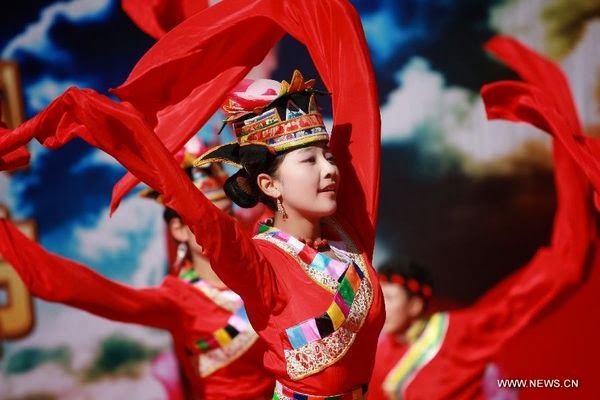
Monpa dance?
Budo, a deputy secretary of Tsona County Communist Party Committee, told the media: “Since the 12th Five-Year Plan was carried out, the economy and culture undertakings of Tsona County have grown by leaps and bounds. The total output value and annual per capita income of four Monpa ethnic townships have increased by 95% and 63% respectively. By the end of 2012, the per capita income of farmers and herdsmen in Legpo had reached 6,424 yuan ( 1,050 dollars), higher than the regional average level.”
To raise the revenue further, Tsona County “is committed to inheriting and promoting the traditional Monpa culture and Tsangyang Gyatso ballads.”
I am not sure what ‘committed in inheriting’ means, but the Communist authorities has stated that they would like the Tsangyang Gyatso Ballad Cultural Tourism Festival to gradually develop “into a grand local gathering integrating art performances, tourism promotion and business negotiation”.
The 1st Tsangyang Gyatso Ballad Cultural Tourism Festival was held in May 2012. The marketing propaganda for the 2nd Festival explains that the area is “centered around magical valley and poetic countryside, beautiful township of Monpa flavor and a holy land of love. It has been widely hailed for offering tourists the simplest folk customs and purest ecological environment.”
Besides the ‘political’ aspect of the festival, the organizers look for tourism promotion, business negotiation and commodity exhibition (sic). Cultural performances with popular ballads and songs are organized as well as “intangible cultural heritage items such as Monpa Akyi Lhamo and Dringking song of Sarma”. The visitors get a bonus by practicing ‘shooting arrows and hitting ox horns’, and sightseeing tours take the vacationers to various scenic spots: “With the clement climate and fertile land, Legpo is celebrated for its snow mountains, sea of clouds, dense forest and magnificent waterfall.”

Monpa costumes
The Chinese authorities also announced that the National Intangible Cultural Heritage ‘Mepa Akyi Lhamo’ and Tibet regional Intangible Cultural Heritage ‘Sarma oenopoetic ballad’ (one of the oldest historical singing performances handed down from ancient times, according to Chinese media, though etymologically it looks as a reference to wine drinking or making or both) performed on the festival. It was reported that the total number of ‘Mepa Akyi Lhamo’ inheritors has reached 16, while ‘Sarma oenopoetic ballad’ only has one inheritor who is an old man in his seventies. This festival is expected to rescue and protect these intangible cultural heritages, according to the Chinese media which explains to the visitors: “In 1683, Tsangyang Gyatso was born in a traditional Monpa family in Tsona. Monpa people are renowned for their singing and dancing down the ages.”
During the festival, the organizers also arrange the visit Tsangyang Gyatso's former residence (after he had left Urgyeling) “while discovering how he grew up, tourists could also learn Monpa people's folk culture, such as daily life, dress as well as vernacular architecture”.
What is happening on the other side of the border, in the Indian district of Tawang?
Despite the Tawang Festival being organized in October, the poor state of the roads and the irregular helicopter’s schedule hamper the Indian and foreign visitors to see the true birth place of Tsangyang Gyatso.
What a pity?

Thursday, June 28, 2012

Spiritual hubs as a formula for peace

My article Spiritual hubs as a formula for peace appeared today in the DNA

News that China is planning a tourist hub, just north of the Line of Actual Control in Arunachal Pradesh, has flashed in the Indian media.
According to an Indian national newspaper: “China is building a ‘golden’ tourist complex in Nyingchi prefecture in Tibet, close to the disputed areas on the India-China border”.
In fact, the ‘hub’ already exists with even a 5-star hotel, but the announcement had perhaps to do with the meeting between Prime Minister Manmohan Singh and Chinese Premier Wen Jiabao on the sidelines of the Rio+20 summit in Brazil.
Just a look at GoogleEarth, will show you the amazing developments in the Nyingchi area; regrettably, it is not merely the base camp for tourists to visit the Yarlung Tsangpo gorges, it is also Chendu Military Region’s most strategic ‘military hub’.
Another news item should have attracted the Indian media’s attention more: the encounter in London between the two Buddhist Nobel Peace Prize laureates, the Dalai Lama and Aung San Suu Kyi, the leader of the Burmese opposition.
Apart from the fact that both these exceptional beings have greatly suffered from totalitarian regimes, each in its own way, the two world icons have something else in common, their love for a ‘spiritual hub’, just south of the McMahon Line.
Let us recall a few important moments in Suu Kyi’s life.
In 1964, she went to Oxford where she studied for three years to earn a BA in philosophy, politics and economics. Later she got her first work experience as an assistant secretary in the United Nations Secretariat.
In 1972, her life took another turn when she met a young and brilliant British scholar, Dr. Michael Aris, whose expertise was the Tibetan Buddhism. Michael’s father was a Tibetan scholar too, so was Michael’s twin brother, Antony.
Soon after Suu Kyi and Michael married in London, they moved to Bhutan, where he worked on Pemalingpa, the famous 15th century yogi and siddha. In the early 1970’s, Aris added another topic to his study: the ‘lives’ of Tsangyang Gyatso (the Precious Ocean of Pure Melody), the Sixth Dalai Lama, born in 1643 in Monyul (today’s Tawang district of Arunachal).
Though Tsangyang Gyatso’s official biography said that he passed away in 1706, some texts said that he survived and roamed around Mongolia and the Gobi desert and had the most extraordinary adventures.
Micheal Aris researched the ‘secret’ life of the Dalai Lama.
Already Tsangyang Gyatso’s ‘first’ life was quite remarkable. His official biography said: “Though he continued to live in the Potala Palace, he roamed around Lhasa and other outlying villages, spending his days with his friends in the park behind the Potala Palace and nights in taverns in Lhasa and Shol (an area below the Potala) drinking chang (barley beer) and singing songs. He was known to be a great poet and writer. In 1706, he was invited to China and died on the way.”
Michael Aris studied both lives of the Dalai Lama. Speaking Tibetan perfectly, Michael (accompanied by his wife) traveled to Urgyeling, at the outskirts of Tawang where the Dalai Lama took birth and to Berkhar, the remote hamlet, south of Tawang where Tsangyang Gyatso’s mother lived. She herself was a descendant of Pemalingpa. The visit of the couple is still remembered in the area. Ironically (or ‘karmically’) in March 1959, Tenzin Gyatso, the present Dalai Lama entered India through the same area.
These past years must have made the Burmese leader closer to the Dalai Lama.
Did they discuss the ‘secret life of Tsangyang Gyatso when the two met in London? Perhaps!
After traveling extensively through the Himalayas and writing on India’s age-old traditions of peace and tolerance, the couple returned to London in early 1988. And then she jumped into politics!
Aung San Suu Kyi surely remembered this poem of Tsangyang Gyaltso (and thought of Michael), when she met the Dalai Lama in London.
The cuckoo bird from the land of Mon (Tawang) brings rain,
It descends from the sky
It brings blessings to the earth.
Life grows and blossoms.
When the cuckoo bird comes from Moon
My lover and I join as one
In body, heart and mind.
It made me think: why can’t the Chinese leadership opt for the Burmese model and use the Dalai Lama as an ally and an ambassador, instead of making him an enemy or a demon?
One can dream of the sea of changes this would bring in China and Tibet (and consequently in India).
First and foremost, from a ‘bully boy’, China would become a ‘normal’ State, respectable and even respected. This would completely change the image of China and ‘image’ has always been important in the Chinese psyche. The Burmese model should inspire them.
But before this, Beijing should stop claiming Tawang as theirs and concentrate on their hubs.
The author is a French-born journalist and writer
URL of the article: http://www.dnaindia.com/analysis/column_spiritual-hubs-as-a-formula-for-peace_1707604-all

Friday, June 22, 2012

The extraordinary life of the ‘Indian’ Dalai Lama

The Dalai Lama wrote with his finger "The Lama knows"
I wrote this article in 1996.
After the recent encounter between the Dalai Lama and Aung San Suu Kyi, I thought it would be interesting to republish it.
The Burmese leader and her husband visited all these places in Monyul (today Tawang district).

In the Footsteps of the Precious Ocean of Pure Melody 
The cuckoo bird from the land of Mon brings rain,
It descends from the sky
It brings blessings to the earth.
Life grows and blossoms.
When the cuckoo bird comes from Moon'
My lover and I join as one
In body, heart and mind.
It may seem incredible, but this song was written by a Dalai Lama. Tsangyang Gyaltso (the Precious Ocean of Pure Melody), the Sixth Dalai Lama. He took birth in Monyul, the land of Mon in 1643.
The Dalai Lama lived his first years in a small hamlet called Urgyeling.  Near the temple of Urgyeling there is a tall and magnificent tree. Many legends revolve around this tree (a sandal tree?): it seems that this tree was planted by the Sixth Dalai Lama before being taken away to his destiny in Lhasa. He made a prophesy saying that when the 3 main branches would become equal he would come back to Tawang. The local priest said that the 3 branches reached the same size in 1959, a few months before the Dalai Lama, fleeing Tibet after the Chinese invasion, passed through Tawang and ‘visited again’ Urgyeling.
Urgyeling
When the delegation reached Urgyeling, the Regent Desi Sangyay Gyaltso had still not revealed that the Lama-King was no more fearing that intrigues would start as soon as the news of his passing away would be known. He was also very keen to finish the task assigned to him by the Fifth Dalai Lama: to complete the Potala Palace in Lhasa.
But a series of divination and special pujas had given the Regent the certitude that the reincarnation of the Fifth Dalai Lama was born in South of Tibet, in Monyul. The care-taker told us that when he was very young, Tsewang Lhamo, the mother of the future Dalai Lama once asked her son to get a piece of wood and fix it in the soil to tie a cow. Instead of planting the stick in the soil, the young Tsangyang made a hole with his finger in the stone and stuck the stick inside it. It is one of the many miracles he is said to have performed. The stone was still on the altar.
Tsangyang Gyaltso was in many ways an exceptional Dalai Lama. At the age of six, he was taken away to Tsona, the main monastery on the other side of the border, where he was kept for 8 years under the tight surveillance of the local Governors (the Regent Sangye Gyaltso had not yet revealed to anybody his real identity). He was already an adolescent he finally left for Nagartse near Lhasa where his Guru, the Second Panchen Lama enthroned him as the Sixth Dalai Lama. He consistently refused to take the monk vows from his Guru and preferred the pleasure of life, visiting at night the taverns in the village of Shol below his Potala Palace and writing love songs to his beloved girl friend:
In my Palace, the place of Heaven on Earth
they call me Rigzin Tsangyang Gyaltso
But below , in the village of Shol
they call me Dangzang Wangpo, the profligate,
for my lovers are many.
Berkhar, the village of the Dalai Lama's mother
His exquisite poetry is known today by all Tibetans and Monpas and is still sang during long evenings around a fire after a few cups of chang. Academicians will fight to decide if he was a great Tantric master or only an ordinary man, if his poetry contains an esoteric teaching written in a secret language or are only the verses of a libertine. He may have been both at the same time, maybe he had come a couple of centuries too early. He loved freedom and could not bear the prison that seems to have been life in the Potala, he was suffocating in the darks rooms housing thousands of gods and wrathful demons. He preferred the company of his friends. How could he have not felt oppressed in the midst of power struggles and intrigues between aristocrats in Tibetan government in Lhasa, the Mongol chieftains and the Emperor of China?
Was he remembering the days when he was a kid in Urgyeling and used to escape to roam around the barley fields and the rhododendron bushes? But his legend continued after his presumed death. The "Secret Biography" of his "hidden life" tell us that he escaped the Mongols who had deposed him, wanted to kill him and he secretly left for Eastern Tibet and Inner Mongolia where he first became a wandering monk and then settled in Alashan which is today in Inner Mongolia. He passed away in 1746 , forty years after his official death. He built a large number of monasteries and had thousand of disciples. Only a very few knew who he really was. His last poem before his presumed death is known by all. It announced his return as the Seventh Dalai Lama.
Descendant of the 6th Dalai Lama

Oh White Crane!
Lend me your wings
I shall not fly far
From Lithang, I shall return

Two years later a young boy Kalsang Gyaltso was born in Lithang (Eastern Tibet) who would soon be recognised as the VIIth Dalai Lama. "Lama Geno" could have said Tsangyang and the story goes on. The Thirteenth Dalai Lama once told Sir Charles Bell, the British Political Officer in Lhasa: "He (the Sixth) did not observe even the rules of a fully ordained monk. he drank wine habitually. And he used to have his body in several place at the same time, e.g. in Lhasa, in Kongpo (a province seven day's journey east of Lhasa), and elsewhere. Even the place whence he retired to the Honourable Field (i.e. died) is uncertain; one tomb of his is in Alashan in Mongolian where there is another in Drepung monastery. One if his bodies used to appear in the crowd in the Reception Hall of the Seventh Dalai Lama. One is said to appear also at my receptions, But I am unable to say whether this is true or not".
Tsangyang Gyalsto has always been the darling of the Tibetan people. For them though remaining a god, his compassion was so great that he condescended to have feelings like a human beings, he even acted like a human being, while still remaining Avalokiteshvara incarnated, the boddhisatva of compassion, the Precious Protector of the Land of Snow. Three beautiful images always come to my mind while thinking of Tsagyang Gyaltso, the first of a boy escaping from Urgyenling and running in the green fields of Monyul, the second of an adolescent tall and handsome (like the Monpas can be) holding a bow in one hand, wearing a sky blue satin robe and a golden hearing; he was passing in front of some high Tibetan dignitaries and blessing them in a hurry with a hand full of rings and the final image of a man at the end of his life, dancing and leaving his footsteps in the snow while trying to show to a group of close disciples the complicated steps of the most esoteric religious dance. These are three images of a same person who was so many persons  at the same time, a fascinating and disconcerting man who was sometimes more than a man and did not want to be a god. A man loved by his people though so many times misunderstood and who loved freedom above all.