Showing posts with label Sixth Dalai Lama. Show all posts

Friday, September 20, 2013

A Dalai Lama popular in China

Last year, I mentioned the extraordinary life of the ‘Indian Dalai Lama’, Tsangyang Gyatso, the Sixth Dalai Lama born in 1643, near Tawang in Arunachal Pradesh.
As a young boy, before leaving for Lhasa, he lived in a small hamlet called Urgyeling, a few kilometers south of Tawang town.
Tsangyang Gyatso was in many ways an exceptional Dalai Lama. As a teenager, he was taken away to Tsona, the main monastery on the other side of the Tibet border (McMahon Line), where he was kept for 8 years under the tight surveillance of the local Tsonpon or Governor (the Regent Sangye Gyatso had not yet revealed to anybody his real identity). He was already an adolescent when he finally left for Nagartse near Lhasa where his Guru, the Second Panchen Lama enthroned him as the Sixth Dalai Lama.
His exquisite poetry is known today by all Tibetans and Monpas and is still sang during long evenings around a fire after a few cups of chang
You may think the Chinese, as believers of Karl Marx atheist religion, do not have a great love for the Dalai Lamas; it seems logical. Further their propaganda machinery loves to bash the present Dalai Lama.
But recently the Communist leadership has ‘rediscovered’, the Sixth Dalai Lama and started organizing Festivals in his name.
Chinanews.com reported that the Tsangyang Gyatso Ballad Cultural Tourism Festival was held in Tibet from September 15 to 19, in Legpo of Tsona County in Lhoka Prefecture. Tsona is just north of the McMahon Line.
The main purpose of this Festival is to show to thousands of Chinese tourists that Tawang is also part of China and whatever belongs to Tawang, also belongs to China.
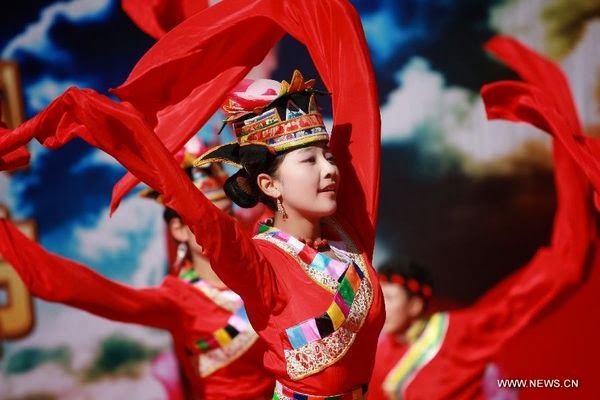
Monpa dance?
Budo, a deputy secretary of Tsona County Communist Party Committee, told the media: “Since the 12th Five-Year Plan was carried out, the economy and culture undertakings of Tsona County have grown by leaps and bounds. The total output value and annual per capita income of four Monpa ethnic townships have increased by 95% and 63% respectively. By the end of 2012, the per capita income of farmers and herdsmen in Legpo had reached 6,424 yuan ( 1,050 dollars), higher than the regional average level.”
To raise the revenue further, Tsona County “is committed to inheriting and promoting the traditional Monpa culture and Tsangyang Gyatso ballads.”
I am not sure what ‘committed in inheriting’ means, but the Communist authorities has stated that they would like the Tsangyang Gyatso Ballad Cultural Tourism Festival to gradually develop “into a grand local gathering integrating art performances, tourism promotion and business negotiation”.
The 1st Tsangyang Gyatso Ballad Cultural Tourism Festival was held in May 2012. The marketing propaganda for the 2nd Festival explains that the area is “centered around magical valley and poetic countryside, beautiful township of Monpa flavor and a holy land of love. It has been widely hailed for offering tourists the simplest folk customs and purest ecological environment.”
Besides the ‘political’ aspect of the festival, the organizers look for tourism promotion, business negotiation and commodity exhibition (sic). Cultural performances with popular ballads and songs are organized as well as “intangible cultural heritage items such as Monpa Akyi Lhamo and Dringking song of Sarma”. The visitors get a bonus by practicing ‘shooting arrows and hitting ox horns’, and sightseeing tours take the vacationers to various scenic spots: “With the clement climate and fertile land, Legpo is celebrated for its snow mountains, sea of clouds, dense forest and magnificent waterfall.”

Monpa costumes
The Chinese authorities also announced that the National Intangible Cultural Heritage ‘Mepa Akyi Lhamo’ and Tibet regional Intangible Cultural Heritage ‘Sarma oenopoetic ballad’ (one of the oldest historical singing performances handed down from ancient times, according to Chinese media, though etymologically it looks as a reference to wine drinking or making or both) performed on the festival. It was reported that the total number of ‘Mepa Akyi Lhamo’ inheritors has reached 16, while ‘Sarma oenopoetic ballad’ only has one inheritor who is an old man in his seventies. This festival is expected to rescue and protect these intangible cultural heritages, according to the Chinese media which explains to the visitors: “In 1683, Tsangyang Gyatso was born in a traditional Monpa family in Tsona. Monpa people are renowned for their singing and dancing down the ages.”
During the festival, the organizers also arrange the visit Tsangyang Gyatso's former residence (after he had left Urgyeling) “while discovering how he grew up, tourists could also learn Monpa people's folk culture, such as daily life, dress as well as vernacular architecture”.
What is happening on the other side of the border, in the Indian district of Tawang?
Despite the Tawang Festival being organized in October, the poor state of the roads and the irregular helicopter’s schedule hamper the Indian and foreign visitors to see the true birth place of Tsangyang Gyatso.
What a pity?

Friday, June 22, 2012

The extraordinary life of the ‘Indian’ Dalai Lama

The Dalai Lama wrote with his finger "The Lama knows"
I wrote this article in 1996.
After the recent encounter between the Dalai Lama and Aung San Suu Kyi, I thought it would be interesting to republish it.
The Burmese leader and her husband visited all these places in Monyul (today Tawang district).

In the Footsteps of the Precious Ocean of Pure Melody 
The cuckoo bird from the land of Mon brings rain,
It descends from the sky
It brings blessings to the earth.
Life grows and blossoms.
When the cuckoo bird comes from Moon'
My lover and I join as one
In body, heart and mind.
It may seem incredible, but this song was written by a Dalai Lama. Tsangyang Gyaltso (the Precious Ocean of Pure Melody), the Sixth Dalai Lama. He took birth in Monyul, the land of Mon in 1643.
The Dalai Lama lived his first years in a small hamlet called Urgyeling.  Near the temple of Urgyeling there is a tall and magnificent tree. Many legends revolve around this tree (a sandal tree?): it seems that this tree was planted by the Sixth Dalai Lama before being taken away to his destiny in Lhasa. He made a prophesy saying that when the 3 main branches would become equal he would come back to Tawang. The local priest said that the 3 branches reached the same size in 1959, a few months before the Dalai Lama, fleeing Tibet after the Chinese invasion, passed through Tawang and ‘visited again’ Urgyeling.
Urgyeling
When the delegation reached Urgyeling, the Regent Desi Sangyay Gyaltso had still not revealed that the Lama-King was no more fearing that intrigues would start as soon as the news of his passing away would be known. He was also very keen to finish the task assigned to him by the Fifth Dalai Lama: to complete the Potala Palace in Lhasa.
But a series of divination and special pujas had given the Regent the certitude that the reincarnation of the Fifth Dalai Lama was born in South of Tibet, in Monyul. The care-taker told us that when he was very young, Tsewang Lhamo, the mother of the future Dalai Lama once asked her son to get a piece of wood and fix it in the soil to tie a cow. Instead of planting the stick in the soil, the young Tsangyang made a hole with his finger in the stone and stuck the stick inside it. It is one of the many miracles he is said to have performed. The stone was still on the altar.
Tsangyang Gyaltso was in many ways an exceptional Dalai Lama. At the age of six, he was taken away to Tsona, the main monastery on the other side of the border, where he was kept for 8 years under the tight surveillance of the local Governors (the Regent Sangye Gyaltso had not yet revealed to anybody his real identity). He was already an adolescent he finally left for Nagartse near Lhasa where his Guru, the Second Panchen Lama enthroned him as the Sixth Dalai Lama. He consistently refused to take the monk vows from his Guru and preferred the pleasure of life, visiting at night the taverns in the village of Shol below his Potala Palace and writing love songs to his beloved girl friend:
In my Palace, the place of Heaven on Earth
they call me Rigzin Tsangyang Gyaltso
But below , in the village of Shol
they call me Dangzang Wangpo, the profligate,
for my lovers are many.
Berkhar, the village of the Dalai Lama's mother
His exquisite poetry is known today by all Tibetans and Monpas and is still sang during long evenings around a fire after a few cups of chang. Academicians will fight to decide if he was a great Tantric master or only an ordinary man, if his poetry contains an esoteric teaching written in a secret language or are only the verses of a libertine. He may have been both at the same time, maybe he had come a couple of centuries too early. He loved freedom and could not bear the prison that seems to have been life in the Potala, he was suffocating in the darks rooms housing thousands of gods and wrathful demons. He preferred the company of his friends. How could he have not felt oppressed in the midst of power struggles and intrigues between aristocrats in Tibetan government in Lhasa, the Mongol chieftains and the Emperor of China?
Was he remembering the days when he was a kid in Urgyeling and used to escape to roam around the barley fields and the rhododendron bushes? But his legend continued after his presumed death. The "Secret Biography" of his "hidden life" tell us that he escaped the Mongols who had deposed him, wanted to kill him and he secretly left for Eastern Tibet and Inner Mongolia where he first became a wandering monk and then settled in Alashan which is today in Inner Mongolia. He passed away in 1746 , forty years after his official death. He built a large number of monasteries and had thousand of disciples. Only a very few knew who he really was. His last poem before his presumed death is known by all. It announced his return as the Seventh Dalai Lama.
Descendant of the 6th Dalai Lama

Oh White Crane!
Lend me your wings
I shall not fly far
From Lithang, I shall return

Two years later a young boy Kalsang Gyaltso was born in Lithang (Eastern Tibet) who would soon be recognised as the VIIth Dalai Lama. "Lama Geno" could have said Tsangyang and the story goes on. The Thirteenth Dalai Lama once told Sir Charles Bell, the British Political Officer in Lhasa: "He (the Sixth) did not observe even the rules of a fully ordained monk. he drank wine habitually. And he used to have his body in several place at the same time, e.g. in Lhasa, in Kongpo (a province seven day's journey east of Lhasa), and elsewhere. Even the place whence he retired to the Honourable Field (i.e. died) is uncertain; one tomb of his is in Alashan in Mongolian where there is another in Drepung monastery. One if his bodies used to appear in the crowd in the Reception Hall of the Seventh Dalai Lama. One is said to appear also at my receptions, But I am unable to say whether this is true or not".
Tsangyang Gyalsto has always been the darling of the Tibetan people. For them though remaining a god, his compassion was so great that he condescended to have feelings like a human beings, he even acted like a human being, while still remaining Avalokiteshvara incarnated, the boddhisatva of compassion, the Precious Protector of the Land of Snow. Three beautiful images always come to my mind while thinking of Tsagyang Gyaltso, the first of a boy escaping from Urgyenling and running in the green fields of Monyul, the second of an adolescent tall and handsome (like the Monpas can be) holding a bow in one hand, wearing a sky blue satin robe and a golden hearing; he was passing in front of some high Tibetan dignitaries and blessing them in a hurry with a hand full of rings and the final image of a man at the end of his life, dancing and leaving his footsteps in the snow while trying to show to a group of close disciples the complicated steps of the most esoteric religious dance. These are three images of a same person who was so many persons  at the same time, a fascinating and disconcerting man who was sometimes more than a man and did not want to be a god. A man loved by his people though so many times misunderstood and who loved freedom above all.

Thursday, June 21, 2012

Aung San Suu Kyi and the Dalai Lamas

Shoes and other relics of the 6th Dalai Lama
Aung San Suu Kyi had a most fascinating life.
In 1964, she went to Oxford where she studied for three years to earn a BA in philosophy, politics and economics. 
Later she got her first work experience as an assistant secretary in the United Nations Secretariat.
In 1972, her life took another turn when she met a young and brilliant British scholar, Dr. Michael Aris, whose expertise was the Tibetan Buddhist. 

Suu Kyi asked her future husband for a 'favour': "I only ask one thing, that, should my people need me, you would help me to do my duty by them". 
He agreed.
After Suu Kyi and Michael were married in London, they moved to Bhutan, where he worked on Pemalingpa, the famous 15th century yogi and siddha.
Her life as a mother of two sons and a scholar continued smoothly during the following years. 
It is during the early 1970's that Aris did most of field researches in Bhutan and Arunachal Pradesh (Tawang).
His wife often accompanied him.
By that time, Aris had added another topic to his study: the 'lives' of Tsangyang Gyatso, the Sixth Dalai Lama, born in Urgyeling near Tawang.
Though his official biography said that Tsangyang Gyatso passed away in 1706, some texts said that he survived and roamed around Mongolia and the Gobi desert and had the most extraordinary adventures. Here is what the official biography says:
In 1701 there was a conflict between the Desi and Lhasang Khan, the descendant of Gushir Khan, and the latter killed the Desi Sangya Gyatso, which disturbed the young Dalai Lama. He left his monastic study and chose the outdoor life, he had no plans to take the fully ordained vows. In fact, he visited the Panchen Lama in Shigatse and requested his forgiveness, and renounced even the vows of a novice monk. Though he continued to live in the Potala Palace, he roamed around Lhasa and other outlying villages, spending his days with his friends in the park behind the Potala Palace and nights in taverns in Lhasa and Shol (an area below the Potala) drinking chang and singing songs. He was known to be a great poet and writer and he wrote several poems. In 1706, he was invited to China and died on the way.
Michael Aris studied both lives of the Dalai Lama. 
Speaking perfectly Tibetan, he knew well the area where the Dalai Lama was born (in March 1959, Tenzin Gyatso, the present Dalai Lama entered India through the same area).
In a previous posting, I have described this region where Michael and Suu Kyi traveled. They went to Urgyeling where the Dalai Lama took birth and to Berkhar, the remote hamlet, south of Tawang where Tsangyang Gyatso' mother lived. She herself was a descendant of Pemalingpa.
The visit of the couple is still remembered in the area.  
These years made the Burmese leader very close to the Dalai Lama. 
It is probably one of the reasons why they met two days ago in London. 
Did they discuss the 'secret life of Tsangyang Gyatso?
Perhaps not!
In the 1980's, the Aris family came back in India where for two years, Michael Aris conducted his research at the Indian Institute of Advanced Studies in Simla.
After traveling extensively through the Himalayas and writing on India's age-old traditions of peace and tolerance, the couple returned to London in early 1988. And then she jumped into politics!


Urgyeling, birth place of the 6th Dalai Lama

Here is excerpts of Hidden Treasures and Secret Lives of Michale Aris:
This is not the place to explain in detail what happened to the Monyul [Tawang] region later in history, but a very brief summary helps to put the Sixth Dalai Lama in his full context. The "Tibetan government appears to have been quick to realize that 'the area had great strategic and economic importance. Not only did it provide the only direct corridor to the Indian plains lying completely within Tibetan territory, but the whole region was extraordinarily rich in natural products unobtainable on the Tibetan plateau. It formed a natural staircase of different ecological levels stretching from the plains of Assam through dense subtropical forests in the foothills to the Alpine regions above and the high plateau beyond. Apart from the trans-Himalayan trade though the corridor which the government could carefully control to its advantage, the whole area was easily exploited for those natural products which lay in such heavy demand in Tibet. These included loads of grain, particularly rice, collected its taxation twice a year; rare medicinal herbs for the medical college in Lhasa; bamboo pens and paper made from the bark of the daphne tree for the offices of the Tibetan government; the skins of wild animals hunted by the Aka, Miji and other tribals who formed part of the district; sheep wool from some areas; butter from the pastoralists of the north; and a variety of fruit for certain privileged government officers. Whole orange trees complete with the ripened fruit were delivered every year to the Dalai Lama himself. It is not known whether this last custom began in the lifetime of the Sixth but it is well remembered today.
Apart from odd skirmishes with the Bhutanese to the west and the tribals to the east, little seems to have happened in the region until the British arrived on the scene in the late nineteenth century. Prior to that the only event of some international significance occurred in 1714 when one column of Lajang Khan's 1714 campaign against Bhutan invaded from the direction of Tawang.30 As will be seen, the khan had deposed the Sixth Dalai Lama seven years earlier and I believe the destruction of the Dalai Lama's restored and enlarged family temple at Ugyenling [or Urgyeling] occurred during this campaign as an attempt to obliterate his memory. In local legend the destruction is blamed on a Mongolian called Sokpo Jomkhar who, if my interpretation is correct, would have been Lajang's commanding general in the area. The temple built later on the original site and still standing is a very modest affair. It is in the hands of the family's present descendants, though the details of their descent are not known. As it now stands, the temple was perhaps reconstructed during the reign of the Seventh Dalai Lama. It was he who was responsible for ennobling the family of the Sixth's mother at Berkhar. They were granted the title of Depa Kushang (roughly "Ruler Uncle".), and confirmed in their estates. At the same time they were exempted from the payment of taxes and the rendering of labour service. All this can be assumed to have happened after the posthumous reinstatement of the Sixth as the true incarnation of his predecessor, as we shall see.
Footprint of the 6th Dalai Lama
The rights which the Tibetan government won over certain tracts in the Assamese plain at the foot of the Monyul corridor, or which were perhaps inherited from the local rulers whom the Tibetan government displaced in Monyul, were ceded to the British in 1844 in return for an annual subsidy. During the Simla Convention of 1914, signed by Great Britain and Tibet (and initialled but never ratified by the Chinese), the entire region was made over to British India. However, the transfer was never fully implemented on the ground and when India won its independence in August 1947 it found part of what it regarded as its own territory still under the control of Tibetan officials. After Communist China had fully annexed let, it was soon realized that independent India had by then consolidated its claim on an area of Tibet which China had traditionally regarded as its own. And so the seeds of a long conflict were truly sown. The Sino- Indian border war of 1962-3 resulted in the defeat of the Indian army in the area but left the status quo intact, with half of the Monpas continuing to live under Indian control south of the main watershed and the other half north of it, where they are classed today as one of China's smallest national minorities. Despite an uneasy truce the conflict continues to flare up from time to time. Even as these lines are written in 1987 there are renewed hostilities.
That the Sixth Dalai Lama was born in the disputed area will always serve to remind the Chinese that for many centuries it lay under the control of what they persist in calling “the local government of Tibet". For the Indian government the birth of the Dalai Lama there will perhaps always be something of an embarrassment. For the old Tibet the area is, like that whole country, lost beyond hope of recovery. From the point of view of the inhabitants of the area itself, the very last of their many acts of service to the old Tibet was to provide an escape route for the Fourteenth Dalai Lama as he fled from the Chinese south to India in 1959. The route took him straight past the family temple at Ugyenling where his sixth embodiment had been born nearly three hundred years earlier.

Friday, June 15, 2012

The bully boys and the Burmese model

Photo: Jeremy Russell/OHHDL
The Chinese are again upset.
They have threatened to leave their Olympics training camp in Leeds, if the Dalai Lama addresses the Yorkshire International Business Convention where the Tibetan leader has been invited to speak on Business Ethics.
The Foreign Ministry spokesman in Beijing did not like it at all: “We hope the British side stops making mistakes again and again, which undermine China's interests. China-UK relations have been affected by the recent meeting between the British leader and the Dalai Lama. The responsibility lies with the British side.” He was referring to the unofficial encounter between David Cameron and the Dalai Lama.
The Spokesman angrily added: “The Chinese delegation is making preparations for the 2012 Olympics. I think politics and sport should be separated.”
It seems rather childish. What is wrong with Ethics? In fact, the Chinese athletes should attend the Dalai Lama’s talk; it may help them.
Mike Firth, the event's orgainser declared that he had been amused by the suggestion of cancelling the Dalai Lama’s talk; he thought it was ridiculous. “Here we have an unelected communist state coming and dictating to local politicians. What we pride ourselves on in this country is freedom of speech. Clearly, they don't.”
At the same time, the Burmese leader Aung San Suu Kyi (also a Nobel Peace Prize Laureate) has undertaken her first foreign trip after 24 years in seclusion (most of the time under house arrest in Burma).
Her main objectives were to collect her Nobel Peace Medal as well as to call for renewed foreign investment in Burma.
It is interesting to compare the two examples.
While the Burmese civilian-military regime agreed to let Aung San Suu Kyi leave for her European tour, the Chinese government continues to insult the Tibetan leader.
One remembers that in 2008, Zhang Qingli, then Party Chief in Tibet had exacerbated the resentment of the Tibetan population by calling the Dalai Lama “a wolf in monk's clothes, a devil with a human face” and declaring that “those who do not love the motherland are not qualified to be human beings”.
More recently, China Tibet Online, a state-run Chinese website, launched another vicious attack on the Dalai Lama, accusing him of Nazi racial policies and of inciting Tibetans to immolate themselves.
The Dalai Lama had explained that the current protests in Tibet were due to the Chinese repressive policies. This greatly angered the Beijing authorities.
The website accused the Dalai Lama of instigating the self-immolations and called the Dalai Lama a "tricky liar skilled in double-dealing who wants to build a Berlin Wall of ethnic segregation and confrontation.”
The commentary added: “The remarks of the Dalai Lama remind us of the uncontrolled and cruel Nazi during the second world war ...How similar it is to the Holocaust committed by Hitler on the Jewish!”
Why? Beijing had not appreciated that the Dalai Lama had pleaded for a ‘genuine’ autonomy for Tibet. And it goes on!
Last month, the visit to UK of Wu Bangguo, the Chairman of the Standing Committee of the National People's Congress, ranked No 2 in the Chinese State (after President Hu Jintao) was cancelled after it was confirmed that David Cameron, the British Prime Minister would meet the Tibetan leader. Fabian Hamilton, the Leeds North East MP and Chairman of the Parliamentary Group for Tibet, called this ‘bully-boy tactics’.
The antagonism vis-à-vis the Tibetan leader takes absurd proportions.
In another incident, Xinhua, the Chinese official agency affirmed that the Jogye Order, a Buddhist sect from the Republic of Korea has broken its promise and interfered with China's internal affairs during a recent Buddhist conference. Why?
The Jogye Order was organizing a Conference of the World Fellowship of Buddhists and invited Prof Samdhong Rinpoche, the former Tibetan Prime Minister and respected Buddhist scholar to speak. Beijing said that this “contradicted the basic Buddhist commandments of refraining from lying, tricking others and slandering”.
Xinhua said that the Korean Buddhist sect “ruined the harmonious atmosphere of Buddhism and seriously harmed the traditional Sino-Korean friendship”.
In other words, Tibetans are not allowed to speak about Buddhism.
On its part, the Burmese regime has relaxed its totalitarian rule and decided to ‘work’ with Aung San Suu Kyi, allowing her to travel abroad and to be an ambassador of Burma.
In Geneva, the first stage of her tour, she addressed the International Labour Organisation about eradicating forced labour in Burma. The Telegraph wrote: "The visit marks a new milestone in the political changes that have swept Burma since decades of military rule were curtailed last year, bringing to power a new quasi-civilian government. Switzerland is the first stop on the more than two-week tour taking her to Norway, Britain, France and Ireland and which will include a speech in Oslo for her 1991 Nobel Peace Prize."
In her Nobel Acceptance Speech in Oslo, Suu Kyi gently mentioned the unsolved issues: “I am standing here because I was once a prisoner of conscience. As you look at me and listen to me, please remember the often repeated truth that one prisoner of conscience is one too many. Those who have not yet been freed, those who have not yet been given access to the benefits of justice in my country number much more than one.”
But during her stay in Europe, she will also work hard to remove the last sanctions against her country and try to attract new investments.
Between the military rulers and her, there is an implicit understanding; she is allowed to speak her mind, but at the same time, she pleads the cause of Burma.
The question which should be asked: who will come out greater after the European tour of Burma’s Iron Lady?
It will clearly be ‘Burma’ and in particular the present rulers who have had the courage to 'open' up the country’s totalitarian system and allow Suu Kyi to stand for elections (and now go abroad as an unofficial ambassador).
The 'bully' generals have understood that if they can use the former dissident's formidable reputation and her highly respected ethics, it will be a win-win solution for the country.
Can the leadership in Beijing understand this?
Why can they not use the Dalai Lama as an ally and an ambassador, instead of making him an enemy or a demon?
One can dream of the sea of changes this could bring in China and Tibet (and consequently in India).
The consequences could be many.
One, from a ‘bully boy’, China would become a ‘normal’ State, respectable and even respected. This would completely change the image of China. ‘Image’ has always been important in the Chinese psyche.
Then, it could progressively dissipate the Tibetan populations’ resentment and put a stop to the series of self-immolations and constant unrest.
In the long run, Tibet could be a model for other restive provinces of China.
The Dalai Lama could further help by giving spiritual guidance to millions of young Chinese lost in the ‘money-is-glorious’ syndrome instituted by Deng Xiaoping in 1978. It has brought some material well-being to the Chinese people, but in the process many have lost their deeper traditional values.
It will be for the next generation of leaders led by Xi Jinping to decide which image they want to project, a ‘normal’ and respected China or a ‘bully’ and reviled one.
The Burmese model should inspire them.

Monday, October 24, 2011

The Hidden and Blessed Land of Mon

‘Lama Geno’, in Monpa language could be translated as ‘The Lama knows’, or more freely, ‘here we are’. It is what Tsangyang Gyaltso, the young Sixth Dalai Lama, wrote in 1688 with his finger on a stone in Urgyeling, a village south of Tawang, the headquarters of the western-most district of Arunachal Pradesh.
A high delegation had just arrived from Lhasa looking for the reincarnation of the Fifth Dalai Lama who had passed away a couple of years earlier in Tibet. The boy was waiting to be ‘taken back’ to his Potala Palace in Lhasa.
It is just one of the numerous stories or legends in Monyul, (the ‘low land’) as Tawang is known. The Monpas are obviously fond and proud of these legends.
Being located near the tri-junction between India, Tibet and Bhutan, south of the McMahon Line, Tawang is today one of the most strategic districts in the country. The Government has however opened it to visitors (an Inner Line Permit is required for Indians and a Protected Area Permit for foreigners).
Long ago, the British created an ‘inner line’, separating these ‘excluded tracks’ from the plains. Though for a long time considered ‘backward’, one soon discovers a culture dating back several centuries; a first darshan of the imposing Gompa (monastery) towering over the valley in all its majesty, will remove all doubts about this.
Tourism is becoming a key to the economic development and the integration of these border areas, and will ultimately a factor for the defence of the frontiers as it gives a tremendous boost to the infrastructure.
In October 1962, when the Chinese entered the Indian territory north of Tawang, the Indian Army was woefully unprepared and the infrastructure inexistent. It was a watershed in Indian history. To keep a part of the Indian territory ‘excluded’ proved to be fatal and humiliating for the nation.
In January 2008, during a visit to Itanagar and Tawang, the Prime Minister announced a Rs 24,000 crores package for the State. Priority was given to connectivity (in particular, the construction of a Trans-Arunachal Highway). 
As a result, the road between the plains of Assam and Tawang is the messiest construction site imaginable. The road has become the favorite joke of the local drivers, unstoppable on the subject; one can however take comfort in the fact that the work has finally started.
Reaching the Sela Pass, at 13,700 feet above sea level between Tawang and Bomdila (West Kameng District), you feel as if entering another world. But you are first reminded that the area was the theater of the 1962 Sino-Indian conflict. A Memorial dedicated to Jaswant Singh, the heroic rifleman who defended the pass and earned a Maha Vir Chakra in November 1962, is a sort of mandir in memory of the brave jawan. It is a compulsory stop for all Army personnel, as well as tourists (more than 95% of the visitors are presently from West Bengal). Looking at the old bunkers, one can imagine the incredible sufferings and bravery of the jawans and officers of the Indian Army, abandoned by an irresponsible leadership (a visit to the 1962 War Memorial in Tawang is also a must).

Two hours later, the first glimpses of the Tawang Gompa perched on one of the highest hills overlooking the Tawang Chu Valley (‘chu’ is ‘river’ in Tibetan/Monpa) are breathtaking.
For the past three centuries, life in Monyul has been centered around the Gompa, the fountainhead of the Buddha Dharma for some 30,000 Monpas and other Buddhist ethnic groups (like the Sherdukpens).
The history of the location of the Gompa is most interesting: a monk called Mera Lama, born in Kitpi village near Tawang, spent several years in Tibet before returning to his native place. Before leaving Lhasa, he met the Fifth Dalai Lama who asked him to propagate the Dharma in Monyul and establish a large monastery with the help of the local population.
The legend says it is Mera Lama's horse who found the location of the new monastery. It became known as Tawang Gompa: in Monpa dialect ‘ta’ means ‘horse’ and ‘wang’ ‘blessings’ (Tawang is ‘the place blessed by the horse’).
Today five hundred monks study in the Gompa, the largest Buddhist monastery in India under the dynamic leadership of a young Lama known as Guru Rinpoche.
The Buddhists believe in the concept of sacred places or pithas. During the 10th century, the great Indian yogi Tilopa said that pithas are to be found inside your own self, though “outer pithas are mentioned in the scriptures for the benefit of simple fools who wander about the country”.
As a tourist, you may be classified as ‘a simple fool’ by siddhas, but you will tremendously enjoy visiting some other ‘outer’ places empowered by the Sixth Dalai Lama, Mera Lama or Guru Padmasambhava.
Most of the tour operators will tell you visit the ‘Madhuri’ Lake. After Rakesh Roshan shot Koyla (starring Madhuri and Shah Rukh), jawans posted in the area began calling it, ‘Madhuri’ Lake; it was a grazing pasture before becoming a lake after the dreadful earthquake of August 1950. Locals say that it is its USP, as there are as many 108 lakes in the area, many of them larger and more stunning, some having been blessed by great tantric masters and yogis.
A few kilometers away is the Tagtsang Gompa (the ‘Tiger Lair’ monastery), perched at 13,500 feet. It is one of the four pithas that Guru Padmasambhava, the great Indian tantric master who helped establishing Buddhism in Tibet, Bhutan and the Himalayan belt visited. The Guru is said to have traversed Tagstang in the form of a Tiger and subdued some powerful local spirits hostile to Buddhism.
Another popular figure in Monyul is the great Mahasiddha Thangtong Gyalpo. Born in 1385 in Central Tibet, he traveled widely in the Himalayas. He is remembered in Buddhist history, not only for his teachings, but also for the iron bridges he constructed. He was a remarkable engineer and maybe the first Asian to understand the meaning of communication (seven centuries before it became the sign of our civilisation). His hagiography said he built 58 iron bridges and 118 boats to cross rivers. One of these bridges called Chaksam Bridge can be seen today across Tawang Chu near Kitpi village towards Mukto. The iron was of such high quality that it is still in use after 7 centuries. Thangtong Gyalpo is also the founder of the Tibetan Opera.
Another special place is the Gorsam Chorten (Stupa) which was built in the 18th century by a monk of Tsona monastery (located in Tibet). He wanted to make a replica of the Bodhnath Stupa in Kathmandu. He is said to have traveled to Nepal and made a perfect model carved in a radish that he managed to conserve and copy once back in Gorsam.

Another name of the Land of the Monpa is ‘Mon Payul Kyinochung’ which means the ‘hidden and blessed land’. This brings a familiar concept in the Himalayan literature: the esoteric concept of ‘Hidden Land’, an initiation is required to enter this region.
Till recently ‘hidden lands’ had a literal meaning in Tawang, but with the relaxation of the Inner Line Permit system, the region is today accessible to all (the initiation being the two-day journey on the road from Assam to Tawang).
The beauty and the sacredness of the sites, the serene atmosphere of the mountains, the luxuriant flora and the gentleness of the local population of Arunachal can make the most tense citywalla relax and take him to another dimension.