Showing posts with label military training. Show all posts

Friday, December 26, 2014

Mondays for flies, Christmas for tigers in the PLA

Wang Jianping behind Chairman Xi Jinping
The South China Morning Post last week asserted that the 'big changes' in China always occurred in Friday or Saturday: "For the past two years it has been accepted – almost as a rule of thumb – among China’s media and interested mainlanders that Fridays and weekends are the likely time for senior officials to fall from grace over allegations of corruption. Yet few observers could tell why – until now."
The Hong Kong newspaper added: "People have described the pattern as 'Mondays for flies, Weekends for tigers' ever since President Xi Jinping launched his anti-graft campaign against both low-level officials and those in the most senior roles."
The 'big change' for the PLA Tigers has happened on the Christmas day.
Want China Times, the news website based in Taiwan has announced the replacement of 40 senior commanders of China's armed forces. The Taiwanese paper reported: "China's president, Xi Jinping, has replaced 40 senior military commanders including the head of the People's Armed Police according to a new nomination list posted by a Chinese internet user."
It added: "Communist Party of China on June, Xi has continued his purge of PLA generals whose loyalty to him may be questionable. The nomination list released on Dec. 20 suggests that various key positions within the Chinese military will be taken over by Xi's close associates."
Apart from Lt. Gens. Qin Weijiang, Hu Yishu and Li Shangfu nominated as the deputy chiefs of the General Staff, General Logistics and General Equipment departments respectively, Lt. Gens. Yin Fanglong and Miao Hua were named as the political commissars of the Second Artillery Corps and Navy, while Lt. Gens.Wang Weiming and Wang Dengping are to be the deputy commanders and deputy political commissars of the PLA Navy. Lt. Gen. Zhang Junxiang and Zhou Yaning will now served as the Second Artillery Corps' new deputy commanders.

Wang Jianping, commander of the People's Armed Police
More interestingly to me is the fate of Lt. Gen. Wang Jianping, who has apparently lost his job to Wang Ning, a deputy chief of general staff of the PLA.
I have often mentioned Wang Jiangping's name on his blog, mainly because he was an old Tibet-hand.
A few words about his career:
Wang Jianping (Han nationality) is a native of Hebei province. He was born in 1953, joined the Army in 1969. In 1997, he was promoted to major general; he became lieutenant general in 2007. He served as deputy commander for one year before becoming Commander of the Chinese People's Armed Police Force (PAPF) in 2009. He is a member of the 18th CCP Central Committee.
He has also been a member of the Central Working Coordination Small Group on Tibet. He served as Commander of the Tibet Autonomous Region's (TAR) PAPF from 1996 to 2000. He knows Tibet well and particularly the Ngari region.
When Wang visited Tibet in June 2014, the TAR's entire Standing Committee was in attendance to receive him.
I then wrote in detail about his visit.
While in Lhasa,he inspected the TAR’s People’s Armed Police training base, a Traffic police detachment, Tibet’s Forest Armed Police Corps, the 117 Police Division, a detachment of Ngari Police.
According to The Tibet Daily, he wanted to get a detailed understanding of the situation. For the purpose, he called on officers and men of the People’s Armed Police.
The Chinese newspapers reported that Wang Jianping acknowledged the success achieved by the Armed Police's Tibet Corps and the Armed Police Forces in every work and asked all the armed police officers and men to understand the serious and complicated situation that they are facing at present. He told the local Party cadres to strengthen the police force for war preparation and continue the good job of building up the police forces.
He said a good chess player takes the initiative.
Well, he was probably too close to Zhou Yongkang, the former member of the Politburo's Standing Committee, who is now 'investigated'.
That was not a good move on the chessboard for Wang.

Will his transfer bring a change in Tibet where the self-immolations continue?
We will have to wait several months to see.
Just before the 'reshuffle' in the PLA, Senior Colonel Yang Yujun, the spokesman of the Ministry of National Defense addressed his regular monthly press conference in Beijing. When asked:
India and China on the military front had a very eventful year this year. There are several interactions at various levels and they have dealt with several issues of differences over the line of actual control. What is the outlook for the next year? Are there any new exchanges in the pipeline? Can you give some details on how you see the next year coming?
He answered:
This year is the year of friendly exchange between China and India. There are several important cooperation programs between the two militaries. For example, there have been frequent exchanges of high-level military delegations. Both sides held defense consultations and joint counter-terrorism Army training. At the same time, neighboring military commands as well as the border defense troops of the two sides conducted meetings and regular exchanges. Both sides also properly handled issues of encounter at the line of actual control and maintained peace and stability in the China-India border.
Next year, the Chinese and Indian militaries will continue to strengthen dialogue, exchange and cooperation, and push forward bilateral military relationship. In particular, we should focus our attention on the implementation of the Border Defense Cooperation Agreement signed by the two governments and ensure peace and stability along the China-India border.
On the specific exchange programs of the two militaries for the next year, both sides are still in the process of discussion.
To focus on the implementation of the Border Defense Cooperation Agreement' does not mean that there will no Chinese intrusions on Indian soil in 2015, he just signifies: "we will tackle these issues through the Border Agreement."
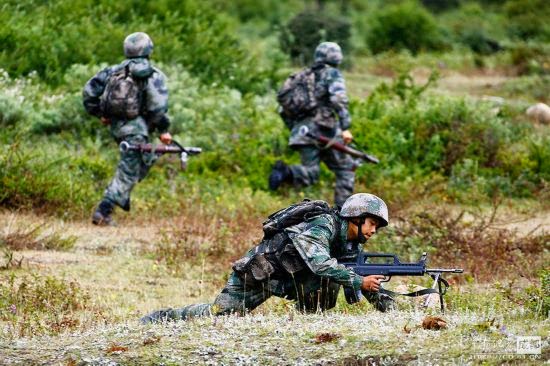
In the meantime, the 'training' of the different units based on the plateau continues.
According to The PLA Daily: "a battalion successfully conducted a tactical drill at the foot of Mount Tanggula in Tibet on Dec. 20, 2014. It’s a great challenge for soldiers to complete missions in the severe cold of a 5000-meter-high plateau."
Tangulla or Tangkha is located at the border between Qinghai Province and Nagchu Prefecture of the TAR. It is important railway station (the highest in the world?) midway between Xining and Lhasa.


Wednesday, September 3, 2014

Tibet: training with live ammunitions

In March, The Times of India reported that the Indian Army is “fast running out of ammunition”.
The daily affirmed: “Tanks and air defence units, artillery batteries and infantry soldiers are all facing the crunch. The Army is, obviously, tight-lipped on the ammunition shortage. But a simple calculation reveals that at present, it may not have enough ammunition reserves to sustain a full-fledged war for even 20 days.”
War wastage reserves (WWR) should be enough for 40 days of intense fighting, with 21 days earmarked for ammunition with shorter shelf-life.
The then Chief of Army Staff, General Bikram Singh had stated that “if there is proper budgetary support for the new ammunition roadmap, the Army should have 50 per cent WWR and three years of training ammunition by 2015.”
It does not seem the case in China where the PLA is conducting frequent trainings with live ammunitions.
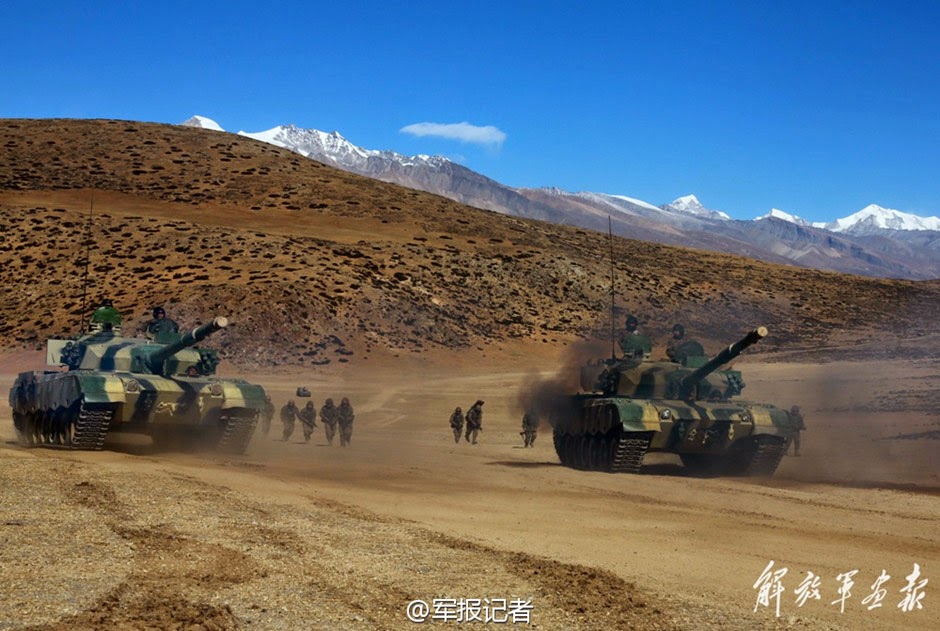
China’s Ministry of Defence published photos of “a scene of the heavy artillery in the joint drill. The tank battalion of an armored regiment under the Xinjiang Military Area Command (MAC) of the Chinese People's Liberation Army (PLA) conducted a joint drill on a snow-covered plateau on August 31, 2014.”
The caption under a picture is “a tank group is about to set out. The tank battalion of an armored regiment under the Xinjiang Military Area Command (MAC)”. Another picture is described as “a tank group is firing at the target.”
The photos seem to have been taken in the Aksai Chin region, opposite Ladakh.


Obviously there is no lack of ammunitions in China.
Another example: between August 24 to 29, China hosted a ‘Peace Mission 2014’ with other States of the Shanghai Cooperation Organization (SCO). Held at Zhurihe training base in Inner Mongolia, it is the largest joint military drill ever organized by China, according to Yang Yujun, a Chinese Defense Ministry spokesperson.
Officially, the drill aims at countering ‘terrorist forces’, particularly the East Turkistan Islamic Movement, based in Xinjiang (and trained in Pakistan).
Yang stated that the exercise played an important role in deterring the ‘three evil forces’ of terrorism, separatism and extremism, safeguarding regional peace and stability and improving the military's ability to coordinate the fight against terrorism.
Here again training with live ammunitions was displayed.
On the Eastern 'Indian' front, north of the McMahon line, regular trainings are also being held.
The People's Daily shows some new all-terrain vehicles recently introduced in the  PLA, and used for the first time for military exercises in the Tibet Military District of Chengdu Military Area Command.


 Here too, live ammunitions are used for the training.
Though in the same series, the last picture may have been taken from another location.

Wednesday, August 20, 2014

Train, Don't be corrupt says General Fan in Tibet

General Fan Changlong (right)
with President Xi Jinping earlier in Xinjiang
On August 17, Xinhua reported that General Fan Changlong, a member of Communist Party’s Politburo and Senior Vice Chairman of the Central Military Commission (CMC) visited Tibet and Qinghai to inspect the forces “stationed on the snow-covered plateau, the loyal soldiers defending the frontiers”.
According to Chinese media, he brought to the troops the sincere greetings of the President Xi Jinping and the Central Committee and convey their high esteem.
General Fan requested the armed forces to thoroughly study and implement President Xi’s series of important speeches about the situation in the Party (read the corruption cases against Zhou Yongkang and others ‘tigers’).
The focus of the defense forces, said General Fan, should be on fighting and be prepared to win a war. For this, they should grasp the importance of military training, the importance of improving the military capability to fulfill the mission and the tasks entrusted by the Party and the People.
General Fan Changlong pointed out that combat training is an important task for the preparation for military struggle; it is the basic starting point.
Interestingly, Chinese reports did not mention which units he visited, how long he stayed in Tibet and Qinghai, where he went; we don’t even know when his visit took place.
It however appears that he was accompanied by three Military Region Commanders (Lt. Gen. Liu Yuejun, commander of the Lanzhou Military Region, Lt. Gen.Zhao Zongqi, Commander, Jinan Military Region and General Li Shiming, Commander, Chengdu Military Region).
What was doing Lt. Gen. Zhao Zongqi around is not clear, though having been posted for some 20 years in Tibetan Military District, he certainly knows the ground.
The main purpose of general Fan's Tibet tour was most likely to convince the PLA officers that they should follow Xi Jinping in his crusade against corrupt officers.
Xinhua reported that General Fan told the army to firmly obey the command of President Xi Jinping and the Communist Party of China (CPC) Central Committee.
China's senior-most general told the troops that “the army and the armed police should resolutely implement the strategies made by the CPC Central Committee and Xi, also the CMC Chairman, and uphold the correct decisions to investigate Zhou Yongkang and punish Xu Caihou.”
General Xu Caihou, a former vice chairman of the CMC (like Fan) was expelled from the CPC for suspected bribery in June. He is the senior most officer to have been ‘expelled’ in the history of the PLA.
To follow the orders of Chairman Xi was important, said Fan; the defence forces should implement the instructions by achieving ‘Four [questions] to Ask’.
What are these ‘Four to Ask’? It is not very clear, as often when written in Communist jargon, but according to the Chinese media:
  • To ask oneself whether one follows the correct guiding ideology in training, whether the practices followed are correct to [avoid] other negative phenomena [i.e. corruption?];
  • To ask oneself whether the organization of scientific [modern] training, training strategy, training tactics, training style is correct to remove the squeamish;
  • To ask oneself whether the conditions are in place for the training [no corruption?] and to strengthen the various types of training bases and venues [in order to get] comprehensive benefits;
  • To ask oneself about the meaning of strict inspection and supervision of training, while one should not be afraid to do mistakes, afraid of messed up, not afraid to reinvent the wheel during the drills.
In the recent months, the Central Military Commission has been insisting on the importance of ‘training’.
For example, China Military Online yesterday announced a free air-combat confrontation drill between an aviation detachment equipped with several fighters belonging to the East China Sea Fleet of the Chinese People's Liberation Army Navy (PLAN) and a troop unit under the PLA Air Force (PLAAF). The announcement says that it is a first in the history of the PLAN and the PLAAF: “The free air-combat confrontation drill will be conducted on the one-to-one and two-to-two basis respectively among the two sides' third-generation fighters. The drill will focus on studying how to deepen the joint operations and improve the joint-combat capability by carrying out the air-combat confrontation.”
It probably means that in the past, the PLA, PLAN and PLAAF had forgotten to prepare themselves for war as they had been engaged in more lucrative activities. President Xi seems determine to change this.
The question remains, why to make this announcement in Tibet?
Does it mean that many corrupt officers are posted on the high plateau?
Probably, otherwise how to interpret this semi-clandestine visit of General Fan Changlong in Tibet.