Monday, July 29, 2019

Reopening the Old Borders

Indus river in the vicinity of Dumchele
We are often hearing questions about what could be suggested as possible Confidence Building Measures (CBMs) between India and China.
I give here a few suggestions for the border in East Ladakh.
One could add joint patrolling in 'semi' disputed areas; by 'semi' disputed, I mean areas where both parties agree on the area disputed (which is often not the case).  

Reopening Demchok
A way forward could be to do what was not done in 1954 during the negotiations for the so-called Panchsheel Agreement: open the Demchok route for the pilgrims visiting Kailash-Manasarovar.
Of course, that would be a first step; the next one being to reopen the border for trade; it could also be done the other way round (first trade, then yatra), if both countries find it more acceptable.
Remember the skirmishes in Sikkim at the end of the 1960s !
When the Nathu-la pass was officially reopened to trade in July 2006, it had the effect of ‘fixing’ the border, drastically reducing the tensions in the area.
Considering the ‘Nathu-la’ effect; reopening Demchok route could be an excellent CBM between India and China in Ladakh.
For years, the people of Ladakh have asked for the reopening of the ancient route.
Why is Beijing, constantly speaking of Old Silk Roads, so reluctant to let people and goods flow again over the Himalaya? 
Why can’t China allow trade and the devotees keen to go to Kailash-Manasarovar to use the easiest route via Demchok?

An alternative to Demchok
If China refuses to open Demchok, for whatever reasons, an alternative would be Dumchele.
Very few in India have heard of Dumchele, a place located east of the Indus river, on the Chinese side of the Line of Actual Control (LAC) between India and China; it used to be marked as a ‘grazing ground’ on old maps of the British Raj.
A couple of months after the 1962 border war, Dumchele appeared for the first time in the correspondence between India and China. On January 4, 1963, Delhi complained that China had an “intemperate and blatantly aggressive attitude”.
One of the examples given was that on October 22, 1962, the Chinese forces had attacked Indian posts at Chang-la, Jera-la and Demchok and occupied “fresh Indian territory upto Dumchele, east of Fukche.” Fukche was then an advanced Landing Ground (ALG) then used by India, West of the Indus.
Since then, the situation has stabilized and the Indus river has become a more or less agreed LAC till Demchok, located some 50 km South of Dumchele.
Though Dumchele is one of the 12 places where India and China have a difference of perception on the location of the LAC, this is not an insurmountable difficulty; The Hindustan Times recently mentioned the opening of a trading post which “could open as soon as the end of the year”.

From Smuggling to Trading
If the political leadership decides so, Dumchele could also become a new Border Personnel Meeting (BPM); presently the meeting points between the Indian and Chinese armies in Ladakh are located at Chushul and Daulat Beg Oldi (known as DBO).
Though Demchok, the historical landport would temporarily be set aside in favour of Dumchele which was the main smuggling center between India and China in Ladakh till 2016, when it was stopped for security reason.
The opening of Demchok or Dumchele would boost the local economy (both sides) and satisfy the local Indian sarpanches …and one day, one can dream of a new route (without crossing a single pass) to Mt Kailash. It would then become the fastest and easiest access to the holy mountain.
It could be an important step on the path of peace and would show China’s sincerity to open its frontiers with its neighbours.
Practically, it would mean, building a bridge over the Indus and build a tar road from Dungti to Dumchele. Technically, it is not a very difficult proposition.

Another possibility
Another feasible alternative would be to give Indian pilgrims access to Gunsa Ngari (Ali) airport.
Recently a two-day meeting between the representatives of the aeronautical authorities of Nepal and China was held to discuss issues pertaining to bilateral air transportation under an Air Services Agreement signed by the two countries.
According The Global Times: “As per the MoU signed between the two sides today, the Chinese side has agreed to designate eight more destinations in China for flights operated by Nepali Airlines, in addition to the existing seven destinations viz., Beijing, Shanghai, Lhasa, Guangzhou, Kunming, Chengdu and Xi’an.”
But more interesting for our purpose, the Chinese tabloid notes: “The two sides also reached a common understanding that after the development of adequate technical facilities at Gunsa Airport in Tibet, flights of Nepalese airlines would be allowed to land at that airport while circumnavigating Mt. Kailash as part of mountain flight.”
Then only a few hours will be necessary for the yatris to reach the base camp of the pilgrimage (via the beautiful G219 highway).
Opening Gunsa airport to Indian flights could be a serious alternative for the Kailash-Manasarowar yatris (especially old ones); the Indian pilgrims could fly from Dehra Dun (Uttarakhand) or Leh (Ladakh) airports after proper acclimatization in the lines of the ones, organized by the Government of India in Pittoragarh district for the Lipulekh-la route or near Gangtok for the Nathu-la one.
This would give a boost to the economy on both sides of the frontier, and show China’s goodwill.

Saturday, July 27, 2019

The succession challenge

The Chinese Panchen Lama (here near Mt Kailash)
is used by Beijing's propaganda
My article The succession challenge appeared in the Edit Page of The Pioneer

Here is the link...

The Lama had made it clear in 2011 that he shall leave clear instructions about who should succeed him. This should clear doubts and cut out the Chinese propaganda

China has mastered the Art of Information Warfare.
We saw it during the Doklam episode, though caught on the wrong foot on the ridge at the border of Sikkim and Bhutan, the Chinese spokespersons managed to convince many Indian scribes of the validity of a defunct 1890 Convention between the Manchus and British India.
More recently, the Dalai Lama was the victim of the Chinese propaganda; for the purpose, Beijing used some Indian journalists ‘invited’ to Tibet for a trip, to ‘see the facts’ for themselves.
On their return, one of the correspondents, quoting the Chinese authorities, wrote: “The successor of the Dalai Lama has to be decided within China and any interference by India on the issue will impact bilateral ties.”
The message that Beijing wanted to pass was faithfully reported by the gullible Indian scribe who quoted one Wang Neng Sheng, Director General (of Propaganda) in the Tibet Autonomous Region’s administration: “The current Dalai Lama was recognized by Beijing and his successor must be found through the ‘draw of lots in golden urn process’ within China. The Dalai Lama’s reincarnation is not decided by his personal wish or by some group of people living in other countries.”
The ignorant Wang was probably unaware that no golden urn was used for the selection of the present Dalai Lama; but propaganda does not need to stick to facts.
Another official, Zha Luo, director of the China Tibetology Research Centre in Beijing confirmed that “any refusal by India to recognise the next Dalai Lama to be chosen within China will impact bilateral ties.”
In other words, if Delhi does not kowtow to Beijing’s choice, there will be ‘consequences’.
It was enough to provoke a flurry of reactions from Dharamsala, the headquarters of the Central Tibetan Administration and from elsewhere India.
A Tibetan official, Tsewang Gyalpo Arya stated: “The Chinese officials pointed out two things as important historical criteria for the selection of the Dalai Lama’s reincarnation. First, the selection should be within China based on the 200-year old historical process. Second, it should have the approval of the Chinese Central government.”
Arya argued that the Golden Urn procedure and the approval of Chinese central government were not mandatory for the recognition of a Dalai Lama: “It is an aggressive and ignominious attempt on the part of the Chinese leadership to distort the ancient religious tradition of Tibet to serve its current political agenda.”
The problem is that the sometimes mischievous Dalai Lama has in the past given ‘controversial’ statements to the press. One, which recently made the headlines, was to Rajini Vaidynathan, a BBC journalist, who was obviously more interested by her audience rating than by a deeper understanding of a complicated question.
When Vaidyanathan asked the Tibetan leader about ‘returning’ as a female, the Dalai Lama said with his characteristic humour that his successor could be a woman, but she ought to be ‘attractive’.
Vaidyanathan used her Twitter account to spread excerpts of the ‘controversial’ video in the social media; the Tibetan leader had to sadly apologize for his ‘misogynist’ remarks.
I remember asking him this question about a female Dalai Lama more than 15 years ago; he had smiled and explained that it was possible, there was no bar on this in Tibetan Buddhism and he had added that if it was useful for the Buddha Dharma and the Tibetan cause, “why not?”
The issue remains that his Office should be aware that the world has changed, and today rogue journalists are only interested in sensationalism.
In any case, Chinese propaganda and ‘modern’ journalism do not help to clarify the complicate issue. The succession is indeed a serious affair, not only for China which has been working hard to prepare a post Dalai Lama scenario with a few pliable Tibetan Lamas presently living in Tibet, but it is also crucial for the Tibetans (in exile and in Tibet) and for India as well.
The succession process could go two-ways, first a ‘traditional’ reincarnation with the huge problem of having a child and later a teenager for two decades at the helm; the other solution would be an ‘emanation’; the latter system is favoured by many as it would bring some stability in the system (and disarm the Chinese ‘religious fervours’); it practically means that the Dalai Lama would ‘emanate’ in a young boy and groom him as his successor.
Though the Indian government would probably not interfere, it still has vital stakes in the outcome (particularly in relation to the Himalayan populations from Ladakh to Arunachal Pradesh).
After the BBC incident, the Dalai Lama declared: “One day you will hear that the Dalai Lama has passed away, but I will come back, even if the institution of Dalai Lama is no longer recognised. I will be back.”
That is the real question: will Tenzin Gyatso come back as a Dalai Lama?
In another statement to The Week, he said that the rule-by-reincarnation system is feudal and may be discontinued.
The result of all these declarations is that the Chinese are confused; but for them to bank on their own Dalai Lama may be risky.
They should also remember the case of the Tenth Panchen Lama, who in May 1951 was forced on a weak Tibetan government by China, against a candidate selected by Lhasa. From his early years, the boy was groomed by Communist China as a ‘model lama’. But slowly over the years, he became his own man. In 1964, a few years after the Dalai Lama had taken refuge in India, in a speech in Lhasa, the so-called puppet Panchen Lama told a large audience: “Long Live to His Holiness the Dalai Lama”. He was immediately arrested and only released in 1978 with the help of Xi Zhongxun …President Xi Jinping’s father.
Again in 1989, while visiting his monastery near Shigatse, he questioned the 30-year occupation of China; a few days later, he died of a heart attack.
The case of the Tenth Panchen Lama proves that China would be wrong to take a Tibetan for granted, even if he is chosen by the Party.
In 2011, the Dalai Lama had clearly stated: “I shall leave clear written instructions about this.”
It is perhaps time that he announces that instructions about his ‘succession’ have already been given, thus removing the doubt in everybody’s minds and cutting out the Chinese propaganda.

Tuesday, July 23, 2019

Chinese Trains are India's Bane

A Train to Yatung, near Sikkim?
My article Chinese Trains are India's Bane appeared in Mail Today on July 15.

The People’s Liberation Army (PLA) walked into Lhasa, the Tibetan capital, in September 1951. Immediately, the generals leading the ‘Liberation of Tibet’ put their troops to work; they had to build motorable roads on two main axes, Lhasa-Sichuan and Lhasa-Qinghai, as well as on feeder roads towards India’s border, particularly the southern route, Lhasa-Gyantse-Yatung, near the Sikkim border. The PLA managed this feat in five years.


Challenge at Nyingchi
Since a few years, Beijing seems to be caught by a comparable frenzy, but this time, it is trains that China is planning to bring onto the Tibetan plateau; the Communist leadership noticed the success of the Qinghai-Lhasa railway which reached Lhasa in July 2006, for developing the plateau, as importantly, ‘stabilizing’ the restive Tibetan populations …and defending the borders against India.
On July 9, Xinhua announced: “The building of the Sichuan-Tibet railway is picking up steam, with construction work on nine new stations on the Lhasa-Nyingchi section in the Tibet autonomous region to begin soon.”
Let us not forget that Nyingchi prefecture faces Arunachal Pradesh.
The laying of track on the 435-kilometer line is the easiest part of the Sichuan-Tibet railway; Xinhua said that “trains travelling at 160 kilometres per hour are expected to begin running by 2021.
The news agency further explained that the Sichuan-Tibet railway was first proposed more than a century ago, “the idea was revived after the foundation of the People's Republic of China in 1949, but various hurdles prevented it from progressing.”
Today trains are already running on the section between Chengdu and Ya'an in Sichuan province.
The toughest and most strategic section (and worrying for India as it can bring troop reinforcement in a short time to any Himalayan front) is from Ya'an to Nyingchi, “one of the world's most challenging railway projects because it winds through the Sichuan Basin, Yunnan-Guizhou Plateau and Qinghai-Tibet Plateau, climbing from 600 meters above sea level to nearly 4,500 meters.”
Zhao Jian, a professor of rail transportation at Beijing Jiaotong University, told Xinhua: “It will go through complicated geological conditions fraught with avalanches, landslides, earthquakes, heat, karst caves and underground streams.”
According to Peng Qinghua, Sichuan’s Communist Party Secretary, “Bridges and tunnels will cover over 90 percent of the line, which means there will be nearly 800 km of tunnels and more than 100 km of bridges."  It is hard to believe. Can China succeed is another question.
In the meantime, China is building a railway line to Nepal which will reach Kathmandu in a few years.
The think tank The Third Pole questioned: “China-Nepal railway: fantasy or reality?” The reporter noted: “The world’s toughest rail route, from Kerung (or Kyirong) in Tibet to Kathmandu, is struggling to get off the ground amid growing fears of debt, earthquakes and benefits bypassing local communities

Track to Kathmandu
In Rasuwa Gadhi, the small village located at the Nepal-China border, 170 kilometres north of Kathmandu, Chinese workers are already busy building a bridge that will link the two countries. The article observed: “The border only opened after the devastating Nepal earthquake in 2015 led to China closing the badly damaged Kodari route. It is also where the new railway will enter Nepal from Tibet;” it further commented: “locals have dubbed the project kagat ko rail (paper railway) and sapana ko rail (dream railway).”
But as it is part of the Chinese Dream of the Great Rejuvenation of the Chinese nation, dear to President Xi Jinping, it is bound to be implemented!
The Global Times, the Chinese Communist Party mouthpiece, asserted: “Most importantly, China's development has made it impossible for any force to make Nepal a pawn in strategic arrangements to counterbalance China's influence.” The tabloid points a finger at the US influence in the land-locked country: “China's development has provided Nepal with the potential of benefit sharing. The China-proposed Belt and Road Initiative has brought the country unprecedented opportunities by linking it to its surrounding areas and the world. Nepal will no longer be closed and poor, but will be an essential hub to connect East, South and Central Asia.”
This remains to be seen, but the train to Kathmandu is undoubtedly a tool to realize this dream-program.

After Tibet, Sikkim?
On the eastern front, a rail route linking Lijiang to Shangri-La, the tourist spot in Tibet (both are located in Yunnan Province), should start operating at the end of next year; the 139-kilometer Lijiang-Shangri-La line will link Kunming, capital of the province and Chengdu in Sichuan Province, via the Kunming-Dali rail line, allowing passengers to make round trips between Kunming and Shangri-La within one day.
An even-more worrying project for India is the railway line to Yatung, near the Sikkim border.
In 2017, a 'Tibet-South Asia' promotion meeting for travel agents was held in Lhasa; the theme was ‘crossing Himalaya, rambling paradise in the clouds’. What was the objective of the gathering?
Travel agencies made some recommendations for outbound ('out of Tibet') tourism products for Nepal …and other South Asian countries.
According to Qiao Zhifeng, director general of Yatung Tourism, the County has rich touristic resources. The train planned between Lhasa and Yatung would drastically increase this potential …and help India, said Qiao!
In July 2015, Ananth Krishnan wrote in The Daily Mail: “Local officials in Yatung say a line running to the India border could transform the currently paltry $15million border trade, which relies on a small border market in Yatung.”
The problem is that India has not been consulted.
In 2018, Yatung already received 1.2 lakh Chinese tourists, an increase of 43% over the previous year. Once the train comes, several lakhs of visitors will come within a short distance of the Indian border and let us not forget that the infrastructure in China is dual use, military and civilian.
What would happen in the case of a new Doklam incident?

Sunday, July 7, 2019

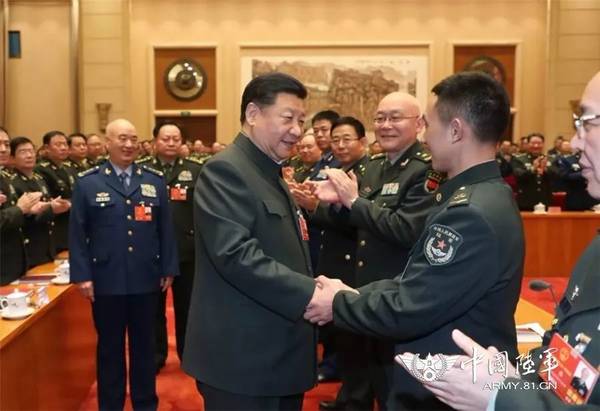
How many Tibetans in the Liberation Army? A difficult guess!

Chairman Xi meeting a young Tibetan Officer at a NPC meet
In an interview to The Week, the Dalai Lama recently said that “the Tibetan issue is no longer a struggle for political independence”. He asserted that there is a need to focus on preservation of Tibet's cultural, religious and linguistic identity.
The Tibetan leader added that “Political independence is mainly meant for the happiness of the people, but does it alone guarantee happiness.”
This can’t be argued that Independence alone does not provide happiness.
The Dalai Lama also stated that “There is a growing feeling among the top leaders in China that their policies have not been able to solve the Tibet issue in the last 70 years. So they should follow a more realistic approach. Even though Tibet was an independent country, politically China occupies Tibet today.”
It is not certain that the top leadership in China believe that Beijing’s Tibet policies have not solved the Tibetan issue for good.
Looking at some current development, it seems the opposite.
The Dalai Lama concluded: “Under the given circumstances, I have been saying for some time now that there is a need to focus on preservation of Tibetan culture, religion and identity. It is no longer a struggle for political independence."
That is an aspect of the problem.

Tibetans in the Communist Party
Another issue should be worrying for India (if not the Tibetans): if the Tibetans become ‘Chinese nationals’ what will happen to the ‘Sino-Tibet’ border? Can we envisage Tibetans fighting Indians soldiers in the Himalaya one day?
A few days ago, The Tibet Daily in Lhasa published a Statistical Communiqué issued by the Tibet Autonomous Region’s (TAR) branch of the Communist Party of China.
On December 31, 2018, the total number of party members in the Autonomous Region was 382,000, a net increase of 18,000 from the previous year.
Further the Party has 21,000 grassroots organizations, an increase of 6.2% compared to 2017. Among them, there are 2,200 grassroots Communist Party’s Committees.

About Party members
•    Out of 382,000, there are 111,000 female party members, accounting for 28.8% of the total number of party members.
•    There are 312,000 minority party members, meaning Tibetans, which make 81.7% of the Communist card holders are local Tibetans. This represents more than 10% of the entire population of the TAR. It is consequent amount of the population who, for whatever reasons, are ‘Communists’ and working for China’s present ethos.
Some 113,000 party members aged 30 and below
71,000 party members aged 31 to 35
51,000 party members aged 36 to 40
39,000 party members aged 41 to 45
34,000 party members aged 46 to 50
24,000 members are between 51 to 55
18,000 party members aged 56 to 60,
and 32,000 party members aged 61 and over.
It shows that a lot of young Tibetans have joined the Communist Party.

•    Job Repartition
There are 13,000 workers (and technicians)
189,000 farmers and herdsmen
47,000 professional and technical personnel in enterprises, institutions and social organizations,
15,000 enterprises and institutions, social organization management personnel,
and 77,000 working in government organs.
Few others are students, professional staff and retired people.
A lot more statistics are given which is not useful to repeat here.

By the end of 2018, there were 77,000 applicants for party membership.
• There are 81 local Communist Party Committees at all levels of the party. Among them, there are 1 Party Committee for the TAR, 6 Municipal Committees (prefecture/city level) and 74 County (dzong) Committees.
• Cities, townships, neighborhood committees and villages have also Party Committees.
• 12 cities, 685 townships, 217 neighborhoods and 5261 recognized villages are covered by Party’s Committees.
• All the 44,000 government agencies in the region have established a Party organization.
• Some 2 million of institutions in the TAR are covered at 99.3% by Party organs; so are the public enterprises at 99.7%.
All this, of course, does not automatically bring happiness.
How the Dalai Lama’s scheme of ‘genuine autonomy’ fits into this scenario is not clear.

More worrying
But the most worrying aspect is the large presence of ethnic Tibetans in the People’s Liberation Army (PLA) and the People’s Armed Police (PAP).
There are no reliable figures, as the Party obviously does not want the people to know how successful the integration of the Tibetan population into the PLA/PAP has been.
This should however cause genuine concerns in India.


How to find out?
For the PLA/PAP, one way to guess is to look at the composition of the local institutions which is in China often based on representative percentages.
If one takes as an example the composition of the 11th TAR People's Congress and the size of the PLA & PAP delegation in it; The Congress has 53 defense delegates (mostly middle level officers with a few senior officers). There are 31 are Han Chinese, 20 Tibetans, one Manchu and one Hui.
Of course, the Tibetan representation in the PLA/PAP is very far from this percentage, but it could indicate, future projections for the Party.
Today, the ‘ethnic’ representation in the PLA/PAP could be at the most 10% of troops serving on the plateau. But the above figures of the Regional Congress’ representation could suggest that in the future the Chinese aim to have a have a pool of junior officers in the TAR reaching 25-30% of the total PLA/PAP personnel posted in Tibet.
It will of course take a long time, as trust of the ‘ethnic minority’ is still lacking today.
This is a serious matter, which needs to be looked into by the Tibetans and India as it has serious implications for the future of the borders.
Incidentally, it is worth looking at the PLA delegation at the National People’s Congress (NPC). There are 269 members in the PLA/PAP delegation, out of 2980 members (75% are new faces).
In the PLA/PAP delegation are represented:
•    The Commanders of the Five Services
•    The Directors of the 15 Departments and Commissions
•    The Commanders of the Five Theater Commands (including Gen Zhao Zongqi for the Western Theater Command)
•    The Commandants of Military academies like the PLA National Defence University
•    and ‘Unknown’ soldiers/officers
Before the NPC gathering in March, it was announced that the current structure of the PLA delegation “has been optimized and fully demonstrated the Universality, Advancement and Representation. All the deputies are outstanding members drawn from all fronts.”
There are three relatively junior Tibetan officers in the Delegation:
Name: Yuk Bak Chu (?)
Delegation: PLA & PAP (1st Lt)
Ethnicity: Tibetan from Kangding, Sichuan
Date of birth: March 1989
Current position: deputy to the NPC
Name:  Tsering Tashi (?)
Delegation: PLA & PAP (Lt)
Ethnicity: Tibetan from Shannan
Date of birth: June 1990
Current position: deputy to the NPC
Name: Yang Chu Geshe (?)
Delegation: PLA & PAP (Sergeant)
Ethnicity: Tibetan from Aba, Sichuan
Date of birth: July  1990
Current position: deputy to the NPC
It is a fact that the leadership in Beijing does not fully trust the Tibetans, but there is nevertheless a clear will to bring more junior and middle-level Tibetans on board. Once again, it will become a challenge for India in the future, especially in the context of a post-Dalai Lama scenario.
Happiness is still a far away dream for the Tibetans; the Indian population bordering Tibet/China too, may suffer about the 'ethnic' changes in China's defense forces.

Friday, July 5, 2019

Lambs before the dragon

My article Lambs before the dragon appeared in the Edit Page of The Pioneer.

In other continents, too, nations have to kowtow to China in return for investment and debt funding, though they are slowly waking up to the fact that all is not rosy

China has managed to tame the wild Tibetans yaks, according to Xinhua: “Under the touch of the petite scientist Yan Ping, the tall and powerful black yak, weighing over 400 kg, is as obedient as a lamb.” And the news agency adds: “Unlike other yaks, this one has no horns.”
Yan, who works for the Lanzhou Institute of Husbandry and Pharmaceutical Sciences explained: "The Ashidan yak has no horns and has a mild temperament, easy to keep and feed.”
Beijing seems to have developed some expertise in taming humans and nations too.
The Taiwan News reported “Manila kowtows to Beijing, cedes Exclusive Economic Zone in South China Sea.”
The once-wild President of the Philippines, Rodrigo Duterte is said to have ceded “ground in the South China Sea through an ‘informal’ and ‘undocumented’ [agreement] with President Xi Jinping.”
The Taiwanese newspaper noted that many citizens of the Philippines were “already concerned over the government’s unwillingness to safeguard the territory of the country’s Exclusive Economic Zone (EEZ).” The article concluded that this makes the Duterte government appear even weaker on protecting the nation’s maritime territory.
But it is not only the Philippines which have been tamed and have accepted Beijing’s diktats. India’s Northern neighbour, Nepal, seems to have fallen in the trap.
Newsgram, an independent media agency, recently pointed out that it is the Nepal Government in Kathmandu which forces local journalists to avoid critical reporting on China, the largest investor of the Himalayan land-locked nation.
Anil Giri, the foreign affairs correspondent for The Kathmandu Post, told Voice of America that “journalists are discouraged from covering Tibetan affairs to mollify China and that government officials shy away from commenting on China-related issues. China sponsors junkets for Nepalese journalists and that’s why probably we don’t see lots of criticism about China’s growing investment in Nepal, Chinese doing business in Nepal and China’s growing political clout in Nepal.”
The lamb-lamb attitude in Kathmandu appeared in an incident which recently took place at the Tribhuvan International airport in Kathmandu; The Himalayan Times reported: “Man labelled Dalai Lama’s agent, deported to US”.
Apparently the Nepal immigration mistook a Tibetan called Penpa Tsering, holding a US passport and arriving from the US, with his homonym the former Dalai Lama’s Representative in the US; Nepali officials argued that the man was ‘on China’s most-wanted list’. In Dharamsala, the former Tibetan Representative observed: “It clearly shows that the Chinese government’s pressure on Nepal is working.”
Nepal’s Home Minister Ram Bahadur Thapa affirmed that the deportation was only an act “of honouring the ‘One-China’ policy.”
A few weeks earlier, two members of Nepal’s Parliament, Ekwal Miyan and Pradip Yadav had to apologize for having attended the 7th World Parliamentarians’ Convention on Tibet, which was held in Latvia’s capital Riga between May 7 and 10, after Beijing pressurized Kathmandu.
In a joint press statement, the two MPs declared that they “happened to inadvertently attend the conference …due to wrong information …when they were on a private visit to Turkey, Switzerland and Latvia.”
They had even given speeches by mistake!
It shows how China can today dictate terms to ‘small’ countries like Nepal.
At the same time, Xinhua proudly reminded its readers that in the summer of 1921: “a dozen Communist Party of China (CPC) members were forced to leave a small building in the French concession area of Shanghai, and boarded a boat on Nanhu Lake in Jiaxing, Zhejiang Province, concluding the first National Congress of the CPC. …Since then, the [Communist] Party has managed to lead a vulnerable country to move closer toward the world's center stage.”
The news agency asserted: “The Chinese nation has stood up, grown rich and is becoming strong. …Socialism with Chinese characteristics have maintained stability and vitality in the tide of global changes.”
The Tibetans, who have been tamed more than 60 years ago, are an easy prey. A couple of weeks ago, a Tibetan minister in the Central Tibetan Administration (CTA) in Dharamsala was denied a visa to attend a conference in Mongolia. Karma Gelek Yuthok, Minister of Religion and Culture was to attend the Asian Buddhist Conference in the Mongolian capital, Ulaanbaatar. The minister could only say that it was “the clearest sign yet of China’s aggressive campaign of undermining core democratic freedoms across the world.”
On the Roof of the World, China has now all the cards in hand to nominate its own 15th Dalai Lama. Gyaltsen Norbu, the Panchen Lama selected and groomed by Beijing has been elected as the President of Tibet’s Branch of the Buddhist Association of China. Gyaltsen Norbu recently visited Thailand; on his return to Beijing, he affirmed “We are fortunate to be in the era of the development and rise of New China, and thank the Communist Party of China for leading the Chinese people in achieving the tremendous transformation of standing up, growing rich, and becoming strong.”
In other continents too, nations have to kowtow, though they are slowly waking to the fact that all is not rosy; the examples of Sri Lanka and the Maldives are often cited, but in Africa too.
The Ethiopian Business Review recently had a cover-story: “Africa falling into debt-trap” while The African Exponent, an online outlet for African news dared to write: “Horror Awaits African Leaders as China Withdraws Debt Funding”. It explained: “After an impressive run of a good relationship with China, scooping up at least $9.8bn between 2006 and 2017, making it Africa’s third-largest recipient of Chinese loans, the good ‘friendship’ between the two countries seems to have come to a snag,” commented the Review.
The reporter noted that in September, China promised another $60bn in aid and loans to the continent: “Xi Jinping promised the money would come with no political strings attached’.”
But all good things have an end. When Uhuru Kenyatta, the Kenyan President visited to China in May “the atmosphere that greeted him was unfamiliar to the China of old. Questions were raised about corruption, as well as the figures and sums [that Kenya] had proposed.” Kenyatta did not like it.
The Chinese even wanted to know if he planned to stand for office again in 2022: “It was like talking to the World Bank,” observed an aide to the Kenyan leader.
All this, as well as the recent events in Hong Kong, show that the taming of humans or nations cannot be taken for granted; nobody remains a lamb forever.

Monday, July 1, 2019

Red Star over Tibet

Phagpala and Gyaltsen Norbu, Beijing places its pawns
My article Red Start over Tibet appeared in Mail Today.

Rumours recently circulated about the Dalai Lama restarting negotiations with China. Nine rounds of fruitless talks were held between 2002 and 2010 between Lodi Gyari Rinpoche, the Dalai Lama’s Special Envoy and Zhu Weiqun of the Communist Party’s United Front Work Department.
Since then China’s control over Tibet has hardened; countries which earlier had some sympathy for the Tibetans, are now hostile.
Take the strange incident which took place at the Tribhuvan International airport in Kathmandu; The Himalayan Times reported: “Man labelled Dalai Lama’s agent, deported to US”.
Apparently the Nepal immigration mistook a Tibetan holding a US passport called Penpa Tsering arriving from the US, with his homonym the former Dalai Lama’s Representative in the US; Nepali officials argued that the man was ‘on China’s most-wanted list’. In Dharamsala, the former Tibetan Representative observed: “It clearly shows that the Chinese government’s pressure on Nepal is working.”
Nepal’s Home Minister Ram Bahadur Thapa affirmed that the deportation was only an act “of honouring the ‘One-China’ policy.”
A few weeks earlier, two members of Nepal’s Parliament, Ekwal Miyan and Pradip Yadav had to apologize for having attended the 7th World Parliamentarians’ Convention on Tibet, which was held in Latvia’s capital Riga between May 7 and 10, after Beijing pressurized Kathmandu.
In a joint press statement, the two MPs declared that they “happened to inadvertently attend the conference …due to wrong information …when they were on a private visit to Turkey, Switzerland and Latvia.”
They had even given speeches by mistake!
It shows how China can today dictate terms to ‘small’ countries like Nepal. This reminds me of what the 13th Dalai Lama, on his way to exile in India, writing to a British official in 1910: “Why do big insects always eat small insects?” More than 100 years later, the situation does not seem to have changed much.
In a similar incident with China, a Tibetan minister of the Central Tibetan Administration (CTA) in Dharamsala was denied a visa to attend a conference in Mongolia. Karma Gelek Yuthok, Minister of Religion and Culture was to attend the Asian Buddhist Conference in the Mongolian capital, Ulaanbaatar. For the minister, it was “the clearest sign yet of China’s aggressive campaign of undermining core democratic freedoms across the world, and even hampering the basic exercises of other countries through severe political intimidation.”
What could a Dalai Lama’s representative discuss with China in these circumstances? How could talks be meaningful?
Zhu Weiqun, recently came back from his supposedly retirement, reacted to Terry Branstad, the US ambassador’s visit to Tibet.
On June 9, he wrote in The Global Times, the mouthpiece of the Party, strongly criticizing the ambassador, who dared, according to him, to encourage Beijing “to engage in substantive dialogue with the Dalai Lama without preconditions.”
Not only was it blatant interference in China's internal affairs, said Zhu, but he also questioned the meaning of a ‘substantive dialogue’. Though time and again the Dalai Lama has said that he wanted an association, not a separation from China, Zhu still considers the Dalai Lama a splittist.
Already in 1981, Hu Yaobang, the CPC’s General Secretary had submitted to Gyalo Thondup, the Dalai Lama’s elder brother, a “Five-Point Policy towards the Dalai Lama”. The ‘conditions’ were not related to Tibet, but only to the Dalai Lama’s future.
Zhu Weiqun reiterated that there was nothing to discuss about Tibet, the ‘negotiations’ could only be about the condition of the Dalai Lama's return to the Motherland and his status ...in Beijing.
Beijing has other cards; it has taken a first step to nominate one day its own 15th Dalai Lama.
Gyaltsen Norbu, the Panchen Lama selected and groomed by Beijing has been elected as the President of the Tibet’s Branch of the Buddhist Association of China, replacing Drukhang Thubten Khedup, a Lama who had been officiating since 2003. Phagpalha Gelek Namgyal a stooge of the Communist Party since the 1950s was ‘invited’ to be the honorary president.
Interestingly, Gyaltsen Norbu recently visited Thailand; on his return to Beijing, he affirmed “that he was able to deeply appreciate the greatness of the motherland while he was in a foreign country.”
He was part of a Buddhist delegation led by Yanjue, the acting President of the Buddhist Association of China. It was Norbu’s first trip abroad, according to the Chinese media, which forgot that he had attended a conference in Hong Kong in 2012; of course, that was not counted as a foreign visit!
Norbu remarked: “We are fortunate to be in the era of the development and rise of New China, and thank the Communist Party of China for leading the Chinese people in achieving the tremendous transformation of standing up, growing rich, and becoming strong.”
In the meantime in Tibet, monks were invited to pass 'legal knowledge' examinations. Monks and nuns are supposed to specialize not only in the Teachings of the Buddha, but they need to grasp intricacies of mundane laws. The monks had to answer questions on the Chinese Constitution, the State Security Laws, Anti-Terrorism Laws, Anti-Spying Laws, Environmental Protection Laws, Internet Safety Laws and Regulations on Religious Affairs Matters. According to the statistics quoted by Xinhua, some 30,000 passed the examination.
Around the same time in Dharamsala, 45 regional chapters of the Tibetan Youth Congress elected new executive members and a new President, Tenzing Jigme who stated that economic and military development has no meaning unless matched by freedom for the people. He also declared: “Independence is our right. We are the rightful owners of Tibet. Irrespective of how strong China is we must continue to fight for our rights.”
If the Dalai Lama wants to negotiate a return to Tibet, he will have to take all this into consideration. The situation seems bleak today.

Thursday, June 27, 2019

Of Allies, New & Forgotten

My article Of Allies, New & Forgotten was published by Mail Today.

The relations between World powers is getting more complicated, more difficult to comprehend, simply because they are often based on deep prejudices.
In an interview to media outlet Mir TV, Russian President Vladimir Putin spoke of the US-Russia relations: “They are in fact deteriorating, getting worse by the hour.”
President Donald Trump had earlier called Russia an ally: he had affirmed that he and Putin discussed “forming an impenetrable Cyber Security unit” to stop election hacking. But that was months ago.
Today all is not well! The relations between the West and Russia have reached an all-time low.
On the occasion of the commemoration of the 75th anniversary of D-Day, CNN asked: “Why wasn't Putin invited to D-Day event?”
Putin had been attending such functions in the past. In 2014, he had gone for the 70th anniversary of the landings of the Allies. When asked why he was not invited, Putin tried to cool down the situation: “Why do I have to be invited everywhere to some event? Am I a wedding general, or what? I have enough of my own business. This is not a problem at all.”
But the general impression was that President Trump had influenced his ‘allies’, first Emmanuel Macron of France not to invite Putin.
CCN said that there is a longstanding Russian grievance: “The perception that the Soviet population's massive sacrifices in World War II have been somehow overlooked in the West.”
Putting aside the Second Front in Normandy, Putin explained: “The first [front] was with us [the Soviets]. If you count the number of divisions, the strength of the Wehrmacht [the German army] who fought against Soviet troops on the Eastern Front, and the number of troops and equipment that fought on the Western Front from 1944 on, then everything will be clear.”
Sixteen heads of States and Governments were represented in Normandy; apart from Macron, Trump and Queen Elizabeth II, leaders from Slovakia, Canada, Poland, Luxembourg, Norway, Belgium, and others such as New Zealand's Governor-General and the German Chancellor were in attendance.
Russia should have been present, when the countries pledged: “We salute the surviving veterans of D-Day and we honour the memories of those who came before us. We will ensure that the sacrifices of the past are never in vain and never forgotten.”
Le Figaro said that the explanations given by the Elysée (French President’s Residence) were rather confused: “It is a choice which has been made,” the newspaper was told. Under US influence …or threat?
Though russophobia has been running high in Europe since a few years, The Figaro, like most of the French press was surprised.; the national daily quoted Jean de Gliniasty, former ambassador of France in Russia (2009-2013): “Explanations [from l’Elysée] are not convincing, this choice is incomprehensible.”
The former diplomat, a specialist in Russian issues at the Institute of International and Strategic Relations (Iris) noted that "instead of going to the West to celebrate the victory over Nazism, Putin will take care of the Chinese [president] in Moscow and St. Petersburg.”
That is the issue.
The Western nations’ ‘hatred’ of Putin will only push the Russians into the arms of the Chinese. While the Western leaders were on the windy beaches of Normandy, Vladimir Putin received President Xi Jinping in pomp in St Petersburg for the inauguration of the 23rd St. Petersburg International Economic Forum.
Xinhua reported: “Hailing the beautiful scenery and attractive art and culture, Xi said St. Petersburg has witnessed a lot of significant historical events.” He pointed to the “huge sacrifices for the victory of the world anti-Fascist war and important contributions, and is the pride of Russia and the Russian people.”
Xi also recalled that the October Revolution which played an important role in the birth of the Communist Party of China.
Perhaps more importantly for the world, the Chinese president observed: “Under the current circumstances, the two sides should deepen strategic coordination, not only to safeguard the interests of China and Russia, but also to defend basic international norms and justice as well as world peace, security and stability.” There might be few takers for these pledges, but Putin added: “The more complex and volatile the international situation is, the more Russia and China should consolidate and deepen political mutual trust, boost coordination and cooperation in international affairs, and safeguard international law and basic norms of international relations.”
The Russian president gave a vivid account of how the two good friends “drank a shot of vodka together and sliced sausages”.
The South China Morning Post commented: “[Putin’s] comments come at a time when Xi is edging closer to the authoritarian Russian leader as Beijing’s relations with the United States become increasingly fraught. Their increasingly tight-knit relations are also a result of Donald Trump’s aggressive and capricious foreign policy.”
In fact, Beijing is a far more authoritarian regime that Moscow; just look at the recent events in Hong Kong, China’s pressure on Taiwan, the happenings in the South China Sea, the tragic situation in Xinjiang or Beijing’s constant support to Pakistan.
Nobody in the West seems to grasp this aspect.
In this polarized atmosphere, Prime Minister Narendra Modi arrived in Bishkek, the Kyrgyz capital for the Shanghai Cooperation Organisation Summit. He met both the ‘good friends’.
Indeed it is an achievement for India’s foreign policy that the Indian Prime Minister managed to be positive with both; India’s Foreign Secretary even announced that Xi confirmed his visit to India later this year. Earlier, Prime Minister Modi had tweeted that his meeting with President Putin was ‘excellent’.
And in ten days time, Modi will receive Mike Pompeo, the US Secretary of State.
In today’s world, nobody can be excluded, even the so-called ‘bad guys’. The West will have to learn this lesson the hard way one day.

Wednesday, June 19, 2019

China-Tibet concord dream fading fast

The Chinese Panchen Lama in Thailand: a political card?
My article China-Tibet concord dream fading fast appeared in The Asian Age and The Deccan Chronicle.

Here is the link...

One man has destabilized China. For the purpose, he has used something which hardly existed a decade ago, Twitter. Though his messages are sometimes eccentric, President Donald Trump has changed the course of the US-China relations. For the first time in recent years, the US has taken the ascendant on the Middle Kingdom in term of communication and propaganda.
This can be seen in all aspects of the bilateral relations.
As a result, Beijing feels insecure like never before; this probably explains the rare authorization given to Terry Branstad, the US Ambassador to China, to visit the Roof of the World between May 19 and 25; a first for a US ambassador since 2015.
A statement issued from Washington said that Branstad spoke his mind; he “urged China to open substantive dialogue with exiled Tibetan Buddhist leader, the Dalai Lama and give the Himalayan region’s Buddhists freedom to practice their religion.”
The State Department added that Branstad “raised our long-standing concerns about lack of consistent access to the TAR. …He also expressed concerns regarding the Chinese government’s interference in Tibetan Buddhists’ freedom to organize and practice their religion."
The ambassador visited several historic places such as the Potala Palace, the Jokhang Temple or the Norbulingka Palace linked to the Dalai Lama and when he met the senior Communist leaders, he encouraged them “to engage in substantive dialogue with the Dalai Lama or his representatives, without preconditions, to seek a settlement that resolves differences.”
All this was obviously not reported in the Chinese press.
Wu Yingjie, Tibet’s Communist Party Chief explained to the ambassador the ‘huge achievements’ undertaken for guaranteeing the rule of law, religious freedom and traditional culture.
According to the Communist Tibet Daily newspaper, Wu added that he sincerely welcomed more American friends to visit the TAR.
On the ambassador’s return, Beijing used a well-known hawk, Zhu Weiqun to counter the US diplomacy. Zhu, though retired, holds the honorific post of Chairman of the Ethnic and Religious Affairs Committee of the Chinese People's Political Consultative Conference; for years, as Executive Deputy Director of the United Front Work Department, Zhu was the interlocutor of the Dalai Lama’s Envoys (2002-2010).
Once, when asked whether if ‘religious’ members could be admitted in the Party, Zhu famously retorted: "No Chinese Communist Party members should be allowed to be religious."
On June 9, Zhu commented on the visit of Branstad to Tibet, in The Global Times, the mouthpiece of the Party. Zhu strongly criticized the ambassador, who dared, according to him, to encourage Beijing “to engage in substantive dialogue with the Dalai Lama without preconditions.”
This was not appreciated by Zhu (in fact by the Party, as the tabloid represents the Party’s views). Why?
Not only it was blatant interference in China's internal affairs, said Zhu, but he also questioned the meaning of ‘seeking a settlement without preconditions’ and the definition of a ‘substantive dialogue’.
Though time and again the Dalai Lama has said that he wanted an association, not aseparation with China, Zhu considers the Dalai Lama a splittist.
While giving an assurance that the CPC's Central Committee had not closed the door to contacts and negotiation with the Dalai Lama, Zhu showed the Party’s hard-line stance, “the proposed negotiation cannot come without preconditions.”
In my book The Negotiations that Never Were, I argued that the ‘talks’ never really took off, because the two sides did not speak the same language.
Already in 1981, Hu Yaobang, the CPC’s General Secretary had submitted to Gyalo Thondup, the Dalai Lama’s elder brother a “Five-Point Policy towards the Dalai Lama”. The ‘conditions’ were not related to Tibet, but only to the Dalai Lama’s future.
One of the Points said: “The central authorities sincerely welcome the Dalai Lama and his followers to come back to live [in China]. This is based on the hope that they will contribute upholding China's unity and promoting solidarity between the Han and Tibetan nationalities.” It was also said: “It is suggested that he not go to live in Tibet or hold local posts there. Of course, he may go back to Tibet from time to time.”
Zhu Weiqun reitarated that there was nothing to discuss about Tibet, the ‘negotiations’ could only be about the condition of the Dalai Lama's return to the Motherland and his status ...in Beijing.
Zhu explained: “First, it must be made clear that in nature, contact and consultation [these] are not talks between China's central government and the Tibetan government-in-exile or ‘Central Tibetan Administration’, nor are [they] ‘Tibetan-Han Talks’ or ‘Tibetan-China Talks’. The Dalai separatist political group is illegitimate and ineligible to have a ‘dialogue’ with representatives of the CPC Central Committee.”
Beijing wants only to talk to the Dalai Lama’s personal envoys.
Such conditions did not yield positive results during the nine rounds of ‘talks’ held between 2002 and 2010, when Lodi Gyari was the Dalai Lama’s Special Envoy.
The second point mentioned by Zhu was: “the Dalai Lama must accept Tibet as an integral part of China, abandon all attempts about so-called Tibet independence, stop all separatist and destructive activities, and recognize Taiwan as an integral part of China.”
Why Beijing wants to link Taiwan to Tibet is perplexing!
Regarding the second point, China has been insisting that the Dalai Lama agrees that historically Tibet has always been a part of China.
When a senior Tibetan exiled Lama went to China a couple of years ago, the Chinese told him that the Dalai Lama should sign a statement acknowledging that Tibet has been part of China since ancient times. This is obviously not acceptable to the Dalai Lama and the People of Tibet, as it is a falsification of history.
Taking a hard stand, Zhu affirmed that in these two preconditions “there is no so-called Tibet issue, but just the problem of the Dalai Lama.”
It means that today, the Chinese stand has not changed since 1981.
All this does not much leave any margin for substantive negotiations and the recent events in Hong Kong, the pressure in Taiwan and the tragic situation in Xinjiang do not indicate a positive change in the Chinese attitude.
Beijing is playing another card; on June 10, the official China News Service announced that Gyaltsen Norbu, the Panchen Lama selected by the Communist Party in 1995 had visited Thailand in May, “the first time he had ever left China”, while the boy chosen by the Dalai Lama as the 11th Panchen Lama still languishes for more than two decades under house arrest.
The announcement came nearly one month after Norbu’s visit; it show Beijing’s nervousness. Norbu just gave a speech at a Buddhist university, but his visit made him even more aware of the “greatness of the motherland and the Chinese Communist Party.”
Tibetans will not be fooled by such cheap propaganda. Substantive progress between the two parties seems to have slipped further away, with or without tweets.

Sunday, June 16, 2019

In the New Era: National Laws are Higher than the Buddhist Canon

Shangda Monastery in Chamdo area
The Chinese-selected Panchen Lama, Gyaltsen Norbu recently visited Thailand. On his return to Beijing, he affirmed “that he was able to deeply appreciate the greatness of the motherland while he was in a foreign country.”
It is a month after Norbus' foreign visit that Xinhua announced that he was part of a Buddhist delegation led by Yanjue, the acting President of the Buddhist Association of China, who traveled to Thailand to attend the ceremony on the occasion of festival of Vesak.
It was said that it was the Panchen Lama's first trip abroad.
Interestingly, Gyaltsen Norbu had spoken at a Buddhist conference in Hong Kong in 2012.
This is not counted as a foreign visit!
In Hong Kong, Norbu had said that he valued inner sciences.
In Thailand, he gave a speech on Let the Light of Compassion and Wisdom Shine upon the World, asserting that since he came “to the foreign country, he could personally better understand the vastness of the motherland, the profound cultural heritage of the Chinese nation, and the unity and harmony of the three major Buddhist communities in China.”
He remarked: “We are fortunate to be in the era of the development and rise of New China, and thank the Communist Party of China for leading the Chinese people in achieving the tremendous transformation of standing up, growing rich, and becoming strong.”
He further emphasized that he has a responsibility and an obligation to guide Tibetan Buddhism to adapt to the socialist society with Chinese characteristics, "to constantly adhere to develop Tibetan Buddhism in the Chinese context, to maximize the positive role of religion, and to make due contributions to safeguarding the unification of the motherland and promoting ethnic unity."
What a program, but what does “adapting Tibetan Buddhism to the socialist society with Chinese characteristics” mean?
An article on a Chinese website run by Xinhua gave an answer.

Testing the monks’ and nuns’ legal knowledge

All monks in Tibet had recently been invited to pass 'legal knowledge' examinations: “In order to promote the basic and leading role of the rule of law, and actively guide the adaptation of religion to the socialist society, and enhance the legal knowledge level and the rule of law awareness” among monks and nuns in Tibet.
You perhaps thought that monks and nuns were supposed to specialize in the Teachings of the Buddha, but in the New Era, they need to be lawyers too.

A New Vinaya?
Xinhua reported that the new program was are jointly organized by the Tibetan Autonomous Region’s Justice Department, the Law Office, the Communist Party’s United Front Work Department and the Religious Bureau. According to the statistics quoted by Xinhua, some 30,000 passed the examination.
On which topics were the tests conducted?
The monks had to answer questions on the Chinese Constitution, the State Security Laws, Anti-Terrorism Laws, Anti-Spying Laws, Environmental Protection Laws, Internet Safety Laws and Regulations on Religious Affairs Matters.
Quite comprehensive?

But where is the Buddha?

All the top TAR’s ‘legal’ big shots visited the test centers.
Lobsang Gyurmey, vice chairman of the Political Consultative Conference and Danba, the Head of the TAR Justice Department inspected the Ganden Monastery's examination center.
Gao Yang, deputy secretary and vice chairman of the Party Committee of the Political Consultative Conference, inspected the test center at Sera Monastery, he was accompanied by Jayong Rinchin, Inspector in the Justice Department. Similarly, Drepung and other monasteries were ‘inspected’ at the time of the examinations.
Xu Xueguang, deputy director of the People's Congress Standing Committee, and the vice chairman of the District Political Consultative Conference and Sonam Rinchen were spotted in Drepung Monastery.
Jigme Gyalpo, Deputy Head of the TAR Justice Department was also on the job, conducting “in-depth inspections and guidance at the examinations’ scene.”
According to Xinhua, after the launch of these (compulsory) tests, “the legal literacy and the rule of law awareness of religious faculty members in our Region have been further improved.”
The website affirmed that “National laws are higher than religious canons and obeying these laws should come before adhering to (Buddhist) precepts”; all this in order to create a harmonious and stable social situation for Tibet.
The examinations created “a good atmosphere of the rule of law.”
In these circumstances, one understands that students in Hong Kong or in Taipei are a bit nervous, to join the Motherland’s ‘legal system in the New Era’.

All over Tibet
Examinations were conducted all over the ‘Autonomous’ Region, particularly in Shigatse, in Lhoka (Lhuntse County), in Nagchu, and Shangda Monastery in Chamdo area.
According to a notice of the United Front Work Department, the People's Committee, the Justice Department, the Religious Office and the Law Office worked hard for implementing the “Legal Knowledge Examination for Religious Faculty” in the entire Region.
A Notice entitled “Doing a Good Job in the Legal Knowledge Examination for Religious Faculty in the Region" required that by March 20 all the monks and the monasteries’ faculty members should be ‘uniformly’ tested.
The examination was conducted in two ways: a Tibetan-Chinese bilingual ‘open-book’ written test and an oral test.
Apart from the topics mentioned above, the questions checked the knowledge of the monks and nuns on the Communist Party's 19th National Congress, Xi Jinping's New Era of Socialism with Chinese characteristics, the Chinese Constitution, the National Flag Law, the National Anthem Law, the National Security Law, the National Regional Autonomy Law, and the Religious Affairs Regulations, and other party ethnic and religious policies and related laws and regulations.
This probably included the Rules for the Reincarnation of ‘Living Buddhas’.
Was the traditional system of debates practiced, is not mentioned.

The Patrols
Xinhua reported that in order to ensure the smooth and orderly examination, “a three-level patrol test group for districts, cities and counties” was formed.
The patrols checked each test center under their jurisdiction.
Moral of the story: “you better know Comrade Xi’s speeches,” because the patrol teams went “deep into the relevant temples to conduct an in-depth and detailed understanding of the examination arrangements and the order of the examination room.”
Xinhua explained that the legal knowledge test for religious faculty members is “another regional large-scale event since the launch of the Seventh Five-Year Plan."
Earlier 'tuition’ activities, and calligraphy contests were organized for the local monks and nuns.
The attendance of the examination was 100%.
It is a follow-up of the Communist Party's 19th National Congress, keeping in mind the spirit of the Tibet Work Forum. It is said that was an important initiative of Party Secretary Wu Yingjie for “strengthening the education on the rule of law.”
Will Comrade Wu get a promotion for organizing these tests?
Future will only say, but according to the news agency, “The purpose was to further promote the rule of law awareness and legal knowledge.” And more importantly to firmly establish the concept that “National law is higher than the Buddhist Canon” and of course for strengthening national unity, safeguarding the unity of the motherland, and striving for patriotism and law-abiding…

Is it why Gyalsten Norbu deeply appreciated the greatness of the Motherland when he was abroad?
I am wondering what would have Karl Marx and the Buddha have thought of the exercises.
They would have probably had heart attacks …for different reasons.
What would have been the reaction of Chairman Mao? I leave to you to guess.
These few photos speak for themselves.

Add caption

Monday, June 10, 2019

When China takes Tibet for a ride!

Jigmey Passang, Bhuchung K Tsering, Tenzin P. Atisha, Kelsang Gyaltsen, Lodi Gyari (left to right)
then Du Qinglin, Zhu Weiqun, Sithar, Nyima Tsering, Chang Rongjun and An Qi Yi (2010)

Zhu Weiqun is a well-known hawk, at least as far as Tibet and ‘religion’ are concerned.
A few years ago, he retired as Executive Deputy Director of the United Front Work Department (UFWD) of the Communist Party of China (CPC).
Born in Jianhu County, Jiangsu Province, Zhu graduated from the department of journalism of the school of the Chinese Academy of Social Sciences; he joined the CPC as early as July 1970.
In February 1999, he became the UFWD’s Executive Deputy Head and as such he was responsible for the negotiations with Dharamsala (2002-2010).
In January 2006, he was promoted to minister rank.
Zhu was supposed to have retired from active politics in 2013; but he took an ornamental job as Chairman of the Ethnic and Religious Affairs Committee of the Chinese People's Political Consultative Conference (CPPCC).
As such Zhu is close to Wang Yang, the CPPCC’s boss, who looks over the Tibetan issue as well as religious and minorities’ affairs and Hong Kong and Taiwan …and the United Front Work.
In May 2013, when asked whether if religious members should be openly admitted in the Party, Zhu is said to have answered: "No Chinese Communist Party members should be allowed to be religious."

Zhu’s nasty writings
From time to time, Zhu still writes a nasty article in The Global Times.
On June 9, in one these articles, he commented on the visit of Terry Branstad, the US Ambassador to China, to Tibet.
Speaking about the ambassador, he remarked: “It is hard to figure out his true feelings about Tibet. On the one hand, he spoke positively of Tibet's economic and social development, (which disproved the Dalai Lama group's lie about the destruction of Tibet's environment by the Qinghai-Tibet Railway). On the other, he repeated the hackneyed remarks of the US government.”
Zhu strongly criticized Branstad, who dared, according to him, to encourage Beijing “to engage in substantive dialogue with the Dalai Lama or his representatives, without preconditions, to seek a settlement that resolves differences."
This was not appreciated by Zhu. Why?
Zhu said it is blatant interference in China's internal affairs.

China wants preconditions
He also questioned the meaning of ‘seeking a settlement without preconditions’ as well as the definition of a ‘substantive dialogue’.
Though time and again the Dalai Lama has said that he wanted an association with China; Zhu considers the Dalai Lama as a splittist. The ‘retired’ Communist leader also said (does he really believes it?) that the Dalai Lama’s clique has only one objective, to split China.
At the same time, Zhu gave the assurance that the CPC's Central Committee had not closed the “door to contacts and negotiation with the Dalai Lama.”
Showing his hard-line stance, he added that “the proposed negotiation cannot come without preconditions.”

The Old Preconditions
One remembers the preconditions given by Hu Yaobang, the CCP General Secretary to Gyalo Thondup in 1981; it was called the “Five-Point Policy towards the Dalai Lama”.
Please note, these five points are not related to Tibet, but only to the Dalai Lama’s status.
Zhu Weiqun and his clique have often asserted that there was nothing to discuss about Tibet, the ‘negotiations’ could only be about the condition of the Dalai Lama's returns to the Motherland and his status ...in Beijing.
The five Points were:
  1. The Dalai Lama should be confident that China has entered a new stage of long-term political stability, steady economic growth and mutual help among all nationalities.
  2. The Dalai Lama and his representatives should be frank and sincere with the Central Government, not beat around the bush. There should be no more quibbling over the events in 1959.
  3. The central authorities sincerely welcome the Dalai Lama and his followers to come back to live. This is based on the hope that they will contribute to upholding China's unity and promoting solidarity between the Han and Tibetan nationalities, and among all nationalities, and the modernization programme.
  4. The Dalai Lama will enjoy the same political status and living conditions as he had before 1959. It is suggested that he not go to live in Tibet or hold local posts there. Of course, he may go back to Tibet from time to time. His followers need not worry about their jobs and living conditions. These will only be better than before.
  5. When the Dalai Lama wishes to come back, he can issue a brief statement to the press. It is up to him to decide what he would like to say in the statement.
In his recent article in The Global Times, Zhu explained: “First, it must be made clear that in nature, contact and consultation are not talks between China's central government and the Tibetan government-in-exile or ‘Central Tibetan Administration’, nor are ‘Tibetan-Han Talks’ or ‘Tibetan-China Talks’. The Dalai separatist political group is illegitimate and ineligible to have a ‘dialogue’ with representatives of the CPC Central Committee.”
Beijing wants only to talk to the Dalai Lama’s personal envoys.
In my book The Negotiations that Never Were, I argued that with such conditions the ‘talks’ could go anywhere and they indeed went nowhere during the Lodi Gyari’s days (nine rounds between 2002 and 2010).
The second point mentioned by Zhu was: “the Dalai Lama must accept Tibet as an integral part of China, abandon all attempts about so-called Tibet independence, stop all separatist and destructive activities, and recognize Taiwan as an integral part of China.”
It has never been clear why Beijing wants to link Taiwan to Tibet.
Regarding the other point, China has been insisting that the Dalai Lama agreed that historically Tibet has always been a part of China.

Tibet is part of China only since 1951
When a senior Tibetan exiled Lama went to China a couple of years ago, the Chinese said that they wanted the Dalai Lama to sign a statement acknowledging that Tibet has been part of China since ancient times. This is obviously not acceptable to the Dalai Lama and the People of Tibet, as it was a falsification of history.
Taking a hard stand, Zhu affirmed that in these two preconditions “there is no so-called Tibet issue, but just the problem of the Dalai Lama. The Dalai group, whose existence is against the Chinese Constitution, is not at all eligible to discuss Tibetan affairs with the CPC Central Committee.”
It means that today, the Chinese stand has not changed; Beijing is ready to discuss the Dalai Lama’s status, not the status of Tibet.

No substantive dialogue
Zhu also objected to Ambassador Branstad speaking about ‘substantive dialogue’.
The former UFWD official does not like the word ‘substantive’.
He listed the ‘substantive’ issues presented by Lodi Gyari and his team during the ‘negotiations that never were’, it included “denying that Tibet has been a part of China since ancient times; defining Tibet as a ‘State’ occupied by China; demanding the Dalai Lama’s rule to be extended to the whole of ethnic Tibet, (i.e.) Qinghai, as well as two autonomous prefectures in Sichuan, one in Yunnan and one in Gansu (an area equal to one fourth of China's territory); requiring the People's Liberation Army (PLA) to withdraw from Tibetan areas and make it a so-called international zone of peace under the control of Western countries; requiring all the Han people who settled down in Tibet return to where they came from - in other words, to implement ethnic cleansing in all Tibetan areas.”
It is travesty of the demands of Lodi Gyari; how could the Special Envoy ask for a Zone of Peace under Western control?

The Seventeen Point Agreement
Incidentally, the Seventeen Point Agreement signed ‘under duress’ by Tibetan delegates in May 1951 admitted the invasion of Tibet; Article I said: “The Tibetan people shall unite and drive out imperialist aggressive forces from Tibet; the Tibetan people shall return to the family of the Motherland the People's Republic of China (PRC).”
The fact that the Tibetans had to return to the Motherland, meant that they were not ‘in the Motherland’ earlier.
In any case, the PRC was only created in 1949.
Article III stated: “In accordance with the policy towards nationalities laid down in the Common Programme of the Chinese People's Political Consultative Conference (CPPCC), the Tibetan people have the right of exercising national regional autonomy under the unified leadership of the Central People's Government (CPG) of the PRC.”
Zhu may have not read the Agreement. This nevertheless raises the question, how and when was the right to autonomy dropped?

Branstad visit to Tibet
To come back to Zhu’s article, he affirmed: “If the US government insists that ‘substantive’ dialogue means meeting all the aforementioned requests of the Dalai Lama, then its hopes would be dashed.”
My question is: what the point to discuss, if what China promised in 1951 cannot even be brought today on the negotiating table.
Zhu Weiqun observed that during his visit to Tibet, Branstad had met with the Communist leaders, that he visited “local communities, educational and cultural institutions and religious sites, which at least improved his understanding of Tibet.”
Zhu’s conclusion was that “the knowledge he gained from the trip will help him in his career.”
The Ambassador’s career should not be the concern of the Chinese …or the Tibetans.
Zhu added that “Since the peaceful liberation [the Chinese term for occupation], especially since the reform and opening-up [the massacre of thousands of Tibetans in 1959], Tibet has witnessed rapid economic and social development, with people's livelihood improving and the environment getting better and better. From my point of view, China could and should create conditions for more foreigners to visit Tibet and encourage them to draw their own conclusions based on what they see.”
It is not the case today, though the Chairman of the CPPCC’s Ethnic and Religious Affairs Committee affirmed that “Tibet's door has always been open to foreigners.”
At the end, he again puts the blame on the 'Dalai clique' who creates disturbance in Tibet, forcing Beijing to take 'administrative measures' to regularly close down Tibet to visitors.

Some conclusions
All this will not help to bring a rapprochement between Dharamsala and Beijing (probably China is not interested).
The time has perhaps come for the Tibetan Administration to set aside the idea to find a negotiated agreement with Beijing and wait for a new leadership to emerge in the Middle Kingdom.
Remember when the Chinese forces invaded Tibet in 1910, the Thirteenth Dalai Lama took refuge in India, and returned to Tibet in 1912 to proclaim the Independence of Tibet.
He wrote in his Testament:
"As a result of our meritorious Karma, and the numerous prayers and services that were conducted in Tibet, internal strife took place in China. It was no problem therefore to completely drive out the Chinese from Tibet."
This shows the importance given by the Tibetans to the power of prayers and rituals.

Zhu Weiqun final conclusion is: “We must start from the needs of stability and development in Tibet.”
We should not forget that 'stability’ has serious implications for the Indian borders and schemes such the Xiaogang villages, often mentioned on this blog, and the fast building of infrastructure on the plateau is truly worrisome.