Saturday, March 12, 2016

India is soft on Chinese intrusions (cont.)

As the People’s Liberation Army (PLA) has done it again in Ladakh, I republished an old post of 2013.
According to PTI, earlier this week, the Chinese troops entered almost 6 kilometer deep inside the Indian territory in the Panggong lake area.
This led to a stand-off between the Indo-Tibetan Border Force (ITBP) and the PLA: “The incident occurred on March 8 when a platoon of at least 11 PLA men led by a colonel-rank officer crossed over the Line of Actual Control at ‘Finger VIII’ Sirjap-I area close to the Pangong lake,” says PTI.
The Chinese soldiers came with four vehicles - two light, one medium and one heavy - from across border post and reached 5.5 km deep inside the Indian territory.
The Indian sources said the Chinese soldiers were soon ‘countered and engaged’ by a patrol of the ITBP.
The confrontation lasted for a few hours “after which the situation got defused and the other side retreated.”
The Chinese intruders were led by a colonel-rank officer and two majors.
Apparently, China has managed to construct a road up to Finger-IV area which also falls under Sirijap area and is five-km deep into the LAC.
When will it stop?
Not soon, considering that Beijing does not even want to exchange maps of the LAC.
 

My September 2013 post
Making a statement in the Parliament on the reported Chinese intrusions in Ladakh, Defence Minister AK Antony asserted that there is "no question of India ceding any part of its territory to China".
The Opposition parties had rightly demanded that the government should clarify some media reports on an official note from the National Security Advisory Board (NSAB) which had been submitted to the Prime Minister's Office. 
The NSAB is said to have alleged (though it was denied later) that Indian troops are not being allowed to patrol the Line of Actual Control (LAC) and that 640 sq km of Indian territory has been occupied by China.
Mr. Antony is right in the sense that the LAC, in fact the LACs (there are today one the 'perceived' Indian and one 'perceived'  Chinese LAC) have never been defined or demarcated.
So, where is the Indian territory and where is the Chinese territory?
The Minister has however forgotten to mention that the NSAB Report pointed out that an LAC was agreed by Zhou Enlai in his letter to Nehru on November 8, 1959. 
Have the Chinese changed their views since?
The fact that China refuses to exchange maps of 'their' today's perceptions tends to show that the Chinese perceptions have greatly move since 1959 (and continue to move south-westernwards).
Five years ago, I had interview for Rediff.com, Thupstan Chhewang, then the Member of Parliament for Ladakh, intrusions were already happening. It continues the same way, except for the fact that yesterday's grazers have been replaced by regular Chinese soldiers.

India is soft on Chinese intrusions
Rediff.com
March 27, 2008
In 1995, after years of protests, the people of Ladakh were finally granted a special status with the formation of the Ladakh Autonomous Hill Development Council. This resulted in some degree of autonomy.
From 1995 to 2004, Thupstan Chhewang, 60, was chairman of the council, trying to lead the erstwhile Buddhist kingdom into modernity, without losing its traditional roots. Since 2004, Chhewang represents Ladakh in the Lok Sabha as an independent member.
Claude Arpi met him to find out the progress of education and development in the Himalayan region, and also about the Chinese incursions in the border areas, the state of the environment and the effects of global warming in Ladakh and the relations between the Muslim and Buddhist populations of this most strategic part of Jammu and Kashmir.


There has been a lot of reports of Chinese intrusions in Arunachal Pradesh, are you facing the same problem in Ladakh?

Yes, off and on. Of course, it is much worse in Arunachal. But in Ladakh also we consistently have Chinese incursions; some of them very serious. For example, the Chinese started building a road on the other side of the Pangong Lake on Indian territory. It was only after the construction had started that it came to the notice of the government of India. It has now been stopped and we have constructed a road right up to the border.

There are reports of incidents with speed boats on the Pangong Lake. Where is the LAC (Line of Actual Control) across the lake? How do you determine the line?

Both sides have speed boats to man the border. The lake is about 120 km long, some 40-45 km are with us, the rest with China. It means some 30 percent of the lake is Indian. The lake is very narrow, I am not very sure how the LAC is determined on the lake, but it is close to the shore.

Are the Chinese entering Indian territorial waters?


Once a Chinese patrol chased an Indian party four or five kilometers inside the Indian side of the lake. They captured the crew of the Indian boat, and took them prisoner.

When was it?

It happened some three to four years ago.

I was told that in Arunachal the Chinese send grazers and if the Indian side does not react, they occupy the place. Is the same thing happening in Ladakh?
We have the same problem in Ladakh in places like Chumur and Skagjung which are very rich in pasture and preserved as a winter pasture for the Changpa tribals. There is also a place called Dungti where a motorable bridge was constructed to take cattle and animals for grazing on the other side of Indus which is well within our borders. It was removed because China objected to it. Skagjung is the main pasture where the entire nomad population of the Changthang area comes. The nomads depend on this pasture for their survival. The Chinese used to intrude in winter. In Chumur sector, the Chinese object to grazing our cattle claiming the area is theirs, which is not true.

Why is the government of India not saying anything?

They are very soft. Like in Chumur, the Chinese send their cattle for grazing, though it is very much Indian territory. When they are asked to go away, the Chinese say it is their territory. Our government agencies do nothing. Instead of encouraging nomads from Changthang to go there (it is legitimately our territory), they advise them to stay away. This is the type of situation that we are facing.

Do you mean to say that while the Indian Army is asking Ladakhi nomads not to go, the Chinese are encouraging theirs to go there?

Yes, exactly.

It is the same pattern as in Arunachal.

Yes, it is the same.

Five years ago, you mentioned that you were lobbying to get the border post in Demchok opened which will allow Indian pilgrims to go to Kailash/Mansarovar by road.

A delegation from Ladakh recently met the prime minister, the home minister and the leader of the Opposition to request them to take up the matter with China. During these meetings, we also objected to plans to cede to China any territory under Chinese occupation, places like Aksai Chin or Lingzinthang. We requested the prime minister to allow the Demchok road to be opened for the Kailash Yatra as well as trade and commerce. Some trade is already illegally taking place, but we want it to be legalised. China has already set up a market near Demchok.

When Premier Wen Jiabao came in April 2005, some guidelines to solve the border issue were agreed upon. It stated that uninhabited places could be exchanged. Does it mean that the government is ready to exchange Aksai Chin?

Exactly, but it is not acceptable to us. We cannot accept that just because some parts of Ladakh are uninhabited, they can be given away. There are many places elsewhere which are uninhabited, if the Chinese claim them, are we going to give them away? Ladakh is a large area; just because there is so much vacant land, do you think that we should cede these areas? We don't agree to these guidelines.

In the Ngari region of western Tibet, a lot of Chinese have settled recently. Is it one of the reasons why the Chinese refuse to open the Demchok road?

I don't know, but in any case, why should the Chinese not allow tourists? We are ready to accept whatever control (they would like to put in place). There is the existing LAC, we always abide by this line as the international border. Today, China is opening to trade and international commerce in a big way. Why not Demchok road? If it is opened for tourism, lakhs of people, especially Hindus, will use the road to go on pilgrimage to Kailash. The road can go right to the base of Kailash. The present road (through Uttarkhand) is very tedious. Old people can't go. It will not be the case with Demchok road. Hindus will benefit, but China will also benefit. They will get a lot of revenue from the pilgrims and also earn goodwill.

Why do they refuse?


Earlier there were some reservations from the Indian side, but now India has agreed, the only reservation is from the Chinese side. But I am told that during the last meeting (between the Indian National Security Advisor and his Chinese counterpart) before the visit of Dr Manmohan Singh to Beijing, it was discussed by the two sides in Delhi and the Chinese might be more inclined to accept.

What is the progress on Union territory status for Ladakh?

It will take a long time. It might come only with a solution of the Kashmir issue. We can only try to persuade the government. The present Congress government is not inclined at all to grant UT status to Ladakh.

Can't the people of Ladakh build more pressure?

As you know, the Indian system is based on electoral politics. We have a small population. Only the large states with large populations are heard today. Although Ladakh is a very strategically located area, nobody listens to us because our population is small. But we will not give up, we will continue our efforts.

The rest of the interview is  available on Rediff.com

Friday, March 11, 2016

Election in Exile

Penpa Tsering and Lobsang Sangay debating
My article Election in Exile appeared in The Asian Age/Deccan Chronicle.

Here is the link...

A Tibetan friend pointed out a small error, Dicki Chhoyang is not born in Canada; she is born in India and moved to Canada at the age of 4.
I should have written 'the Canada-based minister'.
Errare...

It is crucial for the next Sikyong to establish a good working relation with the present government in New Delhi. The incumbent seems to have failed in this regard.

Tibetans refugees will elect their new Prime Minister on March 20.
He is known as “Sikyong” or “Political Leader” in opposition to the “Spiritual Leader”, the Dalai Lama, who in March 2011 decided that the time had come for Tibet to become a true democracy and have an elected leader instead of someone ruling by virtue of his birth-right, as the incarnation of Avalokitesvara, the Bodhisattva-patron of Tibet.
It was a great move from the Dalai Lama; it annoyed Beijing immensely. The current Chinese leadership does not believe in “elections” and democratic norms. Though the Communist Party rules on behalf of the masses, the masses’ participation is not required.
On December 4, 2015, the Election Commission of the Central Tibetan Administration declared the results of the preliminary round for the Sikyong election.
Two candidates with the largest number of votes, Lobsang Sangay, the incumbent Prime Minster, a Fulbright scholar who graduated from Harvard Law School, and Penpa Tsering, the present Parliament-in-exile Speaker, were shortlisted by the Election Commission. They had respectively gathered 30,508 and 10,732 votes.
The second round, on March 20, seemed played in advance. It may not be so. But let us first look at the Tibetan society.
In most places, there is often an anti-incumbency factor against politicians in power. Candidates are extremely good at making tall promises which, later, they are unable to fulfil. This is the beauty of democracy: Voters can register their dissatisfaction with an elected leader by sending him back to the starting blocks, i.e. “normal” life.
Things are different in the Tibetan society where there is immense respect for the established hierarchy. In fact, many believe that the Dalai Lama had to “force democracy” down reluctant Tibetan throats; everybody was quite happy to depend on their wise leader to guide and tell them what to do with their lives, but the Tibetan leader had a greater vision.
Years ago, I interviewed a senior Indian military intelligence officer who was sent to Tibet in 1949 to prepare a report on the threats coming from China, when I asked him what struck him the most during his several weeks mission in Tibet, he said: The sense of hierarchy! As an Indian officer educated by the British, he was deeply shocked to see “common men” prostrating in front of passing lamas or officials, without even knowing their identity; these ordinary folks did not even dare to look up.
Things have changed in exile, but this deep veneration for the leader/lamas has remained ingrained in the Tibetan psyche. Everyone still addresses a “leader” as “kusho-la, kusho-la” (Sir-ji, Sir-ji), with the outmost reverence.
In this election, it is interesting to note that there is no anti-incumbency vote and that partially explains Mr Sangay’s high score during the first round.
But the dye has not been cast.
Less than a month before the final round, out of the blue, Dicki Chhoyang, one of the senior ministers in the Kashag (Cabinet), resigned.
In her statement, the Canada-born minister of information and international relations said that she would like to “participate in the discussions leading up to the March 20, 2016 general election”, and could not do so as a minister.
She admitted that the time was pressing: “H.H. the Dalai Lama is 80 years old… We are blessed by his presence during this critical historical juncture, but great challenges are yet to come. We must be ready to face them. There is no time to be lost.”
Though not saying openly that she would vote for Penpa Tsering (she said so a few days later), her statement contained “some personal character traits” which I considers important for the (Sikyong) to have.
Her list makes interesting reading: motivation and dedication to the collective interest, the ability to think holistically and with a long-term vision, to be honest, a team player, value substance over appearance, respectful of others, humble, etc.
A perspicacious observer could ask, does she mean that the incumbent Prime Minister does not have these qualities?
It is up to the people to decide.
She added one issue that has historically plagued the Tibetan society —regionalism. “The current electoral campaign season has strong regional overtones. This is destructive. We must teach our children to think of themselves as Tibetan first.”
She further had a point when she concluded: “We have a moral duty to prioritise issues touching the 98 per cent of Tibetans living in Tibet.”
What are India’s interests in this election?
More than one lakh Tibetans are refugees in India; they are a vibrant and mostly peaceful community, rarely in the news for the wrong reasons.
The fact that the Dalai Lama has “imposed” a democratic system is important for India. It simply corresponds to India’s values and should definitively be encouraged.
With the Dalai Lama getting older, it is crucial for Delhi to have a solid interlocutor, someone who can speak on behalf of the Tibetan community.
Historically, in Tibet, religious leaders, especially in the interregnum between two Dalai Lamas, have triggered instability (verging on a civil war in 1947 when the two regents violently opposed each other). It is one of the reasons why the Dalai Lama has opted for democracy, a far-more stable system.
It is crucial for the next Sikyong to establish a good working relation with the present government in Delhi. The incumbent seems to have failed in this regard.
The Chinese leadership is always steps ahead of Dharamsala. Not only has Beijing worked for more than a decade on the issue of “reincarnation’, it is flooding the plateau with mainland tourists, changing the demography and landscape of the “Roof of the World”.
More than 50 million yearly visitors have been the pretext of expanding the border infrastructure — hurriedly construct railways, roads and airports… all leading to India.
The new, elected leader will to have to be able to take up these issues with Delhi. For all these reasons, the new man in the Sikyong’s seat in Dharamsala is vital to Delhi.

Thursday, March 10, 2016

More infrastructure, more tourists, more infrastructure...

Tibetan delegates in uniform arriving at the NPC in Beijing
International media reported last month that Tibet would be closed to foreigners for 5 weeks, till the end of March.
CNN explained: “The closure has been an annual occurrence since 2008 when the Tibetan capital Lhasa was rocked by riots linked to the anniversary of an uprising against Beijing rule. Authorities have also stopped issuing travel permits to foreign travelers at short notice during periodic unrest.”
At the same time, according to The China Daily, “Tibet hopes to become a top global destination.”
The Chinese daily asserts:
In a bid to attract more tourists and become one of the world's top destinations during the next five years, the Tibet autonomous region would like to shorten the time it takes to issue travel permits to foreigners. Currently, foreign travelers need Tibet travel permits to tour the region, in addition to a Chinese visa.
The Communist publication rationales the new craze for the Roof of the World, which is
based on Tibet's unique ethnic traditions, cultural heritage, reception capacity and ecological protection needs. Without the permits, which must be applied for through an authorized travel agency, foreigners can't board a flight or train to Tibet.
This is called a contradiction …with Chinese characteristics.
Visitors are banned to visit to Tibet for several weeks, but they are welcome…

Hong Wei, a deputy director of the Tibet Tourism Development Commission and a member of the Tibet delegation at the National People's Congress (NPC) affirms:
Tibet will be more open to domestic and foreign tourists in the next five years. We will simplify the procedure for foreigners to obtain travel permits and cut the waiting time.
Padma Choling, the TAR’s Deputy Secretary (the senior ethnic Tibetan in Lhasa) clarified that Tibet had no plan to completely abolish permits for foreign travelers “because its natural environment is complicated and the purpose of the permits is mainly to ensure the safety of the travelers.”

It is indeed complicated
During the same press conference at the NPC, Li Yiqiang, the deputy director of Shannan (Lokha) Prefecture stated that the number of foreigners visiting the prefecture in 2015 increased by more than 30 percent over the previous year. "Allowing more foreign visitors to come to Tibet can help the locals out of poverty by getting them involved in providing tourism services."
With 20 million Chinese visiting the TAR in 2015, a few foreigners more or less, will not make a difference in term of revenue for the regional government.
But a few 'selected' foreign tourists could make a difference in terms of ‘image’ for the Party's propaganda.

The Sichuan-Tibet Railway 
Regarding the new railway line between Lhasa and Chengdu, already reported on this blog, Padma Choling promised that “Tibet's environment will not be damaged by the construction of a second railroad linking the remote area to the rest of China.”
He affirmed:
Tibet is a highly sensitive spot, not just because of continued opposition by many Tibetans to Chinese control, but because of its strategic location next to neighbors India, Myanmar and Nepal. …The ecological environment of Tibet will not be harmed. The railway will be well built under the condition of environmental protection. That is for sure.
Reuters presented the other side of the coin: “Exiled Tibetans and rights groups also say the first railway has spurred an influx of long-term migrants who threaten Tibetans' cultural integrity, tied to Buddhist beliefs and a traditional herding lifestyle.”
All this is of course denied by Beijing.

India is concerned
India is however concerned by the proximity of the line (this was discussed 2 years ago on this blog) from the McMahon Line.
Padma Choling rejected such fears: “No matter whether it takes 15 hours, or however long, to reach the border, the border belongs to our motherland," he added: "We Tibetans have the responsibility to guard it well."
Lobsang Gyaltsen, the TAR Chairman and No 3 in the Party hierarchy in Tibet affirmed that the planned Sichuan-Tibet railway will help bring more tourists and opportunities to Tibet.
During the annual session of the TAR Regional People's Congress in January, he had declared that “China will accelerate the construction of the 1,629-kilometer Sichuan-Tibet railway” and that it should start in 2016.
In fact it has started more than a year ago.
According to the region's 13th Five-Year Plan (2016-20), nearly 1,000 km of it will be laid in Tibet; the construction of the western and the eastern sections began last year.
The whole project is expected to be completed in the early 2030s:
Perched at over 3,000 meters above sea level and with more than 74 percent of its length running on bridges or in tunnels, the railway will meander through the mountains, the highest of which is over 7,000 meters above sea level, says The China Daily.
Gyaltsen noted that the Sichuan-Tibet railway will significantly improve people's livelihoods along its route.
As mentioned in an earlier post, soon 100 million Chinese will soon travel to the Roof on the World every year.

India's borders
More disturbing, Tibet will now streamline the procedure for Chinese people applying for passes to visit border areas: “Tibet shares a border of more than 4,000 kilometers with countries including India, Nepal and Burma. More trade routes will be built between Tibet and its neighbors in the future,” says the China Daily.
What does it mean?
Tourists will be allowed to visit the LAC in Ladakh and the border in Himachal or the McMahon Line in Arunachal?

New Ximania
Another topic: all the NPC’s deputies from the TAR each wore two badges when they attended the opening session of the legislature on March 5.
Internet users always quick to react; they commented that it looks like “a return to the cult of personality crafted by Mao and employed during the violent Culture Revolution.”
According to the Caixin newspaper: “One badge showed a smiling Xi Jinping, head of the Communist Party, talking to a Tibetan woman. The other showed the busts of Xi and his four predecessors as top leaders of the party and country, Mao, Deng Xiaoping, Jiang Zemin and Hu Jintao. The [Chinese] flag of China appears in the background of the second badge.”
Kelsang, a deputy from Lhasa explained that the delegates “got the badges last year on the 50th anniversary of the founding of the Tibetan Autonompus Region”. They apparently kept them preciously since the.
Kelsang said the deputies decided to wear the round pins at this year's ‘Two Sessions’. She added that the delegates wanted to wear the pins to show their gratitude to the party's top leaders for the changes made in Tibet.
Kelsang praised the Party and said: “Posters similar to the two badges are now hanging in every office, home and public squares in Tibet."
Caixin remarked that the badges are similar “to ones worn during the Cultural Revolution, [it was] a reminder of a period that saw the country brought to the brink of collapse.”
Someone on Sina Weibo, China's Twitter noted that China has moved since then "We should never allow the worship of an individual to become a fashion again," he wrote.
Another blogger commented: “If they are not told to stop doing this, other delegates could follow suit next year.”
But ‘Follow Comrade Xi’ if fashionable this season.
How long will it last?
Nobody is sure.

Future of China

My article Future of China appeared in The Statesman.

Here is the link...

China-watchers are divided. Many believe that the Middle Kingdom will collapse in the new future, some don’t. It is a fact that writing about China’s fall can make you rich and famous; the West loves this hypothesis. But is it not wishful thinking?
A few months ago, David Shambaugh, a respected Chinese expert who is director of the China Policy Program at George Washington University, did this exercise in a Saturday Essay in The Wall Street Journal. ‘Coming Chinese Crackup’ circulated widely on social media and hundreds with an interest in the ‘cracking up’ of China, enjoyed.
Wide circulation being the objective of the journal, Shambaugh’s piece was a great success. I shall come back to David Shambaugh, who has now elaborated his theory in a 203-page new book, China’s Future, where he argues that “China is in a state of ‘atrophy’ and ‘decline’, which will continue if no major political reform takes place in the near future.”
Watching the beginning of the deliberations of the two sessions, i.e., the Chinese People’s Political Consultative Conference (CPPCC) and the National People’s Congress, made me think that China is bound to face serious difficulties in the near future. A last Chinese catchphrase calls the slowing down of the economy the ‘new normal’. It shows, says The South China Morning Post, “the government’s higher tolerance for slower growth compared with the breakneck expansion China’s economy has seen over the past three decades.” Well, it will have consequences.
The first one is the unexpected cut in the PLA defence budget. It was announced at the National People’s Congress that the increment will only be 7.6 per cent (to $140 billion) compared to 10.1 per cent last year; it is the smallest military budget increment in several years; the first single-digit since 2010. Even The Global Times, the party mouthpiece admitted that the news came as a surprise “as some media previously predicted that the defence budget would increase by as high as 20 per cent.”
It is also what the usually well-informed Post had expected. One consequence is the modest rise is that the Communist Party may find it difficult to tackle ‘unhappiness’ in the PLA ranks at a time the party has undertaken sweeping reforms and with renewed tensions over the South China Sea and Taiwan Strait. Never since 1949 have reforms been so drastic; one can mention the retrenchments of 300,000 defence personnel, the reshuffle of the Theater Commands, the setting up of a PLA Rocket Force and a Strategic Support Force or the 15 new departments, offices and commissions.
All this requires funds. In this context, the reduction in defence budget does not appear completely ‘normal’. The Post reported that “military officers have taken the rare step of publicly registering disappointment at the increase in China’s defence budget.” While some analysts argued that the ‘surprisingly low’ budget increase shows that President Xi Jinping is in full control and that he is not scared of offending senior military officials, Major-General Qian Lihua, former head of the foreign affairs office of the Ministry of National Defence, acknowledged during a CPPCC panel discussion that this year’s represented a ‘big reduction’.
This type of acknowledgement is rare in China.
Retired Rear Admiral Yin Zhuo, also a member of the CPPCC, openly said that “the growth in defence spending should be commensurate with the national economy, but it also needed to be proportional to the country’s security need.” Yin Zhuo further told China National Radio: “We should not let our military’s development stall... because the security challenges at our peripherals, especially at sea, have been increasing.”
Yin added that the current share of defence spending to GDP (which is around 1.5 per cent) was still too low: “I think 2 to 2.5 per cent would be optimum,” Yin asserted, adding: “And we are slashing 300,000 military personnel - additional resources are needed to resettle these veterans.” There is clearly resentment in the PLA, traditionally China’s ‘stabilizing’ pillar.
But let us come back to David Shambaugh? What had he ‘prophesied’ last year? He remarked: “The endgame of communist rule in China has begun, and Xi Jinping’s ruthless measures are only bringing the country closer to a breaking point.”
The professor’s main argument is the following: “Despite appearances, China’s political system is badly broken, and nobody knows it better than the Communist Party itself. China’s strongman leader, Xi Jinping, is hoping that a crackdown on dissent and corruption will shore up the party’s rule.” His new book elaborates on his earlier conclusions. According to Shambaugh, it is the political system which is not up to the mark; he cites Bill Clinton, ‘It’s the economy, stupid’ and the American scholar says: “when it comes to China, it’s the political system!”
If China continues on its present track of hard authoritarian rule, then the mainland will crack up, he believes. The only way out would be to “unleash innovation and effectively reform the financial system” but this is unlikely, as the Communist Party is too insecure; it can’t’ envisage any means other than control and coercion. Shambaugh argues that continuing with the current repressive policies is “a recipe for further social volatility.”
A few days ago, Ren Zhiqiang, a property tycoon, one of the richest men in China and a long-time ‘outstanding party member’, dared to question President Xi Jinping’s ‘absolute loyalty to the party’; Ren’s microblogging accounts were swiftly blocked. A party official announced that Ren would be ‘dealt with seriously’ for his critical postings: “Any remark that does not accord with the party’s lines, principles and policies …is not allowed under party discipline,” the official stated. Ren has (or had) 26 million microblog followers. Last week, when President Xi Jinping paid a highlypublicized visit to China’s top media organizations, journalists had to pledge ‘absolute loyalty’ to Xi. A Guardian article was entitled, ‘Love the party, protect the party: How Xi Jinping is bringing China’s media to heel’.
It asserted: “The Communist party is in a ‘no holds barred’ battle to wrestle absolute control of all media to project a better image of China.” Quoting an editorial in The China Daily, the British publication affirmed: “It is necessary for the media to restore people’s trust in the party… The nation’s media outlets are essential to political stability.” Read ‘stability of the party’. Does this make sense? Add the instability of the so-called ‘minorities’ areas (Tibet, Xinjiang, etc.) which remain an explosive issue if it continues to be mishandled by Beijing, as it is presently. Ultimately, nobody knows if (and when) China will crack up, collapse or simply reform.
The last would be the best alternative for China and the rest of the world, but authoritarianism has limits and President Xi seems to have entered a vicious circle with the impossibility to reset the Middle Kingdom to ‘normal’. India does not have these problems. In terms of tolerance, incredibly chaotic India is eons ahead of China with an opinionated press, scores of anti-government news channels and an extra-vigilant judiciary.
It can’t collapse.

Tuesday, March 8, 2016

China's defence spend: $146 bn. India's: $40 bn!

My article China's defence spend: $146 bn. India's: $40 bn! appeared in Rediff.com

Here is the link...
 
Confronting a slowdown in growth, China says it will only increase its defence budget by 7.6% this year, against the anticipated rise of between 20% and 30%.
'It is difficult to explain the reduction in the Chinese defence budget,' says Claude Arpi. 'Is there a hidden budget? Possibly!'


China likes to coin new catchphrases.
Lately, Beijing speaks of the 'new normal.'
It is an economic term referring to the acceptable slowdown of its trade and industry; the coming year's GDP (gross domestic product) growth is estimated to be between 6.5 percent and 7 percent.
The fact that these figures are 'normal' show 'the government's higher tolerance for slower growth compared with the breakneck expansion China's economy has seen over the past three decades,' writes The South China Morning Post.
One of the consequences of the 'new normal' is the unexpected cut in the defence budget.
Quoting Fu Ying, the spokeswoman for the fourth session of the 12th National People's Congress, on March 3, Xinhua, the Chinese news agency, announced that China would raise its defence budget by 7 percent to 8 percent in 2016-2017 (it was later confirmed that the increase will be 7.6%).
It will be the smallest military budget increase percentage-wise in several years.
The Global Times admitted that the news came as a surprise 'as some media previously predicted that the defence budget would increase by as high as 20 percent.' It is what the usually well-informed The South China Morning Post had expected.
A couple of weeks earlier, Reuters had even reported from 'a source with ties to senior officers' that a 30 percent increase in military spending for the coming year would be a possibility; this figure was apparently mooted in military circles.
Reuters had added that the actual rise was unlikely to be that dramatic: 'The party has got to show the troop cuts don't mean the military is being ignored or shunted aside,' the source told the agency.
Well, if 7.6% increase reflects the true budget, it is definitively a let-down.
The justification for the consequent increase, which did not happen, was that the Communist Party wanted to tackle the unhappiness in the People's Liberation Army ranks after the sweeping reforms and the renewed tension over the South China Sea and Taiwan Straits, with a new president taking charge in Taiwan soon.
Fu Ying had stated that the 2016 figure was in line 'with China's national defence needs and fiscal revenue.' The Global Times admitted that the Chinese economy expanded 'at the slowest in a quarter century, weighed down by a property market downturn, falling trade and weak factory activity.'
Interestingly, a military 'expert' told the Chinese Communist Party mouthpiece that it was normal 'as the nation gradually completed the construction of its basic military infrastructure, which used to require the majority of the budget,' less funds were now required. Difficult to believe this argument!
One can cite the reshuffle of the Theater Commands, the setting up of a PLA Rocket Force and a Strategic Support Force or the 15 new departments, offices and commissions, which will directly work under the Central Military Commission, all this requires funds.
These in-depth reforms, without mentioning the retrenchment of 300,000 defence personnel and a large number of sophisticated new military drills, is not free.
The Hong Kong Commercial Daily mentions the military personnel's pay rise which started in 2015, 'to close the gap between Chinese military staff and their Western counterparts.'
'China used to have a limited military budget,' the newspaper added, 'which also led to poor treatment -- this is one of the reasons that gave rise to corruption within the military.'
It is difficult to explain the reduction in the Chinese defence budget. It does not appear very 'normal'. Is there a hidden budget? Possibly!
But many other things are not 'normal' in the Middle Kingdom.
The South China Morning Post described the 'overriding' atmosphere at the opening ceremony of China's political consultative body: In a word, it was tense. Not surprising, given the annual pow-wow of the governing class has arrived at such a strained time for the nation.
In a notice given barely a few hours before the opening of the Two Sessions Show in the Great Hall of the People in Beijing, the use of selfie sticks was banned for the first time for reporters, who were deeply displeased.
Politburo members seated on the rostrum appeared to be stiff throughout the opening of the meeting, The South China Morning Post added. 'Even whispering was rare. Chinese President Xi Jinping barely talked to anyone on the rostrum, until Wang Qishan, the party's anti-graft chief, ran up to him after the ceremony.' What Wang, also a member of the Politburo Standing Committee, told Xi will never be known.
Something else is not 'normal' in China; it the stiffening of the Communist Party's propaganda and discipline. On February 25, Xinhua announced that members of the Communist Party have been asked to 'absorb' Xi Jinping's views by learning from an article written a long time ago by Mao Zedong.
All were requested to do their homework, study and implement the ideas put forward in The Work Method of Party Committees, published in March 1949, hardly six months before the Communists took over the Middle Kingdom.
A Guardian article, titled: 'Love the party, protect the party: How Xi Jinping is bringing China's media to heel,' asserted: 'The Communist party is in a "no holds barred" battle to wrestle absolute control of all media to project a better image of China.'
The China Daily affirmed that 'it is necessary for the media to restore people's trust in the Party... The nation's media outlets are essential to political stability.'; Read 'stability of the Party.'
A few days later, Ren Zhiqiang, a property tycoon, one of the richest men in China and a long-time 'outstanding party member' dared to question Xi Jinping's 'absolute loyalty to the Party.' Ren's microblogging accounts were swiftly blocked.
Ren, a Communist Party official announced, would be 'dealt with seriously' for his critical postings: 'Any remark that does not accord with the party's lines, principles and policies, whether it is on the Internet or other media platforms, is not allowed under party discipline,' the official stated. Ren has (or had) 26 million microblog followers.
In terms of tolerance, India is eons ahead of China with an opinionated press, scores of anti-government news channels and an extra-vigilant judiciary.
Regarding the defence budget, do we need to worry too much for China? Its 7.6 percent increase corresponds to $146 billion. India's defence allocation is only $40 billion. It will take India some time to catch up.

Monday, March 7, 2016

When Tibetans fought for Rangzen

The Panchen Lama with Chinese Fan Ming and another Communist official
I am posting today a personal letter from Apa B. Pant, the Political Officer in Sikkim addressed to Subimal Dutt, India’s Foreign Secretary.
The letter is dated February 17, 1956.
It is interesting in the context of the present campaign to elect the next Political Leader of the Tibetans.
The S.I.B. report mentioned by Pant is unfortunately not available.
It is interesting to note that in the history of modern Tibet, the dissent or even the revolt, has often come from the masses, not from the aristocracy or the clergy.
The same thing will happen 3 years later in Lhasa with the uprising of the 'masses'.
The 'masses' had however supporters among the latter classes as Pant's letter shows. Alo Chonze was then the main leader of the Mimang.
"The absorption of Tibet by China would be a difficult process", says Pant in 1956. It was quite prophetic.
Pant also affirms: "The more they try to put up the Panchen Lama, as an equal of the Dalai Lama, the more the general mass of Tibetans would resist them", the present leadership in China should read this at a time the Party tries to impose their own Panchen Lama on the masses.

Here is Apa Pant's letter

I had asked the S.I.B. [Subsidiary Intelligence Bureau] to prepare a note about the Mimang Tsongdu [Peoples’ Association] from the information they have collected over the past four years. I send you herewith a copy of the report sent to me by Shri Bose, Asst. Director S.I.B. Kalimpong.

2. It is interesting to note that most of the Tibetan officials in the govt. of Tibet have been either inactive or too afraid of the Chinese to take any positives [steps] and amongst them there have been some like Ngapo [Ngabo Ngawang Jigme] Shape who sincerely in the beginning felt that the Chinese would be in a position to help the Tibetans in their progress. His collaboration with the Chinese however has not at all satisfied the general mass of Tibetans. Other Tibetan officials including such people as Tsarong, Surkhang, have sided with the Chinese in order to make their own position secure in the govt.

3. The Mimang movement has thus grown from the bottom. It is an expression of the discontent that now pervades many classes of people inside Tibet. I have been reliably told that the committee of seven have taken oaths in front of some of the sacred chapels in Lhasa to carry through the resistance movement. The committee of fifteen of which the majority of members are not very important has also sworn an oath of secrecy and allegiance to the Mimang.

4. The most important people who are perhaps directing the actions of the Mimang are Lukhangwa the ex-prime minister, Lobsang Tashi and Trijang rimpoche. Trijang rimpoche is very close to the D.L. and I personally have no doubt that he himself is well aware of both these parties the Mimang and the Thamang.

5. What this S.I.B. report says about the actions of some of the nobility from Tibet regarding their attempts to contact foreign powers is very true. Most of them however not understood that outside help for the furtherance of their cause would not be available. There are however, some people like PHU RAGPA PANDATSANG, who still persists in contacting foreign powers. I have given my views about him in a letter which I have written to [T.N.] Kaul [Joint Secretary in the MEA].

6. The absorption of Tibet by China would be a difficult process. Tibetans certainly feel that the Chinese are imposing a form of colonialism on them. They therefore look towards those nations who are professedly anti colonial and take up the cause of the down trodden.

7. The Chinese on their side I am quite sure would try to bring about their dynamic reformist and revolutionary zeal in order to change the pattern of life in Tibet. I think the Chinese will stand or fail not only by their good intentions but by their actions untarnished either by persecution, violence or totalitarian methods. If the Chinese in order to reform Tibet establish a kind of a dictatorship I fear the Tibetans would certainly resist them.

8. Though I am myself not yet convinced that the organization of the Thamang or Mimang is perfect it will certainly come about and the Chinese would find it very difficult to carry on in that country. Nearly six years have elapsed since the arrival of Chinese in Tibet and yet it has not been possible for them to have any substantial majority of the mass of the population on their side on the other hand many who hoped China would help have been disillusioned and some have even joined the Mimang.

9. The action of the Chinese to bolster up the PANCHEN LAMA has also affected of the general mass of Tibetans towards them. The more they try to put up the PANCHEN LAMA, as an equal of the Dalai Lama, the more the general mass of Tibetans would resist them.

I feel that we should keep good watch on these events that are taking place across our border. The Indo-Mongoloid living in Bhutan, Sikkim and Nepal and our other border areas are very deeply affected emotionally and otherwise by all that is happening in Tibet.
They watch the events in Tibet very carefully and also watch the reactions of India and other countries to all that is happening there. To these people the METO [METO or Middle East Treaty Organization?], SEATO (?) [The Southeast Asia Treaty Organization], the Hydrogen bomb or the Atom bomb are far away things. What is vital to them is the position of the D.L. [Dalai Lama] and the fate of their brothers and cousin across the border.

Saturday, March 5, 2016

China prepares the 'after-Dalai Lama' era

China continues to prepare the ‘after-Dalai Lama’ era.
On March 2, Xinhua reported that, a day earlier, Sun Chunlan, a member of the Politburo of the CPC Central Committee and boss of the United Front Work Department dealing with Tibetan affairs, had met Gyaltsen Norbu, the Chinese-selected Panchen Lama in Beijing.
As usual, Sun lauded Norbu’s patriotism and his 'increasing' influence in the Tibetan society.
She asked him to continue “to contribute to national unification and ethnic solidarity.” Norbu was also complimented for his diligence and commitment in Buddhist studies.
Now comes the interesting part.
Xinhua says: “Sun expressed the hope that the Panchen Lama will follow the instructions of the CPC Central Committee's general secretary Xi Jinping during their meeting in June last year and carry forward the fine tradition of his predecessors.”
Why to ‘hope’ only?
Does it mean that it is not a certitude for Beijing?
It appears that with Gyaltsen Norbu, Beijing often ‘hopes’.
Regarding the Panchen Lamas’ ‘fine tradition’ to serve China, it is well-known that of the 10th Panchen Lama revolted against the Party.
See my post Does history always repeat itself?
Norbu replied to Madam Sun that he will “bear in mind the care from the CPC Central Committee and the central government as well as Xi's instructions.”
It is clear that China does not want to put all its eggs in the same basket, by betting everything on 'their' Panchen Lama.

The restoration of Shide monastery
This probably explains why the Communist leadership has decided to 'diversify' its tactics and restore the ancient Shideling (or Shilde) Temple in Lhasa.
Yesterday, China Tibet Online reported that “the Shideling Temple in the heart of Lhasa have long displayed a desolate scene. Now, this thousand-year-old ancient temple will welcome its first major facelift.”
It is clearly a political facelift.
Shide monastery, built during the 9th century, used to be the Lhasa residence of the Reting Rinpoches.
The 5th Reting, one of the two Regents of Tibet died in mysterious circumstances in 1947 in Lhasa.
The Cultural Relics Bureau of the Tibet Autonomous Region (TAR) announced that Beijing plans to ‘invest’ 15 million yuan “in special subsidies from the national cultural relic protection fund for restorations to the ancient Shideling Temple.”
And guess what Shideling will become?
A museum open to the public; in other words, a touristic site for the Chinese wanting to learn the history of Tibet.
Truzhen, a deputy director of the TAR Cultural Relics Bureau, stated that the restorations will use historical photos from the mid-20th century “to maintain the original shape, layout, style, and artistic elements of the temple.”
The Chinese website explains that the buildings and the walls which have been seriously damaged and pose a danger to construction safety, will be torn down and rebuilt and “existing rare murals will be repaired by specially-qualified professionals”.
The project will “not change the original appearance of the cultural relic …[it will be rebuilt] in strict accordance with traditional construction methods, adhering to traditional construction materials, and using multiple methods to ensure the ancient temple will reappear as it did in olden times,” says the official.

The Shide Monastery 
It was Reting Rinpoche's Lhasa residence.
Originally, Shide was the name of a monastic community established in Lhasa during the time of King Ralpachen in the 9th century.
In the thirteenth century, the Shide monastic community was appointed caretakers of Ramoche Temple; this lasted till 1842 when the Reting regent was disgraced.
Shide was reestablished in its present location in Lhasa in the mid eighteenth century under the Seventh Dalai Lama.
When the Third Reting became regent in 1845, he restored the monastery which became his seat in Lhasa. The Reting rinpoches belonged to a high-ranking incarnation lineage which could be selected as Regent of Tibet during the minority of the Dalai Lamas.
It is (was) one of five regency seats in Lhasa.
By restoring Shide, the Chinese bank on the 7th Reting Rinpoche, who is 19 now and has started playing a political role at the TAR level.
The China Tibet Online article quoted earlier explains that the fifth Reting served as the regent after the death of the 13th Dalai Lama, “but was persecuted to death after a political struggle. Shideling Temple was not spared, and it fell into ruins.”
Blogger Tsering Woeser who lives in Beijing, but often travels to Tibet mentioned “How was Shideling Destroyed?” in November 2012. A translation appeared on the website High Peaks Pure Earth in March 2013.
Woeser writes: “I have never met the 5th Reting Rinpoche but I have been to Shideling, the place that used to be a Buddhist monastery and was turned into ruins, innumerable times. Therefore I can only sneer at the claim that the other simultaneously reigning Rinpoche, Taktra, sent people to destroy Shideling.”
After interviewing several elderly people,
all of whom witnessed and experienced the great changes and great loss that gradually happened after the 1950s”, she could make out the Chinese official version was wrong.
The monastery was not destroyed during the power struggle between the 2 regents Reting and Taktra, she argues.
According to Woeser:
a retired cadre Wangchuk La, who was sent to Tsemonling Monastery by his mother to become a monk, told me the following: Shideling Monastery was heavily damaged in March 1959. In the name of ‘putting down a rebellion’, the army of the CCP turned the city of Lhasa into a place of massacre. Monks that were captured at different monasteries were partially locked up at Shideling, including himself. He had witnessed himself how the floor of the Buddhist temple was full of injured bodies, Buddhist statues were also ruined, bent and incomplete.

The blogger dissident continues:
But what really destroyed Shideling was the Cultural Revolution. Back then, there were the ‘Red Guards from the far-away capital’ that started the revolution, the so-called ‘serf emancipation’ vagrants, the Henan Opera Troupes, the local red guards, the pro-Tibetan rebel faction and the working class brothers. They installed a massive tweeter on the highest point of Shideling, turning it into the ‘main rebel’ broadcasting station.
She further recounts that she interviewed a former Red Guard:
He said that the broadcasting station was an immensely important propaganda point for the rebel faction. Thereupon Shideling became a battlefield where the different factions attacked and fought with each other. One hand grenade was countered with innumerous machine gun bullets. Once the smoke and fire had vanished, the once 5-storey-high Buddhist Palace was reduced to three storeys. The monks had been running away, were arrested or murdered just in time for the empty rooms to be taken over by the People’s Liberation Army (PLA), subsequently occupying it for many years. Shideling became a barrack, in the same way that Jokhang Temple became the PLA’s pigsty.
She says that some CCP intellectuals have now revised history and do not want to mention the Cultural Revolution: “Reting Living Buddha has become a ‘patriot’, and after he was persecuted to death by the ‘Taktra Living Buddha’ under the guidance of the British Imperialists, Shide Dratsang [monastery] was burnt down.”
She concludes: “Turning a monastery into a battlefield, a military barrack, a stronghold is more shocking than turning it into a hotel or a storehouse.”
It was however a fact that Shilde was bombarded in 1947.
The 7th Reting 'blessing' devotees

A museum
Now it will be turned into a Museum for the tourists visiting Lhasa; there is no doubt Beijing’s ‘official’ version of the history of Tibet will be shown.
(Incidentally, 900,000 Chinese tourists visited the Potala last year).
But to come back to the other angle, the 'post-Dalai Lama’ era, the 7th Reting Rinpoche is bound to play a political role.
It is at least what China plans.
After all, they rationale, the 5th Reting was the 14th Dalai Lama’s first tutor.
Why not the 7th Reting becoming the 15th Dalai Lama’s teacher?
It seems a joke, but perhaps, it not for the Communist leaders.

Friday, March 4, 2016

Intolerance is rising in Jinping's China

My article Intolerance is rising in Jinping's China appeared in The Mail Today.

Here is the Link...

While India endlessly debates ‘intolerance’ and the ‘lack of freedom to think’, China is following its own path - tolerance with Chinese characteristics.
Of course, none of those who speak of India’s ‘lost freedom’ dare to challenge China. But they should.
On February 25, Xinhua announced that members of the Communist Party of China have been asked to ‘absorb’ the views of President Xi Jinping by learning from an article written long ago by Mao Zedong.

Ideas

All are requested to study and implement the ideas put forward in The Work Method of Party Committees, published in March 1949, during the historic Second Plenary Session of the CPC Central Committee - hardly six months before the party took over the Middle Kingdom.
A Guardian article, ‘Love the party, protect the party: How Xi Jinping is bringing China’s media to heel’, asserted: “The Communist party is in a ‘no holds barred’ battle to wrestle absolute control of all media to project a better image of China.”
Quoting an editorial in The China Daily, the British publication affirmed: “It is necessary for the media to restore people’s trust in the Party… The nation’s media outlets are essential to political stability.”
Read ‘stability of the Party’.
Last week, when President Xi Jinping paid a highly-publicised visit to China’s top media organisations, journalists had to pledge ‘absolute loyalty’ to Xi.
A few days ago when Ren Zhiqiang, a property tycoon, one of the richest men in China, and a long-time ‘outstanding party member’, dared to question President Xi’s ‘absolute loyalty to the Party’, Ren’s micro-blogging accounts were swiftly blocked.
A Party official announced that Ren would be ‘dealt with seriously’ for his critical postings.
“As a party member, any remark that does not accord with the party’s lines, principles and policies, whether it’s on the Internet or other media platforms, is not allowed under party discipline,” the official stated.
Ren has (or had) 26 million followers. What is worse is that the Party diktats are spreading to Hong Kong, jeopardising the model of governance.
In 1997, at the time of the territory’s transfer of sovereignty from the British Crown to the People’s Republic of China, Hong Kong became a Special Administrative Region governed by a principle known as ‘One Country, Two Systems’, a genial brainchild of China’s Paramount Leader, Deng Xiaoping, who thought that the recipe could later be applied to Taiwan, the ‘rebel island’.

Limits
With Beijing’s growing ‘intolerance’, the scheme has now shown its limits. The Sino-British Joint Declaration of 1997 had provided Hong Kong with ‘a high degree of autonomy in all areas except defence and foreign affairs’, while the territory’s political and judicial systems continued to function independently from those of the Mainland. The guarantees for Hong Kongers’ individual rights and freedoms were enshrined in the Hong Kong Basic Law, the territory's ‘constitution’.
Last week, when President Xi Jinping paid a highly-publicised visit to China's top media organisations, journalists had to pledge 'absolute loyalty' to Xi. (Pictured: President Xi Jinping, centre, arrives for the opening session of the Chinese People's Political Consultative Conference on 3 March.)
Recently, strange events have happened, putting all this into question. When in December, Lee Bo, a bookshop owner and publisher in Hong Kong, went missing, his wife filed a police complaint saying that he had ‘disappeared’.
Soon after, alarm bells started ringing louder: four of Lee’s colleagues - Gui Minhai, Cheung Ji-ping, Lui Bo and Lam Wingkei - were also untraceable. Lee Bo was the owner of Mighty Current, a publishing house which specialises in books banned on the Mainland, often revealing secrets about the Party’s apparatchiks.

Censured

Lee’s crime is that he may have been working on a ‘private life’ of Xi. Tricky business these days, certainly not appreciated in Beijing, which has tightened its grip on the internet and literary freedom in the recent months.
Political and gossip books on the Chinese leadership have been a lucrative business for Hong Kong booksellers as Mainland visitors are avid readers of ‘censured’ literature, unavailable at home.
With the Hong Kongers particularly attached to their special status, the issue has quickly taken a political turn.
The CPC’s mouthpiece, The Global Times, articulated Beijing’s position: the booksellers were exercising an ‘evil influence in China through their political publications’.
The South China Morning Post announced last week that Hong Kong police had finally been allowed to meet the missing booksellers, six weeks had passed since they had first requested Beijing.
In the meantime, Lee Bo reappeared on Hong Kong’s Phoenix TV and admitted he had sneaked into the Mainland “to assist in an investigation involving his publishing associate Gui Minhai,” co-owner of Mighty Current and also missing.
Appearing calm and smiling, Lee said he would return to Hong Kong once his help was no longer needed. He declined to say more.
Beijing has always believed in the saying, “Kill a few chickens to scare the monkeys.”
In terms of tolerance India is eons ahead of China, with an opinionated press, scores of anti-government news channels, and an extra-vigilant judiciary.
This is not the case in China, though that can’t be said in as many words to the mighty dragon. Beijing, after all, is far too influential.

Wednesday, March 2, 2016

War and Peace: the Invasion of Tibet, an unequal combat

As Tibetans prepare to elect a new Prime Minister (Sikyong), it is necessary to look back at a time when Tibet was still a free country, not yet ‘liberated’ by China.
But, let us be honest, during the first weeks of October 1950, Tibet was invaded by China, not ‘liberated’ of anything.

Nehru and Tibet
As the PLA makes lightning advances in Kham province, the Indian Prime Minister talks of Peace.
On November 19, 1950, Nehru writes a note to the Foreign Secretary; he is deeply upset with the notes/cables received from Harishwar Day, the Political Officer in Sikkim and Sumul Sinha, the head of the Indian Mission in Lhasa.
Why?
Nehru explains: “I am a little tired of reading the telegrams that come to us from our Mission in Lhasa and our Representative in Sikkim.”
While a drama unfolds on India’s borders, the Prime Minister (who is also Foreign Minister) is ‘tired’ of these two remarkable diplomats: “They are full of their advice to us as to what we should do and criticism of us for what we may have done. I think that it is about time that we reminded these representatives of ours what their functions are and what they are supposed, and what not, to do," remarks Nehru.
The note, addressed to K.P.S. Menon, the then Foreign Secretary, continues: “We want from them full information and appraisals of the situation. We want also their own recommendations. But, it seems to me that their messages go beyond this and indicate a lack of confidence in the Government of India and an apprehension that we might do the wrong thing unless they stop us from doing it. They live in remote parts, cut off from the rest of the world, and judge all world events from their own immediate environments. They appear to have hardly any conception of broad policies in terms of what is happening in the world.”
Dayal and Sinha are probably unable to 'understand' the implications of what is happening in the Korean peninsula and the ‘mediator’ role that Nehru wants to play in the crisis, but these two officers are witnessing of one of the greatest tragedies of the 20th century, a peaceful independent nation is engulfed by a bully neighbour in the name of ‘liberation’.
Nehru further observes that the last paragraph in a telegram from Lhasa (from Sinha) is ‘extraordinary’: “Our representative in Lhasa says that he would be grateful if the Government of India do not adopt a certain policy. Exactly whom does he represent there and on whose behalf is he going to be grateful? This is not a personal concern of his.”
The Prime Minister finally requests the Foreign Secretary to send some message to both Lhasa and Sikkim, “pointing out the functions of our representatives there.”

A Note from Harishwar Dayal
Two days later, on November 21, not knowing that the Prime Minister is ‘tired’ of his comments, Harishwar Dayal sends a long legal note to the Ministry of External Affairs on the importance of Tibet for India.
His points are deeply relevant to the situation on India's borders.
In the last paragraph of his communication, Dayal ‘dares’ to quote the letter from Hugh Richardson sent on June 15, 1949 addressed to South Block.
The British-born first ‘Indian’ representative in Lhasa (he will be replaced by Sinha in August 1950) had suggested that India might consider occupying Chumbi Valley up to Phari ‘in an extreme emergency.’

Take the control of the Chumbi Valley
More than a year later, Dayal brings again the same suggestion: “This suggestion was NOT favoured by Government of India at the time. It was however proposed as a purely defensive measure and with NO aggressive intention. An attack on Sikkim or Bhutan would call for defensive military operations by the Government of India,” he writes.
It is what China’s PLA theorists today call ‘active defence’.
Dayal explains his reasoning: “In such a situation occupation of the Chumbi Valley might be a vital factor in defence. In former times it formed part of the territories of the rulers of Sikkim from whom it was wrested by the Tibetans by force. It is now a thin wedge between Sikkim and Bhutan and through it lie important routes to both these territories. Control of this region means control of both Jelep La and Nathu La routes between Sikkim and Tibet as well as of the easiest routes into Western Bhutan both from our side and from Tibetan side. It is a trough with high mountains to both east and west and thus offers good defensive possibilities. I would therefore suggest that possibility of occupying the Chumbi Valley be included in any defensive military plans though this step would NOT of course be taken unless we became involved in military operations in defence of our borders.”

The Political Officer probably does not realize that China is a ‘friend’!
And he has not yet been informed that the Prime Minister was tired of his comments!
What may have prompted Dayal to write this letter is probably a meeting with members of the Himmatsinghji Committee, who are preparing a contingency plan to defend India’s borders. They may have asked him to put his views in writing in order to put some pressure on the pacifists in South Block which could only see the ‘wider perspectives’.
Retrospectively, only a solution such as the one suggested by Harishwar Dayal, could have stopped the advance of the Chinese troops.
But India's official political thinking was elsewhere. A few days earlier, Nehru explained to K.M. Panikkar, his ambassador in Beiing: “Our present policy is primarily based on avoidance of world war; and secondly on maintenance of honourable and peaceful relations with China.”
Well, China had other objectives.

The Battle of Chamdo
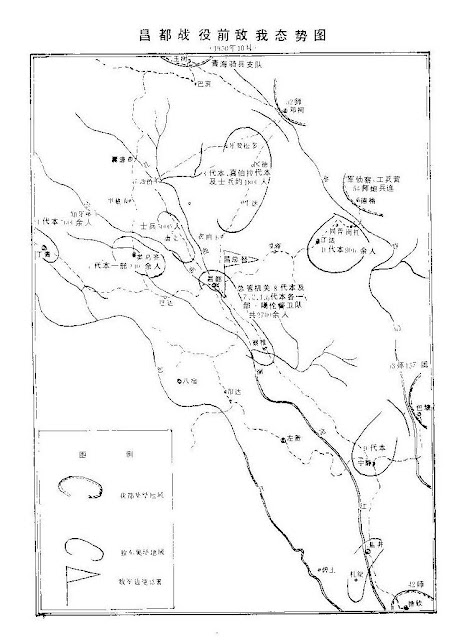
I am posting below the Detailed Report on Battle of Chamdo by the 52nd Division of the 18th Army of the People’s Liberation Army.
The source of this text in Chinese is The Liberation of Chamdo, compiled by Office of Editing and Research, Political Department, Chengdu Military Area Command and Tibet Military Area Command (Chengdu, 1991).
It has been translated by two independent researchers Jianglin Li and Matthew Akester and the entire text in English is available on their blog.
Of course, it reflects the views of Mao Zedong and the Communist Party of China, but it shows that the Battle of Chamdo was a military operation conducted in a professional manner by the 18th Army, as well as other supporting forces coming from the North (Qinghai, then Amdo province of Tibet).
There was no question of ‘peace’ or ‘negotiations’ for Mao (Nehru was banking on 'talks' to peacefully solve the issue)).
Further, it is clear for the Great Helmsman that it is only the first stage before an advance towards Lhasa during the next season.
What is surprising is the elaborate planning of this military operation. Comparatively, the leaderless Tibetans are novices and stand no chance in front of the calculated tactical moves of the PLA.
It should also be noted that the Chinese learned a lot during the Chamdo operations; this is apparent in the Summary.
Did they learn for another operation, 12 years later, on the other side of the Himalayan slopes?
Probably. Look at their slogans:
Surround more, annihilate more; surround less, annihilate less
Cutting into the heart of the enemy position, penetrating, separating, surrounding and annihilating the enemy

India learned nothing during these 12 years. This is another tragedy.
India is still suffering of the crushing defeat of 1962. Stigmas of the rout are still visible in the Indian psyche.

Here is the Chinese narrative of The Battle of Chamdo.
(November, 1950)

After crossing the Jinsha river [Tib: Drichu or Upper Yantze] from October 6th to 9th, troops reached the vast plateau of a thousand li [1000 li, c. 500 km] in length and width and in coordination with brother troops, units of this division were divided into three wings, left, middle and right, forming the assault on Chamdo, a powerful pincer attack targetting the 1500-li-long position of the Tibetan army commanded by Chamdo Governor Lhalu.
During the fourteen days of rapid advance and fighting, all units were moving across the unfamiliar plateau without accurate maps.
Soldiers carried loads of 60 or 70 jin,[ c. 30 to 35 kg] climbed more than 50 high mountains and crossed rivers over 60 times.
On average, foot soldiers cover 72 li , [36 km] cavalry 80 li [40 km] a day, those who had to march day and night moved up to 34 hours continuously without enough food. However, (all units) answered the call by party committees of both the army and the division and endured extreme hardship, annihilated all the defending enemies in Chamdo on schedule, and successfully completed the capture of Chamdo.
The success of this battle, …annihilated five Dapons [commander of a regiment], the main force of the Tibetan army, and over 2000 militia, liberated the region north to Qinghai, south to Yunnan, east to Jinsha river, west to Luolong [Lhorong Dzong] and Leiwuqi [Riwoche], a vast area more than one thousand square li. The success further strengthened our unity with Tibetans west of the Jinsha river, laid the foundation for advancing next year (1951), struck blows directly and indirectly at the British and American imperialist invaders, inspired people in the near east and repaid the people of the whole country who had warmly supported us.
…Tibetans have warmly supported us (taking in and escorting individual stragglers, delivering information, guiding the way, providing transportation, building bridges, preparing firewood and fodder, etc.), all of this shows that we had good influence by carrying out the policies conscientiously before the attack and shows the tangible benefits brought to Tibetans during our westward march. This is a small accomplishment we achieved in the past, and it is also a major pointer for the future in the liberation and construction of Tibet.
In this battle, troops advanced rapidly for 15 days with heavy loads across the high plateau a thousand kilometers in length and width, wrapping up…entire (enemy?) position 1500 li [750 km] in length and accomplished the task on schedule, completely annihilated the third (two Dapons), the seventh, the eighth, the fifth and the tenth Dapon, altogether five Dapons (averaging small regiments) under Tibetan Frontier Envoy Commissioner General,[The Chamdo governor was the ‘Domey Chikyap’ or ‘Eastern Governor’] captured…over 3000 men. This victory is fundamentally due to correct leadership by leading officers of the Military Area Command and the Army Party Committee, strong support from the people of the whole country, coordination from brother troops (particularly engineer corps), favourable influence created by advanced detachment through their hard work and carrying out policies conscientiously, and the eight-month long preparation. All of these contributed to the successful conclusion of this battle.
Review of the battle process is as follows:
Surround more, annihilate more; surround less, annihilate less

I. Process
(I) Judgement of enemy situation:
  1. Based on information obtained by the advanced detachment and by our own battle experience, in terms of the arrangement of their position, the enemy had no focus, no depth and attached no importance to flanks.
  2. Enemy lacks systematic strategic planning and command, they fought wherever they were attacked and were easily misled by us. After we crossed the river from Dengke [Dengo or Denkok on the Yangtze river], it was quite possible that the enemy might mistakenly believe, based on historical experience, that we were going to take Lhasa by way of Yushu [today’s Yushu prefecture, Qinghai] and Heihe [Nagchu].
  3. The enemy had never experienced large scale battle, had no knowledge of modern military science and was equipped with few heavy weapons. Their combat capability was not strong. After our powerful military forces crossed the Jinsha river, it was estimated that the following three changes may appear:
  • Retreat without fighting and escape without hesitation. If this happened, it would definitely make it more difficult for us to annihilate the enemy.
  • Scatter at the first contact, and the possibility of scattering everywhere in the mountains and wilderness to entangle us also existed. This would make it even more difficult for us to annihilate the enemy.
  • Concentrate forces and put up strong resistance in strategic locations. This was exactly what we were hoping for, for we were absolutely sure that we would annihilate them thoroughly, straightforwardly and completely.
  • In the Dengke battle, (we) did not seize the moment of strength to strike the enemy a fatal blow. The enemy might mistakenly have thought that our combat capability was not strong, getting arrogant and inattentive enough to confront us.
(II) Determination and Deployment
Liberating Chamdo, annihilating the main force of the Tibetan army in the area east of Lanchang river [Upper Mekong], Enda and Leiwuqi [Riwochey] lays the foundation for advance into Lhasa next year (1951) and liberate the entire Tibet. (We) decided to deploy a powerful right-flank encircling force composed of infantry and cavalry, providing strong points to offset each other’s weaknesses, making a detour via Batang and Nanqian [Nangchen] and pushing forward vigorously and precipitately. Troops should not be blocked by small numbers of enemy, doing everything possible to clear away obstacles and circle bravely…the entire field, cutting off the enemy’s retreats from Enda to Taizhao [Gyamda Dzong in Kongpo] and from Leiwuqi to Heihe, the two main escape routes, making it impossible for enemies to escape even if they intended to slip away without fighting.
Performance of troops in this wing is the key to success or failure in annihilating more than three Dapons of the enemy force. The middle wing cut into the heart of the enemy position by way of Shengda [Jomda county in today’s Chamdo prefecture], Yayaosongduo [Yayu Sumdo], Yiquka, Dongdong Zhuka, Duozhiduo, etc, cutting into the heart of the enemy position, penetrating, separating, surrounding and annihilating the enemy within the entire enemy position and advancing straight to Chamdo.
If the enemy did not rest, we wouldn’t rest; when the enemy took rest, we annihilate them. The left wing force crossed the river at Gangtuo [Kamtok], marching slowly by way of Tongpu, Jiangda [Jomda] and Jueyong to draw in the enemy. They seized the Damala Pass and controlled Sichuan bridge. Our slogans were “not to worry about breaking up Tibetan army’s positions, but to worry whether we can surround them. Surround more, annihilate more; surround less, annihilate less.”

II. Review of the Battle [not available]


III. A few experiences from the battle

(I) Experiences of fighting the Tibetan army
  1. All Tibetan troops were organized in a comparatively primitive way. Troops have neither (commanding) offices nor maps. Everything was handled by one single officer-in-charge. Special reconnaissance troops and communication tools were very outdated. Everything relied on wula,  and as a result the upper and lower could not communicate during the battle. For example, during the battle when Gaqionba, the third Dapon, retreated in defeat from Jiangda to Chamdo, he was surprised to meet Moxia [Mucha] Dapon, and only at that time did he come to know that the Liberation Army had passed Dengke [Dengo] and that Moxia [Mucha] had been defeated too.
  2. They did not fight aggressively and lacked counter attack ability. In several battles we did not find the enemy launching strong counter attacks.
  3. Lack of systematic strategic thinking, as expressed by:
  • No attention paid to protect flank and rear while deploying the forces. As seen from the deployment of this battle, three Dapons positioned in the front had fallen into our horseshoe-shape encirclement, 200 men were still deployed in the Leiwuqi flank.
  • No knowledge of using the terrain to block our advance. While chasing and attacking the enemy, none of the bridges and passes in the route were destroyed, particularly the Sichuan bridge (this bridge is like the gateway to Chamdo). The 156th regiment was half a day’s distance from the enemy, when they advanced and seized the bridge, it was left intact.
  • No night combat experience. Falling into disorder as soon as fighting began, each man escaping on his own. This was how the enemy behaved in the battle of Jueyong.
  • No guards posted at encampments. In Jueyong one squad of our reconnaissance battalion sneaked into the enemy’s tents at night, and only then did they find out and began screaming and running about in disorder.
  1. Enemies were slow in climbing mountains: the 156th regiment was one day’s distance away, the reconnaissance battalion was two days’ distance away from the enemy, but they both caught up the enemy within 100 to 200 li. Their speed was nearly one third faster than the speed of the enemy.
  2. In terms of tactics: (enemy) was good at riding horses, highly skillful at shooting and utilizing terrain and landforms, but not good at operation. For example: in the battle of Shengda [Sipda in today’s Jomda county], the 155th regiment confronted the enemy across the river for more than ten hours, and over ten men were wounded. The distance in between was about 300 meters, but hardly any enemy could be seen (they were all hiding behind rocks and in dense forest). According to our observations in the battle field, beside Jazhangka and Shengda where a few fortifications were made, the other places had no fortifications. The fortifications were very poorly built, mostly piled up stones in the shape of a pigsty, which could be pushed over by hand.
    (II) Tactics to be used against Tibetan army
  1. To deal with the weak Tibetan army with our current equipment, the key is to encircle the enemy (that is, the more encircled, the more will be annihilated; less encircled, less will be annihilated). No need to worry about breaking through Tibetan army’s positions, the only worry is not being able to encircle them. Since supplies are scarce in Kham-Zang Plateau, once the supply line is cut, enemy will retreat in disorder without fighting.
  2. Based on special conditions of the plateau cavalry is the key to annihilate the enemy, and the guarantee of success. Because the loads foot soldiers have to carry are too heavy, they don’t have enough physical strength to walk long distances to encircle the enemy. As is shown in this battle, the cavalry detachment was able to complete its task on time (to block the enemy), based on the distance, it was impossible for the infantry to complete it.
III. Coordination of Infantry and Artillery
Due to weather conditions on the plateau and our equipment, vigorous activities and rapid charge are not favourable to the troops. Therefore, during combat firepower must be well organized so as to coordinate with foot soldiers continuously and effectively. In arranging firepower, the focal points should be the flank and rear, for enemy fears our artillery attack more than anything.
IV. Reconnaissance
Since there are no accurate maps available and no accountable mileage for roads, plus there are lots of rivers, forests and mountain ranges in Kang-Zang area, knowledge of enemy situation and terrain through reconnaissance prior to battle is highly important. The method is to inquire from Tibetans familiar with (the area) in various ways, and estimate how far it is based on how many days he covers certain distance. As long as we are nice to him, he would give us such information honestly.   
V. Artillery
How to use artillery in plateau combat should be well studied, particularly how to measure distance. Observation is not easy since too many objects block the view, and as a result, distances are often misjudged as closer (than they actually are). Because the air is thin, the speed of the shells is faster.

VI. Suggestions on army structure and equipment
  1. Branches of army: a division should have a cavalry regiment to fulfill the task of circling and surrounding (the enemy). A regiment should have a mounted reconnaissance company to facilitate communication and reconnaissance. When the regiment engages in individual combat, (mounted reconnaissance company) can perform tasks of circling and surrounding in small actions. In addition, one engineers platoon should be allocated (can be attached to guard company) to take on tasks such as building bridges, handling boats, and clearing away obstacles so as to reduce the trouble of crossing rivers and increase advancing speed.
  2. Weaponry: reduce mountain artillery, increase recoilless guns, high-angle guns, dynamite, detonator, fuse and explosive.
  3. Tools: Quality and style of current field tools needs to be improved. Both the shovels and picks the troops are currently equipped with are not practical in combat. Besides being pointed at one end, the other end of the pick should be changed to something that can be used mainly in hacking. Shovel should be changed into American style with removable head, and can be used to dig, scratch and shovel off grass. Besides, since the plateau weather is cold, canteen should be changed into thermal canteen, and more cowhide boats, and bridge-building tools such as saws, hatchets, ropes, etc.
  4. Uniform: There are thorns and gravel everywhere on the plateau and clothes are easily torn, the current style of uniform must be changed and quality must be improved, otherwise it will not be able to last the season (until the next uniform issue).
    It is better to make the uniform with strong and durable cloth, shoulders, backsides and knees should be reinforced. It is better that the cuffs are tightened and trousseaus in the style of jodhpurs. Weight of coat should be reduced. Comforter should be changed into soft, warm, damp-resistant, lightweight, larger size wool blanket which can be used as mattress pad as well as comforter. Raincoat and damp-resistant canvas should be combined into one, based on current raincoat size and shape, adding more rubber to make it thicker so it can be used to wear and to spread as bedding. Quality of shoes should be improved, soles should be softer and the upper should be higher, water-proof and damp-resistant. Headgear should better be helmet (the type used by pilots) with goggles fixed on. Goggle lenses should be made of plastic (at the moment two thirds of the goggles the troops were equipped with have been damaged).
  5. Communication tools: Office at regiment and above level should be equipped with larger radio of 50 watt or more. Current radios cannot function at 11. p.m. because signals are too weak.
  6. Supply: Since the current transportation condition is rather difficult, all food should be high quality, low quantity, long-lasting and easy to carry, otherwise it increases soldiers’ burden, reduces their physical strength, slows down marching speed and has negative impact on accomplishing tasks. For example, the powdered food distributed this time was heavy and the quality was poor. Grain powder was not well cooked, ration was not enough to eat, and hard to digest, causing stomach pain, abdominal bloating and diarrhea. As a result, medical patients sharply increased, and a considerable number of soldiers lagged behind. According to initial statistics, of all the stragglers in the whole division, 80% were because of the food powder.