Sunday, October 28, 2018

New Problems of Internal Security Caused by the Chinese Occupation of Tibet

In a few days, the world's tallest statue, the Statue of Unity dedicated to Sardar Vallabhbhai Patel will be unveiled by Prime Minister Narendra Modi.
The work of 182-meter tall statue has been completed after round the clock work by 3,400 labourers and 250 engineers at Sadhu Bet island on Narmada River in Gujarat.
Sadhu Bet, located some 3.5km away from the Narmada dam, is linked by a 250-meter long bridge.
Flowers will be grown on the hillocks adjoining the statue to make the 230-hectare area look like a Valley of Flowers.

Scarce Scholarly Research
For several reasons, scarce scholarly research has been done on the internal history of the Congress; the main cause is probably that a section of the party would prefer to keep the history under wrap.
Take the acute difference of opinion between Sardar Patel, the Deputy Prime Minister and ‘Panditji’, as Nehru was known.
In the last weeks of Patel’s life (he passed away on December 15, 1950) there was a deep split between the two leaders, leading to unilateral decisions, for which India still has to pay the heaviest price.
The most serious apple of discord was Tibet’s invasion by the Chinese ‘Liberation Army’ in October of 1950.
In the course of recent researches in the Indian archives, I discovered several new facts. Not only several senior Congress leaders, led by Patel, (other leaders were C. Rajagopalachari, President Rajendra Prasad, KM Munshi, etc) violently opposed Nehru suicidal policy, but many senior bureaucrats too, did not agree with the Prime Minister’s decisions and objected to his policy of appeasement, which lead India to lose a peaceful border. 

Patel's letter to Nehru on Tibet 
It is usually assumed that on November 7, Sardar Patel wrote a ‘prophetic’ letter to Nehru, detailing the implications for India of Tibet’s invasion. In fact, Patel used a draft given by Sir Girja Shankar Bajpai, the Secretary General of the Ministry of External Affairs and Commonwealth.
A month after the entry of the People’s Liberation Army in Tibet, Patel sent Bajpai’s note under his own signature, to Nehru, who decided to ignore the Deputy Prime Minister’s letter.
Bajpai, the most seasoned Indian diplomat, lost his legendary cool after witnessing the nefarious influence of KM Panikkar, the Indian Ambassador to China, who ceaselessly defended the Chinese interests.
On October 31, in an internal note, Bajpai detailed the sequence of events which followed Tibet’s invasion and the role of Panikkar, whose attitude was compared to the one of Sir Neville Hendersons toward Hitler.
What decided Patel to send his letter to Nehru was a note from the Intelligence Bureau (IB).
We are reproducing below the IB note which is probably dated from the end of October 1950.
The IB Note was sent by Sardar Patel along with his letter to the Prime Minister.

Draft of Patel's letter kept in the National Archives of India

New Problems of Internal Security Caused by the Chinese Occupation of Tibet
(a Note from the Intelligence Bureau)

India occupies a very important position in the general pattern of world communism and next only to Russia and China. As early as 1923 Lenin after posing the question “Can we save ourselves from the impending conflict with these Imperialist countries”, gave the answer in the following words” “In the last analysis the upshot of the struggle will be determined by the fact that Russia, India and China account for the overwhelming majority of the population of the globe and it is precisely this majority that during the past few years has been drawn into the struggle for emancipation with extraordinary rapidity so that in this respect there cannot be the slightest shadow of doubt what the final outcome of the world’s struggle will be. In this sense the complete victory of socialism is fully and absolutely assured”. Lenin also said that the shortest way to Paris was through Peking and Delhi. In 1924 Moscow declared that India most stand at the head of free Eastern Republics. This view has been reiterated by Soviet leaders since 1923 on numerous occasions and even as late as 1949 Malenkov, the Communist leader next only to Stalin in Soviet Russia, stressed this aspect of the revolution. In fact, India is considered to be the pivotal point round which the south East Asia and the Middle East Asia must revolve not only because of her strategic position but also on account of her vast resources, non-power and moral influence. In articles published in 1949 in the “Problems of Economics” in Moscow, it was stated that during the period between the first and second world wars China was in the vanguard of the revolutionary movement of the peoples of the colonies and semi colonies and now during the period between the second and the third world wars it was India’s turn to take its place. Consistent with these steadfastly held ideas, the USSR and International Communists can never give up their ambition of converting India into a communist State and in fact they can never feel secure in their socialism me long as India does not accept and practise the same creed. Just as India’s struggle for freedom culminated not only in the achievement of independence for India but also for many neighbouring countries, and it is India’s example which is inspiring freedom struggles in other colonial countries in Asia, similarly there is no doubt that India’s conversion to the Communist faith will also envelop all the neighbouring countries in communism. So long as India holds out these countries can also held out, but if India goes they cannot resist. The International Communism therefore must do everything possible to convert India to communism. There is no question of their deviating from this idea by any amount of negotiation or diplomatic pressure. In all Cominform and Russian authoritative publications and even in the publications of the satellite countries, India has been described to be a colonial state, groaning under the heels of the Anglo-American Imperialists and the ‘Nehru’ Government as their lackeys. The Indian Communists have been repeatedly told to unite all progressive classes against the ‘Nehru’ Government, create agrarian troubles and initiate armed struggles which have been held to be the only way in which national liberation can be achieved. All groups in the Communist Party in India have accepted this directive and are trying to pool all their strength to follow it by creating new Telanganas everywhere and put the countryside progressively on the rails of armed struggle. As has been seen repeatedly in the past, Russia and her satellites are quite willing to negotiate on their own terms but they have always achieved their aims by the application of force only.

2. Soviet Russia now feels that India will be more swayed by the influence of China than of Russia and Mao Tse Tung will make a better leader for the Indian masses than even Stalin can. It is with this object that the Peking Liaison Bureau was established last year, that Mao Tse Tung has been given a dominating voice in the affairs of India and Far east and that the Indian Communists have been told by numerous Communist publications, as well as by the Cominform, in clear unambiguous words, to follow the China way to victory. If therefore the occupation of Tibet by the Communist forces gives to the world Communism any strategical and tactical advantages of furthering the cause of communism in India, all such advantages will be exploited legally and illegally to the fullest extent without any consideration for international conventions and even though the Chinese Government may continue to remain superficially in the friend list terms with the Indian Government. And the occupation of Tibet by the Chinese Communists does open up vast possibilities for creating internal disorders and disruptions within India.

3. Up till now India’s northern frontier from Ladakh in the west to the Sadiya Hill Tracts in the east has been free from any dangers of external invasion or from even any subversive movements fostered by external forces. With Tibet as a weak and autonomous country, giving many facilities to India which no other independent country would give, India could rightly feel absolutely secure about its northern frontier and this sense of security was reflected in is best in all the policies followed with respect to this northern frontier and actions taken for its security in these areas and on the understanding that no danger would come to India from the north very little security measures have been taken which in the altered circumstances will be found to be completely inadequate.

4. Within our borders in all these frontier areas live races and tribes who have been practically semi independent and who by religious, linguistic, cultural and ethnical ties are bound more with Tibet than with India. In fact, the hill tribes of the Sadiya Hill Tracts, the Bhutanis, the Sikkimis or the Ladakhis have little affinity with the Aryans of the Gangetic and the Brahmaputra Valleys. The tribes living in the Sadiya Hill Tracts have never been properly subordinated and India exercises only nominal authority over them leaving them free to live their own lives. If given a choice to affiliate either with India or with Tibet, under existing circumstances they are almost sure to vote for Tibet and not for India. Bhutan’s foreign affairs are controlled by India, but this has been possible only because Bhutan’s other neighbor, Tibet, was weak. With a new and aggressive Tibet under China’s guidance there is every likelihood that Bhutan will change her attitude towards India and by all standards the Bhutanese are more akin to the Tibetans than to the Indians and given the freedom of choice there is no doubt in which direction her choice will lie. Sikkim is inhabited by a large number of Tibetans and members of the ruling family have all their marriage ties with the Tibetans. There is little to distinguish between the Sikkimese and the Tibetans. Kalimpong and Darjeeling were originally parts of Sikkim and a fair proportion of the population in these areas also consists of the Sikkimese and the Tibetans. Nepal, which forms the frontier with Bihar and U.P., has got a regime which in extremely unpopular and where the ruling family is sitting on the top of a volcano which may burst out at any moment. Similarly, Ladakh is more a part of Tibet than of India.

5. With an aggressive Chinese Communist Government in Tibet, intent on furthering the creed of International Communism in India and holding the belief that World Communism and so Communism in China can never be safe unless India becomes a Communist country and following the basic Communist creed that the International proletariat (which in other words means the Soviet and the Chinese Governments) must assist the peoples of all Colonial countries (which include India) in their fight for national liberation (which in India means the overthrow of the ‘Nehru’ Government), every method will be adopted to disrupt the integrity of India and what will be more opportune and easy than to foster trouble in these frontier areas where India’s administrative control is not strong and where her cultural influence is less.
All these tribes living the frontier regions will be directly encouraged to agitate for independence so that they can later be drawn into the Communist fold. Russia’s method of solving the problem of small nationalities has been extremely successful and it appeals to all under-civilized tribes and races. Communist China has successfully prosecuted the same policy within its own frontiers and India must be prepared to meet this challenge. There are large numbers of Gurkhas who are residents of Tibet and just as the Chinese formed a Tibetan Liberation Army, similarly they after the occupation of Tibet will form a Nepalese Liberation Army and attempt to liberate Nepal where the present rulers can show very little resistance. There is reliable information that the Nepalese Communists are trying to go into Tibet to contact the Tibetan and Chinese Communists. Even on the eastern frontier of Assam, China claims the northern triangle of Burma, which is inhabited by the Kachins, as part of her own territory and there are reports that some Kachin leaders have already gone to Yunnan and are receiving training under the Communists, probably to form a Kaohin Liberation Army. Burmese Government will be able to offer little resistance to it. If Kachin goes under the Communists, the tribals living in the Naga Hills, Manipur and the Lushai Hills will start trouble because even now the Lushais, the Kukis and the China living on this frontier areas are trying for accession of their territories to Burma. They certainly have more ethnical and cultural ties with the population on the other side of the frontier than with the Aryans of India. Even the Ahoms have agitated for linking up with the Kachins to form an independent State. For the sake of her security, India must firmly retain her hold or influence in these areas because once India loses her control her entire belly will be opened up to direct attacks. Militarily also these areas can be held with comparatively smaller forces but once the Communists establish their hold in there areas the defence of the plains will become extremely difficult and will require large manpower. Communists will no doubt arm these tribals and make them the spearheads of their attacks on and frays into India. There areas will then be just as difficult to protect as the N.W.F.P. has been in the past.

6. With China on India’s long unguarded frontier, the Indian Communists will be in a good position to get help by the way of supply of arms, by the infiltration of trained agents and by direct contact with the Chinese Communists. The Indian Communists have been badly mauled during the last 2 ½ years and they are passing through a difficult period and there is definite information that they are wanting direct guidance from the foreign Communists. So far attempts to make such contacts have to a great extent been countered by Governmental action but with China strongly entrenched in Tibet it will be extremely difficult to stop this contact. With the commencement of trouble in the frontier areas where India’s Armed forces will have to be moved, more Telengana struggles will be launched in India itself so as to dissipate India’s Armed forces by wide dispersal.
Communications and industries will be sabotaged to make the movement of troops difficult and to disrupt India’s economy thereby creating wide dissatisfaction amongst  the masses. These are not more speculations because it is known that these firm instructions have been issued by Soviet Russia to the Indian Communists and the circulars issued by the C.P.I. show that the Indian Communists are preparing to carry out these directives. Therefore the occupation of Tibet by Communist China not only raises problems of security from external danger across India’s long and practically unguarded frontiers and problems of security in the border tribal regions now under India’s control but also very serious problems of internal security in the Sub-continent itself. Suggestions that follow for taking measures against this three-fold danger cover many aspects of the problem, many of which are not the concern of the Intelligence Bureau but they are being made to provide material for the M.H.A. to make final proposals to the Government.

7. Administrative Measures
Sadiya Hill Tracks
Modern administrative measures should be introduced immediately. The area held by each tribe should be formed into a district and a District officer with all necessary staff should be posted. Police Stations should be opened and instead of continuing the old tribal system of maintaining law and order, modern Police methods of administration should be introduced. District officers should make a detailed survey of the economic needs of the areas under them and see that these needs are met by supplies from Indian so that economically these areas are tied to India and not to Tibet. Schools should be opened in which the languages to be taught will be both Hindi or Assamese and the tribal so that the inhabitants may gradually forge cultural links with the plains people. Hospitals and dispensaries should be opened and philanthropic missions, such as the Rama Krishna Mission, may be encouraged by payment of subsidies to open centres in these areas. The strength of the Assam Rifle battalions in these areas should be increased and each district should have the minimum equivalent of one battalion with reserves kept at strategic centres. In the Assam Rifles, the recruitment of northern Indians should be encouraged because in any conflict with the tribes the tribal element in these units may not be found to be very loyal, as has been experienced with the Tripura Rifles recently. These regions should continue to remain directly under the Central Government.

Manipur, Lushai and Naga Hills
The existing administration in Manipur and Lushai Hills should be further strengthened and Police Stations should be opened in the Lushai Hills area. The economic needs of these areas should be studied and met from Indian sources. Indian language should be popularized through schools and other welfare measures should be undertaken. The Naga Hills area, which is at present unadministered, must be brought to the same level of administrations as has been proposed for the Sadiya Hill Tracts. These areas should be under the direct control of the Central Government.

Bhutan
It is necessary to strengthen Bhutan’s ties with India by changing the treaty, if possible, and placing more advisers in the Bhutan administration. More outlet for Bhutan’s trade with India may be created at Government’s initiative instead of leaving it to private enterprisers. Education and medical missions may open schools in Bhutan just as Christian Missions may open schools in Bhutan just as Christian Missions may open schools in Bhutan just as Christian Missions have been educating the tribals, aborigines and backward people in India and China for over a century. The new treaty should have a clause to enable India to post troops in Bhutan for protecting her from external dangers if such a provision does not already exist.

Sikkim
India’s control in this territory may be further tightened and the Sikkim Congress group, which owes allegiance to the Indian National Congress, may be encouraged. Here also, under Indian Government’s efforts educational and medical missions may be established to forge more closely Sikkim’s ties with India. Administration may be brought to the level of an Indian district. A strong contingent of troops should be posted in Sikkim as the highway from Tibet to India traverses Sikkim before entering Darjeeling district.

Nepal
India’s present treaty with Nepal allows for consultations in case of external danger. The present Nepal Government certainly does not welcome communism in its territory but is hardly in a position to resit Communist aggression. Therefore the Nepal Government will probably be only too willing to accept India’s assistance in warding off this external danger. For improving internal resistance, a more democratic set-up is necessary. The consultations may give India facility to ask Nepal to allow her army to be trained by Indian officers in the same way as the Russians are training the Czech and the Polish armies. India should provide equipment to the Nepalese army.

Kumaon Hills Garhwal Hills and Himachal Pradesh

The administration in these areas should be tightened by posting executive officers where there are none and opening up more Police Stations. The economic needs of these areas should also be studied and properly met and educational and medical facilities should be extended/

Ladakh
The administration here should also be brought to the same level as in rest of India and police stations should be opened in this Valley. Economic, educational and medical measures may be taken as in the other areas.

8. Defence

The Defence Department must be considering problems from its own angle but what needs to be emphasized is that the communist world understands force and nothing else. They will be willing to negotiate but will follow Bismark’s policy of always keeping a million bayonets behind to support their discussions and agreements can be reached only on their own terms. The defence needs of Assam, Bhutan and Sikkim, as sell as Nepal, have to be closely studied. The presence of strong units ready to strike back will not only discourage any aggressive acts from across the border but will also keep the hostile elements within our own frontiers under subjugation.

9. Intelligence

For both defence and internal security purposes, India should be in a position to collect reliable intelligence of Communist activities in China, Tibet, Burma, Nepal and all the frontier regions and their possible repercussions in India proper. For this purpose the following measures are suggested:

(i)    Inside Tibet

It is presumed that China will allow an Indian Consulate to work either at Lhasa or at Gyantse. There should be posted to this Consulate an Intelligence Officer of the experience of an Assistant Director of the Bureau. As Tibet cannot be immediately drawn behind an impenetrable iron curtain, the possibilities of collecting intelligence in that country will be great. This post should be linked with the Intelligence post at Kalimpong. Details of developing this intelligence and communication will be worked out in detail and are beyond the scope of this note.

(ii)    Inside China
There should be an Intelligence Officer of the rank and experience of assistant Director in our Embassy in Peking with assistants in Shanghai, Hongkong and other places where we have Consulates or other offices. It will be impossible for the Embassy officials without an Intelligence Officer to get full intelligence of intentions or contemplated actions which may be contrary to India’s interest. In the present case of the invasion of Tibet the shortcomings of system of collecting intelligence by the Indian Embassy in Peking has been only too evident. In China also the possibilities of setting up a good intelligence system are good.

(iii)    Inside Burma
In the Indian Embassy in Rangoon should be posted an Intelligence Officer of the rank and experience of an Assistant Director, with the large Indian population practically all over Burma, a good intelligence system can easily be established. A branch will have to be opened in Kachin area. Links will be with the S.I.Bs. at Calcutta and Shillong. Details will be worked out separately. (The British have their intelligence organisation both in China and Burma).

(iv)    Inside Bhutan
An Intelligence Officer of the rank of a D.C.I.O. should be posted here and may be attached to any mission which India may establish at Punakha. This post will be linked with the post at Kalimpong. Border watch posts will have to be established in the north to prevent infiltration.

(v)    Inside Nepal

An Assistant Director from the Bureau has already been posted at Khatmandu. In the consultations which Nepal Government will have with India, it may be decided that this officer should have full assistance of the Nepal authorities and would liaise fully with them. As the danger from Communists is same both to India and Nepal, therefore co-operation on this aspect should not at all be difficult. Our Embassy at Khatmandu is already in radio-telephonic communication with Patna and this post will be linked with our post at Patna. Nepal will have to be persuaded to open border watch posts in the northern frontier.

(vi)    Within Indian Frontier
A scheme for establishing frontier watch posts was prepared in the Bureau and approved by both the M.H.A. and M.E.A. The implementation of this scheme was however kept in abeyance due to financial reasons and also because it was believed that China would not take any immediate aggressive action against Tibet. As however the situation has radically changed, this scheme should be sanctioned immediately. It visualizes the opening of watch posts all along the Indo-Tibetan border to guard all the passes.

(vii)    Within India.
The intelligence set-up inside India is good and is well posted with the activities of the Indian communists. Improvements are constantly being made. No special step is therefore necessary. All Branches will be alerted to be more vigilant about Communist activities. All attempts to establish Telangans must be frustrated by resolute and timely action. Gun-running must be stopped because without arms liberation armies cannot be set up. Every action should be taken to prevent contacts between the Indian and the Chinese Communists. (Dange has been found to be in contact with the Chinese Ambassador in Delhi). China’s invasion of Tibet should be exploited to prove the aggressive intentions of Communist China.

(viii)    Registration of Tibetans & Chinese.
The Chinese are already being registered and the registration of Tibetans, who will become Chinese nationals after China occupies Tibet, should also be under-taken immediately. Restrictions should be placed on their movements in and out of India and it will be necessary to exercise strict vigilance over the large Chinese population in India and make them conform to all the restrictions which the Act imposes. This may look to be too drastic but proper discretion can be utilized in making the movements of innocuous Chinese as easy as possible whilst exercising real surveillance over the suspects.

9.A. Communications

In the frontier regions, except near Kalimpong and Gangtok (Sikkim) road communication is extremely difficult and consists mostly of foot or mule tracks and there is no telephone or telegraphic communication. For developing proper security measures it is necessary to open up roads in all these areas and also have a net-work of telephone and telegraph lines and wireless stations. The utility of well-developed communications in subordinating hostile tribes was well demonstracted by the policy which the British Army followed in the N.W.F.P. Acutually on many occasions in the past the need for improving communications in these inaccessible areas was recognized by the Government but as there was no immediate danger to India’s security from across these frontiers any expenditure incurred on this work was probably considered to be uneconomic. However, these communications are very necessary for security purposes in the changed circumstances and therefore the development of both road and tele-communication should be undertaken without delay.

10. Other Measures

With the Chinese army in Tibet, which is used to fighting in mountainous territories, probably certain regrouping of India’s Armed Forces will be necessary. As these are however limited, unless new units are raised, which will mean incurring large expenditure, withdrawals have to take place from Commands where no external danger of aggression is present; but these areas, like Telengana, may be important from internal security point of view. But for internal security work and even for operations against armed Communists and operations on the frontier tribal areas, regular army is not necessary, nor is it advisable to dissipate the Army’s strength in this way. Military Police Units of the type, which have been raised in Bihar, U.P., N.Bengal, Madras and Delhi and also the C.R.P. and which are already operating in Hyderabad, should be sufficient to deal with these internal disorders and for maintaining vital communications. It is therefore necessary to examine urgently the question of increasing the Armed Police strength in U.P., Bihar, Bengal and Assam, increasing the strength of the Assam Rifles, Tripura rifles and raising new Units as Manipur Rifles and increasing the strength of the C.R.P. The expenditure incurred on maintaining such Military Police will be much less compared to that of maintaining the same number of troops and for the purpose for which they are intended they will be equally effective. This will leave the Army to concentrate itself on its training and fighting external aggression, if that contingency arises, and for which preparations have to be kept ready. Details of these internal security forces can be separately worked out.

11. This note is not meant to be alarmist but only for the purpose of suggesting precautionary measures for meeting the dangers which are inherent in Communist China’s occupation of Tibet. As has been stressed at the beginning, international Communists can never give up their idea of drawing India within their fold and can never feel secure till they have succeeded in achieving this object and therefore they will follow every method possible, legal or illegal, conforming or not conforming to international conventions to further their aims and experience has shown in Korea and Indo-China that Chinese Communists are quite prepared to give material aid to the local Communist Parties in the latter’s attempt to seize power by force. The measures suggested are meant to resist the implementation of any such aggressive intentions. Some of the measures, suggested above, such as setting up better administration in frontier areas and efficient intelligence organizations in the frontier regions and outside our frontiers will take a long time for full implementation and therefore decision about the measures necessary may be taken immediately so that no further time may be lost in making a start with those of the suggested security measures which are approved.

Saturday, October 27, 2018

Landslide in Tibet: Both India and China have reasons to worry about

My article Landslide in Tibet: Both India and China have reasons to worry about appeared in Mail Today and DailyO

Here is the link...
 
Construction of the proposed railway between Sichuan and Tibet could lead to similar disasters. Arunachal Pradesh and Assam would have to bear the brunt.

Some recent happenings on the Tibetan plateau have serious implications for India; in particular the devastating landslide on the Yarlung Tsangpo, a river which becomes the Siang in Arunachal Pradesh and the Brahmaputra in Assam.

    A barrier lake has formed after a landslide hit the Yarlung Tsangpo River in SW China's Tibet on Wednesday morning. The safe evacuation of local residents is being carried out pic.twitter.com/5rtFXoANMG
    — China Xinhua News (@XHNews) October 17, 2018

Landslide in Tibet
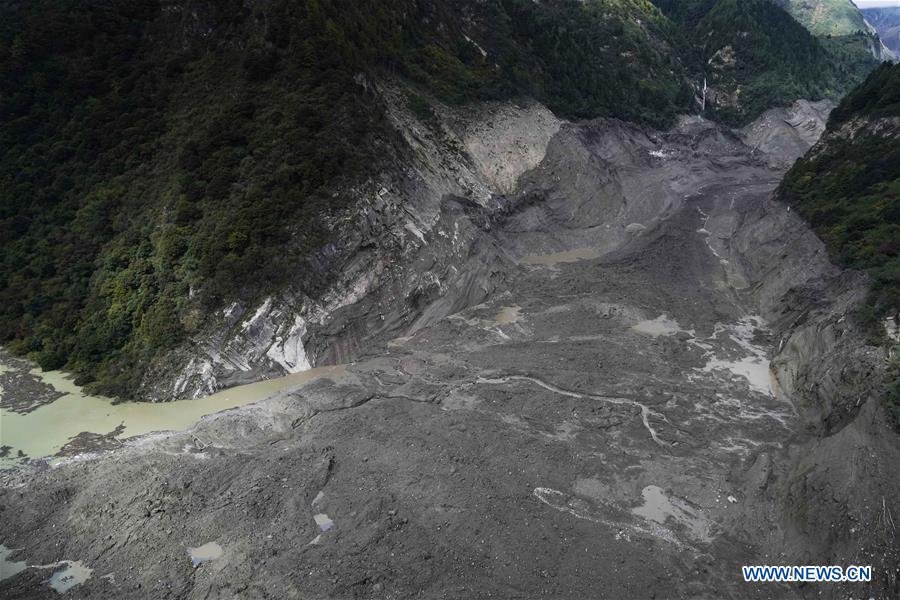
On October 11, Xinhua reported that a ‘barrier lake’ had formed on a section of another river, the Upper Yangtze (Jinsha River in Chinese); the mishap was due a landslide which had taken place in Jomda county of Chamdo prefecture in the Tibet Autonomous Region.
Though no casualties were reported, the amount of water in the new lake reached about 100 million cubic metres in a short time.
The Chinese media affirmed: “the scale of the landslide is vast, clogging the main waterway of the Jinsha River, with several bridges, fields and villages affected."
Was it a coincidence — but the same day, President Xi Jinping chaired an ‘important’ meeting called to improve disaster prevention, which could be triggered by the mega Sichuan-Tibet railway project, planned to cross the same ecologicallyfragile area? If the project is realised, it could undoubtedly result in unthinkable environmental damages.
During the meeting, Xi “called for efforts to improve the country’s ability to safeguard against natural disasters, and fully launch the planning and construction of the Sichuan-Tibet railway".
The Party’s general secretary promised “to protect people’s lives and property and national security.”
Six days later, Xinhua reported the formation of a new lake on the Yarlung Tsangpo, not far from the Great Bend of the river, north of Arunachal Pradesh.
“A barrier lake has formed after a landslide struck a section of the Brahmaputra Valley near Pe Village of Mainling County,” said The Telegraph.
China’s water resources ministry immediately informed Delhi of the seriousness of the situation; emergency bells rang downstream, particularly in the Upper Siang district.
All this raises serious issues for India …and for China.

    The evacuation of more than 10,000 people in SW China's Tibet Autonomous Region is underway following a landslide that blocked a major river in the region, local authorities said on Thursday. pic.twitter.com/fGxHK54WTb
    — People's Daily,China (@PDChina) October 18, 2018

During the meeting chaired by the Chinese president to discuss the SichuanTibet railway, Xi spoke of “profound significance for the country's long-term stability and the development of Tibet.”
Three members of the all-powerful Politburo’s Standing Committee were in attendance: Premier Li Keqiang, Wang Huning and Vice-Premier Han Zheng.
Xinhua commented that China was one of the most disaster-prone countries in the world. “…But its overall capability to respond to such extreme conditions is still relatively weak, and more should be done.”
It had earlier been rumoured that there was a rift between the Chinese President and his Premier, who in July, had visited Tibet in rather strange circumstances, probably to inspect a section of the projected mega railway line. While Xi seems in favour of going full steam on mega projects, his Premier believes in a more human (and less energy consuming) approach.

    Siang river is a very big river & when there are some natural calamities like earthquakes or landslides, it possess danger to people who live downstream: Union Minister Kiren Rijiju on Brahmaputra river blockage caused due to a landslide in Tibet pic.twitter.com/7d79CvORPv
    — ANI (@ANI) October 20, 2018

Cost of mega projects

An article in The Wall Street Journal indicates that a serious debate is raging in the Middle Kingdom and Beijing was trying “to kick its habit of using big-ticket infrastructure spending to fuel the economy, a turning point from a growth model...”.
One of the problems is of course the environmental consequences, especially in ecologically-fragile areas, but the other issue is: who will pay the cost of these pharaonic schemes?
Further, an improvement in the protection of the environment will come at a price; the cost of certain projects like the railway between Sichuan and Tibet may increase many folds.
One of the questions never mentioned in the Chinese press is: can Beijing today afford these mega projects?
What would be the usefulness of a railway line between Sichuan and Lhasa, when excellent highways exist?
The meeting chaired by the Chinese President just said that “it will promote ethnic solidarity, safeguard national unity and consolidate the stability of the frontier, as well as bolster Tibet's economic and social development.” There is no doubt that in the mind of Xi Jinping, the chairman of the Central Military Commission, the ‘consolidation of the frontiers’, (i.e. the Indian border), is crucial.

Ecological approach

A few months ago, The China Daily provided some details of the project: “A preliminary study on the Kangding-Nyingchi section of the Sichuan-Tibet Railway shows the section will include at least 10 rail tunnels each longer than 10 kilometres.”
The China Daily commented: “Since the new line will have to go through intricate and difficult geological conditions, and its construction will have to overcome frozen earth, landslides and rock slides, experts have dubbed the Sichuan-Tibet Railway China’s most challenging rail project.”
The recent landslides are an example of what could (will) happen to the railway line; the construction in such difficult terrain is bound to create havoc for the Tibetan plateau’s environment.
A more ‘ecological’ approach is bound to drastically increase the cost of the project; it is where Li may not fully agree with the Emperor.
As for India downstream, though the waters have started receding, the happenings on the Yarlung Tsangpo are truly worrisome.
Several years ago, a map of the prospective largest hydropower plant in the world, more than twice the capacity of the Three Gorges Dam, had circulated.
The departure point was where the landslide has just taken place last week, while the hydropower station was located in Metok, a few kilometres north of Arunachal.
Is this project still on the cards? It would certainly spell disasters in the making for India. Let us hope that wisdom will prevail.

Thursday, October 25, 2018

Back to the future in China?

Chinese Defense Minister Lin Biao crashed on his way to Soviet Union (September 1971)
My article Back to the future in China? appeared in the Edit page of The Pioneer
Here is the link...

The large number of ‘Lin Biao incidents’ taking place all over China smell of political vendetta and render the current regime weaker than it has ever been. Does Xi realise this?

On September 13, 1971, a Chinese Trident 1E airliner crashed in Inner Mongolia; everyone on board was killed. The special flight carried Marshal Lin Biao, China’s Defence Minister and Vice-Chairman of the Central Military Commission (CMC). Lin, a great soldier and Mao Zedong’s heir apparent, was also one of the architects of the dreaded Great Proletarian Cultural Revolution. The official narrative says that Lin was fleeing to the Soviet Union after a failed coup against Mao when his airplane ran out of fuel. Observers, however, believe Lin was fleeing an impending purge in the military; some leaders had gained too much power for Mao’s liking. Was the crash an accident? A year later, when US President Richard Nixon asked Zhou Enlai, the Chinese Premier, about what happened to Lin, Zhou smiled and cryptically said: “Lin left on a trip to Moscow and disappeared en route.”
This story came back to mind, when on October 21, the news that the head of the Chinese Government’s liaison office in Macau died by falling from the building at his residence. According to the well-informed South China Morning Post: “Hong Kong officials and politicians expressed shock over the sudden passing of Zheng Xiaosong.” He had been ‘suffering from depression’, said the official statement issued by the Hong Kong and Macau Affairs Office (HKMAO).
It was last year only that the 59-year-old cadre had taken up the post in Macau. A Press release from Beijing affirmed that “leaders of the Central Government have entrusted comrades from the HKMAO to travel to Macau and send condolences to Zheng’s family”. Zheng’s death came just a few days before the opening of the 55km-long Hong Kong-Zhuhai-Macau bridge, to be inaugurated by Chinese President Xi Jinping.
Interestingly, Zheng belonged to the Fujian gang of officials, who worked in Xi’s favourite Province: “I spent my beautiful youth in Fujian Province. It lasted for 17 and a half years since I started to work there in 1985…I experienced the process of Fujian’s reform and opening up, moving forward with great momentum and changing with each passing day,” once wrote Xi.
Soon after Xi Jinping came to power, Zheng was promoted secretary of Fujian Party’s provincial committee. In the meantime, officials in Macau were unanimous, “it is unfortunate, one should not speculate”. Let us not speculate, but strange things seem to be happening again and again in China. In November 2017, The New York Times reported: “A senior Chinese general who was under investigation for bribery has killed himself, a development that cast a shadow over President Xi Jinping’s expanding crackdown on corruption and dissent.”
General Zhang Yang, formerly in-charge of the People’s Liberation Army’s (PLA) General Political Department, was found dead in his home in Beijing. He hanged himself. Xinhua said General Zhang was living at home “while being questioned in connection with corruption charges”. The US newspaper added: “Suicides by top officials are almost unheard-of in China, and the ruling Communist Party appeared uncertain how to handle the death. State-run media gave no explanation for the five-day delay in disclosing the news.” General Zhang was called “a traitor and coward for taking his own life.”
The PLA Daily just said: “In committing suicide to avoid punishment from the party and the country’s laws, Zhang Yang’s action was abominable.” General Zhang was called ‘a two-faced’ general. But that was not the end of Zhang’s ordeal.  Last week, it was announced that he had been posthumously stripped of his Communist Party membership and military rank for corruption. His colleague Fang Fenghui, a former chief of joint staff, still alive, received the same punishment for seriously violating political discipline and Central Government rules banning extravagance and taking bribes.
In October 2017, The PLA Daily had reported that Xi Jinping had launched a sweeping anti-corruption campaign: “At least 13,000 military officers found to be involved in corruption have been punished over the past five years.” Apparently, Fang and Zhang were linked to former disgraced Central Military Commission vice-chairmen, Guo Boxiong and Xu Caihou. But were not all the Chinese generals linked to the CMC? There is indeed something strange going on. War on the Rocks, a US publication noted: “Fang and Zhang join a growing list of senior PLA officers that have been arrested, expelled from the Party, and imprisoned on corruption charges…All told, since Xi Jinping came to power in 2012, over 100 PLA general officers have reportedly been forcibly retired or placed under investigation.”
The article added: “This large-scale uprooting, however, is also likely to be driven in part by Chinese internal politics. Many of the senior officers that have been summarily fired and imprisoned are linked to Xi Jinping’s predecessors…As with Xi’s anti-corruption efforts against various civilian leaders, those targeted appear to be political rivals, although this is not to say they may not also be corrupt.” All these incidents (or accidents) create, to say the least, a strange atmosphere in the Middle Kingdom. The oddest has been the arrest of Meng Hongwei, the Interpol chief, when he recently disembarked in Beijing. Let us remember that it was a first time that China held such prestigious post in an international organisation (headquartered in Lyon, France). At the time of Mengs’ arrest, Public Security Minister Zhao Kezhi, presently in India to sign a bilateral agreement, convened a midnight meeting in Beijing to express ‘unanimous support’ for the probe against Meng and pledged, as usual, ‘absolute political loyalty’ to President Xi Jinping.
Meng’s insistence “on doing things in his own way means he has only himself to blame for being placed under investigation,” said a communiqué, which forgot that as the head of an international organisation, he is not supposed to take orders from the Communist Party. Meng was suspected of corruption and violation of laws which ‘gravely jeopardised’ the Party and the police; the same night, Interpol received Meng’s ‘resignation’ as president. Is it not strange that before vetting his name for the prestigious job in France, the leadership in China would have not checked Meng’s antecedents? Nobody can take the sudden accusation of corruption seriously, as it is not while posted in Lyon that Meng could have become rich. All this smells of political vendetta more than anything else. The large number of ‘Lin Biao incidents’ taking place all-over China, render the regime weaker that it has ever been.
Does Xi realise this?

Sunday, October 21, 2018

Zhao Kezhi, the 'Tibetan' arrives in India

Zhao Khezi (left) with Zhao Leji (center), member of the Politburo's Standing Committee
meeting the Tibetan delegates at the NPC, Wu Jingjie, Tibet's Party Secretary (right)
Zhao Kezhi, China's Minister of Public Security will be in India tomorrow.
He will meet Home Minister Rajnath Singh and discuss security cooperation between India and China. During his stay in Delhi, Zhao will also sign a bilateral internal security cooperation agreement.
According to PTI: “The proposed pact is expected to cover areas of intelligence sharing, exchange programme, sharing of best practices, cooperation in disaster mitigation besides others.”
A Chinese delegation has already met some Indian officials on August 28 to discuss Zhao’s visit and the proposed pact.
An Indian official told the news agency: “This will be the first such agreement between the authorities of India and China which look after the internal security of the respective countries.”
PTI added: “While Singh is the head of eight central armed police forces with a combined strength of about 10 lakh personnel, Zhao is responsible for day-to-day law enforcement in China and commands about 19 lakh personnel.”
More interesting Zhao is personally responsible for Tibet in the Communist set-up, being one of the 20 ‘Tibetan’ delegates at the National People’s Congress.
A few months ago, I wrote about his personnel interest in the Tibet affairs.


My March post
In March 2013, I wrote about the Chinese Hans from 'Tibet' on this blog.
I mentioned the nomination of three Han cadres in the Tibet delegation to the National People’s Congress (NPC).
The three members were then
Chang Xiaobing, the Chairman and Chief Executive Officer of China Unicom Hong Kong Ltd (he was later investigated and sacked), Prof Ding Zhongli, Vice President of the Chinese Academy of Sciences and Wang Huning, who since then, has reached the Communist paradise; he is now a member of the Standing Committee of the Politburo.


A new list
Now three new 'Han Tibetans' have been nominated
for the 13th NPC.
This time there is no member of the politburo, however Zhao Kezhi (赵克志) the Minister of Public Security will 'represent' Tibet. 

Other members are Guo Qingping (郭庆平) Deputy Governor of the People's Bank of China and Jing Hanchao (景汉朝)Deputy Secretary of the National Political & Legal Committee and member of the Supreme People's Procuratorate.

Zhao Kezhi (赵克志)
Zhao is born in December 1953. He is presently Minister and Party Secretary of the Ministry of Public Security.
He earlier served as Party Secretary in Hebei and Guizhou provinces and has been Governor of Guizhou province and vice governor of Shandong and Jiangsu provinces.
According to his biography, Zhao was born in Laixi, Shandong province. 

Zhao Kezhi entered the work force in March 1973 as a middle school teacher in his native Laixi, Shandong province; he joined the Communist Party of China in January 1975.
In April 1984, he became the mayor and deputy Communist Party Chief of Laixi County;
in March 1987, he was transferred and served as mayor and deputy party chief of nearby Jimo and later became party chief of Jimo in 1989.
In December 1997, he was promoted to be the party chief of Dezhou, a prefecture-level city in Shandong.

From February 2001 to March 2006 he was a vice governor of Shandong province.
In 2006, Zhao Kezhi was transferred to neighbouring Jiangsu province, where he was the executive vice governor until August 2010, when he was sent again to southwestern Guizhou province as deputy party chief and acting governor.
A month later, he was elected
governor by the Guizhou Provincial Congress.
In July 2012, Zhao was promoted to concurrently serve as the Communist Party Secretary of Guizhou; in December he relinquished his governor post, and Chen Min'er (now politburo member) was selected as his successor.
In July 2015, following the dismissal of Zhou Benshun, Zhao was named party chief of Hebei province.
In October 2017, shortly after the 19th Party Congress, Zhao, then 63, was appointed as the Party Committee Secretary of the Ministry of Public Security.
He took over as Minister of Public Security on November 4, 2017.
He is a member of the 19th Central Committees of the Communist Party of China.


Guo Qingping
Guo Qingping (郭庆平)
The second nominated member of the Tibet delegation for the NPC is Guo Qingping. 

Since March 2015, Guo, a senior economist, is Vice Governor of the People's Bank of China (PBC).
He was born in August 1956.
Here are some details about his career.

  • 1982-1991 Vice President, Fuxin City Branch of the PBC
  • 1992-October 1998 Vice President, Liaoning Provincial Branch of the PBC; President, Shenyang City Branch of the PBC
  • November 1998-November 1999, Vice President, Shenyang Branch of the PBC
  • December 1999-January 2003, Director-General, Internal Auditing Department of the PBC as well as Director-General, Asset Disposal Office of the PBC
  • February 2003-November 2008, President, Tianjin Branch of the PBC
  • December 2008, Assistant Governor, PBC
Is he going to put some order in the accounts of the Tibetan Autonomous Region (TAR) or help the region to secure more funds for its development?
In December 2016, The China Daily reported that Guo had announced that Beijing would strengthen its anti-money laundering cooperation with countries and regions along the Belt and Road Initiative (BRI).
Guo affirmed that China would “enhance domestic enforcement of international sanctions at home. …Combating the financing of terrorism regimes and spread of massive weapons of destruction have become the new battle field for anti-money laundering."
He was speaking at the Sixth China Anti-Money Laundering Summit at Fudan University in Shanghai. He also said that China had “established an inter-ministerial mechanism led by the bank with 22 other government agencies, including the Ministry of Public Security and the Supreme People's Court, to combat illegal money transfers.”
What does it mean for Tibet is not clear?
There is a high probability that he will push for an integration of TAR with the BRI in particular with Nepal.


Jing Hanchao
Jing Hanchao (景汉朝)
The third nominated Han in the Tibet delegation is Jing Hanchao.
He is currently Vice-President of the Supreme People's Court.
He is born in 1960 in Shen County of Hebei Province.
In 2009, he became Vice-President, Supreme People's Court.
He started his career in 1984 as a clerk in the Higher People's Court of Hebei Province (at provincial level)
Later he became Assistant Judge in the same Court; he was later promoted Vice-President and then President.
Between 1994 and 1996, he did a Master of Laws at Beijing University while serving Judge in the Economic Tribunal of the Supreme People's Court.
From 1996 to 2006, he was Deputy Secretary Party Committee of the Higher People's Court.
Between 2000 and 2003, he followed a course to become Doctor of Laws from the Southwest University of Political Science and Law in Chongqing.
From 2006 to 2009, he served a member of the Leading Party Group of the Supreme People's Court.
Later he became a Member of the Judicial Committee and the Director of the General Office of the Supreme People's Court.

In February 2017, Jing Hanchao addressed the opening ceremony of a 'public open day' in East China's Zhejiang province, detailing the progress of dealing with individuals and companies who ignore civil court rulings. 
What will be his role in the Tibet delegation to the NPC is not clear, but he will probably make sure that the corruption is tackled and that the Tibetan flies and tigers are caught.

I will come back on the 17 other members on the TAR delegation in a few days.

Friday, October 19, 2018

Chairman Xi’s new mega project and China's internal politics

Landslide on the Yarlung Tsangpo
More on the environmental havoc in Tibet
Three days after posting the story below on the landslide on the Upper Yangtze, VTIBET.com reported a "Barrier lake forms following landslide in Nyingchi."
This time it is on the Yarlung Tsangpo/Brahmaputra
The article says: "A barrier lake has formed after a landslide struck a section of the Brahmaputra Valley near Pe Village of Mainling County of Tibet Autonomous Region. As of 3 p.m., the amount of water in the barrier lake had reached about 150 million cubic meters."
Some photos show the landslide-hit road in Mainling County, north of Arunachal Pradesh.
According to The Telegraph, China’s water resources ministry has informed the Centre of a landslide in Mainling "which might have an adverse impact downstream, particularly in the East Siang district of Arunachal Pradesh."
The official order issued by the district administration said, “As per information received from the central water commission, Government of India, ...landslides blocked the Mainling section of the mainstream of Brahmaputra/Yarlung Tsangpo ...on October 16,which will have an impact on the water situation of the lower reaches of the Yarlung Tsangpo river.”
Development has a cost.

The Landslide on the Upper Yangtze
On October 11, Xinhua reported a ‘barrier lake’ which had formed due a landslide in a section of the Upper Yangtze (Jinsha River in Chinese) at the border between Sichuan Province and Tibet Autonomous Region.
The landslide struck in Bolo Township, in Jomda County of Chamdo prefecture.
Though no casualties were reported, the amount of water in the barrier lake had in a short time reached about 100 million cubic meters.
Some reports said 24,000 residents had been evacuated: “The Ministry of Emergency Management has initiated an emergency response.”
The PLA and PAP had been called to rescue the affected populations.
According to the same Ministry, some 7,000 tents, 30,000 cotton-padded coats, 50,000 quilts and 5,000 folding beds were sent to the landslide-affected area to help residents.
The local authorities in Chamdo stated that “the scale of the landslide is vast, clogging the main waterway of the Jinsha River, with several bridges, fields and villages affected.”
Bolo is located in the south of Jomda county; the Upper Yangtze separates this Tibetan area from the Sichuan province at an altitude of 2,860 meters. The county counts 8,325 residents in eight villages.
This 'natural' disaster raises seriously questions, not only environmental, but political too.

A coincidence?
Was it a coincidence that around the same time, Xi Jinping spoke at an ‘important’ meeting about the improvement of the disaster prevention while building the mega Sichuan-Tibet railway?
There is no doubt the project is so big, that it will resulted in serious ecological damage.
On October 10, Xi Jinping “called for efforts to improve the country's ability to safeguard against natural disasters, and fully launch the planning and construction of the Sichuan-Tibet railway.”
The Party's General Secretary made these remarks during the third meeting of the Central Committee for Financial and Economic Affairs: “As a stronger capability of safeguarding against natural disasters concerns the economy and people's livelihood, China will set up an efficient and scientific system and improve the capability of the whole society in a bid to protect people's lives and property and national security," said Xi.

The Sichuan-Tibet Railway
The meeting was called to discuss the Sichuan-Tibet railway, which will have “profound significance for the country's long-term stability and the development of Tibet.”
It had been rumoured earlier that there was a rift between the Chinese President and his Premier, Li Keqiang, who had visited Tibet in rather strange circumstances, probably to inspect a section of the projected mega railway line.
At the recent meeting, two more members of the all-powerful Politburo’s Standing Committee were in attendance: Wang Huning and Vice Premier Han Zheng.
Xinhua commented: “As one of the most disaster-prone countries in the world, China has attached great importance to the matter and made remarkable progress. But its overall capability to respond to such extreme conditions is still relatively weak, and more should be done.”
It was said that China would work to build a coordinated disaster-responding system, adopt a people-centered approach, give priority to the environment, try its best to minimize the aftermath, propel reforms and innovation to modernize its capability, and continue international cooperation: “A raft of major projects will be advanced, including ecological restoration of forest, grassland and rivers, coastal protection such as building ecological seawalls, housing reinforcement projects in earthquake-prone areas, flood control and drought relief, relocation of residents in disaster-hit places, construction of emergency centers, natural disaster monitoring and early warning, and the modernization of rescue technology and equipment.”

Who will pay?
All this will cost money and may increase the cost of the project many folds.
One of the questions never mentioned in the Chinese press is: can Beijing afford this mega project?
What would be the main objectives of the railway line between Sichuan and Lhasa?
Is it really necessary at this point in time?
The meeting just said that “it will promote ethnic solidarity, safeguard national unity and consolidate the stability of the frontier, as well as bolster Tibet's economic and social development.”
There is no doubt that in Xi’s mind, the ‘consolidation of the frontiers’ is crucial; let us not forget that he occupies the seat of Chairman of the Central Military Commission.
Observers have asked, why was this meeting called by Xi; after all such project should come under the State Council, in other words Premier Li, who himself held a similar meeting in August.

Another 'important' meeting
Just after the Summer holidays at Beidaihe, Li had chaired a meeting of the Leading Group on the Development of Western Regions on August 21.
It was held in Beijing; Vice Premier Han Zheng, deputy head of Leading Group was also present.
Li Keqiang stated that the Western areas should continue with reform and opening-up and vigorously innovate to achieve high-quality development.
While acknowledging the economic and social achievements in the regions, Li described the development in Western Regions (i.e. Tibet and Xinjiang) as 'a crucial and difficult point' for China to become a moderately prosperous society in all respects and achieve modernization.
Western areas should channel more energy into industrial upgrades, and make more contributions to a stable national economy, Li said.
The railway was mentioned; but a more holistic approach was stressed: “Entrepreneurship and innovation should be promoted in a practical manner, Li said, urging measures to raise industrial competitiveness in western regions and greater steps to cultivate new growth drivers and restructure traditional sectors,” said Li who adding that “The central government will pump more capital into the areas and encourage local governments to attract private investment.”
Li cited projects such as the Sichuan-Tibet railway, power grids, oil and natural gas pipelines, internet infrastructure, and water diversion projects (hopefully not the Brahmaputra!!).
Li highlighted the people-centered development, which not might be the case of the Sichuan-Tibet railway: “China will take solid, precise actions to win the tough battle against poverty and work for equality in public services. Internet technologies will be used to let remote poor regions enjoy better education and medical services, and the employment and old-age care in western regions will also be enhanced.”
It is here that there is a difference of approach between the two leaders; Li being softer.


The Pharaonic project with the longest tunnels
A month earlier, The China Daily had given some details about the project: “A preliminary study on the Kangding-Nyingchi section of the Sichuan-Tibet Railway shows the section will include at least 10 rail tunnels each longer than 10 kilometers."
He Huawu, a member of the Chinese Academy of Engineering, told the newspaper that the total length of the rail tunnels in the Kangding-Nyingchi section would be 843 kilometers - which is longer than the Beijing-Zhengzhou high-speed railway: “The longest rail tunnel, extending 42.5 km, would be the longest in China, eclipsing one 32-km-long on the Qinghai-Tibet Railway.”
There will be six rail tunnels in the Kangding-Nyingchi section longer than 30 km.
He Huawu spoke during an academic seminar on key technologies for building high-speed railways in complicated mountainous areas held in Chengdu.
China Railway had announced that design of the line was ‘not final’, but just part of preliminary research on the construction of the Kangding-Nyingchi section, and it has not been approved by the authorities.
The Sichuan-Tibet line will be the second railway line connecting the Tibet Autonomous Region with the mainland; the first one was the 1,956-km Qinghai-Tibet Railway, which opened in 2006.
The China Daily commented: “Since the new line will have to go through intricate and difficult geological conditions, and its construction will have to overcome frozen earth, landslides and rock slides, experts have dubbed the Sichuan-Tibet Railway China's most challenging rail project.”
Then recent landslide is an example of what could (will) happen to the railway line.
In fact, the construction in such difficult terrain is bound to create havoc for the environment on the marches of the Tibetan plateau. It probably explains the warning of Xi Jinping.
But a more cautious approach will also drastically increase the cost of the project; it is where Li may not fully agree with the Emperor.

Landslide on the Upper Yangtze
Can China afford it?
At the end the question is: can Beijing afford this in the midst of a trade war with the US?
It is one of the many dilemmas that the Chinese leadership will be facing in the years to come.
It could easily create a schism between the different factions in the Communist Party; between the ones promoting a more human approach and the ones vouching for gigantic schemes.
The discreet visit of the Chinese Premier to Tibet should be seen in this perspective.
The article of The China Daily concluded: “Some easier parts of the line have been built in the past few years, but construction of the Kangding-Nyingchi section has yet to start due to the difficulties involved.”
It refers to the Nyingchi-Lhasa railway line which will soon be open to traffic.
The Chinese paper added: “Previous reports have said trains on the Sichuan-Tibet line will travel at between 160 and 200 kilometers per hour. When the line is completed, the travel time by rail between Chengdu and Lhasa will be cut from 48 hours to about 13 hours.”

It is if the line is completed…
In the meantime, development projects in this ecologically fragile area are creating havoc.

To restore the traffic, a new road is being built. All this has a cost.

Jiala Village is close to the Great Band of the Yarlung Tsangpo
Landslide on the Yarlung Tsangpo near Jiala village

Landslide on the Yarlung Tsangpo near Jiala village

Landslide on the Yarlung Tsangpo near Jiala village

Landslide on the Yarlung Tsangpo near Jiala village

Thursday, October 18, 2018

Good life in the smallest Tibetan village?

China Tibet News yesterday reported about the "Villagers’ good life in Yulmed".
Yulmed is Yume, the small village adopted by Emperor Xi, north of Upper Subansiri district of Arunachal Pradesh,
This village has often been mentioned on this blog.
It was said to be the smallest village in Tibet.
According to yesterday's article, it is still "China’s smallest township, located in the foothills of the Himalayas near the border of China and India," but, Oh Miracle, the population has grown from 32 inhabitants to 197.
How? The Chinese media does not explain this detail.
The article just affirms that Yume, located about 200 kilometers from the county seat of Luntse (which incidentally will soon have an airport) is 'happy': "with the development of economy and the improvement of environment of Yume Township [yes, it has become a township!!], it has built numerous new houses for local villagers."
Villagers and obviously outsiders.
It was said that later this month, "197 villagers of the township will be moved into their new houses, and their living environment will be greatly improved."
What does it mean?
There is a definitive plan to repopulate the borders with India by creating new model 'townships'.
This should be a serious issue for Delhi.
Some two years ago, long before anybody had heard of the hamlet, Wu Yingjie the Party Secretary of the Tibet Autonomous Region,  had visited the area.
Probably based on his report, Chairman Xi adopted the tiny village.
For India, whether the villagers have a good life or not, is not the question; this new development is bound to put pressure on the border, at a time, when Indian villagers are migrating in large number from the border areas toward the cities (in Uttarakhand for example, it is an extremely serious issue).
Why can't India open its border villages to eco-tourism?


Monday, October 15, 2018

Why China cannot be considered a dependable global power

My article Why China cannot be considered a dependable global power appeared in Mail Today/DailyO

Beijing is so obsessed with becoming the power center of the world that it does not even hesitate to use unfair means to reach its objectives

Here is the link...

We are perhaps at a turning point in China’s relations with the rest of the world. During recent weeks, a series of events has showed that the "peaceful rise of China" may not be that smooth.
During the last National People’s Congress in March, the Chinese legislative included "Xi Jinping Thought on Socialism with Chinese Characteristics for a New Era" in the country’s constitution, but the sailing for the Great Helmsman of the "new era" will certainly not be the way President Xi Jinping expected it.

No global trust
Take the sudden disappearance of Meng Hongwei, the Interpol chief; the story is unheard of and it is bound to have serious implication for China’s growing role on the world scene. Meng is/was a high dignitary in the Chinese security apparatus; he served as deputy security minister before getting the plum international assignment in Lyon, France; this was till his wife Grace told the French police that she had not heard from her husband for several days. She was especially worried after receiving a text message from Meng’s phone with a knife emoji.
China’s National Supervisory Commission had no choice but to announce in the middle of the night that Meng was under investigation: “his insistence on doing things his own way means he only has himself to blame” said the Commission. It was also announced that he had resigned from his high-profile job.
What is the meaning of "insistence on doing things his own way"? Not listening to Xi? In the process, China’s credibility takes a huge beating as it will be difficult to sweep the story under the carpet for the sake of business.
This is happening at a time China celebrates the 40th anniversary of reform and opening-up, a reference to the transparent policies heralded by Deng Xiaoping. Meng’s arrest looks more like a Stalinist procedure than opening-up.
Can China today be considered a dependable global partner? Another example of China’s wrong ways of dealing with the rest of the world appeared in a Bloomberg article. After long in-depth investigations, the financial newspaper discovered: “The attack by Chinese spies reached almost 30 US companies, including Amazon and Apple, by compromising America’s technology supply chain.” The journalists reached this conclusion after extensive interviews with government and corporate sources.
Bloomberg affirmed: “Nested on the servers’ motherboards, the testers found a tiny microchip, not much bigger than a grain of rice, that wasn’t part of the boards’ original design. Amazon reported the discovery to US authorities, sending a shudder through the intelligence community.”
The microchips may have affected the Department of Defence’s data centres, the CIA’s drone operations, and others. Though the affected companies denied the facts, nobody took Bloomberg to court, knowing perfectly well that the journalists had done their homework in a professional manner: “During the ensuing top-secret probe, which remains open more than three years later, investigators determined that the chips allowed the attackers to create a stealth doorway into any network.” The chips had been inserted at factories run by manufacturing subcontractors in China.

US Criticism

China is today so obsessed to become the World Number One superpower that the party led by Xi does not hesitate to use unfair means to reach its objectives, but the international community is slowly opening its eyes.
Nothing may be the same for China anymore. The so-called Trade War, a small element of a larger design by the Trump administration (which includes a stronger presence in the South China Sea, triggering differences with the CCP, etc) was outlined by the US vice-president Mike Pence in a recent speech.
After saying that President Donald Trump “made our relationship with China and President Xi a priority,” he complained about China’s bad behaviour like never before: “We’re implementing tariffs on $250 billion in Chinese goods, with the highest tariffs specifically targeting the advanced industries that Beijing is trying to capture and control,” he said.
He added that the US is “building new and stronger bonds with nations that share our values across the region, from India to Samoa.” Targeting Beijing repeatedly, Pence asserted that Washington was working on “a just and transparent alternative to China’s debttrap diplomacy,” pointing a finger to Xi’s Road and Belt Initiative. The Vice-President also warned Google not to launch a censored search engine in China.
The distrust vis-a-vis China is fast spreading over the planet and Beijing’s new propagandist tool, the Voice of China, will find it increasingly difficult to defend Beijing’s views (like justifying a million Uyghurs sent to reeducation camps in Xinjiang).

Tightening grip
Two months back, Australia blocked Huawei and ZTE, two Chinese telecom giants, from providing equipment for its 5G network, though Huawei had given assurances that it would not pose a threat to Australian national interests. But who is believing China today?
The wave is spreading to Europe, too. A question remains: can China amend its ways? It is doubtful. A new regulation was recently issued by the Chinese Ministry of Public Security (Mengs’ parent ministry) authorising authorities to enter the premises of all entities that provide Internet services and look for information relevant to cybersecurity.
Beijing is every day tightening its grip on China’s already restricted cyberspace. Where is the opening-up of Deng Xiaoping?
It will certainly have consequences on China’s role on the world scene.

Friday, October 12, 2018

Why suppress right to historical knowledge?

My article Why suppress right to historical knowledge? appeared in the Edit Page of The Pioneer


Here is the link...

While India has touched benchmarks in many fields, the fact that the Government continues to confiscate modern Indian history not only demonstrates immaturity but shows lack of self-confidence

One of the biggest failures of the present Government has been its ignorance of the importance of post-Independence history. Four years after it was elected to bring about some transparency, hardly anything has changed in this field. Take for example the VK Krishna Menon Papers, held at the Nehru Memorial Museum & Library (NMML); they are still kept under wraps and remain inaccessible to researchers and scholars.
The situation is so ridiculous that when the Selected Works of Jawaharlal Nehru published a large corpus of historical documents (more than 300 pages) related to Zhou Enlai’s visit in India in April 1960, the crucial meetings with Menon were unavailable. Why should the fact that Menon often humiliated competent Armed Forces’ officers, in some cases with the backing of the Prime Minister, be kept secret?
In many ways, Menon with his well-known arrogance and brashness was responsible for the debacle against China in 1962, but nothing has been done to unearth the ‘truth’. Why has the Government not bothered to open the Krishna Menon Papers? The reality is that very few politicians or bureaucrats are interested in modern history (it has sadly been true for all Governments since Independence); the distant past of the Mahabharata is perhaps too attractive.
More than four months after the Central Information Commission (CIC) directed the Prime Minister’s Office (PMO) to make public the records of the Raj Narain Committee — constituted in 1977 to look into the mysterious death of former Prime Minister Lal Bahadur Shastri in 1966 in Tashkent — nothing has happened.
We are facing two issues here: One, no interest of the Government (this includes the Ministry of External Affairs) about modern history; two, very few scholars have the necessary knowledge to go through the files to decide if there is anything which can jeopardise India’s ‘security’ or ‘national interests’. In my experience of years of working in the archives, particularly with the Jawaharlal Nehru Collection (known as Nehru Papers and available at the NMML), very few documents (perhaps one out of tens of thousands) would need to remain ‘classified’. Another irony, the famous Henderson-Brooks report, which for years has been circulating freely from the Internet, is still classified. What does it mean? Nobody in the Government has taken the time to go through it. Why? Because it is so much faster and easier to put a blanket ‘classified’ tag on everything than to make the effort to look into, keeping in mind the ‘national interests’ and blackened a few sentences, if necessary.
In fact, it would be in the ‘national interests’, if most of these so-called secret papers, including the Krishna Menon Papers, were put in the public domain or at least opened to genuine researchers. Interestingly, the CIC recently held that the “people’s right to know the truth …cannot be brushed aside”. In its September 24 order, the Commission said that “in view of the startling incidents that followed (Shastri’s) mysterious death, such as killing of his personal doctor and assistant in two separate ‘accidents’, disappearance of records of the Rajya Sabha committee’s probe, and various significant points raised by journalists…and Shastri’s wife Lalitha Shastri and other family members, the Union Government has a duty to explain to the nation why and how Lal Bahadur Shastri died in Tashkent”.
The same ‘right to know’ should apply to all papers more than 25-years-old. It is not that India has no law; the Public Records Act exists, but laws seem to have been made more for the ‘common man’, than for Government offices. In the Shastri case, the Government was ordered “to place all the so-called ‘classified papers’ before the Prime Minister and the Home Minister and recommended that they “consider the fundamental right to know and demand of the people, (and) to declassify (them), either through an expert committee or by any other process, to get the mystery probed and resolved”.
Probably nothing will happen, like in the case of the Sikkim Papers, where the entire record of the Political Officer in Sikkim between 1895 and 1975 had ‘disappeared’. While India has reached a great maturity in many fields, the fact that the Government continues to confiscate the history of modern India not only demonstrates immaturity but also shows lack of self-confidence. I personally believe that the study of history of the subcontinent could be one of the keys to disentangle difficult problems such as the Kashmir issue and the border row with China. Unfortunately, it is practically impossible to access genuine historical records.
Without rewriting history, it is important to learn from past successes, victories, as well as defeats. In fact, there is certainly more to learn from blunders than success. A case worth citing is Lt Gen SPP Thorat’s report about the ‘Chinese threat’ on India’s borders. On October 8, 1959, Thorat, then responsible for the Eastern Command, sent a paper on the defence of the North-East Frontier Agency (NEFA) to the Army Chief who forwarded it to the Minister. Thorat’s findings were outrightly rejected by Menon, and worse, Thorat was accused of being an ‘alarmist and a warmonger’. Maj Gen VK Singh, who wrote Thorat’s biography, noted that the latter had provided a time-table showing “how the defences would fall day by day in case the Chinese attacked”. He had also advocated the use of the Air Force to counter China.
Sometimes, one is lucky. I recently came across a file of the visit of Kushok Bakula Rinpoche to Tibet in 1956; his secretary DD Khosla brought to the notice of the Government, the existence of the Aksai Chin road: “The Chinese Government have secretly circulated a new map of Tibet among their official organisations and the pro-Chinese Institutions — in which they have shown the whole of Aksai Chin (Soda Plains) hump as a part of Tibet.” The information was dismissed by the Indian Embassy in Beijing, but the point is that it was known to the Nehru Government that China had built road on the Indian territory several years before the issue came to Parliament.
Why is the present Government protecting the Congress for blunders committed more than 60 years ago? This, I am unable to understand. The only solution would be to create under the PMO, an office of the historian, which would make sure that the Indian laws pertaining to records are scrupulously respected. Just a Dream!

Tuesday, October 9, 2018

India and the Dalai Lama's Successor

My article India and the Dalai Lama's Successor appeared in Rediff.com

Here is the link...

'While wishing the Tibetan leader a long and healthy life, one can hope for a 'selection' of the Tibetan leader in the Indian Himalayas.'
'It is vital for Tibetan Buddhism, but it is also in India's political interests,' says Claude Arpi.


Recently, an article titled The Dalai Lama has chosen his successor appeared on an Indian Web site.
Tibet watchers did not take the content seriously because the same author had earlier announced the Dalai Lama's imminent death.
One has just to look at the report of the Dalai Lama's recent visit to Europe to understand that the Tibetan leader's health is fine even if he may have less energy than a few decades ago.
Who of his age would not?
However, the Dalai Lama's succession is a subject which concerns India as the religious leader took refuge in this country in March 1959 and more than a lakh of his followers live in India today.
Whether the Dalai Lama decides not to reincarnate (which is doubtful), or to take a new body or else to 'emanate' during his own life time into a young child, Delhi and the people of India are personally and politically concerned.
In this sense only, the article cited above is relevant.
While the situation around his 'return' is rather unclear, the Dalai Lama remains a rock of serenity, virtues and stability in the chaotic world of Tibetan Buddhism.
It is not necessary to mention here the scandals which have recently rocked the Tibetan Buddhist world, with some so-called high Lamas being accused of sexual misbehavour and debauchery.

The Sucession
The 'Succession' is probably the reason why a meeting of the heads of the different schools of Buddhism has been called in November in Dharamsala (incidentally, when the first such meeting was organised in 1966, also in Dharamsala, India was represented by Kushok Bakula Rinpoche of Ladakh).
In the Dalai Lama's own Yellow School, the situation is rather confused.
Traditionally in Tibet, the Panchen Lama was the second most prominent religious figure. Following the passing away of the 10th Panchen Lama in January 1989, the Dalai Lama formally proclaimed a six-year-old boy, Gedhun Choekyi Nyima, as his reincarnation on May 14, 1995.
Three days later, the Chinese government arrested him; he has never been seen again.
Another boy, Gyalsten Norbu, sponsored by the Communist regime, presently seats on the throne in Shigatse in Tibet (in fact he is mostly in Beijing). Recently, the Dalai Lama said 'according to reliable sources, (Gedhun) is alive and carrying normal education.'
He also said that the existence of two 11th Panchen Lamas may not be all that unusual in Tibetan Buddhism; he was citing historical instances for this.
Not easy to understand for common men: Two Karmapas, two Panchen Lamas!
But nobody wants two Dalai Lamas in the future.

What are the alternatives?
The Dalai Lama always urges his followers to think rationally.
Reason tells us that it makes no sense for the Dalai Lama to not reincarnate, his presence is needed too much by the people of Tibet for him to dispense himself from 'returning'.
Further, his 'non-reincarnation' would be a boon for China who is bound to discover its own 'Dalai Lama'.
Returning in the West makes not much sense either; apart from being close to a large following among the Western neo-Buddhists, what would the Tibetan leader gain?
Returning in Tibet under the present circumstances is not viable, it can therefore be discarded as a place of rebirth; in any case the Communist authorities have already planned his 'return' through Communist party regulations.
The 15th Dalai Lama would have to be a Communist first and then a religious leader.
Further, he would not be permitted to stay in Tibet (even Gyaltsen Norbu, the Chinese-recognised Panchen Lama, is only allowed sporadic visits to Tibet).
Other Asian countries also seem difficult as the Tibetan leader is today not welcome in most Asian Buddhist countries such as Thailand, Sri Lanka, Myanmar or Bhutan.
This is due to 'political' pressure from China, but also due to the fact that some of these countries practice Theravada Buddhism.

The best solution

The best bet would, of course, be India, where he would be most welcome by both the people and the government (even if Delhi does not say so openly, to not upset China).
The Dalai Lama has repeatedly stated that he is a Son of India and his favorite food is dal and chapattis; further, for him, India is Aryabhumi, the Land of the Buddha.
The choice is between a reincarnation and an emanation; the latter seems more adapted to a modern system of governance which cannot afford a gap of 20 years or so in leadership.
Historians realise that the 'Rule by Reincarnation' has in the past cost Tibet its independence as the regents were most of the time incapable of ruling the country. In 1947, Tibet was even on the brink of a civil war due to the infighting between the two regents.
During the 19th century, the Manchus may have found the trick, before the new Dalai Lama would reach majority, he would suddenly pass away in mysterious circumstances.
This allowed the Ambans, the Chinese representative of the emperor, to impose their diktats in the Land of Snows.

What would be a positive solution?
This leaves little alternative to the Tibetan leader who will have ultimately to take the call.
But for India, the best would be if he announces that he will 'return' as the 15th Dalai Lama from Ladakh or alternatively from another Himalayan region such as Kinnaur or Spiti.
It could be either in a new body or as an emanation in a young boy born in a refugee family.
An emanation would have the advantage that the chosen boy could be groomed and 'initiated' for several years by the present Dalai Lama himself.
Ladakh has many advantages: The present Dalai Lama is deeply connected with the mountainous region of Jammu and Kashmir which he visits every year.
Ladakh would be an interesting alternative as it would also be a political statement.
The fact that Beijing keeps the border between Tibet and Ladakh closed since 1962 despite Beijing's great love for old trade routes is telling.
Why has Beijing never permitted the reopening of the traditional route to Kailash Manasarovar via Demchok in Ladakh?
Simply because China has never officially accepted Jammy and Kashmir's accession to India in 1947.
Ultimately, the Dalai Lama's presence in India is crucial, especially for the stability of the border areas.

China is preparing the Dalai Lama's rebirth
In the meantime, China is already prepared to have its own Dalai Lama.
In July 2007, the party-State announced the 'State Order number '" or 'Management Measures for the Reincarnation of Living Buddhas in Tibetan Buddhism'. The 14 articles of the Regulation effectively control the system of reincarnation.
For example, Article 7 says: 'No group or individual may without authorisation carry out any activities related to searching for or recognizing reincarnating living Buddha soul children.'
It means that only the Communist party, through the State's Buddhist Association, can decide.
While Article 8 forces the 'applicant' to go through the Golden Urn system, traditionally rarely used in Tibet: 'Living Buddhas which have historically been recognised by drawing lots from the golden urn shall have their reincarnating soul children recognized by drawing lots from the golden urn.'
This would indeed facilitate all sort of manipulation.
China is presently extremely active on the 'succession' front.
Xinhua recently reported that Gyaltsen Norbu worshipped at the Lhamoi Lhatso lake in Gyatsa county of Lhoka prefecture in the Tibet Autonomous Region.
The official Chinese news agency asserted that it was the first time that Gyaltsen Norbu visited the holy lake, famous for the visions that a regent or a high lama can have in it.

It is the way the present Dalai Lama was found.
Regent Reting Rinpoche went to the lake in 1935 and had several visions; he saw the roofs of the house of the young Dalai Lama who was just reborn in a remote village of Amdo province (now Qinghai).
In August, Xinhua reported: The Panchen Lama, together with more than 30 monks, started to lead sutra chanting, praying for peace, prosperity, and stability.'
'The ritual also had other activities, including throwing cereals and planting a blessed bottle in the middle of the lake as sacrifice.'
There is no doubt that China is preparing for the rebirth of the present Dalai Lama.
In the present planetary turmoil, while wishing the Tibetan leader a long and healthy life, one can hope for a 'selection' of the Tibetan leader in the Indian Himalayas.
It is vital for Tibetan Buddhism, but it is also in India's political interests.