Sunday, July 4, 2021

Recruiting Tibetans in the Liberation Army: not an easy task

The issue of recruiting Tibetans in the People’s Liberation Army (PLA) has recently come up in the Indian media.
It is presently not easy to find out what is true and what is exaggerated, but I will try to give here a historic background to understand better the issue.

The debate has started after Nyima Tenzin sacrificed his life during an Indian Army's operation to take control of the Kailash range on the southern bank of the Pangong tso (lake) in Ladakh on August 29, 2020.
At that time, many in India discovered the existence of the Special Frontier Force (SFF), a Tibetan Army, also known as Establishment 22 or Vikas Regiment (read my post The History of the First Months of Establishment 22  - Special Frontier Force ).
Nyima Tenzin had joined the force in 1987 at the age of 18; he went to an Army base in Leh, asking to be recruited into the secretive commandos opearting under the Cabinet Secretariat and the Indian Army; his candidature was accepted and served the following decades with the SFF.
During the night of August 29-30, the Tibetan commandos managed to capture a string of strategic high-altitude areas on the Kailash range. It was a resounding victory for India.
One should be grateful for the SFF and other Special Forces for this.

The Seventeen-Point Agreement
But let us travel in history.
Seventy years earlier, after the Tibetan Army was defeated during the battle of Chamdo and the local commander (and governor of Kham province) Ngabo Ngawang Jigme shamelessly surrendered to the PLA on October 18, 1950;  the doors were opened for Mao Zedong to ‘negotiate’ a agreement with the Dalai Lama’s government; this resulted into the 17-Point Agreement signed ‘under duress’ by Ngabo, then a PoW in Beijing.

Ngabo signing the 17-Point Agreement in May 1951 in Beijing

In the Agreement the PLA is mentioned in five of the 17 articles. It has to be noted that the Chinese knew that the Tibetans have always be good warriors, notwithstanding their Buddhist faith:


2- The local government of Tibet shall actively assist the PLA to enter Tibet and consolidate the national defenses.
5- Tibetan troops shall be gradually reorganized into the PLA, and become a part of the PRC's defense force.
13- The PLA entering Tibet shall abide by all the aforementioned policies, and shall also be fair in all commerce, and shall not arbitrarily take a needle or thread from the people.
15- In order to ensure the implementation of this agreement, the Central People’s Government (CPG or Beijing) shall set up a Military and Administrative Committee and a Military Area headquarter in Tibet and – apart from the personnel sent there by the CPG – shall absorb as many local Tibetan personnel as possible to take part in the work. Local Tibetan personnel taking part in the Military and Administrative Committee may include patriotic elements from the local government of Tibet, various districts and various principal monasteries; the name list shall be set forth after consultation between the representatives designated by the CPG and various quarters concerned and shall be submitted to the CPG for appointment.
16 Funds needed by the military and Administrative Committee, the Military Area HQ and the PLA entering Tibet shall be provided by the CPG. The local government of Tibet should assist the PLA in the purchase and transport of food, fodder and other daily necessities.

Probably not trusting the Tibetans, who had just been ‘liberated’, the Chinese inserted Article 5: “Tibetan troops shall be gradually reorganized into the PLA, and become a part of the PRC's defense force,” but the Tibetan Army would never be assimilated into the PLA, probably due to what is known as ‘Han Chauvinism’.
It is also true that the situation fast deteriorated on the plateau in the 1950s.

The Tibetan Army dissolved

During the following years, the Tibetan Army ceased to exist and most of the Tibetan soldiers joined the guerilla against the occupiers (at least those from Eastern Tibet).
Then March 1959 saw the Tibetan uprising, followed but the flight of the Dalai Lama to India via Southern Tibet and NEFA (see my post, How the Tibetans were emancipated ...by the guns).
On March 28, 1959, New China News Agency reported the ‘Proclamation of the Tibet Military Command of the Chinese PLA’ which had been issued on March 20 (eight days earlier): 

For a long time the Tibet Local Government [the Dalai Lama’s Government] and the upper strata reactionary clique have plotted rebellion in collaboration with imperialists and reactionaries outside the country. For quite some time they have assembled rebellious bandits and connived at their ravages, destruction of communications, plunder of merchants and travellers, rape, and arson, and murder in various parts of Tibet, thereby inflicting suffering on the people. The Central People's Government, adopting an attitude of magnanimity, repeatedly ordered the Tibet Local Government to punish the rebels strictly and protect social order. But the Tibet Local Government only feigned compliance. It not only evaded responsibility for putting down the rebellion, but encouraged and supported it and thus inflamed the rebellious bandits.
It was all lies; the Tibetans were just fighting for their survival.
The ‘proclamation’ continued in this vein mentioning the uprising (or ‘rebellion’ for the Chinese) of March 10, to conclude: “We hope that all the people in Tibet, religious and secular, will energetically help our army in the campaign to put down the rebellion and not shelter the bandits, supply the enemy or provide the rebellious bandits with information. As to the rebels, our army will treat them in accordance with a policy of leniency in various ways: no account will be taken of the past misdeeds of those who desert the rebellious bandits and return to us; those who make contributions will be awarded; all those captured will be well-treated, they are not to be killed, insulted, beaten or searched and deprived of their personal effects. Those who persist in error and carry out stubborn resistance will be punished strictly.”
Nobody in Tibet was ready to help the PLA to suppress further the inhabitants of the Roof of the World.

The Tibetan Defenders of the Faith Volunteer Army
At that time, the Chushi Gangdruk (‘Four Rivers, Six Ranges’, also known as ‘Tibetan Defenders of the Faith Volunteer Army’), a Khampa Tibetan guerrilla warfare group was extremely active in Southern Tibet; it was the Khampa troops who eventually escorted the Dalai Lama to the Indian border in March 1959.
From 1956 onwards, the Chushi Gangdruk fought the Chinese and on June 16, 1958, it took a formal shape, it officially came into being (over the years, they would receive the assistance of the CIA).
The Force had the blessings of the Dalai Lama who conferred the rank of ‘Dsasak’ to Andrug Gompo Tashi, the Force Commander.
In a letter, the Tibetan leader wrote:

“You have led the Chushi Gangdrug force with unshakeable determination to resist the Chinese occupation army for the great national cause of defending the freedom of Tibet. I confer on you the rank of Dzasak (the highest military rank equivalent to general) in recognition of your services to the country. The present situation calls for a continuance of your brave struggle with the same determination and courage.”
According to Wikipedia: “In 1974, guerrilla operations ceased after the CIA, given the realignment of Sino-American relations initiated by President Richard Nixon, terminated its program of assistance to the Tibetan resistance movement and the Dalai Lama, the exiled Tibetan spiritual and temporal leader, taped a message telling the Tibetans to lay down their weapons and surrender peacefully.”
In the meantime, the SSF had been created in India ...to take the relay of the Chushi Gangdruk.
I dealt elsewhere with the history of the creation of the Force (see link above).

Recruitment of Tibetan Youth in PLA in Tibet

A report entitled ‘Confidential Study on Deployment of Chinese Occupational Force in Tibet’, was prepared at the behest of the CIA in the 1980s by a Tibetan called Tashi Chutter; it contains a few lines on the recruitment of Tibetans in the PLA. This partially answers the often-asked question: “Why the PLA did not recruit Tibetans earlier”.
In his report, Chutter explains: “Prior to 1980, class background was the foremost criterion while recruiting Tibetan youth in PLA. The sons of former aristocrats, wealthy traders and peasants and of those who took part in uprising movements against Chinese were totally barred from recruitment. Only the sons of so-called proletarian families with clean background and sound health could find their way in PLA. Educational qualification of the aspirants was not counted at that time.”
Later, when Deng Xiaoping initiated his ‘Open Door Policy’: “class distinction for recruitment was waived off and everyone gets equal treatment. Unlike in the past, now more stress is made on educational qualification of recruits and aspirants are required to have at least primary schooling. Also the language barrier between Tibetan recruits and Chinese army instructors which in the past proved a big problem exists no more now,” writes Chutter.
It was the time when Hu Yaobang, the then General Secretary of the Communist Party visited Tibet and strongly spoke in favour of a greater autonomy for the Roof of the World.
Chutter goes on explaining the military arrangements on the Tibetan plateau: “The recruitment for PLA is generally carried out during winter months annually, which coincides with the slack farming season when youths are easily available for drafting. The minimum age for recruitment is 18 years and the minimum height is 150 cm and each recruit should weigh 85 Gyamas i.e. 42.5 kg. The medical test prior to recruitment is vigorous and thorough, consisting of dozen things to do.”
The recruitment happened at the military office of the sub-military District (SMD or Wu Tang Phu in Chinese) in every dzong (county) of the Tibetan Autonomous Region (TAR): “[the officer] in-charge of the Wu Tang Phu is equivalent to Thoantang i.e. Regiment Commander and only those elderly officers who cannot perform duties in border areas are posted in Wu Tang Phu offices. As such, most of the officers are senior and aged ones, who are responsible for drafting fresh recruits for PLA from areas of their respective jurisdiction. The Wu Tang Phu offices are also responsible for mobilization of local Militia men.”
The CIA report says that the annual recruitment from areas under seven MSDs is about 250-300 men: “However, of late it has come to the notice that this average of fresh recruitment is falling down year by year simply due to unwillingness on part of Tibetan local youths who are reluctant to join PLA as they do not see any future prospect after their discharge from their 3 years service.”
Till recently, the number of recruits remained the same.
The fresh recruits were then trained in physical exercises and the use of small arms as well as in jungle warfare: “Only selected few are trained in handling artillery and machine guns. At the time of recruitment each soldier is given two sets of winter and two sets of summer uniforms in olive green colour, two pairs of shoes, a pair of boot with fur lining inside for winter and one pair of canvas shoes for summer, two pairs of socks, three caps with fur for winter use, one jungle hat and one ceremonial P cap, one leather belt for three years use, two stockings, two pyjamas (one for winter and one for summer).”
There was never a great enthusiasm from the side of the Tibetans to join the PLA. Could it be otherwise?
To create a purely Tibetan unit would probably be an enormous risk that the Han-dominated PLA is probably not ready to take.

The 1962 War against India
A Chinese report of 1962 Sino-Indian war has a few paras about ‘People of Each Nationality Throughout the Nation Provided Active Support to the Front’. It confirms that the Tibetans were not involved in the operations, but the PLA used some of them for support tasks.
The Report says: “The victory in the counter attack operation in self defence [it is the way the Chinese call the 1962 border War] carried out in the Sino-Indian border areas was completed with the vigorous support of the people of each nationality of the entire nation and all the forces.”
This refers to Tibetans and Uyghurs (for the Western front).
The Reports continues: “At that time, the entire country contributed large quantity of material also collected a large batch of material equipments and even various types of specialists from the entire army were sent.”
It is further mentions “In the aspects like rising up supply and transportation of such material, Chamdo military region, Lanzhou military region and the party government, military and civilian of Sichuan and Qinghai provinces and Yu office and Tibet Office of General Logistic Department all did their best.”
The ‘nationalities’ are mentioned: “a part of 76th automobile transport regiments day and night fought bravely for timely transporting combat material to the front lines through thousand miles long transportation line passing through snow covered plateaus with heavy wind. Especially the people of all nationalities from Tibet and Xinjiang autonomous region supported the front by their entire strength. All these have created conditions for the victory in the counter attack battle in self defence.”
As can be seen, there was no Tibetan active participation, though some local Tibetans on the borders might have been used for recce and intelligence gathering, especially to indicate the routes to the advancing PLA.
This state of affairs must have continued to the following decades, with very few Tibetans joining the PLA; the majority of the new recruits being in the militia.

Latest Developments
Recently an article in The Hindustan Times, followed by another one of the IANS spoke of the PLA recruiting “exclusive military formations manned by ethnic Tibetans.”
That would be entirely new. Persistent rumours have circulated to this effect; they are however difficult to corroborate.
In previous post, I have dealt with some of these issues.

A Copper Wall and Iron Wall
Let us jump to the present times.
During the Seventh Work Forum in August 2020, several decisions were taken (‘The Ten Musts’) one in particular received a lot of coverage, sinicizing Tibetan Buddhism. (See my post: A Tibet Forum without Tibetans).
Xi Jinping also pointed out that it was necessary to “extensively mobilize the masses to participate in the struggle against separatism, and form a copper wall and iron wall for maintaining stability. It is necessary to carry out in-depth education on the history of the Party, the history of New China, the history of reform and opening up, and the history of socialist development, and the history of the relationship between Tibet and the motherland.”
The teaching about a truncated History of China has been going on since tis time in China …and in Tibet.
For Beijing, indoctrination of the Tibetan masses and the fight against the Dalai Lama is the need of the day.
Buddhism has a special place in this scheme that is why the Communist Party strived to “actively guide Tibetan Buddhism to adapt to the socialist society and promote the Sinicization of Tibetan Buddhism.”
The new theory of ‘Buddhism with Marxist characteristics’ was further elaborated in later speeches of the Chinese leaders.
While the Party would like to sinicize the Religion, it appears that at the same time, it tries to Tibetanize the defence forces 'to form an Iron or Copper Wall).
There is a dichotomy that it will be difficult to understand or reconcile.

Training on the Plateau
On September 30, 2020, Chinanews reported: “Recently, a regiment of the Tibet Military District (TMD) frontier defense organized a heavy firearms training for newly elected non-commissioned officers in the autumn, and conducted job rotation training for various types of heavy firearms professional non-commissioned officers, pushing the new non-commissioned officers to the exercise.”
Hu Tangsheng, the team leader told the new agency: “The front-line ‘quenching’, through high-intensity, high-altitude, and high-standard training, further improves the military capability and quality of new non-commissioned officers. It is reported that this training camp is divided into two stages. The first stage completes with the theoretical study of weapon equipment and some practical exercises. At the end of this stage, the actual use of weapons and equipment will be assessed, and those who fail to pass will enter the ‘repetition’ stage. …You must use the 'hard levers' that are 'fast, ruthless and accurate' when shooting with live ammunition to test the military quality and abilities of newly recruited non-commissioned officers,” said the article.
This does not specifically speak of Tibetan troops.

Strengthening Military Training for High School Students
Another aspect is the strengthening of military education in High Schools.
The National Defense Mobilization under the Central Military Commission (CMC) recently released a “Syllabus for the Military Training of High School Students.” It is to be implemented on August 1, 2021.
The syllabus mentions that the military training curriculum for Chinese high school students should not be less than 56 class hours or 7 days in total to implement fully ‘the Party’s education policy’. According to a press release, it is necessary to implement the fundamental requirements for strengthening the military and “comprehensively regulate the military training of high school students in order to strengthen the national defense reserve forces.”
‘A mandatory educational activity’ in high schools helps to comprehensively implement the “strategic military policy for the new era and the overall national security concept.”
Again this is not specific for Tibetans.

Preaching the Tibetans
On June 4, China National Defense News reported about the National Defense Education under Conditions of Dispersion, i.e. for nomads and farmers living in remote ‘dispersed’ place.
A farmer living near the border told the agency: "Our village has a special geographical location, and our home is connected to the ‘gate of the nation’ [border with India]. To protect the home is to defend the border..."
The website said that in early summer (2020), Tibet’s Shigatse Military Sub-District (SMD) sent a national defense education propaganda team to the border: “The alpine pasture in Jiru Village, Kampa County [north of Sikkim], carried out national defense education for the grazing people on the borders. …The military sub-district is focusing on national defense education …and it often sends out preaching teams to open ‘mobile classrooms’ to ensure that national defense education covers all personnel and that everyone participates.”
It is explained that national defense education is of great significance for enhancing the people's national defense concept, forging the consensus of strengthening the country and the PLA and strengthening the awareness of jointly guarding the border."
According to the divisional leader of the Army, Shigatse SMD has a large number of pastures near the border: “…It is difficult to organize national defense education in a concentrated way, especially when the masses are nomadic in summer.
When returning from duty, officers and soldiers will also serve as preachers part-time, and they will randomly attend a national defense education class when they encounter nomads.”
The Tibetans are told “grazing means guarding the border. You must pay attention to border security wherever you go, and report suspicious persons in time..."
Tashi, a herder explained to the reporter: “national defense is closely related to production and life, and he wants to take the lead in striving to be a builder of a happy homeland and a guardian of the sacred border.”
That is the formula repeated ad nausea by the Party cadres; the website says: “the military division also organically integrates national defense education with conscription propaganda. According to statistics, in the past two years, the number of young people of school age in Shigatse City who applied for enlistment has increased by an average of 25.8%. With the continuous advancement of the preaching squad, the national defense awareness and concept of the herdsmen have continued to increase, and it has become the norm for the military and civilians to join hands to defend the border.”
It is clear that the recruiters are trying to reach the border populations.

The Recruitment
On March 10, 2021, China Tibet News mentioned the recruitment process.
It appears that some 3,800 people applied for recruitment in Tibet in the first half of the year; it is not specified if they are Tibetans, they probably are, but the recruitment must also be covering the People’s Armed Police (PAP) and the militia.
A picture showed the medical staff of the Physical Examination Center of the General Hospital of the TMD examining some female postulants.
The article explains: “This year is an important year for Tibet to implement biannual conscription. At present, the conscription work in Tibet in the first half of the year has entered the final stage. As a key part of ensuring the quality of the troop source, the TAR’s Recruitment Office has always attached great importance to the medical examination of conscription.”
But it is presumably it is not the main problem for the Tibetans, who are better accustomed to the climate that the Han recruits.
On March 8, 22 young women from all seven Cities (also known as Prefectures) in the TAR passed the preliminary screening and then took part in the final conscription medical examination at the TMD hospital: “Relevant officers in charge of the Recruitment Office came to personally inspect and give instructions [to the staff]. Each medical examination test has a different person responsible in order to strictly control the registration, paperwork, blood test, etc,” says the article.
The young women candidates went through medical examinations such as internal medicine, surgery, ENT, ophthalmology or Doppler ultrasound tests.
The Recruitment Office had set up four groups respectively responsible for physical examinations, physical fitness tests, political assessments, and interviews “to ensure that aspiring female youths meet the standards of physical and psychological quality.”
The women candidates had already undergone two rounds of examinations in their respective counties and the prefectures (the last one was at the level of the TAR).
In the first half of 2021, the number of applicants in Tibet was more than 3,800, of which 3,069 were young men and 753 were young women: “The key targets for the first half of the year were college students, all with college degree or above. After the physical re-examination of male soldiers in various Cities (Prefectures) had been fully completed, the political re-examination and comprehensive quality assessment followed,” continues the reporter.
The Recruitment Office in Lhasa is fully responsible for physical re-examination, political re-examination, and comprehensive quality evaluation.
According to the website mentioned above, the Military Recruitment Office is to select the best candidates “based on the physical re-examination status, physical fitness test and other comprehensive quality assessment; 17 young women are to receive pre-service education and training. The recruits are expected were officially inducted on March 16.”
While the conscription work for the first half of the year was over, the process for the second half one was about to begin: “Many aspiring young people who have not had time to register can also apply for the recruitment in the second half of the year.”
The registration period for male soldiers in the second half of the year is from April 1 to August 15. The applicants are usually young people (including college students) who have graduated from high school (including secondary school, vocational high school and technical school) and above i.e. college students; they are usually between 18 to 22 year-old.
Male soldiers must complete military service registration before appearing for the tests.
According to the China’s ‘Military Service Law’, male citizens who have reached the age of 18 should register for military service before June 30 of each year.
The female soldier's application period for the second half of the year is from June 26 to August 15. The applicants are regular high school graduates and full-time college graduates and current students, who are 18 to 22 years old.
If the above information is correct, (17 women selected out of 753 candidates) the induction of Tibetans is minimal, some 2% for the women, which means 60/65 men would be selected. One can think that the proportion will be higher for the men, but even it is 5%, it makes 150 recruits. Considering that there is two recruitment sessions every year, one can evaluate the number of new male recruits to 300 per year.
This is without taking into account ‘special recruitment drive’. We don’t know much about it, though it was reported in the Indian media.
But it is certain that the large number of candidates will be unable to pass the ‘political’ examination, which is crucial for the PLA or the paramilitray forces like the militia.

Some Conclusions
There is no doubt that Communist China and in particular the PLA sees with a certain envy, not to say, jealousy, the fact India has managed to recruit several thousands of its Special Force troops among the Tibetan community in exile.
From the Chinese point of view, Tibet has been liberated 70 years ago and according to the propaganda, ‘Happiness’ is widely spread across the plateau (every day, photos/videos show smiling Tibetans ‘guarding the border’).
The physical reality is however different.
The PLA also knows very well that they can’t trust the Tibetans; a word of their Leader in Dharamsala and the troops may desert.
It is easier to do propaganda films than to change the hearts of the local population.
One can only hope that the new Administration in Dharamsala will issue a statement saying that it stands with India and would not like Tibetans fighting against the Tibetans. It would go a long way to calm the present recruiting ardours of the PLA.
The issue needs to be followed closely.


Tibetans are usually not involved in routine exercises on the plateau


Wednesday, June 30, 2021

The Queen of Yume: Implications for India


On the occasion of the 100th anniversary of the Communist Party of China (CPC), President Xi Jinping distributed a number of ‘July 1 Medals’ to people “embodying a staunch faith in the CPC.”
“Maintaining staunch faith is to stay true to the original aspiration and dedicate everything, even one’s precious life, to the cause of the Party and people,” Xi said.
One of the recipients was a Tibetan girl called Choekar (or Dolkar). She lives in Yume, in Lhuntse county of Lhoka City (Prefecture); she is already one of the 20 members representing Tibet at the National People’s Congress (NPC).
Important for India is that the place is north of Asaphila, one of the disputed places in Arunachal Pradesh (in Upper Subansiri district) and Lhuntse is the site of a soon-to-be-built airport (see my previous post, Thee new Airports near the Border pose threat).

How did Choekar reach this position?
This is rather strange that an unknown person of a remote hamlet comes so fast into pre-eminence, but it typically related to the Communist tradition of ‘model’ cadres, workers or soldiers.
But first a few words about the History of Yume village.
A year after the conclusion of the 19th Congress in November 2016, President Xi Jinping sent a letter to two young Tibetan herders, who had introduced their village, Yume, north of the Indian border, to the President.
According to Xinhua, Xi “encouraged a herding family in Lhuntse County, near the Himalayas [sic] in southwest China's Tibet Autonomous Region, to set down roots [sic] in the border area, safeguard the Chinese territory and develop their hometown.”
Xi acknowledged “the family's efforts to safeguard the territory, and thanked them for the loyalty and contributions they have made in the border area. Without the peace in the territory, there will be no peaceful lives for the millions of families." 

 What Choekar did for the border has never been clear, but never mind, the CPC’s Central Committee (and the Emperor) had decided.
The two Tibetan sisters, Choekar and Yangzom had told the CCP’s Secretary General in their letter about their “experiences in safeguarding the border area and the development of their township over the years.”
Interestingly, the girls’ village, Yume (or Yumai or Yulmed) is located a few kilometers north of the McMahon Line, not far from Asaphila and the remote Indian village of Takshing.
Xi had hoped that the girls’ family could “motivate more herders to set down roots in the border area ‘like galsang [Kalsang] flowers’, and become guardians of the Chinese territory and constructors of a happy hometown.”
The report also explained that Yume was the China's smallest town in terms of population.

Yume Village

Yume: 32 Inhabitants
Already in November 2016, China Tibet Online had mentioned Yume ‘town’ on the southern slope of the Himalayas, as the border area between China and India: "By road, you will have to drive 400 km south from Lhasa to Lhuntse, then there was another 200 km of muddy mountain roads before you reached Yulmed.”
The Chinese site then asserted that “It is the least populous administrative town in China. With an area of 1,976 km2, Yulmed has one subsidiary village, and only nine households with a total of 32 people. Yulmed has very few residents, but it is neither impoverished nor backward.”
Incidentally, Yume has today some 300 inhabitants (probably many of them Chinese).
The journalist added: “For a long time, there was only one family in Yulmed. After the Tibet Autonomous Region (TAR) government dispatched officials and doctors, built the roads, and added a power station and a medical clinic, Yulmed became more and more lively. In 2015, the annual average per capita disposable income in Yulmed was 26,000 yuan.”

Dakpa Shelri sacred mountain

The Pure Crystal Mountain Pilgrimage of Tsari
Not far from Yume is the Tsari Valley, one of the most sacred places in Tibet and the location for a famous pilgrimage.
China Tibet Online, a Chinese website thus praised the area: "Dzari (Tsari) Township, 2,800 meters above the sea level, is located in Lhuntse County of Lhoka Prefecture. Tsari means the holy mountain in Tibetan language. Hailed as the Tibet’s Shambhala, Tsari Township boasts its lush vegetation, moderate weather, still lake, running brook, vast forest, holy mountains as well as a satisfactory variety of herbs."
But Tsari has been more than just this.
It was once one of the most sacred pilgrimages in Tibet and the site of the first clash between the Chinese and Indian troops in Longju in August 1959.
One of the characteristics of this pilgrimage was that it was running across the Indo-Tibet border (the McMahon Line); half being in Tibet, half in NEFA (India).

Tsari Pilgrimage
Tsari has always been synonymous of ‘sacred place’ in the Tibetan psyche. With the Mount Kailash and the Amye Machen in Eastern Tibet, the pilgrimage around the Dakpa Shelri, the Pure Crystal Mountain has, since centuries, been one of the holiest of the Roof of the World.
The ‘Pure Crystal Mountain’ lies at 5,735 meter above the sea in the Tsari district of southeastern Tibet.
Toni Huber is one of the foremost scholars who wrote a great deal about this region from which the Subansiri and the Tsari chu (river) flow: “The area of the two rivers into which [Gen] Tsarong [at the beginning of the 20th century] ventured for military and commercial reasons had for centuries defined a very significant territory for both Tibetans and neighbouring non-Tibetans ”.
Huber describes thus the region:

“[these] rivers encompassed the southern slopes of the famous Tibetan holy mountain of Dakpa Shelri at Tsari. The large-scale, 12-yearly circumambulation of Tibetan Buddhist pilgrims around the mountain known as the Rongkor Chenmo, had the character of a state ritual for the Ganden Phodrang [Tibetan Government]. Pilgrims in this huge procession crossed the McMahon Line below the frontier village of Migyitün in Tsari district and followed the Tsari Chu southwards. They then turned back up the Subansiri westwards, crossing the McMahon Line once again to reach the first Tibetan frontier settlements in Chame district. In doing so, they traversed non-Tibetan lands during this entire southern leg of the procession. This was the territory of the Mra (Tibetan: Morang Loba) clan, which ran downstream along the Tsari Chu valley and around its junction with the Subansiri at Geling Sinyik, and also of the neighbouring Na (Tibetan: Khalo, Lungtu Lopa) community of Taksing, which extended upstream along the Subansiri heading westwards towards Tibet.”

The pilgrims went down the Tsari chu, past Migyitün which was recognised as the frontier of Tibet - to a place where the Tsari chu joined the combined waters of the Char, Nye and Chayul chus.
It is interesting to note that in the early 20th century, Migyitün was already considered to be the border with Tibet.
The McMahon Line, drawn a few months later (under the supervision of Capt Bailey, a British intelligence officer who had visited the area in 1913), only acknowledged this fact.
Bailey had noted:

“This was five or six days' journey. Then they turned up the combined rivers, towards Sanga Choling, which they reached about a fortnight later. Some pilgrims went very much slower, the minor official said; and I inferred there was merit in delay. The slower, the better.”

The terminus of the pilgrimage was Yume.

Longju Village on India's Territory

Tsari in the News for the Bad Reasons
Apart from the celebrity bestowed on Choekar, Tsari has been in the news when a few months ago, it was discovered that China had built one of its ‘Xiaogang’ (‘well-off’) border villages on the model of Yume, a few hundred meters within the Indian territory at the place where the Longju incident took place in August 1959.
Since 2016, Tibet has built 965 Xiaogang villages and relocated 266,000 people, many on India’s border. Official Chinese statistics said that by the end of 2019, “Tibet had lifted 628,000 people out of poverty and delisted 74 county-level areas from the poverty list.” ‘’Lifting out of poverty’ is a euphemism for relocating thousands of Tibetans.
Longju now is one of such villages; it was reported by NDTV that “China had built some 101 homes in the remote place of Upper Subansiri district of Arunachal Pradesh.”
The TV channel acquired satellite imagery dated November 1, 2020; analysed by several experts, the images confirmed: “the construction, approximately 4.5 kms within Indian territory of the de facto border [the McMahon Line].”
India should be seriously concerned, added the channel: “Though this area is Indian territory, according to official government maps, it has been in effective Chinese control since 1959 [which is not correct, it remained in India’s control for many more years]. However, earlier only a Chinese military post existed, but this time a full-fledged village that can house thousands has been built. The village, located on the banks of the River Tsari chu, an area which has been long disputed by India and China.”
The location of the new village of Longju is a highly symbolic; five months after the arrival of the Dalai Lama in India (March 1959), the Chinese attacked an Assam Rifles’ platoon; it was a first ‘punishment’ for granting asylum to the Dalai Lama.
Today, China wants to change the status quo of the Indian Northern Border and proves that it can do whatever it wants in what it perceives as its own territory. It has serious implications elsewhere on the border, particularly in the Aksai Chin area, where Beijing has started exploiting the largest zinc deposits in the Middle Kingdom. If India does not object now, it will be too late in Aksai Chin too.
If China was really interested by peace, as it pretends to be in international fora, it should reopen the Rongkor pilgrimage for world peace around the Dakpa Shelri, instead of opening new fronts against India.

Tsari Town

More about Tsari
On June 22, Chinanews.com mentioned about the duties of “the immigration management police.”
It seems a bad joke as there is no question of ‘immigration’ in this area.
The article said that the Network Information Office of the Tibet Autonomous Region (TAR) and the Tibet Entry-Exit Frontier Inspection Station jointly searched for ‘the Most Beautiful Frontier People’.
Of course, the Tsari area has many of them.
The article stated that the Tsari Border Police Station is “responsible for border prevention and control, public security and rescue tasks for this small town in southern Tibet, China. The police station is located at an altitude of 2,800 meters, and its jurisdiction has natural scenery such as virgin forests and meadows, which is a typical subtropical climate. The climate here is humid and rainfall is abundant,” wrote a reporter.
What were journalists from Beijing doing in this most remote areas of Tibet is a mystery; but there is no doubt that something is cooking up.
The reporter followed the immigration management police “into the primeval forest to experience their different patrol roads. In fact, there is no way to enter the primeval forest. Everyone walks carefully on the rotted branches and dead leaves. It is extremely difficult to go uphill and downhill, and beware of dangerous wild animals such as black bears from time to time.”
A policeman told the journalists that the patrol route is different each time, during their own visit “[as we did not go] too far, the equipment was simpler, usually for farther places, the load is about 40 kilograms,” explained the policeman.
The article said: “During this period, the wild strawberries on the mountain were ripe. During the rest, the immigration management police picked fruits to quench their thirst, wild fruits are a rare pleasure for them while patrolling the road to the border.”

Patrolling the Border

Another article on Tsari
Chinanews.com had published another article the previous day.
The reporter wrote: “Tsari Township is close to India, with an altitude of about 2,800 meters. There are dense virgin forests and occasional snow on the tops of the mountains. The climate is warm and humid. The misty town is like a beautiful picture scroll in the south of the Yangtze River.”
The article continued: “The rapid development of infrastructure and the rapid improvement of people's lives have made this border town in the deep mountains more and more active. Jin Xianwei, a police officer from the Lhuntse-Tsari border police station, who has been working here for 11 years, has a good memory of his experience when he first came to report: [it was] a 14-hour drive from Shannan (Lhoka) City to Tsari.”
After two years, Jin Xianwei had the opportunity to go home in China on vacation for the first time. Then, there was no regular bus; Jin explained that “cooking at the time, we had to burn firewood, and to pay phone bills, we had to but phone cards, there was no continuous power supply, meat and vegetables would always be damaged before being eaten. It's like a village in the interior of China that has gone backwards for many years. …since 2016, the development of this border town has pressed the fast forward button, from a static development to a hot development.”
This corresponds to the time XI Jinping wrote to the two sisters.
The policeman said: “Vegetables do not need to be collected once a month, and our table is more abundant. Online express shopping can send special products from the south and the north, and the most remote duty stations also have the Internet.”
Jin Xianwei thought he would work here until retirement; he hoped that the living conditions was getting better and better and the area becoming more and more prosperous.
Kesang Wangmo, a local villager explained to the reporter: “In recent years, subsidies for border residents in Tibet have increased manyfold, and the subsidies for frontier residents have risen to as high as 6,000 yuan per person per year.”
Kesang Wangmo pointed out that the Central and the TAR governments had decided to invest in the borders. She also believed that even without subsidies, many people would still protect their homes (against India?).

Patrolling the Borders

Xiaogang Villages
In 2017, the scheme of setting up well-off demonstration villages on the border of Tibet has been implemented and villages have come up one after another
Kesang told the reporter: “The houses are built uniformly, which is more spacious and beautiful. The pavement in the village is hardened, and there are street lights, which is much more convenient.”
Tsari Township, close to her beautiful home, is still undergoing infrastructure construction.
Another interviewee, Dechen Dolma said that “The roads used to be difficult, and it was usual for the mountain roads to be blocked by snow in winter. His elder brother once took his son to the county seat to study in the elementary school."

Now it takes 4 hours instead of 2 days earlier: “In the past, the township primary school was only up to the third grade. From this year, our children here can complete primary school nearby."
According to the article, the traditional income of Tsari comes “from grazing, digging wild medicinal materials and weaving bamboo utensils. In recent years, the central government and the local government in Tibet have made this area more and more open [to tourism], and it has also brought more opportunities to local herdsmen. …more and more people doing business in the local area, and more villagers have bought construction trucks and transport vehicles, and private cars have also become family vehicles.”
Han tourists will soon flood this area ... and bring prosperity according to the Chinese propaganda.

Conclusions
There is no doubt that infrastructure development is going on full swing in the highly strategic area of the Indian border.
The need of the hour is not to ‘wait and watch’, a formula often used by Indian government officials, but to develop the border areas, in particular the Upper Subansiri district and provide decent roads, good schools and proper communication facilities to the local population. Agriculture (fruits) and arboriculture could also easily be developed and bring good recenues. 

Perhaps only mindsets of the local babus need to change. 

This is not an easy task, but let us not forget that the airport will soon serve the other side of the border.


Some photos of Chinese patrols in Asaphila area, south of Yume. Note that it is not Choekar and Yangzom who are patrolling the border.
Their role seems to be tourist guides (for Han visitors), more than 'Guardian of the Sacred Border'.

Tourists already arrive in Yume

Patrol in Asaphila Area


Wednesday, June 9, 2021

Lhasa invaded again ...by Han Chinese


According to China Tibet News Network, the permanent population of Lhasa is 867,891, an increase of 55.14% compared to the Sixth National Census.


It is an enormous increase, particularly because it only takes into account the ‘permanent’ settlers in the Tibetan capital.
The number of ‘migrants’ or ‘temporary settlers’ which can easily be manipulated, should ba added to these figures. It is a real invasion of the Tibetan capital.

On June 8, 2021, a communiqué released by the Office of the Leading Group for the Seventh National Census of Lhasa, announced the new figures were “in accordance with the Regulations on the National Census and the decision of the State Council.”
It was the seventh census and it was carried out on November 1, 2020.
China Tibet News says that “the national census is in accordance with the unified deployment of the State Council and the Tibet Autonomous Region’s Seventh National Census Leading Group.”
According to the same source, the staff who conducted the census was supported by “Lhasa City’s governments at all levels, census agencies and all census personnel.”
The communiqué adds: “With the hard work and selfless dedication, the majority of census subjects participated and actively cooperated, and successfully completed the tasks of the Seventh National Census in Lhasa.”

Let us remember that the data for the 'permanent' and 'temporary' populations are compulsorily contained in each individual's phone.
Even if it has probably been ‘polished’, the outcome is shocking.

1. Permanent Population
Today, the ‘permanent’ resident population of Lhasa is 867,891.
Compared with the 559,423 in the Sixth National Census in 2010, it is an increase of 308,468 or 55.14%; it means an average annual growth rate of 4.49% says the communique (arithmetically, 55% divided by ten (years) does not make 4,5%).
It must be a first time that an urban area witnesses a 55% population increase in 10 years. It is only possible, if formerly ‘migrants’ workers have been incorporated in these figures.
This raises many questions, in particular for the environment.
How much  increment of population can the Land of Snows take without choking? The natural resources are limited and the fragile ecology of the plateau has certainly limits.
Beijing has probably never taken this into account. 

The Chinese Government objective seems only to flood the local population with Han Chinese.

2. Family population

There were 292,976 households in the Seventh Census, for a population of 683,405 people. The average population of each household was 2.33 people, which was a decrease of 0.86 people from the 3.19 people in the Sixth National Census in 2010.
Only an expert in statistics could analyse this, but too me, it seems to indicate that many more single persons have settled in Lhasa during the last 10 years; It shows that tens of thousands more migrants have come to the Tibetan capital.

3. Gender composition
Among the city’s permanent population, the male population is 470,353, accounting for 54.19%; the female population is 397,538, accounting for 45.81%. 

The sex ratio of the total population (100 women, the ratio of men to women) rose from 105.68 in the Sixth National Census in 2010 to 118.32.
The gender composition also seems to indicate the massive arrival of migrant male workers.
Many of them have now be given the status of ‘permanent’ resident of the Tibetan capital and others married Tibetan girls.

4. Age composition
Among the city’s permanent population,

  • the population aged 0-14 is 143,069, accounting for 16.48%;
  • the population aged 15-59 is 651,141, accounting for 75.03%;
  • the population aged 60 and above is 73,681, accounting for 8.49%;
  • the population aged 65 and above is 48,170 people, accounting for 5.55%.

Compared with the Sixth National Census in 2010,

  • the proportion of people aged 0-14 dropped by 1.05 percentage points,
  • the proportion of people aged 15-59 dropped by 0.24%,
  • the proportion of people aged 60 and over rose by 1.29%.
  • The proportion of the population of and above increased by 0.85 percentage points.

Age-wise, if the statistics are correct, it seems a rather stable population.
These statistics should be read with Xi Jinping mega project for poverty alleviation.
On October 17, 2020, according to Xinhua: “Tibet Autonomous Region has accomplished the historical feat of eradicating absolute poverty. …By the end of 2019, Tibet had lifted 628,000 people out of poverty and delisted 74 county-level areas from the poverty list.”
Wu Yingjie, the boss of the Communist Party of China in Tibet called this achievement a "major victory." 

He said that the average annual net income of poor people in Tibet had risen from 1,499 yuan (about 220.44 U.S. dollars) in 2015 to 9,328 yuan in 2019.
Wu also mentioned that since 2016, a total of 39.89 billion yuan has been invested in over 2,900 poverty alleviation projects, which helped lift more than 238,000 impoverished people out of poverty and benefited more than 840,000 people.
For this, 965 ‘relocation’ villages (known as Xiaogang villages) were built and 266,000 people were moved to new houses. "The relocation programs were carried out entirely on a voluntary basis," Wu said.
This means that if these villages have to be inhabited, from where the populations have come, especially when the population of the Tibetan capital has already increased so drastically during the same period.
The answer is probably from China.
Though we do not have the figures for the other Cities/Prefectures and the Xiaogang villages, the same pattern in population increase than in Lhasa, must have taken place, if not worse. 

It means more Hans are daily arriving in Tibet to settle.

5. Ethnic composition
Among Lhasa City’s permanent population, the Tibetan population is 608,856, the population of other ethnic minorities is 25,953, and the Han population is 233,082.
Compared with the Sixth National Census in 2010, the Tibetan population increased by 179,752, the population of other ethnic minorities increased by 16,699, and the Han population increased by 112,017.
In their own admission, the ‘permanent’ migrant population has increased nearly as much as the Tibetans.

  • Tibetan increase = 179,75
  • Other minorities increase =  16,699
  • Han increase =  112,017

What about the ethnic composition in the border villages?

6. Population with education level
Among the City’s permanent population,

  • 147,800 people have a university education (referring to a junior college or above);
  • 107,840 people have a high school (including technical secondary school) education;
  • 174,689 people have a junior high school education; and those with elementary school education.

The population is 256,544 (the above-mentioned population with various educational levels includes graduates, undergraduates and students from various schools).
Compared with the Sixth National Census in 2010, the number of persons with college education per 100,000 people rose from 12,319 to 17,030; those with high school education rose from 8,817 to 12,426; those with junior high school education rose from 19,654
The number of people rose to 20,128; the number of people with primary school education dropped from 34,105 to 29,559.
There is no doubt that the level of education has improved.

7. Urban and rural population
Among the city’s permanent population,

  • the population living in urban areas is 605,511, accounting for 69.77%;
  • the population living in rural areas is 262,380, accounting for 30.23%.

Compared with the sixth national census in 2010, the urban population increased by 364,553, the rural population decreased by 56,085, and the proportion of the urban population increased by 26.70 percentage points.
These figures are for Lhasa City (ex-Prefecture) only.
Let us hope that we can soon access the figures for the other Cities/Prefectures.

8. Regional population
The last part of the report mentions the ‘region distribution’ of Lhasa’s ‘permanent’ population.
The fact that the report speaks of ‘permanent’ population shows that a large percentage of the migrant population is not accounted. This is even more worrisome.

The following figures show that the permanent population of Lhasa is 867,891, of which:

  • the permanent population of Chenggoin (Chengguan) District is 473,586, accounting for 54.57%;
  • the permanent population of Tolung Dechen (Duilung Deqing) District is 91065, accounting for 10.49%;
  • the permanent population of Tagtse (Dazi) District is 32,318, accounting for 3.72%. The permanent population of Lhundrup (Linzhou) County is 50,596, accounting for 5.83%;
  • the permanent population of Damshung County is 47,900, accounting for 5.52%;
  • the permanent population of Nimo County is 29,989, accounting for 3.46%;
  • the permanent population of Chushul County is 41,851, accounting for 4.82%;
  • the permanent population of Medro Gonkar (Mozhugongka) County is 49,511, accounting for 5.70%;
  • the permanent population of Lhasa National Economic and Technological Development Zone is 11,804, accounting for 1.36%;
  • the permanent population of Lhasa Liuwu High-tech Zone is 34,582, accounting for 3.98%;
  • the permanent population of Tibet Cultural Tourism Creative Park is 4,689, accounting for 0.54%.

The Tibetan Autonomous Region's Figures
Last month The China Daily had announced that the Tibet Autonomous Region (TAR) continued “to enjoy a demographic dividend as young adults make up a relatively high proportion of its population, providing abundant labor resources.”

It is probably due to migrant workers.
The article said that despite a steadily growing aging trend nationwide, less than 9 percent of Tibet's population is aged above 60: “The number of Tibet residents aged 60 or older on November 1, 2021 was 311,000, accounting for just 8.52 percent of the region's population and up by 0.85 percentage points from a decade previously. …Across the country, the average proportion of the population aged 60 or older was 18.7 percent.”
 
According to census, the TAR's ‘permanent’ resident population on November 2020, was 3.64 million, an increase of 645,900 or 21.52 percent over a decade previously. 

Between 2000 and 2010, the region's population increased by 385,800, or by an average of 1.39 percent a year.

Therefore, there is an acceleration of the migration in Tibet in general.

Vast Sea of Chinese Migrants
Remember in 1985, the Dalai Lama wrote in The New York Times that A Vast Sea Of Chinese Threatens Tibet.
The Tibetan leader then observed: "It is now more than 30 years since China forcefully occupied Tibet. In this period, our religion and culture has been destroyed. The people of Tibet have suffered tremendous physical and economic deprivation, and at least 1.2 million have died as a direct result of the occupation. But never, even in the worst of times, did the Tibetans lose their distinct national identity. That is the threat we face today: The complete assimilation and absorption of our people by a vast sea of Chinese settlers streaming across our borders."

The Tibetan leader continued: "Early this century, the Manchus were a distinct race with their own culture and traditions. Today, only two to three million Manchurians are left in Manchuria, where 75 million Chinese have settled. In Eastern Turkestan, which the Chinese now call Sinkiang [Xinjiang], the Chinese population has grown from 200,000 in 1949 to seven million, more than half of the total population of 13 million. In the wake of the Chinese colonization of Inner Mongolia, Chinese now outnumber the Mongols by 8.5 million to 2.5 million."

On June 8, Xi Jinping visited a Tibetan village in Amdo
In 1985, the Dalai Lama mentioned his native place, Amdo, an area visited yesterday by Xi Jinping: "The area where I was born, the Kokonor region of northeastern Tibet, now already has a population of 2.5 million Chinese and only 700,000 Tibetans, according to a recent Chinese newspaper report. The Chinese claim to be giving special care and attention to the so-called Tibet Autonomous Region, which comprises only the western and central parts of Tibet, but they are sending large numbers of young Chinese colonists into the eastern and northeastern parts of our country."

The situation is far more dramatic today, but nobody seems to bother.


Friday, June 4, 2021

Is Xi Scared of Tiananmen 1989?

They gave Death
My article Is Xi Scared of Tiananmen 1989? appeared in Rediff.com

Why omit the Tiananmen massacre from the history of China's Communist party? asks Claude Arpi.

Here is the link...

Since the beginning of the year, China has started celebrating the 100 years of the Communist Party of China.
For the occasion, Chairman Xi, the new Mao, has decided to teach the history of Modern China to everyone in China; every citizen should “learn about a century of party history and write a new great legend [for the Party].”
An article in Xinhua states: “General Secretary Xi Jinping attaches great importance to the Party history study and summarizes the main content of Party history study into 16 words, namely, "learning history to be clear [about the role of the Party], learning history to increase credit [points], learning history to respect morality, and learning history to practice [Communism].”
The ‘credit points’ refer to the way the totalitarian regime is keeping a tab on its citizens, by crediting (or debiting) each and every Chinese for his/her actions; even the most seemingly insignificant deed is recorded into the Communist Party’s mega computers’ memory.
The News Agency adds: “…The new journey of a modern socialist country has started well.”
On March 1, 2021, Xi addressed the young cadres at the Central Party School in Beijing; he told them that they were the successors of the old comrades, “the glory of the party is in your hands”, and exhorted them to be the “faithful successor of the tradition and fine work-style of the Communist Party, constantly enhancing willpower, perseverance and self-control and making contributions in the new journey of comprehensively building a modern socialist country in the New Era!” And, of course, “loyalty to the party is the primary political quality of Communists,” he added.
The words of the new Great Helmsman sound good, but there is another side to it; there are black (or ‘bloodied’ red) holes in the official history.
One of the ‘red’ holes occurred 32 years ago, on Tiananmen Square.
If Beijing has forgotten, the world has not.

The Black Book of Communism

In 1997, French scholar Stéphane Courtois, along with other European academics, published Le Livre noir du communisme which was later translated in several languages under the title The Black Book of Communism: Crimes, Terror, Repression.
The Black Book sold tens of millions of copies; it is still considered by many as one of the most influential publications written about the history of Communism in the 20th century. The authors documented the history of political repression by Communist states, including genocides, extrajudicial executions, deportations, killing populations in labour camps as well as artificially-created famines.
In the first chapter, The Crimes of Communism, Stéphane Courtois quoting Plato’s Republic and Thomas More as Communist examples of ‘utopian philosophy’, Courtois explains, “We must make a distinction between the doctrine of communism and its practice. As a political philosophy, communism has existed for centuries, even millennia.”
Courtois gave figures, people killed by Communist governments amount to more than 94 million, including 65 million in the People’s Republic of China, 20 million in the Soviet Union, 2 million in Cambodia, 2 million in North Korea, 1.7 million in Ethiopia, 1.5 million in Afghanistan, 1 million in Vietnam.
In China alone, there is no doubt today that the Great Leap Forward resulted in 40 to 50 million deaths. According to Frank Dikötter in his masterly Mao’s Great Famine: The History of China’s Most Devastating Catastrophe, 45 million people died unnecessarily. Yang Jisheng in Tombstone: The Great Chinese Famine, 1958–1962 put the tally between 43 million and 46 million.

No candle vigil any more

In the past, Hong Kong used to commemorate the Tiananmen Square events, today, the former British colony have banned to do so.
A historical event is worth recalling.
Dr Zhisui Li, Mao's private physician recorded the death of Zhou Enlai, the Chinese Premier and Mao Zedong’s reactions to it in 1976, Dr Li wrote: 'Beginning in mid-March, knowing that the Qing Ming festival for honoring the dead would be celebrated on April 4, the citizens of Beijing began going to the Monument to the Revolutionary Heroes in Tiananmen Square to place mourning wreaths for Zhou. The movement was spontaneous, and the crowds grew larger by the day. The country had not witnessed such an outpouring of popular sentiment since before the Communists came to power in 1949.”
As April 4 approached, Dr Li visited Tiananmen clandestinely: 'The Square was filled with tens of thousands of people singing, making speeches, and reading poems. The mourning wreaths stretched from the Monument to the Revolutionary Heroes in the centre of the square all the way to Changan Avenue just in front of the Gate of Heavenly Peace. …It was impressive and moving.”
A similar event occurred in 1989, 13 years later.
Though Hu Yaobang had been sacked as the secretary general of the Chinese Communist Party in January 1987, he was still a member of the Politburo and entitled to attend important meetings. On April 9, 1989, after uttering some strong words on the Communist Party's failures, the respected Hu Yaobang had a stroke. A week later he passed away (similarly, the Panchen Lama had a ‘stroke’ when he mentioned the misdeeds of the Party in January 1989 in Shigatse, Tibet).
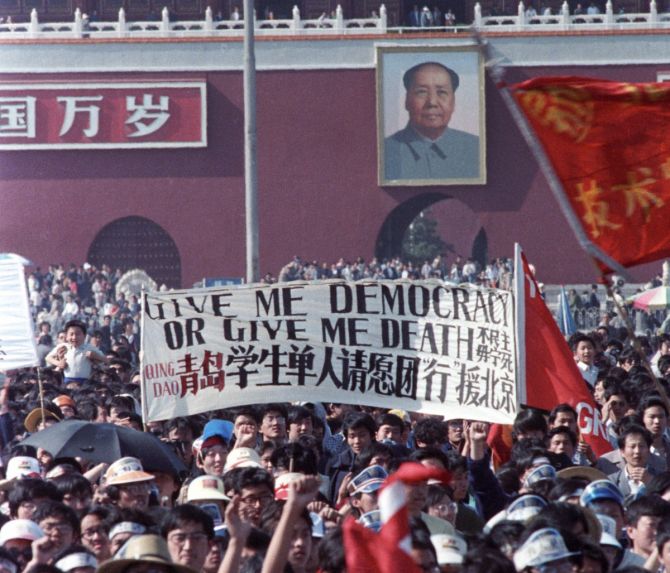
The death of Hu Yaobang was the beginning of the largest spontaneous student revolution since 1919.
During the following days and weeks, the students demanded freedom of speech and the press, democratic elections, greater transparency in government dealings.
The students believed that Hu Yaobang had been sacked though he had followed 'correct' policies. They demanded that the government “should affirm as correct Hu Yaobang's views on democracy and freedom.”
When The People's Daily termed the first spontaneous demonstrations as 'turmoil', the events took a new turn. For the students, the word 'turmoil' (‘dongluan’) had a strong meaning in Chinese reminiscent of the black days of the Cultural Revolution.
Zhao Ziyang was then the Party’s General Secretary; having the same conviction as Hu Yaobang, he thought that a possibility of political reform existed in Communist China. During the following weeks, he constantly tried to negotiate a compromise with the students. This could have changed the Middle Kingdom's fate.
We know what followed: during the night of June 3, Premier Li Peng ordered the tanks to roll out on the Square. Several thousand students lost their lives that night. The Party was saved and the fate of China was sealed (at least for the next few decades). One of the many ironies was that Li Peng was Zhou Enlai's adopted son.
In the meantime, the history of Modern Tibet is also rewritten; forgotten are the hundreds of thousands dead or the complete destruction of innumerable monasteries; on May 23, the Communist Party celebrated the 70th anniversary of the ‘Liberation of Tibet’, when the Dalai Lama’s representatives were forced under duress to sign that Tibet had ‘returned’ to the Motherland (China).
On the occasion, the local press in Lhasa reported: “Early in the morning, in the Potala Palace Square, the golden characters of the Tibet Peaceful Liberation Monument shined brightly. As evidenced by the monument, the peaceful liberation of Tibet 70 years ago not only shattered the delusional attempts of external forces to separate Tibet from China, safeguarded national sovereignty and territorial integrity, safeguarded the unity of the motherland and ethnic unity, and opened up the liberation of millions of serfs.” The Communist newspaper added: “This is a new day, and the sun shines all over the snowy plateau.”
The Xinhua article quoted earlier, concluded: “Looking back on the party’s history …our party has always adhered to the original aspiration and mission of seeking happiness for the Chinese people and rejuvenation for the Chinese nation, and it has never hesitated to advance toward this goal, thus winning the sincere and firm support of the people.”
If it was true, why omit the Great Leap Forward, the Cultural Revolution or the Tiananmen massacre from the history of the Party? It should at least have been analyzed to understand what went wrong; hiding a large portion of history does not give credibility to the Party.
Similarly, the Party is today hiding what happened in Wuhan.
It is time the world starts pressurizing Beijing to tell the truth.

Tuesday, June 1, 2021

When the Chinese Glasnost died again

One the occasion of the 32th anniversary of the Tiananmen massacre, I re-post an article written in January 2005.
Two years ago, during the monthly briefing by senior Colonel Wu Qian, the spokesman of the Chinese Ministry of National Defence, a correspondent asked if the People's Liberation Army had any comment on the suppression of students 30 years ago.
Wu Qian replied: "I don't agree with the word 'suppression' in your question." 
He added "Over the past 30 years, the process of our reform and development and our stability and achievements have already addressed your question."
Even this was deleted from the official transcript of the Press Conference...
It shows that China has not been nervous for a long time...

From Rediff.com, The Day Chinese Glasnost Died.
Did Zhao Ziyang die on January 8 or did he die on the morning of January 17? That is a million yuan question!
On the same day in 1976, another Chinese leader, its Prime Minister Zhou Enlai, passed away.
When Zhou died, the Great Proletarian Cultural Revolution had just ended. Modern China had gone through its 10 most tormented years.
During previous months, Mao had refused to provide treatment for his premier who had cancer; the Emperor wanted Zhou to die before him.
Even in Communist China, there is protocol!
In fact, the problem was that the premier was more popular than the Great Helmsman with the masses. Zhou's death was observed by Dr Zhisui Li, Mao's private physician who commented: 'What worried me most was the power struggle to follow.'
In Beijing, memories of the Cultural Revolution purges were still fresh in the populace's psyche. Though resentment was growing, nothing could be done openly as yet.
At that time, the Chinese New Year was approaching. When Mao decided to celebrate the event with firecrackers, the crowd outside Zhongnanhai (the residential enclave where Politburo members live) thought the Chairman rejoiced over his premier's death. Anger mounted, but the people of Beijing had to wait a few more weeks to express their respect for the deceased leader.
Dr Li wrote: 'Beginning in mid-March, knowing that the Qing Ming festival for honoring the dead would be celebrated on April 4, the citizens of Beijing began going to the Monument to the Revolutionary Heroes in Tiananmen Square to place mourning wreaths for Zhou. The movement was spontaneous, and the crowds grew larger by the day. The country had not witnessed such an outpouring of popular sentiment since before the Communists came to power in 1949.'
As April 4 approached, Dr Li visited Tiananmen clandestinely: 'The Square was filled with tens of thousands of people singing, making speeches, and reading poems. The mourning wreaths stretched from the Monument to the Revolutionary Heroes in the centre of the square all the way to Changan Avenue just in front of the Gate of Heavenly Peace, and thousands of banners were flapping in the breeze. It was impressive and moving.'
A similar event occurred 13 years later.
In 1989, though Hu Yaobang had been sacked as the secretary general of the Chinese Communist Party in January 1987, he was still a member of the Politburo and entitled to attend important meetings. On April 9, after uttering some strong words on the Communist Party's failures, the respected Hu Yaobang had a stroke. A week later he passed away.
Zhao Zhiang, then secretary general of the Chinese Communist Party, made the customary brief assessment of Hu's life: 'Comrade Hu was a loyal, tried and tested Communist fighter, a great proletarian revolutionary and politician, an outstanding political worker for the army.'
It was agreed that Hu would have a national funeral service with the norms of standing members of the Politburo. The plan was accepted by all the party's senior leaders including Deng Xiaoping. During that meeting, Zhao requested Qiao Shi, No 3 in the party and responsible for security, to 'keep a close watch on how Comrade Yaobang's death might impact society.' Qiao Shi is said to have replied: 'At the moment, society is in pretty good shape, Things are fairly stable.'
In the afternoon of April 17, 600 students of the Chinese University of Political Science and Law marched into Tiananmen Square with mourning banners and wreaths. They were 10,000 by the evening.
The next day, students and onlookers poured in from Beijing University and other places. Wreaths accumulated in front of the Monument to the Revolutionary Heroes.
The rest is history.

It was the beginning of the largest spontaneous student revolution since 1919.
During the following days and weeks, the students demanded freedom of speech and the press, democratic elections, greater transparency in government dealings.
The pretext for the explosion of the students' ire was the fact that Hu Yaobang had been sacked though he had followed 'correct' policies. They demanded that the government 'should affirm as correct Hu Yaobang's views on democracy and freedom.' When the People's Daily termed the first spontaneous demonstrations as 'turmoil', the events took a new turn. For the students, the word 'turmoil' (dongluan) had a strong meaning in Chinese reminiscent of the black days of the Cultural Revolution.
One man played a major role in the Tiananmen events -- Zhao Ziyang. Having the same conviction as Hu Yaobang, he thought that a possibility of political reform existed in Communist China. During the following weeks, he constantly tried to negotiate a compromise with the students. This could have changed the Middle Kingdom's fate.
One of his collaborators, Wu Guoguang, remembered in Time magazine: 'In the wrong place at the wrong time, Zhao Ziyang did the right thing. It was close to midnight on the night of May 19, 1989. China's leaders were finalising their plans to declare martial law and crush the Tiananmen Square democracy protests that had, in the preceding 48 hours, swelled to include more than a million demonstrators.
Zhao, then general secretary of the Chinese Communist Party, might have remained with the commissars inside Beijing's Great Hall of the People as they called in the troops. Instead, stooped with fatigue, tears in his eyes, he waded into the throngs of students and in the gathering darkness pleaded with them to abandon their vigil before it was too late.'
Three days earlier Zhau had received Mikhail Gorbachev, then general secretary of the Soviet Union Communist Party. Was Zhao trying to emulate his Soviet counterpart when he spoke to the students? The Chinese leader told Gorbachev, 'Some young people now had doubts about the superiority of socialism, that these doubts arose from genuine problems with the Party leadership and certain entrenched habits, and that the only way out for socialism was continued vigorous reforms.'
This view was certainly not shared by all in the standing committee of the Politburo. Just after Zhao had met Gorbachev, an important meeting was held, the verdict was split: two members were in favour of using force against the students, two were for a continuation of the dialogue and one, Qiao Shi, abstained.
The next day, the matter was referred to Deng Xiaoping. Zhao had told Gorbachev: 'Even though Deng Xiaoping had retired from his Party posts in 1987, the Party had recognised that his wisdom and experience were essential and that for the most important questions he would still be at the helm.'
Deng decided to use force. On May 20, the martial law order was signed by Prime Minister Li Peng. Two days later, Zhao Ziyang was sacked and Jiang Zemin was called from Shanghai to replace him.
During the night of June 3, Li Peng ordered the tanks to roll on the Square. Between 3,000 and 10000 students lost their lives that night. The Party was saved and the fate of China was sealed (at least for the next few decades). One of the many ironies was that Li Peng was Zhou Enlai's adopted son.
On October 17, 2004, Zhao celebrated his 75th birthday. The Human Rights in China group reported: 'In the past three days large groups of people have been gathering outside Zhao's Beijing home, requesting permission to see him. The groups, which range in size from a dozen to upwards of 100 people, seem to be made up largely of Zhao's former subordinates and his close friends and relatives.'
On the same day, a group of senior Chinese citizens and Zhao's supporters wrote to President Hu Jintao and Premier Wen Jiabao about Zhao's continuous detention: 'We strongly urge that you unconditionally and immediately release Mr Zhao Ziyang from house arrest, restore his freedom, and resume all his civil rights!
'No matter how the CPC (Chinese Communist Party and its government would now judge the 1989 political storm and whether Mr Zhao was right or wrong at that time, as a citizen of the People's Republic of China, his civil rights ought to be respected and protected. Without due legal procedure, his freedom and civil rights are not to be deprived. We believe that you share this common view with us, and with all those who respect the constitution and laws of China.'
On January 8, 2005, the media reported from Hong Kong that Zhao had died. This was denied by Chinese Foreign Ministry spokesman Kong Quan as totally untrue: 'Zhao Ziyang is an old man who is over 80. He fell ill, but after attentive treatment, his condition is currently stable,' he told reporters. However, one can doubt the veracity of this declaration (Zhao's daughter admitted he was in a coma).
Probably, like Yasser Arafat, the announcement of his death will be stage managed to ensure that all arrangements for his 'non-official' funeral are complete.
Already news from the BBC says, 'A thousand policemen are to be deployed every morning on Beijing's Tiananmen Square to escort visitors to the flag-raising ceremony. The new rules may be designed to prevent any dawn protests on the square, scene of a bloody pro-democracy crackdown in 1989.'
All this coincides with the publication of a Gallup report which concluded: 'The people of China may be far wealthier than they were a decade ago, but they are not very satisfied with their quality of life, a survey showed.'
In the meantime, the European Union prepares to lift the arms embargo imposed after the Tiananmen events.
This will be the third time Zhao died. Politically, he died at Tiananmen Square in May 1989; he probably died in a Beijing hospital earlier this month; and the principles he fought for will be buried for the sake of selling a few weapons more.

Sunday, May 23, 2021

Tibet's so-called Peaceful Liberation: 70 year ago

My article Tibet's so-called Peaceful Liberation appeared in The Daily Guardian.

Here is the link...

As China plans to celebrate the 70th anniversary of the 17-Point Agreement, it is important to remember that the violence and subjugation Tibet has witnessed since 1950 cannot be termed as a ‘peaceful liberation’ of the region.

The history of Mao's China is a tale of well-planned and well-executed moves. All the events from 1949 onwards have unfolded in a perfectly calculated sequence: first, the invasion of Tibet in 1950; after a vague protest by the Indian Government and the adjournment of the Tibetan Appeal to the UN (at Delhi's instance), in 1951, the 17-Point ‘Agreement’ was signed. Then, in 1954, the ‘Panchsheel’ accord (which neutralized India under the Hindi-Chini Bhai-Bhai bluff) was inked and soon after the first incursions started on Indian soil. It was followed by the crushing of the Tibetan uprising in 1959, and finally in October 1962, the ‘teaching of a lesson’ to India for daring to give asylum to the Dalai Lama and his followers in March 1959.
This should not be forgotten at a time China plans to celebrate the 70th anniversary of the “Agreement between the Central People's Government and the Local Government of Tibet on Measures for the Peaceful Liberation of Tibet”, also known as the 17-Point Agreement. The paramount question remains: has Tibet really been liberated?
Here too, Mao executed a meticulously planned two-pronged operation; the first part culminated in the Battle of Chamdo which saw the Tibetan forces being decimated; the Great Helmsman’s second step was ‘diplomatic’, the weak Tibetan State was forced to put its thumbprint on an agreement allowing Communist China to take over the Land of Snows.
In May 1951, the Tibetan delegates had no alternative but to accept that the “the Tibetan people shall return to the family of the Motherland of the People's Republic of China” and “drive out imperialist aggressive forces from Tibet.” (Article I)
Ngabo Ngawang Jigme, the former governor of Kham province at that time a prisoner of war, was nominated by the Communists as ‘head of the Tibetan delegation’; with his colleagues, Ngabo had to agree that “the local government of Tibet shall actively assist the People's Liberation Army (PLA) to enter Tibet and consolidate the national defenses.” (Article II)
One can ask: against who was this ‘defence consolidation’?
Very few realized then that it could only be against India; though the Indian officials posted on the Roof of the World would soon discover the true objectives of the Communists, nobody was ready to listen in Delhi.
This period coincided with the beginning of the Hindi-Chini-Bhai-Bhai, the honeymoon between Delhi and Beijing.
Several years ago, the Central Tibetan Administration claimed that the number of Tibetans who died of starvation, violence, or other indirect causes due to the invasion was approximately 1.2 million. Though this figure could not be confirmed, the Chinese occupation was far from ‘peaceful’.
Over the years, the age-old Indo-Tibet relations were gradually replaced by a cruder relation with the new occupiers of Tibet; the Indian kinship with Tibet progressively disappeared with the presence of the ‘Liberation Army’ (PLA) the plateau. This was witnessed with dismay by the Indian diplomats and officials posted in the Land of Snows till the 1962 War.
At the beginning, very few Tibetans had the courage to fight the ineluctable; most, whether from the aristocracy or the clergy, first collaborated with the occupying forces, but these years also witnessed the birth of a national conscience and a ‘people’s movement’, which unfortunately never got Delhi’s support.
Soon after the signature of the 17-Point Agreement, the arrival of the Chinese troops in Lhasa brought a famine in Lhasa. Delhi came to the rescue and fed rice the PLA for a couple of years via Sikkim.
The first and foremost consequence of the signature of the 17-Point Agreement was that the Land of Snows lost its sovereignty; Tibet had become a part of the ‘Great Motherland’. It was the first time in its 2,000 year-old history, that Tibet consented to be a province ‘within the boundaries’ of China in an official document.
The Tibetans were put in front of a fait accompli and the Government of India did react to the ‘Agreement’, even though some clauses were in clear contradiction with several articles of the 1914 Simla Convention, binding between India and Tibet.
Three weeks after the Agreement was inked, during a press conference, Nehru pretended that he was unaware: “I do not know much more about it than you probably know. The story about an agreement being reached between the People's Government in China and the Tibetan authorities has reached us too. That is all; no further development has taken place to our knowledge. It is not proper for me to react to something which is not complete, which is not fully known.”
Washing his hands of the tragedy, the Prime Minister remained extremely vague when asked about the status of Tibet: “Throughout this period some kind of Chinese suzerainty has been recognised in the past as well as Tibetan autonomy. We have certain interests there which are not political but which are cultural, etc, which we should like to preserve. These are our approaches and we should like to preserve our cultural and trade interests in a friendly way with the people concerned.”
The Chinese propaganda said that the Dalai Lama welcomed the Agreement, he would have sent a telegram to Mao: "the local government of Tibet as well as the Tibetan monks and laymen unanimously support this agreement, and will actively assist the PLA in Tibet to consolidate national defense, drive imperialist forces out of Tibet and safeguard the unification of the territory and the sovereignty of the motherland." The 16-year old probably never did.
Some 15 years ago, in an interview, the Tibetan leader told us: “when the Tibetan delegation was negotiating in Beijing they were reluctant to sign, but the Chinese told them clearly: ‘If you do not sign, it is very easy for us, we just have to give a signal to the army and the army will march into Tibet.’" The Tibetan leader concluded: “It is clear, there were only two choices: either to accept the agreement or to go through what they called a military 'liberation'. For some years, we derived some benefit, but later, it became plain military occupation.”
Today China has started the most wide-apread campaign since the Cultural Revolution, to teach the glorious history of the Communist Party to the Chinese people. The propaganda says: “hostile forces at home and abroad make use of the history of the Chinese revolution and the history of the new China, doing their utmost to attack, vilify and smear them, with the fundamental aim of inciting the over throw of the leadership of the Communist Party of China and our socialist system.”
But history can’t be changed. The Tibetans were not ‘peacefully liberated’ in 1951.