Showing posts with label Mao Zedung. Show all posts

Sunday, May 23, 2021

Tibet's so-called Peaceful Liberation: 70 year ago

My article Tibet's so-called Peaceful Liberation appeared in The Daily Guardian.

Here is the link...

As China plans to celebrate the 70th anniversary of the 17-Point Agreement, it is important to remember that the violence and subjugation Tibet has witnessed since 1950 cannot be termed as a ‘peaceful liberation’ of the region.

The history of Mao's China is a tale of well-planned and well-executed moves. All the events from 1949 onwards have unfolded in a perfectly calculated sequence: first, the invasion of Tibet in 1950; after a vague protest by the Indian Government and the adjournment of the Tibetan Appeal to the UN (at Delhi's instance), in 1951, the 17-Point ‘Agreement’ was signed. Then, in 1954, the ‘Panchsheel’ accord (which neutralized India under the Hindi-Chini Bhai-Bhai bluff) was inked and soon after the first incursions started on Indian soil. It was followed by the crushing of the Tibetan uprising in 1959, and finally in October 1962, the ‘teaching of a lesson’ to India for daring to give asylum to the Dalai Lama and his followers in March 1959.
This should not be forgotten at a time China plans to celebrate the 70th anniversary of the “Agreement between the Central People's Government and the Local Government of Tibet on Measures for the Peaceful Liberation of Tibet”, also known as the 17-Point Agreement. The paramount question remains: has Tibet really been liberated?
Here too, Mao executed a meticulously planned two-pronged operation; the first part culminated in the Battle of Chamdo which saw the Tibetan forces being decimated; the Great Helmsman’s second step was ‘diplomatic’, the weak Tibetan State was forced to put its thumbprint on an agreement allowing Communist China to take over the Land of Snows.
In May 1951, the Tibetan delegates had no alternative but to accept that the “the Tibetan people shall return to the family of the Motherland of the People's Republic of China” and “drive out imperialist aggressive forces from Tibet.” (Article I)
Ngabo Ngawang Jigme, the former governor of Kham province at that time a prisoner of war, was nominated by the Communists as ‘head of the Tibetan delegation’; with his colleagues, Ngabo had to agree that “the local government of Tibet shall actively assist the People's Liberation Army (PLA) to enter Tibet and consolidate the national defenses.” (Article II)
One can ask: against who was this ‘defence consolidation’?
Very few realized then that it could only be against India; though the Indian officials posted on the Roof of the World would soon discover the true objectives of the Communists, nobody was ready to listen in Delhi.
This period coincided with the beginning of the Hindi-Chini-Bhai-Bhai, the honeymoon between Delhi and Beijing.
Several years ago, the Central Tibetan Administration claimed that the number of Tibetans who died of starvation, violence, or other indirect causes due to the invasion was approximately 1.2 million. Though this figure could not be confirmed, the Chinese occupation was far from ‘peaceful’.
Over the years, the age-old Indo-Tibet relations were gradually replaced by a cruder relation with the new occupiers of Tibet; the Indian kinship with Tibet progressively disappeared with the presence of the ‘Liberation Army’ (PLA) the plateau. This was witnessed with dismay by the Indian diplomats and officials posted in the Land of Snows till the 1962 War.
At the beginning, very few Tibetans had the courage to fight the ineluctable; most, whether from the aristocracy or the clergy, first collaborated with the occupying forces, but these years also witnessed the birth of a national conscience and a ‘people’s movement’, which unfortunately never got Delhi’s support.
Soon after the signature of the 17-Point Agreement, the arrival of the Chinese troops in Lhasa brought a famine in Lhasa. Delhi came to the rescue and fed rice the PLA for a couple of years via Sikkim.
The first and foremost consequence of the signature of the 17-Point Agreement was that the Land of Snows lost its sovereignty; Tibet had become a part of the ‘Great Motherland’. It was the first time in its 2,000 year-old history, that Tibet consented to be a province ‘within the boundaries’ of China in an official document.
The Tibetans were put in front of a fait accompli and the Government of India did react to the ‘Agreement’, even though some clauses were in clear contradiction with several articles of the 1914 Simla Convention, binding between India and Tibet.
Three weeks after the Agreement was inked, during a press conference, Nehru pretended that he was unaware: “I do not know much more about it than you probably know. The story about an agreement being reached between the People's Government in China and the Tibetan authorities has reached us too. That is all; no further development has taken place to our knowledge. It is not proper for me to react to something which is not complete, which is not fully known.”
Washing his hands of the tragedy, the Prime Minister remained extremely vague when asked about the status of Tibet: “Throughout this period some kind of Chinese suzerainty has been recognised in the past as well as Tibetan autonomy. We have certain interests there which are not political but which are cultural, etc, which we should like to preserve. These are our approaches and we should like to preserve our cultural and trade interests in a friendly way with the people concerned.”
The Chinese propaganda said that the Dalai Lama welcomed the Agreement, he would have sent a telegram to Mao: "the local government of Tibet as well as the Tibetan monks and laymen unanimously support this agreement, and will actively assist the PLA in Tibet to consolidate national defense, drive imperialist forces out of Tibet and safeguard the unification of the territory and the sovereignty of the motherland." The 16-year old probably never did.
Some 15 years ago, in an interview, the Tibetan leader told us: “when the Tibetan delegation was negotiating in Beijing they were reluctant to sign, but the Chinese told them clearly: ‘If you do not sign, it is very easy for us, we just have to give a signal to the army and the army will march into Tibet.’" The Tibetan leader concluded: “It is clear, there were only two choices: either to accept the agreement or to go through what they called a military 'liberation'. For some years, we derived some benefit, but later, it became plain military occupation.”
Today China has started the most wide-apread campaign since the Cultural Revolution, to teach the glorious history of the Communist Party to the Chinese people. The propaganda says: “hostile forces at home and abroad make use of the history of the Chinese revolution and the history of the new China, doing their utmost to attack, vilify and smear them, with the fundamental aim of inciting the over throw of the leadership of the Communist Party of China and our socialist system.”
But history can’t be changed. The Tibetans were not ‘peacefully liberated’ in 1951.


Monday, March 29, 2021

The Return of Red Genes in Tibet

China has found a new love for history.
But it is history with strong Chinese characteristics, in other words, far from facts.
As mentioned in my previous post, March 28, which marked the dissolution of the Tibetan Government in 1959, is now celebrated as Serf’s Emancipation Day.
According to Xinhua, the Communist Party of China (CPC) “led the people in Tibet to launch the democratic reform, abolishing Tibet's feudal serfdom under theocracy.”
The propaganda goes on and on: “The emancipation of one million serfs was a groundbreaking event for Tibet. It was under the CPC leadership that Tibetans started to embrace happy lives.”

A Museum of the 'Emancipation'?
A Museum has now been opened in Lhasa to display “photos and items from the serfdom era, including torture instruments and ritual artifacts made from serfs' bones and skin, and those recording the democratic reform and serfs' new lives.”
The Tibetan society might not been perfect (which society is perfect?), but this interpretation is pure non-sense.
Che Dalha, chairman of the Tibetan Autonomous Region (TAR) government declared on the occasion: “Tibet will keep pace with other parts of the country in completing the building of a moderately prosperous society in all respects and embarking on a new journey toward socialist modernization.”
But are the people really happy under the Communist Party’s joke is another question.

Taking oath to follow the Party

Learn from History
In the meantime, the Propaganda Department of the Communist Party held public lectures on Party's history in Lhasa and all over-Tibet.
Everyone has to learn the glorious past of the Party, which killed hundreds of thousands Tibetans in the first two decades of its rule; the intention was of course only to 'liberate' them.
On March 27, Wu Degang, the Deputy Director of the Central Party History Research Office and Deputy Dean of the Central Party History and Documentation Research Institute, came to Lhasa to lecture the members of the Standing Committee of the Tibetan Autonomous Region (TAR).

Guess who was in attendance with the big shots of the Party?
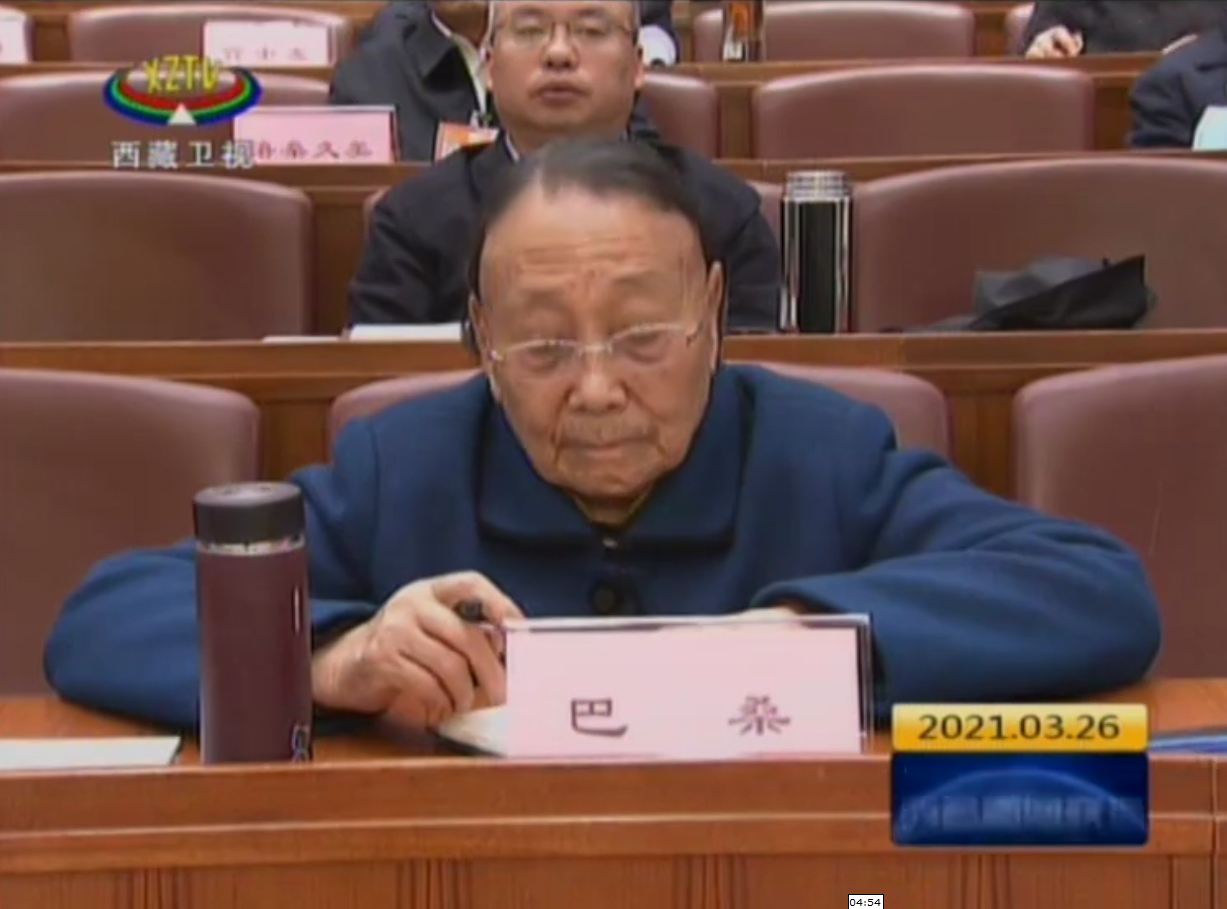
Pasang, the most infamous Maoist, who ruled Tibet during the dark days of the Great Proletarian Cultural Revolution and who later escaped all purges, was sitting with the TAR's Standing Committee members.
Is it a sign of the ‘New Era’ heralded by Xi Jinping?
It strangely resembles the Darkest Days of the Land of Snows.

Pasang, the 84-year old 'ex-serf'
Who is Pasang?
According to the Communist propaganda, Pasang was born in a ‘slave’ family in Gongka County in 1937; she was named Kalsang by parents. As child she lived in Lhasa and worked as a ‘slave’ in a nobleman's estate.
Her Communist biography quotes her: “They were just treating us as ‘talking’ animals, just ‘talking tools’. We were not treated as a human being. At that time, there were really no human rights at all [in Tibet].”
Her biographer continues: “Because she could not bear this kind of abuse, she went to the Lhasa River several times. She thought of throwing herself into the river, but thinking of her father, sister and two younger brothers who had stayed in Lhoka [Southern Tibet] as slaves and because she had not met them for several years, each time, she decided to return to her master’s house.”
Soon after, Pasang heard that the PLA had arrived in Lhasa: “they were good to the poor, and some slaves had already joined the PLA.”
Her official biography says that Pasang remembered: "In July of the 56th Tibetan calendar, there was festival. When it became dark at night, I was asked to go to the slaughterhouse to pick up some meat, many guests had come for a festival. In the slaughterhouse, there was only beef and no mutton. I told the lady when I came back. Then she took me to a room in a warehouse and beat me up. I fainted on the spot. When I woke up, it was dark,  as the door was still open, I left and I ran away.”
After escaping from the host's house, she decided to change her name to avoid pursuit.
She explained: "How did I change my name? I walked along the Qinghai-Tibet Highway; it was already night. I was walking, and suddenly I saw the stars in the sky. The brightest star in Tibetan speaks Karma Pasang, which is Venus, so I thought my name should Pasang. My name was changed this way. From then on, Kalsang became Pasang [also Friday].”
Then, she came into contact with the PLA, but due to her illiteracy, she encountered many difficulties. Pasang was however sent to Tibetan Cadre School, she remembered later: “I didn’t learn anything at the Cadre School. At that time, the upper-level reactionary group of the Kashag [Cabinet] government led by the Dalai Lama opposed running schools and training ethnic cadres in Tibet, so they sent people there to sabotage it. As these schools failed, the central government [read the Communist Party] decided to set up schools in the Mainland to train Tibetan cadres."
This is obviously a very biased reading to modern Tibetan history. The Tibetan masses were upset by the imposition of the Communist ideology and the denigrating of the Tibetan culture, particularly, Buddhism considered as a ‘poison’ by Mao; they obviously opposed the Communist schools.
From then, Pasang became a good Communist, one of the main collaborators working for the Chinese occupying forces and an active Maoist during the Cultural Revolution.
Her reappearance on the Tibetan political scene is not a good sign.
As an indication, I give here some extracts of Pasang’s 'official' CV.

Pasang’s Personal History
•    1956: Joined a unit of the PLA
•    1957: Sent to study at Tibet Nationalities Institute
•    1959: Joined CCP
•    1965-68: Deputy Magistrate of Nang Dzong County
Pasang’s rise to the top dates from the Great Proletarian Cultural Revolution. She came into prominence in May 1966 when she wrote an article in The People's Daily praising Mao Zedong's Thought.
It is always good to praise the Great Helmsman, yesterday or today.
In September 1969, when the Revolutionary Committee of the Tibet Autonomous Region (TAR) was established to replace regional government, she was elected Vice-Chairperson.
In 1971, she was made a deputy party secretary in the TAR Party Committee, a position she held until her retirement in 2002.
It is the highest position that a Tibetan has ever reached since 1959 till date.
Incidentally, two Tibetan leaders survived the purge of leftist officials and the fall of the Gang of Four in October 1976; it was Ragti and Pasang. They are still around and used by the Party when necessary. 

Very Few Tibetans Trusted by the Party
According to historian Tsering Shakya, the explanation given by CCP General Secretary Hu Yaobang at the Second National Work Forum in 1984 for keeping these two Tibetans in their positions despite their Cultural Revolution background: “It was clear that even the most liberal leader was not prepared to carry out a purge of Tibetan leftists, perhaps because...only those Tibetans who had gained most under the Communists could be relied upon to support Beijing.”
This is a serious issue, even today; very few Tibetans can be trusted by the Party.
The return of Pasang on the centre stage is another proof of this.

Let us continue with her CV:
•    1971 August: She is reelected secretary of the new TAR Communist Party Secretariat towards the end of the Cultural Revolution
•    1973 July: Pasang is elected chairman of the Women's Federation of Tibet and member of the CCP Central Committee by the 10th People's Congress
•    1975 January: member of the Standing Committee of the 4th NPC; head of a women's delegation to Japan
•    1978 February: deputy for the TAR to the 5th NPC
•    1979 June: member of the Budget Committee at the 2nd Session of the 5th NPC
•    1979: August: Vice-person of the People's Government of the TAR; held post until 1983
•    1971-85: Secretary of TAR Party Committee
•    1982 November: Member of the Presidium, 5th Session of the 5th NPC
•    1983-1986: President of the Tibet Nationalities Institute (concurrently with Yang Dongsheng)
•    1984 May: Director of the office of the Party Rectification Guidance Group under TAR Party Committee and deputy secretary of TAR Party Committee
•    1984 July - 1987 November: Member of Standing Committee of 4th term of CPPCC Tibet Regional Committee
•    1985 November: secretary of the TAR Party Committee Discipline Inspection Commission
•    1986: Deputy Secretary of TAR Committee and secretary of TAR Party Committee Discipline Inspection Commission 

Pasang
•    1993: Vice-chairperson of the CPPCC 6th Tibet Regional Committee
•    1975-1978: Member of Standing Committee of 4th and 5th NPCs
•    1973-87: Member of CCP 10th through 12th Central Committees
•    1992: Deputy to CCP 14th National Congress. Member of 14th CCP Central Discipline Inspection Commission
•    From January 1993 to November 1994, he served as Deputy Secretary of the TAR.
•    In April 1994, he was clearly treated as chairman of the Government of the TAR
•    From November 1994 to September 1998, he served as Deputy Secretary of the CPC TAR Committee
•    After September 1998, she was Deputy Secretary of the TAR and Vice Chairperson Chairman of the All-China Women’s Federation
•    She was an alternate member of the 9th Central Committee and a full member of 10th, 11th, and 12th Central Committees, and a member of the Central Commission for Discipline Inspection at the 13th and 14th National Congress and also a member of the Standing Committee of the Fourth and Fifth National People's Congress.

The return of Pasang symbolizes the return of the darkest era in the history of Modern Tibet; is it what Xi Jinping calls the “New Era?’
The Chinese propaganda today provides ‘education and guidance’ to all Party members and cadres who need “firm up their ideals and beliefs, inherit the red genes and always maintain their political qualities.”
Even in the PLA: “Every soldier should be loyal to the core, uphold the core, follow the core.” 

The 'core' is the new Helmsman. 

The objective is to make soldiers "appreciate the glorious truth about Xi Jinping's Thought on Socialism with Chinese characteristics.”

Isn't it frightening?


Saturday, March 6, 2021

Communism in China: A hundred years later

My article Communism in China: A hundred years later appeared in The Daily Guardian

Here is the link...

As China prepares to celebrate the centenary of the Communist Party, the world must remember the massacres which Communist regimes have unleashed throughout history and question why Xi Jinping’s march towards the ‘New Era’ is marked by such aggression directed at neighbouring countries.

The year 2021 is supremely important for the Middle Kingdom and its Emperor: Not only will it bring the occasion to unveil the 14th Five-year Plan and China’s 2035 Vision, but, more importantly, Beijing will celebrate the 100th anniversary of the Communist Party of China.
Already, in January, President Xi Jinping declared that “the party and country are on the right track… time and momentum are on our side”, and even though the country faced “unprecedented challenges and opportunities,” he urged his Politburo colleagues to “create favourable social conditions” for the important anniversary.
On 1 March, Xi spoke at the opening ceremony of the training class for young and middle-aged cadres at the Central Party School in Beijing. He told the young cadres that they were the successors of the old comrades, “the glory of the party is in your hands”, and exhorted them to be the “faithful successor of the tradition and fine work-style of the Communist Party, constantly enhancing willpower, perseverance and self-control and making contributions in the new journey of comprehensively building a modern socialist country in the New Era while striving to create a worthy party, worthy of the Chinese people!”
And, of course, “loyalty to the party is the primary political quality of Communists,” he added.
The words of the new Great Helmsman sound great, but there is another side to the coin.
In 1997, French scholar Stéphane Courtois, along with other European academics, published Le Livre noir du communisme. It was later translated in several languages, with the title The Black Book of Communism: Crimes, Terror, Repression in English.
The Black Book, which sold millions of copies, is still considered by many as one of the most influential publications written about the history of Communism in the 20th century. The authors documented the history of political repression by Communist states, including genocides, extrajudicial executions, deportations, killing populations in labour camps as well as artificially-created famines.
Though some leftist ‘intellectuals’ objected to the Communist label being put on some of these dark events, the facts are difficult to change.
In the first chapter, The Crimes of Communism, Stéphane Courtois recalls, “Communist regimes turned mass crime into a full-blown system of government …and are responsible for a greater number of deaths than Nazism or any other political system. …Communism predated fascism and Nazism, outlived both, and left its mark on four continents.”
And today, it is still thriving in China and North Korea.
Quoting Plato’s Republic and Thomas More as Communist examples of ‘utopian philosophy’, Courtois explained, “We must make a distinction between the doctrine of communism and its practice. As a political philosophy, communism has existed for centuries, even millennia.”
Courtois gives figures, people killed by Communist governments amount to more than 94 million, including 65 million in the People’s Republic of China, 20 million in the Soviet Union, 2 million in Cambodia, 2 million in North Korea, 1.7 million in Ethiopia, 1.5 million in Afghanistan, 1 million in Vietnam.
In China alone, there is no doubt today that the Great Leap Forward resulted in 40 to 50 million deaths. According to Frank Dikötter in his masterly Mao’s Great Famine: The History of China’s Most Devastating Catastrophe, “45 million people died unnecessarily …6 to 8 percent of the victims were tortured to death or summarily killed—amounting to at least 2.5 million people.” Yang Jisheng in Tombstone: The Great Chinese Famine, 1958–1962 put the tally between 43 million and 46 million.
We could argue that it was another age, another time. But in this case, why continue to eulogise Communism and the Party?
Of course, Xi Jinping’s Thought is known as Socialism with Chinese characteristics for a New Era. A couple of years ago, it was even enshrined in the Chinese Constitution.
But if it is a new era, why arrest all the pro-democracy activists in Hong Kong? Recently, pro-China prosecutors argued in court that the defendants were involved in a “massive and well-organised scheme to subvert the Hong Kong government” by organising and participating in an unofficial primary election last July, although CNN commented, “such contests are a normal function in democracies around the world, during which political parties select the strongest candidates for an election.”
Look at the situation in Xinjiang where millions of Uyghur Muslims have been forced to live in ‘reeducation camps’, in Tibet, where the Communist regime wants to impose its own Dalai Lama (over one hundred years, the Party seems to have acquired great knowledge in spiritual matters), in Taiwan, which perpetually lives under Beijing’s invasion threat, or closer to us, India, which during the past nine months was subjected to an uncalled for aggression on its borders. Examples could be multiplied to show that China has not really entered a ‘New Era’.
A few weeks ago, I was watching a Chinese program on Tibet and, to my surprise, spotted an old Maoist figure named Pasang, along with the present Standing Committee of the Tibetan Autonomous Region (TAR). The old lady served Mao well during the darkest days of the Cultural Revolution. She managed to survive the purges of other leftist officials and even the fall of the Gang of Four in October 1976 to become a vice chairwoman of the TAR Revolutionary Committee in September 1968. In 1971, she was made a deputy party secretary in the TAR Party Committee, a position she held until her retirement in 2002.
The fact that China is ready to use figure-heads of the darkest days of Communism tends to prove that the New Era has not yet landed in the Middle Kingdom.
In the coming months, Chinese propaganda will try to convince us of the contrary.
Xi Jinping, the General Secretary of the Communist Party, likes to say, “The original aspiration and the mission of Chinese Communists is to seek happiness for the Chinese people and rejuvenation for the Chinese nation… This founding aspiration, this mission, is what inspires the Chinese Communists to advance.”
Today, former Premier Zhou Enlai, who joined the CPC in 1921, the year when the Party was founded, has become a ‘lofty character’ who selflessly pursued a just cause for the common good throughout his life, says Chinese propaganda.
We remember him in India as a Machiavellian politician who took the Nehru government for a ride. The recent happenings in Ladakh have their origin in Zhou’s lofty words—the world’s standard for ‘lofty’ are obviously different than the Chinese’s.
Large-scale massacre may not occur today (mainly due to the information revolution), but has the mindset really changed in Beijing?

It does not seem so, even in the New Era.

Monday, November 16, 2020

The Tibet Factor in India-China Relations

Seventy Years Ago: Tibet Invaded
October 7, 2020 marks the 70th anniversary of the Chinese People’s Liberation Army (PLA) crossing the Upper Yangtze and entering into the territory controlled by Lhasa.
While invading Eastern Tibet, Beijing asserted that it was ‘liberating’ the Land of Snows. Today, seven decades later, the Tibetans, particularly the first ‘liberated’ populations of Eastern Tibet, still disagree with this interpretation. Tragically, in the process, India lost a peaceful border shared with a Buddhist nation.
The Battle of Chamdo, the first and only encounter between the Tibetan and Chinese forces, is interesting to look at for several reasons.
Tibet, a Buddhist nation was not military and tactically ready to oppose the seasoned troops of Mao (and some of China’s brilliant commanders). From the start, The Land of Snows stood no chance, especially without outside support from India or the West.
Further, many in Tibet still believed that increasing the number of japa (recitation) or parikramas (circumambulations) around the monasteries and stupas of Kham, would be sufficient to make the Truth Prevail. As Robert Ford, the British radio operator posted in Chamdo, remarked ‘The gods are on our side’ was the mantra most oft-repeated in the town, “but it seemed to me that something more Churchilian was needed.”
For the Chinese, it was a well-prepared operation (a ‘police operation’ would have said Marshal Peng Dehuai) in 2 stages: the fall of Chamdo, the capital of Kham province during the Fall of 1950 and then the advance to Lhasa during the next season.
India was fooled into believing that Communist China wanted a ‘negotiated’ settlement with the Tibetans: it was never the case. Marshal Liu Bosheng in a message in August 1950 made it clear that he was going to ‘liberate’ Tibet.
Opposite the Chinese strategists was Ngabo Shape , the Tibetan Commissioner for the Kham province, a weak leader, ready to surrender; he was obviously not the military chef de guerre that Tibet needed at that point in time to coordinate the defence of the different border posts.
It has to be noticed that Mao Zedong entered the Korean campaign on the same day  as the PLA crossed the Yangtze and started its operations in Tibet. It shows the confidence the Communist leadership had in the local PLA commanders.
The PLA summary of the battle and the recommendations distributed by the PLA after the Battle of Chamdo tend to show that it was an excellent preparation for the Chinese troops for another battle 12 years later on the Himalayan slopes. Against India this time!

Emergence of a ‘Liberated’ World
Looking back into the fifteen-year period before the India-China War (1947-1962), one can see that the world witnessed earth-shaking changes: India became independent; China did its own revolution, resulting in the arrival of a new regime, more brutal in its approach, especially towards the periphery of the Middle Kingdom; most of the African and Asian nations were decolonized. However, at the same time, a de facto independent nation came under the yoke of Communist China; hardly two months after the founding of the People’s Republic of China, Xinjiang was annexed, opening the door to Western Tibet which would be occupied a few months later, thereby changing the status of India’s Northern frontiers.
An unprepared and peaceful Land of Snows became part of the Chinese ‘Motherland’ in a two-pronged strategic move, i.e. the military fall of Chamdo and Eastern Tibet in October 1950 and then in May 1951, a ‘diplomatic’ coup, forcing a 17-Point Agreement on a weak and disunited Tibetan nation. Mao was indeed a master strategist.
Tibet lost its independence and India’s serene northern frontier vanished. Even though at that time, India had some excellent strategic thinkers, the Government in Delhi decided not to use their competence; their conclusions and recommendations were not accepted by the then Prime Minister.
The tumultuous last six months of 1950 saw the emergence of two factions in India: one led by Prime Minister Jawaharlal Nehru and KM Panikkar, his ambassador in Beijing, both obsessed with an imaginary friendship with New China and fixated on the ‘larger implications for World Peace’ for any decision concerning Tibet; the other, which immediately saw the strategic implications for India, if Delhi let Tibet down, was led by Sardar Patel, the Deputy Prime Minster with Sir Girja Shankar Bajpai, the Secretary General of the Ministry of External Affairs and Commonwealth Relations as his main adviser, but also comprised President Rajendra Prasad, C. Rajagopalachari, KM Munshi and others. They were fed with reports ‘from the ground’ by Harishwar Dayal, the Political Officer in Sikkim and Sumul Sinha, the Head of the Indian Mission in Lhasa, two sincere and far-sighted civil servants. At that time, India had a full-fledged Mission in Tibet as well as three Trade Agencies in Gyantse, Yatung and Gartok.
This tragic dichotomy between the officers on the ground with first hand information and the ‘visionaries’ in Delhi continued throughout these fifteen years.
Today China speaks of ‘poverty alleviation’ for the Roof of the World, but what has the Communist regime been doing since they entered Lhasa in September 1951, if the Tibetans have remained poor 70 years later?
The truth is that Mao was only interested in the strategic assets of Tibet; China gained not only a huge landmass, but the access to the ‘water tower of Asia’, large mineral resources and a strategic position dominating the subcontinent. The Tibetan masses were nowhere in China’s periscope.
At that time, the Indian government decided to ignore the Tibetan issue, probably due to a lack of vision and courage, despite the warnings of Sardar Patel and his colleagues. This move would have tremendous consequences; some that continue to be felt even 70 years later, for example, on the Northern borders of India, particularly in Eastern Ladakh.

The Tibetan appeal at the UN

On the same day that the Deputy Prime Minister Patel, wrote his prophetic letter to Nehru , a well-drafted appeal sent from Kalimpong  pointed to the fact that “the Tibetans were racially, culturally and geographically far apart from the Chinese.” It also made a parallel with the situation in the Korean peninsula: “The attention of the world was then riveted on Korea where aggression was being resisted by an international force.
Similar happenings in Tibet were taking place with the world covering its eyes: … [The problem is] largely the outcome of unthwarted Chinese ambitions to bring weaker nations on her periphery within her active domination,” said the Appeal, which continued: “As a people devoted to the tenets of Buddhism, Tibetans had long eschewed the art of warfare, practised peace and tolerance and for the defence of their country, relied on its geographical configuration and on non-involvement in the affairs of other nations.”
It added that the Chinese, in their natural urge for expansion, “have wholly misconstrued the significance of the ties of friendship and interdependence that existed between China and Tibet.”
Some twenty years ago, Claudia Johnston, an independent researcher in International Law at the University of Victoria, Canada, wrote a fascinating paper, Tibet: The International Mistake of the Century.
The outcome of her research was that the Tibetan Appeal was still a pending matter in the UN …waiting to be reopened: “The UN and individual Member States, have been conducting their decisions based on the false assumption that Tibet is not a ‘State’, but ‘an internal affair’ of China. UN official records show this to be a mistake.” Tibet was then a legal State.
As a result, “the issue of Tibetan Statehood remains unconsidered by the United Nations. United Nations mechanisms for ‘States’ to employ peaceful solutions to ‘Disputes’ have not been utilised.”
All this was done …at the request of India.
From the start, Nehru was pessimistic about the outcome of the UN appeal: “We doubt whether a discussion of Tibetan problem in General Assembly or in Security Council will yield any useful result,” wrote the Prime Minister. The friendship with China was already too important to be sacrificed for the fate a weak neighbour like Tibet.
The Prime Minister frankly admitted that though Beijing had repeatedly expressed itself in favour of Tibetan autonomy “but of course we do NOT know what their idea of autonomy is.”
He thought: “We do NOT think that legal argument will be helpful or that [General] Assembly should attempt more than appeal to two parties to come to a peaceful settlement. Condemnation of China will NOT help Tibet; and neither Security Council nor Assembly is in any position to render physical aid to Tibet.”
As a result China was not condemned and could complete its task of entering Lhasa without hindrance; in Sun Tzu’s jargon, ‘liberating Tibet without waging war’.
In the course of the discussions at the UN in New York, most of the representatives indicated that India was the nation most concerned and that they would follow India’s lead. In a note, Nehru sadly asserted: “I think it may be taken for granted that China will take possession, in a political sense at least, of the whole of Tibet.”  
He further admitted that for the Tibetan people the “autonomy can obviously not be anything like the autonomy, verging on independence, which Tibet has enjoyed during the last forty years or so.”
His final words were: “We cannot save Tibet, as we should have liked to do so, and our very attempts to save it might bring greater trouble to it. It would be unfair to Tibet for us to bring this trouble upon her without having the capacity to help her effectively.”
The strange argument was: if we do anything to help Tibet, it will upset the Chinese and the fate of Tibet would be worse.
The case was eventually ‘put in abeyance’ at India’s demand.
Let us remember that Sardar Patel was by then a dying man and nobody else could stand up to Nehru.
But today China stubbornly continues to occupy Indian territory in Ladakh; however if the Western Theatre Command generals manage to convince President Xi Jinping that India should be taught more lessons, there are plenty of old issues for India to reopen; the UN appeal is one of them.

The Panchsheel Agreement: a Turning Point
One of the most immoral actions of the Indian Government was to ignore the existence of the Tibetan Government during its dealing with the new masters of the Roof of the World, particularly during the talks for the 1954 Tibet Agreement. It was wrong of the government to be vociferous about the decolonization of Africa or Asia, while at the same time ignoring the occupation by force of Tibet, a gentle neighbor at its gates, which enjoyed what the Indian Prime Minister himself described as ‘verging on Independence’.
The “Agreement on Trade and Intercourse between the Tibet region of China and India”, remembered as the Panchsheel Agreement, was signed on April 29, 1954 in Beijing. At the end of 1953, negotiations started for an accord on Tibet, taking into account the new situation, i.e. China’s occupation of the plateau. The talks were to be settled in a couple of weeks; it would take four months to arrive at a settlement …but forgetting the border.
The Panchsheel Agreement resulted in the unhindered advance of the Communist ideology and Mao’s army on the Tibetan plateau. Having received the green light from Nehru, the Communists imposed a new way of life, less compassionate, less enlightened over the Roof of the World.
The Chinese officials in Tibet did not look favorably upon the Dalai Lama’s aspiration to radically change the Tibetan society while still maintaining its 2,000-year old tradition. This would have cast a shadow on the Communist Party.
It is however true that many senior Indian politicians and diplomats, educated in ‘modern’ ideas, thought the ‘old Lama hierarchy’ should go and Tibet become a ‘modern’ country; they believed that the Chinese invasion was a chance to make a clean sweep of the old superstitions, beliefs or rituals.

The Slow Take-over of the Plateau

Soon after the Tibet Agreement was signed, the Chinese leadership took a radical approach towards Tibet, though, for a couple of years, the main emphasis was the building of the infrastructure needed to ‘stabilize the revolution’ on the plateau.
This period was marked by a general deterioration of the situation in Central Tibet and the slow take-over of the institutions by the PLA and the representatives of the Communist Party’s Central Committee.
The Tibetans were at a loss, should they collaborate with the Communists or revolt against the Chinese occupation? Interestingly, it was the poorer sections of the society who started to rebel, while the high clergy and the aristocracy were not unhappy with the Chinese ‘largesse’ (which often included collaboration).
Over the years, the situation slowly changed with the Chinese getting bolder and establishing themselves by force, imposing their law on the local Tibetan officials as well as the Indian representatives. The pilgrims to Mt Kailash and the traders from the Himalayan region and Ladakh started to face harassment. It was only a beginning.
As the situation in Lhasa and elsewhere in Tibet continued to deteriorate, strengthening the Indian borders was imperative. For the purpose, an Indian Frontier Administrative Service was created and several ex-Army officers were recruited. This was one of the positive outcomes of the exacerbated tensions on the borders. These remarkable officers performed miracles on the frontiers. One wishes that the government would today recreate such a service.
By 1955, the construction of the Tibet-Sinkiang Highway cutting across Ladakh, had started and the roads heading towards the NEFA (now Arunachal Pradesh) and Sikkim had already been completed. The significance of these moves was ignored by Delhi; we are seeing the consequences today in Ladakh.

The Nehru-Zhou Talks in 1956

The visit of the Dalai Lama and Panchen Lama to India in 1956-57 should be seen in this perspective. The former was hesitant to return to Lhasa. He finally decided to return and give a chance to the Communists to ‘reform’ Tibet in a peaceful manner. It was not to be.
In 1956, during bilateral talks with his Indian counterpart , Zhou Enlai gave his rationale for invading Tibet ‘only’ in 1950: “The Ching [Manchu] Emperor appointed Governors to Tibet and troops were also stationed in Lhasa. The British wanted to go into Tibet under the pretext that Russia wanted to get into Sikang . Russia also made the same pretext, namely, that Britain was trying to get into Tibet, to get into Sikang. Exactly because of this rivalry and balance of power, Sikang and Tibet were never taken actually [by China].”
This is a strange argument; the truth was that the Tibetan nation was an independent country with all the attributes of a sovereign State (a government, a language, a script, a flag, a (weak) army, coins, stamps, etc); further, for centuries, the Land of Snow had close relations with India, first and foremost in the cultural and spiritual domains (Tibetan Buddhism originates from Nalanda, let us not forget), but also politically and economically with countless ‘silk’ roads across the Himalaya; in other words, there was a deep kinship.
Zhou continued to explain: “But there are many still who are not acquainted with these facts. Even the Pakistan Prime Minister recently  told me that he always thought Tibet to be independent. Even the Simla Conference admitted Chinese suzerainty over Tibet.”

Zhou did not know about the McMahon Line
The Chinese Premier then tried to justify China’s new claims in the North East Frontier Agency (NEFA), i.e. the McMahon Line: “People like me never knew about it [the Line] till recently. The then Chinese Government, namely, the warlords in Peking and the KMT naturally knew about it. Perhaps U Nu might have told Your Excellency [Nehru] that we studied this question and although this Line was never recognised by us, still apparently there was a secret pact between Britain and Tibet and it was announced at the time of the Simla Conference. And now that it is an accomplished fact, we should accept it. But we have not consulted Tibet so far.”
The clever Chinese statesman then mentioned the Panchsheel Agreement: “In the last agreement which we signed about Tibet , the Tibetans wanted us to reject this Line; but we told them that the question should be temporarily put aside. I believe immediately after India's independence, the Tibetan Government had also written to the Government of India about this matter. But now we think that we should try to persuade and convince Tibetans to accept it. This question also is connected with Sino-Burmese border and the question will be decided after Dalai Lama's return to Lhasa. So, although the question is still undecided and it is unfair to us, still we feel that there is no better way than to recognise this Line.”
The Indian Prime minister gave a nehruvian answer, with the consequences that India experiences on the border today: “The border is a high mountain border and sparsely populated. Apart from the major question, there are also small questions about two miles here and two miles there. But if we agree on some principle, namely, the principle of previous normal practice or the principle of watershed, we can also settle these other small points. Of course, this has nothing to do with the McMahon Line.”
His Chinese counterpart answered: “Yes, the question can be solved and we think it should be settled early.” That was in 1956.
Nehru then ‘excused’ some Indian mayors who wanted ‘to make out Tibet as an independent country’, he said: “Reference by a Mayor has no significance. He does not know much politically and probably very little about China and Tibet. They would generally only know about the great religious significance of Tibet to Indians and that is all that they must be stressing.” The Prime Minister concluded: “Our policy has been to deal with the Chinese Government about Tibet …We are naturally interested in what happens in Tibetans one of our near neighbours but we don't want to interfere. Our main interest is from the point of view of the pilgrims not only Buddhist pilgrims but Hindu pilgrims too for whom Kailash and Manasarovar are sacred places and abodes of God.”
The Indian Prime Minister’s last words were: “Your Excellency [Zhou Enlai] has said that Tibet is backward and cut off. But it cannot remain long that way. They are a deeply religious people and they are naturally afraid that their religion and customs would be upset. I myself personally think that changes are inevitable in Tibet, but I would like Tibetans to feel that they themselves have brought about the changes. As Your Excellency has said, Tibet is a part of China but with full autonomous powers. Then I don't understand why there should be any trouble in Tibet at all.”
Severe troubles had already started in Eastern Tibet.

The Events of March 1959: the Background
On June 1, 1959, Maj SL Chibber sent his report for the months of March, April and May 1959  to the Political Officer in Gangtok and the Ministry of External Affairs in Delhi; he reported about the crucial months in the life of the Tibetan nation which witnessed the uprising of the Tibetan population in Lhasa and the departure of Tibet’s temporal and spiritual leader in exile. This is a unique and remarkable document as it is the only eye-account by a ‘foreigner’.
Before going into the details of those historic months, Maj Chibber gave the background of the events of March 1959 in the Tibetan capital: “The nationalist movement in Tibet, the climax of which was reached on 10th March, 1959, had started sometime in 1955 in Kham, Eastern Tibet and then spread to west in Amdo region and north-east in Golok areas. In 1955 and 1957, it took shape of an open revolt against the Chinese regime in these areas. These people though did not succeed but they were a constant headache to the Chinese who had to resort to aerial bombing and deploy large number of forces to subjugate the local inhabitants.”
Chibber described the happenings in Kham: “During [the] operations, number of monasteries was destroyed and the local people suffered heavy losses. Due to absence of proper means of communication and security measured adopted by Chinese to suppress the information the correct news of happenings in these areas-seldom reached out-side world. However, whatever little news trickled through traders and travelers contained horrible accounts of atrocities committed by the Chinese against the people of these areas, especially against the lamaseries. This naturally had an effect on the minds of Tibetans elsewhere and a stage had reached that some among these Tibetans who had thrown their lot with the Chinese previously, many became apprehensive and doubted Chinese promises of respect for religion and internal autonomy.”
The Consul said that the Khampas finding, it difficult to face frontal attacks from the Chinese troops resorted to guerilla tactics and “moved towards the south where the Chinese garrisons were few and far between and the difficult terrain suited to hit and run type of war.”
He remarked that at the beginning the Chinese did not take any action against these Khampa, “except on one or two occasions but pressed the Tibetan Government to suppress them.”
Under pressure from the Chinese authorities, the Tibetan Government tried to reach a compromise by sending some Peace Missions of monks and lay officials to Kham and Lhoka areas, but this did not help, according to the Consul “most Tibetan Government officials did not like the presence of Chinese in Tibet.”
The rejection of the Chinese occupation by the Tibetan populations was the turning point in the history of Modern Tibet.

The Events of March 1959

The first-hand account of Maj Chibber is important, because the Chinese propaganda would like us to believe that during these dramatic weeks of March 1959, they ‘emancipated’ the serfs. But in fact, the opposite happened; recounting the events that he witnessed in Lhasa, Chibber observed: “In the history of movement for free Tibet the month of March, 1959, will be most historic as during this month Tibetans high and low, in Lhasa, capital of Tibet, openly challenged the Chinese rule in Tibet. They set up an organisation called ‘Pho Mimang Ranchen Chi Chog’, meaning, ‘Tibetan Peoples Independent Organisation’; renounced the Sino-Tibetan Agreement of 1951; staged demonstrations to give vent to their anti-Chinese feelings and demanded withdrawal of the Chinese from Tibet.”
The Indian Consul General first reported about the Might of Chinese People’s Liberation Army, “who on 20th March, 1959, started an all out offensive against the ill-organised, ill-equipped, untrained-Tibetans with artillery, mortars, machine guns and all types of automatic weapons.”
The revolt was short lived: “His Holiness the Dalai Lama, smelling danger, left Lhasa secretly on the night of the 17th March, 1959, with important members of his personal staff, three Cabinet Ministers and members of his family for Lhoka area (south of Lhasa), where at that time Khampas had full sway and from where it was easier for him to escape to India if need arose. Many other important and un-important-Tibetans followed him when the actual trouble started on the night of 19th March, 1959,” noted Chibber.
On March 28, 1959, the State Council dissolved the ‘local’ Tibet Government; the Kashag was no more and its functions and powers were transferred to the Preparatory Committee for the Tibetan Autonomous Region.
A Chinese communiqué announced that the Panchen Lama would be Acting Chairman, “for the period the Dalai Lama was held in duress .”
A Military Control Commission was established in Lhasa on March 23, 1959. Chibber also remarked that the Chinese Transport Department’s passenger service between Yatung, Shigatse, Gyantse and Lhasa had been stopped several months earlier. A dusk to dawn curfew was promulgated, while meetings to criticize the former Tibetan Government, the ‘imperialists’ and the Indian ‘expansionists’ were organized to denounce their interference in the internal affairs of Tibet.
Military Control Commissions were also installed in other areas in Tibet. Soon after the events of March, the Preparatory Committee held two meetings, one under the Chairmanship of the Panchen Lama and the other under General Zhang Guohua as the Panchen Lama had gone to Beijing to attend the Second National People’s Congress Session.
The Consul General commented: “the booms of Chinese guns and fire from their weapons, which destroyed number of buildings including religious places, large scale killing of Tibetans followed by mass arrests, departure of Dalai Lama and high-ranking Tibetan officials from Lhasa completely shattered the morale of Tibetans in general and they were left with no other alternative but to bow before the Chinese.”
Today, the Tibetans in exile still celebrate March 10 as their Uprising Day. Will the Day be commemorated one day in Lhasa by the Tibetans?
It is impossible to answer.
In March 1959, India could only witness the events, without taking an active part.
A couple of weeks later, the Dalai Lama took refuge in India, creating a new narrative in the India-China relations.

What can be done to untie the past knots?
Delhi should officially start a dialogue with the Tibetans in exile. One possibility is to immediately set-up a mechanism with the Dalai Lama’s representative in Delhi , to discuss the issues of mutual interests. It should not be done in a hushed-up way.
Some general principles should dictate the new policy.
First, India should look after her own interests and the security of the people living on the borders; it seems obvious, but it has not always been the case.
Another principle is that India’s policies or actions should not be dictated by what others will think or say, particularly how China will react to a particular decision. This tendency has lasted too long with no tangible gain for the country; for example, the 2018 notice circulated to all ministries/departments ordering that no Indian officials should meet the Dalai Lama, had serious counter-productive effects.
It is unfortunate but it is a fact that India faces a country which still believes that power comes from the barrel of a gun; without emulating China, India needs to quietly and forcefully look after her own interests and be straightforward about it; a closer kinship between Delhi and Dharamsala is in the country’s interests.
Whatever over-all policy is adopted by the Government at a later stage, one element is critical: coordination. In view of the individualistic tendencies of the Indian bureaucracy, this is crucial in order to achieve the targeted aim of the policy between the different shakeholders (Ministries of External Affairs, Defence, Home Affairs, Education, Culture, intelligence agencies, etc).
Without proper coordination, it will be just one more futile new policy.
The creation of a Department, coordinating the different aspects of the Tibet policy would be the first step to strengthen the relations with Tibet; India should use the goodwill of the Tibetans towards India; the rest will follow. But undoing the knots of the past will take time.
It is however necessary if India wants to play a role of leader in the world affairs and have peace and prosperity on her frontiers.

Wednesday, October 7, 2020

70 Years ago: War and 'Liberation' - The Battle of Chamdo

Robert Ford, the British Radio Operator captured by the PLA
On the occasion of the 70 years of the Battle of Chamdo (October 7, 1950), I republished this article War and Liberation which originally appeared in the USI Journal (April 2016 - June 2016 issue).

See the original article for proper references: here is the link...

A Liberation?
During the first weeks of October 1950, as Tibet was invaded by the People’s Liberation Army, Communist China stated that it was ‘liberating’ Tibet. It is not the place here to enter into this debate, but one can see that several decades later, the Tibetans, particularly the first ‘liberated’ in Eastern Tibet, still disagree with this interpretation.
The Battle of Chamdo, the first and only encounter between the Tibetan and Chinese forces, is however interesting to look at for several reasons.
Tibet, a Buddhist nation was not military and tactically ready to oppose the seasoned troops of Mao (and some of China’s brilliant commanders). From the start, The Land of Snows stood no chance, especially without outside support.
Many in Tibet still believed that increasing the number of japa (recitation) or parikramas (circumambulations) around the monasteries and stupas of Kham, would be sufficient to make the Truth Prevail. As Robert Ford, the British radio operator posted in Chamdo, remarked ‘The gods are on our side’ was the mantra most oft-repeated in the town, “but it seemed to me that something more Churchilian was needed.”
For the Chinese, it was a well-prepared operation (a ‘police operation’ would have said Marshal Peng Dehuai) in 2 stages: the fall of Chamdo, the capital town of Kham province during the Fall of 1950 and then the advance to Lhasa during the next season .
India was fooled into believing that Communist China wanted a ‘negotiated’ settlement with the Tibetans: it was never the case. Marshal Liu Bosheng in a message in August 1950 made it clear that he was going to ‘liberate’ Tibet.
Opposite the Chinese strategists was Ngabo Shape , the Tibetan Commissioner for the Kham province, a weak leader, ready to surrender; he was obviously not the military chef de guerre that Tibet need at this point in time to coordinate the defence of the different border posts.
It has to be noticed that Mao Zedong entered the Korean campaign on the same day (October 7) as the PLA crossed the Yangtze and started its Tibet operations. It shows the confidence the Communist leadership had in the local PLA commanders.
Finally, the PLA summary of the battle and recommendations distributed by the PLA after the Battle of Chamdo tends to show that it was a good preparation for the Chinese troops for another battle 12 years later on the Himalayan slopes. Against India this time.

Marshal Liu Bocheng Communique

On the first day of August, a message from Marshal Liu Bocheng, the Chairman of Southwest Military and Political Committee, was widely distributed by Xinhua: “[The] People Liberation Army will soon march towards Tibet with object of driving out the British and American aggressive forces so as to make Tibetans return to the Great Family of the Peoples Republic of China.”
The general lines of the ‘liberation’ were given: “As soon as the Liberation army enters into Tibet they will carry out the Programme of National Regional Autonomy, religious freedom, protection of Lama church and will respect the religious belief and customs of the Tibetans, develop their languages and characters as well as their educational and their agricultural, pastural, industrial and commercial enterprises and work for betterment of the Peoples living standard.”
Did the CCP’s Central Committee have the intention to seriously implement these policies? It is difficult to say.
Lui’s message continues: “The military and political systems prevailing in Tibet now will remain as they are and will NOT be changed.” However the present Tibetan Army will become a part of the National Defence Force of the Peoples Republic of China. It was ominous for the Tibetans.
Liu generously added: “All expenditure of the Peoples Liberation Army when they enter into Tibet [will be borne] by this Central Peoples Government so as to reduce the burden of the Tibetans.”
The dice was cast.

The military plans for the ‘liberation’
On August 23, Mao Zedong sent a telegram to the Southwest Bureau of the Central Committee; it is entitled: “Strive to Occupy Chamdo This Year and Advance to Lhasa Next Year”. This cable, repeated to the Northwest Bureau in Qinghai , lays down the Communists’ military plans for the year 1950 and 1951.
Answering a note that he had received 3 days earlier  Mao writes: “The plan to push for occupying Chamdo this year and to leave three thousand men to consolidate Chamdo is good. You can actively make preparations according to this plan, and when it is ascertained by the end of this month or the beginning of next month that the road has reached Ganzi  without obstruction, the advance can go ahead. It is expected that Chamdo will be occupied in October. That would be advantageous for pushing for political changes in Tibet, and marching into Lhasa the next year.”
A few days earlier, KM Panikkar, the Indian Ambassador in China had met Zhou Enlai, the Chinese Foreign Minister. The Ambassador reported to Delhi: “I am satisfied that the representations we have made have had two important results; the Chinese will NOT now proceed to attack Tibet unless all efforts at peaceful settlement have been exhausted. …Short of giving Tibet its privileged position, China, I am convinced, would do everything to satisfy Tibetans, at least for the time, and will NOT proceed to military action.”
Such a foolish assessment!
On August 22, the Ambassador had handed over an aide-mémoire to the Chinese Government in which he stated that the Government of India “have no political or territorial ambitions in Tibet and no desire to seek any novel privileged position for themselves or their nationals in Tibet.”
The next day, the Great Helmsman could affirm: “Now India has issued a statement recognizing Tibet as China’s territory, only expressing hope that the issue can be settled peacefully, not by force. …If our army can occupy Chamdo in October, there is the possibility of pushing the Tibetan delegation to Beijing for negotiation, begging for a peaceful solution… Right now we are using the strategy of urging the Tibetan delegation to come to Beijing and reducing Nehru’s fear.”
The strategy was clear. The PLA had to occupy Chamdo before the winter; stop the advance for a while; get time to force ‘an agreement’ with the Tibetans and then complete the ‘liberation’ by advancing to Lhasa in 1951.
In his telegram to Chengdu, Mao explains: “When Tibetan representatives arrive in Beijing , we plan to use the Ten Points already decided as the basis for negotiation, urge the Tibetan representatives to sign it, and make the Ten Points an agreement accepted by both sides. If this can be done, it will make things easier for advancing into Tibet next year.”
In other words, it would be a ‘peaceful liberation’.
It is what happened in May 1951 when the Tibetan ‘negotiators’ were forced ‘under duress’ to sign the 17-Point Agreement; the road to Lhasa was open.
In August 1950, Mao’s rationalizes further: “Your plan to leave 3,000 men in Chamdo for the winter after occupying it, not to advance into Lhasa this year, and withdraw the main force back to Ganzi may be seen by the Tibetans as a gesture of good will. The matter of 30 airplanes is in process, but it takes time. You should not count on them in the short term. All the provisions for the 16,000 men marching from Ganzi to Chamdo have to be carried by manpower and yaks, and 3,000 men among them will need provisions for winter. …Part of the grain and meat (needed by troops) may be purchased in Chamdo etc., and have you prepared some gold, silver and goods that Tibetans need, such as silk, to take with you?”
That was it. The military operations could start.


The Battle of Chamdo
For the description of the Battle of Chamdo, our source is a Chinese text called Detailed Report on Battle of Chamdo by the 52nd Division of the 18th Army of the People’s Liberation Army.
It is part of a Chinese report, The Liberation of Chamdo, which was translated by two independent researchers, Jianglin Li and Matthew Akester.
While reflecting the views of Mao Zedong and the Communist Party of China, it shows that the Battle of Chamdo was a military operation conducted in a professional manner by the 18th Army of the Second Field Army, with the possibility to receive support from the North (Qinghai), the South (Yunnan) and even a few troops from Xinjiang.
While Nehru was banking on 'talks' to peacefully solve the issue, there was no question of ‘peace’ or ‘negotiations’ for Mao, and Chamdo was merely the first stage before an advance towards Lhasa during the next season.
What is surprising is the elaborate planning of this military operation. Comparatively, the leaderless Tibetans were novices and stood no chance in front of the calculated tactical moves of the PLA. We shall see that the Chinese learned a lot during the Chamdo operations; this is apparent in their ‘Summary’.
While Panikkar in Beijing was talking peace and dialogue, the PLA’s slogan in Eastern Tibet as: “Surround more, annihilate more; surround less, annihilate less” or “Cutting into the heart of the enemy position, penetrating, separating, surrounding and annihilating the enemy.”
It did not mean that some of the Tibetan troops did not fight well, particularly the Gadang regiment under Dapon Muja.
It is a tragedy that nobody in India thought of studying the Battle of Chamdo, it would have perhaps avoided a lot of suffering and the crushing defeat of 12 years later.

Chinese narrative of the Battle of Chamdo
The Chinese report tells us that after crossing the Jinsha river  from October 6 to 9, the troops reached “the vast plateau of a thousand li  in length and width and in coordination with brother troops, units of this division were divided into three wings, left, middle and right, forming the assault on Chamdo, a powerful pincer attack targetting the 1500-li-long position of the Tibetan army commanded by Chamdo Governor Lhalu. ”
It has to be noted that before the operations started, Governor Lhalu had been transferred to Lhasa. Robert Ford was not happy with Ngabo who ‘seemed too cool and confident’.
It was one could say, ‘a British understatement’.
The report continues: “During the fourteen days of rapid advance and fighting, all units were moving across the unfamiliar plateau without accurate maps. Soldiers carried loads of 60 or 70 jin , climbed more than 50 high mountains and crossed rivers over 60 times. On average, foot soldiers cover 72 li,  cavalry 80 li  a day, those who had to march day and night moved up to 34 hours continuously without enough food. However, all units answered the call by party committees of both the army and the division and endured extreme hardship, annihilated all the defending enemies in Chamdo on schedule, and successfully completed the capture of Chamdo.”
How such a quick success?
It is explained in detail: “[the PLA] annihilated five Dapons , the main force of the Tibetan army, and over 2,000 militia, liberated the region north to Qinghai , south to Yunnan , east to Jinsha river, west to Luolong  and Leiwuqi , a vast area more than one thousand square li. The success further strengthened our unity with Tibetans west of the Jinsha river, laid the foundation for advancing next year (1951), struck blows directly and indirectly at the British and American imperialist invaders, inspired people in the near east and repaid the people of the whole country who had warmly supported us.”
Of course, apart from the poor Robert Ford, who soon would be captured and kept five years in a Chinese gaol, there were no imperialist around.
But the Tibetans had to be ‘liberated’ from something or somebody. It was an easy alibi for the world at large, and particularly for the gullible Indian Ambassador in Beijing.
The military operation to ‘liberate’ Tibet also demonstrates how Mao’s concept of a ‘Liberation War’ was applied on the ground.
The Report says: “…Tibetans have warmly supported us (taking in and escorting individual stragglers, delivering information, guiding the way, providing transportation, building bridges, preparing firewood and fodder, etc.), all of this shows that we had good influence by carrying out the policies conscientiously before the attack and shows the tangible benefits brought to Tibetans during our westward march. This is a small accomplishment we achieved in the past, and it is also a major pointer for the future in the liberation and construction of Tibet.”
The ‘political’ instructions to the ground forces were: ‘Three Keep-in-Mind’  and ‘Eight Things-to-do’.  
The Political Department of Tibet Military Area Command in Chengdu later prepared “A Brief Report on Battle of Chamdo by Southwest Military Area Command”. One gets an idea of the role of the ‘liberated populations’  in the military operations: “Before the battle, troops had gone through comprehensive education on minority policy and conducted work aimed at uniting with the minority people in a planned way. This work contributed greatly to accomplishing the battle smoothly,” notes the Report.
Of course, the situation rapidly changed and by mid-1950s, the Khampa guerrilla started resisting the ‘liberation’.
To come back to the Report of the Battle, it notes: “In this battle, troops advanced rapidly for 15 days with heavy loads across the high plateau a thousand kilometers in length and width, wrapping up…entire enemy position 1500 li  in length and accomplished the task on schedule, completely annihilated the third (two Dapons), the seventh, the eighth, the fifth and the tenth Dapon, altogether five Dapons (averaging small regiments) under Tibetan Frontier Envoy Commissioner General , captured …over 3,000 men. This victory is fundamentally due to correct leadership by leading officers of the Military Area Command and the Army Party Committee, strong support from the people of the whole country, coordination from brother troops (particularly engineer corps), …and the eight-month long preparation.”
In some places, the Tibetans fought quite well. As noted by Melvyn Goldstein, already in August, the Tibetans fought a pitch battle in Denkok: “The battle of Dengo [Denkok] was technically a victory for the Tibetans, in that they had pushed the Chinese back and demonstrated they could contend with the People's Liberation Army. The battle boosted the morale of the Tibetan forces in Kham, but it did not alter the basic military situation of the Tibetans, who were woefully undermanned and under- armed.”
But at the time, Mao and his generals had not completed the preparations for the Battle of Chamdo.

Analysing the Tibetan opposition
We shall not go into the details of the operations, but it is worth stopping for a moment at the Chinese analysis of their opponents, the Tibetan troops:

  • The enemy had no focus, no depth and attached no importance to flanks.
  • Enemy lacks systematic strategic planning and command, they fought wherever they were attacked and were easily misled by us. After we crossed the river from Dengke , it was quite possible that the enemy might mistakenly believe, based on historical experience, that the Chinese could be stopped.
  • The enemy had never experienced large scale battle
  • The Tibetans had no knowledge of modern military science and were equipped with few heavy weapons.
  • Their combat capability was not strong.
  • The Chinese estimated that there were 3 possibilities:
  • The Tibetans would retreat without fighting and escape without hesitation (“if this happened, it would definitely make it more difficult for us to annihilate them”)
  • The Tibetans would scatter at the first contact, everywhere in the mountains and wilderness to entangle us also existed (“this would make it more difficult for us to annihilate them”).
  • The Tibetans would concentrate forces and put up strong resistance in strategic locations (“this was exactly what we were hoping for, for we were absolutely sure that we would annihilate them thoroughly, straightforwardly and completely”).

After a first encounter in Denkok in August, the Chinese report comments: “we did not seize the moment of strength to strike the enemy a fatal blow. The enemy might mistakenly have thought that our combat capability was not strong”.
But this was not the real Battle of Chamdo. Mao wanted to complete the logistic preparations before the fatal blow to the Tibetans.

A first step well-accomplished
The Report gives insight on the strategy; the Battle of Chamdo was the first step towards Lhasa: “Liberating Chamdo, annihilating the main force of the Tibetan army in the area east of Upper Mekong, Enda  and Riwoche lays the foundation for advance into Lhasa next year 1951 and liberate the entire Tibet.”
The report describes the battle: “We decided to deploy a powerful right-flank encircling force composed of infantry and cavalry, providing strong points to offset each other’s weaknesses, making a detour via Batang and Nangchen and pushing forward vigorously and precipitately. Troops should not be blocked by small numbers of enemy, doing everything possible to clear away obstacles and circle bravely…the entire field, cutting off the enemy’s retreats from Enda to Gyamda Dzong in Kongpo  and from Riwoche to Nagchu, the two main escape routes, making it impossible for enemies to escape even if they intended to slip away without fighting.
Performance of troops in this wing is the key to success or failure in annihilating more than three Dapons of the enemy force. The middle wing cut into the heart of the enemy position by way of …cutting into the heart of the enemy position, penetrating, separating, surrounding and annihilating the enemy within the entire enemy position and advancing straight to Chamdo.”
If the enemy did not rest, we wouldn’t rest; when the enemy took rest, we annihilate them. The left wing force crossed the river at Kamtok, marching slowly by way of Dongpu, Jomda and Jueyong to draw in the enemy. They seized the Damala Pass  and controlled Sichuan bridge.
The Chinese also wrote down the lessons of the battle and analyzed the strengths and weaknesses of the Tibetan Army. It makes interesting reading:

  • All Tibetan troops were organized in a comparatively primitive way. Troops have neither commanding offices (headquarters?) nor maps.
  • Everything was handled by one single officer-in-charge.
  • Special reconnaissance troops and communication tools were very outdated.
  • They did not fight aggressively and lacked counter attack ability. In several battles we did not find the enemy launching strong counter attacks.
  • Lack of systematic strategic thinking
  • No attention paid to protect flank and rear while deploying the forces. No knowledge of using the terrain to block our advance.
  • No night combat experience.
  • No guards posted at encampments.
  • Enemies were slow in climbing mountains: the 156th regiment’s speed was nearly one third faster than the speed of the enemy.
  • In terms of tactics: the Tibetans were good at riding horses, highly skillful at shooting and utilizing terrain and landforms, but not good at operation. There is certainly some exaggeration in this account, but the lack of larger strategic thinking cannot be discounted.
    One should also not forget that the Tibetan troops were less than 5,000 (perhaps 7,000 if one includes the local militia) and the PLA numbered around 20,000.
 
The tactics used against Tibetan army are also mentioned in the Report:
  • To deal with the weak Tibetan army with our current equipment, the key is to encircle the enemy
  • No need to worry about breaking through Tibetan army’s positions, the only worry is not being able to encircle them.
  • Once the supply line is cut, enemy will retreat in disorder without fighting.
  • Based on special conditions of the plateau cavalry is the key to annihilate the enemy, and the guarantee of success.

A good coordination between the Infantry and Artillery is required: “Due to weather conditions on the plateau and our equipment, vigorous activities and rapid charge are not favourable to the troops. Therefore, during combat firepower must be well organized so as to coordinate with foot soldiers continuously and effectively.”
About the reconnaissance, as no accurate map was available and rivers, forests and mountain ranges are serious obstacles: “knowledge of enemy situation and terrain through reconnaissance prior to battle is highly important. The method is to inquire from Tibetans familiar with the area …as long as we are nice to him, he would give us such information honestly.”
About the Artillery, to combat on the plateau, distance should be well measured: “Observation is not easy since too many objects block the view, and as a result, distances are often misjudged as closer.”
Perhaps more interesting for India are the suggestions on the PLA structure and equipment required for future operations.

The Summary recommends:

  • A division should have a cavalry regiment to fulfill the task of circling and surrounding the enemy.
  • A regiment should have a mounted reconnaissance company to facilitate communication and reconnaissance.
  • Mounted reconnaissance company can perform tasks of circling and surrounding in small actions.
  • One engineers platoon should be allocated for building bridges, handling boats, and clearing away obstacles to increase advancing speed.
  • Reduce mountain artillery, increase recoilless guns, high-angle guns, dynamite, detonator, fuse and explosive.
  • Quality and style of current field tools needs to be improved.
  • The current style of uniform must be changed and quality must be improved, otherwise it will not be able to last the season
  • It is better to make the uniform with strong and durable cloth, shoulders, backsides and knees should be reinforced.
  • Weight of coat should be reduced. Comforter should be changed into soft, warm, damp-resistant, lightweight, larger size wool blanket which can be used as mattress pad as well as comforter.
  • Raincoat and damp-resistant canvas should be combined into one, based on current raincoat size and shape, adding more rubber to make it thicker so it can be used to wear and to spread as bedding. Quality of shoes should be improved, soles should be softer and the upper should be higher, water-proof and damp-resistant.
  • Headgear should better be helmet with goggles fixed on.
  • Regiment and above level should be equipped with larger radio of 50 watt or more.
  • All food should be high quality, low quantity, long-lasting and easy to carry, otherwise it increases soldiers’ burden, reduces their physical strength, slows down marching speed and has negative impact on accomplishing tasks.

These lessons were certainly useful for a far more difficult campaign; i.e. against India in 1962. The battle of Chamdo can hence also be considered, logistically at least, as a rehearsal of the 1962 ‘Indian’ War.

Friday, June 26, 2020

The great Chinese bluff on Galwan and Aksai Chin

My article The great Chinese bluff on Galwan and Aksai Chin appeared in The Daily Guardian


On June 19, 2020, the Chinese Foreign Ministry Spokesperson Zhao Lijian, one of the ‘wolf-warrior’ diplomats, provided what he called a step-by-step account of the Galwan clash which occurred on June 15; he stated that the Galwan Valley was located “on the Chinese side of the Line of Actual Control in the west section of the China-India boundary”.
While accusing India of “unilaterally building roads, bridges and other facilities in the Galwan Valley region”, Zhao asserted that Galwan has always belonged to China. To understand how false this statement is, it is necessary to look into history.

The Annexation of Xinjiang
Hardly two months after Mao solemnly announced the birth of the People’s Republic of China from the Tiananmen Square, the People’s Liberation Army (PLA) annexed Xinjiang, closing down the Indian Consulate General in Kashgar in the same stroke.
Delhi was told that the new regime wanted to renegotiate all its former agreements, a position untenable in international law.
By taking over Xinjiang, Mao controlled the western borders of the Middle Kingdom and the access to Central Asia; he also came for the first time in contact with the Indian frontiers, particularly the Aksai Chin area, witnessing the present tension.
The capture of Xinjiang, formerly East Turkestan was perhaps one of the greatest military and strategic feats in modern annals; it is only due to India’s weakness at that time that China could advance its frontier southward.

What happened next?
After the PLA entered Lhasa in September 1951, the Chinese made plans to improve communications and built new roads on a war-footing. One should not forget that in 1950 (when Eastern and Western Tibet were invaded), a caravan from the Chinese border took two months to reach Lhasa, the Tibetan capital. The only way to consolidate and ‘unify’ the Empire was to construct a large network of roads. One of these roads was the Tibet-Xinjiang Highway (today infamously known as the Aksai Chin road).
The first surveys were done at the end of 1951-52 and construction began in 1953-54 and it was eventually inaugurated in July 1957.

A daring mission
In early 1957, the Army selected an officer to go with a patrol and physically confirm the reports that China was building a road in the Aksai Chin area; the officer was Lt Col RS Basera of 1 Kumaon Rifles. Later, in a note Basera’s son wrote: “His mission was to be tough, exciting and most unique, as he had to proceed under cover to the vast plateau of Aksai Chin and confirm reports that the Chinese were constructing a motorable road from Kashgar to Lhasa.”
Disguised as a yak herder, Basera was accompanied by Havildar Diwan Singh from the Corps of Engineers. They were to move with three genuine Ladakhi yak herders. During a briefing at the Headquarters in Leh, Basera was told that it was crucial to maintain utmost secrecy about the mission.
The Military Intelligence (MI) instructed them not to carry any documents that could disclose their identities, no notes should be taken. They were asked to memorize the map and the route: “They had to move in the easterly direction from Leh for about 250-300 km, till they reached the expected location of the new Chinese built road, in Aksai Chin. Initially, they would pass over difficult, undulating terrain, till they crossed the Karakoram Mountain Range and Shyok River,” wrote Basera’s son. Their mission was of national importance, said their handlers in the MI.
After a long and adventurous journey, they finally entered Aksai Chin. On the third day, one of the herders suddenly pulled Basera's shoulder and showed him a dark line on the horizon; it was the road. They mentally noted every detail of the road that was not yet tarred and rushed back to inform the authorities of their discovery. They were asked to report in Delhi. According to the report of Basera’s son: “the defense minister surprisingly supported the Chinese side, and even called it a friendly neighbour. He asked the MI director (DMI), if the area through which the road passed had been confirmed on a map.”
But that was not all, the Prime Minister and the defense minister, “more or less rebuked the DMI for sending the patrol. The PM told the defense minister that no more such patrols were to be sent to Aksai Chin till the matter had been thoroughly investigated,” as such patrols could easily vitiate the good relations between friendly neighbours, Nehru added.
Returning to his post, Lt Col Basera felt utterly dejected: “The long and difficult patrol they had undertaken, now appeared to have been a futile, month-long exercise.”
The History of the Conflict with China, 1962 published by the Indian Ministry of Defense cited other cases: “In order to ascertain the exact alignment of the road before sending a protest to China, two reconnaissance-cum-survey parties were send out in the summer of 1958; an army party under Lt Iyengar [from the Madras Sappers] towards the north and an Indo-Tibetan Border Police party under Karam Singh, Deputy Superintendent of Police towards the southern extremity of the road.”
The Official History says: “The Army party did not return because they had been arrested by the Chinese and were released two months later. From the police party, it was learnt that a part the Tibet-Sinkiang highway was definitely in Indian territory.”
There is no doubt that the Indian government had information about the road crossing the Indian territory, as early as the mid-1950s.
The greatest tragedy is that there must be hundreds of such files zealously kept in the almirahs of South Block (either in the MEA or the MOD).
The ‘secrecy’ is today helping some political parties to criticize the government, overlooking what had been happened in the past, with the consequences what we can see today in Galwan or Hot Springs.
Why the present government is not releasing these files is a mystery.
Regarding Mr Zhao’s assertions, there was no Chinese in the Aksai Chin before the mid-1950s; it is probably what China calls ‘time immemorial’.