Friday, September 1, 2023

The Holy Waterfalls and the Great Guru

My article The Holy Waterfalls and the Great Guru appeared in Rediff.com

Here is the link...

It is on the exact spot where the Guru is said to have created 108 waterfalls, that the Yangtse clash took place between the Indian Army and the Chinese PLA on the night of December 9, 2022.
As it had done in Ladakh in May 2020, the PLA tried to change the unmarked LAC in the Yangtse sector in Arunachal Pradesh.
It was the most serious border incident since the Galwan Valley clash in June 2020, notes Claude Arpi.


The Chumig Gyatse Holy Waterfalls are truly special and worth a visit, if you have the occasion (or the good karma) and this for several reasons.
First, this very sacred place in Arunachal Pradesh has been blessed by Guru Padmasambhava (also known as Guru Rinpoche by the Tibetans), the great yogi and tantric master who lived in the 8th century AD.
Padmasambhava (‘Born from a Lotus’) was a tantric Vajra practitioner from Oddiyana (or Swat, in today’s Pakistan) who played a crucial role in the establishment of Buddhism in Tibet.
After King Trisong Detsen invited Shantarakshita, the Nalanda Abbot to Tibet to teach Buddhism, the latter faced a lot of difficulties from the old shamanic faith. The King had to send him back to Nepal to fetch Padmasambhava in order to tame the local spirits and covert the Tibetans with his magical and ritual powers.
Padmasambhava practiced various forms of tantric Buddhist yoga and thanks to his great occult siddhis, the Samye Monastery, the first Buddhist monastery in Tibet, could be constructed.
The Great Guru extensively visited the border areas and his legacy can still be found not only in Nepal and Bhutan (for example Taktsang monastery in Paro), but on the Indian side too (Rewalsar in Himachal Pradesh or Gurudongmar in Sikkim, etc.).

The 2022 Yangtse Clash

It is on the exact spot where the Guru is said to have created 108 waterfalls, that the Yangtse clash took place between the Indian Army and the Chinese People's Liberation Army (PLA) in the night of December 9, 2022.
As it had done in Ladakh in May 2020, the PLA tried to change the unmarked Line of Actual Control (LAC) in the Yangtse sector, northeast of Tawang in Arunachal Pradesh.
According to the Indian media, violent clashes took place between the two armies which confronted each other with nail-studded clubs and other melee weapons on a ridgeline above the waterfalls. It was the most serious border incident along the boundary since the Galwan Valley clash in June 2020.
After receiving timely reinforcements, the Indian troops were able to send back the Chinese PLA to their side of the LAC, though six Indian soldiers who with severe injuries had to be flown to Guwahati for medical treatment. As usual, the casualties on the Chinese side were not disclosed.
Interestingly, Yangtse was one of three main ‘disputed’ areas in 1960 when the Indian and Chinese officials held several months of talks to try to sort out the boundary issue (the other places were Khenzimane/Sumdorong chu sector in the west and Longju sector in today’s Upper Subansiri district).

A Tourist Spot
The good news is that the area has recently been opened to Indian tourists.
To reach the place is a pilgrimage in itself; it takes some 4 hours drive from Tawang. One first moves in the direction of Bumla, the pass where senior Indian and Chinese officers regularly meet to sort out their differences of ‘perceptions’, it is known as Border Meeting Point or BPM.
Just 6 km before Bumla, one takes an eastward turn towards Nagu-la Lake: “One of the most picturesque places to visit in Tawang. …with some alluring reflections of the mountain waters in its serene waters, Nagula Lake is a captivating tourist attraction in Tawang,” says a tourist site.
The scenery around the lake and the pass (at an altitude of 4,200 meters) leaves you spellbound. Of course, one encounters a heavy military presence, due to the proximity of the border and the constant Chinese belligerence.
Then after one more hour drive on the high plateau one reaches a grazing ground for a large number of healthy yaks and often wild horses; the only vegetation is rhododendrons.
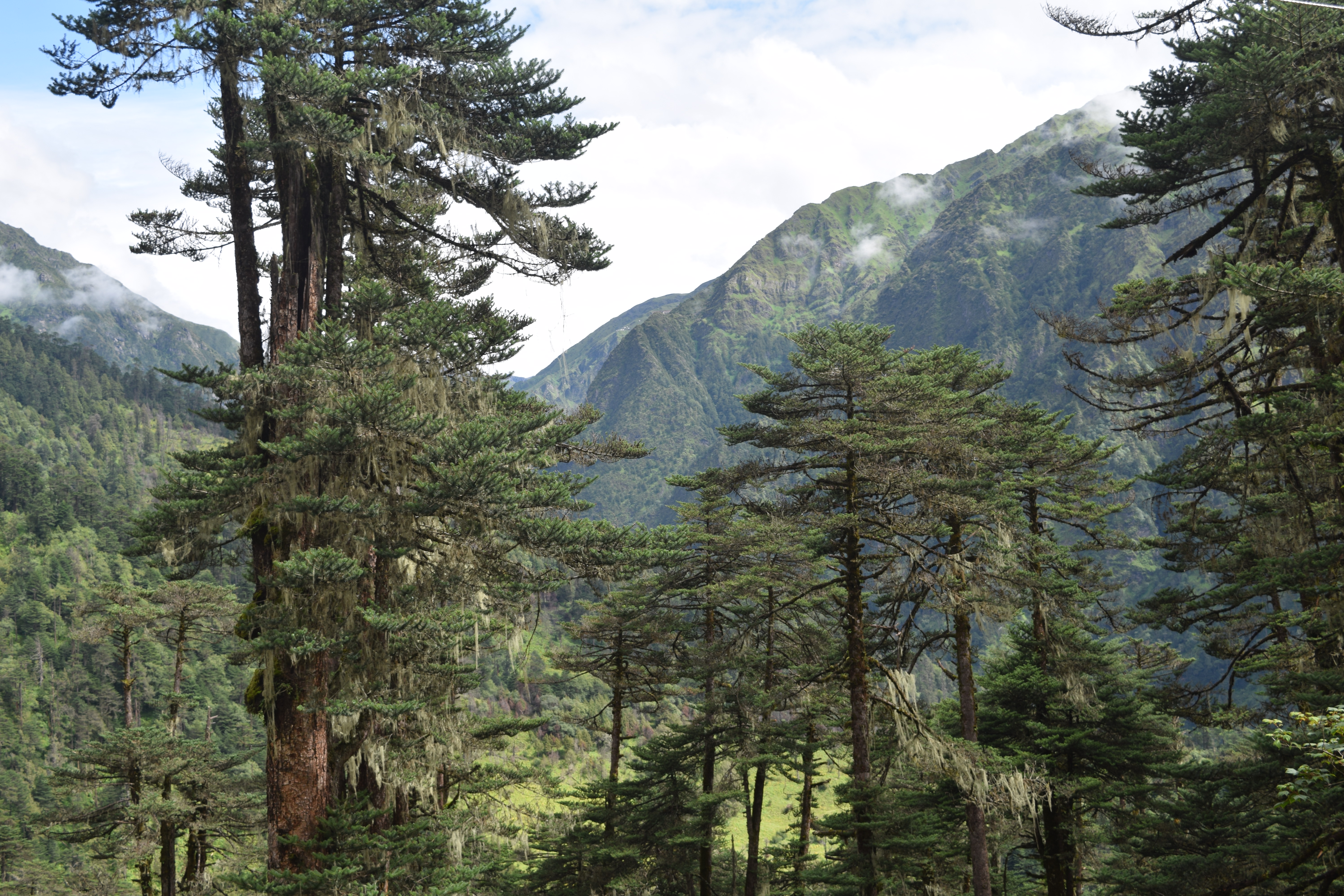
Later, moving down, one returns to a thickly forested area with extremely old and tall pine trees. The sight of the sharp gorges further down is rather scary. It takes one more hour of driving in this stunning paradise-like landscape before reaching the Tsona chu (river) gushing down from Tibet a few kilometers upstream.
Everywhere on the road, one crosses groups of local ladies working for the Border Road Organisation (BRO) to improve the road. In this very difficult terrain, the BRO’s work is really commendable.
After a few hundred meters walk, the great falls dropping from the cliffs like fairy hair suddenly appear; a signboard says “Enjoy the Magical, Mystical & Magnificent falls.”
Though the fighting took place on the ridge above the falls, it is in this idyllic surrounding that the clash took place in December 2022. 


Chumig Gyatse
It is truly is a magical place; as in most of the places associated with Guru Padmasambhava, one can feel the presence of the great master around.
A small Chumig Gyatse monastery, below the falls, was inaugurated by the young Chief Minister of Arunachal Pradesh, Pema Khandu on July 20, 2020 (note that it was a month before the Galwan incident in Ladakh). Khandu had then to walk for an hour or so before reaching the holy place.
Below the falls, a board said: “The temple is a symbol of spirituality. The magnificent falls adds to the beauty of the temple and makes it one of the most picturesque and mystic sights on earth.”
The same board describes various beliefs about the origin of Holy Waterfalls (also known as HWF by the Indian Army). According to the most popular religious belief: “during 8th century an epidemic struck the villages of this area and all villagers came to Guru Padmasambhava in the hope for relief. Guru Padmasambhava mediated and did penance in the area; in order to make the villagers free from the epidemic, [he] took out his rosary beads garland & threw the 108 beads on the mountain. Wherever the beads fell, a stream of water originated and thus Holy waterfalls came into existence. It is believed that the water here has magical medicinal values.”
It is said that Guru Rinpoche spent five days near the falls before moving to another retreat.
The board near the small gompa which houses a statue of Guru Rinpoche (and where a resident Lama reads the scriptures) informs us: “The Holy water is believed to have medicinal and healing properties and anyone consuming it with faith & devotion gets healed from all his ailments. Also childless couples if consumes holy water with credence, then blessings of Guru Padmasambhava are showered upon them and they are blessed with children. …Chumig Gyatse is a sight to behold.”

Chumig Gyatse and the LAC
The Chumig Gyatse falls lie some 250 meters from the LAC; it is today the main landmark in the Yangtse sector where the two prominent ridges, namely the Bumla ridge to its southwest and the Tulung-la ridgeline to its northeast, meet. The McMahon line at Yangtse is said to be coterminous with the two ridgelines.
It is only after the Chinese tried to occupy the Wangdung pasture in the Sumdorung chu area in 1986 that Indian troops moved troops to the ridge above the falls and occupied the area.

Open for Tourism
It is a great move from the Government of Arunachal Pradesh and the Ministry of Defence to have decided to allow tourists to visit the sacred place. Isn’t it the best proof that the area belongs to India despite the repeated Chinese claims?
Last year only, 6,000 Indian pilgrims/visitors had the darshan of the falls. Probably a similar number will visit this year.
A Tibetan friend told me that by throwing his mala, Guru Rinpoche certainly knew that one day the area would be disputed; he marked the place with the beads of his mala.
A news item reported by Radio Free Asia (RFA) came back to mind: a three-storyed high statue of Guru Padmasambhava was destroyed at the Chanang Monastery in Drago county of the Kardze Tibetan Autonomous Prefecture in Tibet. According to sources living in exile and satellite imagery, it was razed in late January 2022.
Satellite imagery of the Chanang Monastery taken October 3, 2019, shows the statue of the Guru on the site, but on another shot taken February 25, 2022, one can see the destruction of the statue indicated by the circular mounts on the ground: “Though there has been no explanation of the reasons for its destruction, it falls in line with the Chinese government’s policy of demolishing Tibetan religious sites in the region,” a Tibetan told RFA.
It is really a grace that the falls are on the Indian side of the LAC; had they been 500 meters north, Guru Padmasambhava would never have been even mentioned, let alone worshipped.
Further, many believe that the Tantric Master still offers protection to the Indian soldiers, who guard this remote scenic spot.

The Gompa

The Holy Waterfalls and Tibet in the background

The Gompa

Guru Padmasambhava looking after the place

Yaks on the route

En route

The Ridge marking the LAC

Tsona chu flowing from Tibet


Tuesday, August 15, 2023

August 15, 1947: The saddest day in Pondicherry

Seven years ago, I wrote this paper on the 'saddest day' of Pondicherry.  
What happened was very unfortunate indeed!

The attendant of the rishi, Sri Aurobindo, who had given his life for the Freedom of India, was killed by supporters of a political party in front of the Ashram.
On Day 1 (August 15, 1947), goodaism was already part of the Indian political life.
Despite the French police's reputation, nothing happened to the criminals who were never arrested.

...The British Consul General reported that he had heard “rumours of a clash between the Socialists and some passers-by and that some of the Ashram buildings were stoned.”
He informed Delhi that one unconfirmed report mentioned that one member of the Ashram had died as a result of injury inflicted by a stone.
This incident is the most tragic of a day otherwise marked by joy and patriotic fervor. The death of Mulshankar, Sri Aurobindo’s attendant deeply blurred the Independence Day celebrations.
Mulshankar, a young Gujarati had come to the Ashram in the thirties and soon started serving Sri Aurobindo as an attendant and a masseur.
On the fateful day, Mulshankar was stabbed in the neck by local goondas; when he reached the Ashram main door, he was profusely bleeding, and ultimately, he could not be saved.
The press reported: “In the evening of 15 August 1947, the day of India’s independence, armed rioters attacked the Ashram, killing one member and injuring several others.”

Click here to read the paper...

Wednesday, July 26, 2023

Son, roll down this nalla

On the occasion of the Kargil Vijay Day, I re-post my  interview with Param Vir Chakra, Jogender Singh Yadav entitled, Independence Day Special: The Hero of Tiger Hill is posted on Rediff.com.

Click here to read...

Yogender Singh Yadav survived 15 bullets while capturing Tiger Hill in the Kargil War and was awarded the Param Vir Chakra, India's highest award for gallantry.
On the eve of Independence Day, the 32-year-old soldier relives that night when he and his fellow commandos won one of India's most historic military victories.
Yogender Singh Yadav of the 18 Grenadiers believes that every deadly bullet has a name engraved on it. Yadav knows what he speaks about; after all he survived some 15 bullets while capturing Tiger Hill during the Kargil conflict and was awarded the highest award for gallantry: The Param Vir Chakra.
Yadav was a member of the 'ghatak' (assault) commando platoon which captured three strategic bunkers on Tiger Hill overlooking the Drass-Kargil road on the night of July 3-4, 1999.
Twenty-two highly-trained men approached the Pakistan-occupied peak via a vertical cliff at an altitude of 16,500 feet.
The Param Vir Chakra citation said Yadav 'Unmindful of the danger involved, volunteered to lead and fix the rope for his team to climb up. On seeing the team, the enemy opened intense automatic, grenade, rocket and artillery fire, killing the commander and two of his colleagues and the platoon was stalled. Realising the gravity of the situation, Grenadier Yogender Singh Yadav crawled up to the enemy position to silence it and in the process sustained multiple bullet injuries. Unmindful of his injuries and in the hail of enemy bullets, Grenadier Yogender Singh Yadav continued climbing towards the enemy positions, lobbed grenades, continued firing from his weapons and killed four enemy soldiers in close combat and silenced the automatic fire.'
Claude Arpi met the hero recently. Interestingly, the long list of prepared questions was soon set aside as the commando, now 32 years old, started to 're-live' his experience. It is only towards the end of the encounter that Claude could ask him a few clarifications.


Claude Arpi (CA): Some thirteen years ago, on July 3, you and your team was given the task of capturing Tiger Hill. What do you remember of these difficult days?
What were your feelings then? How do you recall the events today?


Yogender Singh Yadav (YSY): Even though 13 years have passed, I still feel that the Kargil war happened just yesterday. I will never be able to forget through my whole life the memories of Kargil.
During this war, I do not know how many comrades I lost; comrades who were even dearer than my own brothers.
Inside me live their memories and it will thus continue to be.
I do not know how many hundreds of my comrades were injured; today some among them cannot even walk or move.
Those are 13 years of memories... it is still as if it all just happened to me yesterday.
I remember, 13 years ago, on the night of July 3-4, my battalion was ordered to capture Tiger Hill top.
Tiger Hill was the highest peak in the Drass sector. To take control of it was very difficult; a height of 16,500 feet, with sheer, precipitous sides of ice and snow.
Before that we had won mastery over many hills (particularly Tololing), but our success could turn into failure, if the dominating feature of Tiger Hill was not won, all other victories could be nullified.
The senior commanders concluded that only after Tiger Hill is captured would our other gains bring a complete success.
Our battalion was then ordered to capture the top of Tiger Hill; attack plans were made. A 'ghatak' (assault) platoon was formed, with Lieutenant Balwan Singh as commander.
This 'ghatak' platoon, under the battalion, was to attack the top of Tiger Hill first. The path that we decided to take was such that the Pakistani forces could not envisage that the Indian Army would be using this path to reach the top.
The path to the Pakistani positions had sheer, vertical peaks.
We made plans on how to accomplish our task and finally on July 2, we set out to accomplish our goal. The whole battalion moved together. The attack could only happen at night as the enemy, from their heights, could observe us from afar.
If we had attacked during the day, they would have shot down our jawans; hence we could only attack in the dead of night, that too, when the moon was hidden.
After an arduous climb for two days, during the night of July 3-4, we went through a tremendously difficult path, a very small path. But hearing the stones sliding under our feet, the enemy surmised that the Indian Army has reached this area. They opened fire on us.
When the firing started, there were only seven jawans who were ahead; the others were slowly reaching up from below in a line. A bit of path was blocked and only those seven jawans had been able to reach this higher spot.
We reached up to a 8 to 10 feet level with Pakistani bunkers; 4 to 5 soldiers opened fire at us. All seven of us went on firing and sent several Pakistani soldiers into the valley of death.
We obtained victory on that ledge. But the top of Tiger Hill was still 30 to 35 metres higher. From there the enemy could see where the Indian soldiers had reached. They started firing at us so heavily that neither were we able to move higher, nor could we could come out from behind the rocks.

For five hours, the exchange of fire continued, however they were unable to estimate how many jawans were present below them.
At about 10.30 am, the Pakistanis sent some 10, 12 soldiers to check. When the enemy came close to us, we fired at them and killed them all, excepting one or two.
But by then our positions had been marked by the Pakistanis and they knew how many we were; they returned to the top to report to their commanders that there were only 8, 10 Indian soldiers below.
Within 30 minutes of getting this information, the Pakistani troops launched a counter attack on us; such a powerful attack, using several supporting weapons, throwing big boulders down on us.
As they slowly came closer and closer, they managed to damage our LMG (Light Machine Gun), our supporting weapon.
Then they got still closer and launched a hand to hand battle, during which six of my companions were martyred.
I still remember that moment, those preceding instants when we seven mates were discussing and talking together about what to do next and what was going to happen, and the instant later when all my comrades had been martyred.
I was bereft by this loss, but also glad that before losing their lives they had killed 10, 12 enemy soldiers. I too was severely wounded and was taken for dead by the enemy.
Two, three times, they returned to shoot some bullets into all the dead bodies and checked that no one was alive.
The enemy also shot bullets into my body, I was shot in the arm and leg, but had firmly resolved that unless I got a bullet in my heart or head, I would remain alive, even if they cut off my arms and legs.
It is due to that resolve and will that I am alive today.
Some 500 metres below was our MMG (Medium Machine Gun) post, the enemy then made plans to destroy it. Next to Tiger Hill was the Mushkoh valley, where their base camp was located. It is from there that the orders to destroy the MMG post came.
I heard this order; I knew that some 10, 12 of my fellow soldiers were manning the MMG post.
In my heart, a voice spoke to me and said that I must save my companions. It is true that if one remembers Ishwar (the Lord) with full faith, then Ishwar-shakti (the Lord's power) aids you. It can even appear before you.I prayed to Ishwar to keep me alive long enough to save my comrades.
Perhaps He heard my prayer.

When the Pakistani soldiers again shot at us and tried to take our weapons, I attacked them with a grenade. One of their soldiers was killed.
Another turned his muzzle at me and fired at my chest. In my breast pocket was my purse which contained some five rupee coins. The bullet hit the coins and ricocheted away; I felt that I had died.
But the next instant, when he bent to take my weapon, my eyes opened and I realised that I was still alive. Within a moment, I turned and grabbing a rifle, opened fire on them.
During the firing, four Pakistani soldiers were killed. I fired from one boulder, then rolled behind another to fire again and then a third.
They thought that some Indian reinforcements had reached from below and they ran away. I returned to my companions to check if any of them were alive, but to my deep sorrow, no one was.
I tried to see how to descend, when Devi-shakti appeared before me and told me how to go down.
My broken arm was useless at my side, I tried to tie it, I even tried to break it off with a jerk, but I could not manage. Finally, I fixed it into my belt behind my back and rolled downhill towards my companions.
I gave my mates the warning about the impending attack and told my team commander, Lieutenant Balwan Sahib the entire story.
He, in turn reported to our battalion commander that our leading section had been entirely destroyed, only one jawan had returned (Yogender Singh Yadav) and he is giving this information.
Battalion Commanding Officer Colonel Khushal Chand Thakur told them to get this jawan down to him as quickly as possible so that he could hear the information first hand.
At that time it must have been 1:30, 2 in the afternoon (of July 4). Blood was flowing from my wounds like water. Though my comrades gave me first aid, the bleeding would not stop. They brought me back to the CO and by the time we reached, it was completely dark, and I was unable to see.
The CO asked, "Son, do you recognise me?" but I could see nothing. He had me laid in his personal tent, and had 2, 3 stoves lit around me. When my body gradually got warmer, the RMO (Regiment Medical Officer) Sahib came and gave me again some first aid and made me drink some glucose.
I got some sort of energy back in my body and then the CO asked again, "Tell me now, son, what happened with you all?"
I told him the whole story and concluded that "Now Sir, they are going to attack the MMG post. Sir, you see, beyond this helipad there are stones, behind which are the living tents of the enemy, they have support weapons deployed there, and ammunition has been dumped there."
After I gave this information, RMO Sahib gave me an injection to put me to sleep.

When I woke up three days later, I was at the Srinagar base hospital. I learned that the same night, our reserve company had attacked the top of Tiger Hill, and without any casualties, had succeeded in capturing the top.
I was then shifted to the army hospital, New Delhi, and after 16 months of treatment, I could serve the army again.
It is the dream of every soldier to fight for his country and with his own blood to anoint this motherland. To be able to do this is his great fortune.
I consider myself fortunate to have taken birth on Mother India's soil and to be part of this great Indian Army, which is today considered to be one of the best in the world.
I am proud of my country and of our army and I would tell the youth of this country that we can be devoted to our nation from anywhere, but the real progress, the inner and outer protection only comes when we all come together, when we try to progress in every realm and each one tries to grow in our own sphere.
I would appeal to our youth that no matter which area you chose, you should work with honesty, straightforwardness and work hard and you should keep their devotion to their country awake, alive. Jai Hind!
You said that the Devi Ma's Shakti came to you. You had earlier already had a vision, telling you that you would be injured, but would not die. Please can you elaborate?
When, with full faith, a man surrenders everything he has to accomplish a certain task, and this, without reserve, (ulterior) motive or calculation, certainly then, an inner strength, a shakti, arises in him.
He becomes conscious of what is going to happen to him today or tomorrow or whenever.
This happened to me, I was given the awareness that I would be injured; my arms and legs would become useless, but that I would remain alive.
It is a fact that in Kargil we had surrendered ourselves fully to our task (to recover Tiger Hill from the Pakistanis), we were fully aware that we could lose our lives, but we still surrendered ourselves to the task ahead with complete faith in the Lord... then there is no question of thinking that one could fail in one's work.
The task has to be completed -- the Lord himself tests man, He tests how much a person can take, how much pain he can bear; only when one can bear the most intolerable pain does the divine strength comes (to accomplish the task).

CA: You had the certitude that you would not die, tell us more about this vision of 'Devi Ma' who showed you the way down to the MMG post?

YSY: At that time, I knew that I had to reach my comrades; it was a selfless wish, to try to save the lives of my mates, my brothers.
I had no desire to try to save my own life, in fact having witnessed my six companions sacrifice their lives, I was proud that I was now being given another opportunity to serve my motherland and follow in their footsteps.
This is the dream of every soldier, his glorious journey to fulfil the prime duty of his life.
When he returns home wrapped in the national Tricolour, his family, his country and even the whole world rejoices with tears at his self-sacrifice.
I was given that strength and She showed me the way down.

CA: The 'vision' told you which way you must take?

YSY: Yes, absolutely, in front was a being in white who said, "Son, roll down this nalla (gully)."

CA: Have you seen LOC Kargil, the Hindi movie made about your action?
They did not interview me for that. But the movie, LOC Kargil has my role played by Manoj Bajpai.
Did you see the movie? How did you find it?


YSY: I liked it. They have highlighted the task that I and my companions performed; our sacrifice for the good. The world could see this. It made the general public aware of the difficulties a soldier has to endure to do his duty successfully. I liked it very much.

CA: Thirteen years later, would you do it again?

YSY: Yes. Many citizens wants to join the army, (not all are selected), but those who are, feel they are blessed that out of so many aspirants they are the chosen few who will serve to protect their country.
A soldier's ultimate wish is that he should be allowed to do this job of protecting his country, and even if he has to lay down his life to do it, that is not too big a sacrifice.
I have merely shed some of my blood for my motherland, only put a tilak with my blood on her land, but I am still alive. But if I were given the chance, I would put down this life for her.

CA: Since that time, there have been a lot of changes in the army?

YSY: The Army is the Army.
At that time, there were many shortages in the army, lack of equipment, ammunitions, adequate clothing, etc. Has the situation improved?
At that time (in 1999), the war was declared all of a sudden. In those areas (Kargil-Drass sectors), there was little army deployment. The units which had to be called in from other parts of India, from the plains and they did not have the right clothing.
But the main need of the hour (during the war(, was neither adequate clothing nor right equipment available, but to accomplish the task at hand, and this, with whatever means we had.
It is a matter of pride that the Indian Army jawan has a dedication, a patriotism not present in any other army of the world.
It is only because of this that we were able to vanquish the enemy at those impenetrable mountain heights.

CA: It is said that a soldier believes that every bullet carries someone's name on it. Do you believe that too?

YSY: Of course. See, I am a soldier, and so is the man fighting against me, we are not bothered by which bullet carries whose name.
Definitely each bullet carries a name, just as we say that every morsel of food bears the name of the person who must eat it.
Similarly, for a soldier, he has a bullet with his name on it, the one which will kill him; perhaps the bullet with my name was not made and as a result, I am still alive.

Though not mentioned in this interview, one of the motivations of the jawans and officers during the Kargil conflict was the barbarian behaviour of the Pakistanis.
On May 15, 1999, India sent a patrol to ascertain if some parts of her territory were occupied by intruders.
The patrol was ambushed on the Indian side of the LoC and the patrol leader, Lieutenant Saurabh Kalia and five of his jawans were captured and tortured.
Their mutilated bodies were returned on June 9. Yogender and his companions knew this. It motivated them further to recapture Tiger Hill.
Before the attack on Tiger Hill, Yogender Singh Yadav's battalion had been involved in the battle for Tololing, another peak occupied by Pakistan. They fought for 22 days.
Many Indian jawans and officers lost their lives in the battle. Yogender who was just married and could only reach his battalion a few days after the battle had started was given the task of supplying ammunition to the forward troops.
The 19-year-old Grenadier managed to climb the peak twice a day to supply his companions.
In a booklet on his life, he stated: 'It was gruelling and back-breaking work. My officers noted that I had tremendous stamina and could climb these treacherous steep and snow-covered slippery slopes almost constantly for 2 days carrying heavy loads. Please see: Our Heroes: Param Vir Chakra, Grenadier Yogender Singh Yadav, Shyam Kumari, Vraja Trust, Pondicherry, 2011.
It is why he was selected to lead the final assault on Tiger Hill.


Claude Arpi gratefully acknowledges the help of Mrs Shyam Kumari, Lieutenant Colonel Uma Tewari (AMC, Retd) and Abha. The interview was conducted in Hindi.

Friday, July 14, 2023

PM Modi in Paris: How Indo-French ties have evolved into an epitome of strategic, economic and cultural cooperation

My article  PM Modi in Paris: How Indo-French ties have evolved into an epitome of strategic, economic and cultural cooperation appeared in Firstpost

Here is the link...

In the present turbulent times, the stability of the relation between Delhi and Paris is important for the world

This year, France and India are celebrating 25 years of their strategic partnership. The visit of Prime Minister Narendra Modi as the chief guest for the parade on the French National Day (Bastille Day) in Paris will be the culmination of this momentous year. It will also witness a host of new agreements between the two nations.
One could believe that Narendra Modi’s decision to purchase 36 Rafale planes ‘off-the-shelf’, during his April visit to Paris in April 2015, was the true beginning of the partnership; it is true that it was a quick, pragmatic and smart move. Delhi brought the IAF’s ‘critical operational necessity’ to the negotiating table while dropping the cumbersome Medium Multi-Role Combat Aircraft framework. But it was far from being the first bilateral deal in terms of defence.
A letter sent by HS Malik, India’s Ambassador to France to prime minister Jawaharlal Nehru in October 1953 testifies that 70 years ago, France and India were already special friends.
At that time, India purchased 71 Ouragans (known in India as ‘Toofanis’) from the French firm, Dassault.
Though at that time the question of the French settlements in India was not solved; (the de facto transfer of Pondicherry and the three other settlements Yanon, Mahe and Karikal took only place a year later on 1 November, 1954), some trust was obviously already present.
Addressing Nehru, the Indian ambassador wrote: “All of us in the Embassy who have been working on the implantation of the contract with the Defence Ministry for the supply of Ouragan aircraft were greatly relieved and delighted when we got the news that our four pilots with the four Ouragans had reached Palam safely. This flight from France to India has involved a great deal of organizational work for which much credit is due to the team of the Indian Air Force Officers.”
Malik continued: “I venture to bring to your notice the wonderful cooperation that we have received both from the French officers of the Ministry of Defence, from the Cabinet Minister downwards, and from the French industry. We signed the contract only last June. Already four planes have reached India; another 35 are being sent on October the 30th on the aircraft carrier Dixmude, and the remainder, 32 aircraft, will be dispatched in January 1954. I think you will agree that this is indeed prompt execution of the agreement as embodied in the contract between us and the French.”
Malik added: “Our pilots who came here to learn to fly this type of aircraft, which was new to them, won the admiration and respect of the French Air Force and, generally speaking, …in spite of the language handicap, [the pilots] have made friends and won the respect of the people among whom they have lived.” These words speak for themselves.

Old and stable relations

The selection of the Toofanis or the Rafales was a hallmark of the partnership between Delhi and Paris.
Historians usually consider the period between 1947 and 1962 as the first phase of Indo-French relations. Year 1962 was for France the year it constitutionally departed from the subcontinent and for India.
As early as January 1947, though the relations were not too cordial between France and India due to the colonial burden, the French government asked for a 10-year extension of the 1945 agreement permitting military air ferries to fly across India. Nehru, the interim prime minister noted: “Public opinion in India is very much against the use of force by the French Government against the people of Indochina and anything which we do to facilitate the use of this force is bound to be resented and vigorously criticized”, but on 16 July, 1947 an agreement on air services between India and France was signed.
Soon after, an interesting development occurred. Nehru, then interested in the programme ‘Atoms for Peace’, was “anxious to help in every way in developing atomic energy in India”. He decided to unofficially send Homi J Bhabha to enquire about the possibility of collaboration for the peaceful use of atomic energy: “In view of the fact that India possesses very large resources of minerals suitable for the generation of atomic power, India is destined to play an important part in research on atomic energy in cooperation with other countries.”
Homi Bhabha had extremely cordial contacts with Frédéric Joliot-Curie and Raoul Dautry, the first heads of the French Atomic Energy Commission (CEA), founded by de Gaulle in 1945.
The French armament sales during this first phase were relatively large despite the factors mentioned above.
On 22 September, 1962, General de Gaulle received Nehru in Paris. Nehru first congratulated him for the settlement of the Algerian crisis as well as the ratification of the cession of the French Establishments in India. De Gaulle replied that he was happy to see that India had dealt successfully with some of the issues the West had doubts about at the time of independence.
Though the Indian Air Force did not directly take part in the conflict with China, Toofanis, as well as 110 Mystère and 12 Alizée (of Bréguet Aviation), were in service in 1962. Further, 150 AMX 13 light tanks were sold to India after an agreement was signed in 1957 (remember the battle of Chushul in November 1962).
With Dassault, the collaboration continued uninterrupted and in the 1980s India acquired the Mirage 2000.
If president François Mitterrand laid the foundation of a solid friendship with India, the regular dialogue was institutionalised during president Jacques Chirac’s visit in early 1998 through a ‘strategic’ partnership. This is still the base of the present trusted relationship. As for cultural relations, they will go on regardless of who is at the helm of India or France.

Modi in Paris
To be invited as the chief guest at the Bastille Day Parade is a rare honour. French Ambassador in India, Emmanuel Lenain told India Today that the visit would have “maximum impact and maximum outcomes”.
Lenain mentioned “the leaps in defence cooperation, which would be visible at the special military parade. We’re going to have Indian troops marching on the Champs-Elysées at the beginning of Bastille Day, and we have Indian Rafale participating in the fly past.” The ambassador added: “We provide the best technology to India as a close partner and ally. We also provide maximum content of ‘Make in India’, so we have made a good offer. The decision is now really in the hands of Indian authorities.”
The cherry on the cake could be the signature for Rafale-M; the Indian Navy is believed to have expressed a preference for the French fighter plane for its new aircraft carrier.
The Indian Navy is also interested in additional Scorpene-class submarines (six Kalvari submarines were built by Mazagon Dock Shipbuilders Limited with French transfer of technology), also in the pipeline, an Airbus deal to manufacture C-295 tactical transport aircraft in Gujarat.
But there is more, after the Indian prime minister managed to get Washington’s agreement for the transfer of jet engine technology; negotiations with Paris should materialise to co-develop a high-thrust engine for the country’s stealth fighter jet programme, the Advanced Medium Combat Aircraft (AMCA).
According to India Today: “France’s Safran is believed to have agreed to completely share its jet engine technology with India to help develop the high-thrust 110kN engine. Safran has already co-developed a helicopter engine for India’s homegrown chopper fleet, and has been negotiating over the fighter jet engine for long.”
It is interesting to note that in recent years, France has emerged as a winner over Russia in defence purchases by India; with the Ukraine war, this trend can only increase.
In another interview with ANI, Lenain explained: “We work in the spirit of partnership, French companies have been the pioneers for years for make in India and now we totally understood the philosophy of Aatmanirbhar Bharat and they really want to share best technologies and to develop jointly in future.”
India and France will also be working on a roadmap for renewed cooperation for the next 25 years, which might be extremely challenging for the planet.
Indeed, India and France have gone a long way during the last 70 years (and especially after 1998). But it is important to remember that when India conducted its nuclear tests in Pokhran in May 1998, France was one of the few countries which did not condemn Delhi (or impose sanctions). This was greatly appreciated in Delhi and when in October 1998 prime minister Atal Bihari Vajpayee returned president Jacques Chirac’s visit to India, the new strategic dialogue could take its first concrete steps.
These events set in motion a closer collaboration and the indeed present partnership owes much to these two leaders.
From the ‘friendship’ mentioned by General de Gaulle in 1962, the relationship has become a true strategic, economic and cultural partnership.
In the present turbulent times, the stability of the relationship between Delhi and Paris is important for the world.

Thursday, June 15, 2023

China in suspense as Xi, 70, has junked succession plan

My article Claude Arpi | China in suspense as Xi, 70, has junked succession plan appeared in Asian Age/Deccan Chronicle

Here is the link...

After Xi Jinping was given a third five-year term as China’s president in March 2023, AP News commented that he was “on track to stay in power for life at a time of severe economic challenges and rising tensions with the U.S. and others. The endorsement of Xi’s appointment by the ceremonial National People’s Congress was a foregone conclusion for a leader who has sidelined potential rivals and filled the top ranks of the ruling Communist Party with his supporters since taking power in 2012.”
While a number of analysts like to make predictions about the succession of the Dalai Lama and its immediate implications, very few think of a sudden departure of the ‘Core Leader’ of the Communist Party of China (CPC).
However in a book entitled Party of One, The Wall Street Journal reporter Chun Han Wong documented what could happen in case of Xi’s sudden death or purge.
But before analyzing Wong’s conclusion let us have a look at the death of Zhou Enlai who should have succeeded Mao, the Great Helmsman, …if it was not in China.
By the end of 1975, both were suffering from cancer, but Mao was keen to see his Premier to leave this world before him as the Premier was more ‘popular’ than him with the masses.
Dr Li Zhisui, the Chairman’s private physician remembered that as Zhou Enlai was dying, Mao never went to see him in the hospital.
On November 29, 1975, when Dr Li visited the Premier, Zhou was too weak to even lift his hand: “That was the last time I saw him. Zhou Enlai died on January 8, 1976,” noted Dr Li.
The doctor remembered that there was hardly any reaction in Group One, Mao’s close guard: “Many of the doctors on Mao’s medical team had also treated Zhou, and they wanted to visit the 305 Hospital [in Beijing] to pay their last respects. When I presented their request to Zhang Yaoci [the commander of the Central Garrison Corps.], his response was swift and stern. The doctors were not permitted to go, and no one was to wear the black armband of mourning.” Mao was jealous of Zhou’s popularity.
Dr Li continued: “As Chinese New Year approached, Zhang Yufeng [Mao’s Secretary and female companion] wanted to celebrate. She suggested that Zhang Yaoci set off firecrackers outside Mao’s residence. Zhang was happy to please her, …the area suddenly swarmed with guards and soldiers from the Central Garrison Corps. Zhongnanhai had long had a ban against firecrackers. … [at the same time] a rumor began circulating that the Chairman was celebrating Zhou’s death with firecrackers.”
This shows that succession is always simple in China.
In Axios China, Bethany Allen-Ebrahimian analyzed: “After the death of Chinese dictator Mao Zedong in 1976, which resulted in years of instability at the party's highest levels, party leaders eventually developed a relatively stable model of succession in which each top leader served for two five-year terms, with a clear successor already waiting in the wings. …But Xi dismantled that system by abolishing term limits, not designating a successor and assuming a third term.”
That is a serious issue for China today.
Wong believes that a drama looms once again: “Xi confronts a timeless conundrum that scholars call the ‘Successor’s Dilemma’. Dictators prefer to choose their own successors, but Xi has so far avoided this path.”
The WSJ correspondent further elaborated: “as the designated successor tries to build power, the political elite will naturally start realigning their loyalties — a process that can undermine the incumbent leader, who may come to fear that the heir apparent is plotting to usurp power.” This happened with Mao’s once heir-apparent, Lin Biao who disappeared in a mysterious plane accident.
It is also probably why the one-time heir apparent Hu Chunhua was dropped during the last Party Congress.
Wong’s conclusion is: "By remaking the party around himself, Xi may have become the weakest link in his quest to build a Chinese superpower.”
On June 15, Xi will be 70 year old.
According to Wong: “The uncertainty over his succession plans keeps the party elite on their toes. …But keeping the suspense for too long could backfire, alienating protégés and antagonizing enemies enough to undermine the leader or even sow the seeds for a coup d’état.”
The WSJ journalist has a point.
Today China is a country with the world’s second-largest population (behind India) and economy (behind the United States).
Further it has one of the most powerful militaries which could be tempted to grab the power in case of a crisis.
A 2010 study, political scientists Alexandre Debs and HE Goemans looked at the fate of some 1,800 political leaders worldwide: “from the late 1910s to the early 2000s. Some 41% of the 1,059 autocrats suffered exile, imprisonment or death within a year of leaving office, compared with just 7% of 763 democratic leaders,” they noted.
On May 26, Wang Junzheng, Party Secretary of the Tibet Autonomous Region gave a speech in Lhasa. Wang asked all cadres to study and implement of Xi Jinping's important instructions on Tibet …and defend the ‘two establishments’, resolutely enhance the ‘four consciousnesses’, firmly stand by the ‘four self-confidence’, achieve ‘two safeguards’, …and promote the strict governance of the Party, in order to vigorously promote the ‘four creations’ and strive to achieve the ‘four leading positions’ and the ‘four in the forefront’.” All this to bring peace and stability on the snowy plateau.
You may not understand this type of Communist jargon, but it hides a real problem, what will happen if the supreme boss goes; this nobody knows.
Ko Wen-je, nominee for the Taiwan's People's Party (TPP) for the next presidential election, recently declared that Xi Jinping's rule over China will not last forever: "If we believe in universal values, then why do we think China will never have democracy and freedom?"
It is fine thought, but it may not happen soon.
Xi himself recently spoke of the complexity and severity of national security problems faced by China: “We must be prepared for worst-case and extreme scenarios, and be ready to withstand the major test of high winds, choppy waters, and even dangerous storms.”
The fact remains that the system put in place by the ‘Core Leader’ seriously aggravates the already difficult internal and external situation.
India and the World should be prepared for the worst.

Tuesday, June 6, 2023

The Barahoti saga: Failure of 'Nehru doctrine' and deceitful nature of Dragon

My article
The Barahoti saga: Failure of 'Nehru doctrine' and deceitful nature of Dragon  appeared in Firstpost

Here is the link...

Hardly two months after the Panchsheel Agreement was signed, India discovered that all problems had not been solved. The first Chinese incursion took place in Barahoti in June 1954. This was followed by a series of intrusions numbering in the hundreds 

The Hindu recently reported that new posts of the People’s Liberation Army (PLA) had sprung up some six-seven kilometres north of the Line of Actual Control (LAC) in the Middle Sector on the Indo-Tibet boundary, “while the frequency of patrolling has also significantly increased in certain areas,” it noted.
Citing sources in the Government, the newspaper asserted that China was actively expanding its network of ‘Xiaokang’ model villages (‘Xiaokang’ meaning ‘moderately prosperous villages’), along the Middle Sector of the LAC. These villages are said to be constructed with the main objective of ‘poverty alleviation’, but one could ask: is there a need for hundreds of such villages precisely on India’s northern borders …if there was no other purpose?
Obviously, these villages have a ‘dual use’; further, the fact both that Tibetans and Hans are settled there will quickly change the demography of the border areas, moreover providing bases or garrisons for the PLA when required.
The report also mentioned that the Chinese are “building villages at a rapid pace, sometimes as many as 300-400 houses in multi-storey blocks within 90-100 days. …Construction of a likely border settlement village was observed northwest of Tholing area [north of Chamoli district Uttarakhand] and a military complex is also under construction close by. Superstructures of buildings in both the locations are complete.”
China apparently uses prefabricated parts extensively to construct the houses at a quick pace.

Historical Background
The history of how Barahoti became a disputed area is interesting.
Let us remember that for centuries the Indo-Tibet frontier had been peaceful; however the Indian diplomats who negotiated the Panchsheel Agreement foolishly ‘avoided’ confirming India’s northern frontiers during the talks and in the final accord signed in April 1954. India still pays dearly for this monumental lapse.
The signature of the Panchsheel Agreement with China, through which India surrendered all its rights and responsibilities in Tibet while getting nothing in return, was a complete surrender to China; Delhi did not wait long to see the consequences of The ‘Nehru doctrine’ (to be friendly at any cost with China).

A Historical Background by the Intelligence Bureau
Let us go into the history of the so-called dispute; in July 1952, in a note ‘Border Disputes and Collection of Taxes by Tibetans in Garhwal District’, the Intelligence Bureau (IB) described the topography of the area (today’s Chamoli district of Uttarakhand): “The Garhwal-Tibet border can only be crossed through the Mana and Niti Valleys where there are open places and habitation, while the rest of the border area consists of snow-covered mountains studded with glaciers…”
The IB report continued its descriptions of the area: “There are four passes between Niti Valley and Tibet, namely: Gothing Pass, Damjin [Tunjun] Pass, Hoti Pass and Ghirti Pass. Niti, the Northern most village in the Indian territory, is situated 11 miles from Gothing Pass and Damjin Pass. There are few plains situated near these passes in the Indian territory.”
These passes marked the watershed line: north was Tibet (China after 1951), south was India.
The Intelligence note admitted that once in the 19th century, there was a short boundary dispute about Hoti Plain. Giving the background, it says: “About the end of the last [19th] century, the Tibetans had established a Customs Post at Hoti Plain. To stop this practice, the British Govt. had to send out a detachment of Gurkhas along with Shri Dharma Nand Joshi, Deputy Collector in 1890.”
The Tibetan official (called a Sarji, an emissary of the Tibetan Dzongpon or District Commissioner) usually crossed the border at Tunjun-la pass to announce the beginning of the trading season.
Though the access to the place was difficult, making it hard to keep a tab on the area, the British were quick to understand the plot and stop the Tibetan official to cross the pass.
Soon after the Chinese occupied Western Tibet in the early 1950s, they started claiming Barahoti as theirs. The IB recommended to the Government of India that it was essential that Delhi “should make it clear to the Govt. of Tibet and its Dzongpon that the Hoti Plain is Indian territory and the Tibetans have no right to establish any customs post there; nor can they exercise any authority in the area.”
But the Tibetan Government was fast losing its independence.

The Ink was Hardly Dry
Hardly two months after the Panchsheel Agreement was signed, India discovered that all problems had not been solved, as just announced in Parliament by the Prime Minister. The first Chinese incursion took place in Barahoti in June 1954. This was followed by a series of intrusions numbering into hundreds and culminating in the attack on India in October 1962.
The irony of the story of the first intrusion is that it was China which complained about the incursion of Indian troops… on India’s territory!
Though Barahoti was well inside India’s frontiers (clearly south of Tunjun-la, the watershed), arguments about the new ‘dispute’ continued with the exchange of hundreds of notes during the following months ...and years.
TN Kaul who had negotiated the Panchsheel Agreement, (before being sent back to Delhi for having an affair with a Chinese woman), philosophically explained later: “Territorial disputes have existed between near and distant neighbours through the ages. The question is whether they can and should be resolved by war, threat, use of force or through the more civilized and peaceful method of negotiation... Both sides still profess their faith in the Five Principles, and therein lies perhaps some hope for the future.”
The Five Principles had put Kaul and his colleagues to sleep.

1850 Map of Hoti
Where is Wuje?
In the meantime, the Chinese started calling Barahoti by the name of ‘Wuje’ creating more confusion in the minds of the Indian diplomats (the same tactic of changing the names of places is today used in Arunachal Pradesh).
During the following months, the Chinese would insist on sending a joint investigating team to this spot, something Delhi always refused. The main reason for Beijing to insist on a joint investigation team was that Beijing did not know that Barahoti was located south of Tunjun-la and therefore in India.

A New Note

Over the years, as the situation continued to deteriorate, a note was prepared by Jagat Mehta, Director (China) in the Ministry of External Affairs in 1961. It provides the background of Barahoti saga during the preceding years. Mehta writes: “The Chinese claim to the Barahoti became known to us in 1954, when the Indian and Chinese army faced each other in the small pasture ground. The suggestion for refraining from sending the troops was first made in 1955 and was reiterated in 1956; it was agreed that no troops should be sent by either party in 1957, and a conference to discuss the dispute regarding Bara Hoti was held in April – June 1958.”
At the end of the conference, it was agreed that “neither side should send forces in exercise of its supposed right during the talks and until the question was settled.”
At the same time, the Chinese reiterated again their desire for a joint investigation, while “persistently refused to specify the actual area of Wuje. When pressed, in a vague manner they said that Wuje covered 15 kms north to south and 10 kms, east to west, but no coordinates were given even with reference to this area.”
Mehta explained that India made it clear that Barahoti was a small pasture ground south of Tunjun-la: “during the talks we specified the relevant coordinates and pointed out that the area involved was 2 miles in length and ¾ of a mile in breadth. The Chinese did not agree to our suggestion for the complete neutralization of this area and hinted that they would continue to send civil officials, where upon we also informed them that we were reserving the right to send our own revenue officials to this area.”
The agreement was that the patrols should be unarmed; while India always kept its promise, already in 1958, China sent an armed detachment to the area after the Indian civil party withdrew in September.
Two points should be made to conclude: though it was not necessary for India to participate in a conference for Barahoti in 1958 as the area was clearly south of the watershed and therefore in India, Delhi agreed out of goodwill and for the sake of the ‘friendship’ with China. It did not help to find a solution for the issue.
The second point is that even after agreeing not to send armed patrols to the remote plain, Beijing did not keep its word. It was the beginning of a series of un-kept promises, which continues till today in Eastern Ladakh or Arunachal Pradesh.

Thursday, May 25, 2023

What lies behind China’s new role as ‘peacemaker’

My article What lies behind China’s new role as ‘peacemaker’ appeared in The Asian Age/Deccan Chronicle.


Beijing’s Global Security Initiative (GSI) is another move from Beijing which indicates that China wants to play a bigger international role

Here is the link...

China has become a peacemaker, or at least would like to project itself as the world’s new ‘peacemaker’; we have seen it in the Middle East (between Saudi Arabia and Iran), we witness it now in Moscow.
A year after the invasion of Ukraine by the Russian troops started, Beijing released a twelve-point document proposing a framework for a political settlement. The Carnegie Endowment for International Peace commented: "The document is a laundry list of familiar Chinese talking points about the war. It repeats Beijing’s support for the UN Charter and the territorial integrity of states, but at the same time condemns unilateral sanctions, and criticizes the expansion of U.S.-led military alliances. …China’s vague plan is aimed not at actually ending the war, but at impressing the developing world and rebutting accusations that Beijing has become a silent accomplice to Moscow.”
Beijing’s Global Security Initiative (GSI) is another move from Beijing which indicates that China wants to play an international role.
On February 21, at the Lanting Forum, Qin Gang, China’s Minister of Foreign Affairs, spoke of his country’s new role: “The world today is not a tranquil place: changes unseen in a century are fast evolving, major-country competition is intensifying, geopolitical conflicts are escalating, the global security governance system is woefully lagging behind. …The choice made by China is clear-cut.”
That is why, Qin explained, Xi Jinping proposed the Global Security Initiative (GSI) which upholds “the vision of common, comprehensive, cooperative and sustainable security, pursues the long-term objective of building a secure community, and advocates a new path to security featuring dialogue over confrontation, partnership over alliance and win-win over zero-sum.”

A growing Dichotomy

But a dichotomy is growing between Beijing’s totalitarian policies at home and the peacemaker role outside; it is striking and the question is: are the two stands reconcilable?
The hardening at home can be explained by the fact that China wants to assume the role of Power No 1 in the world and it believes that only the strictest adherence to the Communist Party lines can achieve this goal.
It is indeed a fact that the Chinese regime is becoming more and more authoritarian and autocratic.
One could take several examples, Reuters cites one: “China is increasingly barring people from leaving the country, including foreign executives, a jarring message as the authorities say the country is open for business.”
The US news agency quotes from a report for the Safeguard Defenders, a human rights group: "Since Xi Jinping took power in 2012, China has expanded the legal landscape for exit bans and increasingly used them, sometimes outside legal justification.”
It is estimated that tens of thousands of Chinese are banned from exit at any one time.
Reuters concludes: “This contrasts with China's message that it is opening up to overseas investment and travel, emerging from the isolation of some of the world's tightest COVID curbs.”
But why do more and more people want to leave the Middle Kingdom? Simply because they can’t express themselves freely.
The fact that people like Jack Ma, the founder of the Alibaba group has to exile himself in Japan and take an assignment at the University of Tokyo, is indeed speaking for itself. The School in Tokyo said: “Ma will work with researchers, serve as an adviser to the college and participate in seminars. He will also conduct research with university staff, especially in the field of sustainable agriculture and food production.” What a loss for a China, which today does not accept differing views.
In this context a new report from the Hoover Institution written by Matthew Johnson, expert on the Chinese Communist Party’s politics, about China’s strategy to achieve a global edge through the accumulation and control of data, is an eye-opener.
According to Johnson, China’s strategy is “to accumulate and control data at a global scale.” The scholar believes that the origin of this strategy is a 2013 speech given by Xi at the Chinese Academy of Sciences. The then new Chinese President said: “The vast ocean of data, just like oil resources during industrialization, contains immense productive power and opportunities. Who controls big data technologies will control the resources for development and have the upper hand.”
The way to do this is for Chinese commercial enterprises to “siphon data at a global scale,” explains Johnson who spoke of an “accumulation espionage ecosystem,” i.e. a network of internal data storage and processing facilities; data is later “absorbed into military, technology, and surveillance projects in China and is potentially shared with like-minded international partners such as the Russian Federation or the Islamic Republic of Iran.”
The point is that the same ‘vast ocean of data’ is used on the Chinese populations (particularly the so-called minorities like the Tibetans and the Uyghurs) to monitor their lives in minutest details.
Johnson concluded. “In this sense, China’s grand strategy for data is a case study which highlights the current gap that exists between the complexity of the challenge and the [US] current response.”
However, it is not clear what the free world can do for the Chinese people living in the Middle Kingdom.
At the meantime, ‘peaceful’ China is preparing to invade Taiwan, the democratically-run island. Like the GSI, it may however lead nowhere; the US strategic platform War on the Rock warns: “A worst-case Taiwan scenario for Chinese leader Xi Jinping would be a major military operation in which the People’s Liberation Army fails spectacularly or displays shocking incompetence akin to Russia’s in Ukraine. Could this happen?”
The specialized website believes that the bad news is that “even if China’s armed forces fail spectacularly, this does not necessarily mean a shorter, less bloody, or less costly conflict. If the People’s Liberation Army stumbles badly, Xi is unlikely to call off his military. Where Taiwan is concerned Xi can be expected to press his armed forces to persist in the fight, producing a protracted conflict in the center of the Indo-Pacific and profoundly disrupting commerce and stability across the region.”
So much for the ‘peace initiatives’!
The other question is of course: do the Taiwanese people, who have tasted freedom and democracy, have to go back to Mao’s dreadful days when everyone has to follow the Party …or else.
Certainly not. Hong Kongers themselves have started discovering the difference between freedom and the dictatorship of the Party.

Friday, May 19, 2023

The US primarily looks after its own interests: Can Washington be a good ally?

Taken for a ride...
My article The US primarily looks after its own interests: Can Washington be a good ally? appeared in Firstpost

There is no reason why India should blindly follow America in a military adventure in Taiwan or elsewhere

Here is the link...

A question has been going around in the strategic circles in the recent weeks: should India enter into a military alliance with the US and will the US be a good ally?
Quoting several experts, The Scroll.in noted: “India may eventually help the United States militarily in a security contingency involving China, in some form, to protect its own interests.”
The Indian digital news publication also cites other views, for example an article of Ashley Tellis in The Foreign Affairs magazine in which the US strategist argues that the US policy “of courting India as a partner is a ‘bad bet’ because New Delhi will not follow Washington’s lead in confronting China during a regional crisis.”
There is indeed some truth in the argument as there no reason why India should blindly follow Washington in a military adventure in Taiwan or elsewhere.
The Scroll.in mentions “a long discussion in foreign policy circles: what exactly should a US-India relationship look like in the age of Great Power rivalry between Washington and Beijing?”
It notes that the US “has increasingly supported India when it comes to defence, hoping that Delhi will reciprocate with military help in case of a confrontation with China.”
While Tellis rightly considers that Delhi would maintain its strategic autonomy in case Washington engages in the Taiwan Strait, other experts believe that even if Delhi does sign a mutual defence arrangement with Washington, India is “still a good bet for Washington.” They argue that Delhi may eventually come around to helping the United States militarily. Just wishful thinking!
The ‘experts’ quote in particular from a US News & World Report which says that “real-time intelligence shared by the United States military helped India stall a Chinese incursion in Arunachal Pradesh in December 2022.”
This refers to the confrontation in Yangtse, east of Bumla in the Tawang sector.
Not only it is difficult to confirm what exact help the Indian Army received from the US at the time of (or before) the confrontation, but there is no doubt that the credit should go to the Indian Army who was fully prepared and hence was able to push the People’s Liberation Army (PLA) back behind their lines in the Yangtze sub-sector; it is indeed only due to the alertness of the local commanders and the bravery of the Jat and Sikh Light Infantry troops posted in the area.
Of course, the US experts usually only take American interests into consideration. This is not new, as we shall see.

The Case of 1962 War
When China invaded Northern India in 1962, India had apparently no other recourse but to appeal to Western nations, particularly to the United States, for support. Washington was only too happy to offer help, thus gaining some leverage over a formerly 'non-aligned' India.
It is true that during the Cold War, India, in its 'neutrality', often sided with Moscow while Pakistan was deliberately on the West’s side. The US even had a mutual defence pact with Pakistan, itself part of SEATO and the Baghdad Pact, whose objectives were to stem the advance of communism in Asia.
When Chinese troops invaded northern India, it was logical for the US to immediately come to India's assistance, especially after the two panicky letters sent on November 19, 1962 by the Indian Prime Minister to President Kennedy begging for American assistance.
A few days later (coinciding with the ceasefire announced by China on the two Himalayan fronts), Britain and the United States decided to use the opportunity: with India in a position of weakness the Kashmiri dispute between Pakistan, (the West’s ally) and India (who was now begging for their support), could finally be settled.
Averell Harriman, the US Under Secretary of State, and Duncan Sandys, the British Commonwealth Secretary, visited the Pakistani and India capitals in order to persuade the ‘fraternal enemies’ that it was time to bury the hatchet and find a solution to the then fifteen-year-old Kashmir question. Harriman and Sandys even signed a joint communiqué and asked the two countries to resume negotiations. This was the answer to Nehru’s appeal for support against China.
Although India had doubts about the possibility of obtaining positive results from negotiations conducted under such circumstances, it had no choice but to accept the Western offer.
On December 22, 1962, Nehru wrote to the Chief Ministers: "I must speak to you briefly about the Indo-Pakistani question, especially Kashmir. In four days' time, Sardar Swaran Singh, will lead a delegation to Pakistan. We realise that this is not the right time to have a conference like this, as the Pakistani press has vitiated the atmosphere with insults and attacks on India. Nevertheless, we have agreed to go and we will do our best to reach a reasonable solution. It is clear, however, that we do not want an agreement that will be against our basic principles.”
The two delegations eventually had a series of six meetings, from which nothing was achieved. The first round took place in Rawalpindi: Swaran Singh and Zulfikar Ali Bhutto, the Pakistani Foreign Minister, limited themselves to a historical presentation of the problem and the reiteration of their respective points of view.
During the discussions India reaffirmed its position that Kashmir was an integral part of India. This was in accordance with international law and democratic norms, but this being said, India was ready to explore all possibilities to resolve the issue, as it wanted to live in peace with Pakistan.
Where was the support against China in all this?
But worse was to come, just before the talks began, the Pakistani government announced that it had reached an in-principle agreement with China on the Kashmir-Xinjiang issue. Pakistan was ready to give China a piece of territory (Shaksgam Valley, east of the Karakoram Pass) that India considered its own. What a slap in the face for India just one month after the end of the Sino-Indian war!
Many believe that the agreement on the China-Kashmir border was announced by Pakistan as a way of derailing the talks. It is indeed surprising that Pakistan, an ally of the US and the Western world, chose this moment to make the announcement. It was an indication that Pakistan had no expectations from the talks with Delhi, even though they were initiated by the US.
Nehru was still optimistic, or perhaps, like the ostrich, preferred not to see anything. In a letter to the Chief Ministers, he remarked: “The talks have not yielded any result as far as our problems are concerned, except that they have reduced, to a small extent, the barriers of fear and mistrust which make it difficult to approach these problems.”
Negotiations continued, without tangible results, between 16 and 19 January in Delhi and 8 and 11 February in Karachi. Pakistan wanted a plebiscite, but India insisted on prior demilitarisation of the areas occupied by Pakistan.
Talks were held in Calcutta between 12 and 14 March. India proposed some readjustments to the Line of Control, but this was rejected by Pakistan.
During the fifth round of talks held in Karachi between 22 and 25 April, India protested that Pakistan had ceded part of Kashmiri territory to China.
Since Pakistan had chosen to invite a new player into the game, none other than India's enemy No. 1 (China), there was no chance of finding a negotiated solution to the Kashmir issue.
At the end, India did not get much military support from the US to face China and additionally lost part of its territory in Shaksgam Valley to China.

The Withdrawal from Kabul (2021)
Another example shows that the US primarily looks after its own interests: it is the American evacuation from Afghanistan on August 15, 2021.
Not being informed of the US plans, the allies of the US were left to manage by themselves in Kabul, though an official US report says: “Once the evacuation had been initiated, President Biden repeatedly gave clear direction to prioritize force protection, relying on the advice of his senior military officials on how best to proceed on operational decisions. As Secretary Blinken testified on September 14, 2021, “Because of that [earlier] planning [for a wide range of contingencies], we were able to draw down our Embassy and move our remaining personnel to the airport within 48 hours.”
But the allies were left behind.
Perhaps less ambitious but more interesting for India and the US are the joint exercises between the two Armies, i.e. the 18th edition of Indo - US joint training exercise ‘YUDH ABHYAS 22’ conducted in Uttarakhand in November 2022 with the aim of exchanging best practices, Tactics, Techniques and Procedures between the Armies of the two nations.
It is a very concrete way for both armies to know each other better and share the best respective practices.
And of course, exercises such as the Quadrilateral Security Dialogue (Quad), a strategic security dialogue between Australia, India, Japan and the US should continue as it does not engage India into unwanted alliance or treaties’ obligations, while at the same time puts pressure on China.

Wednesday, May 10, 2023

Chinese social media abuzz with 'tank dens' in Tibet chatter: Why India needs to heed seriously

My article Chinese social media abuzz with 'tank dens' in Tibet chatter: Why India needs to heed seriously appeared in Firstpost.

Here is the link...

Whether all details are confirmed in their entirety or not about the presence of 'tank dens' is an altogether different matter, but it should be a serious warning for India 

In the recent times, the Chinese social media has been agog with ‘tank dens’ being built by the People’s Liberation Army (PLA) in Tibet; one article speaks of “fully underground design, to prevent Indian troops from starting artillery sneak attack.”
In December 2022, the site ximalaya.com mentioned: “India always wants to act tougher with China in order to please the United States; it is the root cause of disputes on the Sino-Indian border and in the border areas.”
This is forgetting that the ‘dispute’ started at the end of the 1950s, at a time India was close to the Soviet Union.
The article affirmed: “The PLA is far better prepared for war than the Indians could imagine, and recently, India has even discovered an unexpected situation. This will not only effectively protect against Indian bombardment, but also provide a fairly good environment for the equipment.”
Of course, this can be seen as part of the Information Warfare (IW) waged against India, but it can’t be fully ignored.
The article mentioned some Chinese PLA 96A tanks hidden in 'tank dens' near the Indian border (probably in the Chumbi Valley between Sikkim and Bhutan).

Old Habits Die Hard

There is nothing new in the Chinese mania to ‘dig’, except that the PLA’s technology is today far ahead of what it was decades ago.
Nearly 30 years ago, I had the opportunity to interview several senior Tibetan officials who accompanied the Dalai Lama in exile in 1959.
One of them was Rinchen Sadutshang, who as a young translator accompanied the Tibetan delegation who signed a 17-Point Agreement with China in Beijing in 1951; later he served as the Dalai Lama’s representative in Delhi.
When asked whether the Chinese had massive deployment of troops in Southern Tibet at the end of 1950s (for example in places like Tsona, north of Tawang), Sadutshang replied: “Oh yes, all over the place. Wherever the PLA went, they were very secretive. …They were always stationed in mountains and they dug tunnels and tunnels and tunnels.”
This surprised me greatly.
Later, I asked him again about the tunnels; for example, was the local population involved? Sadutshang recounted: “They did not allow the local population [to come nearby]. All aspects of military operations were top secret. Very few civilians were involved, maybe one or two who were indispensable. It was people that either were completely trusted or some after being used, were eliminated. It was so secret, and all the [PLA] movements were happening at night, never during the day. [Tibetan] people could only report: ‘we heard a lot of vehicles moving, a lot trucks moving, it must be the army’; they had not seen them.”
The Tibetan official continued: “…Even in Yatung, they used to be a lot of Chinese military forces there, all inside tunnels, they dug the mountains, huge tunnels, [they were] like mice living under the ground. Exactly the same as mice, you do not see them from outside and they are so well guarded, they do not allow anybody to go 10 km from the entrance as all roads were blocked.”
I had forgotten about this interview until I recently came across the ‘tank dens’.

The Underground City
Some other historical cases are well-known; during the Cold War, a bomb shelter consisting of a network of tunnels existed beneath Beijing, the Chinese capital. Some observers spoke of the ‘Underground Great Wall’, it was built for military purposes.
The complex was constructed from 1969 to 1979 in anticipation of a nuclear war with the Soviet Union as the Sino-Soviet relations had worsened.
It is Mao Zedong who ordered the construction of the Underground City.
The complex was designed to withstand nuclear, biochemical and conventional attacks. The averred purpose was to protect Beijing's population, and allow government officials to leave in the event of an attack on the capital.
Lying some 18 metres underground, the ‘dark, damp, and genuinely eerie’ tunnels covered an area of 85 square kilometers: “At one time there were about 90 entrances to the complex, all of which were hidden in shops along the main streets of Qianmen,” says the online encyclopedia Wikipedia.
The complex had facilities such as restaurants, clinics, schools, theaters, factories, a roller skating rink, grain and oil warehouses, and a mushroom cultivation farm. It was built by more than 300,000 local workers, including ‘volunteer’ school students.
There were also almost 70 potential sites where water wells could easily be dug if required. To this add elaborate ventilation systems with 2,300 shafts that could be sealed off to protect the tunnels' inhabitants from poison gases. All contingencies had been taken into consideration.
Many believe that the tunnels linked important governmental buildings such as Zhongnanhai, the Great Hall of the People, and even PLA bases in the outskirts of the city; the rumour was that every senior official’s residence had a secret trapdoor leading to the tunnels.

Project 131
Another grandiose scheme was Project 131, located in the town of Gaoqiao of the Xian'an District of the Xianning prefecture-level city in Hubei Province. It was located some 80 km south of Wuhan.
The origin of the Project is also the split with the Soviet Union. On January 31, 1969, the decision was taken to build an underground command headquarters for the PLA (the name derives the date of the decision or 1-31). The Chief of Staff of the PLA’s General Staff Department, Gen Huang Yongsheng was responsible for the construction.
In 1955, Huang had risen through the 1950s and 1960s, and during the Cultural Revolution he became close to Lin Biao, the Defence Minister.
The tunnels, which had meeting rooms, offices for the top commanders, were constructed under the nearby hills; luxurious villas for Mao Zedong and his heir apparent Lin Biao were also built but over the ground.
After the latter’s dramatic escape and his subsequent death, Huang was purged due to his close association with the defence minister; the project was stopped and Mao and his cronies never used the facilities.

The ‘Tank Dens’

Now, it appears that the PLA has built semi-underground as well as fully underground fortifications and military bases along the Tibet-India border.
The article quoted above said: “In recent reports, the PLA's plateau underground fortifications have been revealed and although not many specific [details about the] plateau underground fortifications have become public, there are enough to show the existence of a number of them, including a rare Chinese ‘tank fortress’; it can also be called a staging area for tanks and troops. A hundred tanks as well as other armoured vehicles and a large number of PLA troops are already stationed directly in this semi-underground fortification.”
The site ximalaya.com added: “the PLA plateau bases are now fully underground facilities, and though the amount of work is very important, it has the advantage of good protection for the equipment and it greatly improves the living conditions of the [army] personnel. More importantly, it can provide good protection against sneak attacks by Indian troops using artillery. Due to the very large range of modern weaponry, the problem of facing a surprise attack must be considered even at a distance of several dozen of kilometres from the front line.”
The article further rationales: “It is not possible to rule out the possibility of a surprise attack by the Indians, [for example] a sudden and massive artillery attack. The PLA should then be prepared with a large number of armoured vehicles [tanks] to ensure that our forces are not destroyed by the Indian army, after all, we can't afford to have a defensive [position] only.”
Whether all these details are confirmed in their entirety or not, it should be a serious warning for India.

The Border Situation
In this context, it was interesting to see that Defence Minister Rajnath Singh recently stood firm on India’s position when he met his Chinese counterpart General Li Shangfu. Held on the sidelines of the Shanghai Cooperation Organisation (SCO) defence ministers’ meeting in Delhi, the Indian Minister is said to have used plain words to characterize the recent developments in the India-China border. A statement said: “Rajnath Singh categorically conveyed that development of relations between India and China is premised on the prevalence of peace and tranquility at the borders …. He reiterated that violation of existing agreements has eroded the entire basis of bilateral relations and disengagement at the border will logically be followed with de-escalation.”
Undoubtedly, China is getting ready for a long haul; the ‘tank dens’ should be seen in this perspective.

Where the Dalai Lama reincarnates is critical to Indian security


Where the Dalai Lama reincarnates is critical to Indian security

In this interview, Ishan Dhar speaks to Claude Arpi on the political importance of Tibetan Buddhist reincarnates, how Chinese interference in this sacred tradition can have ramifications for the entire Himalayan belt, and the steps India can take to ensure its security in this context.

Sunday, May 7, 2023


My Interview with Tibet TV

Tibet's Historical Status and Its Relevance Today with Claude Arpi, a renowned Tibetologist and a journalist.

Wednesday, May 3, 2023

The Tibet Conundrum: Part 1. The Annexation

The Tibet Conundrum: Part 1. The Annexation.
Samvad with Claude Arpi
An Interview with Mayank Singh

Claude Arpi in Samvad discusses the period between 1950-51 as China annexed Tibet militarily. PM Jawaharlal Nehru's idealism was no match for Mao's strategic thinking. India's refusal to get involved in Tibet as a peaceful nation was being ravaged by a revisionist China resulted in a situation where a peaceful Indo-Tibet border was converted into a hostile Indo-China border. Nehru's refusal to pay heed to Sardar Patel's strategic advice and warning would soon have grave repercussions for India. The British deception in the takeover of Tibet is also elaborated upon by Arpi.

Tuesday, May 2, 2023

"China Tried To Change Yangtze Status Quo, But India Showed It Can't Be Bullied"


My interview "China Tried To Change Yangtze Status Quo, But India Showed It Can't Be Bullied" with Amitabh Revi for StratNews Global.


New Delhi: On 'Talking Point', Claude Arpi, Distinguished Fellow, Centre of Excellence for Himalayan Studies, Shiv Nadar Institution of Eminence, Author, Historian and Tibetologist speaks to StratNews Global Associate Editor Amitabh P. Revi. Claude Arpi discusses China's claims over Arunachal Pradesh, the Dalai Lama's succession, Tibet, the proposed U.S Senate resolution on Arunachal, the Ladakh standoff, the Xi Jinping-Vladimir Putin meet and the global pushback against an aggressive China.

Monday, May 1, 2023

China Challenges India in Bhutan

My interview on Bhutan with Aadi (DEF Talks)

Indias Challenge in Bhutan and the danger to India's Chicken Neck. China and Bhutan border Dispute. Are the Chinese claim valid in Bhutan and what should India do?


DEF Talks is a space for clear cut discussions on important subjects of current affairs of the world with a prime focus to the Indian Subcontinent. I cover issues related to conflicts, Geopolitics, Military Strategy and Foreign Affairs.