My book review of The Division of Heaven and Earth titled The Tibet factor appeared in The Statesman.
Here is the link...
The Division of Heaven and Earth: On Tibet's Peaceful Revolution
1st Edition
by Shokdung (Author), Matthew Akester (Translator)
ISBN-13: 978-1849046770
ISBN-10: 1849046778
The Division of Heaven and Earth not only relates to the struggle of the courageous Tibetan people who took part in a large-scale uprising in the Spring of 2008 on the Tibetan plateau, but it also brings a different perspective on the tragic fate of the Land of Snows.
Though Tagyal, writing under the pseudonym Shokdung, has lived his entire life under an authoritarian regime, he is convinced about some positive aspects of the Marxist revolution.
On 2 May 1999, on the occasion of the 80th anniversary of the 4 May student revolution in China, he published an article in Qinghai Tibetan News, titled Blood-letting to kill the tumour of ignorance, using the Marxist theory to argue that “the new cannot be established without destroying the old”. For him Tibetan society and culture were backward, and in order to evolve further “the ingrained influence of Buddhism on Tibetan attitudes must be wiped out.”
At that time, the article provoked a fierce debate in Tibetan society.
But when The Division of Heaven and Earth was published in China, the government was displeased; it immediately banned the book and Shokdung was arrested. As the preface puts it, “But now that he has antagonised the Chinese state and Tibetan society in different ways, this book can be seen as a milestone marking his move into political opposition.”
This makes Shokdung’s work all the more interesting. An important issue, which has been ignored by most students of history of the 1962 India-China War, is the Tibetan factor, which greatly hampered a longer conflict with India. In early 1962, the population of the high plateau had begun showing strong signs of discontent. It was manifested by a 70,000-character petition sent by the Panchen Lama, then the most senior Lama in Tibet, to the Chinese Premier Zhou Enlai in April 1962.
In September, one month before the war, during a CCP Conference, Mao denounced the “poisonous arrow” sent by the Lama and called him “an enemy of our class”. Tibet was in a state of unrest and that certainly shortened the war.
Already on 11 March 1959, the entire population of Lhasa had revolted to protect the Dalai Lama who had been “summoned” by the Chinese General commanding the PLA in Lhasa to attend a play inside the Chinese camp “without his escort”.
A week later the Dalai Lama, escorted by a band of some 200 brave Khampas, took the road to exile in India. In September 1987, a few days after the Dalai Lama presented his Five Point Peace Plan to the US Congress in Washington DC, riots erupted again in the Tibetan capital.
Unrest continued sporadically during the following two years, to deteriorate further in March 1989 after the massacre of more than 400 Tibetans near the Central Cathedral on 6 March. Martial law was subsequently imposed for a year. The Chinese State learned its lesson; it installed sophisticated video cameras strategically all over Lhasa and other large cities in Tibet.
That did not stop 500 monks of the Drepung monastery, commemorating the 49th anniversary of the 1959 uprising, to demonstrate on 10 March 2008. Shokdung analysed this important event using historical examples to argue his views.
At the end of the 1940s, “Finally the Tibetans, who seek spiritual perfection for all living beings, became aware of the rest of the world, and arranged to send a delegation abroad. …The land and people of Tibet appeared to stand for nothing and no one in particular, like a fox riding on a tiger’s back, at which anyone could aim a kick, and so it has remained until now: a country of nobodies, sitting idle after banging the drum in celebration of their own defeat.”
He has strong words for the prevailing political system at that time, “a history of repeated capitulation, sectarian conflict, priestpatron alliances and closure to the outside world.”
While the world around spoke of “liberation”,“the Tibetans were stuck in their pursuit of religion, and through seeking protection in the political sphere, failed to secure their own political interests.”
The authoritarian system imposed by China and the Tibetan “aspirations” eventually led the author to jail.
His ideas are unusual for an outside reader – “our large-scale peaceful revolution …is a sure sign of a new awareness of nationality, culture and territory.This revolution … was like a stone thrown into a pond, sending ripples out in all directions.”
He sees the spontaneous 2008 uprising as a waking up of the Tibetan nation to its own identity, which was earlier centered on Buddhism alone. Shokdung claimed that for a thousand years, the Tibetan people had been taken in by the “Non-Self” doctrine of Buddhism, thereby losing their own “Self”, “Therefore, unless the engrained influences of the Buddhist ‘Non-Self’ on the Tibetan psyche were erased, they would never realise the ‘Self’ of imperial territoriality and ancestry.”
The Communist regime was obviously not pleased by this hidden nationalism, but interestingly his beliefs are also far away from the discourse of the Tibetan diaspora.
Showing posts with label Tibet 2008 Unrest. Show all posts
Friday, September 15, 2017
Sunday, November 22, 2015
What is ‘terror’ for China?
China does not seem to have the same definition of the word ‘terrorism’ than India and the rest of the world.
It was obvious when a 26-member delegation of the People’s Liberation Army (PLA) headed by General Fan Changlong, Vice-Chairman of China's powerful Central Military Commission (CMC) recently visited New Delhi.
After meeting Manohar Parrikar, India’s Defence Minister, Rear Admiral Guan Youfei, Director General, Foreign Affairs Office in China's Ministry of National Defence broke a surprising piece of news to the Indian Press: “Pakistan is also a victim of terrorism. In the past few years, Pakistan has been fighting terrorism with a lot of casualties,” he affirmed.
Had the visit of General Fan’s delegation to Pakistan earlier in the week influenced this Chinese perception?
Rear Admiral Guan also asserted that Pakistan has in the recent “past started a military operation to fight terrorism with positive achievements.” Was the Admiral speaking seriously?
When asked by a journalist, how China’s 'all-weather friend' could be a ‘victim’ when it harbours and uses terrorists itself, Guan answered, "China will continue to support Pakistan's efforts in fighting terrorism, especially in fighting the Eastern Turkistan Islamic Movement."
Why mention only this nebulous Uyghur group, which, according to Beijing, has been involved in terrorist acts in Xinjiang?
The Admiral expounded on Beijing’s position on terrorism: “There should not be any double standards,” he affirmed.
He was referring to the United States, which, according to Beijing has been ‘interfering’ in the South China Sea region: "The South China Sea in essence is a dispute caused by different understanding and perception on the islands and reefs in the South China Sea," he asserted.
He added that in case of a dispute, “China always stands for negotiations directly between states in the South China Sea region. China does not agree with the interference of countries outside the region in this issue."
Guan also said that China wants to work towards deepening counterterrorism cooperation with India. But for this, one needs to have the same definition of ‘terrorism’.
China’s clean sheet to Pakistan comes after November 13, the Dark Friday when Paris witnessed the worst terror attack in France's history: some 132 people were killed and more than 350 injured.
It was only 3 days later that Abdelhamid Abaaoud, the mastermind of the attack in Paris, was killed during a seven-hour raid conducted by French police commandos on a flat in Saint Denis suburb near Paris. The French police action ended in bloodshed with the death of the 27-year-old Belgian IS militant and the surrender of 7 terrorists. Paris Prosecutor François Molins also confirmed that the woman who blew herself up with a suicide vest during the raid (damaging the building's structural integrity) was Abaaoud's cousin.
The situation was so bad that the French Parliament agreed (nearly unanimously) to a 3-month state of emergency, giving greater powers to the police to deal with the threat.
How can China give a certificate of good conduct to Pakistan, the terrorist state par excellence, when such tragic events have just occurred?
To understand Beijing’s mindset, one should read an article which appeared in the China Tibet Online. It is entitled: “Ugliness of western politicians in contrast to Xi Jinping’s message of condolence”. The article explains: “Chinese people express strong indignation and condemnation towards terrorist acts. Chinese President Xi Jinping immediately sent a message of condolence to French President Hollande saying, ‘We strongly condemn such barbaric acts’.”
The author however continues: “In contrast to Xi Jinping’s message of condolence, western politicians reacted differently to the violent terrorist incidents taking place in China.”
It then refers to the unrest in Tibet in 2008 and compares the events in Paris with what happened in Lhasa and other parts of Tibet in the Spring of 2008. The article asserts: “The March 14 Lhasa riots: French politicians were the most heartless!”
After giving its own version of the incidents which occurred on the plateau, the website explains: “After the incident, the United States, Britain, Germany, France and other countries, didn’t have the slightest sympathy for the victims [read the Han population in Tibet], nor express the slightest condemnation against the terrorists.”
The article quotes the then US presidential candidate Barak Obama: “We express concern and condemnation towards the Chinese government’s repression and arresting of demonstrating monks. We urge the Chinese government to respect basic human rights in Tibet and to account for the whereabouts of the detained monks.”
Nancy Pelosi, the Speaker of the House of Representatives, who was recently in Tibet, committed the worst crime according to China: shortly after the unrest had taken place, she visited the Dalai Lama in Dharamsala and expressed “her support for a non-violent stance and calling for the establishment of an international independent investigation into finding out the truth.”
It also cites British Prime Minister Gordon Brown, Foreign Secretary David Milliband, German Chancellor Angela Merkel and French President Sarkozy, ‘the most heartless’ according to Beijing; he had dared to speak about the boycott of the Beijing Olympics opening ceremony.
What to conclude?
It is clear that the definition of ‘terrorism’ is not the same in Paris and in Beijing. It was so in 2008, it remains so today.
China Tibet Online concludes: “Opposing all forms of terrorism has been China’s position all along.”
Can Tibet’s situation be associated with the IS’s barbaric actions?
Beijing forgets that Tibet was a peaceful independent country when the PLA marched into Eastern Tibet in October 1950. Mao’s objective was to ‘liberate’ the Tibetans, but when the latter didn’t agree to be 'liberated', China used brutal force. During the uprising in Lhasa in March 1959, according to Chinese figures, 87,000 Tibetans were killed in a couple of weeks.
Are Tibetans ‘terrorists’ for resisting their own 'liberation'?
At the same time, the killing by the IS of Fan Jinghui, a 50-year-old Chinese, who was involved in advertising and TV production and had been captured in Syria, should be condemned in the strongest terms and in this case, the words of President Xi are right: “China firmly opposes terrorists of all forms and resolutely cracks down on any crimes that challenge the foundation of human civilisation.”
The Chinese President was attending the APEC Meet which, as a rare gesture, called for more solidarity to combat global terror: “Under the shadow cast by the terrorist attacks in Paris, Beirut, and against Russian aircraft over the Sinai, and elsewhere, we strongly condemn all acts, methods, and practices of terrorism in all their forms and manifestations,” the joint declaration said.
But how can China mix up real terrorist acts like in Paris (or elsewhere) with the aspiration of the Tibetan people for more freedom?
Liu Zhongmin, an expert on the Middle East at Shanghai International Studies University, told The South China Morning Post that even if Beijing was feeling global pressure to take action against terrorism, “It is very unlikely China would initiate military action over this incident [Fan Jinghui’s killing] …Even if China wanted to, conditions do not allow it.”
For Beijing, apart from the ideological confusion about the term ‘terror’, the issue is rather complicated due to its policy of ‘mutual respect for each other's territorial integrity and sovereignty,’ born out of the Panchsheel doctrine. In any case, Beijing needs to do some homework and clarify to the world what it considers as ‘terrorism’.
At the time of Admiral Guan’s statement, Colonel Santosh Mahadik was killed in a gun battle with militants in Kupwara district of Jammu and Kashmir. The 38-year-old Mahadik is the second Commanding Officer (CO) to die in a terrorist encounter this year. Col Mahadik, who belonged to the 41 Rashtriya Rifles was chasing heavily-armed terrorists, who had infiltrated across the LoC.
Can China still say that Pakistan is the victim?
It was obvious when a 26-member delegation of the People’s Liberation Army (PLA) headed by General Fan Changlong, Vice-Chairman of China's powerful Central Military Commission (CMC) recently visited New Delhi.
After meeting Manohar Parrikar, India’s Defence Minister, Rear Admiral Guan Youfei, Director General, Foreign Affairs Office in China's Ministry of National Defence broke a surprising piece of news to the Indian Press: “Pakistan is also a victim of terrorism. In the past few years, Pakistan has been fighting terrorism with a lot of casualties,” he affirmed.
Had the visit of General Fan’s delegation to Pakistan earlier in the week influenced this Chinese perception?
Rear Admiral Guan also asserted that Pakistan has in the recent “past started a military operation to fight terrorism with positive achievements.” Was the Admiral speaking seriously?
When asked by a journalist, how China’s 'all-weather friend' could be a ‘victim’ when it harbours and uses terrorists itself, Guan answered, "China will continue to support Pakistan's efforts in fighting terrorism, especially in fighting the Eastern Turkistan Islamic Movement."
Why mention only this nebulous Uyghur group, which, according to Beijing, has been involved in terrorist acts in Xinjiang?
The Admiral expounded on Beijing’s position on terrorism: “There should not be any double standards,” he affirmed.
He was referring to the United States, which, according to Beijing has been ‘interfering’ in the South China Sea region: "The South China Sea in essence is a dispute caused by different understanding and perception on the islands and reefs in the South China Sea," he asserted.
He added that in case of a dispute, “China always stands for negotiations directly between states in the South China Sea region. China does not agree with the interference of countries outside the region in this issue."
Guan also said that China wants to work towards deepening counterterrorism cooperation with India. But for this, one needs to have the same definition of ‘terrorism’.
China’s clean sheet to Pakistan comes after November 13, the Dark Friday when Paris witnessed the worst terror attack in France's history: some 132 people were killed and more than 350 injured.
It was only 3 days later that Abdelhamid Abaaoud, the mastermind of the attack in Paris, was killed during a seven-hour raid conducted by French police commandos on a flat in Saint Denis suburb near Paris. The French police action ended in bloodshed with the death of the 27-year-old Belgian IS militant and the surrender of 7 terrorists. Paris Prosecutor François Molins also confirmed that the woman who blew herself up with a suicide vest during the raid (damaging the building's structural integrity) was Abaaoud's cousin.
The situation was so bad that the French Parliament agreed (nearly unanimously) to a 3-month state of emergency, giving greater powers to the police to deal with the threat.
How can China give a certificate of good conduct to Pakistan, the terrorist state par excellence, when such tragic events have just occurred?
To understand Beijing’s mindset, one should read an article which appeared in the China Tibet Online. It is entitled: “Ugliness of western politicians in contrast to Xi Jinping’s message of condolence”. The article explains: “Chinese people express strong indignation and condemnation towards terrorist acts. Chinese President Xi Jinping immediately sent a message of condolence to French President Hollande saying, ‘We strongly condemn such barbaric acts’.”
The author however continues: “In contrast to Xi Jinping’s message of condolence, western politicians reacted differently to the violent terrorist incidents taking place in China.”
It then refers to the unrest in Tibet in 2008 and compares the events in Paris with what happened in Lhasa and other parts of Tibet in the Spring of 2008. The article asserts: “The March 14 Lhasa riots: French politicians were the most heartless!”
After giving its own version of the incidents which occurred on the plateau, the website explains: “After the incident, the United States, Britain, Germany, France and other countries, didn’t have the slightest sympathy for the victims [read the Han population in Tibet], nor express the slightest condemnation against the terrorists.”
The article quotes the then US presidential candidate Barak Obama: “We express concern and condemnation towards the Chinese government’s repression and arresting of demonstrating monks. We urge the Chinese government to respect basic human rights in Tibet and to account for the whereabouts of the detained monks.”
Nancy Pelosi, the Speaker of the House of Representatives, who was recently in Tibet, committed the worst crime according to China: shortly after the unrest had taken place, she visited the Dalai Lama in Dharamsala and expressed “her support for a non-violent stance and calling for the establishment of an international independent investigation into finding out the truth.”
It also cites British Prime Minister Gordon Brown, Foreign Secretary David Milliband, German Chancellor Angela Merkel and French President Sarkozy, ‘the most heartless’ according to Beijing; he had dared to speak about the boycott of the Beijing Olympics opening ceremony.
What to conclude?
It is clear that the definition of ‘terrorism’ is not the same in Paris and in Beijing. It was so in 2008, it remains so today.
China Tibet Online concludes: “Opposing all forms of terrorism has been China’s position all along.”
Can Tibet’s situation be associated with the IS’s barbaric actions?
Beijing forgets that Tibet was a peaceful independent country when the PLA marched into Eastern Tibet in October 1950. Mao’s objective was to ‘liberate’ the Tibetans, but when the latter didn’t agree to be 'liberated', China used brutal force. During the uprising in Lhasa in March 1959, according to Chinese figures, 87,000 Tibetans were killed in a couple of weeks.
Are Tibetans ‘terrorists’ for resisting their own 'liberation'?
At the same time, the killing by the IS of Fan Jinghui, a 50-year-old Chinese, who was involved in advertising and TV production and had been captured in Syria, should be condemned in the strongest terms and in this case, the words of President Xi are right: “China firmly opposes terrorists of all forms and resolutely cracks down on any crimes that challenge the foundation of human civilisation.”
The Chinese President was attending the APEC Meet which, as a rare gesture, called for more solidarity to combat global terror: “Under the shadow cast by the terrorist attacks in Paris, Beirut, and against Russian aircraft over the Sinai, and elsewhere, we strongly condemn all acts, methods, and practices of terrorism in all their forms and manifestations,” the joint declaration said.
But how can China mix up real terrorist acts like in Paris (or elsewhere) with the aspiration of the Tibetan people for more freedom?
Liu Zhongmin, an expert on the Middle East at Shanghai International Studies University, told The South China Morning Post that even if Beijing was feeling global pressure to take action against terrorism, “It is very unlikely China would initiate military action over this incident [Fan Jinghui’s killing] …Even if China wanted to, conditions do not allow it.”
For Beijing, apart from the ideological confusion about the term ‘terror’, the issue is rather complicated due to its policy of ‘mutual respect for each other's territorial integrity and sovereignty,’ born out of the Panchsheel doctrine. In any case, Beijing needs to do some homework and clarify to the world what it considers as ‘terrorism’.
At the time of Admiral Guan’s statement, Colonel Santosh Mahadik was killed in a gun battle with militants in Kupwara district of Jammu and Kashmir. The 38-year-old Mahadik is the second Commanding Officer (CO) to die in a terrorist encounter this year. Col Mahadik, who belonged to the 41 Rashtriya Rifles was chasing heavily-armed terrorists, who had infiltrated across the LoC.
Can China still say that Pakistan is the victim?
Thursday, November 19, 2015
Are Tibetan terrorists? Yes, says China
![]() |
| General Fan Changlong calls on Prime Minister Modi |
After the delegation met Manohar Parrikar, the Indian Defence Minister, Rear Admiral Guan Youfei, Director General, Foreign Affairs Office in China's Ministry of National Defence gave a surprising piece of news to the Indian Press: “Pakistan is also a victim of terrorism. In the past few years, Pakistan has been fighting terrorism with a lot of casualties,” he affirmed.
Let us not forget that General Fan’s delegation had earlier visited Pakistan.
Rear Admiral Guan also asserted that Pakistan has in the recent “past started a military operation to fight terrorism with positive achievements.”
Was the Admiral speaking seriously?
When asked how China’s 'all-weather friend' can be a ‘victim’ when it harbours and uses terrorists, Guan answered, "China will continue to support Pakistan's efforts in fighting terrorism, especially in fighting the Eastern Turkistan Islamic Movement."
Why to mention only this nebulous Uyghur group which, according to Beijing, has been involved in terrorist acts in Xinjiang?
“There should not be any double standards,” said the Admiral.
This is China’s position on terrorism.
He was probably referring to the United States, which, according to Beijing has been ‘interfering’ in the South China Sea region: "The South China Sea in essence is a dispute caused by different understanding and perception on the islands and reefs in the South China Sea," he said.
He added that when there is a dispute, “China always stands for negotiations directly between states in the South China Sea region. China does not agree with the interference of countries outside the region in this issue."
Guan also asserted that as China opposes terrorism in any form, his country will work towards deepening counterterrorism cooperation with India.
At the time of Paris' terrorist attack
The words of Admiral Guan sound weird a few days after Paris witnessed the worst terror attack in France's history: some 129 people were killed and more than 350 injured.
How can China give a certificate of good conduct to Pakistan, the terrorist state par excellence?
To understand Beijing’s mindset, one should read an article which appeared in the China Tibet Online.
It is entitled: “Ugliness of western politicians in contrast to Xi Jinping’s message of condolence”.
The article explains: “The terrorist attacks in multiple locations in Paris killed 153 [132 in fact] people. Chinese people express strong indignation and condemnation towards terrorist acts. Chinese President Xi Jinping immediately sent a message of condolence to French President Hollande saying, ‘We strongly condemn such barbaric acts’.”
The author however continues: “In contrast to Xi Jinping’s message of condolence, western politicians reacted differently to the violent terrorist incidents taking place in China.”
| Demonstration in Tibet in 2008 |
After giving its own version of the incidents which occurred on the plateau, the website explains: “After the incident, the United States, Britain, Germany, France and other countries, didn’t have the slightest sympathy for the victims [read the Han population in Tibet], nor express the slightest condemnation against the terrorists.”
The article quotes the then US presidential candidate Barak Obama: “We express concern and condemnation towards the Chinese government’s repression and arresting of demonstrating monks. We urge the Chinese government to respect basic human rights in Tibet and to account for the whereabouts of the detained monks.”
Nancy Pelosi, the Speaker of the House of Representatives, who was recently in Tibet, committed the worse crime for China: shortly after the unrest had taken place, she visited the Dalai Lama in Dharamsala and expressed “her support for a non-violent stance and calling for the establishment of an international independent investigation into finding out the truth.”
The article also cites British Prime Minister Gordon Brown and Foreign Secretary David Milliband who “called upon both sides to exercise restraint and continue dialogue.”
The German Chancellor Angela Merkel is supposed to have said: “We are very concerned about developments in Tibet,” while the German Foreign Ministry called “for no further escalation of the violence and for a peaceful solution.”
China Tibet Online said that French President Sarkozy called “for China to exercise restraint and to solve the problem through dialogue. He said France is willing to resume talks with the Dalai for Beijing, but would not rule out boycotting the Olympics opening ceremony.”
The article also mentions the reaction of Italian Foreign Minister Massimo D’Alema and the Swedish Foreign Minister Carl Bildt who condemned repression and urged the Chinese authorities to "fully respect human rights in Tibet".
Australian Prime Minister Kevin Rudd and the Parliament of New Zealand are also quoted. The latter passed a resolution saying: “We strongly support Tibetan people’s rights to peaceful demonstration and urge the Chinese government to react cautiously and carry out meaningful dialogue with Tibetan representatives.”
And the most heartless for Beijing was President Sarkozy who dared speaking about the boycott of the Beijing Olympics opening ceremony.
What to conclude?
It is clear that the definition of ‘terrorism’ is not the same in Paris and in Beijing.
It was so in 2008, it remains so today.
The article on the official China Tibet Online concludes: “The message of condolence highlights China’s position and generosity.”
It says: “Opposing all forms of terrorism has been China’s position all along. In line with France and the international community, strengthening security cooperation, combating terrorism together and safeguarding the security of the people – these are the resolutions and desires expressed in Xi Jinping’s message of condolence.”
Beijing just forgets that Tibet was a peaceful independent country when the PLA walked into Eastern Tibet in October 1950.
Their objective was to ‘liberate’ the Tibetans, when they did not agree to be 'liberated', force was used by Beijing.
They have become ‘terrorists’ for resisting their own 'liberation'.
Speaking of 'terrorism' in the case of the Tibetans, will not solve the issue.
It however shows that there is long long way to go to find a common ground to define 'terrorism' amongst nations, especially with authoritarian states such as China.
![]() |
| Col Santosh Mahadik |
In the meantime, Colonel Santosh Mahadik was killed in a gun battle with militants in Kupwara district of Jammu and Kashmir.
The 38-year-old Mahadik is the second Commanding Officer (CO) to die in a terrorist encounter this year.
Col Mahadik, who belonged to the 41 Rashtriya Rifles was chasing heavily-armed terrorists, who had infiltrated across the LoC.
Can China say that Pakistan is the victim?
Saturday, December 17, 2011
China in Turmoil
While more and more 'serious' analysts have begun predicting that China will soon be the Number 1 Super Economic Power of the planet, turmoil and unrest are increasing by the day in the Middle Kingdom.
The repression is often ferocious as we can see from this video which has recently emerged on YouTube. It was shot during the months of March/April 2008, near Sera Monastery in the outskirts of Lhasa.
According to The International Campaign for Tibet:
The footage shows a total of eight people – seven men and one woman – being detained, although a list that appears in the hands of police in the video suggests police were targeting at least ten people for detention. The sheer display of force to detain these unarmed individuals, who are mostly in bed at home when the police arrive, is notable; the video shows personnel from at least three branches of the police involved in the sweep.
The security personnel in black uniforms and helmets, many of whom are carrying assault weapons – and who appear to be leading the operation – are Special Police, although some are also seen carrying long sticks; several of whom have plain clothes beneath their vests and helmets, and not all of these personnel appear to be armed. The normal civilian police are involved, identified in some instances by the characters “Jing Cha” and “Police” in English on their vests; while those in green camouflage uniforms and black helmets often seen carrying only a truncheon, are from the People’s Armed Police Border Defense, according to the characters clearly seen on the sides of their helmets throughout the video.Last week, Michael Bristow reported for BBC News about a grave incident between villagers and the authorities in a village of the southern province of Guangdong. Bristow said:
Police have blocked roads leading to the village of Wukan. Local people are trying to keep them out. The row - over village land taken by the local government - has been simmering for some time.Someone told Bristow: "We will continue our fight until the end."
A new wave of protests broke out several days ago after the death of a villager while in police custody.
It is not easy to get information about what is going on in the area. One local official denied there was a problem.
But it appears that villagers have held a series of protest rallies over recent days involving hundreds of people.
A video of one demonstration, posted online, shows angry protesters shouting slogans such as "Down with corrupt officials.
Since then, 'Silence': it is so serious that the incident has been blocked on Internet sites, blogs and microblogs.
Even more ominous is an incident between Han Chinese and Tibetans in Chengdu, the capital of Sichuan Province.
Some 3000 Chinese students went on a rampage on December 15, beating Tibetan students and breaking into their dormitories and class rooms at the Railways Vocational Institute.
Tibetan poetess Woeser reported on her blog:
The incident took place at a Chinese railway engineering vocational institute in the provincial capital city of Chengdu. Around 200 Tibetan students were held hostage as 3000 Chinese students attacked their dormitory, trashing the Tibetan students and breaking the doors, windows, and furniture. The Chinese students shouted 'Beat a Tibetan, Get an extra credit,’ and broke the doors of the Tibetan dormitories in the institute.
Many Tibetan students have been reportedly hospitalised carrying severe injuries. After the school authorities failed to quell the clashes, police had to be called to control the situation. More than 1000 People’s Armed Police personnel arrived at the scene and reportedly hurled tear gas to disperse the crowd. Several police and school vehicles were also damaged in the clashes.
It appears that when then Tibetans students came for lunch at the school mess the next day, the Chinese students started shouting: ‘Han Chinese have been victorious over the proud Tibetans’.
This demonstrates the seriousness of the ethnic tensions between Han Chinese and other 'minority' groups.
China has today become World No 1 for unrest and riots (all categories).
Saturday, December 10, 2011
The Mustache of the Dalai Lama
![]() |
| At the Sera monastery |
![]() |
| Worshiping the Dalai Lama |
The Chinese authorities have to paint a mustache to the present Dalai Lama to avoid that the Tibetans recognize him.
Tibetans are not fooled by the subterfuge.
These photos have been taken in Sera monastery at the outskirt of Lhasa.
Sixty years after the official 'Liberation of Tibet', the Tibetan masses' love and respect for their leader has remained unchanged.
Why can't Beijing accept this fact and deal with it in a civilized manner, instead of using more and more repressive measures.
The Chinese leadership would earned more respect from the world, if they could understand that the Dalai Lama is their ONLY chance to solve the Tibetan issue.
Perhaps, with the change of guard in Beijing next year, some leaders will be able to grasp this basic principle.
"Lhasa? Lhasa!"
By Woeser
December 7, 2011
![]() |
| Tsering Woeser |
High Peaks Pure Earth presents the English translation of a blogpost by Woeser written on October 13, 2011 for the Tibetan service of Radio Free Asia and posted on her blog on October 22, 2011.
During the era of China’s reform and opening up, Lhasa was generally where the Tibetan elites wanted to be. I met many young Tibetans who could have stayed in big cities like Beijing and Shanghai after graduation but they preferred to go and live and work in Lhasa, which at the time was very far from any hustle and bustle. In the Spring of 1990, I returned from Kham to my birthplace Lhasa, where I had colleagues from Amdo at the Tibet Autonomous Region Literature Association.
![]() |
| The Dalai Lama with a mustache |
It is not the same now. A Khampa mother and father came to see their daughter who had married a Lhasan and were extremely sad about their daughter when they left because she would be living in a city under the muzzle of a gun. The streets are lined with soldiers and Buddhist monks are being desecrated; Lhasa has changed from being a holy city to a fallen place of dirt and danger.
Monks from outside Lhasa must have documents and permits to go to Lhasa otherwise there is no way they can get past all the checkpoints along the roads. Rinpoches from elsewhere avoid Lhasa and transfer instead to Han areas. Monks from Lhasa itself are cautious and wary and wear plain clothes as much as possible when they are out, and in the old city with the Jokhang Temple at its centre, one often sees police arbitrarily stopping monks in robes or youths in Tibetan dress, checking and registering them. Rinpoches in Lhasa go out as little as possible, as though they live behind closed doors. And there is even mutual wariness between Tibetans, family members don’t even dare speak openly with each other, fearing the possibility that someone might be a snitch or would sell them out. The number of foreigners is unprecedentedly low, tourists are restricted in what they can see and the majority of foreign foundations and NGOs have been driven out.
Tibetan entrepreneurs have either seen their business shrink or they have had to transfer to Tibetan areas in other provinces or to cities in China in order to develop. Even though they don’t adapt too well to the climate, language or lifestyle in Han areas, at least there’s a little less fear in those places. Ever since 2008, many successful Tibetans have been sentenced to imprisonment and there is a general sense of fear among businessmen and entrepreneurs in Tibetan areas. No one knows what tomorrow will bring and no one can say that the wealth people have accrued over the decades will not disappear overnight under trumped-up charges. One businessman used the Buddhist concept of impermanence to describe the situation: like ants, people bit by bit transport and accumulate but the wealth they build with such difficulty can be destroyed in an instant by a bear’s paw; and never mind one’s personal wealth – the wealth that we as a people have accumulated over hundreds and thousands of years, all of it amounted to nothing when the Chinese Communist Party came!
The centripetal forces drawing Tibetans to Lhasa seems to be weakening because the hardships there in all aspects of life are so much worse than elsewhere. Getting a passport, for example, has simply become a fantasy for the majority of Tibetans. Even getting a border travel permit to go on pilgrimage to Mount Kailash is hard. And even though many new communities and new homes have been built in Lhasa, many of them are vacant. Previously, people from Kham and Amdo would have bought a house in Lhasa but now, Tibetans from Lhasa and elsewhere in U-Tsang are buying houses in Chengdu. It’s said that 20,000 Tibetans have bought homes in Chengdu, and of those people a number were probably home owners first in Lhasa but who now refuse to live in the shadow of fear.
Of course, Tibetans are oppressed in other provinces, but less so than in Lhasa. This can be seen from one small detail: from late July to early August I travelled from the Tibetan areas of Qinghai to the Tibetan areas of Sichuan province, and in monasteries and private homes all along the way, portraits of His Holiness the Dalai Lama were openly displayed. Having strictly forbidden them previously, local governments are now turning a blind eye because they not only don’t have the ability to stop it happening, they also fear they would provoke greater protests if they did. But such compromises are nowhere to be seen in Lhasa. On portraits of His Holiness the Dalai Lama in some monasteries, work teams have painted on a mustache to try and stop pilgrims and tourists from recognising the Dalai Lama.
October 13, 2011, Lhasa
Wednesday, July 28, 2010
On the 2008 unrest in Tibet
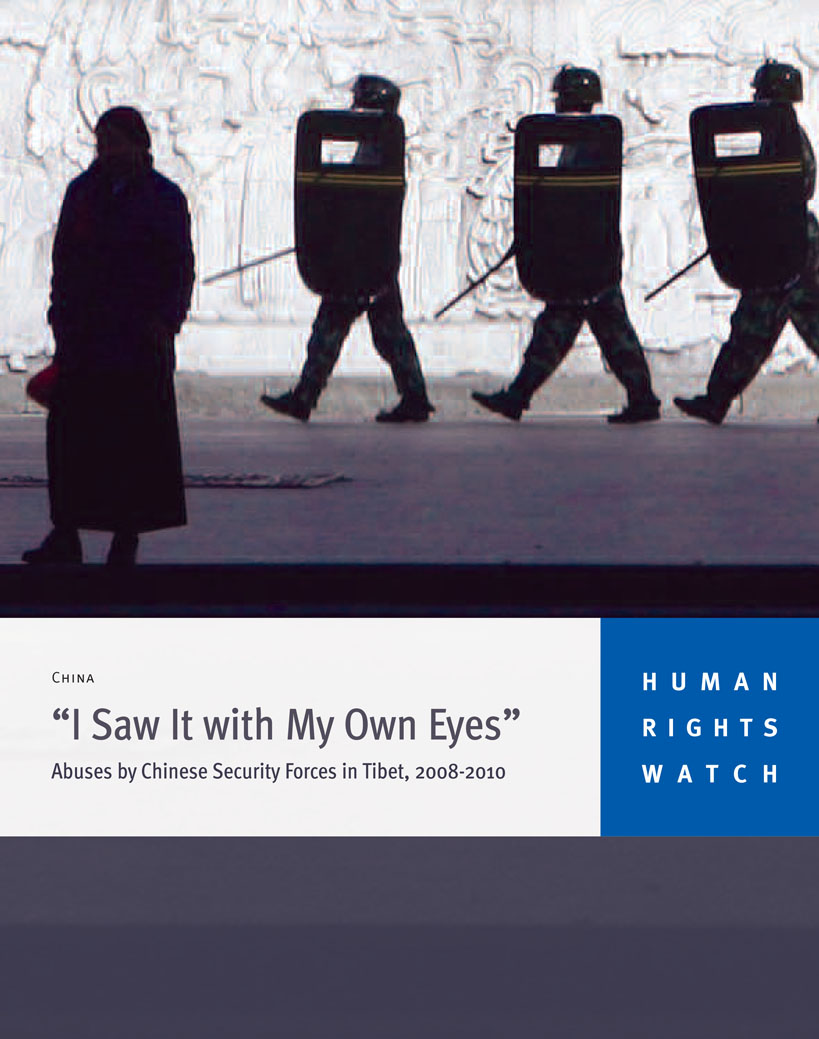
A new Report of Human Rights Watch (HRW) entitled “I Saw It with My Own Eyes — Abuses by Chinese Security Forces in Tibet, 2008-2010” has recently made the headlines. It deals with the unrest on the Tibetan plateau in March/April 2008. As a lot of ink has already gone into the subject, one could ask why publish a new report, two years after the happenings?
It is not really the sequence of events which preceeded those tumultuous days, but rather the way the Chinese authorities handled the riots which are unveiled in the HRW report.
For the human rights organization: “the Chinese government has yet to explain the circumstances that led to dozens of clashes between protesters and police. It has not addressed how its security forces responded to the unrest …Nor has it revealed the fate of hundreds of Tibetans arrested during the protests, or disclosed how many it has detained, sentenced, still holds pending trial, or has sentenced to extrajudicial forms of detention”.
In other words, Beijing has something to hide.
Nicholas Bequelin, who is based in Hong Kong and worked for HRW explains in an interview with the French Daily Le Monde: “We worked without a priori, but to answer the main issue, what is the Chinese government trying to hide by locking the entire Tibetan plateau since the demonstration of March 2008.”
Bequelin considers that it is now difficult for Beijing to refute the HRW Report based on official Chinese sources and eyewitness accounts (200 interviews conducted by HRW between March 2008 and April 2010).
One of the conclusions is that the scale of human rights violations was far greater than previously believed: Chinese forces broke international laws such as disproportionate use of force, torture and arbitrary detention. Further, it reveals that violations continue, including disappearances, wrongful convictions or persecution of families.
Let us remember the facts. Troubles started on 10 March 2008 when 300 monks from Drepung Monastery, near Lhasa started a peaceful protest march towards Barkhor Street, in Central Lhasa. A few monks were immediately arrested by Public Security Bureau (PSB) officials.
The next day, the Sera Monastery in turn got involved in peaceful demonstrations. Again some monks were arrested, severely beaten and manhandled by PSB officials.
The following day, about 2,000 Chinese troops fired tear gas to disperse hundreds of Sera Monastery monks calling for the release of their fellow monks while shouting pro-Tibet slogans.
March 14, 2008 will remain etched in the history of protests in Tibet. It was subsequently termed ‘the 3/14 incident’ by Beijing, probably to make it sound like a terrorist attack against the People’s Republic of China.
In the morning, about one hundred monks from Ramoche monastery began to demonstrate about monks arrested on the previous days. Once again they were stopped and beaten by the police. This infuriated the Tibetan by-passers. From then on, the situation went out of control.
Soon, a large scale demonstration involving tens of thousands of people lead to a confrontation between Tibetans and the People’s Armed Police.
The unrest spread to all the Tibetan-inhabited areas of Qinghai, Gansu, Sichuan and Yunnan. All the events occurred when local Party cadres were attending the annual National People's Congress in Beijing.
Many eyewitnesses told HRW tales of horror: “The witness described soldiers beating an elderly man in his sixties who continued to shout slogans after he had already been loaded in a truck: From inside the truck he kept shouting ‘May His Holiness the Dalai Lama live for 10,000 years!’ and ‘Tibet is independent!’, and for this, five or six soldiers threw him to the ground and beat him so severely that he seemed close to death.”
The Chinese government immediately put the blame on the ‘Dalai Lama and his clique’. An official in Lhasa told Xinhua that there had been enough evidence to prove that the sabotage in Lhasa was "organized, premeditated and masterminded" by the Dalai clique. Though the Chinese government always maintained that it applied ‘limited’ use of force (and spoke about the loss of 10 lives ‘mainly Chinese and Muslim business persons!’), the Dalai Lama’s Administration mentioned at least 100 dead.
Instead of cooling down the situation, Zhang Qingli, Party Chief in Tibet created more resentment by calling the Dalai Lama “a wolf in monk's clothes, a devil with a human face” and declaring that “those who do not love the motherland are not qualified to be human beings”. The HRW report however points out that no evidence of any external intervention has ever been given by Beijing
Interestingly, another report prepared by a Chinese think-tank, Beijing Gongmeng Consulting was published in 2009. It had also contradicted the Party’s official version. The authors, a group of Chinese lawyers spent one month in Tibet “interviewing Tibetan monks, nomads, farmers, scholars, migrants, artists, and business people”.
The lawyers first point out “major errors in government policy” after the March–April 2008 protests. One was ‘over-propagandizing of violence’; another, encouragement of racist sentiment towards Tibetans: “The excessive response of the government all over Tibet was to regard every tree and blade of grass as a potential enemy soldier.”
According to them, this further strained the relations between the local Tibetans and the Han migrants. One of their conclusions was: “Understanding is a precondition for discussion, unity and development. If the promotion of healthy development in Tibetan areas is truly desired then there must be a change in thinking and an adjustment in thinking behind the current nationality theories and policies.”
The Lawyers’ Report found that in Tibet, the difficult terrain has created “locally fixed power networks, which inevitably lead to a high incidence of corruption and dereliction of duty.” For the Chinese lawyers, this new aristocracy, which is ‘legitimized by the Party’, is even more powerful than the old one.
The Tibetan Diaspora probably could not disagree with some of the Lawyers’ conclusions. Particularly, when they say that, ‘Foreign forces’ and ‘Tibet independence’ are used by “many local officials as fig leaves to conceal their mistakes in governance and to repress social discontent …elevating everything to the level of splittist forces in order to conceal their errors.”
A similar conclusion was arrived at in the 70,000 character petition sent by the previous Panchen Lama to Premier Zhou Enlai way back in 1962, for which the Lama spent 17 years in jail.
After his release, he worked closely with the Communist Government, but continued to be disturbed by the situation inside Tibet. In January 1989 while declaring open the tombs of his predecessors at the Tashilhunpo Monastery, he declared: “The Chinese rule in Tibet had brought more destruction than benefit to the Tibetan people”. Four days after delivering this historic speech (witnessed by the then Party Boss, today President Hu Jintao), he passed away.
The mysterious nature of his death generated a lot of speculation. Six years later, soon after the Dalai Lama formally announced that Gedhun Choeki Nyima, a six-year old boy born in Tibet, was the genuine reincarnation of the Eleventh Panchen Lama, the boy was arrested. Since then, he is known as the Youngest Political Prisoner in the World.
Beijing later ‘discovered’ its own incarnation of the Panchen Lama who has recently been 'promoted' as a delegate to the Chinese People's Political Consultative Conference.
Incidents like these are the root cause of the resentment of the local Tibetan populations against the Chinese occupants, there is no need to go further to understand the events of March/April 2008.
The HRW report is however a welcome addition.
Thursday, July 22, 2010
I saw it with my own eyes
In India, we believe in "Satyamev Jayate" (the Truth will prevail).
The problem is that usually it takes a bit of time, but we keep faith that truth will slowly, but surely emerge.
This Report of Human Rights Watch brings some 'inconvenient' (for Beijing) truths on the '2008 incident' as the Chinese prosaically call it.
To read the Report, click here.
Report Reopens Questions on Tibet Crackdown
Human Rights Watch accuses Chinese authorities of using disproportionate force and “acting with deliberate brutality” in the aftermath of antigovernment protests in Tibet two years ago, in a report likely to reignite debate over Chinese rule of the region.
Human Rights Watch said its findings in the new report released today were based on interviews with some 200 people and official sources of information.
The police crackdown started after March 10, 2008 protests against Chinese rule turned into violent riots in Lhasa and other parts of Tibet and neighboring provinces. Officials said some 21 people were killed. Tibetan activists put the toll much higher.
After the protests, the government strictly limited outsiders’ access to Tibet, for example, only allowing a handful of foreign reporters in on tightly scripted government-run trips.
Researchers on the report say they were unable to confirm either version’s death toll because of the restricted access.
But they said their interviews revealed a widespread pattern of abuse and mistreatment of prisoners and called on Chinese authorities to reveal the total number of people detained, and release those still being held without charge.
Authorities have repeatedly defended their actions, saying they were acting within the law to prevent looting from getting out of hand, and have denied accounts they used deadly force in responding to protests.
Saturday, January 9, 2010
New Deputy Party Secretary in Tibet
It is always amazing to see how colonizers spell local names according to their own pronunciation. Pema Thinley becomes Baima Chilin. Beijing continues to pretend that Tibet always belonged to them, but then why having changed the spelling of the names in the 1960's.
And of course, Tibetans will always remain 'Deputy Secretary', they will never make it to the 'Secretray' level. A colony has to be administred by the central power!
Pema Thinley named new TAR deputy party secretary
Dharamsala, January 8:
A 58-year old Tibetan has been appointed as the new deputy party secretary of the Tibetan Autonomous Region (TAR), China’s official China Daily said on Thursday.
Pema Thinley (Ch: Baima Chilin, Pelma Chiley – different versions used by Chinese state-run media), former Executive Vice Chairman of TAR, has been named the vice secretary of the Region's Party committee, the report said, giving no further detail.
As the person in charge of political and legal affairs, Pema Thinley is reportedly seen as a man who had played a prominent role in justifying the crackdown on Tibetans after the March 2008 protests in the Tibetan capital city, Lhasa.
During a conference of "TAR" court officials in the wake of unrest in Tibet, Thinley urged "the usage of law as a tool to strike back at the enemies" and called for a "swift and quick judicial proceedings" for those involved in the March protest, Tibetan Centre for Human Rights and Democracy (TCHRD) said in a report at the time.
In April last year, Thinley was sent to Markham, in eastern Tibet, as a rightful official to control situation during a tense face off between Tibetans and Chinese security forces over gold mine at Ser Ngol Lo (Year of gold and silver) in Markham county, Chamdo prefecture.
He had to be quickly escorted back to Lhasa after hundreds of angry Tibetan demonstrators ignored his appeasement efforts.
And of course, Tibetans will always remain 'Deputy Secretary', they will never make it to the 'Secretray' level. A colony has to be administred by the central power!
Pema Thinley named new TAR deputy party secretary
Dharamsala, January 8:
A 58-year old Tibetan has been appointed as the new deputy party secretary of the Tibetan Autonomous Region (TAR), China’s official China Daily said on Thursday.
Pema Thinley (Ch: Baima Chilin, Pelma Chiley – different versions used by Chinese state-run media), former Executive Vice Chairman of TAR, has been named the vice secretary of the Region's Party committee, the report said, giving no further detail.
As the person in charge of political and legal affairs, Pema Thinley is reportedly seen as a man who had played a prominent role in justifying the crackdown on Tibetans after the March 2008 protests in the Tibetan capital city, Lhasa.
During a conference of "TAR" court officials in the wake of unrest in Tibet, Thinley urged "the usage of law as a tool to strike back at the enemies" and called for a "swift and quick judicial proceedings" for those involved in the March protest, Tibetan Centre for Human Rights and Democracy (TCHRD) said in a report at the time.
In April last year, Thinley was sent to Markham, in eastern Tibet, as a rightful official to control situation during a tense face off between Tibetans and Chinese security forces over gold mine at Ser Ngol Lo (Year of gold and silver) in Markham county, Chamdo prefecture.
He had to be quickly escorted back to Lhasa after hundreds of angry Tibetan demonstrators ignored his appeasement efforts.
Wednesday, September 2, 2009
China Harmony or Chaos?
China Harmony or Chaos? published in the Indian Defence Review (Vol 24.3, September 2009) is now available on line. Just click here.
Sunday, August 23, 2009
Xu Zhiyong's Assistant Disappears
I had reported the arrest of Xu Zhiyong, the Chinese Human Rights lawyer. His organisation had prepared a report on the 2008 unrest in Tibet. Now it is the turn of Zhuang Lu, his secretary to disappear. The leadership in the Forbidden City is becoming more and more intolerant. How can China expect to be considered as a Great Power by the rest of the world?Assistant to pioneering Chinese rights lawyer 'disappears'
Guardian
Saturday, August 22, 2009
By Tania Branigan in Beijing
Office worker for Xu Zhiyong, who himself faces trial for tax evasion, has not been seen for three weeks
Xu Zhiyong is a co-founder of Gongmeng, a legal group which has dealt with some high-profile human rights cases. No one in China has heard of Zhuang Lu, which is hardly surprising. Plainly dressed and introverted, the 27-year-old office assistant completed her mundane daily tasks – booking tickets, paying bills – with minimum fuss. Then, three weeks ago, she disappeared.
Family and colleagues believe she is being held in a detention house in Beijing. Like her boss Xu Zhiyong, a prominent human rights lawyer who has fought a string of high-profile cases, she was taken from her home at dawn on 29 July by security officials. But unlike Xu's detention, which has made headlines internationally, her disappearance has gone unnoticed outside her immediate circle.
"Information about her has always been out. But because the main focus has been on Xu, not many people have noticed her case," said their colleague Yang Huawei.
Xu – who was formally arrested for tax evasion this week – is well known for his tenacious pursuit of sensitive cases such as deaths in custody. Shortly before his disappearance he was featured in Chinese Esquire. He co-founded the legal organisation Gongmeng, also known as the Open Constitution Initiative, which has helped the families of children made ill by tainted baby milk powder and issued a report criticising the handling of demonstrations in Tibetan areas.
In comparison, Zhuang's work at Gongmeng was essential but inconspicuous - the administrative grind without which no organisation can run. She is "thin and small, plainly-dressed, introverted, not talkative," wrote Teng Biao, another of the founders.
But though she appeared vulnerable to Teng, "one thing proved that she was not weak and maybe that is the most shining thing she did [at] Gongmeng," he added.
"In 2008, when summer was replacing spring, she was invited by police for a cup of tea. The national security people asked her to report on our work to them and told her that she would benefit. But Zhuang Lu refused. She told us about it. She had the courage and [they] must have been very angry and we are not sure whether today's 'serious result' has anything to do with them or not."
In his blog posting – since erased by censors – he described how she wept when officials came to shut the Gongmeng legal centre in mid-July.
"Such a gentle and honest girl was kidnapped by Big Brother without any legal justification," he added.
Xu's case comes amid a crackdown on activist lawyers. Zhuang's shows how others can be drawn into such investigations.
"I guess it is possible that they took her in the hope of getting some testimony from her against Xu," Teng told the Guardian.
Nicholas Bequelin, Asia researcher for Human Rights Watch, describes that as "standard operating procedure".
"It is also, of course, a way of putting pressure on Xu, because he is responsible not only for himself. Police like to make threats about consequences for relatives and people around [detainees] and he doesn't have family," Bequelin added.
"This is scaring people who work for NGOs. They are thinking it's not only the boss who can be taken away; officials can also go for the 'small' people."
Zhuang and Xu were due to meet the tax bureau on the day they disappeared. Gongmeng's problems began when authorities slapped a 1.2m yuan (£100,000) fine for unpaid taxes on it last month. Its founders say it paid slightly late but in full and points out that the penalty is five times larger than the tax bill. Staff who tried to pay off some of the fine after Xu's detention were told they could not do so because he had not signed papers to appoint them as legal representatives.
Xu has now been formally arrested, allowing him access to lawyers, but Zhuang is still in limbo. Staff at the detention centre where she is thought to be held told the Guardian they were too busy to speak when asked about her case.
Zhuang's father, who rushed to the capital when he heard of her detention, has returned home to southern China without authorising lawyers to act for her. Now, like her colleagues, he waits anxiously for her return.
Sunday, August 9, 2009
Xu Zhiyong arrested

I had quoted in several of my articles the research done by Xu Zhiyong and his group on the 2008 unrest in Tibet. He has now been arrested for telling the truth.
When will independent thinking be allowed in China? Repression seems the only way the Mandarins of Zhongnanhai know; whether it is in Tibet, in Xinjiang or in the mainland. How long will it last?
Well-known human rights lawyer arrested
Xu Zhiyong was taken away on Wednesday and has not been heard ever since. A member of his staff, Zhuang Lu, also disappeared. Experts believe a campaign of arrests and intimidation is underway to silence dissenters ahead of this year’s celebrations of the founding of the People’s Republic of China in October.
Beijing (AsiaNews/Agencies) – Xu Zhiyong, a well-known Beijing lawyer and human rights activist, was taken away by the police on Wednesday, the Chinese Human Rights Defenders (CHRD) organisation reported. Reasons for his detention or his whereabouts are currently unknown.
Xu heads the Open Constitution Initiative, or Gongmeng, a legal aid centre that provides free legal counsel to people who cannot afford to pay a lawyer. Zhuang Lu, a Gongmeng staff member, was also seized at around the same time as Xu’s arrest. Reasons for his detention or his whereabouts are also unknown.
Gongmeng was banned on 17 July after receiving a 1.42 million yuan (about US$ 200,000) fine for tax evasion.
The centre had applied for tax exemption status because it provided non-profit services to some of its clients. The tax authorities rejected their application and claimed that having provided such services it had not pay taxes on them. The government then proceeded to shut down the centre and block its website, arguing that its administrators were guilty of with tax irregularities.
Yesterday, after Xu’s arrest, the State Administration of Taxation held a hearing about its decision to fine Gongmeng 1.42 million RMB for “tax evasion”. The activities for which it was closed included providing legal counsel to parents of children who were poisoned by melamine-tainted milk and legal advice to petitioners, particularly those detained in black jails.
For some time Chinese bar associations, which are controlled by the Communist Party, have been advising their members not to provide legal counsel to such people, especially if they intend to sue the State or public agencies. Many of the lawyers who refused to do as they were told have lost their licence to practice.
On Wednesday in Beijing police raided the offices of another NGO, the Yirenping Centre, an advocacy group for the rights of hepatitis patients as well as other health-related discrimination issues. Claiming that Yirenping was involved in unauthorised “publishing activities”, law enforcement officers seized its publications even though they did not have any warrant authorising them to do so.
According to the CHRD, Beijing is clamping down on independent rights groups in order to silence all forms of dissent ahead of next October’s 60th anniversary of the founding of the People’s Republic of China.
Sunday, July 12, 2009
An unending tale of repression
My article on the events in Xinjiang was published today in The Sunday New Indian Express. It is available on line. Click here.
Friday, July 10, 2009
The New Aristocracy
My article on The New Aristocracy in Tibet, published in The New Indian Express on June 22 is available on line. Click here.
Wednesday, July 8, 2009
The New Dominion in Flames

Will the Emperors in Beijing read the writing on the Wall of History?
July 6 was the Dalai Lama’s birthday. It was certainly not the kind of birthday present the apostle of non-violence would dream of.
In the morning, the news flashed that in Urumqi, capital of Xinjiang (The New Dominion in Chinese), violence had erupted the previous day, resulting in at least 156 people dead and more than 800 wounded.
The background of the bloodiest-ever riot in the restive region is not clear. Apparently, it started with a peaceful protest which later turned violent. At one point, the crowd (between 1,000 to 3,000 people according to agencies reports) angered by the brutal reaction of the People’s Armed Police (PAP) started overturning vehicles, attacking houses and clashing with police. A few hours later, the Chinese TV began showing images of the riots.
For Uygurs groups abroad, the trouble was triggered when the police violently cracked down on peacefully demonstrating students who were protesting against the killings of two Uygurs by Han Chinese in a factory in South China.
According to Wu Nong, a spokesperson for the Xinjiang provincial government, 260 vehicles were attacked or set on fire and 203 houses damaged. The figures are quite astonishing. The number of dead and wounded and material damage seems extraordinarily high compared to the number of participants.
Tensions are not a new phenomenon in a province which over the past decades, has been flooded by millions of Han settlers. Part of the Republic of East Turkistan till 1949, the Uygurs, Muslims of Turkish origin have sporadically demonstrated their resentment against Han colonization. Today the overwhelming majority of Urumqi's 2.3 million inhabitants are Chinese.
The Communist Party’s satraps were quick to blame the incident on a ‘foreign’ hand. Xinjiang CCP boss, Wang Lequan declared that the riot in Urumqi showed the violent and terrorist nature of the separatist World Uyghur Congress leader (and businesswoman) Rebiya Kadeer. Similar declarations had been issued when unrest erupted in Tibet in March 2008. The Dalai Lama was then called by Party Chief, Zang Qingli, a ‘wolf in monk’s dress’.
In an interview with Xinjiang TV, Wang added: “The riot has destroyed the spiritual support with which the terrorist, separatist and extremist forces cheated the people to participate in the so-called Jihad”.
His conclusion was that “all Party members should take the strongest measures to deal with the enemies' attempt at sabotage and keep regional stability”. No doubt that ‘extreme measures’ have been taken!
The motivation for the revolt in Urumqi seems to be the same as in Tibet: both are fuelled by a deep resentment against the Han Chinese settlers. When ordinary people risks demonstrating against a repressive totalitarian State like China, it means that they are desperate. For the past 50/60 years, Tibetans and Uygurs have gone through a similar history: they have had no say in their own lives and the affairs of their respective provinces. In both cases, Beijing has reacted similarly: put blame on ‘foreign hands’ for the unrest and used force to counter ‘splittist’ elements. In the case of Xinjiang, ‘jihad’ label has been added to make the repression more palatable.
In Xinjiang however, there is a difference: the swiftness of the repression.
In 2008 in the New York Times, Tibet-expert Robbie Barnett had thus described the authorities’ reaction after the first riots in Central Lhasa: “No reinforcements were sent into the area for at least three hours (one Western journalist who witnessed the events saw no police for twenty-four hours), though they were waiting on the outskirts. It was the traditional response of the Chinese security forces to serious unrest — to wait for orders from Party leaders on whether to shoot or not. …In this vacuum, a number of Tibetans turned from attacking police to attacking the next available symbol of Chinese governance, the Chinese migrant population.”
In Urumqi, the repression was swifter and perhaps even more brutal than the Roof of the World.
Interestingly, a report, prepared by a Chinese think-tank, Beijing Gongmeng Consulting has recently given an interesting picture of the 2008 unrest in Tibet; it contradicts the official version. The authors, Li Kun, Huang Li, Li Xiang and Wang Hongzhe are lawyers “committed to building a modernized China and promoting human rights, democracy, and rule of law in China."
Their research team spent one month in Tibet “interviewing Tibetan monks, nomads, farmers, scholars, migrants, artists, and businesspeople”.
Their objective was to come into personal contact with voices which can give “a clear and objective outline of ordinary people’s living conditions in Tibetan areas”.
The lawyers point out “major errors in government policy" after March-April 2008 protests. One was ‘over-propagandizing of [Tibetan] violence’; another, encouragement of racist sentiment towards Tibetans: “The excessive response of government all over Tibet was to regard every tree and blade of grass as a potential enemy soldier.”
According to them, this further strained the relations between the local Tibetans and the Han migrants.
One of their conclusions is: “Understanding is a precondition for discussion, unity and development. If the promotion of healthy development in Tibetan areas is truly desired then there must be a change in thinking and an adjustment in thinking behind the current nationality theories and policies.”
Another issue was the emergence of a new aristocracy in Tibet (it is not different in Xinjiang!). The Chinese Revolution is supposed to have wiped out the old aristocracy and emancipated the masses.
For the Chinese lawyers, this new aristocracy, which is ‘legitimized by the Party’, is even more powerful than the old one.
The Report analyses in detail the rapport between the new aristocracy and the masses: “there is a lack of any effective supervision over the local officials …who have learned how to use stability to protect themselves. …‘Foreign forces’ and ‘Tibet independence’ are used by many local officials as fig leaves to conceal their mistakes in governance and to repress social discontent …elevating everything to the level of splittist forces in order to conceal their errors.”
The final conclusions are not far from the Tibetan Diaspora’s views: “Earnestly listen to the voices of ordinary Tibetans and on the basis of respecting and protecting each of the Tibetan people’s rights and interests, adjust policy and thinking in Tibetan areas to formulate development policies which are suited to the characteristics of Tibetan areas, and which accord with the wishes of the Tibetan people.”
One important issue is religious freedom: “Fully respect and protect the Tibetan people’s freedom of religious belief, resuming and supporting normal religious lives and activities. Fully recognize the important significance of religion and a religious life to Tibetan areas and to the Tibetan people.”
Beijing is also advised to “promote rule of law in governance processes in Tibetan areas”, if it is interested in a stable Tibet. All this could apply to Xinjiang.
The Report made similar points than the 70,000 character petition sent by the late Panchen Lama to Premier Zhou Enlai in 1962 for which he spent 17 years in jail.
The CCP General Secretary Hua Yuabang had also presented a report in the same vein after a visit to Lhasa in May 1980. His was soon removed from the political scene, though his disciple, Zhao Zyiang continued as Premier till the Tiananmen events.
Obviously, the Beijing leadership had not read these Reports before giving the order to the PAP to ‘strike hard’. But in the long term, the use of brutal repression to subdue genuine resentment and injustice can only weaken the State and lead to an implosion of the Middle Kingdom.
Wednesday, June 17, 2009
An Interesting Report
A group of Chinese independent lawyers has just published an interesting report entitled: "An investigative report into the social and economic causes of the 3.14 incident in Tibetan areas"
The Report has been prepared by the Gongmeng Law Research Center in Beijing (Contributors: Li Kun, Huang Li, Li Xiang; Research: Li Kun, Huang Li, Li Xiang, Wang Hongzhe)
Here is some of their conclusions and recommendations:
For the sake of the long-term harmony and unity of the state, the 3.14 [March 14, 2008] incident in Tibet is worthy of our deep reflection. If external factors alone are emphasized and we ignore reflections upon internal social and political structures, this would be irresponsible to the long-term interests of the state. Against the great background of modernization, although there have been great developments to the economy in Tibetan areas, compared to other provinces, other countries, and even ordinary people of other nationalities living in Tibetan areas, it is still evidently backward. This is particularly so when more and more people from elsewhere are acquiring great wealth in Tibetan areas, and unintentionally creating a sense of relative deprivation. At the same time, religious traditions have come under attack from modernization, and many young Tibetans have been cast into a state of puzzlement and confusion. Behind all of these questions lies an urgent problem, and that is the problems in our country’s political structures. Power relations from top to bottom have created a group of local Tibetan cadres who use the resources of authority that come to them from above in order to build a complex network of contacts in nationality areas, where the state’s economic assistance largely becomes used for career projects for the few, or for the personal wealth of the few. They are not good at facing the masses, not good at facing a society in the process of development and with a plurality of thought, and they frequently stir up social contradictions and then hope that the central government will foot the bill. Ordinary Tibetans have a far keener and evident sense of deprivation than any sense of government help, and like many people living in provinces in the interior, are deeply discontented with the local power-brokers. This accumulation of frustration and anger over a long period of time with the added fuses of religion and external forces led to the 3.14 incident.
We believe that at present, there is no factual basis for the “extinction of Tibet” as described by some. In the main, Han-Tibetan relations are good. However, following the chaos of 3.14 in Tibetan areas we discovered that there are many prominent contradictions and hardships in society in Tibetan areas. We tried to understand this situation by means of research and documentary analysis, and to understand the living conditions of the masses in Tibetan areas. This report is only the reflection of a merest glimpse, and such perspectives can in no way cover all of the issues facing Tibetan areas. However, it has been based on the intention to understand the changes taking place in Tibetan areas, and at the same it is hoped that it will bring about further and ever more detailed exploration.
We call for ethnic relations of “unity, equality, mutual assistance, harmony and people first,” and “a unified multi-ethnic joint struggle, common construction, common prosperity and shared success.” The prerequisite is for the government to fully recognize the citizen status of ordinary people in Tibetan areas, to ensure the rights and interests of ordinary Tibetan people, and that conceptual thinking needs to adapt to the social reality of Tibetan areas in a period of rapid modernization, where it is hoped to be able to be unencumbered by current ideological frameworks to broaden horizons and make policy breakthroughs.
In focusing its research on the social factors of the “3.14 incident,” the research panel presents the following suggestions:
1. Earnestly listen to the voices of ordinary Tibetans and on the basis of respecting and protecting each of the Tibetan people’s rights and interests, adjust policy and thinking in Tibetan areas to formulate development policies which are suited to the characteristics of Tibetan areas, and which accord with the wishes of the Tibetan people.
2. Guide the rational development of economic structures in Tibetan areas, paying particular attention to guiding all Tibetans to share in acquiring ample benefits from opportunity and development. Pay attention to nurturing local economic entities; in the process of support, pay close attention to changing the degree of serious inequalities, reducing the discrepancy between urban and rural rich and poor in Tibetan areas; extend the scope of Aid Tibet to Tibetan autonomous areas outside Tibet. Continue the model of economic development based on a combination of financial aid, technical assistance and human resource expertise, and adopt measures to attract foreign investment at the same time as taking appropriate measures to protect local industries. In the labor market pay close attention to fully protecting the employment rights of Tibetan people. In farming and nomadic regions within Tibetan areas, promote support and protections which benefit the individual.
3. Increase effective supervision over local power structures in the implementation of regional ethnic autonomy policies, and speed up the process of democratizing power structures. End tolerance of corruption, poor administrative abilities and dereliction of duty which is apparent in government in Tibetan areas, and in particular of those officials who suppress local social problems in the name of “anti-splittism.” Establish more rational and democratic selection policies for Tibetan cadres in order to optimize current cadre structures.
4. Pay close attention to the living situation of young Tibetans, and with the greatest good faith resolve current education problems in Tibetan areas, particularly the problems of rural education and education for farmers and nomads, and by means of subsidies and guidance entice children to complete nine-year compulsory education. Continue to develop and encourage training mechanisms for highly skilled personnel in Tibetan areas, and to optimize specialized knowledge structures among college students. Speed up and improve grass-roots professional technical education in Tibetan areas, and using the method of joint work and study as used in schools in the eastern provinces, allow Tibetan students to set out and increase the degree of training in schools’ high-tech content and training in practical production in Tibetan areas, in order to train up skilled workers and eliminate all barriers for encouraging varied Tibetan employment and entrepreneurship. Particular attention should be paid in school education on extending and developing appropriate content on Tibetan history and culture, and increasing the civic awareness content of the training. Education and training must be regarded as the most important long-term resolution to the question of Tibetan areas.
5. Fully respect and protect the Tibetan people’s freedom of religious belief, resuming and supporting normal religious lives and activities. Fully recognize the important significance of religion and a religious life to Tibetan areas and to the Tibetan people. In the area of culture and religion, make best use of the situation and pay close attention to the role of religious authority. Respect and resume normal religious activities such as Dharma events, the practice of traveling to study, receiving teachings, and the monastic examination hierarchy. Pay close attention to protecting the transmission of Tibetan Buddhism. Fully protect and respect the Tibetan people’s religious sentiment in propaganda activities.
6. When resolving problems in Tibetan areas, thinking must be transformed; adopt appropriate measures and thinking which is more positive and wise. With the guiding thought of facilitation, understanding and integration, reduce inter-ethnic prejudice, ignorance and injury. When handling sudden incidents, change the overly-strong attitude of “from top to bottom,” and wisely mobilize positive forces in Tibetan areas (such as religious forces) to solve them.
7. Promote rule of law in governance processes in Tibetan areas. Urge the introduction of laws and regulations as represented by ordinances in the Tibet Autonomous Region and other autonomous areas, to change the current status quo of a lack of lower laws since the promulgation of the Regional Ethnic Autonomy Law. Regulate the ownership rights and disposal rights of key natural resources. Encourage positive expert participation in advising and discussing all aspects of policy in Tibetan areas.
8. When upholding and propagandizing construction to the state of ethnic unity, propagandize the successes of reform and opening up in Tibetan areas instead of depicting the past system of serfdom. At the same time as manifesting the vitality of development, admit to the social problems facing Tibet. Be vigilant against the dark racist waves of secession and ethnic revenge.
9. When handling crisis situations, it must first be discerned whether there is a social problem, an economic problem, or a religious problem, with different problems having different means of being handled. The central government should be in the position of “arbiter,” and maintain a distinction to the best of their ability from local officials’ inappropriate conduct. Sensitive incidents should be “de-sensitized” to the greatest degree.
To read the full Report, visit http://www.savetibet.org/media-center/ict-news-reports/bold-report-beijing-scholars-reveals-breakdown-china%E2%80%99s-tibet-policy
Subscribe to:
Posts (Atom)