Showing posts with label China's Economy. Show all posts

Tuesday, March 1, 2022

Where is China Going?

My article Where is China Going? appeared in Chanakya Forum.

Here is the link...

Soon the Games are over.
The Emperor of China, Xi Jinping, with his colleagues of the Politburo, had planned a grand show to prove to the world that the Middle Kingdom was one of the two most powerful players on the planet (if not the most). It is a partial failure; as The Nikkei in Tokyo titles: “Xi’s Olympics diplomacy stumbles as leaders avoid Beijing Games.”
In the end, only 24 heads of state and other leaders (such as the discredited Tedros Adhanom Ghebreyesus, the Director General of WHO or António Guterres, the UN Secretary General) attended the opening ceremony.
It cannot be called a grand success.

Since February 2020, when the the coronavirus pandemic became ‘official’, Xi had not physically met foreign leaders; however, he could not be avoided in-person diplomacy during the Beijing Winter Olympics, especially as the Communist Party’s Secretary will seek a third term during the 20th National People’s Congress in November.
While many Western States had announced a ‘diplomatic’ boycott, The Nikkei noted: “Chinese President Xi Jinping’s diplomatic push timed with the Beijing Winter Olympics hit a snag after Saudi Arabia’s crown prince and India’s top envoy canceled plans to attend the opening ceremony at the last minute.”
Let us remember that after Qi Fabao, the aggressive PLA regiment commander who triggered the Galwan Valley border clash in June 2020 had been nominated as a torchbearer during the Winter Olympic Torch Relay in Beijing, Delhi rightly decided not to participate in the opening and closing ceremonies.

After the Games
Once the dust (or the artificial snow) settles, the Party will have to face the most serious challenges since Mao and his infamous Great Leap Forward and Great Proletarian Cultural Revolution.
Let us go through some of them.
Chinese companies listed on China’s stock markets (in the Shanghai or Shenzhen stock exchanges) had to indicate their profits and losses for the year 2021 by the end of January.
On February 4, The Epoch Times reported that: “many companies with big losses submitted their information on January 28, the last trading day in January. Suning.com Co had the largest loss, around 43.3 billion yuan (US $6.8 billion), more than the company’s market cap of 36.4 billion yuan. The company was on the Fortune 500 list in August 2021 and ranked number one among the Chinese retail companies. The second largest loss was from China Fortune Land Development, a real estate developer, with an estimated loss of 33.1 to 39.1 billion yuan.”
Caixin, China’s influential financial publication, observed that by January 29, out of the 66 real estate companies which published their 2021 performance information, 30 reported a loss: “After the real estate companies, pig farming companies are the next group with the largest losses. Jiangxi Zhengbang Tech, ranked around 370 in Fortune’s China’s Top 500 companies. It estimated a 19 billion yuan loss for 2020.”
Next were the Airlines which lost a lot of money in 2021.

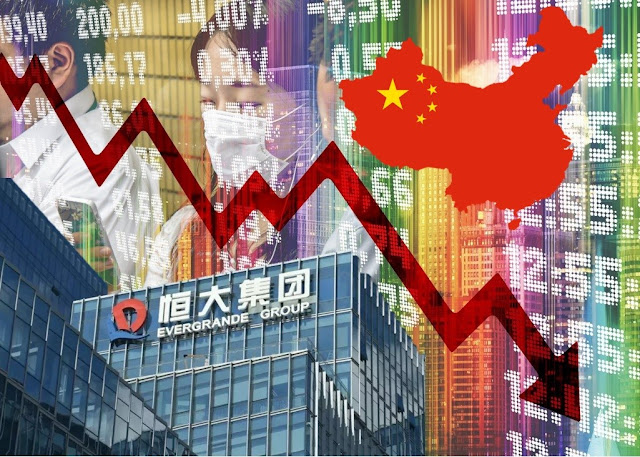
Evergrande and the construction bubble
It is said that the housing construction sector contributes something like 35% to 40% of Chinese GDP.
It has started crashing, with no revival in sight, as Beijing’s government does not want to jump to the rescue of companies such as Evergrande; it practically means that the savings of millions of people may be wiped out. Consequently, the purchasing power of these people will be greatly reduced.
What option is left to the government to avoid a crash?
Beijing will have first to spend on infrastructure to bail the steel and cement industries and then on the defence sector hoping to kick-start a revival of the economy.
But, there is a ‘but’, these moves will create more deficit, the internal debt which is already estimated at 5 trillion US dollars (more than 50% of their GDP), will increase further.
An analyst said: “So with the continuing opacity of the health of their banking system this is tantamount to continuing their long-standing Ponzi scheme.”
The financial stress could become wider.
It may also result in an increased military belligerence, which could in turn result in an armed conflict which will only aggravate the financial situation, even if it keeps the ‘masses’ temporarily mobilized behind the Party and its new Great Helmsman.

Redistribution of Wealth
In August 2021, Xi Jinping spoke of the importance of ‘common prosperity’ aiming at expanding the size of middle-income groups, increasing the earnings of low-income groups, ‘reasonably’ regulating high-income groups …and banning illegal incomes.
Can Xi Jinping succeed in his plans to redistribute the wealth?
Will he not kill the Golden Hens which made China rich?
The Foreign Policy magazine commented: “a much harder task than [making artificial snow] confronts President Xi Jinping: delivering on his pledge for a fairer distribution of China’s wealth while maintaining stable growth.”
Simply because, says the magazine, Xi’s plan threatens to undermine “the key drivers behind China’s success during Deng Xiaoping’s era of reform and opening up. Over the past 40 years, betting against the Communist Party has been a fool’s game, but China’s development model is now facing its sternest test.”
The Nikkei advanced an interesting theory that while China’s economic power, military might, and geopolitical influence have seen massive growth: “At the same time, Beijing has taken to aggressive posturing towards territories like Hong Kong, Taiwan, islands in the South China Sea, besides neighboring nations.”
The Japanese newspaper concludes: “While some believe that it is the Asian giant’s rise to power that is behind this posturing, other quarters have noted that it is actually the opposite: the communist nation is being aggressive because of its inevitable slowdown in growth.”
The process behind China’s grandiose militarized infrastructure projects is termed the ‘peak power trap’. And again, there can be a temptation to use this ‘dual’ infrastructure for a conflict, with the consequences that we have already mentioned.
The Foreign Policy magazine mitigates its views: “Economic stagnation could well threaten the Communist Party’s survival, but it has managed to pull back from the brink of collapse before.”

Aging of the Population

Another seemingly insurmountable problem is the aging of the population.
According to the National Bureau of Statistics, the total population in mainland China was 1.41 billion people as of the end of 2021, an increase of 480,000 people compared to 2020.
There were 10.62 million newborns and 10.14 million deaths (only 0.034 percent rise for 2021); it means that China had in 2022, the lowest increase since 1949.
It is said that presently China’s newborns are half that of India (the rate will be one-third of India’s by 2050) and while China’s total population is more than four times that of the United States, the number of newborns will be overtaken by the United States in two generations.
All this has of course serious economic implications.

Can China indoctrinate the masses?

A crucial question, are the Chinese masses ready to follow Xi and the Party forever? A lot depends on the answer to this.
The Chinese youth seems today to believe the Communist propaganda.
Yan Xuetong, a professor at the Institute of International Relations of Tsinghua University, recently mentioned the intergenerational differences between college students born in the 2000s and the previous generations. Yan pointed at their idiosyncrasy in terms of ideology, aesthetic standards, values and moral concepts.
The scientist’s observations are that college students born in the new millennium: “often look at the world with a dichotomous view, treating countries other than China as the same group, and regarding universal values such as peace, morality, fairness and justice as unique Chinese traditions.”
They generally believe that China is righteous and innocent, while all other countries, especially the US, are ‘evil’; they think that Westerners naturally hate China.
Yan came to the conclusions that this generation “is deeply influenced by the Internet and they take what they have learned from cyberspace, such as economic determinism and conspiracy theory as common sense.”
He realized that “contemporary students often have a strong sense of superiority and self-confidence, and they are easily influenced by the Internet.”
He then suggested that teachers “should help students understand the twists and turns of history and the diversity of the world; they should also help them enhance their ability to think logically and critically.”
This is perhaps a key to the future, but today the Communist propaganda is so well entrenched, that only a Revolution (remember 1989) could challenge the Party and there is no guarantee that it will solve the economic issues.
China has many more vital issues to tackle (eg, Taiwan, Hong Kong, Tibet, Xinjiang, etc.), but the economy and the problem of population seem the toughest ones to solve.

The future of the Middle Kingdom seems bleak.

Thursday, July 21, 2016

For a few tanks more

The Chinese are not happy!
Last week, they were furious after the announcement of the verdict of the Permanent Court of Arbitration (PCA). The International Tribunal in The Hague had given its ruling on a reference by the Philippines over the South China Sea (SCS): China has no historic ‘rights’ over the natural resources in most of the areas of the SCS; further any right must not exceed what’s permitted by the UN Convention on the Law of the Sea (UNCLOS).
Now, China is upset again.
This time, it is because the Indian press reported the deployment of T-72 battle tanks in Ladakh.
Quoting official sources, The Tribune, whose correspondent visited Ladakh, spoke of a possibility for China and Pakistan to launch a collusive two-front war against India: “In the past four-five years, ground troops have been added to pre-positioned locations along the Line of Actual Control (LAC), or the de facto border, that is not marked on the ground.”
Since the past 36 months, ground forces and artillery guns have been backed by T-72 Russian-origin tanks and another tank unit is slated to move to Eastern Ladakh facing China: “This adds a new dimension to any future war in the area that is marked by an average height of 14,000 feet, where oxygen is scarce,” says The Tribune.
According to The Daily Excelsior published from Jammu, for the Indian Army “the move is part of the winter drill to validate the capability of the tanks at such heights and is not an inimical move against China.”
Colonel Vijay Dalal, Commanding Officer of the tank regiment explained: “What we have done is that we have procured special additives and lubricants for high altitude terrain such as winter grade diesel and additives for the lubrication system, which prevents it from freezing in the tank.''
The Colonel added: “While the tanks and crew have acclimatised, they have not been able to test their fire power in the heights here due to lack of firing ranges. There is a need to verify their firing capacity at higher altitudes.”
The Global Times objected to this move: “Deploying tanks on Indo-China border hinders potential for Chinese investment.”
How can protecting the Indian borders ‘hinder’ Chinese investments?
Are the Chinese doing India a favour by investing?
The Global Times links the deployment of the Indian forces on the border to Chinese business investments in India: “A media report stating that nearly 100 Indian tanks have been positioned near the Indo-China border to counter any possible threat grabbed people's attention as more Chinese firms are looking to increase their investment in India.”
Then it quotes statistics of the China’s Ministry of Commerce: “Chinese outbound investment [in India] increased by 58.7 percent in the first half of the year, as the country [India] has sought to further integrate itself into the world economy.”
Probably referring to the announcement by Delhi of a new foreign direct investment (FDI) policy, opening up several sectors, including defense, to 100 per cent equity, The People's Daily says: “the Modi administration has recently promoted a second round of reforms to attract more overseas investment by allowing foreign firms to increase their shareholding in local enterprises.” It however adds that “it is puzzling that while deploying tanks near China's border, India still strives to woo Chinese investment.”
What have the tanks to do with the investment policy?
You may call this ‘logic with Chinese characteristics’, especially at a time China is behaving badly and illegally the South China Sea.
Though it sounded like a threat, Chinese Foreign Ministry Spokesman Lu Kang was more courteous; Lu just said: “There have been a series of significant agreements and consensus reached between China and India on upholding stability of the border area. …The two countries should abide by relevant agreements and consensus, work in concert to maintain peace and tranquillity of the border area and create a favourable environment for improving bilateral mutual trust and bolstering the proper settlement of the boundary question.” He further pointed out: “The China-India border area has long been peaceful and stable.”
To come back to The Global Times article, it paternalistically explains: “In an index on the ease of doing business, from the World Bank, India currently ranks 130 out of 189. Despite India's stated goal to rise to within the top 100 this year, the nation has its work cut out for them.”
In other words, it tells Delhi, ‘forget about your borders, make business easier for us’.
What is amazing is that China has developed its dual-use infrastructure on the Tibetan plateau at a very rapid pace during the last few decades, but now it objects to India occupying its own territory and taking necessary measures to defend its borders.
Further, China recently raised the level of the Tibet Military Command's (TMC) authority. China Military Online admitted: “China continues to strengthen its military presence in the autonomous region and aims to allow the military command to shoulder more combat assignments. …The TMC's political rank will be elevated to one level higher than its counterpart provincial-level military commands, and will come under the leadership of the PLA Army.” It added that the promotion marks a "new journey for the Tibet military command's construction."
Zhao Zhong, deputy director of the Political Work Department of the TMC told the PLA website: “The elevation of the authority level is not only an improvement for the troops' designation, but also an expansion of their function and mission.”
Song Zhongping, a Beijing-based military expert, told The Global Times that the TMC “bears great responsibility to prepare for possible conflicts between China and India, and currently it is difficult [for the TMC] to secure all the military resources they need.”
So why make so much fuss for a few Indian tanks at a time when China moved its 15th Airborne Corps to Tibet?
The Global Times’ conclusion is that deploying tanks near the Indo-China border “may hit a nerve within the Chinese business community, causing investors to weigh the threat of political instability when they make investment decisions.”
According to the same principle, Delhi should stop doing business with China because Beijing has illegally (according to the La Hague Tribunal) occupied most of the South China Sea, where it has built mega infrastructures, even on ‘rocks’?
This is one more example of Chinese double standards.
But Delhi has probably touched a raw nerve.
After the announcement of the verdict of the PCA, a PLA commentator wrote: “The great rejuvenation of Chinese nation is an unstoppable historical trend that won't be diverted by the will of any individual country or person.”
A rejuvenated China is bound to bully its neighbours and economic partners.
India has to take all measures to counter the Chinese tactics, investment or no investment.

Tuesday, August 23, 2011

Château Lafite for Dinner?

According to this article between 80 to 90 percent of Château Lafite wine sold in China is fake.
In less than ten years, the price of Château Lafitte has risen 857%!!!
A few months back, as I visited some of the Châteaux in the Médoc where Château Lafite is located, I noticed several mini-buses loaded with Chinese visitors/tourists. 
I wondered, 'what are they doing here?'. 
I was later told that they are the Châteaux' best customers since 'Europeans are broke'.
I then realized that the newly-found love of the Chinese people for Bordeaux 'grand crus' was serious business.
The Chinese are well-known for their prowess in retro-engineering, but it is probably easier to duplicate a Russian fighter plane than a "Première Côte de Bordeaux".  
In this case, only the labels can be copied easily. But, this serves the purpose of the 'nouveaux riches'.

PCWorld reported a few weeks ago that Chinese authorities have found 22 more fake Apple Stores just in the city of Kunming (Yunnan). A month earlier, five fake stores had been discovered in the capital of the Yunnan province, two of which had been ordered to close.
The Rothschild family, the owner of famous vintage since the 19th century can find a consolation, no Chateau Lafitte stores will be open soon in China, though the fake red wine will probably continue to abundantly flow for the 'nouveaux riches' of the Middle Kingdom.

The Brand Name Château Lafite Rothschild at Chinese Officials' Dinner Table
Source: news.163.com, August 15, 2011
Lafite is a trademark not registered in Mainland China. Château Lafite Rothschild, a wine estate in France, produces 15,000 to 25,000 cases of wine annually, or about 200,000 bottles. China's annual quota of Lafite wine imported from France is only 50,000 bottles. However, the annual sale of Lafite in China exceeds 3 million bottles, meaning 80 to 90 percent of Lafite sold in China is fake. In less than 10 years, the price of Lafite has risen 857%.
Over time, Lafite in China has gradually lost its original nature and now serves a social function. It is used to judge someone’s economic situation. To show off their status, people dare not to comment on Lafite. Even if they have bought fake Lafite, they silently accept it, fearing ridicule for not being able to recognize true Lafite. Lafite’s high price and the reputation of the wine of kings satisfies the proclivity of government officials, who, at a party, must drink the best wine. The rising demand has resulted in a higher price for Lafite, which, in turn, makes Lafite more popular among government officials and elite groups. “Lafite,” a symbol of status, has become the “official wine.” The taste and color are no longer important. A businessman observed, “I cannot take the risk of not providing Lafite at the dinner table.”
http://news.163.com/11/0815/01/7BF99J6O00014JHT.html

Thursday, July 28, 2011

China's economic quake shakes the west

My article China's economic quake shakes the west appeared yesterday in DNA.
Click on the title to read.

Certain analysts believe that a forthcoming economic crisis could be ten times more serious than the one triggered by the Lehman Brothers’ collapse in 2008.
The French daily Le Monde commented: “Never in the economic and financial history of the postwar, has the risk of a systematic explosion of the global economy been so high. We risk a real conflagration, if there is no last-minute wake up of the political leaders of the Western world to prevent a collision between default payment of the United States with the cascading defaults in Europe. The appalling management on both sides of the Atlantic has one thing in common: they are trying desperately to believe that we will resolve decades of fiscal laxity without difficulty. The issue is however much more serious; we need to adjust our lifestyle to our means.”
President Barack Obama was ready to offer substantial reductions of the public debt, but the powerful lobbies behind the Republicans are not interested. The Christian Science Monitor reported, “When you add up the interest payments, Social Security, Medicare, Medicaid, defense operations, active-duty military pay, and unemployment insurance, the costs in August will outweigh incoming funds for that month. Moreover, there would be nothing left for huge areas of the government including federal courts, the FBI, food stamps, Pell grants, highway projects, tax refund checks, or federal employee pay”...

Read on...

Monday, June 20, 2011

Chinese Dams in Burma


A few days ago, I posted Will China dam the Indus, quoting an article of The Financial Times affirming that Beijing has sent to Islamabad a proposal to invest 15 billions dollars to dam the Indus.
Unfortunately, the human, sociological and ethnic factors are generally not included in the cost estimate. 
Look at what is happening in Burma: a Chinese company (or a conglomerate) comes, local people are displaced, then the construction starts under Chinese soldiers' protection, creating more tension and clashes. 
Already in 2008, IDSA had mentioned these two dams in its Weekly Report: 
A Chinese-Myanmarese joint project to construct a series of hydroelectric dams in Kachin State has met with resistance from the Kachin Independence Organization (KIO), said sources close to the armed ethnic group. The KIO, which signed a ceasefire with the junta in 1994, was reportedly unhappy that several projects to build dams in Kachin State. Tensions soared two weeks ago when Chinese authorities refused to pay tax to the KIO, which responded by deploying soldiers around the two dams in progress - Tarpein 1 and Tarpein 2 - which are being constructed on the Tarpein River in Momauk Township by Myanmar’s Ministry of Electric Power No 1 and a conglomerate of Chinese companies. Soon after two battalions of armed KIO soldiers took up positions around the dams the Chinese construction workers on the project fled, causing construction to be suspended. Sources close to the KIO said that the workers returned and the project resumed about one week ago after Chinese authorities paid 1.5 million yuan (US $220,916) to the KIO. The negotiation was reportedly mediated by newly appointed Commander of Northern Command Brig-Gen Soe Win. The Tarpein 1 hydroelectric dam is designed to generate a capacity of 240 megawatts and is located about 3.5 miles from Momauk Township, while Tarpein 2, which should generate 168 megawatts, is located about 6 miles downstream of Tarpein".
Perhaps the bosses of Pakistan (btw, who are the bosses in Pakistan?) should visit Burma and inspect the Chinese dams' sites to understand the danger of getting the Indus dammed. 
The local populations in Gilgit-Baltistan may not believe in the 'all-weather-friends' concept, the way the generals do in Islamabad. 
What about Tibet? Has the Chinese Academy of Sciences taken into consideration the lakhs of local villagers and herders who will have to be 'reallocated' for the grand diversion scheme. 
These details do not probably bother Mr Guo Kai and his  friends. But it should!
To know more on the dams in Burma, visit the Burma Rivers Network website.

Poster from Burma Rivers Network

Myanmar blames Kachin rebels for fighting
The Associated Press
Yangon
June 18, 2011
In its first public comments on a week of fighting in northeast Myanmar, the government said Saturday that ethnic Kachin rebels fired first and the army had to act to protect a major Chinese-built hydroelectric power project.
The skirmishes were some of the fiercest in nearly two decades between government forces and the Kachin Independence Army. They erupted June 9, displacing at least 10,000 people over the course of about one week. The rebels have blamed the government for launching an offensive after militia fighters rejected a call to leave the strategic region.
The government says it did call on rebels to leave, but accused them of firing first after threatening Chinese technicians and detaining two army officers, according to a report Saturday in the state-run New Light of Myanmar newspaper.
The 8,000-strong Kachin militia is one of several minority ethnic rebel armies in Myanmar who say they are fighting for greater autonomy.
The government paper said Myanmar's military ordered rebels to withdraw from a camp near the Tarpein hydropower project, a joint venture between Myanmar's Electric Power Ministry and China.
The government said that during the fighting, militia fighters blew up power pylons that fed the project, as well as 20 bridges. The violence forced 215 Chinese employees to flee home across the border, the report said.
Military columns "had to inevitably attack the KIA just to rescue their officers ... who were detained without any reason and to protect the high-cost Tarpein hydropower project," the report said.
The U.S. Campaign for Burma, a Washington-based lobbying group, said last week the militias had returned six detained army soldiers during a lull in fighting. It was not immediately clear if the two officers reported detained by the government were among them.
Myanmar's central government has tenuous control of many parts of the country where minority groups are strongest. Many of those groups maintain their own militias. The government has reached cease-fire agreements with 17 rebel militias since 1989 and most have been allowed to keep their weapons and maintain some autonomy over their areas.
The Kachin militia reached a peace deal with the country's former ruling junta in 1994, but the truce broke down last year after the militia rejected a call by the government for them become border guards under army leadership. The junta made the appeal ahead of last November's elections, Myanmar's first in 20 years, which introduced the nominally civilian government now in power.

Thursday, May 12, 2011

Trading with China

While the Chinese have been able to find an understanding with Nepal to simplify the procedure for non-tariff barrier items in the border trade between Tibet and Nepal, the situation is more difficult between India and China in Sikkim (Nathu-la).
On May 10, a report of The Sikkim Mail affirms: "The border trade between India and China that is being carried out since 2006 has been stalled from 4th May after the goods taken by the Indian traders were not cleared by the Chinese authorities at Nathu La border gate. The Chinese authorities allegedly told the Sikkimese traders that they do not recognize the list of items approved by the Indian government."
Since 2006, the border trade was going rather smoothly  and no custom duty was raised as per the bilateral agreement between India and China. 
The Sikkim Mail explains: "The Mart (Donqingang) in-charge of China side has informed the traders that they would impose tax per kilogram on the approved items which will be exported to China from India. The District Magistrate said that custom duties cannot be imposed on border trade items."
Apparently, the  Sikkim Government has not even been informed of the change of rules. The local District Magistrate has assured the traders that the matter will be taken by Commerce and Industries Secretary to the Ministry of External Affairs in Delhi. 
One more Chinese unilateral decision which will not help to smooth out the Sino-Indian relations.
Regarding Nepal, note the trade deficit in favour of China: "Nepal had a trade deficit of around Rs 42 billion with China in 2009-10 which was around Rs 31 billion during 2008-09, while the deficit was of around Rs 23 billion during 2007-08. During 2007-08, Nepali exports to China were worth less than a billion rupees."
Even if Nepal is able to sign an agreement with the Tibetan Autonomous Region, Kathmandu remains the looser. 
  
Meeting for simplification of trade between Nepal and Tibet ends
Trade panel to be deputed at border
HIMALAYAN NEWS SERVICE
2011-05-10
KATHMANDU: The second meeting of Nepal-Tibet Trade Facilitation Committee (NTTFC) decided to form a working committee at the border point for trade barrier simplification. “During the meeting representatives from both the countries agreed for the formation of a working committee that will actively work to solve trade related problems at the border,” said Binod Acharya, under secretary at Ministry of Commerce and Supplies (MoCS).
NTTFC meeting was organised on May 9-10. The two-day meeting was organised in Kathmandu and was led by joint secretary at the ministry Toya Narayan Gyawali and the visiting delegation was led by deputy secretary general of Government of Tibet Autonomous Region Ye Yinchuan. They also signed they also signed an MoU for Nepal-Tibet Trade Fair.
“As per the MoU, the trade fair will have around 50 stalls each from Nepal and China,” said Acharya. The trade fair will be organised for five days from November 2-6 in Kathmandu. The first Nepal-Tibet Trade Fair was organised in Tibet in September 2009 and after two years, the fair is being organised in Kathmandu. The first meeting of NTTFC was organised in Lhasa on April 21, 2010. The NTTFC meeting was very much positive on simplification of Nepal-China trade barriers, said Acharya.
The meeting was focused on trade related technical assistance and removal of trade barriers. “Representatives from Nepal and Tibet discussed the simplification of non-tariff barrier, encouragement to Chinese investment and increased Chinese technical assistance in Nepal,” said Acharya. Representatives from both sides discussed over the duty-free access different Nepali products.
“China has given duty-free access to 33 countries’ products including Nepal. However, traders here are unable to enjoy the facility of duty-free access,” he said adding that we also discussed about infrastructure development at customs points and simplification of language barriers at the border.
Nepal had a trade deficit of around Rs 42 billion with China in 2009-10 which was around Rs 31 billion during 2008-09, while the deficit was of around Rs 23 billion during 2007-08. During 2007-08, Nepali exports to China were worth less than a billion rupees.
However export to China increased to Rs 2.15 billion during 2008-09 while import was worth Rs 34.46 billion, said Gyawali. However exports to China dropped to Rs 1.38 billion with import increasing to Rs 43.44 billion. China mainly imports wheat flour, grain, coffee, vegetable fat, sugar, mix-juice, paints, painting, incense stick, statue, handicraft products, carpet, bricks, mattress from Nepal.

Sunday, May 8, 2011

Salt, garlic and other rushes


Reproduced below, an important article found on Chinascope website.
It shows the poor credibility of the Chinese Government.  Mao's era is far away. At that time, each and every Chinese citizen would believe the words of the Chairman. 

It is true that during these days, it was better not to show your doubts about the Great Helmsman's policies .
Those who dared saying that China had a food problem during the Great Leap Forward, (like Marshal Peng Dehuai), had to pay the heavy price for expressing their disagreement.
It is not that Indian citizens have a great confidence in their own government, but even if the credibility is about the same level in India as in China, the difference is a free press, a free uncensored Internet access and an independent judiciary. 

As a result, the Kalmanis, Rajas and co are now hosted by Tihar Jail officials.
As long as China lives under the dictatorship of one Party (the dictatorship of the proletariat does not exist since long), there is little chance that the Chinese leadership finds again some credence in the eyes of the ‘common men’.
However despite many restrictions, Internet has started playing an important role to fight corruption and injustice in China.
In the coming years, the response of the Government will remain the same, 'let us keep stability': “The local governments take measures against the farmers, saying they are a threat to stability and try to resolve it in order to maintain order. Our inability to solve these conflicts suggests that our thinking about maintaining stability is quite limited” says the article.

But when it comes to external 'enemies', Chinese citizens are unanimously ready to believe their government. Amazing!

The Credibility of China’s Government Is Dangerously Low 
Chinascope 
[Editor’s Note: Several articles in the Chinese media have criticized the government of China, saying it has lost its credibility with its citizens, who now have no trust or confidence in the authorities. For the majority of the people, casting doubt on whatever the government says has become a habit, as the followings excerpts from some articles show.]

1. “Please Try to Let Me Trust You” [1]
“Many online top stories, including the ‘Bleached Mushroom’ investigation case in Beijing and Yueqing’s case in Zhen Jiang [2], have become a mirror reflecting the trust factors of the local governments and news media. Today, the sentiment of ‘mistrust’ has penetrated into the very fabric of Chinese people’s lives: when we Chinese eat, we can’t trust the safety of our food; when we travel, we can’t trust the ability or sincerity of the railroad industry to solve the problem of the shortage of tickets; when we go to the hospital, we can’t trust that the doctor won’t over-prescribe medication; when we go to court, we can’t trust that the judiciary system will make a just decision. …
“We were full of trust in everything in the past: the leaders, the revolution, the end of capitalism, the bright future of communism … but now we can’t trust anything: what the local government’s say, media reports, the people next to us, and particularly ‘it has become the habit of most people to question whatever the government says.’
“Nowadays, suspicion and alerts have become the way of life for Chinese people, because there are so many unimaginable incidents constantly taking place. If we talk about where we live, there are buildings that have collapsed or are unstable, tilted, and poorly built; about what we eat, we have to be careful about fake cigarettes, liquor, eggs, milk, waste water trench oil [3], synthetic fat, bleached rice, bean sprouts soaked in contaminated water, turtles fed with contraceptive drugs, deep-fried flour sticks made with detergent powder; about where we go outside of our home, we need to be careful about sales people, con artists, and law enforcement officers (who can fine you for anything); about going to the hospital, we are concerned about fake drugs, unlicensed doctors, or being “over-treated” (The Hong Kong Sun newspaper recently disclosed that China consumed 10.4 billion bottles of IV fluid last year, an average of 8 bottles per person.) Moreover, we need to deal with fake tickets, fake licenses, fake lotteries, bank fraud, fake tigers [4], and fake news.
“All of sudden, the ‘conspiracy theory’ is all over China’s Internet. Sometimes, the more clarifications the government puts out, the more questions Internet users have. The Guardian made the following comments: ‘The display of mistrust over such incidents (referring to the death of village head and activist Qian Yunhui in the Yueqing’s case) shows the scale of the credibility challenge the authorities face. Conspiracy theories flourish online in all countries, but they have a particularly strong appeal in China.’ Professor Huang Yasheng at MIT also said, ‘No matter what caused the death of Mr. Qian, considering the focus of the media coverage, wouldn’t this display a type of crisis? If you were a government official, wouldn’t you feel worried and concerned?’
“Last year, an 11-year-old elementary student in Beijing conducted a simple food safety test with the assistance of his teacher. He found that, out of 14 types of fresh mushrooms he selected randomly, 13 were bleached. At the same time, the Beijing Food Safety office carried out an “official” investigation and claimed that 97 percent of the mushrooms sold in Beijing’s market tested negative for bleach and were therefore safe to eat. On the one hand an elementary student does a random investigation; on the other hand, the government’s official publishes an official statement. Who would you trust? In a survey of 1100 people, most trusted the results of the elementary student–only 8 said they trusted the government’s report.
“Trust in children is not limited to the general public. Certain government agencies, publicly or semi-publicly, have shown their distrust of adults. The Liangzhou District in Wuwei City, Gansu Province, assigned 18 Communist Party Young Pioneers (all students under age 14) to monitor a written test conducted in their public security and judiciary department in July 2009. By the end of the test, 25 participants had been caught cheating. The public security and judiciary department is charged with the responsibility of safeguarding social justice. How ironic that it would employ under-aged children to monitor its own internal test.
“Social conflict from housing demolition directly reduces the public’s trust in the government. … All of these instances reflect the conflict between officials and civilians. The reasons are deeply rooted. The current rash of incidents in the countryside is mostly related to land confiscation, forced-demolition, and forced-relocation. [5] Farmers try to protect their rights, which has caused conflicts with local governments. The local governments take measures against the farmers, saying they are a threat to stability and try to resolve it in order to maintain order. Our inability to solve these conflicts suggests that our thinking about maintaining stability is quite limited.
“Public trust in the regional governments has declined in the past two years. … In summary, the mass incidents involve protecting farmers’ rights during land confiscation and relocation. They also reflect what governments think ‘stability’ is when there is a conflict between our mentality of maintaining stability and farmers’ protection of their rights. Concerns about the farmers can’t be considered an instability factor and should be handled properly. We need to adjust our mentality about maintaining stability. Public trust basically involves these two fundamental issues. The issue of farmers’ rights not only covers land confiscation but also involves rights to cemetery plots, mineral exploration rights, and local farmers’ rights, and environmental issues.”

2. The Salt Rush in China
[Editor’s Note: A recent rush to buy up salt in China, after Japan’s nuclear leak at the Fukushima plant, is a further example of what little trust and confidence the public has in the government. On March 16, 2011, people in the coastal cities on the Mainland rushed to buy iodized salt. On March 18, the salt rush spread throughout China. Many stores ran out of salt, and people bought soy sauce and other salt replacements instead.]
“According to a Shanghai resident, Cai Wenjun, the salt rush was caused, to a large extent, by TV news. She said, ‘Some people say that due to the radioactive impact of the Japan earthquake, salt from a contaminated ocean will not be edible. Then the TV news tried to quash the rumor and said it would not impact the Mainland. However, the people on the Mainland have lost confidence in the government. Every time the government makes some high profile statement, it means the truth is exactly the opposite. Starting on March 16th, all salt in stores (in Shanghai) had completely sold out, and the next day even all of the soy sauce was gone. I think the government orchestrated all of this. For example, milk products contain melamine, port has traces of clenbuterol, glutinous rice wine includes preservatives, and Sudan Red was found in salted duck eggs. Didn’t the government deny all of it?  Yet these violations are real and are continuing today.’
“Postings online said that, while the salt rush did show some people blindly following along, in fact what it highlights is the total absence of any social credibility or sense of security. In their personal experiences, the people who participated in the salt rush felt there was no one—no person or government department—that they could trust. They felt safe only when they could physically possess the resource in question, in this case, salt. One can laugh at their ignorance, but it is a clear demonstration of a deep social crisis.
“Internet writer Li Li pointed out, ‘Chinese authorities unleashed some so-called experts to quash the rumor that edible salt is not from the sea but from salt mines. From my personal experience, this is untrue. Even if sea salt is not contaminated at this time, the Communist Party consistently went all out after previous major safety accidents to cover up the truth. That has led to people’s complete loss of trust and confidence in the government. So if sea salt were contaminated due to nuclear radiation, the authorities would certainly cover it up and not notify the people. It does not mean our people are stupid, but, rather, our people are rational. Many postings online also concurred that this brief incident exposes the extent to which the Communist Party’s credibility has become bankrupt.’ The salt rush, in fact, is a public referendum, a no-confidence vote against the Communist Party.” [6]
“Another fact that one cannot ignore is that, as a result of long-term suppression, the entire country has plunged into utter confusion and distrust. We truly feel the pendulum twist and swing between truth and lies. Take the example of earthquake predictions. After an earthquake, officials often say that earthquakes cannot be accurately predicted. [7] When there really are indications of earthquakes, the authorities, using experts, assert that earthquakes will not occur. [8] So many incidents like this have happened. Step by step, people have lost their trust and confidence in the government and its experts; now, none feel safe and secure.
"For several years now, minor events have resulted in panic. It reflects deep social problems in China. ‘The garlic rush’ [9] and ‘the iodized salt rush’ are not terrible.  What is really alarming is the fear and mistrust that these incidents have, again and again, brought out. When rumors start to spread, in addition to actively clearing the rumors, the authorities should look at themselves and search for the underlying cause. Re-building the social mechanism to restore public trust and credibility is the key to the ultimate cure." [10]

Endnotes:
[1] International Herald Leader, “Please Try to Let Me Trust You,” January 17, 2011.
http://news.xinhuanet.com/herald/2011-01/17/c_13694007.htm.
[2] Editor’s Note: Mr. Qian Yunhui was a village manager in Yueqing City, Zhejiang Province. He died on December 25, 1010, after a construction truck rolled over him. Several times before his death, he had reported how the local government had illegally taken villagers’ land for construction projects. Though the police and government immediately stated that his death was an accident, some claimed that witnesses had reported seeing unidentified people push or throw Qian under a truck. Public opinion on the web overwhelmingly suspected that the government had deliberately arranged to have him killed. The recently disappeared Ai Weiwei also looked into his case.
[3] Editor’s Note: Many Chinese restaurants dump their used oil into waste water trenches. Some people collect the oil from the trenches and reuse it when they cook food to sell.
[4] Editor’s Note: On October 12, 2007, Zhou Zhenglong, a peasant in Shaanxi Province, reported that he had seen a South China Tiger, a critically endangered species, in a forest. Zhou also presented a picture of the tiger that he claimed he took in the forest. Since then, many people, including government researchers have pointed out that the picture was a fake. However, the local government kept reassuring the public that the picture was real (so that they could attract tourists). Eight months later, the Shaanxi Province government declared the picture was a fake and ended the charade.
[5] Editor’s Note: In many land confiscation and forced-demolition cases in China, the local government offers a significantly below market price for residents’ houses. The local government then re-sells the land at a much higher price in order to profit from taking over the land. The residents suffer a great loss but they cannot really argue with the government. They face forced-demolition if they refuse to move out.
[6] Epoch Times, “The Earthquake Hasn’t Settled Yet, But People Are Already in Chaos in Buying up Salt: All Stirred up by CCTV,” March 19, 2011.
http://www.epochtimes.com/b5/11/3/19/n3202606.htm.
[7] Editor’s Note: Referring to how the Chinese government did not warn the public about the Wenchuan Earthquake, but afterwards only claimed that the earthquake could not have been accurately predicted.
[8] Editor’s Note: This refers to the fact that official earthquake experts claimed that there would be no earthquake at all in Qinghai Province, even though earthquake rumors had been spreading. On April 14, 2010, less than a month (after the rumors started), Yushu County, Qinghai Province had a 7.1 level earthquake.
[9] Editor’s Note: When SARS was spreading in China, a rumor circulated that garlic could prevent SARS, which caused a “garlic rush” in China.
[10] Sichuan Online, “The Trust Crisis behind the Salt Shortage,” March 18, 2011.
http://comment.scol.com.cn/html/2011/03/011009_843437.shtml.

Wednesday, April 27, 2011

Trading pettily with China

On May 2, the border will reopen between India and Tibet at Nathula in Sikkim.
Business is not flourishing.
An article in iSikkim reported: "The fifth edition of Indo-China trade through the Nathu-La border in 2010 recorded absolute zero import."
At the same time, a few hundreds kilometers westwards the trade is with Nepal is increasing (though one-way only). 
The website China Tibet Online affirms that the "total volume of cross-border petty trade between Tibet and Nepal has increased remarkably in the first quarter of 2011".
Lhasa Customs figures show that the overall petty trade value amounted to 131 million US dollars, 62.3 % higher than the figure over the same period of last year, accounting for 98.4 % of the total cross-border trade value. 
Of the total petty trade volume, imports reached up to 748,000 US dollars, dropped by 16.2 % while exports took up 130 million dollars, increased by 63.2 %."
Like in the case of India and the United States, the trade is heavily tilting in China's favour, but the Nepalis do not seem to mind too much.
An amusing story about the term 'petty trade'. At the time of signing the Panchsheel Agreement in 1954 and despite the nice preamble (The Five Principles), the two delegations were miles apart. 
A telling incident shows how little confidence there was between India and China. 
In the Hindi version of the Agreement, the Indian translators had written 'chhota mota vyapar' for ‘petty trade’. 
'Chhota' means ‘small’ and 'mota', ‘fat’ or ‘big’. The Chinese Hindi expert could not reconcile the two contradictory words. He did not realise that it was a widely used idiomatic Hindi phrase for ‘petty’. He thought that there was some trick behind the term. It took two weeks to convince the Chinese that the term chhota mota was correct. They finally accepted it only after having cross-checked with their embassy in Delhi.
The problem is the trade is 'chhota' for India and 'mota' for the Chinese side.

Nathu La opens from May 2 for trade
April 20, 2011
iSikkim
Gangtok: The sixth edition of Nathu-la border trade with Tibet Autonomous Region (TAR) of China will start on May 2 this year. It will continue till November 30 when the pass at 14,420 ft closes down for winte. Under the bilateral agreement between India and China, there are 29 exportable items. Sikkim traders are allowed to export them to TAR. But the Indian business community can import only 15 items. The trade through the Nathu La pass started in 2006.
The fifth edition of Indo-China trade through the Nathu-La border in 2010 recorded absolute zero import. In 2009 also the Nathu-La border trade closed for the season recording zero import.
As per the official record 2010 saw exports worth a little over Rs 4 crore. Canned foods, utensils, textiles, copper items, vegetable oil, tea, cigarette, coffee, misri, and blankets have been the most popular export items.
ist of items allowed for trade across Nathu La border
List of items allowed for trade across Nathu La border (Pic Courtesy: The Hindu)
China’s In-charge of Tibetan Autonomous Region (TAR), Ms Kesang Diki said that the reason for zero import was because of the non-feasible list of items for trade across the historic post. She requested the Indian Government to expanding the trade list so as to cater to today’s market demands.
As per the bilateral agreement in 2006 only 29 items can be exported to TAR from the Indian side while the Chinese traders can export only 15 items. Most of these items listed in the schedule are obsolete and do not have commercial value, a fact both the Chinese and the Sikkimese traders have highlighted in the past four years.
The Chinese traders, however, did brisk business by selling non-permitted items such as blankets, woollen jackets and carpets to tourists and locals. Custom officials said it was difficult to check imports of such items in the absence of adequate staff.

Saturday, October 2, 2010

Is China rich?


These two articles were published the same day (in Chinese) by Xinhua and China News Service. They show the dichotomy of Middle Kingdom's economy. The 'Chinese characteristics', dear to the leadership in Beijing enable the Party to reconcile  the fact that "China is not rich enough to shoulder the international responsibilities that Western governments want to impose" and at the same time has 5000 billionaires (in yuan). So, is China rich or poor?
From the outside, it seems that the wealth is not shared with everybody. This is a dangerous trend for the stability of the regime, especially when most of the 5000 lucky ones belong to the Party.


Wu Bangguo to Publish Article Stressing China Is a Developing Country     
Wu Bangguo, a high-ranking Chinese official and chairman of the Standing Committee of the National People's Congress, will publish an article in the upcoming issue of Qiushi Journal, the core publication of the Central Committee of the Chinese Communist Party. The article, titled “Fully Understand the Characteristics of China's Development Stage,” will emphasize that China is still a developing country.
“As a matter of fact, China is still at the preliminary stage of socialism and will be for a long time. China remains the largest developing country in the world. This is our conclusion based on basic national conditions.”
This article, added to the current number of official pieces, implies that China is not rich enough to shoulder the international responsibilities that Western governments want to impose.
Source: Xinhua, September 30, 2010
http://news.xinhuanet.com/politics/2010-09/30/c_12622468.htm


Hurun Report: Chinese Billionaires Number More than 5,000     
In a recent interview, Rupert Hoogewerf, the founder of China’s Hurun Report, a famous list of wealthy Chinese, estimated the number of Chinese billionaires to be over 5,000.
The calculation is based on official statistics that count 1,393 individuals as having personal assets of 1 billion yuan ($0.15 billion US). Hoogewerf believes that the those who are excluded from the official count generally number about twice those who are included, or around 3,000 people. Adding the two numbers together, the richest group may well be above 5,000.
Hoogewerf said that their wealth mainly comes from real estate, manufacturing, IT, medicine, and retail business. The average age of wealthy Chinese is only 51 years old.
Source: China News Service, September 30, 2010
http://www.chinanews.com.cn/cj/2010/09-30/2566310.shtml