Showing posts with label Olympic Games. Show all posts

Tuesday, March 1, 2022

Where is China Going?

My article Where is China Going? appeared in Chanakya Forum.

Here is the link...

Soon the Games are over.
The Emperor of China, Xi Jinping, with his colleagues of the Politburo, had planned a grand show to prove to the world that the Middle Kingdom was one of the two most powerful players on the planet (if not the most). It is a partial failure; as The Nikkei in Tokyo titles: “Xi’s Olympics diplomacy stumbles as leaders avoid Beijing Games.”
In the end, only 24 heads of state and other leaders (such as the discredited Tedros Adhanom Ghebreyesus, the Director General of WHO or António Guterres, the UN Secretary General) attended the opening ceremony.
It cannot be called a grand success.

Since February 2020, when the the coronavirus pandemic became ‘official’, Xi had not physically met foreign leaders; however, he could not be avoided in-person diplomacy during the Beijing Winter Olympics, especially as the Communist Party’s Secretary will seek a third term during the 20th National People’s Congress in November.
While many Western States had announced a ‘diplomatic’ boycott, The Nikkei noted: “Chinese President Xi Jinping’s diplomatic push timed with the Beijing Winter Olympics hit a snag after Saudi Arabia’s crown prince and India’s top envoy canceled plans to attend the opening ceremony at the last minute.”
Let us remember that after Qi Fabao, the aggressive PLA regiment commander who triggered the Galwan Valley border clash in June 2020 had been nominated as a torchbearer during the Winter Olympic Torch Relay in Beijing, Delhi rightly decided not to participate in the opening and closing ceremonies.

After the Games
Once the dust (or the artificial snow) settles, the Party will have to face the most serious challenges since Mao and his infamous Great Leap Forward and Great Proletarian Cultural Revolution.
Let us go through some of them.
Chinese companies listed on China’s stock markets (in the Shanghai or Shenzhen stock exchanges) had to indicate their profits and losses for the year 2021 by the end of January.
On February 4, The Epoch Times reported that: “many companies with big losses submitted their information on January 28, the last trading day in January. Suning.com Co had the largest loss, around 43.3 billion yuan (US $6.8 billion), more than the company’s market cap of 36.4 billion yuan. The company was on the Fortune 500 list in August 2021 and ranked number one among the Chinese retail companies. The second largest loss was from China Fortune Land Development, a real estate developer, with an estimated loss of 33.1 to 39.1 billion yuan.”
Caixin, China’s influential financial publication, observed that by January 29, out of the 66 real estate companies which published their 2021 performance information, 30 reported a loss: “After the real estate companies, pig farming companies are the next group with the largest losses. Jiangxi Zhengbang Tech, ranked around 370 in Fortune’s China’s Top 500 companies. It estimated a 19 billion yuan loss for 2020.”
Next were the Airlines which lost a lot of money in 2021.

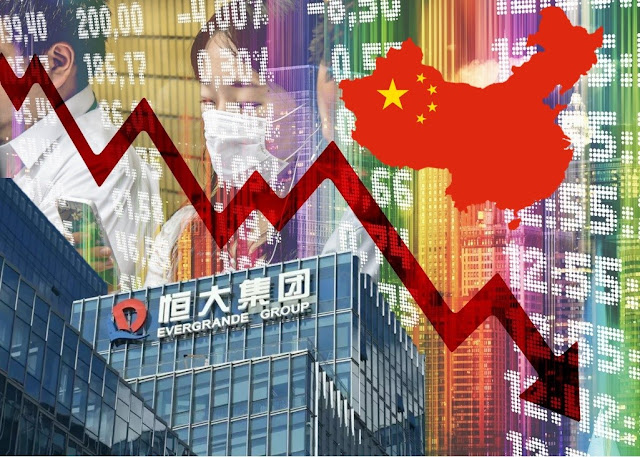
Evergrande and the construction bubble
It is said that the housing construction sector contributes something like 35% to 40% of Chinese GDP.
It has started crashing, with no revival in sight, as Beijing’s government does not want to jump to the rescue of companies such as Evergrande; it practically means that the savings of millions of people may be wiped out. Consequently, the purchasing power of these people will be greatly reduced.
What option is left to the government to avoid a crash?
Beijing will have first to spend on infrastructure to bail the steel and cement industries and then on the defence sector hoping to kick-start a revival of the economy.
But, there is a ‘but’, these moves will create more deficit, the internal debt which is already estimated at 5 trillion US dollars (more than 50% of their GDP), will increase further.
An analyst said: “So with the continuing opacity of the health of their banking system this is tantamount to continuing their long-standing Ponzi scheme.”
The financial stress could become wider.
It may also result in an increased military belligerence, which could in turn result in an armed conflict which will only aggravate the financial situation, even if it keeps the ‘masses’ temporarily mobilized behind the Party and its new Great Helmsman.

Redistribution of Wealth
In August 2021, Xi Jinping spoke of the importance of ‘common prosperity’ aiming at expanding the size of middle-income groups, increasing the earnings of low-income groups, ‘reasonably’ regulating high-income groups …and banning illegal incomes.
Can Xi Jinping succeed in his plans to redistribute the wealth?
Will he not kill the Golden Hens which made China rich?
The Foreign Policy magazine commented: “a much harder task than [making artificial snow] confronts President Xi Jinping: delivering on his pledge for a fairer distribution of China’s wealth while maintaining stable growth.”
Simply because, says the magazine, Xi’s plan threatens to undermine “the key drivers behind China’s success during Deng Xiaoping’s era of reform and opening up. Over the past 40 years, betting against the Communist Party has been a fool’s game, but China’s development model is now facing its sternest test.”
The Nikkei advanced an interesting theory that while China’s economic power, military might, and geopolitical influence have seen massive growth: “At the same time, Beijing has taken to aggressive posturing towards territories like Hong Kong, Taiwan, islands in the South China Sea, besides neighboring nations.”
The Japanese newspaper concludes: “While some believe that it is the Asian giant’s rise to power that is behind this posturing, other quarters have noted that it is actually the opposite: the communist nation is being aggressive because of its inevitable slowdown in growth.”
The process behind China’s grandiose militarized infrastructure projects is termed the ‘peak power trap’. And again, there can be a temptation to use this ‘dual’ infrastructure for a conflict, with the consequences that we have already mentioned.
The Foreign Policy magazine mitigates its views: “Economic stagnation could well threaten the Communist Party’s survival, but it has managed to pull back from the brink of collapse before.”

Aging of the Population

Another seemingly insurmountable problem is the aging of the population.
According to the National Bureau of Statistics, the total population in mainland China was 1.41 billion people as of the end of 2021, an increase of 480,000 people compared to 2020.
There were 10.62 million newborns and 10.14 million deaths (only 0.034 percent rise for 2021); it means that China had in 2022, the lowest increase since 1949.
It is said that presently China’s newborns are half that of India (the rate will be one-third of India’s by 2050) and while China’s total population is more than four times that of the United States, the number of newborns will be overtaken by the United States in two generations.
All this has of course serious economic implications.

Can China indoctrinate the masses?

A crucial question, are the Chinese masses ready to follow Xi and the Party forever? A lot depends on the answer to this.
The Chinese youth seems today to believe the Communist propaganda.
Yan Xuetong, a professor at the Institute of International Relations of Tsinghua University, recently mentioned the intergenerational differences between college students born in the 2000s and the previous generations. Yan pointed at their idiosyncrasy in terms of ideology, aesthetic standards, values and moral concepts.
The scientist’s observations are that college students born in the new millennium: “often look at the world with a dichotomous view, treating countries other than China as the same group, and regarding universal values such as peace, morality, fairness and justice as unique Chinese traditions.”
They generally believe that China is righteous and innocent, while all other countries, especially the US, are ‘evil’; they think that Westerners naturally hate China.
Yan came to the conclusions that this generation “is deeply influenced by the Internet and they take what they have learned from cyberspace, such as economic determinism and conspiracy theory as common sense.”
He realized that “contemporary students often have a strong sense of superiority and self-confidence, and they are easily influenced by the Internet.”
He then suggested that teachers “should help students understand the twists and turns of history and the diversity of the world; they should also help them enhance their ability to think logically and critically.”
This is perhaps a key to the future, but today the Communist propaganda is so well entrenched, that only a Revolution (remember 1989) could challenge the Party and there is no guarantee that it will solve the economic issues.
China has many more vital issues to tackle (eg, Taiwan, Hong Kong, Tibet, Xinjiang, etc.), but the economy and the problem of population seem the toughest ones to solve.

The future of the Middle Kingdom seems bleak.

Sunday, August 12, 2012

The dilemma of the Middle-Way

Choeyang Kyi on the podium after the 20-kilometer walk race
The dilemma of the Middle-Way Approach appeared concretely during the London Olympics Games when a young Tibetan walker, Choeyang Kyi for the Tibetans (or Qieyang Shenjie to the Chinese) earned a bronze medal in the women’s 20-kilometer race walk.
The Chinese supporters on the road in front of the Queen's Palace were heard shouting “Jia You!” while many Tibetans encouraged her, “Gyuk!” (“Go on!” in their respective language).
Both groups had their flags, the red one of the People's Republic of China, under which Choeyang participated and the one with the snow lions of the Tibetan supporters.
Where was the Middle-Way Approach in this?
The Dalai Lama has thus described his philosophy for the future status of Tibet:
The Tibetan people do not accept the present status of Tibet under the People's Republic of China. At the same time, they do not seek independence for Tibet, which is a historical fact. Treading a middle path in between these two lies the policy and means to achieve a genuine autonomy for all Tibetans living in the three traditional provinces of Tibet within the framework of the People's Republic of China. This is called the Middle-Way Approach, a non-partisan and moderate position that safeguards the vital interests of all concerned parties-for Tibetans: the protection and preservation of their culture, religion and national identity; for the Chinese: the security and territorial integrity of the motherland; and for neighbours and other third parties: peaceful borders and international relations.
Can the Tibetan and Chinese supporters be side by side in this scheme?
In London, they appeared to be on a different wave-length. 
The bronze-medal earner kept very quiet during the Press Conference.
One can understand.
Regarding the flag, I have already mentioned about Mao's remarks on the Tibetan flag on this blog. In the mind of the Great Helmsman, it is not incompatible to have two flags (the red one and the snow-lion one flying together) flying together (Kashmir has also 2 flags after all, why not Tibet?).
For the rest, it is more complicated, much more complicated.
It looks like the Chinese government was testing the waters; for the first time, they brought a Tibetan athlete to the Games to see if the situation is controllable in a foreign arena, especially after the series of self-immolation in Eastern Tibet.
Choeyang Kyi must have had harder times during the Press Conference than during the race. But she should be congratulated to have managed well in both.
The dilemma of the Middle-Way appears to be: was Choeyang Kyi a Chinese runner or a Tibetan one?
Can she be both?
Not sure for the Tibetans supporters. One of them told the AP reporter: "As an individual, we are proud of her, but that she is representing China, I’m not happy."
But it is what the Middle-way is about, isn't it?
This does not pose a problem for Mary Kom, who can be an Indian and a Manipuri at the same time; it poses a serious dilemma in Communist China.
Thanks God India is not China, though the China's tally is fuller than India's.
In the meantime, let us hope that Choeyang Kyi will trigger new vocations in Dharamsala (and why not amongst the well-trained Tibetan Special Frontier Forces).
Unfortunately, the dynamic Tibetan Prime Minister, Dr Lobsang Sangye does not seem to have a sports policy.
A great pity!

China makes history and causes dilemma at the Olympic Games
Associated Press
August 12,
LONDON — On any other day and in any other situation, the Tibetan exiles who gathered excitedly in groups next to Buckingham Palace would never have come to cheer for an athlete wearing the colors of China, a country they regard as their oppressor, a country that invaded and has governed their Himalayan homeland with an iron fist for six decades.
But this was exceptional. Because, apparently for the first time at an Olympics, the athlete was one of them, a Tibetan.
Standing apart but, just this once, both wanting the same thing, groups of Chinese supporters shouted “Jia You!” while the Tibetans yelled “Gyuk!” — both meaning, “Go on!”
The Chinese waved their red flags. The Tibetans waved the flag of Tibet that is banned in China, with a bright yellow sun rising over a snow-clad mountain. They could hear and see each other, but they studiously ignored each other, too.
The athlete — Qieyang Shenjie to the Chinese, Choeyang Kyi for the Tibetans — could hear the yells of encouragement. But she kept her head down and concentrated on not putting a foot wrong. It seemed a fitting metaphor for a Tibetan competing for China, one smart enough not to get sucked into the politics that have swirled around her Olympic participation.
Not only did Qieyang make history for Tibetans, she won a medal, too — bronze in the women’s 20-kilometer race walk Saturday. She beamed when she crossed the finish line, a picture of delight. If she felt discomfort at all as a Tibetan in Chinese colors, she didn’t show it.
“I’m extremely honored to take part as the first representative of the Tibetans at the Olympic Games and to win a medal,” she said.
She said she heard Tibetans encouraging her along the route that went past the residence of Queen Elizabeth II.
“I heard it! Really. I heard a Tibetan cheering me on. At the time, I looked backward but couldn’t see who that person was,” she said.
But she looked alarmed when asked if she saw the Tibetan flags, shaking her head and refusing to answer.
Because Tibet is ruled by China, it does not have its own team or athletes at the Olympics or other international competitions, like the football World Cup. So, for Tibetans, this was the first time they’d been able to cheer on one of their own. But it also was a shock to some of them to see Qieyang striding past them in Chinese red.
“Am I really cheering for Tibet or China?” wondered Ugyen Choephell, who said his parents fled Tibet in the 1960s to India, where he was born.
Still, he yelled “Choeyang Gyuk!” and was thrilled when she went past.
“Great, really. Very emotional,” he said. “History in the making.”
If there was another Tibetan at previous Olympics, history has forgotten them. In China, the government-run Xinhua News Agency and other media said Qieyang was the first Tibetan to make a Chinese Olympic team.
Olympic historian Bill Mallon said Tibet has never fielded an Olympic team and that he and other Olympic experts he consulted weren’t aware of any previous Tibetan Olympian. The Tibetan government in exile in India said likewise.
“As an individual, we wish her well,” said Dicki Choyang, the exiled administration’s minister for information and international relations. “She must have put in a lot of effort to reach there. But we are sad that she cannot represent a free Tibet.”
“China uses things like this for their political gain. The fact that a Tibetan is participating in the Olympics does not take away anything from the dire situation prevailing inside Tibet,” Choyang added.
Qieyang, 21, said she was born in what is now the Chinese province of Qinghai and that her family are Tibetan herders, although she was stumped when asked how many animals they have.
“I can’t remember. I haven’t been home for many years,” she said.
She seemed something of a curiosity to reporters from China who peppered her with questions after the race, won by Russian Elena Lashmanova. They asked Qieyang for a Tibetan song. She refused.
She told them her Tibetan name means “the sun,” that she started running as a kid, that she said a Buddhist prayer before the race and that her family isn’t well off.
On the blog she keeps, Qieyang said she was sworn in as a member of China’s ruling Communist Party in July before coming to London to compete. “Will be making a swear-in speech. A bit excited and a bit nervous,” she wrote.
That drew a range of responses from other Chinese bloggers, from those who called her “disgusting” and questioning why she wanted “to join the world’s biggest mafia?” and was “boarding the wrong boat” to others who wrote “congrats,” ‘’impressive,” ‘’very good.”
She sounded embarrassed when asked why she joined — again, clearly trying not to put a foot wrong.
“Why? I ... I ... How to say? It’s all good,” she said.
If Qieyang was keeping her real feelings to herself — and it was impossible to know — Tibetans who turned out in support found it hard to believe that she might be happy competing for China, even though she certainly seemed to be.
“For her, I can understand it’s a difficult situation. I imagine that the Chinese have given her threats of all sorts. I would think she is brainwashed or forced to do this. There’s not much choice for Tibetans in Tibet,” said Yangchen Kikhang, a Tibetan born in India.
“As an individual, we are proud of her, but that she is representing China, I’m not happy,” she said.
Still, she cheered Qieyang and consoled herself with this thought.
“Inside her head,” she said, “she probably thinks she is Tibetan.”
Associated Press writers Ashwini Bhatia and Didi Tang contributed.
John Leicester is an international sports columnist for The Associated Press. Copyright 2012 The Associated Press. All rights reserved. This material may not be published, broadcast, rewritten or redistributed.