Showing posts with label KK Tewari. Show all posts

Wednesday, October 5, 2022

The Forgotten Hero of the Indian Air Force

Chinese PLA surrounding the Bell helicopter of Sqn Ldr Vinod Sehgal

My article The Forgotten Hero of the Indian Air Force appeared today in Rediff.com

Did Vinod Sehgal die in Tsangdgar or was he taken PoW to China?
Why has the IAF kept so quiet for all these years, asks Claude Arpi.

Here is the link...

Perhaps the main unsolved mysteries of the 1962 India-China War is the fate of 35-year old Squadron Leader (Sqn Ldr) Vinod Sehgal, (sometimes is name is written ‘Sahgal’); the Vayu Sena Medal awardee of the 105 Helicopter Unit of the Indian Air Force, went ‘missing in action’ at Tsangdhar in the Tawang sector of the then Kameng Frontier Division of the North East Frontier Agency (today Arunachal Pradesh) on October 20, 1962.
In the early hours of this fateful day, the People’s Liberation Army (PLA) attacked the Indian positions south of the Thag-la ridge. It soon turned into a debacle recounted by Brig John Dalvi, the Commander of the ill-fated 7 Mountain Brigade in his remarkable Himalayan Blunder; the ‘leadership’ in Delhi had insisted of defending indefensible positions on the river Namkha chu (river), with the tragic well-known outcome. 

Tsangdar Dropping Zone where Sqn Ldr Sehgal landed
What happened in the vicinity of the Thag-la ridge and the Namkha chu (river) has been the object of a number of good or less good books.
Nobody has forgotten that the foolish (not to say criminal) leadership in Delhi did not think it fit to use the services of the IAF for offensive operations; the 7 Brigade was soon decimated; Hatung-la, the ridge next to the Thag-la fell on October 21 and Brig Dalvi was taken prisoner of war (PoW) on October 22; by that time, Maj Gen Niranjan Prasad, the General Commanding Officer (GOC) of the 4 Infantry Division had trekked back to Tawang from Zimithang, his tactical headquarter.
Maj Gen KK Tewari was then a Lt Col commanding the Signal Regiment of the 4 Corps based in Tezpur; on October 18, he had flown with Vinod Sehgal to the front and landed at Tsangdhar to inspect some deficient equipment on the forward posts, particularly in the Namkha chu sector.
Tewari, like many other officers and jawans, was taken PoW on October 20 morning; not hearing from his boss, with all communication lines cut, Tewari’s second-in-command (2iC), Maj Ram Singh decided to find out the situation on the front; he flew to Tsangdhar in Vinod Sehgal’s Bell helicopter.

Gen Tewari wrote in his memoirs: “Numerous cases of men who deserved to be honoured for their outstanding examples of devotion to duty in the face of enemy were ignored because of the confusion and failure in the higher directions and conduct of war. …The case of my own 2iC, Maj Ram Singh who gave his life along with Sqn Ldr Vinod Sehgal when they had tried to land at Tsangdhar in a two seater Bell helicopter after the Chinese attack, is one such. They came to find out what had happened after my last radio transmission that morning, when we suddenly went off the air after giving news of intense shelling and they were shot down.”
The GOC of the 4 Division later remembered that Maj Ram Singh, not knowing the true situation, had suggested sending a replacement set to the front; according to Gen Prasad’s memoirs: “I decided to go with him, not only to keep an eye on the battle while 7 Brigade HQ was on the move, but because I was keen to supervise the Tsangle withdrawal ...I called out to (Sqn Ldr) Vinod Sehgal to get his helicopter ready, collected Ram Singh and set out for the helipad. When emplaning, however, Sehgal raised an objection about the load. While he had no objection to carrying an extra passenger against regulations, he said, he just could not risk taking a heavy wireless set and battery in addition. At those heights, this was asking for trouble. My first reaction was to tell Ram Singh to wait for the next sortie, but Ram Singh quite rightly argued that establishing the set on Tsangdhar was more important as I would be helpless up there without communications In any case, by then the set and the battery had already been strapped on to the outside carrier frame; Ram Singh argued that it would only take a turn-around of 20-25 minutes to drop it at Tsangdhar and return. This made sense, so I got out of the helicopter and allowed Ram Singh to proceed to Tsangdhar.” The fate of the two officers was sealed; Ram Singh and Sehgal would never return. 

The Thagla ridge in the background
Gen Prasad then sent Flight Lieutenant (Flt Lt) AS Williams to check what was going on: “It was not more than fifteen minutes later I received a report from Borkungthang post that they had seen a helicopter come crashing near them. The pilot appeared to be safe and even then making his way towards Zimithang. Sure enough, Williams appeared down the path in about ten minutes time, looking visibly shaken. …The loss of both my helicopters was a serious blow - apart from the fact that I was more than a little worried about the fate of Ram Singh and Vinod Sehgal."
Air Marshal Bharat Kumar, who wrote the history of the 1962 air support operations, noted: “It can be surmised that Sehgal and Ram Singh were captured after their landing - they were not aware that the post had been overrun by the Chinese. The Chinese have kept silent about the incident, as if nothing ever happened. It is probable that both of them were shot after they were captured as their names did not appear either in the list of Prisoners of War (POWs) or declared dead by the Chinese.”
In a Chinese video clip released a few years later, Sqn Ldr Williams recognized the Bell 47-G2 Helicopter piloted by Sqn Ldr Sehgal: “the helicopter was intact and apparently Sehgal and his passenger [Ram Singh] were captured by the Chinese, never to be heard or seen again.”
After another helicopter was later shot by the Chinese; the Operational Record Book of No. 105 Helicopter Unit concluded: “Zimithang was abandoned with a sad heart as three beautiful valuable aircraft were lost and one very experienced pilot (Vinod Sehgal) taken prisoner by the enemy. Zimithang detachment came to a tragic end.”
That was it!

Sqn Ldr Vinod Sehgal, VSM
Why was Vinod Sehgal’s action never rewarded?
One of the tragedies within the greater 1962 tragedy is that Sq Ldr Vinod Sehgal’s bravery has never been acknowledged by the Indian Air Force. The young pilot’s name has today been forgotten though he performed a heroic feat several hours after the war was started.
Incidentally, a few years ago, Brig Amar Jit Singh Behl who was a young Second Lieutenant of the 17 Parachute Field Regiment fighting in Tsangdhar, told me in an interview for Rediff.com that after he was made prisoner by the Chinese: “On October 21, we were kept near the helipad and I saw the two officers who had been killed near their chopper. I went to the Chinese officers who had interpreters in English and Hindi. I asked this officer, I want to bury these officers; after I insisted, he said: 'Alright'. With two of my boys, we dug a two feet trench and buried Major Ram Singh and Squadron Leader Sehgal. We saluted them.” The next day, Behl and his companions started their long walk to the PoW camp in Tibet.
The question is: was it Vinod Sehgal that they buried?

from the ICRC Archives, Geneva

The Red Cross Angle
The mystery deepened further when during a recent visit to Geneva, I had the opportunity to visit the archives of the International Committee of the Red Cross (ICRC). I came across a cable from the Indian Red Cross (IRC) to the ICRC dated November 9, 1962 requesting the humanitarian organization in Switzerland to take up the case of Vinod Sehgal with the Chinese Red Cross: “Kindly obtain confirmation Peking [Beijing] Radio News that Brigadier Dalvi, Lt Col Tewari and Sqd Ldr Saigal [are] in Chinese hands; also news [of] their welfare.”
The cable further says: “In conformity with Third Geneva Convention, we would appreciate receiving news concerning above mentioned prisoners.”
Does it mean that Vinod Sehgal was not killed in Tsangdhar, but taken prisoner in China? Probably.
Why has the IAF been silent on this event for all these decades?
The same day, the IRC was informed by the ICRC: “We have transmitted your request to Chinese Red Cross and [other] authorities.”
In a letter to Wu Chin-Shih, the Chinese General Consul in Geneva, the ICRC enquired: “[We] would appreciate receiving news of these prisoners in accordance with the Geneva Convention of August 12, 1949 relative to the treatment of prisoners of war (Convention No III).”
There is no answer in the file.
Does it mean that what happened to Vinod Sehgal will forever remain a mystery?
Apparently (and sadly), Sehgal’s family was never informed of the fate of the young pilot. Gen Tewari mentioned in his memoirs an incident which took place when the PoW officers arrived in Kolkata after their captivity: “At the mess, an Air Force officer had ‘sneaked’ in a lady. She approached me to ask about Sqn Ldr Vinod Sehgal. Vinod was the Bell helicopter pilot who had flown me to Tsangdhar on October 18 with that jar of electrolyte in my lap. This lady was his sister. When I told her that Vinod was not with us, she said that she had a picture from a newspaper in which he was supposed to be standing next to me. She showed me the faded picture and of course, it was not my picture, nor Vinod’s. We had also been told already by the Chinese in the PoW camp that a Bell helicopter had been shot down at Tsangdhar on 20th October. …When I told her that it was not my picture, she broke down and cried bitterly. It was so sad and upsetting. In the happiness of our home coming we had forgotten even if temporarily, the pain of others who had lost their dear ones. We were not otherwise allowed to talk to anyone. In fact, all the mess staff also were forbidden to talk to us.”
Had Vinod Sehgal’s sister been informed that he was a PoW in China? It is possible.

Confluence of the Namkha chu and the Namjiang chu

This leaves us with a host of unanswered questions:
•    Did Vinod Sehgal die in Tsangdgar?
•    What happened to the helicopter? Was it dismantled and taken to China? Why China has never acknowledge it?
•    Or was Vinod Sehgal taken PoW to Tibet or China?
•    If he was, where was he kept? Why was he not kept with other PoWs who did not know about his whereabouts?
•    How did he finally die? Was he killed? Was the Indian government informed?
•    Why has the IAF kept so quiet for all these years?
We can only hope that one day the Ministry of Defence will seriously take up these questions; it is up to the Indian Air Force to take the initiative.

Equipment used by the Signals Regiment on the front near Tsangdhar

Sketch of the battle of Namkha chu by Brig John Dalvi


Sunday, October 2, 2022

PoW in Tibet

PoWs in Tibet: Lt Col Ratan Singh, Lt Col Balwant Singh Aluwallia, Brig John Dalvi,
Lt Col Maha Singh Rikh, Lt Col KK Tewari in front of the Potala (April 1963)

Sixty years ago, China started an uncalled-for war against India.
On the occasion, I repost an old article which appeared
on this blog in 2012; it is about a painful episode in the life of a soldier: on October 20, 1962, he was taken PoW in Tibet by the Chinese People's Liberation Army.

I have added at the end some rare pictures of the area (courtesy: Michael Dalvi)

Here is my 2012 post:

Continuing with the 1962 War with China: 50 Years Later, here is the story of  Gen Tewari. 
He was commissioned in the British Indian Army in 1942. 
In 1962, he was Commander Signals of the 4 Infantry Division based in Tezpur, Assam. 
On October 20, 1962, as he was visiting his forward troops, the Chinese attacked India. He was taken prisoner and sent to Tibet where he stayed for nearly 7 months. 

In his book, Himalayan Blunder Brig. John Dalvi wrote: “Col. Tewari was a gentle, God-fearing man in addition to being a first rate signaler. He had worked against tremendous odds through the operations and had overcome difficulties which would have taxed an Army Signals Regiment. He is due much credit for providing communications with obsolete equipment and the distances involved. Instead of praise they came in for criticism for not being able to work miracles with out-dated sets and distances which were beyond the range of divisional signals”.
Brig. Dalvi added: “There was a sad sequel to Tewari’s visit [on the Namkha chu]. …When the Gorkhas were attacked, Tewari found himself in the midst of an infantry battle. He was taken prisoner after the Chinese had over run the position. Who has ever heard of a Commander Signals being sent to an infantry battalion on the night before a massive attack, if there was any anticipation of a battle? He would have been at Divisional HQ attending to the Division’s communications.” 
Maj. Gen. K.K. Tewari's story: 
As a result of the Chinese threat on our northern borders, sometime in 1959 the Headquarters of Eastern Command at Lucknow was given the operational responsibility for the defense of Sikkim and NEFA. I was at that time, the Commander Signals of the 4th (Red Eagle) Division Infantry Division located at Ambala. We were immediately ordered to move to Tezpur in Assam.
This Division, trained and equipped for fighting in the plains, had suddenly to be deployed to guard these high mountain regions. While a normal division occupies an area frontage of 30 to 40 km in the plains, we were assigned a front spreading on more than 1800 kilometers of mountainous terrain!
But worse! Before the Division could take its operational responsibilities to defend the border with Tibet, orders for the execution of an Operation Amar 2 were received from Lt Gen BM Kaul, then Quarter Master General in the Army HQ. We were suddenly supposed to build temporary basha (house with straw) accommodations for the Division.
Besides the fact that my regiment had to provide communications for the Division in an entirely new and undeveloped area, we had now to become engineers and builders! You have to understand that a Signal Regiment is a functional unit in war or peace which is supposed to cater 24 hours a day to the various types of communications for its formation.
So, immediately after arrival in Tezpur, the Regiment got involved in the mad rush of building: the Prime Minister was to inaugurate the newly built bashas.
My first four months in command were a real nightmare. We would certainly have preferred to rough it out in tents and spend the time developing a reasonable communications set-up, getting our equipment properly checked and maintained and getting the men used to working with the available equipment in the mountains.
It was a personal relief when, on 14 April 1960, the inauguration was over. Only then did we turn any serious attention and effort towards our operational responsibilities. Even our equipment was antiquated and unsuitable for mountainous terrain and the excessive ranges.
At that time, there were hardly any roads existing in any of the five frontier divisions (FD) of Arunachal Pradesh. The road into Kameng FD, the most vulnerable, finished at the Foothills just beyond Misamari [4 days walk from Tawang]
We were faced with shortages of every kind. It was during these early days in NEFA that one of the COs of an infantry battalion sent a note written on a chapatti. When asked for an explanation, he gave a classic reply: "Regret unorthodox stationary but atta (wheat flour) is the only commodity available for fighting, for feeding and for futile correspondence."
Sometime in 1962, orders came from Army HQ for Operation Onkar (the famous “Forward Policy”), which directed all Assam Rifles posts to move forward, right up to the border. Of course, we were to back them. The idea was to establish the right of possession on our territory and to deter the Chinese from moving forward and occupying it, as was claimed by them. This order was certainly not supported by resources.
At that time, our Division had done almost three years non-family station service and some of the units were already on their way out on turnover. Suddenly all moves out of the area were cancelled and orders reversed.
Brig John Dalvi, the Commander Infantry Brigade who was in Tawang was ordered to move his HQ on a man/mule pack basis to Namkha Chu River area. An ad hoc Brigade HQ was created for Tawang sector overnight with hardly any Signal resources.
At that time, I was the only field officer of Lt Col or higher rank who had the longest tenure at not only the divisional HQ but among all the divisional troops. I should have been posted out after a two-year tenure in a non-family station. But I had also a sort of premonition, and I recorded it in my diary, that a severe test was in the offing for me to assess my faith in the Divine. I certainly had no idea that I would be taken a prisoner of war.
On September 8, 1962, the Dhola post manned by the Assam Rifles on the McMahon line, was encircled by the Chinese. A few days later, we had a meeting of the senior commanders from the Army Commander downwards at Tezpur. A relief party had been ordered to relieve the besieged Dhola post. This linkup was expected by nightfall on the 14th of September: Everyone was tensely waiting for the news of the link-up. Naturally all eyes were on me; as the communications `chief’, to bring them the message. But there was no news until late in the evening.
After this incident, a new Corps HQ was created to take charge of operations in NEFA. Lt Gen B.M. Kaul was appointed as the Corps Commander. He arrived from Army HQ in a special aircraft at Tezpur in the late afternoon of 4 October. At about 10 pm, Lt Gen Kaul announced in his typical flamboyant style that he had taken over command of all troops in NEFA. It was all so dramatic!
Here was a new situation, normally a Corps HQ in those days would be served by a corps signal regiment and another communication zone signal regiment. These had yet to be raised.
To compound these difficulties, Lt Gen Kaul had his own way to send messages.
Normally, a signal message is supposed to be written in an abbreviated telegraphic language. But all messages from the new Corps Commander ran into a couple of typed sheets in prose language and were all marked Top Secret and Flash. They were not addressed to the next higher HQ but directly to Army HQ. You should understand that it required to stop all other traffic to clear FLASH messages.
In September 1962, the higher authorities had obviously assumed that it would be easy to beat the Chinese. Otherwise, one cannot imagine how such an order to engage the enemy could have been issued by Delhi to the ill-equipped, ill-clothed, ill-prepared, fatigued, disillusioned troops.
Do you realize that when Dalvi’s brigade arrived near the Namkha Chu river after forced marches, he was ordered to throw the Chinese out of the Thagla ridge.
I have to tell you a telling incident: arriving near the river, after an exhausting journey, the brigade signal officer discovered that the generating engine to charge the wireless batteries was not here. A porter had dropped the charging engine in a deep khud on the way. It could not be retrieved. I believe it was dropped deliberately, because some of these civilian porters were in the pay of the Chinese.
But I was in for a still bigger shock when it was discovered that almost all the secondary batteries had arrived without any acid. I presume that what had happened is that the porters must have found it lighter without liquid and they probably decided to lighten their loads by emptying out the acid from all the batteries.
How to establish communications when the batteries are dead and could not be recharged? Despite of our good relations with them, the Air Force helicopter boys refused to carry acid. There was no question, of course, of dropping sulphuric acid by air. What was I to do? Fate was also pushing me to my inevitable destiny.
We filled up a jar of acid and marked prominently it: `Rum for Troops' and on October 18, I flew from Tezpur to Zimithang where I met with the GOC, Maj. Gen. Niranjan Prasad. Later, I went to Tsangdhar near the Namkha chu in a two-seater Bell helicopter with just the pilot and with the `Rum' jar strapped onto my lap. I landed there in the late afternoon and I marched down to Brig Dalvi's brigade HQ.
As I arrived there, I could quite clearly see the massing of the Chinese troops on the forward slopes of Thagla ridge.
When I discovered that every unit on the front had numerous signals problems, I decided to extend my stay by a day. It is where fate caught up with me!

On the 19th, Brig Dalvi informed over the telephone the GOC at Zimithang. He pleaded with his boss to let him move out of the `death trap', up to a tactically sound defensive position. Brig. Dalvi was told not to flap but to obey orders and stay put. He was extremely upset and passed the telephone to me saying, "You won't believe me, Sir, but talk to your `bloody' Commander Signals and he will tell you what all he can see with his naked eyes in front."
I spoke to the GOC equally strongly saying that one could see the Chinese moving down the Thagla Ridge like ants and also see at least half a dozen mortars which were not even camouflaged. I added that the Chinese could not be there for a picnic. I was also told to concentrate on my work and not to worry.
I stayed on with the 1/9 Gorkhas during the night of 19th October. Early on the 20th morning, I was woken up from a deep sleep by the noise of an intense bombardment. There was utter confusion in the pre-dawn darkness, shouting and yelling and running around in the midst of these exploding shells. I came out of the bunker and somehow found my way to the Signals bunker with two of my signalmen.
I looked out of the bunker. It was mystifying to see no visible movement outside. There was no one in sight. I peeped out of the bunker again. I saw a line of khaki clad soldiers with a prominent red star on their uniforms advancing towards our bunker. I had never seen a Chinese soldier till then at such close range.
I used to carry a 9 mm Browning automatic pistol in those days with one loaded clip.
The thought immediately was that one's dead body should not be found with an unfired pistol; it must be used, however hopeless our situation. So, when a couple of Chinese soldiers approached our bunker, I let go the full clip at them. And suddenly hell was let loose with the Chinese yelling and firing and a number of them converging onto our bunker. My two assistants were killed and I was alive, but a PoW.


On the road to Tibet
On October 20, 1962, the Indian prisoners were marched along a narrow track across the Namkha chu (river); later we went up to the Thagla pass (about 15,000 feet). On our way, we passed huge stocks of unfired mortar shells by the sides of our mortar positions, while on the northern side of the ridge, Chinese parties were still bringing up 120 mm mortars on a man pack basis.
After 3 days walk, we reached a place called Marmang in Tibet. From there we were taken in covered vehicles at night. During the journey, the Chinese tried to demoralize us; they would make fun of our army: "You do not even have cutting tools for felling trees. You use shovels to cut down trees." It was true; they had seen our troops preparing their defensive positions near the Namkha chu. There were other remarks such as, "You people have strange tactics. You sit right at the bottom of the valley to defend your territory instead of sitting on a high ground."
We arrived at the PoW camp located at Chongye [in Central Tibet] on 26 October and were accommodated in Lama houses which were all deserted although we could see some activity in the monastery above these houses on the side of a hill. 
We were to spend over five months in this camp, located south west of Tsetang, off the main highway to Lhasa. The prisoners were segregated into four companies: No. 1 Company was all officers, JCOs and NCOs. Majors and Lt Colonels were also separated from the JCOs and men. No. 2 and 3 Companies were jawans of various units. No. 4 Company, consisted only of Gorkhas and was given special privileges, for obvious political reasons. Each company had its own cookhouse where the Indian soldiers selected by the Chinese were made to cook.
In our house, we were four Lt Colonels (Maha Singh Rikh of the 2 Rajputs, Balwant Singh Ahluwalia of the Gorkhas, Rattan Singh of 5 Assam Rifles and myself), while John Dalvi was kept in confinement in Tsetang, a few km away from Chongye.
When we made representations to the Chinese that under the Geneva Convention on PoWs, officers had the right to be with their men, we were told quite bluntly that all these were nothing but imperialist conventions.
I shivered through the first couple of nights but then had a brain wave. I had noticed a pile of husk outside. We asked the Chinese if we could use it. Luckily, they accepted, and we could use the stuff as a mattress as well as a quilt.
For almost a month after our arrival, we were not let out of the room. Each of these lama houses had its own latrine in one corner with an open but very effective system of soil disposal. Unfortunately, by the time we arrived, the `disposal squad' of pigs had itself been disposed off by the Chinese.
There was an English speaking Chinese officer, Lt. Tong who was with us almost throughout our stay in the POW camp. He would come daily and talk to us individually or together. The theme of his talk with the POWs was monotonously the same: the Chinese wanted to be friends and it was only the reactionary government of Nehru, who was a lackey of American imperialism that wanted to break this friendship. "Then why did you attack us on 20 October?" They would try to explain that India attacked first and the Chinese attacked only in self-defense.
On 5 December, we were given for the first time some books and magazines to read. This consisted of Mao's Red Book, some literature on the India-China boundary question and a few Red Army journals. But whatever they were, they were most welcome for me at least. There was something to do at last to occupy the mind. I took notes from the Red Book. It is a pity that our government did not read some of the Mao’s thoughts. I noted them down at that time: "Fight no battle unprepared, fight no battle you are not sure of winning" or "The enemy advances, we retreat; the enemy halts, we harass, the enemy tires, we attack; the enemy retreats, we pursue."
Towards the end of December 1962, the Red Cross sent us one parcel each with two packets in it. One packet had warm clothes, a German battle dress, a pair of long johns, warm vest, muffler, cap, jersey, warm shirt, boots and a towel. The second packet contained foodstuff including a bar of Sathe chocolate, tins of milk, jam, butter, fish, packets of sugar, atta (wheat flour), dal (pulses), dried peas, salt, tea, biscuits, condiments, cigarettes and vitamin pills. It certainly was a very well thought-out list of items.
Perhaps to demoralize us, the Chinese would often play Indian music on the public address system in the camp. One of the songs which was played repeatedly was Lata Mangeshkar's "Aa Ja Re-Main to kab se Khari Is par...." [Come, I have been waiting for so long] This would make us feel homesick.
With my habit of writing a diary, I kept notes as a POW also. In the first week or so, the only available paper to write on, were some sheets of toilet paper in my para jacket pocket. The question was how to keep these papers from being discovered by the Chinese. What I had done was to open the stitching on the ‘belt’ part of the trousers and then slide the folded papers inside. This was how my diary notes on toilet paper could be brought out to India.
One other episode of our stay in the camp is worth recording. One day, towards the end of our stay, at our request we were taken to see the palace and the monastery. It was a shock to see the palace with all the beautiful Buddha statues of all sizes and fabulous scrolls (tankhas) lying broken, defiled and torn and trampled on the ground.
On 25 December, we, the seven field officers were taken in one of the captured Indian Nissan trucks to spend the Christmas morning with Brig. John Dalvi at Tsetang. He was kept all alone and was comfortably accommodated. We had breakfast and lunch with him and were shown a movie. Dalvi had suffered a great deal mentally — being all by himself. He was now better.
The first letters we received from home came only in the third week of February 1963. Some of us, including myself, received parcels of sweets too.
On March 26, we were informed that we would soon be released and taken for a conducted tour of the mainland China. Suddenly we became VIPs, though still held as prisoners. We were given various comforts and given new clothes and shoes.
Before leaving the PoW camp, we asked the Chinese to take us to the graves of our soldiers who had died in our camp. There were seven of them including Subedar Joginder Singh, who had been awarded a PVC. We were told by the Chinese that he had refused to have his toes, which were affected by frost-bite, amputated. According to the Chinese, he had told them that his chances of promotion to Subedar Major would be adversely effected if his toes were amputated. We were told that he died of gangrene.
On 28 March, we left the camp, ironically in an Indian captured vehicle and were driven to Tsetang to pick up Brig John Dalvi and three other Lt. Colonels and five Majors. On 29th March, we were all driven in a bus to Lhasa. On 5 April, we were flown in two IL 14 aircrafts to Xining [Qinghai Province]. After a long tour of China, during which we were shown China’s ‘progress’ after the Communist revolution, we were informed on 27 April that we shall be handed over to India at Kunming on 4 May.
At the handing over ceremony, we witnessed a last surprise performance by the Chinese. Throughout our tour of China, an immaculately dressed Chinese had accompanied us. He was not dressed in cotton padded clothes like all the others. He commanded a lot of respect from the other Chinese. We used to refer to him as the ‘General’. He had a chap trailing around behind him always, helping him with things, offering a chair, a cup of tea, etc. We used to refer to that fellow as the orderly to the General. At the handing over ceremony, however, the person who sat down and signed on behalf of China was the ‘orderly’ and the one who stood behind to pass him the pen to sign was the ‘general’! Such are the Chinese ways!
On May 5, we took off at 9.10 a.m. from Kunming and were scheduled to land at Calcutta at 1.20 p.m. Before reaching Calcutta, the pilot announced that there was some problem with the under carriage not opening and that we might have to crash land, finally we landed ultimately at 2.30 p.m. at Dum Dum with all the fire tenders lined up. It would have been such an irony of fate if we had been killed in a crash landing in India!
In my opinion, the Chinese had prepared their attack for at least 2 or 3 years. I can give you few examples: one day a Chinese woman came and recited some of Bahadur Shah Zafar's poems, much to our delight. The Chinese had certainly prepared for this war most diligently because they had interpreters for every Indian language right in the front line. This Urdu-speaking woman must have lived in Lucknow for a long time. Same thing for one of our guards, though he had not said a single word for 5 months (we used to call him Poker Face), we discovered that he could speak perfect Punjabi when he left us in Kunming.
Their constant brainwashing was to make us accept that we had attacked them.

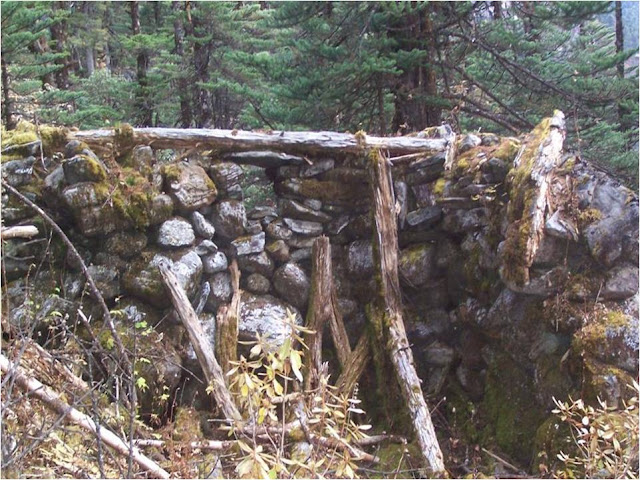
Bunker near Namkha chu

Bunker Bunker near Namkha chu
Bunker near Namkha chu
Namjiang chu with Thagla ridge in the background

Namkha chu (river). Thagla ridge was held by the Chinese.
Tsangdhar dropping zone
Radio set found on the battle field  near the Namkha chu

Friday, January 31, 2020

Wrong person at wrong time

My article Wrong person at wrong time appeared in the Edit Page of The Pioneer
Here is the link...

Nehru made a wrong choice of making Menon Defence Minister. Though the trauma of the 1962 war remains, many things have changed. The CDS should help in neutralising threats

India’s controversial Defence Minister VK Krishna Menon was recently in the news, courtesy a well-researched book, which did not elaborate enough on the implications for the country on account of having a wrong person at the wrong place and at the wrong time. Menon was one of the strangest characters, who appeared on the political scene after independence. PK Banerjee, the Indian chargé d’affaires in Beijing in 1962, who often encountered the haughty politician, wrote in his memoir: “Krishna Menon’s appearance in the Indian political arena was as sudden as it was unexpected... he had his education and was enrolled as a Barrister. He hardly had any legal practice …[but] became a protégé of Palme Dutt, a lawyer and founder member of the British Communist Party.”
How, after independence, he was suddenly nominated as the Indian High Commissioner in the UK is still not clear. A few years later, he came back to India and was made the Defence Minister: “In addition, for all practical purposes, he functioned as Foreign Minister de facto,” noted Banerjee. Menon was certainly brilliant in some ways. He joined the Union Cabinet as a Minister without a portfolio in 1956. It was former Prime Minister Jawaharlal Nehru who appointed him as the Defence Minister in April 1957.
Sixty-three years later, India still suffers because of Nehru’s choice. One of the many blunders that he committed was to stop using the seniority system in the Army, replacing it with the so-called merit-based method of promotion; in fact, posting his favorites in positions where they should have never been. This eventually led to the resignation of the then Chief of Army Staff, General KS Thimayya.
Let’s take a look at a few examples of the wrongs committed by Defence Minster Menon at the time when the Chinese troops attacked India in the North-East Frontier Agency (NEFA) and in Ladakh. It was only after meeting Wing Commander Jag Mohan (Jaggi) Nath, the first of the six officers who have been twice decorated with the Maha Vir Chakra (MVC), India’s second highest war-time military award, that I realised that the outcome of the 1962 war could have been completely different had India used its Air Force.
Nath received his first MVC for his role in reconnaissance missions between 1960 and 1962 over the Aksai Chin and Tibet. His missions proved immensely useful to learn everything about the Chinese military build-up on the Tibetan plateau. Unfortunately, the political leadership (first and foremost the Defence Minister) refused to believe the hard evidence gathered during of his sorties. After one of his missions over the Aksai Chin and Tibet, a message came that Nehru, Menon and their favorite General, Biji Kaul, wanted to be briefed about Nath’s reconnaissance sorties.
Along with former Air Vice Marshal DAM Nanda, the then Deputy Chief of the Air Force, Nath went to South Block to meet Menon. They were waiting outside the Minister’s room when Kaul came and he started talking non-stop: “I know, I know, these fellows [the Chinese] are there. They asked me to throw them back. I can throw them back, not a problem! But they will be back the next day. It has to be planned out properly.”
Nath was surprised that Gen Kaul would speak this way in front of a junior officer: “I was a low-level officer” but [Kaul] continued shouting: “You saw the Chinese soldiers.” I said, “Yes, sir, I saw them.” “OK, go to the Defence Minister”, he finally said.
Nanda and Nath finally landed up in Menon’s office.  Nath recalled: “He did not ask anything”, he just said, “Did you see the Chinese soldiers?” I answered: “Yes sir, I saw them.” “That’s alright, you can go.” That was it. Nath concluded: “There was a total breakdown.”
In a secret report written as he was forced to resign in November 1962, the flamboyant Defence Minister wrote: “China is reported to have the third largest Air Force in the world. This may well be true.” Though Menon was aware of the fuel issue: “[China] had inadequate  fuel capacity in terms of war requirements,” he ignored the findings of the brave airman, who explained: “If we had sent a few airplanes [into Ladakh or NEFA], we could have wiped the Chinese out and everything could have been different in the 1962 war. The political leadership did not believe me that China had no Air Force…” Unfortunately, the then Chief of Air Staff did not have the courage to put his foot down. This led to one of the greatest tragedies in India’s modern history. Mao had bluffed Nehru and it worked.
Another sad story about the 1962 episode was recounted by Lt Col (later Maj Gen) KK Tewari, the Commander of the Signal Regiment of the Corps based in Tezpur (Assam), responsible in the early 1960s for the Tawang sector of the NEFA. Tewari wrote: “On the 19th [October], Brig Dalvi [Commander of the 7th Infantry Brigade] talked to the General Officer Commanding [GOC] at Zimithang [near the Tibet border] on the telephone. He was pleading with the latter to let him move up to a tactically sound defensive position.” He described the existing position along the river where he had been ordered to stay by the Corps Commander [BM Kaul] before his departure for Delhi as a “death trap.” Brig Dalvi was told “not to flap but to obey orders and stay put. He was visibly upset and was very abrupt on the telephone to his boss. He passed the telephone to me.”
Tewari told the GOC that the Chinese were moving down the Thagla Ridge like ants. He could also see at least half a dozen mortars, which were not even camouflaged: “The Chinese could not be there for a picnic, their attack was imminent on a massive scale,” he added. But Dalvi and his men were told that they had been informed by the “higher authorities in Delhi” that the Chinese would not attack …at a time they had already attacked.
Today, though the trauma of the 1962 thrashing remains, many things have changed on the ground. The creation of a post of Chief of Defence Staff should go a long way in overcoming the complete lack of coordination between the three services experienced in 1962. This, however, will not absolve Nehru’s wrong choice of making Menon the Defence Minister, a post he occupied for five crucial years.

Saturday, October 20, 2012

'I was, I am, and will remain anti-Chinese'

Part II of my interview with Brig. Amar Jit Singh Behl.

'I know by experience that they can put a dagger in our back at any time...'
'It was a state of total chaos. Nobody knew what was happening. The fog of war was so thick that nobody could see anything... It is an experience which marked everybody's life.'
Brigadier Amarjit Singh Behl (retd), then a second lieutenant, and his men fought to the end before being taken prisoners of war by the Chinese in the 1962 Indo-China war.
Then a 21 year old, the soldier looks back at a war fought in extremely difficult circumstances and life as a Chinese PoW in this interview to Rediff.com's Claude Arpi.


Did they capture a lot of arms and ammunitions?

They must have; also trucks and other equipment from south of Tawang till the Assam border. As far as the 7 Brigade is concerned, it was totally and entirely an on-foot battle. A battle of the fit men only!
From Tawang to Bridge III, it was between 5 and 7 days walk. You had to be strong and I was strong, I was only 21 years old.
With my boys, I walked from Ziminthang to Tsangdhar in 16 hours only.
On October 21, we were kept near the helipad and I saw the two officers who had been killed near their chopper. I went to the Chinese officers who had interpreters in English and Hindi (while in the Chinese prisoner of war camp, they also would speak Gorkhali and Punjabi).
Chopper of Sq Lrd Sehgal and Major Ram Singh
I asked this officer, I want to bury these officers; after I insisted, he said 'Alright'. With two of my boys, we dug a 2-feet trench and buried Major Ram Singh and Squadron Leader Sehgal. We saluted them.
The next night (October 21-22) we stayed on there.
On the 22nd morning, we walked till Bridge III on the Namkha chu where we stayed for the night. Then we went to Khenzimane (the Indo-Tibet border) and the next day, we reached Le village on Nyamjiang chu in Tibet.
We stayed for two days in Le and moved to Marmang where we spent two nights before being taken in trucks to the PoW's camp near Tsetang in central Tibet.

Read on...

Tuesday, October 2, 2012

Prisoner of War in Tibet

Indian POWs in front of the Potala after their release (April 1963)
Lt. Col. Rattan Singh, Lt. Col. Balwant S. Alhuwalia, Brig. John Dalvi,
Lt. Col. Maha Singh Rikh, Lt. Col. K.K. Tewari
This is the continuation of yesterday's article The Death Trap of the Namkha Chu recounting the story Maj. Gen. K.K. Tewari (Retd.), Commander Signals of the 4 Infantry Division during the 1962 War.

As told by General Tewari:
On the road to Tibet
On October 20, 1962, the Indian prisoners were marched along a narrow track across the Namkha chu (river); later we went up to the Thagla pass (about 15,000 feet). On our way, we passed huge stocks of unfired mortar shells by the sides of our mortar positions, while on the northern side of the ridge, Chinese parties were still bringing up 120 mm mortars on a man pack basis.
After 3 days walk, we reached a place called Marmang in Tibet. From there we were taken in covered vehicles at night. During the journey, the Chinese tried to demoralize us; they would make fun of our army: "You do not even have cutting tools for felling trees. You use shovels to cut down trees." It was true; they had seen our troops preparing their defensive positions near the Namkha chu. There were other remarks such as, "You people have strange tactics. You sit right at the bottom of the valley to defend your territory instead of sitting on a high ground."
We arrived at the PoW camp located at Chongye [in Central Tibet] on 26 October and were accommodated in Lama houses which were all deserted although we could see some activity in the monastery above these houses on the side of a hill. 
We were to spend over five months in this camp, located south west of Tsetang, off the main highway to Lhasa. The prisoners were segregated into four companies: No. 1 Company was all officers, JCOs and NCOs. Majors and Lt Colonels were also separated from the JCOs and men. No. 2 and 3 Companies were jawans of various units. No. 4 Company, consisted only of Gorkhas and was given special privileges, for obvious political reasons. Each company had its own cookhouse where the Indian soldiers selected by the Chinese were made to cook.
In our house, we were four Lt Colonels (Maha Singh Rikh of the 2 Rajputs, Balwant Singh Ahluwalia of the Gorkhas, Rattan Singh of 5 Assam Rifles and myself), while John Dalvi was kept in confinement in Tsetang, a few km away from Chongye.
When we made representations to the Chinese that under the Geneva Convention on PoWs, officers had the right to be with their men, we were told quite bluntly that all these were nothing but imperialist conventions.
I shivered through the first couple of nights but then had a brain wave. I had noticed a pile of husk outside. We asked the Chinese if we could use it. Luckily, they accepted, and we could use the stuff as a mattress as well as a quilt.
For almost a month after our arrival, we were not let out of the room. Each of these lama houses had its own latrine in one corner with an open but very effective system of soil disposal. Unfortunately, by the time we arrived, the `disposal squad' of pigs had itself been disposed off by the Chinese.
There was an English speaking Chinese officer, Lt. Tong who was with us almost throughout our stay in the POW camp. He would come daily and talk to us individually or together. The theme of his talk with the POWs was monotonously the same: the Chinese wanted to be friends and it was only the reactionary government of Nehru, who was a lackey of American imperialism that wanted to break this friendship. "Then why did you attack us on 20 October?" They would try to explain that India attacked first and the Chinese attacked only in self-defense.
On 5 December, we were given for the first time some books and magazines to read. This consisted of Mao's Red Book, some literature on the India-China boundary question and a few Red Army journals. But whatever they were, they were most welcome for me at least. There was something to do at last to occupy the mind. I took notes from the Red Book. It is a pity that our government did not read some of the Mao’s thoughts. I noted them down at that time: "Fight no battle unprepared, fight no battle you are not sure of winning" or "The enemy advances, we retreat; the enemy halts, we harass, the enemy tires, we attack; the enemy retreats, we pursue."
Towards the end of December 1962, the Red Cross sent us one parcel each with two packets in it. One packet had warm clothes, a German battle dress, a pair of long johns, warm vest, muffler, cap, jersey, warm shirt, boots and a towel. The second packet contained foodstuff including a bar of Sathe chocolate, tins of milk, jam, butter, fish, packets of sugar, atta (wheat flour), dal (pulses), dried peas, salt, tea, biscuits, condiments, cigarettes and vitamin pills. It certainly was a very well thought-out list of items.
Perhaps to demoralize us, the Chinese would often play Indian music on the public address system in the camp. One of the songs which was played repeatedly was Lata Mangeshkar's "Aa Ja Re-Main to kab se Khari Is par...." [Come, I have been waiting for so long] This would make us feel homesick.
With my habit of writing a diary, I kept notes as a POW also. In the first week or so, the only available paper to write on, were some sheets of toilet paper in my para jacket pocket. The question was how to keep these papers from being discovered by the Chinese. What I had done was to open the stitching on the ‘belt’ part of the trousers and then slide the folded papers inside. This was how my diary notes on toilet paper could be brought out to India.
One other episode of our stay in the camp is worth recording. One day, towards the end of our stay, at our request we were taken to see the palace and the monastery. It was a shock to see the palace with all the beautiful Buddha statues of all sizes and fabulous scrolls (tankhas) lying broken, defiled and torn and trampled on the ground.
On 25 December, we, the seven field officers were taken in one of the captured Indian Nissan trucks to spend the Christmas morning with Brig. John Dalvi at Tsetang. He was kept all alone and was comfortably accommodated. We had breakfast and lunch with him and were shown a movie. Dalvi had suffered a great deal mentally — being all by himself. He was now better.
The first letters we received from home came only in the third week of February 1963. Some of us, including myself, received parcels of sweets too.
On March 26, we were informed that we would soon be released and taken for a conducted tour of the mainland China. Suddenly we became VIPs, though still held as prisoners. We were given various comforts and given new clothes and shoes.
Before leaving the PoW camp, we asked the Chinese to take us to the graves of our soldiers who had died in our camp. There were seven of them including Subedar Joginder Singh, who had been awarded a PVC. We were told by the Chinese that he had refused to have his toes, which were affected by frost-bite, amputated. According to the Chinese, he had told them that his chances of promotion to Subedar Major would be adversely effected if his toes were amputated. We were told that he died of gangrene.
On 28 March, we left the camp, ironically in an Indian captured vehicle and were driven to Tsetang to pick up Brig John Dalvi and three other Lt. Colonels and five Majors. On 29th March, we were all driven in a bus to Lhasa. On 5 April, we were flown in two IL 14 aircrafts to Xining [Qinghai Province]. After a long tour of China, during which we were shown China’s ‘progress’ after the Communist revolution, we were informed on 27 April that we shall be handed over to India at Kunming on 4 May.
At the handing over ceremony, we witnessed a last surprise performance by the Chinese. Throughout our tour of China, an immaculately dressed Chinese had accompanied us. He was not dressed in cotton padded clothes like all the others. He commanded a lot of respect from the other Chinese. We used to refer to him as the ‘General’. He had a chap trailing around behind him always, helping him with things, offering a chair, a cup of tea, etc. We used to refer to that fellow as the orderly to the General. At the handing over ceremony, however, the person who sat down and signed on behalf of China was the ‘orderly’ and the one who stood behind to pass him the pen to sign was the ‘general’! Such are the Chinese ways!
On May 5, we took off at 9.10 a.m. from Kunming and were scheduled to land at Calcutta at 1.20 p.m. Before reaching Calcutta, the pilot announced that there was some problem with the under carriage not opening and that we might have to crash land, finally we landed ultimately at 2.30 p.m. at Dum Dum with all the fire tenders lined up. It would have been such an irony of fate if we had been killed in a crash landing in India!
In my opinion, the Chinese had prepared their attack for at least 2 or 3 years. I can give you few examples: one day a Chinese woman came and recited some of Bahadur Shah Zafar's poems, much to our delight. The Chinese had certainly prepared for this war most diligently because they had interpreters for every Indian language right in the front line. This Urdu-speaking woman must have lived in Lucknow for a long time. Same thing for one of our guards, though he had not said a single word for 5 months (we used to call him Poker Face), we discovered that he could speak perfect Punjabi when he left us in Kunming.
Their constant brainwashing was to make us accept that we had attacked them.