Sunday, August 24, 2025

Celebrating the Partition of Tibet

On August 20, at noon, Chinese President Xi Jinping, also General Secretary of the Communist Party of China and Chairman of the Central Military Commission, landed at Lhasa Gongkar airport. 
His fourth visit to Tibet was to celebrate sixty years of the Tibet Autonomous Region (TAR).

But what is the TAR?
In 1965, a Tibet Autonomous Region was established to ‘administrate’ Central and Westen Tibet. The area corresponded to the former Ü-Tsang Province and some parts of western Kham. It was a tragedy for the Tibetans because it meant the Partition of Tibet. 
Traditional, ethnic, linguistic Tibet was composed of three provinces Ü-Tsang, Kham and Amdo. Suddenly Tibet was divided in five parts, TAR was one of them, and the remaining parts were amalgamated to the Chinese provinces of Qinghai, Gansu, Sichuan and Yunnan.
Tibet was dismembered. It has always been one of the Dalai Lama’s demands to reunite the five parts of Tibet into one administrative and political entity.
Further, the autonomy promised in the name itself was never given; for the past 60 years the First Secretary of the TAR Communist Party, is not a Tibetan, but a Han. There are very few ethnic Tibetans in the higher echelons of the Party, as we could see in the videos of Xi Jinping’s recent visit.

The Delegation
Xi was accompanied by a large delegation from Beijing.
The Xinhua release observed that Xi was looking at “the long-term stability and high-quality development of Tibet in the new era and the construction of a socialist modern Tibet.”
Xi was greeted by “a cheering crowd when he stepped out of the cabin and waved to the people. Dressed in festive attire, people from different ethnic groups waved red flags and flower bouquets, dancing to joyful rhythms.” 
It looked more a North-Korea type of reception with everyone clapping at unison. Did the Tibetans ‘crowds’ have the choice to not participate? Probably not.
During the following day, the ‘clapping’ continued wherever Xi went. 
During such visits, it is always important to look at the composition of the ‘Central’ delegation; it is the best way to decipher the visit. 
Xi was accompanied by Wang Huning, No 4 in the Party, chairman of the Chinese People's Political Consultative Conference and member of the Politburo’s Standing Committee. Wang’s colleague, Cai Qi, No 5 in the Partry and director of the General Office of the Central Committee who often accompanies Xi in his tours, was present.
Three other members of the Politburo came to Lhasa: Li Ganjie, head of the United Front Work Department along with He Lifeng and Zhang Guoqing; also present was the powerful Minister of Public Security Wang Xiaohong and Gen Zhang Shengmin, a member of the Central Military Commission who replaced the CMC’s strong man Gen Zhang Youxia, who had accompanied Xi in 2021. Why Gen Zhang did not come is probably because Xi and Zhang have lately not seen eye to eye. 
More importantly and hardly noticed was the presence of Hu Chunhua, a former Party Secretary in Tibet who was at one time Xi’s heir apparent. After being apparently disgraced, he seems to be back in favour; his eventual return needs to be followed closely. Incidentally, Hu is one of the very few Han leaders who can speak Tibetan.
Apart from Gen Zhang Youxia, Gen Wang Haijiang who since August 2021 has been commanding the Western Theatre Command opposite India, was missing in action. Earlier Wang had a long career in Tibet. Has he been purged? Everything is possible in China today. Also missing, Lt Gen Wang Kai, the commander of the Tibet Military District; only the TMD’s Political Commissar Lt Gen Yuan Honggang was seen around. 
These absences are intriguing.

The Fourth Visit
It was Xi’s fourth visit to the Roof of the World. 
In June 1998, then deputy secretary of the Fujian Provincial Party Committee, he came to Tibet for the first time to take back a first batch of Tibet Aid cadres in Fujian and bring a second batch. 
In 2011, Xi Jinping, then Vice-President, led a delegation from the Central Committee to attend the celebration of the 60th anniversary of the so-called Peaceful Liberation of Tibet. He then said “the ecological protection of Tibet is an important issue, and it is necessary to protect Tibet's blue sky.”
His next visit was in 2021. From July 21 to 23, the General Secretary was in Tibet “to congratulate the 70th anniversary of the peaceful liberation of Tibet and visit and comfort the cadres and masses of all ethnic groups in Tibet.”
He also visited Nyingchi Prefecture, near the Indian border where he inspected the ecological environment protection of the Yarlung Tsangpo River and the Nyang River basin. Later, he travelled by train to Lhasa.

The Program
President Xi met six representative groups: people of ethnic groups and ‘all walks of life living in Lhasa’; then cadres who are posted in Tibet; next were judicial workers and police officers, followed by ‘grassroots role models’ and ‘patriotic members of the religious circles’, finally, he had a photo session with military officers ranked colonel and above.
During all these sessions, Xi looked tired, sometime haggard (while the other leaders visited the six Cities/Prefectures outside Lhasa, Xi remained in the capital to rest).  
During his meeting with the religious leaders, Xi had a brief encounter (not more than 5 seconds) with Gyaltsen Norbu, the Chinese selected Panchen Lama. It was the only time that the latter was seen during the visit, which probably means that Norbu will not play an important role in the selection of the next Dalai Lama as he was not given any prominent role during the visit. 
Wang Huning and Cai Qi attended all the meetings.

The Work Report
Xi was invited to listen to the work report of the TAR government.
During his interaction, Xi stressed that “Tibet should fully implement the party's strategy of governing Tibet in the new era, adhere to the general tone of steady progress, implement the new development concept in a complete and accurate manner, solidly promote high-quality development, continue to grasp the four major events of stability, development, ecology and strong edge, and strive to build a socialist modern new Tibet that is prosperous, civilized, harmonious and beautiful.”
The usual  jargon. Do the Tibetans really believe this? It is doubtful but do they have a choice?
The Chinese President then made a summary of the Party’s successes for 60 years: “its economic and social development has achieved remarkable progress, leading to profound changes in the plateau region.” It cannot be denied that materially Tibet has changed.
Xi explained Beijing’s policies: “Governing Tibet, ensuring its stability and promoting its prosperity must begin with maintaining political and social stability, ethnic unity and amity among different religions, calling for further advancing the building of a community for the Chinese nation,” Xi asserted. Stability is a recurrent issue in Xi’s discourse.
Xi then emphasized the need to guide “Tibetan Buddhism in adapting itself to socialist society.” He did not use the usual term of ‘sinisation’ of Tibetan Buddhism, but the result will be the same, erasing all traces of Indian influence on the propagation of Buddhism in Tibet.
He also asserted that Tibet (now called ‘Xizang’ by the Chinese government) “needs to develop competitive plateau industries based on local conditions, with a particular focus on industries of agriculture and animal husbandry with local features, as well as the clean energy sector.” This is being done on a large scale, completely changing the landscape of the Roof of the World and worse, changing the demography of the plateau by bringing lakhs of migrants from China.
Finally, he mentioned the construction of a series of hydropower plants on the Yarlung Tsangpo/Brahmaputra which cause deep anxiety in India: “major projects such as the hydropower project in the lower reaches of the Yarlung Tsangpo River and the Sichuan-Xizang Railway project in a vigorous, orderly and effective manner.”
He spoke of the promotion of ecological conservation: “to make coordinated efforts to cut carbon emissions, reduce pollution, expand green development, and pursue economic growth, so as to protect the roof of the world and the water tower of Asia."
It does not make practical sense. One can’t destroy and protect the environment at the same time.


The Return of Zhao Zongqi
During the Gala reception in the evening, India was in for a surprise: Gen Zhao Zongqi, the artisan of the Doklam confrontation (2017) and the Eastern Ladakh Chinese intrusions in 2020, was posturing, seated in full uniform in the row behind the top leader. Gen Zhao has retired in December 2020 as Commander of the Western Theatre Command after spending two decades posted in Tibet; after taking the command of this sensitive area facing India, he created havoc in the Sino-Indian relations by trying to occupy five places in Ladakh. So, why was he invited? 
Probably to show India, that the border issue is far from being settled, despite the recent meeting of the Special Representatives in Delhi.
This visit (the shortest of Xi’s four visits) is ominous for the Tibetans as well; gaining any type of autonomy in the present circumstances is utopic.
And the question remains: are the Tibetans allowed to not clap?


Gen Zhang Shengmin member CMC in Lhoka


Stage managed reception for Xi Jinping in Lhasa Airport


Saturday, August 2, 2025

Finding the Future Dalai Lama: The Role of the Ganden Phodrang Trust

 My interview Finding the Future Dalai Lama: The Role of the Ganden Phodrang Trust is on YouTube

In this compelling interview with Ishan Dhar, eminent historian and Tibetologist, Mr Claude Arpi—currently a Distinguished Fellow at the Centre of Excellence for Himalayan Studies, Shiv Nadar University—delves into the complex dynamics of the forthcoming succession of His Holiness the 14th Dalai Lama. He offers insights into the role of the Ganden Phodrang Trust, its composition, and the potential challenges it may encounter in navigating this critical transition.


Thursday, July 10, 2025

Dalai Lama@90

My article Dalai Lama@90 appeared in The Times of India

 The Tibetan spiritual leader’s succession could see nasty exchanges between India and China. That’s why Dalai should quickly provide details about the process of finding his successor

Here is the link...

The Dalai Lama is 90 years old.
What an incredible destiny for Lhamo Dhondrub, a boy born in Taktser, in a remote hamlet of Amdo province in north-eastern Tibet; at the age of four Tenzin Gyatso was recognized as the reincarnation of the Thirteenth Dalai Lama and for the Tibetans, the incarnation of Avalokiteshvara, the Bodhisattva of Compassion.
The world is in turmoil today; time seems to have accelerated and violence has reached every corner of the planet. In the midst of all this, the Dalai Lama continues to preach love and compassion to other human fellows. 
He was hardly 15-years when the Chinese People’s Liberation Army walked unhindered onto the Tibetan soil. A new ideology, less compassionate than the Buddha Dharma which had come from India 12 centuries earlier, had according to Mao, ‘liberated’ the Land of Snows. A few months later, the young Dalai Lama was officially enthroned as the spiritual and temporal head of the Tibetan State. 
In March 1959, following a mass uprising in Lhasa, the Dalai Lama had to flee his motherland and take refuge in India where he still lives in Dharamsala, Himachal Pradesh. 
Apart from possessing an extraordinary charisma, why does the Dalai Lama matter so much in today’s world?
I had the good luck (or good karma) to meet him over the years. First in July 1972 in Dharamsala: after this first encounter, I began to understand something that I had not so far realized: the poor Tibetan refugees and their leader had a different set of values than westerners have. 
In seeing this ‘simple monk’, as he prefers to call himself, I saw that inner strength and the power of compassion are qualities which are practically unknown today in the world, but he embodies a wisdom which was part of the spiritual and cultural heritage of a nation that had spent most of its time looking ‘within’.
Though the Dalai Lama reached India in 1959, the world’s interest in Tibet began in the 1970s only, when the Tibetan leader started travelling abroad.
In May 2011, he took a radical decision: he relinquished his secular power, offering it to the people of Tibet, who thereafter started electing their own ‘political’ leader. Today, a Sikyiong or President runs the Tibetan administration from Dharamsala.
On September 24, 2011, the Dalai Lama released a long statement about his succession, he mentioned two options: a traditional reincarnation (leaving written instructions on how to find the reincarnation) or an ‘emanation’, which would mean the transfer of his consciousness and knowledge into a selected young boy (or girl). 
In the same message, the Tibetan leader wrote that at the age of 90, he would re-evaluate whether the institution of the Dalai Lama should continue or not.
It is what he did on July 2, when he reaffirmed that the Institution was there to stay. A few months ago, in a book Voice for the Voiceless, the Tibetan leader had clarified: “Since the purpose of a reincarnation is to carry on the work of the predecessor, the new Dalai Lama will be born in the free world (outside China).”
It was certainly a shock for Beijing who expects to control the succession process …and the next Dalai Lama.
The recent statement is however does not give details about the succession of the Dalai Lama. In 2011, he had mentioned two possibilities; today he seems to have opted for the traditional reincarnation which often means a gap of 20 years or so before the new Dalai Lama is able to lead his people. 
The possibility of an emanation seems to have been dropped; it would have cut the time gap (till the Dalai Lama reaches majority) which can be used by China to interfere during the regency. 
This period has often been used in the past by China to intervene in Tibet’s religious affairs. Many Tibet watchers believe that this gap is too dicey; Buddhism should adapt to the modern world and a new system of succession should be devised, but ultimately, it remains the choice of the Dalai Lama alone.
Beijing was quick to react to the July 2 statement; China’s Foreign Ministry spokeswoman Mao Ning told the press: “The Dalai Lama’s reincarnation must follow the principles of domestic recognition and approval by the central government, in line with religious traditions and laws.” 
It is ironic that an atheist State which believes that “Religion is Poison” can be so affirmative on an esoteric issue like soul migration. 
When Minority Affairs Minister Kiren Rijiju asserted that the decision would only be taken by the established institution and the Dalai Lama himself, and “nobody else”, Beijing started threatening.
The Ministry of External Affairs then clarified that it “does not take any position or speak on matters concerning beliefs and practices of faith and religion.” Later, the Indian Prime Minister wrote from Argentina: “I join 1.4 billion Indians in extending our warmest wishes to His Holiness the Dalai Lama on his 90th birthday.”
Beijing will certainly not leave it at that, exchanges may soon become nastier and could end with two Dalai Lamas? But what legitimacy would the Communist one have? 
The point remains that a world in turmoil needs a Dalai Lama; we can only pray for a smooth succession and hope that Dharamsala will provide more details on the process in the coming months.

Succession stakes on the roof of the world

My article Succession stakes on the roof of the world appeared in The New Indian Express

No wonder that during the last few weeks, a lot of excitement and expectation could be felt around Dharamsala
.

Here is the link...

In May 2011, the Dalai Lama decided to relinquish his secular power and offer it to the people of Tibet, who could thereafter elect their own ‘political’ leader. Today, a Sikyiong or President runs the Tibetan administration from Dharamsala in Himachal Pradesh, where the Dalai Lama lives since 1959.
On September 24, 2012, the Dalai Lama released a long statement about his succession, he mentioned two options: a traditional reincarnation (leaving written instructions on how to find the reincarnation) or an ‘emanation’, which would mean the transfer of his consciousness and knowledge into a selected young boy (or girl). 
In the same message, the Tibetan leader wrote that he would consult senior lamas: “When I am about ninety I will consult the high Lamas of the Tibetan Buddhist traditions, the Tibetan public, and other concerned people who follow Tibetan Buddhism, and re-evaluate whether the institution of the Dalai Lama should continue or not.” During the last few weeks, a lot of excitement and expectations could be felt around Dharamsala. 
Finally on July 2, as promised in 2011, a statement was released reaffirming that the Institution of the Dalai Lamas will continue. The Tibetan leader also reiterated: “…responsibility for doing so will rest exclusively with members of the Gaden Phodrang Trust, the Office of His Holiness the Dalai Lama;” it will be “the sole authority to recognize the future reincarnation; no one else has any such authority to interfere in this matter." It was a clear message to China.
Earlier this year, the Tibetan leader released a book, Voice for the Voiceless, in which he asserted: “Since the purpose of a reincarnation is to carry on the work of the predecessor, the new Dalai Lama will be born in the free world (outside China) so that the traditional mission to be the voice for universal compassion, the spiritual leader of Tibetan Buddhism, and the symbol of Tibet embodying the aspirations of the Tibetan people, will continue.”
It was certainly a shock for Beijing who expects to control the succession process …and the next Dalai Lama.
After July 2 Statement, Beijing was quick to react; The Global Times asserted: “At its core, his [the Dalai Lama’s] intention remains the same -- to deny the traditional religious rituals and historical conventions that have governed the Dalai Lama reincarnation system for centuries, and to manipulate the reincarnation process for his own purposes.”
Of course, it is strange that an atheist State which believes that “Religion is Poison” (as per Mao Zedong’s words) can be so affirmative on such an esoteric issue like reincarnation. 
In recent years, the Dalai Lama’s succession has been widely debated. ‘Reincarnation’ is of course the fascinating topic at a time when everything is ‘scientifically’ decided (and soon by Artificial Intelligence).
However, it entails a 20-year gap (till the Dalai Lama reaches majority) in spiritual governance, a period often used in the past by China to intervene in Tibet’s religious affairs. Many believe that this gap is too risky; Buddhism should adapt to the modern world and a new system of succession should be devised, but ultimately, it remains the choice of the Dalai Lama alone and certainly not of any Marxist government to decide where the Dalai Lama’s soul will migrate.
On June 6, President Xi Jinping summoned had the Panchen Lama, a young monk imposed by Beijing as the second hierarch after the Dalai Lama. Xi requested him to “play an even better role in forging a strong sense of community for the Chinese nation, systemically promoting the principle that religions in China must be Chinese in orientation.”
In plain words, it means the ‘sinization’ of Tibetan Buddhism and eradication of the Indian origin and influence in the spread of Buddhism on the plateau.
The Dalai Lama’s recent statement must have been a relief for the 200 journalists and more importantly the 120 senior lamas representing different schools of Tibetan Buddhism and the Bon faith, assembled in Dharamsala; the latter unanimously welcomed the Dalai Lama’s message; though not providing details, the statement made it clear that it is the sole responsibility for the Dalai Lama’s succession lies with the Tibetan leader’s own Office. 
 

‘Beijing Cannot Select Dalai Lama’s Successor’

A recording for the Gist

‘Beijing Cannot Select Dalai Lama’s Successor’ by Ramananda Sengupta

Even if China and the Tibetan clergy select rival Dalai Lamas, Claude Arpi felt a spiritual schism is unlikely. “The Tibetan people will not accept a Chinese-appointed figure,” he said


The Planet needs a Dalai Lama

My article The Planet needs a Dalai Lama appeared in The Week

Here is the link...

In the midst of the present planetary chaos, one man preaches love and compassion to other fellow human beings. This man is Tenzin Gyatso, the Dalai Lama of Tibet, who turns 90 on July 6.
For the last 66 years, he lives as a refugee in India where he is considered the leader of all the Tibetans (including those in the Land of Snow), as well as of nearly one million Indian Buddhists in the Himalayan belt, from Ladakh to Arunachal Pradesh.
Following an uprising in Lhasa on March 10, 1959, the Dalai Lama left Lhasa in the dead of night in dramatic circumstances. A week later, he reached Lhuntse Dzong, a couple of days march from the McMahon Line, the border between India and Tibet, from where he wrote to the Indian Prime Minister, seeking asylum in India.
Four days later, he reached the first Indian post at Chuthangmu, north of Tawang, then part of Kameng Frontier Division of the North East Frontier Agency (NEFA). A letter from Nehru was waiting for him: “We shall be happy to afford the necessary facilities for you, your family and entourage to reside in India. The people of India who hold you in great veneration will no doubt accord their traditional respect to your person.”
Since that day, the Indian Government and people have considered the Dalai Lama an honoured guest in the Land of the Buddha.
Was it a coincidence, but soon after his arrival in India, the Indo-Tibet border became tense? At the end of August 1959, a first serious incident took place at Longju in Subansiri Frontier Division? Several Indian jawans lost their lives. This marks the beginning of protracted dispute between India and China about the northern borders of India; it still continues today, as we have witnessed in Ladakh in May 2020.
For the Eastern sector, there was an agreed map of the border (known as the McMahon Line); it was signed in 1914 between British India and the government of free Tibet in Lhasa. After walking onto the Tibetan plateau in 1950, Beijing not only refused to recognize the 1914 agreement, but it also started to claim the entire NEFA till the foothills in the South, as its territory. 
In October 1962, a war erupted when the People’s Liberation Army marched into the Tawang sector; the very place where the Dalai Lama had entered three years earlier. Was it again a coincidence? The conflict rapidly spread to other areas like Walong in the Lohit Valley and Ladakh. The scar it left on India’s psyche still endures.
For years, the young Dalai Lama lived peacefully in Dharamsala in Himachal Pradesh taking care of the education of the young Tibetans and preserving their culture; it is only in 1973 that the Tibetan leader traveled to Europe for the first time; during the following decades, he would be instrumental in giving a concrete shape to the prophecy of the Great Indian Master, Guru Padmasambha: "When the iron bird flies and horses run on wheels, the dharma will come to the land of the red faces." 
As the Dalai Lama tirelessly traveled over the five continents to spread the Buddha’s message of Love and Compassion, his focus widened and he became a global leader.
A turning point was an address to the US Congressional Human Right's Caucus in Washington in 1987 when he presented his Five Point Peace Plan; the first point was: “I propose that the whole of Tibet, including the eastern provinces of Kham and Amdo, be transformed into a zone of Ahimsa.”
It was an interesting proposal for India as a demilitarized Tibet could have been a solution to the border dispute. But the Tibetans were soon told by Beijing that it was unacceptable to China. 
In the following years, the Tibetan leader continued to travel abroad and to India’s Northern frontiers where he brought a new life to Tibetan Buddhism. 
Interestingly, the Dalai Lama always refers to his faith as “the Nalanda Tradition”, simply because several Indian gurus of the ancient Nalanda University visited Tibet to teach the Buddha Dharma. 
This old relation is especially important at a time when all the contacts between the Indian Himalaya and Tibet have been cut and the Tibetan monasteries in Tibet are subjected to what the Communist party calls the ‘sinization of Tibetan Buddhism’, which in fact aims to obliterate the Indian origin of the Buddha and his Dharma to replace it by the diktats of Karl Marx.
Today, the Dalai Lama’s followers are worried about his succession; what will happen if he departs for The Heavenly Fields? Will a Fifteen Dalai Lama replace him? Who will select him? These are still unanswered questions.
The Dalai Lamas traditionally ‘reincarnate’ in a young boy, who is then groomed to take-over as the next Dalai Lama.
The fact that the Dalai Lama has recently announced that his successor will be from outside China, makes Beijing extremely nervous; the Communist regime fully realizes the importance of controlling the next Dalai Lama. 
Already in February 2023, The Global Times, the mouthpiece of the Communist Party, asserted that religious rituals for the selection of a new lama “have [for centuries] been supervised by the Chinese Central Government”; this is simply not true.
The Global Times also hides the fact that the boy recognized by the Dalai Lama as the Panchen Lama (the second highest hierarch in the Dalai Lama’s Yellow Hat School) was arrested in 1995 and 30 years later, he remains in the custody of the Chinese government somewhere in China. 
India is deeply concerned by the Dalai Lama’s succession as he has nearly one million followers in the Indian Himalaya …and Buddhism is born in India, not in China. It is also a fact that the Tibetan leader’s presence has always been a stabilizing factor for the northern borders. 
Today, in the midst of wars and conflicts, the planet needs a Dalai Lama; we can only pray for a smooth succession.

The Importance Of Being The Dalai Lama

My article The Importance Of Being The Dalai Lama appeared in Rediff.com

Here is the link...

One can only sincerely wish the Dalai Lama a very long life at the service of world peace.
His presence is much required today on the planet, notes Claude Arpi, who has known His Holiness for more than half a century.


The Dalai Lama will be 90 years old on July 6.

Personally, it is an occasion for me to look back and realise the luck (or good karma) that I have had to meet him over the years. Let me start at the beginning of my 'Tibetan adventure.

The year was 1971. That summer I decided to visit Afghanistan during my university holidays.

In July, while I was in Kabul I heard some hippies speaking about what they called a 'cool' place called 'Manali.' I was also told that 'cool' Tibetan refugees were living there.

I did manage to come to India the very next year, and though I could hardly speak English, I decided to make the trip to Manali. I reached Palam airport early in the morning, jumped into a cab for the old Delhi railway station and boarded the first available train (and then bus) to the North.

It was on the road between Kulu and Manali that I saw my first Tibetan. This encounter was to change my life.

In India or in Tibet for that matter, everything that happens can be explained by one word -- 'karma.' It must have been my karma to meet this Tibetan!

The more I met with these peculiar people, the more I became interested in their way of being as well as their history.

They had lost everything: Their country, their wealth, very often members of their family and still they could stand on the side of the road that they were building and smile.

How could someone educated in a Cartesian country with a modern utilitarian education understand this bizarre phenomenon?

We are taught that if one loses everything important and dear in life, one must be sad and grim-faced, there are no two ways about it.
In the beginning I wondered whether the experience of the Chinese invasion and the destruction of their thousand-year-old civilisation had been too much for them and that something had cracked in their brains. It was not the case.

My First Encounter in July 1972

While in Dharamsala, Himachal Pradesh, I met their leader, the Dalai Lama and I began to understand something that I had not so far understood: These people had a different set of values than the Westerners have.

In seeing this 'simple monk', as he prefers to call himself, I saw that inner strength and the power of compassion are qualities which are practically unknown today in the world.

This monk seemed the embodiment of a wisdom which was part of the spiritual and cultural heritage of a nation that had spent most of its time looking 'within', into the heart of man.

World Interest in Tibet

Today there is an explosion of interest in Tibet.

The Dalai Lama is central to this interest, especially at a time when the planet is plunged in violence and chaos.

This interest has multiplied after the Dalai Lama reached India in 1959 and was granted asylum by the Government of India.

Suddenly Tibet was no more the last 'hidden' kingdom of the planet and the 'God-King' could be approached.

The Dalai Lama and Auroville

In recent years, my main contact with the Tibetan leader has been through Auroville.

Since January 1973, when the Dalai Lama spent two days in Auroville and Pondicherry (on January 17, he met the Mother in the Sri Aurobindo Ashram), the exchanges between the community of Auroville and the Tibetan refugees and their leader have been frequent and regular.

In 1978, a group of us met the Dalai Lama in Dharamsala where he encouraged us to start a Tibetan Pavilion in the International Zone of Auroville.

In December 1991, the Pavilion of Tibetan Culture officially became part of Auroville Foundation thanks to a resolution of the Auroville governing board under Dr Karan Singh and Dr Kapila Vatsyayan, the famous art and Tibetan scholar.

In January 1993, His Holiness agreed to be the Patron of the Pavilion.

Later in the year, the Dalai Lama came to Auroville to lay the foundation stone of the Pavilion and in January 2009, he returned to inaugurate the building.

Some anecdotes

Fifty-three years after my first encounter with the Dalai Lama in Dharamsala, what can one say about him?

Too many things, of course, to fit into an article, but his sense of humour, his down-to-earth attitude, and his capacity to bring together opposites in a world often torn apart by different faiths, different religions or different cultures, stand out.

When I met him for the first time in 1972, he was truly an 'ordinary monk' walking freely out of his 'palace' (Z+ security cover was not yet necessary at that time); he used to visit construction sites or the main temple (known as Tsuglhakang) for prayers or pujas.

He then had a Land Rover that he would share with his two teachers, Ling and Trichang Rinpoches.

In the early 1970s, there were hardly two and three cars in McLeod Ganj (then known as 'Upper Dharamsala'); of course, there were no traffic jams like today.

Whenever Tibetans would hear the sound of a car approaching, they would bend low in reverence, not daring to look up; it was sure to be either 'His Holiness' or one of his gurus.

To see such devotion was deeply touching for my Cartesian mind.

I have to admit that during that first year, I did not ask for a private audience as my English was more than limited and I would not have known what to say.

The Dalai Lama travelled for the first time to Europe in September/October 1973. I managed to go to the airport in Geneva (he was to arrive from Italy where he met the Pope).

There was hardly anybody to receive him; however I was thrilled when he told one of his attendants: "I have seen him in Dharamsala".

Unfortunately, the photos of his arrival in Geneva have been lost.

His sense of humour

In the late 1990s, I had gone to Hunsur, Karnataka to interview him for my first book The Fate of Tibet, (he granted me three long interviews to clarify some points of Tibet's modern history).

One senior police officer who was not given a room near the Tibetan leader was very upset; he told the Dalai Lama's attendants that he would take revenge.

I arrived just then for the interview. He stopped me from going to meet the Dalai Lama; it took a good half an hour for the Dalai Lama's secretaries to finally 'negotiate' my release.

During all this time the Dalai Lama was waiting in his apartments.

When I reached I profusely apologised; he then said: "It is fine, they [the police] are aware that most of the French are terrorists" and he kept on laughing!

A couple of years later, The Fate of Tibet was released by him in Delhi; once the function ended, I bragged and several times said 'Thuk-je-che' (Thank you); he immediately cut me: "You don't know Tibetan. I know as much French as you know Tibetan, Merci beaucoup monsieur."

My face went red.

Tawang


During the series of interviews, I once asked the Dalai Lama if the Tibetan government had not committed a great blunder at the time of India's Independence, when it refused to immediately acknowledge the 1914 border agreement and the Simla Convention.

He thought about it and told this this story which took place just before independence, he said: "About Mon (Tawang) in NEFA area, I remember that around 1945/45, at that time I had no responsibility. I heard and noticed that a special Tibetan national assembly took place as a British [Indian] mission came to see the Kashag [Tibetan cabinet] in the Potala.

"Mr H. Richardson [later head of the Indian Mission in Lhasa] was one of them. From my window in Potala, I noticed that and I was told that the Tibetan national assembly was taking place; the session was going on because the British army wanted to enter Tawang area and the Tibetan government wanted to protest. ...

"At that time, because Tawang and these areas had been in possession of the Tibetans [in the past], and the [national assembly] wanted to hold on to these areas although in 1914 at the Simla Convention the border had already been demarcated and [the McMahon Line] was agreed by the Tibetan government.

"But most of the Tibetans did not know that (laughing). But they did not know that the government had already decided in 1914 [about the border between Tibet and India].

"So they did not know what had been decided [in 1914, i.e. the McMahon Line]." The Dalai Lama could stop laughing, "such a wonderful government!" he repeated.

This truthfulness, this straightforwardness, this capacity to be able to make fun of oneself or those close is extremely rare for a head of a State.

One can only sincerely wish the Dalai Lama a very long life at the service of world peace. His presence is much required today on the planet.

The High Stakes In Dalai Lama's Succession

My article The High Stakes In Dalai Lama's Succession appeared in Rediff.com

Here is the link...

On July 2 or July 6, the Dalai Lama will reveal his mind on his successor.
This makes Beijing extremely nervous as the Communist regime fully realises the importance of controlling the next Dalai Lama, points out Claude Arpi.

Nobody will disagree that the world is in turmoil; time seems to have accelerated on every continent and violence has reached every corner of the planet.

In India, we witnessed a four-day war between India and Pakistan, triggered by constant acts of terrorism from Islamabad; in the Middle East, a bloody war has been going on for months between Israel and Hamas; now a new conflict has erupted between Iran and Israel while there is no solution in view for the Ukraine-Russia war; yet while another bloody conflict may now take place between China and Taiwan for control of the rebel island.

In the midst of all this, a man preaches love and compassion (Ahimsa and Karuna) to other human fellows.

For 66 years, he lives as a refugee in India, his name is Tenzin Gyatso, he is the 14th Dalai Lama of Tibet, but also the leader of one million Buddhists from the Indian Himalayas (from Ladakh to Arunachal Pradesh) as well as several million Buddhists from every continent.

This man will turn 90 on July 6.

His followers are worried about his succession; what will happen if he departs for The Heavenly Fields? Will a 15th Dalai Lama replace him? Who will select him? These are still unanswered questions.

According to The Deccan Chronicle: 'The Dalai Lama will issue a message on July 2, days ahead of his 90th birthday and a hugely anticipated decision as to whether he will have an eventual successor.'

Earlier this year, the Tibetan leader released a book, Voice for the Voiceless, in which he asserted: 'Since the purpose of a reincarnation is to carry on the work of the predecessor, the new Dalai Lama will be born in the free world (outside China) so that the traditional mission to be the voice for universal compassion, the spiritual leader of Tibetan Buddhism, and the symbol of Tibet embodying the aspirations of the Tibetan people, will continue.'

It was certainly a shock for China who expects to control the succession process ... and the next Dalai Lama.

The Background


On October 7, 1950, Chinese troops crossed the Upper Yangtze and began their 'liberation' of Eastern Tibet, then known as Kham province.

Ten days later, after sporadic battles, Chamdo, the capital of Kham, fell and Ngabo Ngawang Jigme, the Tibetan Governor, surrendered to the Chinese without fighting.

It would take more than two weeks for the information to filter out.

Till October 25, the Tibetan government in Lhasa knew nothing, the Indian government had heard nothing, and the Chinese were keeping quiet; other governments, depending on India for news, were not 'informed' either.

On October 26, a brief communique of the New China News Agency (Xinhua) broke the news: 'People's army units have been ordered to advance into Tibet to free three million Tibetans ...the conquest of Tibet was a 'glorious task' which would put the final seal on the unification of Communist China.'

Hardly three weeks later in Lhasa, the Gods spoke through the Nechung State Oracle: 'Make Him King'.

Thus, Tenzin Gyatso was enthroned as the 14th Dalai Lama of Tibet at the young age of 15; the 'God King' became the temporal and religious leader of Tibet.

Nine years later, under mounting Communist pressure, the Dalai Lama had no choice but to take refuge in India, where he was received as an honoured guest by the Government of India.

In the early 1970s, the Tibetan leader started travelling all over the world; for more than five decades he would be instrumental in giving a concrete shape to the prophecy often attributed to Guru Padmasambha: 'When the iron bird flies and horses run on wheels, the dharma will come to the land of the red faces.'

The Dalai Lama tirelessly traveled to spread the Buddha's message of Love and Compassion.

Origin of the reincarnation system


Dusum Khyenpa, the First Karmapa Lama, was a disciple of the Tibetan master Gampopa, himself a disciple of the famous yogi and poet Milarapa.

The First Karmapa is said to have attained enlightenment at the age of 50; he then became known as the Karmapa.

The Second Karmapa, Karma Pakshi (1204-1283), was recognised as the reincarnation of Dusum Kyenpa, who had predicted the circumstances and time of his rebirth.

This is the origin of a system which has been prevalent in Tibet since then.

The Dalai Lama is 90 years old; due to his age and health, he has practically stopped going abroad; he remains most of the time in his residence in the Himalayan hill station of Dharamsala, north of Delhi.

In recent years, his succession has been widely debated in the media, the diplomatic and other circles.

Dalai Lamas 'reincarnate' in a young boy, who is then groomed to take over as the next Dalai Lama.

'Reincarnation' is, of course, the fascinating topic at a time when everything is 'scientifically' decided (and soon by Artificial Intelligence).

However, it entails a 20-year gap in spiritual governance, a period often used in the past by China to intervene in the Roof of the World's religious affairs; it does not seem to be a system adapted to our quick-changing world.

Traditionally, the Dalai Lama had two roles, one temporal (as head of the Tibetan State, though today in exile) and the other spiritual (guiding millions of Tibetans, but also Himalayan and foreign followers of Tibetan Buddhism).

In May 2011, the Tibetan leader decided to relinquish his secular power and offer it to the people of Tibet, who could thereafter elect their own 'political' leader.

Today, a Sikyiong or president runs the Tibetan administration from Dharamsala.

A few months later, on September 24, 2011, the Dalai Lama released a long statement about his succession, he mentioned two options: A traditional reincarnation (leaving written instructions how to find the reincarnation) or an 'emanation', which would mean the transfer of his consciousness and knowledge into a selected young boy (or girl).

In the same message, the Tibetan leader wrote that it was entirely his decision, though he would consult senior lamas: 'Reincarnation is a phenomenon which should take place either through the voluntary choice of the concerned person ... Therefore, the person who reincarnates has sole legitimate authority over where and how he or she takes rebirth.'

The 2011 statement further explained: 'When I am about ninety I will consult the high Lamas of the Tibetan Buddhist traditions, the Tibetan public, and other concerned people who follow Tibetan Buddhism, and re-evaluate whether the institution of the Dalai Lama should continue or not.'

It is what his followers (and probably the Indian Government too) are expecting to happen on July 2 or 6.

This makes Beijing extremely nervous as the Communist regime fully realises the importance of controlling the next Dalai Lama.

Already in February 2023, The Global Times, the mouthpiece of the Communist party, asserted: 'Recognition of new Dalai Lama must be conducted in China'.

It emphasised that the religious ritual for the selection of a new lama 'has been supervised by the Chinese Central Government and conducted within Chinese territory since the late 13th century', omitting that in the past 'religious rituals' (if any) for the recognition of the Dalai Lamas were conducted by Tibetans, not by the Communist party.

But half truths and blatant lies in Beijing's narrative continue: The Global Times dishonestly omits that the boy recognised as the Panchen Lama by the Dalai Lama was arrested and more than 30 years later is still in the custody of the Chinese government somewhere in China.

The Panchen Lama was the second highest lama in the Yellow School of Tibetan Buddhism.

Xi Jinping meets the Chinese Panchen Lama

On June 6, China's President Xi Jinping summoned Gyaltsen Norbu, the Panchen Lama imposed by Beijing, to Zhongnanhai, the official compound where live the Communist party's senior leaders.

Xi requested the young lama 'to make greater contributions to promoting ethnic unity and religious harmony.' The Chinese leader called upon the young lama to 'play an even better role in forging a strong sense of community for the Chinese nation, systemically promoting the principle that religions in China must be Chinese in orientation'.

In plain words, it means the 'Sinization' of Tibetan Buddhism and eradication of the Indian origin and influence in the spread of Buddhism on the plateau.

Many believe that the times of Dusum Kyenpa have gone and a gap of 20 years in spiritual governance is too risky; Buddhism should adapt to the modern world and a new system of succession should be devised, but ultimately, it remains the choice of the Dalai Lama alone and certainly not of any Marxist government to decide on this highly esoteric issue.

It remains that the planet needs a Dalai Lama.

« La succession du dalaï-lama n’est pas qu’une question spirituelle, c’est un levier géopolitique »

My article in Le Monde
Claude Arpi, spécialiste du Tibet :
« La succession du dalaï-lama n’est pas qu’une question spirituelle, c’est un levier géopolitique »

Here is the link...

Alors que le chef spirituel bouddhiste doit fêter ses 90 ans le 6 juillet, l’historien et tibétologue appelle, dans une tribune au « Monde », la communauté internationale à ne pas rester passive face à la mainmise de la Chine sur le Tibet.

Les célébrations pour le 90e anniversaire de Tenzin Gyatso ont débuté cette semaine à Dharamsala, en Inde, et une prise de parole du quatorzième dalaï-lama est attendue mercredi 2 juillet. Figure mondiale de la paix, défenseur infatigable de la non-violence, il incarne depuis plus de soixante ans la mémoire vivante du Tibet libre et la conscience spirituelle de millions de bouddhistes. Mais cet anniversaire symbolique met en lumière une question cruciale et largement ignorée du grand public : sa succession.

Traditionnellement, le dalaï-lama est reconnu comme la réincarnation d’un bodhisattva – un être éveillé voué à la compassion envers les êtres humains. Sa désignation ne relève ni du hasard ni d’une élection politique, mais d’un processus religieux complexe fondé sur la reconnaissance de signes spirituels. Cette transmission a toujours été assurée par les autorités religieuses du Tibet.

... 


Saturday, June 14, 2025

China is preparing the Dalai Lama’s succession

Gyaltsen Norbu, the Chinese Panchen Lama visits the Indian Border
north of Upper Subansiri (Arunachal)

China is at it again: “Recognition of new Dalai Lama must be conducted in China”, asserted an article in The Global Times on February 22.
The mouthpiece of the Communist Party explained that the China Central Television has already given a detailed historical account “of the search for the reincarnations of the Dalai Lama and Panchen Lama, who hold equal positions in Tibetan Buddhism. It emphasized that this religious ritual has been supervised by the Chinese Central Government and conducted within Chinese territory since the late 13th century.”
Not only have the Dalai Lama and the Panchen Lama never held ‘equal position’ on the roof of the World, but Tibet was not part of the Chinese territory before 1951 when Mao invaded it; further, in the past in Tibet ‘religious rituals’ for the recognition of the Dalai Lamas were conducted by Tibetans, not by Chinese (or the Emperor).
But half truths and blatant lies continue in Beijing’s narrative: “the reincarnation convention of Living Buddhas in Xizang was established during the Yuan Dynasty (1271-1368), developed in the Ming Dynasty (1368-1644) and improved during the Qing Dynasty (1644-1911) under the administration of the central government.”
‘Xizang’ is the new name given to Tibet. Like for the Tibet-Indian border, Beijing believes that by changing names, it can change historical facts.
The Global Times continues: “Since Xizang's peaceful liberation in 1951, the central government of the People's Republic of China showed its respect by preserving this convention and religious ritual. In 1995, the 11th Panchen Lama was conferred with his title by the central government through this strict religious ritual.”
The Global Times dishonestly omits that the boy recognized as the Panchen Lama by the Dalai Lama was arrested and more than 25 years later, he is still in custody of the Chinese government somewhere in China. Does Beijing believe that the world has forgotten?
The article then cites the ‘Measures on the Management of the Reincarnation of Living Buddhas of Tibetan Buddhism’ announced in 2007 by Beijing: “It stipulated that the reincarnation of Living Buddhas should not be interfered with or manipulated by any external forces.”
According to Beijing, the Dalai Lama has no say in his own succession.

Continuous Propaganda

On January 5, quoting so-called experts on Tibet issues, the same Global Times already announced: “The Chinese Central Government will support and guide the work of finding the successor of the 14th Dalai Lama and the successor, like his predecessors, will be finally approved by the Central government.” It added that this was “refuted reports from India media quoting Penpa Tsering, the current head of the ‘Tibetan government-in-exile’, who claimed that China will interfere with the Dalai Lama's succession.” This declaration shows that Beijing prepares itself to interfere in the succession.
Interestingly, the main ‘expert in reincarnation’ quoted by The Global Times is a hard-core Communist, Zhu Weiqun, former head of the Ethnic and Religious Affairs Committee of the Chinese People's Political Consultative Conference (CPPCC) who, a few years ago, derailed the negotiations between Beijing and Dharamsala: "For years, the Dalai Lama himself has been making lies to fool people who are not clear about history and the facts,", Zhu told the tabloid.
However, who is fooling who is clear. How an atheist ‘expert’ does suddenly becomes knowledgeable about the return of a boy’s soul on earth.

Concrete Steps taken?
More worrying than the persistent propaganda about the Communist Party new skills at finding ‘souls, are the concrete steps taken to announce the Dalai Lama’s return on earth.
Shi Taifeng, member of the Political Bureau of the CPC Central Committee and Minister of the United Front Work Department, met with Gyaltsen Norbu, the Chinese selected Panchen Lama on February 17 in Beijing.
The occasion (or excuse) was to ‘congratulate’ Norbu and Tibetan Buddhists for the Tibetan Water Rabbit New Year.
Shi Taifeng started by praising Gyaltsen Norbu for his progress in various domains, then he asserted that he “hoped that he [Norbu] would keep in mind the ardent wishes of General Secretary Xi Jinping and maintain a high degree of consistency with the Party Central Committee with Comrade Xi Jinping as the core in ideology, politics and action; play a leading and exemplary role, study and implement the spirit of the 20th CPC National Congress in depth.”
Does it mean that the Chinese-selected Panchen Lama is not trusted and remains a Tibetan at heart? Apparently, he does not fully understand and follow the ‘The Two Establishes’?
In Communist jargon, the Two Establishes are: "To establish the status of Comrade Xi Jinping as the core of the Party's Central Committee and of the whole Party and to establish the guiding role of Xi Jinping Thought on Socialism with Chinese Characteristics for the New Era."
Shi’s message clearly was, “you better follow Xi and the Party, otherwise…”
Beijing must still have in mind the 10th Panchen Lama, who was also selected and groomed by the Party in the 1950s, but openly declared in 1964: “Long Life to His Holiness the Dalai Lama”. He was subsequently jailed for 14 years.
Shi also told Norbu to “refine his knowledge and moral character, and make new achievements in upholding the Chinese orientation of our religion and promoting the adaptation of Tibetan Buddhism to socialist society.”

The Objective of the Communist Party
On the eve of Tibetan New Year, a Chinese government website, China News Service (ECNS) published an interview with Sheng Kai, vice president of Tsinghua University's Institute of Ethics and Religion, about the real objective of the Communist Government: the sinization of Tibetan Buddhism.
The journalist asked Sheng: “Since Buddhism was introduced from India to China more than 2,000 years ago, it has not only merged with Chinese culture and philosophy, but also deeply integrated into the daily lives of Chinese people without their noticing. Has the Sinicization of Buddhism been completed? Can the historical process be interpreted as the secularization and Sinicization of Buddhism?”
Sheng explained that Buddhism, though it came from India, it had “to be compatible with the traditional inheritance of Confucian and Taoist cultures, blended into the faith and belief of the Chinese ritual culture …so discussion of the historical connotation of the Sinicization of Buddhism means exploring the process and laws of Buddhism’s transformation from an alien civilization to Chinese religion…”
One of his conclusions is that Buddhism in China has four fundamental characteristics; the last being: “an integration of globalization and localization. As a result of the Sinicization of Buddhism, Chinese Buddhism is not only a local transformation of religious civilization from overseas [read India] but also a rediffusion to East Asia and Southeast Asia.”
Clearly Xi Jinping and the Party would like to forget that Buddhism came from India and transform it into a Chinese secular Marxist religion which would in turn spread in Asia.
The control over the succession of the Dalai Lama is the key for this plan.
Can Beijing succeed?

A Way Out
One solution to avoid controversies after the present Dalai Lama’s departure has been mentioned by the Tibetan leader himself in 2011.
The Dalai Lama spoke of the origin of the custom of recognizing ‘Emanation Bodies’ or ‘tulkus’; he further elaborated: “The main purpose of the appearance of a reincarnation is to continue the predecessor’s unfinished work to serve Dharma and beings.”
The Tibetan leader spoke of an alternative, which would be less disruptive: “Alternatively it is possible for the Lama to appoint a successor who is either his disciple or someone young who is to be recognized as his emanation.”
A problem linked to incarnations is that finding the new reincarnation can be manipulated at will; for example, serious doubts have been be raised about the authenticity of lamas such as Gyaltsen Norbu, the Chinese-selected Panchen Lama.
Viewed from a political angle, many issues would be solved if the Dalai Lama decides to go for an ‘emanation’.
He himself would select the next Dalai Lama and the Chinese would have nothing to say in the process; it would certainly bring far greater stability to the political scene of Tibetans in exile and the Himalayan belt.
But the final decision is the Dalai Lama’s choice.
In the meantime, India should clearly state that the 15th Dalai Lama will be a ‘guest of honour’ if he decides to come back to India, whether as a reincarnation or an emanation.

Friday, June 6, 2025

Hot Summer on the Tibetan Plateau

The political climate is hotting up on the Tibetan plateau.
Xinhua has announced that President Xi Jinping ‘accepted an audience’ with the Chinese-selected Panchen Lama Gyaltsen Norbu at Zhongnanhai in Beijing on June 10. The term ‘accepting an audience’ is a euphemism to say the least, because the ‘audience’ seemed more like summon-cum-lecture, I shall come back to it.
A few weeks ago, the United Front Work Department (UFW) of the Central Committee held a 3-day Conference in Beijing (from May 18 to 20) to take stock of China’s ‘internal threats’. The UFW usually deals with the ‘minorities’ such as Tibetans and Uyghurs as well as non-Communist Party organizations. The Conference decided to recruit ‘three types of people’ for ‘Party Work’. Who are these 3 types?
Xi Jinping named them: overseas students, media representatives, and ‘private’ businesspersons, like Jack Ma of Alibaba. A few days later, China Tibet Online asked a pertinent (for Beijing) question: “do overseas Tibetans count among the ‘three types of people’?”
The Tibetan Diaspora was painted in black and white: “Among the exiled Tibetans, only a handful of ‘high-ranking officials’ Tibetans can obtain the ‘nationality status’ or ‘green cards’ from their host countries, such as several Kalons (cabinet ministers) of the ‘Tibetan government-in-exile’. Most of the overseas Tibetans, especially those living in India and Nepal, are living in poverty and are basically dependent on others.”
However, the Party seemed keen to return to the Deng Xiaoping’s days, when China ‘opened-up’: “all patriots belong to one family …patriotism can be shown at any time”. These ‘patriotic Chinese’ should be given “the freedom to come and go, letting bygones be bygones” adding that “expatriate Tibetans are welcome to come home.”
It sounded like an open invitation to the refugees to return, ‘let the bygones, be bygones’. How many will take the ‘socialist’ bite in the present repressive atmosphere is another question.
The UFW Conference nevertheless “reiterated the bottom line that so long as overseas Tibetans are not involved in separatist activities, but safeguarding the unity of the motherland, they [should be] the targets of the united front’s work.”
This brings us back to the Panchen Lama’s invitation to Zhongnanhai.
He seems to be the No. 1 target of the UFW.
“Why did Xi Jinping meet with the Panchen Lama just now?” asked a Chinese website. But before answering the question, the article notes that the two leaders (Xi and Norbu) have already met in 2006, on the occasion of the first World Buddhism Forum in Hangzhou; then, when Xi, then vice-president went to Tibet in July 2011 and paid homage to the 10th Panchen Lama at the Tashilhunpo Monastery. Xi even offered a khata, a ceremonial scarf, on the tomb of the great Tibetan leader.
The article forgets to mention that for decades, Xi Zhongxun, the President’s father, had been extremely close to the 10th Panchen Lama and even wrote his official obituary in The People’s Daily, when the Tibetan leader passed away in mysterious circumstances in January 1989 in Shigatse.
The present meeting is ‘very appropriate’ says Xinhua, because it shows that the Party “has consistently given a high level of attention to Tibet.” It also indicates, says the news agency, “the great importance that the Central Committee attaches to the religious work,” affirming that Xi Jinping has “set an example for the rest of the Party members by taking the lead in uniting the religious figures.”
What happened during the Xi-Panchen encounter?
First, if one looks at the picture published by Xinhua, apart from Xi, three other members of the Politburo were in attendance (Yu Zhengsheng of the Standing Committee, Sun Chunlan, the UFW head and Li Zhanshu, director of the General Office of the Party); also present was Jampa Phuntsok (the senior-most Tibetan in the Party). Why such a rare lineup?
Apparently Gyaltsen Norbu needed to be briefed.
Xi did most of the talking. If bygones have to be bygones, the Party has to be reassured that those who are supposed to represent the Party understand properly the stand of the Party.
In Beijing’s game plan, Gyaltsen Norbu is destined to play a central role. He has been especially selected by Beijing from a family of faithful Communist cadres from Nagchu prefecture (let us not forget that the boy selected by the Dalai Lama as the Panchen Lama, has for the past 20 years been languishing under house arrest).
What will happen if Norbu, though groomed by the Party, behaves like the Great Tenth, who sent a 70,000 charcater letter to Zhou Enlai in 1962 criticizing the Party’ actions in Tibet and who, a few hours before his death, again asked, what good 30 years of ‘liberation’ had brought to Tibet.
A frightful thought for the Party!
Xi told Gyalsten Norbu to “keep the motherland and its people in his heart and firmly work for the unification of the country and all its ethnic groups.” Is there any doubt in Beijing’s mind?
The Panchen Lama was told that he is expected to grow into "a Tibetan Buddhist leader with great religious achievement, deeply loved by the monks and secular followers." Further, the young Lama should “carry on the legacy of his predecessor and actively engage in the cause to incorporate Tibetan Buddhism into socialist society under the Buddhist principles of equality and compassion among all beings.” This is a tricky one, because the 10th Panchen was a rebel, a courageous monk who never hesitated, at the cost of his own security, to call a spade a spade, even if it was a Party spade.
Gyaltsen Norbu was told to “promote positive Buddhist doctrines, such as those upholding kindness, denouncing wickedness, promoting equality and generosity as well as helping the needy.”
Am I dreaming: the Secretary General of the Communist Party, giving a religious lecture to a Buddhist monk!
Not a word about what the Lama said! It is rare in a Xinhua communiqué.
Clearly China is preparing the 6th Tibet Work Forum which, later this year, should decide on the new Tibet policy for the 5 or 10 years to come.
A few days earlier, Xinhua had reported that the Panchen Lama had concluded a seven-day tour in Yunnan Province where he visited several Buddhist sites. Two places are of particularly interest to decipher the role that Beijing would like the Lama to play.
The Zongfo Temple in Jinghong of Xishuangbanna Prefecture is a Theravada monastery, located in Yunnan, close to the Thailand border. The visit was clearly a political one as Beijing is keen to show that Norbu can take the lead not only of the Mahayana, but of the Hinayana Buddhism too. Beijing wants to use the young Lama for this purpose in the future.
The second ‘political’ important stop was at the Ganden Sumtsenling Monastery in Gyalthang county. It is the largest Tibetan-Buddhist temple in Yunnan. It has been linked to the Shugden practice denounced by the Dalai Lama. Does it mean that the Panchen Lama will lead an anti-Dalai Lama movement in the years to come? It is too early to say, but it was probably part of Xi’s ‘lecture’.
Where is the Dalai Lama in all this? In early June, China Tibet Online had asked “Will the Dalai Lama be united by the CPC?”
The website says: “In the 1950s, Chairman Mao Zedong often wrote to him and sent valuable gifts. However, after the rebellion in 1959, the Dalai Lama fled the country. What is more ridiculous is that recently he called himself a ‘Son of India’, even though he still has the Chinese nationality.”
Xinhua’s publication answers its own question: “The Dalai Lama does not seem to be a person who can be united. For decades he has not totally given up separatist activities. …he seems to be more a qualified force to be united by the United States and other western powers than by the CPC,” adding: “Furthermore, he is neither a patriot who supports socialism and the reunification of the motherland, nor is he dedicated to the rejuvenation of the Chinese nation.”
The conclusion is that only the Chinese Panchen Lama is left to do the ‘United Front Work, therefore the need of a high level ‘briefing’ in Zhongnanhai. Will it work, is a billion yuan question.

Saturday, May 17, 2025

Should China's Arunachal Name Changes Worry India?

Chinese map with the 'new' names
Note that Sakteng area is part of Bhutan

My article Should China's Arunachal Name Changes Worry India? appeared in Rediff.com

May 15, 2025
China has published a new list of names for places in Arunachal Pradesh.
On May 14, 2025, in response to media queries on renaming places in Arunachal Pradesh by China, the Spokesperson of the Ministry of External Affairs Randhir Jaiswal said: We have noticed that China has persisted with its vain and preposterous attempts to name places in the Indian state of Arunachal Pradesh. Consistent with our principled position, we reject such attempts categorically. Creative naming will not alter the undeniable reality that Arunachal Pradesh was, is, and will always remain an integral and inalienable part of India.”


Here is the link of the 2023 article...

China has done it again.  
China’s Ministry of Civil Affairs has standardized the names of 11 places in Zangnan, a new name for Southern Tibet - 'Zangnan' is an abbreviation of (Xi)Zang = Tibet, and 'Nan' (south in Mandarin).
China has recently started using this term for the Indian State of Arunachal Pradesh.
For Beijing, the so-called Zangnan is itself part of the Xizang Autonomous Region, Xizang being the Chinese name for ‘Tibet’.
Is it not confusing this name changing? It is probably Beijing’s main purpose.
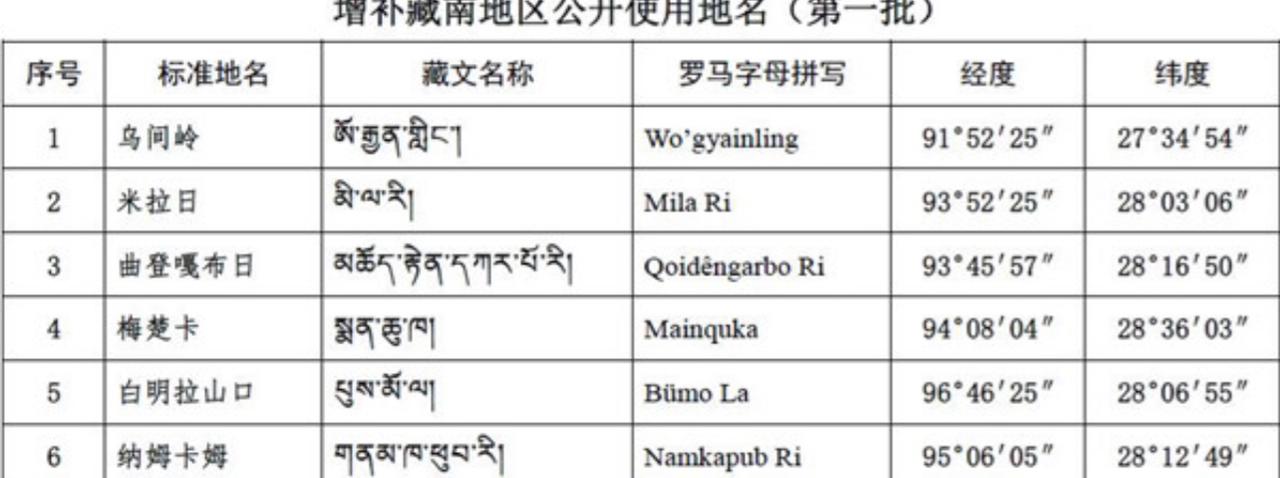
A chart in Chinese characters, Tibetan and pinyin transliteration of the 11 new names was released “in accordance with regulations on geographical names issued by the State Council - China's Cabinet.”
It is not the first time that China has changed names, but one can ask what is Beijing’s ultimate purpose?
We shall come to it later, but it is clear that it could be related to the visit of Jigme Khesar Namgyel Wangchuck, the Fifth King of Bhutan in Delhi to clarify the position about Bhutan’s negotiations with China, and about the existence of a ‘border deal’ with China.
In this perspective, the fact that a map accompanying the article (in Chinese) about the renaming in Arunachal shows Sakteng, an area in Trashigang District of Eastern Bhutan, previously claimed by China, as part of Bhutan, is worth noting.

Renaming places
Renaming places is not new. It has been done by all colonizers; India still remembers the British days.
China has done it in a more systematic manner. After it invaded Tibet in 1950-51, Shigaste became Rìkazé or Xigatse, Sakya was Sa’gya, Metok, north of Arunachal’s Upper Siang district, Mutao or Medog.
Apart from the cases of pure pin yinsation like the ones just mentioned, in many cases, names have been completely changed. Ngari province is now called Ali Prefecture (perhaps due Chinese faulty pronunciation which can’t pronounce ‘Ng’ and ‘r); Kyirong at the border with Nepal is now Jilong and worse, Barahoti in today’s Uttarakhand is called Wuje, while Demchok in Ladakh is termed Parigas.

First Renaming in Arunachal Pradesh
In 2017 already, the Chinese Cabinet had announced the ‘standardised names’ for six places in Arunachal Pradesh.
At that time, it looked like a childish reaction to the Dalai Lama’s visit to the state a month earlier.
The Chinese media then admitted that Beijing’s objective was to reaffirm China’s claim over Arunachal, ‘South Tibet’ (now Zangnan) for the Chinese.
The official names of the six places (transcribed in Roman alphabet) were Wo’gyainling, Mila Ri, Qoidengarbo Ri, Mainquka, Bumo La and Namkapub Ri. Let us have a look at a couple of them.
Wo’gyainling is the new spelling for Urgyeling, the birthplace of Tsangyang Gyaltso, the sixth Dalai Lama, a few kilometers south of Tawang town. One understands the political reasons why China would be so attached to the place. Beijing was/is not ready to accept that a Dalai Lama could be born outside Tibet (China for Beijing).
Another place was Qoidengarbo Ri, for ‘Chorten Karpo’ or ‘White Stupa’. It refers to Gorsam Chorten, the only large white stupa in the area (and the largest in Arunachal). It is not far from Zimithang, the tactical HQ of the 4 Infantry Division during the 1962 war. The name ‘Ri’ or ridge in Tibetan may refer to one of the ridges around the stupa.

Second ‘Renaming’: 15 Places in 2021
In 2021, 15 places were given new names with precise coordinates; eight were residential areas/settlements, four were peaks/mountains, two were rivers and one is a mountain pass (Sela).
Contrary to what the Indian media wrongly mentioned at that time, the names are not ‘invented’ names; they were transcriptions of the old Tibetan names for these 15 areas.
This is far more serious than ‘invented names’; by ‘proving’ that these places had Tibetan names, China can come to the easy conclusion that they have been Tibetan places …and therefore Chinese.
The argument is tenuous, as it is often the case, but it does not stop China from using it. It however gives a clear message to India: whatever has been Tibetan (or even had a Tibetan name) belongs to China.
One day, places in Ladakh, Sikkim or Kinnaur …and Bhutan will thus be claimed.

Eleven New Names

On April 2, a communiqué announcing a third renaming, was released by the Chinese Ministry of Civil Affairs; it stated that it was “a legitimate move and China's sovereign right to standardize the geographical names.”
It included two residential areas/settlements, five most-unknown mountain peaks, two tiny insignificant rivers and two other areas; all shamelessly linked with Tibetan administrative counties (Tsona, Lhuntse, Metok and Zayul) in the North.
It asserted that “China's move to standardize the names in Zangnan completely falls within China's sovereignty"
Zhang Yongpan, a research fellow of the Institute of Chinese Borderland Studies of the Chinese Academy of Social Sciences, is quoted by The Global Times as saying: “It is more meaningful to safeguard national sovereignty, maintain peace in border regions and manage border-related matters at the legal level.”
How does blatantly claiming Indian territory help to maintain ‘peace in border regions’, is a mystery that only China can explain.
Looking at the list of 11 places, most of them are unknown or remote areas, however three are close to the Line of Actual Control (LAC); namely Pangchen, a village in the Zimithang Circle which has a historic background during the 1962 border war with China; then Chakmutse Gangri, near Taksing in Upper Subansiri and finally Goyul Thang, a tiny flat ground near Kaho on the river Lohit. Except for the Pangchen village, these places are small and unknown even to most Arunachalis.

Why this Futile Exercise Now?
China knows that the Indian media will jump on this type of ‘scoop’.
The PTI correspondent in Beijing was the first to quote the State Council’s latest notification and spread the news.
This is fine; one can consider it as part of the Information Warfare (IW) against India. Delhi should just be aware of it.
More worrying is the map mentioned earlier. Does it signal that Sakteng has now been accepted as part of Bhutan by China and that Beijing does not claim the place anymore? In itself it is good, but if it is part of the ‘package deal’ between China and Bhutan mentioned in the Indian press, it has other implications. Were the declarations of the Bhutanese Prime Minister, which probably triggered the visit to the Bhutanese King to Delhi, meaning that a deal has been arrived at?
In this case, India’s interests are at stake, especially as far as the Siliguri Corridor is concerned. Is such a deal is in the pipeline?

A Small Anecdote
Several years ago, a senior officer of the Royal Bhutanese Army was having talks with a Chinese delegation which started arguing that ‘la’ was a Chinese word (it means ‘pass’ in Tibetan and Bhutanese, but not in Chinese).
Even after the Bhutanese negotiators told their Chinese counterparts that it was not a Chinese name, the latter continued to insist.
It is then that the smart Bhutanese official interrupted the Chinese argument and asked: “What about Patia-la? Is it a Chinese place?”
The Chinese were so much taken by surprise that they kept quiet …at least for some time.
This anecdote came to mind when I read that Beijing had released the third batch of ‘new’ names for places in Arunachal Pradesh.
In the meantime, India should systematically only use the traditional English transliteration of Tibetan places, i.e. Tsona (not Cona), Shigatse (not Xigazê or Rigazê) or Lhuntse (not Lóngzǐ); tens of thousands of names of Tibetans twons/villages have thus been changed by China.
After all, as the Chief Minister of Arunachal Pradesh often says: “my State has no border with China, only with Tibet.”

2017 list

2021 list

2023 list