Tuesday, November 22, 2022

Changing Ladakh

Chushul Village near the Spangur Gap

Ladakh is changing
I still remember my first visit in 2002. There were hardly any roads outside Leh and the approach from Manali in Himachal Pradesh or Zoji-la in Jammu and Kashmir was not an easy one; only a few flights were landing at the Bakula Rinpoche airport and it was always tricky to get a seat in a plane.
Three years ago, I had the chance of visiting Leh again; it was a few months after the mountainous region became a Union Territory (a long-time demand of the Ladakh Hill Development Council, the Ladakh Buddhist Association and the people in general).
By that time, Leh and a few selected areas had tremendously developed.
But all this was before what the historians will one day call ‘the BC era’ (‘before COVID’) and perhaps more importantly before the confrontation with China in several places on the northern boundary.  
Incidentally, is it not a paradox that one of the most peaceful spots on earth, with its high-perched monasteries, its innumerable stupas and prayers flags floating around everywhere, has witnessed the bloodiest conflicts since independence? It is only due to the belligerence of the neighbours.

Some History
At the time of Kashmir's accession to India in October 1947, political and economic power was offered to Sheikh Abdullah's National Conference government in Srinagar despite the fact that Ladakh covered 70 per cent of the area under India's administration. Dominated by the successive Kashmiri governments for several decades, practically Ladakh was deprived of any say in its development.
Soon after the signature of the Instrument of Accession in October 1947, raiders from the North West Frontier Province began pouring into the valley, looting and burning villages; Ali Jinnah and his colleagues’ motto was: “Let us liberate our Muslim brothers from the yoke of the Dogras”.
But thr Pakistanis leaders' greed had no limit. Their 'two nations' theory, according to which the Muslim dominated areas of the subcontinent were to become part of Pakistan and the Hindus, Sikhs and others were to remain with India, was thrown into the wind when Karachi decided to 'liberate' their Buddhist brothers in Ladakh. The motivation for Operation Sledge, which aimed to take over the vast Ladakh plateau, was not ideological: the treasures of the Buddhist gompas (monasteries) were a great lure for finance-starved Pakistan.
In February 1948, Brig 'Bogey' Sen, the brigade commander in Srinagar was in a fix; how to save Ladakh. The formidable Zoji-la pass was an uncrossable barrier between the valley and Ladakh and there was no way to airlift reinforcements to Leh.
It was then that Capts (later Colonels) Kushal Chand and Prithvi Chand, two young Buddhist officers from Lahaul offered their services; they told the brigadier they were ready to cross Zoji-la in winter with a small caravan of men and mules carrying arms and ammunitions. Though Buddhists and believers in ahimsa, these men were ready to risk their lives and fight their way through the weather, the altitude and the raiders to defend their co-religionists in Ladakh. Nobody thought the mission feasible, but there was no other solution. They succeeded and saved Ladakh (and were awarded Mahavir Chakra or MVC).
One should also mention the Ladakhi, Col Chewang Rinchen, who was twice awarded the MVC-- first for having stopped the advance of raiders in the Nubra Valley in June 1948 and the second for the bravery he displayed in the Turtuk sector in December 1971.
More recently, Col Sonam Wangchuk (another Buddhist soldier to be awarded the MVC) and his Ladakh Scouts recaptured some of the crucial peaks occupied by Pakistan during the Kargil war in 1999.
These Buddhist heroes had to first conquer their own non-violent Buddhist principles before they could take on the invaders; they knew the survival of their dharma was at stake.
From the start, the Ladakhis took the stand that their future was linked with India, though culturally, racially and linguistically they had in the past been close to Tibet.
In May 1949, the first delegation of the Young Men's Buddhist Association of Ladakh led by Kalon Chhewang Rigzin met Nehru in Delhi and presented him a memorandum: “We seek the bosom of that gracious Mother India to receive more nutriment for growth to our full stature in every way. She has given us what we prize above all things -- our religion and culture.”

Creation of a Union Territory

Things started moving faster after the Central Government decided to abrogate Article 370 of the Constitution on August 5, 2019; the Parliament of India voted in favour of a resolution tabled by the Home Minister to revoke the temporary special status, or autonomy, granted under Article 370 of the Indian Constitution to Jammu and Kashmir. Ladakh could finally become a Union Territory (UT).
Then early 2020, the COVID wave swept Ladakh, stopping tourism, the newly created UT’s main revenue. A few months later, the northern borders were subject to armed attack at several locations by the People’s Liberation Army. It was a turning point in the history of the relations with China, but ironically the development of the border region got a boost due to the new requirements of the Indian Army and large-scale infrastructure projects started to reach the remotest parts of the UT for the first time.
During a recent visit to Rezang La and Chushul, I could personally witness the changes over the last three years.
But let us first remember the events which took place 60 years.

The Battle of Rezang La
On 18 November 1962, the ‘Charlie’ Company of the 13th Battalion of the Kumaon Regiment fought at Rezang La Pass at the incredible height of 18,000 feet, one of the greatest battles in history; 114 soldiers of the 124-strong company led by Maj Shaitan Singh, lost their lives, heroically defending the nearby Chushul airstrip, the last defence before Leh.
Shaitan Singh was posthumously awarded the Param Vir Chakra, the highest military decoration; his battalion received eight VCs (Vir Chakras), four SMs (Sena Medals) and one Mention-in-Dispatches, making it one of the highest decorated companies of the Indian Army.
A recent book on the battle says: “The valour of the Charlie Company not only successfully stopped China’s advance, but it also resulted in the Chushul airport being saved, thereby preventing a possible Chinese occupation of the entire Ladakh region in 1962. According to reports, a total of 1300 Chinese soldiers were killed trying to capture Rezang La.”
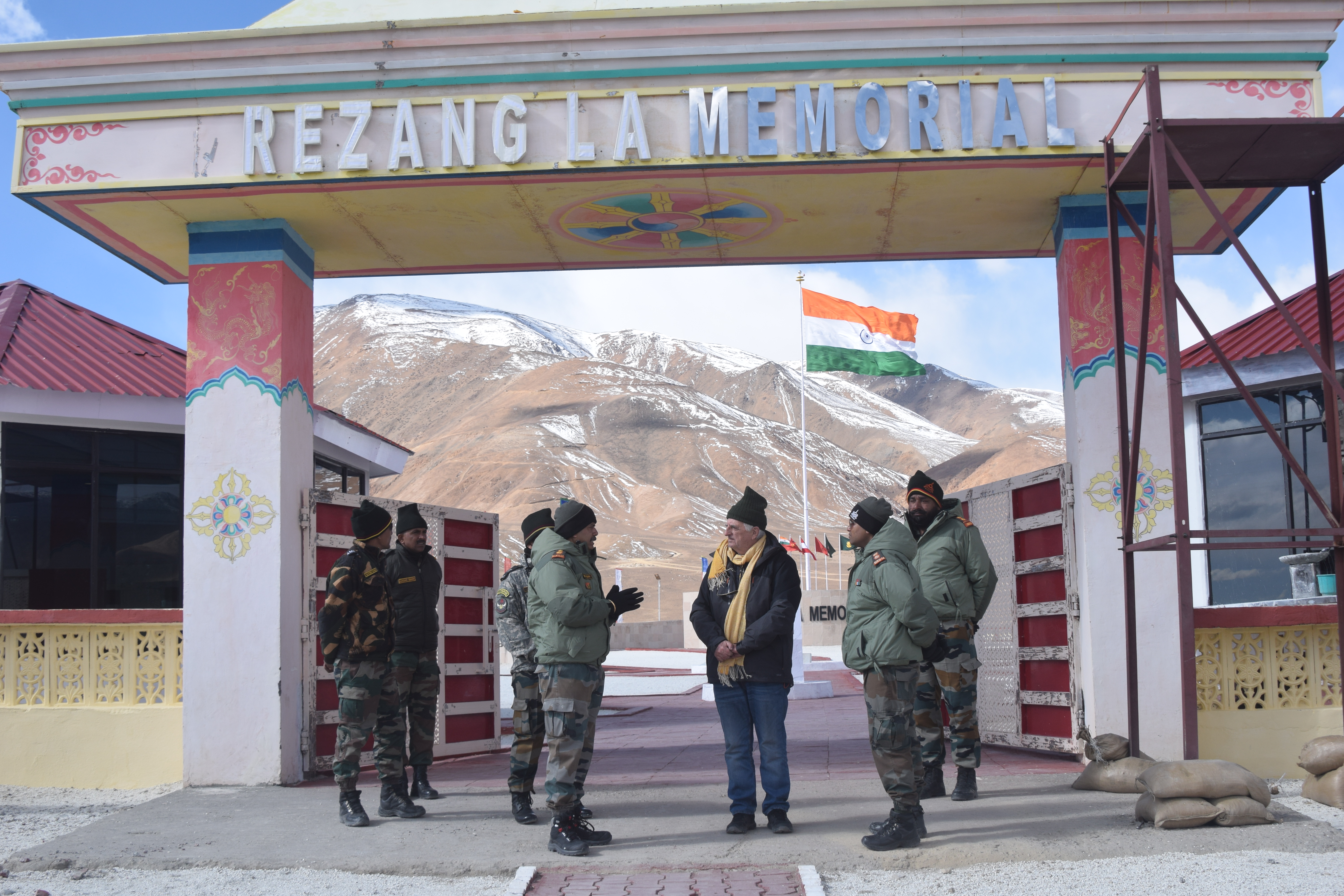
Visiting the War Memorial, one has a feeling of super-humans defending the Indian territory against the Chinese onslaught; it is deeply touching; remember that most of the soldiers of the Charlie Company who fought the battle at this altitude had come from the plains of Haryana.

The Role of the Army
One of the greatest changes in the region is the opening of the area to Indian visitors, something which was not possible during my last visit in 2019.
It is necessary to mention the exemplary role of the Indian Army, which has not only encouraged these changes, but due their own strategic requirements, have built dual-use roads, facilitated the construction of schools and the erection of communication towers (one gets 4G Jio connection in Chushul, nearby the Rezang La Memorial).
During an encounter with some local herders, they unanimously agreed that their lives had definitively changed, they have better access to education (though they would like the school in Chushul to go up to Class 12), health services and communications have greatly improved.
The local population has benefited from the many changes brought by the Indian Army and the UT Administration; they can now provide taxi services (thanks to the opening of the area and better roads); they can open home stay which helps them to add to their poor pastoral revenue and contrary to what has been said in some poorly-informed media articles, the grazers are able to take their yaks till the LAC (except for a small area which has been demilitarized in the vicinity of the Spangur Gap, north of the Kailash Range). The rapid changes are likely to continue in the years to come, hopefully taking care of the fragile environment.
It remains striking that these majestic mountains remain the theater of an armed conflict, some sixty years after the Battle of Rezang La.
Looking at the snowy peaks, one wonders what are the objectives of President Xi Jinping when he speaks of ‘The Peaceful Rise of China’? However, Beijing’s belligerence has indirectly brought a better life to these deprived populations.

Friday, November 18, 2022

The Heroes Who Saved Ladakh For India

My article The Heroes Who Saved Ladakh For India appeared in Rediff.com.

Here is the link...

Visiting the Rezang La Memorial, one has a feeling of super-humans defending Indian territory against the Chinese onslaught, says Claude Arpi on the 60th anniversary of the heroic battle of the 1962 War.

Several years ago, I had the opportunity to interview one of the most renowned Indian mountaineers, who had chosen to live like local folks in the Himalaya. She recounted an anecdote which took place during the All-Women Himalayan Traverse expedition; one day the expedition arrived in a small mountain village; speaking about the majestic surroundings, the mountaineer told one of the villagers: ‘Kitne sundar!’ (How beautiful they are!), the local pahari’s immediate reply was, ‘Kitna dukh!’ (So much suffering!).
Somehow, the pithy phrase summarized the hard life in these high mountainous areas.
These words came back to mind when I recently visited the site of the the Battle of Rezang La, near Chushul village in Ladakh at more than 15,000 feet.
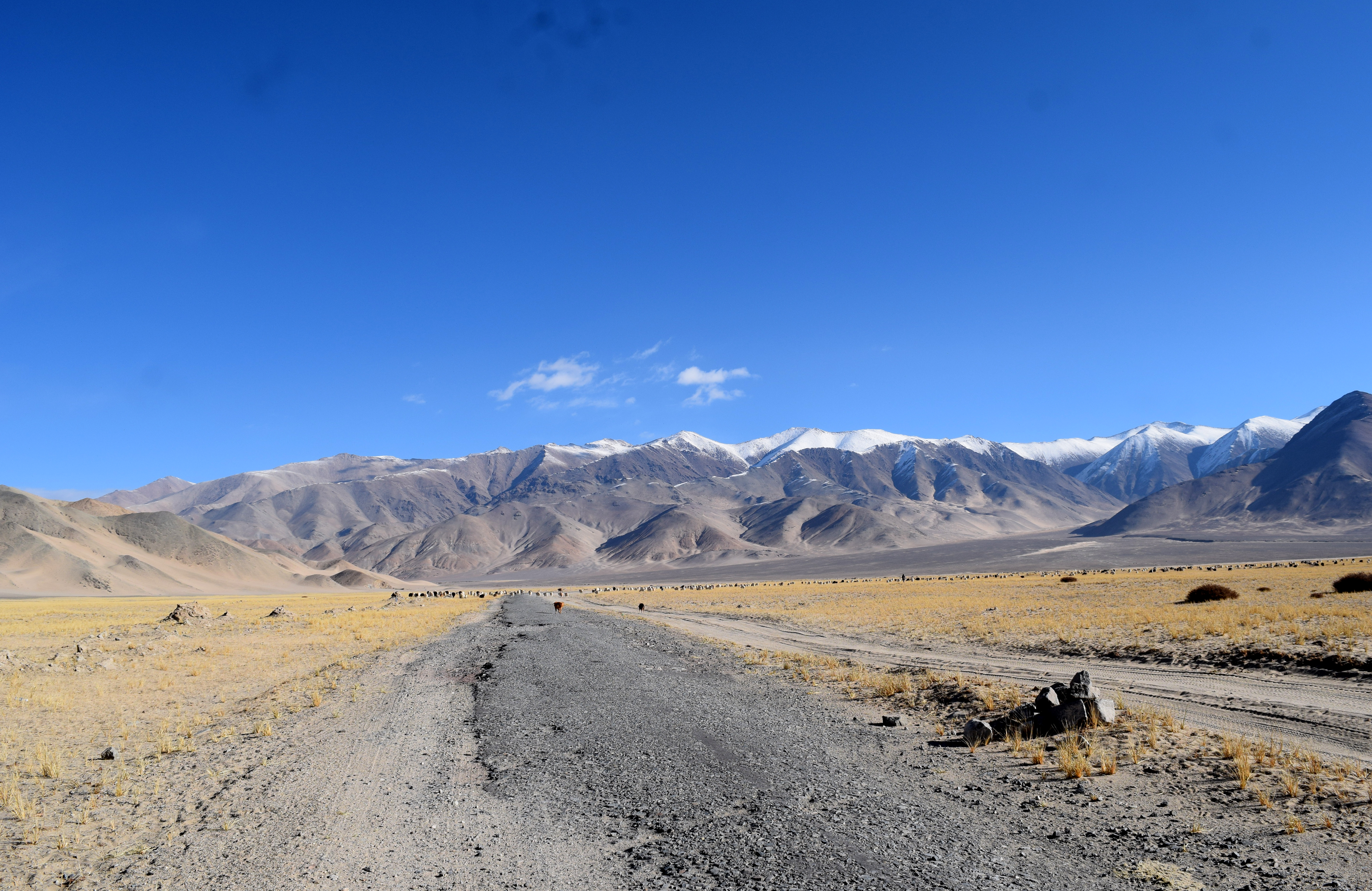
As one arrives by car from Nyoma, the track follows the imposing Kailash range, covered with snow. Immediately, one is confronted by this paradox faced by one of the most peaceful and magnificent spots on earth, which has however witnessed some of the bloodiest battles since independence.
After crossing the Tsaga La (pass) and a few kilometers before arriving at the site of the newly-renovated War Memorial in honour of the ‘Charlie’ Company of the 13th Battalion of the Kumaon Regiment, one can have the magnificent sight of a tri-colour flag floating in the blue sky.

 The ‘dukh’ side
On 18 November 1962, a battle was fought at Rezang La (pass) at the incredible height of 16,000 feet, one of the greatest battles in history; 114 soldiers of the 124-strong company led by Maj Shaitan Singh, PVC, lost their lives heroically defending the nearby Chushul airstrip, the last defence before Leh, Ladakh’s capital.
Maj Shaitan Singh was posthumously awarded the Param Vir Chakra (PVC), the highest military decoration; his battalion received eight VCs (Vir Chakras), four SMs (Sena Medals) and one Mention-in-Dispatches, making it one of the highest decorated companies of the Indian Army.
The citation which appeared in the gazette, said: “Major Shaitan Singh was commanding a company of an Ahir infantry battalion deployed at Rezang La in the Chusul sector at a height of about 16,000 feet. The locality was isolated from the main defended sector and consisted of five platoon-defended positions. On 18 November 1962, the Chinese forces subjected the company position to heavy artillery, mortar and small arms fire and attacked it in overwhelming strength in several successive waves. Against heavy odds, our troops beat back successive waves of enemy attack.”
It is further mentioned that “Major Shaitan Singh dominated the scene of operations and moved at great personal risk from one platoon post to another sustaining the morale of his hard-pressed platoon posts. While doing so he was seriously wounded but continued to encourage and lead his men, who, following his brave example fought gallantly and inflicted heavy casualties on the enemy. For every man lost to us, the enemy lost four or five. When Major Shaitan Singh fell disabled by wounds in his arms and abdomen, his men tried to evacuate him but they came under heavy machine-gun fire. Major Shaitan Singh then ordered his men to leave him to his fate in order to save their lives. Major Shaitan Singh's supreme courage, leadership and exemplary devotion to duty inspired his company to fight almost to the last man.”
Visiting the War Memorial, one has a feeling of super-humans defending the Indian territory against the Chinese onslaught; it is deeply touching; remember that most of the soldiers of the Charlie Company who fought the battle at this altitude had come from the plains of Haryana.
The Ladakh Range and particularly Rezang La and the nearly peaks/passes have an extraordinary strategic importance as they dominates the Spangur Tso (lake), the Spangur Gap (the narrow area between the Pangong Tso and the Spangur Tso) as well as the strategic road to Rutok, the main garrison in Western Tibet and the route to Leh.
By controlling these ridges, the Indian Army stopped the Chinese advance on Leh and probably saved Ladakh. Incidentally, the cease-fire was declared by China four days later. Was it a coincidence?
Though still classified, parts of the Henderson-Brooks-Bhagat Report (hereafter the Report) on the 1962 conflict have found their way to the Internet. It is worth quoting some extracts.
In November 1961, a ‘Forward Policy’ was ordered by the Government; the Report commented: “the ‘Forward Policy’ was primarily introduced to bunk the Chinese claims in Ladakh. Had the developments stemming out of it been correctly apprised by the General Staff at Army Headquarters and correlated to NEFA [North East Frontier Agency], it is possible that we would NOT have precipitated matters till we were better prepared in both theatres.” This sentence has been used by anti-India elements like Neville Maxwell to put the blame on Delhi.
The General Staff of the Army Headquarters knew that any move in NEFA would have consequences in Ladakh, here the level of preparations was minimal; according to the Report: “we acted on a militarily unsound basis of not relying on our own strength but rather on believed lack of reaction from the Chinese. We forgot the age old dictum of the ‘Art of War summed up so aptly by Field Marshal Lord Roberts.”
The latter had said “The art of war teaches us to rely not on the likelihood of the enemy NOT coming, but on our own readiness to receive on the fact that we have made our position unassailable.”
But till the last minute, the government (primarily the Defence Minister Krishna Menon) believed that “The Chinese will not dare”.
The Report continued: “Militarily, it is unthinkable that the General Staff did not advise the Government on our weakness and inability to implement the ‘Forwards Policy’. General [BM] Kaul [Chief of General Staff] on his report has brought out that, on a number of occasions in 1961-62, the Government were advised of our deficiencies in equipment, manpower, and logistic support, which would seriously prejudice our position in the event of a Chinese attack on us.”
At the same time: “orders were given by the General Staff in December 1961 for the implementation of the ‘Forwards Policy’ without the prerequisite of ‘Major Bases’ for restoring a military situation, as laid down by Government. Indeed General KAUL as CGS and the DMO [Director of Military Operations, Maj Gen DK Palit], time and again, ordered in furtherance of the ‘Forward Policy’ the establishment of individual posts, overruling protests made by Western Command.”
Winds of folly were blowing over the Army Headquarters in Delhi; we know what happened a few months later, in October/November 1962.
Maj Shaitan Singh and hundreds of his comrades sacrificed their lives to undo the foolishness of the politicians; the Report added: “There might have been pressure put on by the Defence Ministry, but it was the duty of the General Staff to have pointed out the unsoundness of the ‘Forwards Policy’ without the means to implement it.”
Further, Gen Henderson pointed out: “It is apparent that none of this planning took place and NO operation orders or instructions were issued by the General Staff. It was therefore NOT possible for Command or lower formations to issue any comprehensive order without a directive from the General staff.”
Is it the reason why the Report is still classified 60 years after the event?
One of the conclusions of the Report was: “It was a junior leaders and jawans battle and there is no doubt that they acquitted themselves well. They fought under grave handicaps and in face of defeat; yet there was no sign of undue panic and never a rout. The main reason for this was that troops fought under commanders they knew and trusted. There was no interference or short-circuiting in the chain of command and commanders on the spot were given freedom of action. The good name of our Army was NOT completely marred in LADAKH and the grave errors committed by the General Staff to an extent mitigated, thanks to the fighting ability of our troops.”
Indeed the 13 Kumaon and other units fought like lions. It is said that some 3,000 Chinese lost their lives in a couple of days in this sector.
Leh was probably saved by their act of heroism.
Ironically, the 58 years later, the Tibetan commandos captured the same peaks to have a strategic peep on the Rutok road.
In the process of the negotiations in Chushul and Moldo in the nearby Spangur Gap, the area was demilitarized in exchange of an agreement in the Fingers area on the Pangong Lake. Without commenting on the wisdom of this political move, one can only say Kitna dukh these stunning mountains have witnessed.
While on the spot, an idea came to me, when Chinese officers come to Chushul/Moldo for LAC talks, they should be invited to visit the Memorial to understand what the Indian soldiers are made of. 


Tuesday, October 18, 2022

Had India employed its Air Force in 1962, there would have been fewer casualties

My article Had India employed its Air Force in 1962, there would have been fewer casualties appeared in The Week.

Here is the link...

India needs to tell the world about the valour of its soldiers who fought China
 

In July 2017, a few weeks after the start of the confrontation in Doklam near the India-China-Bhutan trijunction, Lt Gen Zhang Xuejie, the then Political Commissar of the Tibet Military Region (TMD) went to an ‘undisclosed place on the border’ (probably North of Sikkim) and wrote in red letters ‘1962’ on a stone. What message did he want to convey? That China could repeat the operations of 1962?
A month later, as the confrontation had entered its third month and with Delhi not showing any sign of backing off from its position of stopping the People’s Liberation Army (PLA) to build a road in a disputed area, the Chinese media counter-attacked.
The Communist Party’s mouth-piece, The Global Times warned, "The border standoff has stretched out for nearly two months. If the Narendra Modi government continues ignoring the warning coming from a situation spiraling out of control, countermeasures from China will be unavoidable."
The newspaper then mentioned the 1962 war: “India made constant provocations at the China-India border in 1962. The government of Jawaharlal Nehru at that time firmly believed China would not strike back. …However, the Nehru government underestimated the determination of the Chinese government to safeguard China's territorial integrity even as the country was mired in both domestic and diplomatic woes," the newspaper cautioned.
Beijing was probably still dreaming of repeating 1962 ‘victory’, not realizing that India and the world have changed since then.

A Turning Point: the Galwan Clash
Interestingly, after the Galwan clash on June 15, 2020 (it was Xi Jinping's birthday), during which China is said to have lost some 40 of its soldiers, including a Commanding Officer, the Chinese media was quieter: Beijing had started realizing that India would not be bullied so easily.
This raises an obvious question: can China play a redo of 1962 on India, or putting it differently, has Indian learnt the lessons of 1962.

Projecting the Narratives of the Victors
It is necessary to first point out the Sino-Indian border war was not the debacle which has been depicted by Beijing and by some foreign commentators. India fought extremely well during the battles of Walong or Rezang-la and in several other areas on the front, where hundreds of Chinese PLA were killed by Indian soldiers. Has Xi, the Chairman of the Central Military Commission (CMC) heard of these battles?
This part of the story was never told to the Chinese people; similarly what happened in 1967 when the PLA was forced to back out after having intruded Indian territory in Sikkim, remains a State secret in the Middle Kingdom.
Beijing, presently working on publications about China’s ‘victory’, would today like that India remembers 1962.
The Chinese narative remains the same: India attacked China; according to The Hindu: “Chinese military researchers have compiled a new history of the war reassessing its significance and legacy, bringing the spotlight back to the war amid the current tensions in relations.”
The author is Zhang Xiaokang, the daughter of Gen Zhang Guohua, who commanded the Tibet Military Command (TMC) and directed the Chinese offensive against India in the eastern sector in October 1962. Her ‘new history of the war’ is titled One Hundred Questions on the China-India Border Self-Defence Counterattack.
Extracts published on a Chinese website show that Beijing continues to propagate the myth: Mao had no other choice but to ‘counter-attack’.
The history of 1962 needs to be rewritten, and India should not be ashamed of its Army during those fateful months; on the contrary, it is time to do more research into those battles, build more memorials and museums and let the general public (and China) know about the outstanding valour of the Indian soldiers.
One can only hope that Indian scholars and historians will revisit the conflict and show that the outcome could have been very different.

The Political Management of the 1962 War
Undoubtedly, with a better political management and the use of the Indian Air Force (IAF) in particular, the war could have had a different end.
But let us look at what went wrong.
First and foremost, it was folly for the then political leadership not to use the IAF.
In an interview with this writer, Wing Commander Jag Mohan (‘Jaggi’) Nath, the first officer to have twice been decorated with the Maha Vir Chakra (MVC), India’s second-highest war-time military decoration, had been on regular missions over Tibet for more than two years from 1960 to reconnoiter the Chinese military build-up on the Tibetan plateau. Jaggi Nath concluded that China had no Air Force on the Tibetan plateau in 1962.
Unfortunately, the political leadership refused to believe the hard evidence gathered during his sorties.
Had the IAF been used, one can imagine that the casualties would have been less on the Indian side and more on the Chinese; the Line of Actual Control would have remained where it was in September 1959, and the border dispute with China would not be so acute today; the Shaksgam Valley would have not been offered to China by Pakistan in 1963; Mao Zedong would have lost his job. As a result, the relations with China would have today been completely different.

India is Ready Today
It is certainly the most important lesson that India learnt from the 1962 War. Today after the induction of the 36 Rafale fighter aircrafts, the IAF is ready to take on China and even has an edge due to the terrain as well as the preparedness, the professionalism and experience of the Indian pilots.
India has also a far better knowledge of the border; let us not forget that the 7 Brigade was fighting in the Namkha chu (river) sector, north of Tawang, without maps; weaponry was antediluvian and the arrogant political leadership would not allow the local commanders (Maj Gen Niranjan Prasad of 4 Division and Brig John Dalvi of 7 Brigade) to move to better strategic positions to defend the Indian territory.
More recently, as the Doklam and the Eastern Ladakh confrontations have demonstrated, the commanders have a far greater autonomy of decision. The present government has also delegated the negotiations about the disengagement on the border to the 14 Corps Commander based in Leh.
With its in-depth knowledge of the terrain, the Indian Army has been able not only to hold onto their positions (though China still refuses to fully disengage from some places, i,e, Depsang, PP 15 or Demchok), but in the process, the defence forces have been able to establish a far better synergy with the Ministry of External Affairs and other stakeholders; something totally lacking in 1962.
One can say that though it has today delegated tactical decisions to the local commanders, the political leadership is far more aware of the situation on the ground.
On their part, after 16 rounds of talks, the PLA generals have probably realized that India in 2022 is not the same as in 1962 and their Indian counterparts will not bend backward.
In fact during this exercise, officers from both sides have learnt to know each other; they today understand better the other’s mindset and motivations. One should add that the political leadership meets far more frequently than Mao and Nehru did, which is a good thing. A better understanding of India’s principled and firm stand could hopefully act as a deterrent for China.
Further, senior generals in the Indian Army, Air and Navy headquarters are today more professional and are ready to make their voices heard. It was certainly not the case in 1962, when a Chief of Air Staff did not even dare to try to convince his political masters to use the IAF, despite the fact that, after the split with the Soviet Union, Delhi had the full knowledge that China had no Air Force on the plateau and even lacked the necessary fuel supply.

The Situation today

Sixty days later, the infrastructure on the Indian side has tremendously improved (on the Chinese side too); there was a time when an argument was heard on the borders, particularly in Arunachal Pradesh: “It is better not to build roads on our side, otherwise they can be used by the Chinese invading troops once again”.
During the last few years, though the PLA always keeps a superior edge in infrastructure (the terrain is also easier on the plateau), Delhi worked hard to reach every corner of the 3,500 km LAC with China.
One important factor in the ‘defeat’ in 1962 was the failure of the Indian intelligence. The intelligence inputs were probably there (through Wing Cdr Jaggi Nath’s secret flights or the regular reports of the Indian Consul general in Lhasa, the Indian Trade Agents in Yatung, Gyanste and Gartok, but also the Tibetan refugees in India), but they were not properly analyzed by the Intelligence bosses, who were too busy obeying the ‘ideological’ orders of their masters; this was particularly true for the Director of Intelligence Bureau who had served too long in the job.
Another important factor which may force China to think twice before embarking on a new 1962: the Tibetan population living in India and particularly on the borders is emotionally and physically supporting India. The role of the Special Frontier Force, composed of Tibetan commandos during August 2020 on the Kailash range, south of the Pangong tso, is a case point which should not be underestimated.
The Tibetan populations on the plateau are also aware that their countrymen in India are allowed to practice their own faith and freely follow their leader, the Dalai Lama; it is not the case north of the McMahon Line.
In case of a long conflict, it could be a determining factor.
Finally, the Ukraine war has demonstrated that it is not easy to win a short ‘local’ war, like China had hoped to do; even if the Middle Kingdom is in advance in many domains compared to India (theaterisation of defence forces, infrastructure, use of Artificial Intelligence, drones, etc.), there is no way for China to ‘teach a lesson’ to India today.
Finally, post-COVID pandemic, the world opinion is much more aware of China’s totalitarian side than two years ago. In case of a conflict, this would translate into better real-time intelligence sharing and support; this can’t be neglected.  
Xi Jinping, the CMC Chairman was probably briefed of all these changes when he recently visited Xinjiang and met the top brass of the Western Theater Command and the Xinjiang Military District.
But would China become desperate, due to an economic collapse for example, adventurism could be a way-out for a totalitarian regime.
Though India has learned many lessons, but should remain aware of these dangers; especially knowing tomorrow’s war(s) may be ‘unrestricted’, fought on multiple new fronts simultaneously.

Thursday, October 13, 2022

Nehru and the ‘pending’ case of Tibet in United Nations

My article Nehru and the ‘pending’ case of Tibet in United Nations appeared in The Firstpost.

Here is the link...

A Canadian scholar, Claudia Johnston, went through the old UN files and found out that following India’s assurance that it would ‘sort out the Tibet issue peacefully with China’, the case was still pending in the UN
 

On September 30, Russia held four referenda with the objective of annexing Luhansk, Donetsk, Kherson, Zaporizhzhia regions of Ukraine recently occupied by Moscow; it immediately draw strong condemnation from Kyiv as well as Western nations who called the votes a sham.
Ukrainian President Volodymyr Zelenskiy said: "These are not just crimes against international law and Ukrainian law, these are crimes against specific people, against a nation."
The G7 foreign ministers released a strong statement saying that Putin’s actions “constitute a new low point in Russia’s blatant flouting of international law. …[The G7 countries] will never recognize these purported annexations, nor the sham ‘referenda’ conducted at gunpoint."
While the UK and the US announced fresh sanctions against Russia, the European Union strongly condemned the annexation.
At the UN, a resolution, tabled declaring the annexations illegal and demanding an immediate and unconditional withdrawal of all Russia’s military forces from Ukraine, was vetoed by Russia (while China, India, Brazil and Gabon abstained).
Without going into the merits and demerits of the present imbroglio, it is interesting to look at what happened to Tibet in 1950 in the same UN forum, soon after the invasion of the Land of Snows by Communist China.

The Case of Tibet
Early October 1950, Eastern Tibet was occupied by Mao’s troops. The world kept quiet, nobody wanted to know about it, while the Tibetan government was not even queen to inform the world about what had happened to their country …not to make it worse.
By the end of October 1950, things finally began moving in Lhasa, the Cabinet of Ministers (Kashag) decided to appeal to the General Assembly of the UN against the act of this blatant act of aggression.
The Tibetan Government was quite confident in the Nehru’s government who had constantly taken the side of the oppressed people against the imperialist and colonialist powers.
To the Tibetan surprise, Delhi’s reply was that they certainly would support an appeal from Tibet, but it was not ready to sponsor the case.
On November 1, Nehru sent a cable to BN Rau, the Indian Representative in the UN: “Chinese military operations against Tibet have undoubtedly affected our friendly relations with China. But these developments do not affect our general policy or even our policy regarding admission of new China in United Nations.” At that time, Delhi supported the Communists’ admission in the UN (with a seat in the Security Council for Mao!).
Finally, a well-drafted appeal was cabled by the Government of Tibet to the UN on November 7, 1950; it stated that "the Tibetans were racially, culturally and geographically far apart from the Chinese. …The problem is not of Tibet’s own making but is largely the outcome of unthwarted Chinese ambitions to bring weaker nations on her periphery within her active domination.”
The appeal continued: “This unwarranted act of aggression has not only disturbed the peace of Tibet, but is in complete disregard of the solemn assurance given by the Chinese to the Government of India. …the problem is simple. The Chinese claim Tibet as part of China.”
It concluded that Lhasa hoped that “the conscience of the world would not allow the disruption of our State by methods reminiscent of the jungle.”
The appeal eventually was dispatched from Kalimpong, where lived the Tibetan representative in India. This would be objected by the UN bureaucracy, as an appeal is supposed to emanate from the territory of the aggrieved country.
On November 14, The Hindu commented: “India’s support, it is understood, will mainly be based on the ground that the issue could be solved peacefully and without resort to arms and the extent to which there were military operations, world peace was endangered.”
Finally on November 15, it is the tiny State of El Salvador which requested the Secretary General to list the Tibetan appeal on the Agenda of the General Assembly.
During the following days, the procedural battle went on at Lake Success.

India abandons Tibet
On November 20, in a cable to BN Rau, Nehru affirmed: “Draft resolution of El Salvador completely ignores realities of situation and overlooks fact that only result of passing such a resolution will be to precipitate conquest of Tibet and destruction of Tibetan independence and perhaps even autonomy.”
In the meantime, the United Kingdom was in a dilemma; the British had always managed to keep the status of Tibet nebulous, as the vagueness had worked well for years and decades; however, the times were changing; a State could claim to be under the suzerainty of another State and at the same time fully autonomous.
For the British government, it was a real issue.
The place and status of the Land of Snow on the Asian chessboard and its appeal to the General Assembly depended on this issue as according to the UN rules, only from a ‘State’ could make an appeal to the General Assembly.
Was Tibet a State for the British Government?
Surprisingly, after consulting legal experts, His Majesty’s Government accepted the fact that Tibet was a separate State. One of the points of White Hall was that the British Government had concluded a Convention between China, Tibet and herself in 1914 in Simla (and agreed to the McMahon Line with India). The other point was that the Chinese had been expelled from Tibet in 1911 and Tibet had declared her independence two years later. The fact that Tibet had from 1911 to 1950, kept the control of her internal as well as external affairs was certainly qualifying Tibet under Article 35 (2) of the UN Charter as a separate state.
But then India’s position began vacillating, though the Prime Minister admitted to his Representative in New York: “Chinese Government has repeatedly expressed themselves In favour of Tibetan autonomy, but of course we do not know what their idea of autonomy is.”
A few days later, Vijayalaksmi Pandit, Nehru’s sister was quoted as saying: “India’s view that communist China should be given a seat in the UN, …[she thought that], if this had been done earlier, some of the present troubles in Korea might have been avoided” And what about Tibet?
Incredibly political logic!

Another Argument
Suddenly an unbelievable argument cropped up, if the opinion of the legal cell of the Foreign Office (stating that Tibet was a separate State) was not changed, the logical conclusion would be that a firm stand (and action) would have to be taken. As a consequence the UN would have to accept that an aggression had been committed and as a result pressures would be exerted by the community of nations to take an action in favour of Tibet. But nobody wanted to take an action!
The British Representative to the UN concluded: “I greatly hope therefore that I shall be instructed when and if the Indians raise this matter in the Security Council, to argue to the general effect that the legal situation is extremely obscure and that in any case Tibet cannot be considered as a fully independent country.”
The British government then asked for another legal opinion from its Attorney General.

India changes its mind

At that time, Britain and the USA had made their position known: they would support the stand of the Government of India, but at the last moment, Nehru backed out of the understanding India had given to Tibet.
He requested Washington to refrain from publicity condemning China for its action in Tibet for fear that such condemnation might give credence to China's claims that Western powers had an interest in Tibet and that the American were exerting an influence over Indian policy.
Nehru wrote these appalling words: "We cannot save Tibet, as we should have liked to do so, and our very attempts to save it might bring greater trouble to it.” India then informed that UN that it would sort out the issue peacefully with China.
A couple of decade ago, a Canadian scholar, Claudia Johnston went through the old UN files and found out that following India’s assurance, the Tibet issue was still pending in the UN.
Obviously, the present case of annexation of parts of Ukraine is different, but the morale remains that it is often the bullies who prevail, at least today, many nations (often big bullies themselves) are ready to object.
The Prime Minister is absolutely right when he says that “this was not the era for war”, but what about Tibet? Will it be forever ‘pending’?

Wednesday, October 5, 2022

The Forgotten Hero of the Indian Air Force

Chinese PLA surrounding the Bell helicopter of Sqn Ldr Vinod Sehgal

My article The Forgotten Hero of the Indian Air Force appeared today in Rediff.com

Did Vinod Sehgal die in Tsangdgar or was he taken PoW to China?
Why has the IAF kept so quiet for all these years, asks Claude Arpi.

Here is the link...

Perhaps the main unsolved mysteries of the 1962 India-China War is the fate of 35-year old Squadron Leader (Sqn Ldr) Vinod Sehgal, (sometimes is name is written ‘Sahgal’); the Vayu Sena Medal awardee of the 105 Helicopter Unit of the Indian Air Force, went ‘missing in action’ at Tsangdhar in the Tawang sector of the then Kameng Frontier Division of the North East Frontier Agency (today Arunachal Pradesh) on October 20, 1962.
In the early hours of this fateful day, the People’s Liberation Army (PLA) attacked the Indian positions south of the Thag-la ridge. It soon turned into a debacle recounted by Brig John Dalvi, the Commander of the ill-fated 7 Mountain Brigade in his remarkable Himalayan Blunder; the ‘leadership’ in Delhi had insisted of defending indefensible positions on the river Namkha chu (river), with the tragic well-known outcome. 

Tsangdar Dropping Zone where Sqn Ldr Sehgal landed
What happened in the vicinity of the Thag-la ridge and the Namkha chu (river) has been the object of a number of good or less good books.
Nobody has forgotten that the foolish (not to say criminal) leadership in Delhi did not think it fit to use the services of the IAF for offensive operations; the 7 Brigade was soon decimated; Hatung-la, the ridge next to the Thag-la fell on October 21 and Brig Dalvi was taken prisoner of war (PoW) on October 22; by that time, Maj Gen Niranjan Prasad, the General Commanding Officer (GOC) of the 4 Infantry Division had trekked back to Tawang from Zimithang, his tactical headquarter.
Maj Gen KK Tewari was then a Lt Col commanding the Signal Regiment of the 4 Corps based in Tezpur; on October 18, he had flown with Vinod Sehgal to the front and landed at Tsangdhar to inspect some deficient equipment on the forward posts, particularly in the Namkha chu sector.
Tewari, like many other officers and jawans, was taken PoW on October 20 morning; not hearing from his boss, with all communication lines cut, Tewari’s second-in-command (2iC), Maj Ram Singh decided to find out the situation on the front; he flew to Tsangdhar in Vinod Sehgal’s Bell helicopter.

Gen Tewari wrote in his memoirs: “Numerous cases of men who deserved to be honoured for their outstanding examples of devotion to duty in the face of enemy were ignored because of the confusion and failure in the higher directions and conduct of war. …The case of my own 2iC, Maj Ram Singh who gave his life along with Sqn Ldr Vinod Sehgal when they had tried to land at Tsangdhar in a two seater Bell helicopter after the Chinese attack, is one such. They came to find out what had happened after my last radio transmission that morning, when we suddenly went off the air after giving news of intense shelling and they were shot down.”
The GOC of the 4 Division later remembered that Maj Ram Singh, not knowing the true situation, had suggested sending a replacement set to the front; according to Gen Prasad’s memoirs: “I decided to go with him, not only to keep an eye on the battle while 7 Brigade HQ was on the move, but because I was keen to supervise the Tsangle withdrawal ...I called out to (Sqn Ldr) Vinod Sehgal to get his helicopter ready, collected Ram Singh and set out for the helipad. When emplaning, however, Sehgal raised an objection about the load. While he had no objection to carrying an extra passenger against regulations, he said, he just could not risk taking a heavy wireless set and battery in addition. At those heights, this was asking for trouble. My first reaction was to tell Ram Singh to wait for the next sortie, but Ram Singh quite rightly argued that establishing the set on Tsangdhar was more important as I would be helpless up there without communications In any case, by then the set and the battery had already been strapped on to the outside carrier frame; Ram Singh argued that it would only take a turn-around of 20-25 minutes to drop it at Tsangdhar and return. This made sense, so I got out of the helicopter and allowed Ram Singh to proceed to Tsangdhar.” The fate of the two officers was sealed; Ram Singh and Sehgal would never return. 

The Thagla ridge in the background
Gen Prasad then sent Flight Lieutenant (Flt Lt) AS Williams to check what was going on: “It was not more than fifteen minutes later I received a report from Borkungthang post that they had seen a helicopter come crashing near them. The pilot appeared to be safe and even then making his way towards Zimithang. Sure enough, Williams appeared down the path in about ten minutes time, looking visibly shaken. …The loss of both my helicopters was a serious blow - apart from the fact that I was more than a little worried about the fate of Ram Singh and Vinod Sehgal."
Air Marshal Bharat Kumar, who wrote the history of the 1962 air support operations, noted: “It can be surmised that Sehgal and Ram Singh were captured after their landing - they were not aware that the post had been overrun by the Chinese. The Chinese have kept silent about the incident, as if nothing ever happened. It is probable that both of them were shot after they were captured as their names did not appear either in the list of Prisoners of War (POWs) or declared dead by the Chinese.”
In a Chinese video clip released a few years later, Sqn Ldr Williams recognized the Bell 47-G2 Helicopter piloted by Sqn Ldr Sehgal: “the helicopter was intact and apparently Sehgal and his passenger [Ram Singh] were captured by the Chinese, never to be heard or seen again.”
After another helicopter was later shot by the Chinese; the Operational Record Book of No. 105 Helicopter Unit concluded: “Zimithang was abandoned with a sad heart as three beautiful valuable aircraft were lost and one very experienced pilot (Vinod Sehgal) taken prisoner by the enemy. Zimithang detachment came to a tragic end.”
That was it!

Sqn Ldr Vinod Sehgal, VSM
Why was Vinod Sehgal’s action never rewarded?
One of the tragedies within the greater 1962 tragedy is that Sq Ldr Vinod Sehgal’s bravery has never been acknowledged by the Indian Air Force. The young pilot’s name has today been forgotten though he performed a heroic feat several hours after the war was started.
Incidentally, a few years ago, Brig Amar Jit Singh Behl who was a young Second Lieutenant of the 17 Parachute Field Regiment fighting in Tsangdhar, told me in an interview for Rediff.com that after he was made prisoner by the Chinese: “On October 21, we were kept near the helipad and I saw the two officers who had been killed near their chopper. I went to the Chinese officers who had interpreters in English and Hindi. I asked this officer, I want to bury these officers; after I insisted, he said: 'Alright'. With two of my boys, we dug a two feet trench and buried Major Ram Singh and Squadron Leader Sehgal. We saluted them.” The next day, Behl and his companions started their long walk to the PoW camp in Tibet.
The question is: was it Vinod Sehgal that they buried?

from the ICRC Archives, Geneva

The Red Cross Angle
The mystery deepened further when during a recent visit to Geneva, I had the opportunity to visit the archives of the International Committee of the Red Cross (ICRC). I came across a cable from the Indian Red Cross (IRC) to the ICRC dated November 9, 1962 requesting the humanitarian organization in Switzerland to take up the case of Vinod Sehgal with the Chinese Red Cross: “Kindly obtain confirmation Peking [Beijing] Radio News that Brigadier Dalvi, Lt Col Tewari and Sqd Ldr Saigal [are] in Chinese hands; also news [of] their welfare.”
The cable further says: “In conformity with Third Geneva Convention, we would appreciate receiving news concerning above mentioned prisoners.”
Does it mean that Vinod Sehgal was not killed in Tsangdhar, but taken prisoner in China? Probably.
Why has the IAF been silent on this event for all these decades?
The same day, the IRC was informed by the ICRC: “We have transmitted your request to Chinese Red Cross and [other] authorities.”
In a letter to Wu Chin-Shih, the Chinese General Consul in Geneva, the ICRC enquired: “[We] would appreciate receiving news of these prisoners in accordance with the Geneva Convention of August 12, 1949 relative to the treatment of prisoners of war (Convention No III).”
There is no answer in the file.
Does it mean that what happened to Vinod Sehgal will forever remain a mystery?
Apparently (and sadly), Sehgal’s family was never informed of the fate of the young pilot. Gen Tewari mentioned in his memoirs an incident which took place when the PoW officers arrived in Kolkata after their captivity: “At the mess, an Air Force officer had ‘sneaked’ in a lady. She approached me to ask about Sqn Ldr Vinod Sehgal. Vinod was the Bell helicopter pilot who had flown me to Tsangdhar on October 18 with that jar of electrolyte in my lap. This lady was his sister. When I told her that Vinod was not with us, she said that she had a picture from a newspaper in which he was supposed to be standing next to me. She showed me the faded picture and of course, it was not my picture, nor Vinod’s. We had also been told already by the Chinese in the PoW camp that a Bell helicopter had been shot down at Tsangdhar on 20th October. …When I told her that it was not my picture, she broke down and cried bitterly. It was so sad and upsetting. In the happiness of our home coming we had forgotten even if temporarily, the pain of others who had lost their dear ones. We were not otherwise allowed to talk to anyone. In fact, all the mess staff also were forbidden to talk to us.”
Had Vinod Sehgal’s sister been informed that he was a PoW in China? It is possible.

Confluence of the Namkha chu and the Namjiang chu

This leaves us with a host of unanswered questions:
•    Did Vinod Sehgal die in Tsangdgar?
•    What happened to the helicopter? Was it dismantled and taken to China? Why China has never acknowledge it?
•    Or was Vinod Sehgal taken PoW to Tibet or China?
•    If he was, where was he kept? Why was he not kept with other PoWs who did not know about his whereabouts?
•    How did he finally die? Was he killed? Was the Indian government informed?
•    Why has the IAF kept so quiet for all these years?
We can only hope that one day the Ministry of Defence will seriously take up these questions; it is up to the Indian Air Force to take the initiative.

Equipment used by the Signals Regiment on the front near Tsangdhar

Sketch of the battle of Namkha chu by Brig John Dalvi


Sunday, October 2, 2022

PoW in Tibet

PoWs in Tibet: Lt Col Ratan Singh, Lt Col Balwant Singh Aluwallia, Brig John Dalvi,
Lt Col Maha Singh Rikh, Lt Col KK Tewari in front of the Potala (April 1963)

Sixty years ago, China started an uncalled-for war against India.
On the occasion, I repost an old article which appeared
on this blog in 2012; it is about a painful episode in the life of a soldier: on October 20, 1962, he was taken PoW in Tibet by the Chinese People's Liberation Army.

I have added at the end some rare pictures of the area (courtesy: Michael Dalvi)

Here is my 2012 post:

Continuing with the 1962 War with China: 50 Years Later, here is the story of  Gen Tewari. 
He was commissioned in the British Indian Army in 1942. 
In 1962, he was Commander Signals of the 4 Infantry Division based in Tezpur, Assam. 
On October 20, 1962, as he was visiting his forward troops, the Chinese attacked India. He was taken prisoner and sent to Tibet where he stayed for nearly 7 months. 

In his book, Himalayan Blunder Brig. John Dalvi wrote: “Col. Tewari was a gentle, God-fearing man in addition to being a first rate signaler. He had worked against tremendous odds through the operations and had overcome difficulties which would have taxed an Army Signals Regiment. He is due much credit for providing communications with obsolete equipment and the distances involved. Instead of praise they came in for criticism for not being able to work miracles with out-dated sets and distances which were beyond the range of divisional signals”.
Brig. Dalvi added: “There was a sad sequel to Tewari’s visit [on the Namkha chu]. …When the Gorkhas were attacked, Tewari found himself in the midst of an infantry battle. He was taken prisoner after the Chinese had over run the position. Who has ever heard of a Commander Signals being sent to an infantry battalion on the night before a massive attack, if there was any anticipation of a battle? He would have been at Divisional HQ attending to the Division’s communications.” 
Maj. Gen. K.K. Tewari's story: 
As a result of the Chinese threat on our northern borders, sometime in 1959 the Headquarters of Eastern Command at Lucknow was given the operational responsibility for the defense of Sikkim and NEFA. I was at that time, the Commander Signals of the 4th (Red Eagle) Division Infantry Division located at Ambala. We were immediately ordered to move to Tezpur in Assam.
This Division, trained and equipped for fighting in the plains, had suddenly to be deployed to guard these high mountain regions. While a normal division occupies an area frontage of 30 to 40 km in the plains, we were assigned a front spreading on more than 1800 kilometers of mountainous terrain!
But worse! Before the Division could take its operational responsibilities to defend the border with Tibet, orders for the execution of an Operation Amar 2 were received from Lt Gen BM Kaul, then Quarter Master General in the Army HQ. We were suddenly supposed to build temporary basha (house with straw) accommodations for the Division.
Besides the fact that my regiment had to provide communications for the Division in an entirely new and undeveloped area, we had now to become engineers and builders! You have to understand that a Signal Regiment is a functional unit in war or peace which is supposed to cater 24 hours a day to the various types of communications for its formation.
So, immediately after arrival in Tezpur, the Regiment got involved in the mad rush of building: the Prime Minister was to inaugurate the newly built bashas.
My first four months in command were a real nightmare. We would certainly have preferred to rough it out in tents and spend the time developing a reasonable communications set-up, getting our equipment properly checked and maintained and getting the men used to working with the available equipment in the mountains.
It was a personal relief when, on 14 April 1960, the inauguration was over. Only then did we turn any serious attention and effort towards our operational responsibilities. Even our equipment was antiquated and unsuitable for mountainous terrain and the excessive ranges.
At that time, there were hardly any roads existing in any of the five frontier divisions (FD) of Arunachal Pradesh. The road into Kameng FD, the most vulnerable, finished at the Foothills just beyond Misamari [4 days walk from Tawang]
We were faced with shortages of every kind. It was during these early days in NEFA that one of the COs of an infantry battalion sent a note written on a chapatti. When asked for an explanation, he gave a classic reply: "Regret unorthodox stationary but atta (wheat flour) is the only commodity available for fighting, for feeding and for futile correspondence."
Sometime in 1962, orders came from Army HQ for Operation Onkar (the famous “Forward Policy”), which directed all Assam Rifles posts to move forward, right up to the border. Of course, we were to back them. The idea was to establish the right of possession on our territory and to deter the Chinese from moving forward and occupying it, as was claimed by them. This order was certainly not supported by resources.
At that time, our Division had done almost three years non-family station service and some of the units were already on their way out on turnover. Suddenly all moves out of the area were cancelled and orders reversed.
Brig John Dalvi, the Commander Infantry Brigade who was in Tawang was ordered to move his HQ on a man/mule pack basis to Namkha Chu River area. An ad hoc Brigade HQ was created for Tawang sector overnight with hardly any Signal resources.
At that time, I was the only field officer of Lt Col or higher rank who had the longest tenure at not only the divisional HQ but among all the divisional troops. I should have been posted out after a two-year tenure in a non-family station. But I had also a sort of premonition, and I recorded it in my diary, that a severe test was in the offing for me to assess my faith in the Divine. I certainly had no idea that I would be taken a prisoner of war.
On September 8, 1962, the Dhola post manned by the Assam Rifles on the McMahon line, was encircled by the Chinese. A few days later, we had a meeting of the senior commanders from the Army Commander downwards at Tezpur. A relief party had been ordered to relieve the besieged Dhola post. This linkup was expected by nightfall on the 14th of September: Everyone was tensely waiting for the news of the link-up. Naturally all eyes were on me; as the communications `chief’, to bring them the message. But there was no news until late in the evening.
After this incident, a new Corps HQ was created to take charge of operations in NEFA. Lt Gen B.M. Kaul was appointed as the Corps Commander. He arrived from Army HQ in a special aircraft at Tezpur in the late afternoon of 4 October. At about 10 pm, Lt Gen Kaul announced in his typical flamboyant style that he had taken over command of all troops in NEFA. It was all so dramatic!
Here was a new situation, normally a Corps HQ in those days would be served by a corps signal regiment and another communication zone signal regiment. These had yet to be raised.
To compound these difficulties, Lt Gen Kaul had his own way to send messages.
Normally, a signal message is supposed to be written in an abbreviated telegraphic language. But all messages from the new Corps Commander ran into a couple of typed sheets in prose language and were all marked Top Secret and Flash. They were not addressed to the next higher HQ but directly to Army HQ. You should understand that it required to stop all other traffic to clear FLASH messages.
In September 1962, the higher authorities had obviously assumed that it would be easy to beat the Chinese. Otherwise, one cannot imagine how such an order to engage the enemy could have been issued by Delhi to the ill-equipped, ill-clothed, ill-prepared, fatigued, disillusioned troops.
Do you realize that when Dalvi’s brigade arrived near the Namkha Chu river after forced marches, he was ordered to throw the Chinese out of the Thagla ridge.
I have to tell you a telling incident: arriving near the river, after an exhausting journey, the brigade signal officer discovered that the generating engine to charge the wireless batteries was not here. A porter had dropped the charging engine in a deep khud on the way. It could not be retrieved. I believe it was dropped deliberately, because some of these civilian porters were in the pay of the Chinese.
But I was in for a still bigger shock when it was discovered that almost all the secondary batteries had arrived without any acid. I presume that what had happened is that the porters must have found it lighter without liquid and they probably decided to lighten their loads by emptying out the acid from all the batteries.
How to establish communications when the batteries are dead and could not be recharged? Despite of our good relations with them, the Air Force helicopter boys refused to carry acid. There was no question, of course, of dropping sulphuric acid by air. What was I to do? Fate was also pushing me to my inevitable destiny.
We filled up a jar of acid and marked prominently it: `Rum for Troops' and on October 18, I flew from Tezpur to Zimithang where I met with the GOC, Maj. Gen. Niranjan Prasad. Later, I went to Tsangdhar near the Namkha chu in a two-seater Bell helicopter with just the pilot and with the `Rum' jar strapped onto my lap. I landed there in the late afternoon and I marched down to Brig Dalvi's brigade HQ.
As I arrived there, I could quite clearly see the massing of the Chinese troops on the forward slopes of Thagla ridge.
When I discovered that every unit on the front had numerous signals problems, I decided to extend my stay by a day. It is where fate caught up with me!

On the 19th, Brig Dalvi informed over the telephone the GOC at Zimithang. He pleaded with his boss to let him move out of the `death trap', up to a tactically sound defensive position. Brig. Dalvi was told not to flap but to obey orders and stay put. He was extremely upset and passed the telephone to me saying, "You won't believe me, Sir, but talk to your `bloody' Commander Signals and he will tell you what all he can see with his naked eyes in front."
I spoke to the GOC equally strongly saying that one could see the Chinese moving down the Thagla Ridge like ants and also see at least half a dozen mortars which were not even camouflaged. I added that the Chinese could not be there for a picnic. I was also told to concentrate on my work and not to worry.
I stayed on with the 1/9 Gorkhas during the night of 19th October. Early on the 20th morning, I was woken up from a deep sleep by the noise of an intense bombardment. There was utter confusion in the pre-dawn darkness, shouting and yelling and running around in the midst of these exploding shells. I came out of the bunker and somehow found my way to the Signals bunker with two of my signalmen.
I looked out of the bunker. It was mystifying to see no visible movement outside. There was no one in sight. I peeped out of the bunker again. I saw a line of khaki clad soldiers with a prominent red star on their uniforms advancing towards our bunker. I had never seen a Chinese soldier till then at such close range.
I used to carry a 9 mm Browning automatic pistol in those days with one loaded clip.
The thought immediately was that one's dead body should not be found with an unfired pistol; it must be used, however hopeless our situation. So, when a couple of Chinese soldiers approached our bunker, I let go the full clip at them. And suddenly hell was let loose with the Chinese yelling and firing and a number of them converging onto our bunker. My two assistants were killed and I was alive, but a PoW.


On the road to Tibet
On October 20, 1962, the Indian prisoners were marched along a narrow track across the Namkha chu (river); later we went up to the Thagla pass (about 15,000 feet). On our way, we passed huge stocks of unfired mortar shells by the sides of our mortar positions, while on the northern side of the ridge, Chinese parties were still bringing up 120 mm mortars on a man pack basis.
After 3 days walk, we reached a place called Marmang in Tibet. From there we were taken in covered vehicles at night. During the journey, the Chinese tried to demoralize us; they would make fun of our army: "You do not even have cutting tools for felling trees. You use shovels to cut down trees." It was true; they had seen our troops preparing their defensive positions near the Namkha chu. There were other remarks such as, "You people have strange tactics. You sit right at the bottom of the valley to defend your territory instead of sitting on a high ground."
We arrived at the PoW camp located at Chongye [in Central Tibet] on 26 October and were accommodated in Lama houses which were all deserted although we could see some activity in the monastery above these houses on the side of a hill. 
We were to spend over five months in this camp, located south west of Tsetang, off the main highway to Lhasa. The prisoners were segregated into four companies: No. 1 Company was all officers, JCOs and NCOs. Majors and Lt Colonels were also separated from the JCOs and men. No. 2 and 3 Companies were jawans of various units. No. 4 Company, consisted only of Gorkhas and was given special privileges, for obvious political reasons. Each company had its own cookhouse where the Indian soldiers selected by the Chinese were made to cook.
In our house, we were four Lt Colonels (Maha Singh Rikh of the 2 Rajputs, Balwant Singh Ahluwalia of the Gorkhas, Rattan Singh of 5 Assam Rifles and myself), while John Dalvi was kept in confinement in Tsetang, a few km away from Chongye.
When we made representations to the Chinese that under the Geneva Convention on PoWs, officers had the right to be with their men, we were told quite bluntly that all these were nothing but imperialist conventions.
I shivered through the first couple of nights but then had a brain wave. I had noticed a pile of husk outside. We asked the Chinese if we could use it. Luckily, they accepted, and we could use the stuff as a mattress as well as a quilt.
For almost a month after our arrival, we were not let out of the room. Each of these lama houses had its own latrine in one corner with an open but very effective system of soil disposal. Unfortunately, by the time we arrived, the `disposal squad' of pigs had itself been disposed off by the Chinese.
There was an English speaking Chinese officer, Lt. Tong who was with us almost throughout our stay in the POW camp. He would come daily and talk to us individually or together. The theme of his talk with the POWs was monotonously the same: the Chinese wanted to be friends and it was only the reactionary government of Nehru, who was a lackey of American imperialism that wanted to break this friendship. "Then why did you attack us on 20 October?" They would try to explain that India attacked first and the Chinese attacked only in self-defense.
On 5 December, we were given for the first time some books and magazines to read. This consisted of Mao's Red Book, some literature on the India-China boundary question and a few Red Army journals. But whatever they were, they were most welcome for me at least. There was something to do at last to occupy the mind. I took notes from the Red Book. It is a pity that our government did not read some of the Mao’s thoughts. I noted them down at that time: "Fight no battle unprepared, fight no battle you are not sure of winning" or "The enemy advances, we retreat; the enemy halts, we harass, the enemy tires, we attack; the enemy retreats, we pursue."
Towards the end of December 1962, the Red Cross sent us one parcel each with two packets in it. One packet had warm clothes, a German battle dress, a pair of long johns, warm vest, muffler, cap, jersey, warm shirt, boots and a towel. The second packet contained foodstuff including a bar of Sathe chocolate, tins of milk, jam, butter, fish, packets of sugar, atta (wheat flour), dal (pulses), dried peas, salt, tea, biscuits, condiments, cigarettes and vitamin pills. It certainly was a very well thought-out list of items.
Perhaps to demoralize us, the Chinese would often play Indian music on the public address system in the camp. One of the songs which was played repeatedly was Lata Mangeshkar's "Aa Ja Re-Main to kab se Khari Is par...." [Come, I have been waiting for so long] This would make us feel homesick.
With my habit of writing a diary, I kept notes as a POW also. In the first week or so, the only available paper to write on, were some sheets of toilet paper in my para jacket pocket. The question was how to keep these papers from being discovered by the Chinese. What I had done was to open the stitching on the ‘belt’ part of the trousers and then slide the folded papers inside. This was how my diary notes on toilet paper could be brought out to India.
One other episode of our stay in the camp is worth recording. One day, towards the end of our stay, at our request we were taken to see the palace and the monastery. It was a shock to see the palace with all the beautiful Buddha statues of all sizes and fabulous scrolls (tankhas) lying broken, defiled and torn and trampled on the ground.
On 25 December, we, the seven field officers were taken in one of the captured Indian Nissan trucks to spend the Christmas morning with Brig. John Dalvi at Tsetang. He was kept all alone and was comfortably accommodated. We had breakfast and lunch with him and were shown a movie. Dalvi had suffered a great deal mentally — being all by himself. He was now better.
The first letters we received from home came only in the third week of February 1963. Some of us, including myself, received parcels of sweets too.
On March 26, we were informed that we would soon be released and taken for a conducted tour of the mainland China. Suddenly we became VIPs, though still held as prisoners. We were given various comforts and given new clothes and shoes.
Before leaving the PoW camp, we asked the Chinese to take us to the graves of our soldiers who had died in our camp. There were seven of them including Subedar Joginder Singh, who had been awarded a PVC. We were told by the Chinese that he had refused to have his toes, which were affected by frost-bite, amputated. According to the Chinese, he had told them that his chances of promotion to Subedar Major would be adversely effected if his toes were amputated. We were told that he died of gangrene.
On 28 March, we left the camp, ironically in an Indian captured vehicle and were driven to Tsetang to pick up Brig John Dalvi and three other Lt. Colonels and five Majors. On 29th March, we were all driven in a bus to Lhasa. On 5 April, we were flown in two IL 14 aircrafts to Xining [Qinghai Province]. After a long tour of China, during which we were shown China’s ‘progress’ after the Communist revolution, we were informed on 27 April that we shall be handed over to India at Kunming on 4 May.
At the handing over ceremony, we witnessed a last surprise performance by the Chinese. Throughout our tour of China, an immaculately dressed Chinese had accompanied us. He was not dressed in cotton padded clothes like all the others. He commanded a lot of respect from the other Chinese. We used to refer to him as the ‘General’. He had a chap trailing around behind him always, helping him with things, offering a chair, a cup of tea, etc. We used to refer to that fellow as the orderly to the General. At the handing over ceremony, however, the person who sat down and signed on behalf of China was the ‘orderly’ and the one who stood behind to pass him the pen to sign was the ‘general’! Such are the Chinese ways!
On May 5, we took off at 9.10 a.m. from Kunming and were scheduled to land at Calcutta at 1.20 p.m. Before reaching Calcutta, the pilot announced that there was some problem with the under carriage not opening and that we might have to crash land, finally we landed ultimately at 2.30 p.m. at Dum Dum with all the fire tenders lined up. It would have been such an irony of fate if we had been killed in a crash landing in India!
In my opinion, the Chinese had prepared their attack for at least 2 or 3 years. I can give you few examples: one day a Chinese woman came and recited some of Bahadur Shah Zafar's poems, much to our delight. The Chinese had certainly prepared for this war most diligently because they had interpreters for every Indian language right in the front line. This Urdu-speaking woman must have lived in Lucknow for a long time. Same thing for one of our guards, though he had not said a single word for 5 months (we used to call him Poker Face), we discovered that he could speak perfect Punjabi when he left us in Kunming.
Their constant brainwashing was to make us accept that we had attacked them.

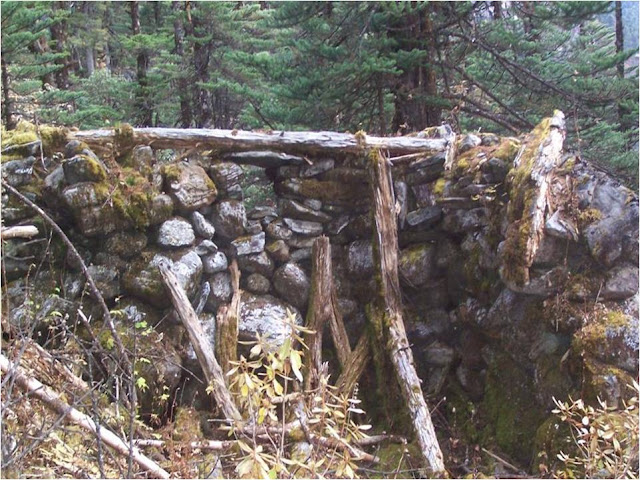
Bunker near Namkha chu

Bunker Bunker near Namkha chu
Bunker near Namkha chu
Namjiang chu with Thagla ridge in the background

Namkha chu (river). Thagla ridge was held by the Chinese.
Tsangdhar dropping zone
Radio set found on the battle field  near the Namkha chu