Showing posts with label Pranab Mukherjee. Show all posts

Thursday, December 15, 2016

On Dalai Lama, India stops being defensive

My article On Dalai Lama, India stops being defensive appeared in the Edit Page of The Pioneer.

Here is the link...

China can keep complaining, but the Dalai Lama is a guest in India, and it is certainly the prerogative of the President to invite him to Rashtrapati Bhavan. The NDA regime is not going to be defensive about the issue
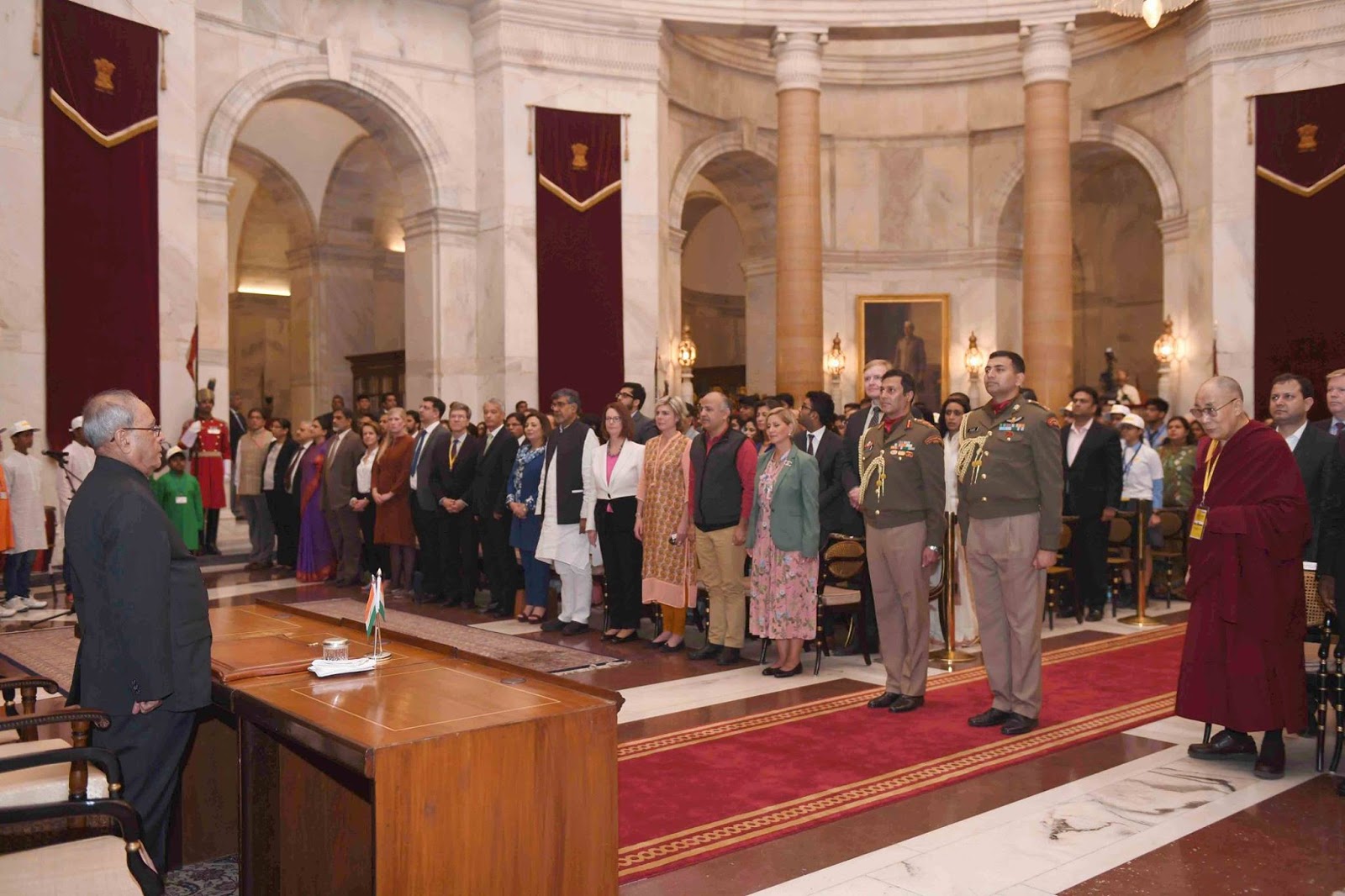
On December 10, President Pranab Mukherjee hosted the first-ever ‘Laureates and Leaders for Children Summit’ at Rashtrapati Bhavan. While reiterating that his Government was committed “to the noble task of fulfillment and protection of child rights everywhere”, the President admitted that some factors “hampering the progress of disadvantaged children need to be removed and equal opportunities provided to them”. The fact that India has decided to take a lead in this field is welcome, and to offer the presidential residence for such noble cause is commendable.
But there’s more to it. One of the guests was the Dalai Lama, Beijing’s bête noire. In the past, Beijing had given all sort of uncharitable names, such as ‘splitist’ or even ‘devil in monk’s garb’, to the Tibetan leader. The last time the Dalai Lama was a formal guest at Rashtrapati Bhavan was when he visited India on the occasion of the 2,500th anniversary of the Buddha Jayanti in the 1950s. In 1957, President Rajendra Prasad hosted a dinner party, which was attended by Prime Minister Jawaharlal Nehru, his Cabinet colleagues and the Tibetan delegation (including the Panchen Lama). The Panchen Lama was then zealously accompanied by Chinese ‘guardians’.
Apa B Pant, the political officer in Sikkim dealing with Tibetan affairs later wrote: “The Chinese in the party gave an impression as if they were ‘greatly upset’… in many ways they tried to ‘protect him’ from too many contacts with Indians. They used to suspect every move of ours and get upset by small incidents which were trifling and insignificant in themselves. The flying of special flags for the two lamas and the non-appearance of the Chinese flag also brought about some comments… they thought that we were ‘making too much of these two lamas’ and giving them too much importance.” What upset the Chinese most was President Rajendra Prasad calling on the Dalai Lama: In a way they thought that we were trying to steal away the lamas from them.”
After nearly 60 years, the Chinese are still upset, though this time they did not make their anger public. How can they criticise the President of India and dictate whom he chooses to receive?
It was not the case when the Tibetan leader recently visited Mongolia. Chinese Foreign Ministry spokesman Geng Shuang saw red and urged Mongolia “to stick to its commitment to Tibet-related issues for maintaining the sound development of bilateral ties... The Dalai Lama is a political refugee who has long been engaged in activities to split China and alienate Tibet from China in the name of religion.”
Geng added: “China resolutely opposes the Dalai Lama visiting any country…We also stand firmly against all forms of contacts between officials from any country and the Dalai Lama.” Well, the Dalai Lama is a guest in India, and it is certainly the prerogative of the President to invite him to Rashtrapati Bhavan.
Does this indicate a change of the Indian policy vis-à-vis the Tibetan issue? It is too early to say, but in the case of Mongolia, the leaders in Ulaanbaatar have been quite courageous to dare facing Beijing’s ire. Beijing’s response was not long to come: A meeting to negotiate soft loans and projects on Tavan Tolgoi railroad, a copper plant and coal gasification project were cancelled. Munkh-Orgil Tsend, Mongolia’s Foreign Minister informed the Press that China had also canceled a bi-annual consultative meeting between the two countries’ Parliaments.
The spokesperson was angry: “We strongly demand that Mongolia…do not provide any form of support and convenience to the group of the Dalai Lama.”
The interesting outcome is that Mongolia turned to Delhi for support. Ulaanbaatar asked India’s help to cope with the freezing of the critical $4.2 billion loan, which was to provide an important lifeline for the country. Vikas Swarup, Ministry of External Affairs spokesperson, asserted that India was “ready to work with Mongolian people in this time of their difficulty.”
Prime Minister Narendra Modi, during his Mongolian visit in May 2015, announced a credit line of one  billion dollars: “Mongolian leadership was highly appreciative of this gesture”, said Swarup.
China is not amused. The Global Times remained philosophical: “China won’t be overly sensitive about India’s cooperation with Mongolia, and won’t mistake India’s assistance as a counter to China… China’s influence on Mongolia’s economy cannot be replaced by India in the short run, and efforts will be in vain if India attempts to ‘bribe’ Mongolia’s loyalty with only one billion dollars.”
While India ‘bribes’ Mongolia, China only ‘helps’ Nepal!Xinhua reported that dozens of trucks carrying $2.8 million worth of products such as clothes, appliances, electronics and building materials had left mainland China for the Nepalese border.
In that case: “When it comes to cooperation with other countries, both China and India should refrain from excessive sensitivity” commented The Global Times, adding: “China’s efforts to connect itself with Nepal will be conducive not only to the export of Chinese-made products, but also to the import of goods from Nepal or even from India.”
Regarding the Lama’s visit to Mongolia, there is probably a political angle to it, which disturbs Beijing; the Mongols would like the Lama to find a reincarnation of their religious leader. It was rumoured that it might have been one of the reasons for inviting the Dalai Lama; the Jetsun Dhampa Lama, who lived many years in India and passed away in 2012, is due to reincarnate. This cannot please Beijing, which would like to keep a monopoly on ‘reincarnations’, and has started making preparations to recognise the next Dalai Lama.
Was the Dalai Lama’s presence at Rashtrapati Bhavan’s function a part of a new Great Game? A soft one? In any case, it is a sign of bolder soft diplomacy on the part of the Modi Government. Remember November 2011? As the preparations for the Global Buddhist Congregation (GBC), organised by the Ashoka Mission (with an attendance by some 900 monks and nuns from over 40 countries), were going on in Delhi, Beijing suddenly objected to the presence of the Dalai Lama in one of the functions; it threatened to call off the 15th round of the border talks between the Special Representatives if India refused to yield and cancel the conference. Beijing also objected to the Indian Prime Minister and President attending the opening ceremony of the GBC.
Eventually, India backed down partially, with the Prime Minister and the President suddenly becoming ‘busy’. But Modi’s India is not Manmohan Singh’s. This time, the Dalai Lama was seen offering a Buddha statue to President Mukherjee.
There is a message for China: India likes the Dalai Lama.

Sunday, December 11, 2016

A great image of soft diplomacy

Yesterday President Pranab Mukherjee spoke during the opening session of the first-ever “Laureates and Leaders for Children Summit” at the Rashtrapati Bhavan.
The President affirmed that the government is committing itself “to the noble task of fulfillment and protection of child rights everywhere”.
However some factors which are “hampering the progress of disadvantaged children need to be removed and equal opportunities provided to them through policy actions taken by the government.”
A Rashtrapati Bhavan spokesperson said the President added: “programmes and actions for children have to take centre stage in national policy-making. We have a shared responsibility to reduce the inequalities that harm the underprivileged children more than any other age group.”
He also asserted: “The path towards an equal future will come through prioritising. The disparities in education, health and poverty indicators will have to be eliminated. The factors hampering the progress of disadvantaged children will have to be removed. We, indeed, have a moral obligation towards our children, towards their development and security and in giving them equal opportunity.”
The fact that the Dalai Lama participated in the function is sign of bolder soft diplomacy from the part of the Modi government.
Remember in November 2011.
As the preparations for the Global Buddhist Congregation (GBC), organized by the Ashoka Mission (with an attendance by some 900 monks and nuns from over 40 countries), were going on in Delhi, Beijing suddenly objected to the presence of the Dalai Lama in one of the functions.
At that time, China went a step further than just protest; it threatened to call off the 15th round of the border talks between the Special Representatives (SR) if India refused to yield and cancel the Conference. Beijing also objected to the Prime Minister and the President attending the opening ceremony of the Congregation.
Eventually, India backed partially down with the Prime Minister and the President suddenly becoming ‘busy’, but the program with the Dalai Lama was reconfirmed.
This time the Dalai Lama participated to the function in the Rashtrapati Bhavan.
Great soft diplomacy? A message to China?

The Dalai Lama with President Rajendra Prasad in 1957
One of the Tibetan leader's last visits to Rashtrapati Bhavan


Sunday, June 28, 2015

The curious case of Zhang’s visit

My article The curious case of Zhang’s visit appeared yesterday in The Asian Age/Deccan Chronicle
Here is the link..

Has not India missed a chance to convey that everything is not rosy in the bilateral relations? Why was the MEA nowhere to be seen? Why did India lose such an opportunity to convey to this powerful Chinese politician, its position on several vexed issues?


The Indian media is a strange creature. It spends its time and energy on obsessions; every few days, it focuses on a new one while wearing blinkers for everything else. But even when it ignores “important” news, nobody seems too much disturbed, as long as there is a good cricket ingredient and some spicy masala.
Imagine my surprise as a China watcher when, one morning earlier this week, I found in my mailbox a communique of the Public Information Bureau announcing that an all-powerful member of the standing committee politburo of the central committee of the Communist Party of China had met Prime Minister Narendra Modi on the previous day.
Zhang Dejiang, chairman of the National People’s Congress (NPC), China’s legislature, had called on Mr Modi, said the PIB.
Mr Zhang is not an ordinary Chinese; he is third most powerful person in the Middle Kingdom; he is one of the seven “emperors” ruling a country which everyone fears (though few will say it openly).
This powerful personage was in Delhi (and later in Mumbai) and nobody seems to have known about it. Was Mr Zhang not as important as LaMoGate? Probably!
Remember when Middle Kingdom No. 2, Premier Li Keqiang, came to Delhi in May 2013. The press went wild for several weeks before. It is true, some People’s Liberation Army’s jawans had come uninvited and were camping in the desolate Depsang plains of Ladakh; this was really irritating.
Then, in 2014, “Emperor No. 1” came. When Xi Jinping landed at Ahmedabad in September, Mr Modi was determined to give him a genuine taste of “Modi Land”. This time again, the masala came from the remote Chumur area of South Ladakh where 1,500 PLA men crossed the “undefined” Line of Actual Control; they were ready to set up camp when India decided to send 2,000 Indian jawans to push them away. Media coverage lasted for weeks.
This time Communist boss No. 3 came and went and noticed?
Hardly anybody!
Even the ministry of external affairs was silent. Its spokespersons are usually known to be amongst the quickest twitterers in India, but this time not a single tweet.
On June 15, the Prime Minister’s Office merely reported, via the PIB, that Mr Zhang called on him on that day. The visit was termed a “parliamentary exchange”.
The PIB communique did not tell us what was really discussed. A new proposal for the LAC in Ladakh? An alternative to the stapled visas for the people of Arunachal or Kashmiris? The “peaceful” spread of the PLA Navy on the oceans of the planet? The new route for the Kailash yatra, flagged off by the foreign minister herself? We will have to wait at least 50 years to read the declassified files.
Mr Zhang just endorsed the Prime Minister’s views that the 21st century is the Asian century and the future of the continent will depend on what India and China achieve individually and jointly.
Apart from the usual bilateral collaboration, the leaders expressed their appreciation for the new interest for the ancient cultural and “spiritual” ties between India and China, citing the joint yoga-tai-chi demonstration witnessed by Mr Modi and Premier Li in Beijing.
Why waste such a high-level visit for such banalities?
I got to know what had happened while scanning the Chinese press. Mr Zhang’s visit lasted four days. It was a “friendly” visit at the invitation of the vice-president and the Lok Sabha’s Speaker, Sumitra Mahajan. It was the first trip in India of an NPC’s chairman in 14 years.
Xinhua reported that Mr Zhang met with vice-president Ansari. They called for strengthening cooperation between legislative bodies of China and India.
During his meetings with the chairpersons of the Indian Houses, Mr Zhang said that he wanted to “upgrade the level and improve the quality of the current cooperation between the legislative bodies of the two countries.” He suggested that the two sides should carry out closer exchanges.
Mr Zhang also met President Pranab Mukherjee to whom he conveyed the cordial greeting of President Xi. He told the Indian President that India and China are not only the two biggest developing countries, but also the two most dynamic market economies in the world. He added: “The two countries should join hands to realise goals for peaceful development, cooperative development and inclusive development, to benefit the 2.5 billion people of the two countries.”
In other words, the usual stuff, but it is always good when it is reiterated at the highest level.
Mr Mukherjee told him that India always lays great importance to developing good, friendly, neighbourly relations with China.
Later, Mr Zhang went to Mumbai where he met the governor and the chief minister.
Has not India missed a chance to convey that everything is not rosy in the bilateral relations, especially on the border issue?
Why was the MEA nowhere to be seen? Even the South Block twitters had fallen silent? Why did India lose such an opportunity to convey to this powerful Chinese politician, its position on several vexed issues?
As for the media, could it not have dropped the cricket scams for a day and covered the visit, asking the right questions?

Sunday, June 21, 2015

Who has seen Zhang Dejiang?

Zhang and President Mukherjee
The Indian media is a strange creature. It spends its time and energy on obsessions; every few days, it focuses on a new one while wearing blinkers for everything else. But even when it ignores ‘important’ news, nobody seems too much disturbed, as long as there is a good cricket ingredient and some spicy masala.
Last week, it was the Minister of External Affairs, Sushma Swaraj’s ‘chance’ to make the headlines; the Everest could have change place (and it did, moving a few centimeters inside Tibet), nobody was bothered.
Of course, cricket is the national game and it has to prime over all other national and international issues. With the foreign minister linked with a latest cricketgate, other information had no chance to make it on the TV plateaus or on the first page of the ‘national’ press (these days, page 1 often becomes page 3 or 5, thanks to giant advertisements for e-commerce or attractive investments).
Imagine my surprise as a China watcher, when one morning earlier this week, I found in my mailbox, a communique of the Public Information Bureau (PIB) announcing that an all-powerful member of the Standing Committee Politburo of the Central Committee of the Communist Party of China had met Prime Minister Narendra Modi on the previous day.
Zhang Dejiang, Chairman of the National People’s Congress (NPC), China’s legislature, had called on Mr. Modi, said the PIB.
Zhang is not an ordinary Chinese, he is third most powerful person in the Middle Kingdom; he is one of the 7 ‘emperors’ ruling a country which everyone fears, (though few will say it openly).
This powerful personage was in Delhi (and later in Mumbai) and nobody seems to have known about it. Was Mr Zhang not as important as LaMoGate? Probably!
Now, remember when Middle Kingdom No 2, Premier Li Keqiang, came to Delhi in May 2013. The press went wild for several weeks before. It is true, some People’s Liberation Army’s jawans had come uninvited and were camping in the desolate Depsang Plains of Ladakh; this was really irritating. But Mr. Li’s visit was so important that the then Indian Foreign Minister ran to Beijing to beg the Premier to come to Delhi.
Then in 2014, ‘Emperor No 1’ came. When Xi Jinping landed at Ahmedabad in September, Prime Minister Narendra Modi was determined to give him and his beautiful wife Peng Liyuan, a genuine taste of ModiLand. The two leaders took a stroll down the picturesque Sabarmati riverfront and sat on a traditional Gujarati swing. This time again, the masala came from the remote Chumur area of South Ladakh where 1,500 PLA men crossed the ‘undefined’ LAC; they were ready to set up camp when India decided to send 2,000 Indian jawans to push them away. They eventually did. Media coverage lasted for weeks.
This time Communist Boss No 3 came and went and who noticed?
Hardly anybody!
On June 15, the Prime Minister's Office merely reported, via the PIB, that Mr Zhang called on him on that day; of course, the Prime Minister “warmly recalled his meeting with the NPC’s Chairman in Beijing on 15 May 2015”.
Zhang’s visit was just termed a ‘parliamentary exchange’, though Mr Modi acknowledged that this was ‘an important pillar of the bilateral relationship’. The Indian Prime Minister stressed the need to broaden the foundation of India-China relations by promoting exchanges between State-level legislatures as well. The fact remains that Zhang’s visit did not get the coverage it should have got in the Indian media.
Even the MEA was silent (though Syed Akbaruddin or his successor, Vikas Swarup are known to be amongst the quickest twitterers in India); this time, not a single tweet; blank. Where was the MEA? Fending for its minister? Not even.
As oftentimes, the PIB communique remained vague and dis not tell us what was really discussed. A new proposal for the LAC in Ladakh? An alternative to the stapled visas for Arunachalis or Kashmiris? The ‘peaceful’ spread of the PLA Navy on the oceans of the planet? The new route for the Kailash yatra, flagged off by the foreign minister herself? We will have to wait at least 50 years to read the declassified files.
Zhang Dejiang just endorsed the Prime Minister’s views that the 21st Century is the Asian Century and the future of the continent will depend on what India and China achieve individually and jointly.
Both leaders emphasized the importance of promoting investment, trade, tourism and people to people ties, and enhancing strategic communication and coordination, they even expressed their appreciation for the new interest in India’s and China’s ancient cultural and ‘spiritual’ ties, citing the joint Yoga Tai-Chi demonstration witnessed by Prime Minister Modi and Premier Li in Beijing.
Why waste such a high-level visit for such banalities?
I asked many journalist friends, but nobody knew anything about the visit.
But being persistent, I finally got to know what had happened while scanning the Chinese press. Mr Zhang’s visit lasted four days. It was a ‘friendly’ visit at the invitation of the Vice President and the Lok Sabha’s Speaker, Sumitra Mahajan. It was the first trip in India of a NPC’s Chairman in 14 years.
Xinhua reported (with nice photos) that Mr. Zhang met with Vice President Ansari the same day that he met the Prime Minister. They called for strengthening cooperation between legislative bodies of China and India.
During his meetings with Chairpersons of the Indian Houses, Mr Zhang said that he wanted to “upgrade the level and improve the quality of the current cooperation between the legislative bodies of the two countries.” He suggested that the two sides should carry out closer exchanges.
Mr Zhang also met President Pranab Mukherjee to whom he conveyed the cordial greeting of President Xi. He told the Indian President that “China and India have thousands of years of friendly exchanges and a history of mutual learning and benefiting from each other's culture” and pointed out that India and China are not only the two biggest developing countries, but also the two most dynamic market economies in the world. He added: “The two countries should join hands to realize goals for peaceful development, cooperative development and inclusive development, to benefit the 2.5 billion people of the two countries."
In other words, the usual stuff, but it is always good when it is reiterated at the highest level.
Pranab Mukherjee told him that India always lays great importance to developing good, friendly, neighborly relations with China.
Later, Mr Zhang went to Mumbai where he met the Governor and the Chief Minister.
Has not India missed a chance to convey that everything is not rosy in the bilateral relations, especially on the border issue?
Why was the MEA nowhere to be seen? Even the South Block twitters had fallen silent? Why did India loose such an opportunity to convey to this powerful Chinese politician, its position on several vexed issues? Why was the Indian public not informed?
As for the media, could it not have dropped the cricket scams for a day and covered the visit, asking the right questions?
The media need not worry, there will be more cricket scams to cover in the future.