Thursday, May 23, 2024

The Last Indian Villages On Tibet Border

My article The Last Indian Villages On Tibet Border appeared  in Rediff.com

Here is the link...

'It is a breathtaking journey towards the Tibet border, especially since the Border Road Organisation has accomplished a fabulous feat in black-topping the road till the border.'

'One is left with a salute for the dauntless Indian soldiers who spend the winter in these majestic, though inhospitable areas (we were told that the temperature comes down to minus 40 in winter),' recounts Claude Arpi.


After searching for years in the old dusty files of the National Archives of India to unveil some of the secrets on a specific subject, one becomes rather familiar with the object of one's research ... but on paper only.
Often the physical reality is vastly different.
This is what happened to me when I recently visited a remote area in Uttarkashi district of Uttarakhand.
The places are Nilang (also written as Nelang), a village located in the Jadh Ganga valley, Jadhang (or Jadhung) and Pulam Sumda, the latter two lying on the upper reaches, towards the India-Tibet frontier. The Line of Actual Control (LAC) with the Chinese army occupying Tibet is located on top of the ridge.
The particularity of the place is that the area was claimed by Tibet before India's independence (and subsequently by China) as part of Tsaparang in Tsamda county of Ngari Prefecture of Western Tibet.

Today, when China claims any area, its Liberation Army first physically takes over the place and later Beijing announces that it is ready for discussions; the disagreement between the Lhasa government and the administration of the erstwhile princely Tehri state (and by extension British India) was different, it continued for decades, at the end of which no mutually acceptable solution was found, but the 'dispute' did not result in any physical clashes or even an increase of the police personnel posted on the border.
A large amount of correspondence took place between Tibet (Lhasa and the Dzongpen or commissioner in Tsaparang) and the princely states of Tehri‐Garhwal, Bashahr (today Kinnaur) as well as the provincial governments of the United Provinces, Punjab and, of course, the Foreign and Political Department of British India in Delhi.

The Brief History of the Dispute

The Gumgum nalla. Not really a border

Let us first look at the long history of the area.
The difference of perception seems to have arisen when the Dzongpen of Tsaparang, the nearby Tibetan district, visited the Gumgum nala in 1914. He publically announced his decision of setting up a boundary pillar on the spot near a bridge.
When the local villagers objected, the Dzongpen left without any further action.


A few kilometres beyond Gangotri, I kept asking my guide, "Where is this Gumgum nalla?" Finally, he pointed out a most insignificant place ...without a real nalla.
It is where the Tibetans had unilaterally decided to 'fix' their border with India. Of course, the watershed principle or other features determining a boundary were unknown to them.
Four years later, in 1918, the Tehri State decided to erect 3 pillars on the top of the watershed, at Tsang Chok‐la, following the watershed principle.
In 1920, the Tehri State surveyed for the first time the area and prepared cultivation maps of the Nelang area. The Jadh Ganga valley was then included in the maps of the princely state.
In 1921, the Tsaparang Dzongpen visited Nelang again. This time, he sent a letter to the Raja of Tehri requesting him to nominate an official to sort out the boundary issue; at that time, it was not yet considered a 'dispute'; it was only a 'difference of perceptions' between friendly neighbours.
The Raja answered that the issue had to be raised through the Government of India as it involved a problem between two foreign governments.
In 1924, it was finally proposed by British India to appoint a boundary commission, but due to the poor communications and the fact that these areas could only be visited in summer, the commission could meet only in the summer of 1926.
Travelling in the Valley, you first note the inaccessibility of the area. On the opposite side of the road, perched on a cliff, is the Gartang Gali (bridge), built some 150 years ago, by Pathans who are said to have come from Peshawar to build this bridge at a height of 11000 feet.
It was finally slightly easier for the villagers to move in the valley and eventually visit the trade marts in Tibet. This wooden step bridge path was closed after the 1962 War; today it has been opened for tourists.
The 3.5 km bridge is indeed a marvel of wooden architecture, worth the visit.

Gartang Gali, a wooden bridge, said to be built by Pathans from Peshawar

The Acton Commission
To return to history, in June 1926, T J C Acton, an officer of the Indian Civil Service, was nominated as the British representative to discuss the issue with Tibetan officials near the Gumgum nala.
The Tibetans claimed that the Tehri people had removed their boundary marks after they had returned to Tibet.
The British commissioner commented: 'Their attitude, I think, was that His Highness [His Holiness] the Dalai Lama had said that the boundary was the Gumgum nala, and that any criticism of that decree would be a dangerous form of blasphemy.'
It was the first of several commissions which would try to solve the problem with the Buddhist neighbour during the following years.

The Chor Gad, another route to Tibet.
At one point, the British, great adepts of compromise, suggested that Nelang could remain with Tehri State while Jadhang would go to Tibet. But a complication soon cropped up, Jadhang (and even Nelang) was claimed by the Bashahr state.
The Tibetan claim of a frontier in line with the Gumgum nala remained 'clearly absurd', according to Acton.
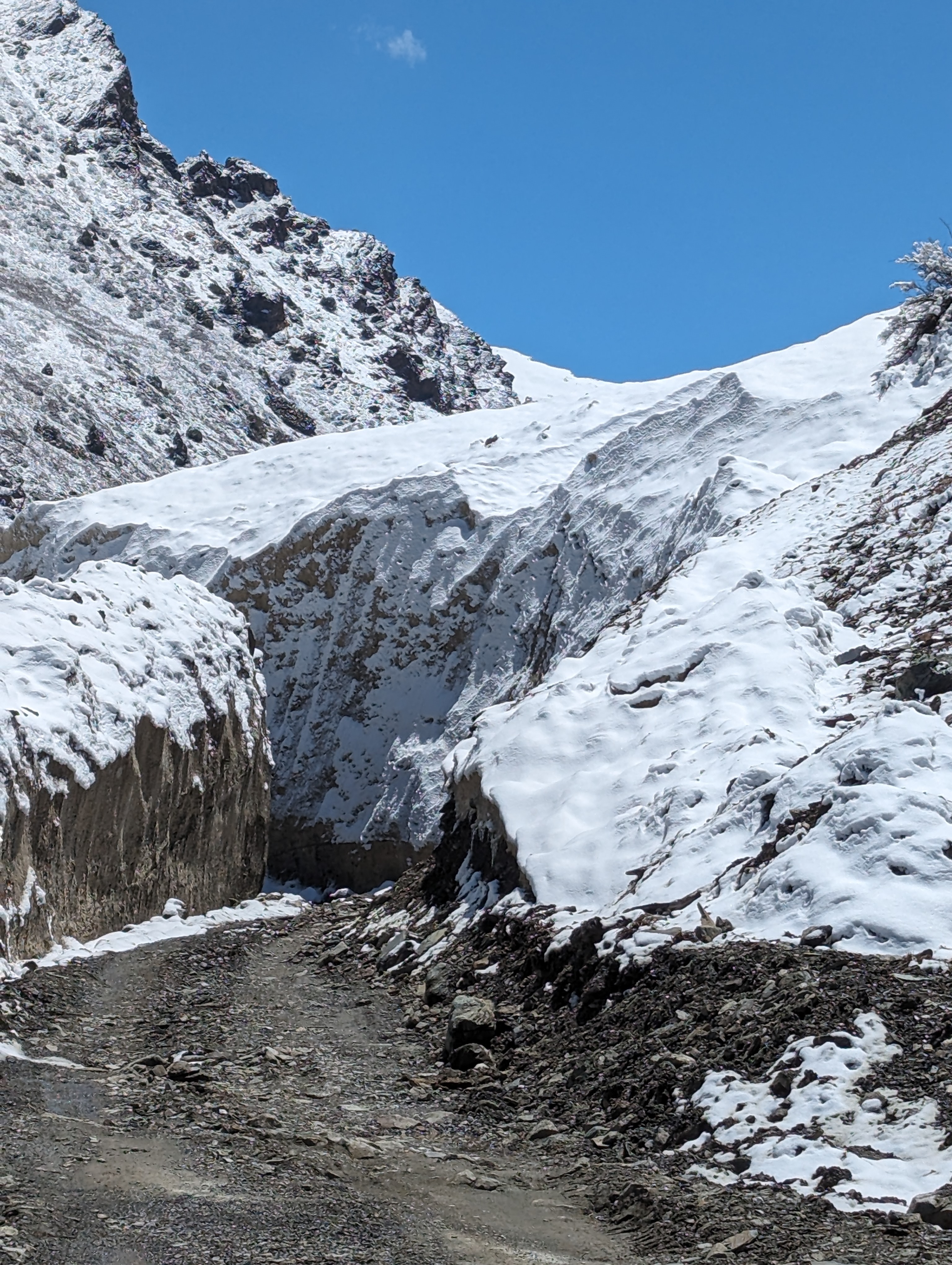
A moraine, a pile of unconsolidated debris, usually soil and rock
left behind by a moving glacier

The Saga Continues

Two years later, on November 14, 1930, Colonel J L R Weir, the political officer in Sikkim, informed the foreign secretary in Delhi that he had received a letter from Lhasa about the Tibet‐Tehri boundary question.
Weir commented: 'This Tehri boundary is one to which much importance is attached by the Tibetan Government so much so that they paid me a special visit to discuss the matter that day.' Nothing came out of a new enquiry.
Colonel Weir was replaced by Frederick Williamson as the political officer in 1932. During a tour in Western Tibet from August to October 1932, Williamson was requested by the Government of India to look into the 'Tehri‐Tibet' dispute again.
In his report, the political officer mentions the Acton Report which 'reported in favour of the watershed boundary claimed by Tehri, but the Government of India considered that the evidence showed that Tibet was entitled to a frontier further to the west.'
Williamson commented 'with the exception of the northwest corner, this tract appeared to my untrained mind to be practically valueless. But the south‐west corner contains valuable deodar forest.'
The discussions continued till Independence.

Nelang Village
Post Independence: The valley occupied
In the early 1950s, the government moved fast following the Himmatsinghji Committee report prepared by the Government of India. One of the actions suggested by the Committee was that areas such Tawang and Nelang should be immediately occupied by Indian forces.

Already in May 1950, the ministry of external affairs had sent a note to the ministry of defence asking the latter to comment on the feasibility to occupy the Nelang/Jadhang area; the Political Officer in Sikkim had noted: 'The guiding principle in the new circumstances must however be the Government of India's ability to vindicate what they would regard as the appropriate frontier.'
While visiting the area today, one realises the difficulty to sustain a permanent occupation of these villages. 

On April 4, 1950, the ministry of defence answered: 'The area under dispute is an extremely difficult country physically and climatically with hardly any communications. It therefore follows that operations in the area will have to be confined to short periods and undertaken by specially trained infantry.'

Six years later, China walked into the area.

On May 2, 1956, the ministry of external affairs complained about a Chinese intrusion. The ministry said: 'Nilang at the area right up to Tsang Chok‐la pass is clearly within Indian territory and has always been in our possession.'

Apart from the fact that the border follows the watershed, the area is clearly Hindu with two small mandirs being maintained by the Indian Army on behalf of the Jadh population.
Today, what remains of the villages of Nelang and Jadhang has been opened to visitors and the Government of India has decided to repopulate the villages under the Vibrant Village programme. This is a fine initiative, though it is not certain that the scheme will immediately succeed. In the meantime, the villages are worth visiting.

 As I entered the Jadh Ganga valley, the story of George Fernandes, the then defence minister, sending babus to the Siachen Glacier to study the topography of the place, instead of getting their knowledge from the files alone, came back to mind.
It is indeed an entirely different experience to travel on a road between two majestic ridges and slowly go up in altitude, from the base camp in Harsil village.
It is a breathtaking journey towards the Tibet border, especially since the Border Road Organisation has accomplished a fabulous feat in black-topping the road till the border.
One is left with a salute for the dauntless Indian soldiers who spend the winter in these majestic, though inhospitable areas (we were told that the temperature comes down to minus 40 in winter).
When India had a peaceful neighbour such measures were not necessary, but today Delhi has no other choice.

Jadh Ganga


Thursday, May 16, 2024

Xi in Europe: How Chinese President posed as ‘ruler of world’ while Europeans 'begged' a solution for Ukraine

My article Xi in Europe: How Chinese President posed as ‘ruler of world’ while Europeans 'begged' a solution for Ukraine appeared in Firstpost

Here is the link...

Macron probably wanted to impress the French public with his diplomatic skills before the European elections in June. Unfortunately for him, banners and flags were unfurled by Uyghur, Tibetan and Chinese activists on the streets of Paris
Xi in Europe: How Chinese President posed as ‘ruler of world’ while Europeans 'begged' a solution for Ukraine


Observers could see that France was fascinated by China when President Xi Jinping of China paid a three-day visit to France; he was lavishly received by his French counterpart, President Emmanuel Macron.
What is strange is that at a time when President Vladimir Putin of Russia is considered to be the supreme villain in France (and in Europe in general), Xi is seen as a decent person that France needs to engage with.
But is Xi really different from Putin? Does he treat his minorities better? Have the Chinese people more freedom than the Russians? Certainly not. But Europeans and Westerners in general remain fascinated by China and prefer to bury their faces in the sand about the dark side of the Middle Kingdom.
Let us not forget that it is thanks to China that, for the past two years, Russia has survived all the US and European sanctions.
Putin may not be what one can call a ‘good human being, but unlike India, France has been unable to find a balanced relationship with Russia and China.
What were Macron’s motivations to receive so elaborately Xi Jinping and his wife Peng Liyuan (a major general of the People’s Liberation Army) with red carpets all over Paris and even in the snows of the Pyrenees mountains?

France’s Short Memory
In France, as elsewhere, political leadership has a short memory.
Who remembers February 23, 2017, when French Prime Minister Bernard Cazeneuve went to Wuhan to inaugurate a ‘P4’ virology laboratory? That day, Cazeneuve declared, “France is proud and happy to have contributed to the construction of the first high biological security ‘P4’ laboratory in China.”
The French Prime Minister further explained: “This cutting-edge tool is a central element in achieving the 2004 intergovernmental agreement on Franco-Chinese cooperation for the prevention and fight against emerging infectious diseases.”
This investment did not prevent or even foresee the forthcoming disaster, though it showed the level of trust between the two countries.
My point is that, despite having a very privileged relationship with India, Paris would not have trusted New Delhi enough to build a P4 lab in India.
But thankfully, during the following years, relations between New Delhi and Paris have grown in strength and depth.

First Visit to China

During his first state visit to China in 2018, the French President brought with him two key messages.
One was the huge possibility of cooperation between China and Europe and France’s commitment to that effort.
The other is a warning to not underestimate growing concern and frustration in Europe and elsewhere with what many regard as China’s unfair trade practices (such as investment restrictions).
At that time, Mathieu Duchatel, deputy director of the Asia and China Programme at the European Council of Foreign Relations, stated: “[Macron] wants to present himself as a leader of the EU, but at the same time, I think he wants to send a signal that Europe and the EU are in better shape than many think in China.”
In 2018, in a speech in Xi’an, in northwestern China’s Shaanxi province, Macron admitted that China faced a “united front from developed countries against its unfair trade practices”.
Nothing has changed since then. This has become acutely worse after the COVID crisis (made in Wuhan), though today the Chinese leadership desperately needs to be accepted by the world. This explains the Chinese President’s first outing after five years (to France, Serbia, and Hungary).

A Failure?
In an article published in Le Figaro (belonging to the Dassault family), President Xi Jinping spoke of “carrying forward the spirit that guided the establishment of China-France Diplomatic Relations [in 1964], working together for global peace and development.”
Xi wrote that he was bringing three messages with him: “China will work with France to carry forward the spirit that guided the establishment of their diplomatic ties, build on past achievements, and open new vistas for China-France relations.” He further observed: “I think it’s important to have a dialogue, everyone together, so we can all go in the same direction. It’s very important for French and Chinese people to communicate. China is a very important country."
He added that China understands the repercussions of the Ukraine crisis on the people of Europe, adding that the longer the Ukraine crisis drags on, the greater harm it will do to Europe and the world.
Good intentions indeed, but will they be followed by resolute action when an economic war is raging between China and the United States?

The French Motivations
Since the beginning of the war in Ukraine, Macron has expressed his desire to ‘play a role’, but it was doubtful from the start that he could influence Beijing, which has its own interests with Russia; despite the official declarations, China has always stood firm behind Putin.
Further, the French President has stated several times that he does not rule out sending ground troops to Ukraine. Is it compatible with ‘playing a role’?
In an interview with The Economist earlier this month, Macron reaffirmed his previous statements backing Ukraine: “If the Russians were to break through the front lines, if there were a Ukrainian request, which is not the case today, we would legitimately have to ask ourselves this question,” he said.
Isabelle Lasserre in Le Figaro frankly noted: “Emmanuel Macron failed to win over his Chinese counterpart, reflecting France’s lack of clout in the face of China.”
Speaking of the joint press conference, she wrote: “Behind the tense face of the French president…and that of the Chinese president, uncomfortable and closed, we could not see the ‘friendship’…but the confrontation between two worlds that oppose each other on everything.”
It is indeed two opposite worlds.

Special Friendly Outing
In a very special gesture, Emmanuel Macron and his wife Brigitte took Xi Jinping and his wife to the Col du Tourmalet in the Pyrenees, where they watched folk local dancers and enjoyed local gastronomy.
Does it remind you of an outing in Mahabalipuram?
They had lunch on the spot; on the menu, typical Pyrenean dishes were chosen by Dominique Bouchait, the local chef. For starters, garbure, the traditional local soup. Then shoulder of lamb confit, with ham from Porc Noir de Bigorre cut into pieces, accompanied by Tarbais beans and porcini mushroom heads. After a cheese platter, for dessert, the chef had prepared a pastry known only to the local Béarnais: le russe (the Russian). It is made with an almond-based cookie and praline paste and is said to originate from Crimea.
However, in view of the war in Ukraine, this dessert, particularly appreciated by Emmanuel and Brigitte Macron, was at the last minute replaced by a banal blueberry tart. Diplomacy and politics prevailed.

Not Much Progress
The bilateral negotiations did not see much progress, though China will allow imports of pig origin protein feed as well as pork offal from France. However, European hopes for an Airbus plane order have been dashed, with the two sides only agreeing to expand cooperation.
A European diplomat said Xi was the ‘winner’ of the visit, having ‘cemented his image as the ‘ruler of the world’ where westerners are begging him to solve European problems in Ukraine’.
Macron probably wanted to impress the French public with his diplomatic skills before the European elections in June. Unfortunately for him, banners and flags were unfurled by Uyghur, Tibetan, and Chinese activists on the streets of Paris. “Free Tibet. Dictator Xi Jingping, your time is up!” stated a large white banner that his motorcade had to drive under on the Outer Boulevard. On the top of the banner was the flag of Tibet, a symbol of the Tibetan independence movement.
The protesters were joined by Chinese, Taiwanese, Mongolian, and Vietnamese human rights activists, as well as Hong Kong pro-democracy supporters, because after all, France is a democracy and people can express their views.

Indo-French Relations
More discreet but perhaps more concrete, on May 13 in Versailles, France will host its seventh edition of the ‘Choose France Forum’.
A French official told Business Today Television: “Seven Indian CEOs will meet President Macron on the 13th. There will be a Franco-India forum where the Indian CEOs will interact with the French CEOs."
The official objective is to welcome more Indian investments in France and to increase further partnership between both countries.
This may not bring votes for the European elections to Macron’s party, but it will certainly enhance relations between France and India.
The South China Morning Post summarised Xi’s three-nation tour: “Xi Jinping, his tour over, leaves behind a Europe split by how to deal with China,” adding: “Despite long-standing ties to President Emmanuel Macron, [Xi] made few if any concessions to reduce the flood of Chinese imports into the European Union.” And no concession on Ukraine either.
But for Xi, these few days must have been a relief from the pressure under which he lives in Beijing.

Saturday, May 11, 2024

Nepal’s flimsy claims on Kali River will not change ground realities, but India must be vigilant

Adi Kailash
My article Nepal’s flimsy claims on Kali River will not change ground realities, but India must be vigilant appeared in Firstpost.

Here is the link...

Though China does not have any claim in the area, it is clear that Chinese have been inciting Nepal to claim Kalapani and beyond, and this is probably to destabilise India


Nepal’s flimsy claims on Kali River will not change ground realities, but India must be vigilant
Kathmandu seems to have forgotten that the location of the Kali river on the maps of the Sino-Nepali treaty matches with the Indian stand: Kalapani is on Indian territory. Image: Wikimedia Commons
A recent visit to the border areas of the Central Sector of the Indo-Tibet boundary was an eye-opener. The first thing that I witnessed was the considerable efforts that have been made by the Central government (through the Border Road Organisation of the Indian Army) to connect to ‘the world’ in these remote locations.
The accounts of travellers, yogis (particularly Swami Pranavanada in the 1930s), yatris (to Kailash Mountain), or Indian officials posted in Gartok in western Tibet always struck me for the description of the harsh terrain near the tri-junction of India, Tibet, and Nepal; till recently, the journey was indeed extremely perilous.
To give an example, a few years ago, it took up to a 27-day walk for a yatri to travel from Darchula to Lipulekh and later come back (in Tibet, they were taken by buses to the Kailash base camp). Today the road reaches a few hundred metres from the top of Lipulekh, the border pass separating Kumaon (near the trijunction with Tibet and Nepal) from Purang County (Dzong) in Tibet.
The black-topping of the road between Darchula and Lipulekh is not yet fully completed, but it is a matter of a few more months before the tar will be laid all the way to the pass.
The implication of this development is that access to the Indian Army and the Indo-Tibet Border Police (ITBP) is far easier; today, the defence forces can answer any contingencies in the shortest possible time, which also makes the lives of the local population simpler.
Though this area did not witness any confrontation during the 1962 War with China and is not directly claimed by Beijing, it remains ‘disputed’ through China’s proxy, Nepal.

In the News Again
The issue was recently in the news when Kathmandu decided to incorporate on their 100-rupee banknotes a new political map of Nepal, covering the so-called disputed territories of Lipulekh, Limpiyadhura, and Kalapani as part of the Nepali territory.
External Affairs Minister S Jaishankar was quick to answer: “I saw that report. I have not looked at it in detail, but I think our position is very clear. With Nepal, we were having discussions about our boundary matters through an established platform. And then, in the middle of that, they unilaterally took some measures on their side. But by doing something on their side, [Nepal is] not going to change the situation between us or the reality on the ground,” said Jaishankar.
Nepal, which now tries to unilaterally change the maps, has not always claimed the Indian village of Kalapani, the main resurgence of the Kali river, which has its origin in a rivulet near Lipulekh.
In May 2020, an argument erupted between India and Nepal; the immediate reason was an 80-km road from Darchula to Lipulekh.
Strategically, this road is crucial for India, but also important for the yatris and local traders, Lipulekh being one of the three landports between India and Tibet.
It was only in 1998 that the CPN-ML faction led by Bam Dev Gautam started claiming some Indian territory in the vicinity of Kalapani as Nepalese. According to Buddhi Narayan Shrestha, a former Director General of the Land Survey Department, the ‘Kali River’ was the Kuti Yankti river that arises below the Limpiyadhura range and not the Kali accepted by India; Nepal began then claiming an entire area of 400 km².

But why was no claim put forward by Nepal for the previous 150 years?
This has never been explained by Kathmandu, and some flimsy historical excuses are being used today.
A Nepali argument is that the flow of the Kuti river is more significant, though this does not prove anything. In his book, History of the Kailash-Mansarovar, Swami Pranavananda, who extensively wrote on the subject, mentioned the confluence of the Kali and Kuti rivers “at a distance of 2 or 3 furlongs down below the road. Though the River Kuti is almost twice or thrice as big as Kali, the Kali is taken to be the main river.” The Swami also noted that the local population attached to Garbyang village is not of Nepali stock.
Advertisement

Tracing the History
After a war between British India and Nepal in 1814, the Nepalis were sent back across the Kali River in May 1815, and subsequently, the Sugauli Treaty was signed on March 4, 1816. Article 5 of the Treaty stated: “The Rajah of Nepaul renounces for himself, his heirs and successors, all claim to or connexion with the countries lying to the west of the River Kali, and engages never to have any concern with those countries or the inhabitants thereof.”
Unfortunately, no map was attached, which could have authoritatively shown the exact alignment and source of the Kali River.
In any case, at that time, no scientific survey worth the name could be carried out; it was only by the mid-19th century that the Himalayan border was first surveyed by the Great Trigonometrical Survey of India (a precursor of the Survey of India), in a more scientific manner.
Today, the Nepalis base their claims on an old map that is neither accurate nor authentic. From 1998 until 2020, the Nepalese government continued to keep quiet, but in May 2020, Kathmandu for the first time released a map incorporating the entire area east of the Kuti Yankti River as part of their territory. To make it worse, on June 13, a bill seeking to give legal status to the new map was unanimously approved by the lower house in the Nepal Parliament.
The political struggle within the ruling party in Nepal further complicated the issue.

The Border in the 1950s
Interestingly, in the early 1950s, the Indian police already manned a check post at Kalapani. In his diary, Lakshman Singh Jangpangi, the Indian Trade Agent in Gartok, wrote: “July 10, 1955. I could not start on 9th, as my clerk suddenly ran a very high temperature and was unable to leave his bed. The Compounder was sent with the advance party on 6th. This clerk was today better and fit to travel, I started and camped at Kalapani Police Post. A section of P.A.C. [Provincial Armed Constabulary] under Subedar Sher Singh has been stationed here since June 28, 1955. The Garbyang villagers have cultivated land close to the post.”
When the police post was set up by the Uttar Pradesh government, probably in 1952, Nepal did not object.

The 1961 Sino-Nepal Treaty
But there is more, the “Boundary Treaty between the People’s Republic of China and the Kingdom of Nepal,” signed by President Liu Shaoqi of China and King Mahendra of Nepal on October 5, 1961, shows the Kali River as per the Indian stand. Article I (1) defines the China-Nepal boundary line, which “starts from the point where the watershed between the Kali River and the Tinkar River meets the watershed between the tributaries of the Mapchu (Karnali) River on the one hand and the Tinkar River on the other hand”.
More telling are the precise maps attached to the treaty and signed by both parties; Kathmandu seems to have forgotten that the location of the river on the maps of the Sino-Nepali treaty matches with the Indian stand: Kalapani is on Indian territory.

Other Proofs in Favour of India’s Stand
The Memorandum between the Government of the Republic of India and the Government of the People’s Republic of China on the Resumption of Border Trade, signed on December 13, 1991, and the Protocol on Entry and Exit Procedures for Border Trade, signed on July 1, 1992, are other examples confirming that China agreed with India on the border in this area.
For Beijing, the border pass was (and still is today) Lipulekh. Once again, Kathmandu did not protest.

The Chinese Stakes
Though China does not have any claim in the area, it is clear that Chinese have been inciting Nepal to claim Kalapani and beyond, and this is probably to destabilise India.
The visit of Wang Junzheng, the TAR party secretary, to Kathmandu last November set the ball rolling. The Tibet delegation (without any Tibetans) announced that they wanted to maintain the “good momentum of high-level exchanges between the two countries”. During his stay, Wang met, among others, Prime Minister Pushpa Kamal Dahal ‘Prachanda’.
A five-year initiative for Nepal’s northern border districts was then created; it offered different kinds of logistical and material support, mostly for building schools and health posts, installing solar electricity in the 15 northern districts of Nepal.
A preparatory meeting was recently held in Lhasa on April 23 and 24; all this means a more important Chinese presence in Nepal, including in Darchula district (of Nepal), bordering India.
Besides these political aspects, the stunning and majestic beauty of the area (particularly the Om Parvat and the Adi Kailash) will hopefully attract more and more Indian visitors in the years to come. After all, it is Indian territory.

The border in the Kalapani/Lipulekh sector

Om Parvat near the trijunction India-Tibet-Nepal at Tinkar Pass


Cave in which Maharishi Vyasa meditated and wrote the Mahabharata (near Kalapani)

Chinese map showing Chinese claims (green) and Nepali claims (mauve)

First Pillar on Sino-Nepal border near Tinkar Pass

Friday, April 19, 2024

A Tibetan Lama in the Land of the Dragon

A few years ago, during a visit to Drukyul, the Land of the Dragon as Bhutan is locally known, I had the occasion to meet a group of Bhutanese scholars and historians belonging to a local think-tank. During the course of the discussion, the term “our Northern neighbour” kept coming up in the conversation.
As I was wondering why the Bhutanese were not naming China, I asked an Indian friend accompanying me: “why nobody names China”. My friend explained that as a ‘small’ (by size at least) country, Drukyul does not like even to pronounce the name of its northern neighbour.
A formula used by the 13th Dalai Lama as he was chased out of his country by a Chinese warlord in 1910, returned to my mind: “The big insect always eat small insects”.
In the past Tibet played the role of ‘big insect’ for Bhutan, the southern neighbour.
Till very recently, Thimphu has been extremely wary of the Tibetans; for example the Dalai Lama has never been permitted to visit the Land of Dragon, even 65 years after he took refuge in India.
The recent visit to Bhutan by one of the highest Tibetan lams should be seen in this background.

Sakya Trichen

Known as His Holiness Kyabgon Gongma Trichen Rinpoche, the respected lama served as the 41st head (Trizin) of the Sakya School of Tibetan Buddhism from 1951 until March 2017, when he handed over his responsibilities of throne-holder to a successor.
His biography says: “His Holiness Sakya Trichen [former throne-holder] is renowned throughout the world for the brilliance and clarity of his teachings and his fluency and precise command of English. Receiving teachings directly from His Holiness carries a special lineage of blessings from the founders of the Sakya Order, as well as from Manjushri himself.”
It speaks of an unbroken lineage dating back to 1073 A.D.: “Since this celestial race descended upon earth over one thousand years ago, the lineage remains unbroken to this day. Many illustrious masters and practitioners have appeared in the lineage including the Five Great Masters of the Sakya Order”.
Sakya Trichen is a member of Khon noble family, which founded the Sakya School in the eleventh century and ruled over Tibet for centuries. The present Sakya Trichen is said to be a manifestation of Manjusri, the Buddha of transcendent wisdom.
First relocated in Darjeeling in 1959, the Lama soon shifted to Rajpur, near Dehra Dun from where he reestablished the Sakya monastery and preserved his lineage’s tradition.

The Visit
Sakya Trichen left India for his inaugural visit to Bhutan on April 9.
As he arrived at the Paro Airport, he was received by Dzongsar Jamyang Khyentse Rinpoche, one of his foremost disciples, who apparently organized the visit.
Incidentally, Khyentse is not only a renowned religious teacher, but also a filmmaker (he directed the hugely successful “The Cup”), a photographer and a football fan. Khyentse was born in 1961 into a ‘hard-core Buddhist family’ in the ‘staunchly Buddhist country’ of Bhutan. At the age of seven, he was recognized by the same Sakya Trichen as the main incarnation of the unrivaled Dzongsar Jamyang Khyentse Chökyi Lodrö, the spiritual heir of one of the most influential and admired 19th century ‘Rime’ (non-sectarian) traditions of Tibetan Buddhism; his biographer says: “At a time when sectarianism threatened to decimate the Tibetan Buddhist tradition, in a unique collaboration with Jamgon Kongtrul Lodrö Taye and Chogyur Lingpa, Khyentse Wangpo was responsible for initiating and promoting Rime throughout the Land of Snow, effectively breathing new life into all schools of Buddhism, and rescuing many lineages from complete extinction.”
It was in the 19th century.

Sakya Trichen in Bhutan
On April 11, Sakya Trichen emphasized the importance of devotion to Guru Rinpoche (also known as Padmasambhava) in today’s world.
The next day, he met Dzongsar Khyentse and other Bhutanese Rinpoches.
Most impressive was the grand procession in Bumthang on April 13 where tens of thousands of devotees had gathered to receive the teachings and blessings of the 78-year old lama. Sakya Trichen took the opportunity to bestow a number of oral transmissions and empowerments to the local population.
On April 15, he had an audience with the King and the Queen of Bhutan and some of the members of the royal family, during which the Tibetan lama was accompanied by his wife Dagmo Tashi Lhakyi Sakya.
Interestingly, on the following day, he met the Lopens of the Zhung Dratshang or Central Monk Body of the Drukpa Kagyu tradition established in 1620 by Shabdrung Ngawang Tenzin Namgyel, the Founder of the Bhutanese State who unified the country, codified the laws, and set up the dual system of governance (religious and secular).
In 1637, the Sangha moved to Punakha Dzong, which still today continues to serve as the winter headquarters of the Zhung Dratshang, representing more than 7,000 monks, nuns and gomchens (meditators). According to the Constitution of Bhutan, the Zhung Dratshang is an autonomous institution, financed by an annual grant from the Royal Government.
The Tibetan Rinpoche had the occasion to mention the long cordial relations between the Zhung Dratshang and the Sakya lineage since the 17th century.

Why the Visit is Important
There is no doubt that the visit, though not covered by the world media, has important religious as well political implications.
First, it showcased that despite the differences, the cultural bondage between Tibet and Bhutan remains strong; it also demonstrates the spiritual reverence for a non-Bhutanese respected lama; let us remember that Sakya Trichen belongs to a different school than the main stream Drukpa Kagyu in Bhutan.
In his speeches, the Tibetan lama lauded time and again Bhutan's spiritual atmosphere; he was happy to visit the ancient gompas and enjoyed meeting the common people as well as the religious leaders of the country. He was all praise for the royal family, particularly the “Dharma Raja”, the present king (the Fifth of the Wangchuk dynasty), whose role was stressed time and again as pivotal to the nation’s progress.
Religiously, the Sakya lama stressed Guru Rinpoche's significance; he asked the Bhutanese to pray for the Tantric master of Swat, who strengthen Buddhism in the 8th century in Tibet and visited several places in Bhutan during his spiritual peregrinations. For the lama, Bhutan, with its ethos of Gross National Happiness, encapsulates a harmonious blend of cultural development, spiritual atmosphere and aspiration for global peace.
The visit of Sakya Trichen to the famous Paro Taktsang or ‘Tiger's Nest’, a monastery built on a cliff wall about 900 m above Paro valley is significant in this context as the monastery is built around a cave where Padmasambhava is said to have meditated. The sage is said to have flown there from Tibet on the back of Yeshe Tsogyal, his consort, whom he had, for the purpose, transformed into a flying tigress.

Political Significance

But the visit has also a political significance, at a time whom the ‘northern neighbour’ repeatedly intrudes into Bhutanese territory to bully Thimphu; the visit of the Indian Prime Minister Modi in April was probably linked to this, particularly the fact that Beijing is trying to force a border agreement on Bhutan. Could a Tibetan lama siding with its former ‘southern neighbour’ make Beijing think twice? Not sure.
One should remember that relations have not always been cordial between the Tibetans and the Bhutanese.
On April 5, 1964, Jigmie Dorji, then Bhutanese Prime Minister was assassinated by some Bhutanese officers.
Three days after the murder, the alleged assassin, Zambay was arrested; he apparently confessed that Bhutan’s deputy commander-in-chief, Brigadier Namgyal Bahadur, had ordered him to kill the Prime Minister.
The then King Jigme Dorji Wangchuk was then away in Switzerland; he returned hurriedly but rumours had already circulated that Yankie, the Tibetan mistress of the King, was involved, being jealous of the power of the Dorji family.
Eventually, a total of 39 army officers, including Brigadier Bahadur, were arrested and the brigadier was executed by a firing squad on May 17. Zambay was put to death on July 4.
Referring to local reports, the Bhutanese court that convicted Brigadier Bahadur noted: “There is no evidence at all that any foreign power was in any way involved.... The full and the entire responsibility for this plot belongs to these accused and only to them.”
Though Yankie was exonerated, mistrust continued to persist.
One could mention many such incidents showing that the suspicion between the Bhutanese and the Tibetans has continued; with this background, the visit of the Sakya lama is a most welcome change and it could be a powerful message to China that ‘divide and rule’ between traditional neighbours cannot be exploited forever.
Will the visit of the Sakya Trichen be followed by a trip of the Dalai Lama to the Land of the Dragon?
It is too early to say, but it would be interesting…

Sunday, March 31, 2024

From Tibet To India: Looking Back At Dalai Lama’s Journey

The program of Nitin Gokhale ('Simply Nitin') of StatNewsGlobal quotes me.
Here is the Video...

It was this week sixty-five years ago that will remain etched in the minds of Tibetans as a watershed. On March 31, 1959, His Holiness the 14th Dalai Lama, Tenzin Gyatso, entered India to seek refuge. It was a particularly troublesome month for the Tibetan administration when Chinese troops marched into Tibet and took control. The Dalai Lama was barely 23 then and there was a sense that he could be arrested by PLA troops.

On March 17, 1959, the Dalai Lama, his family members and some of his close associates left the Potala Palace in Lhasa. They travelled south towards the McMahon Line (which separates Tibet from India) and the destination was India, the North East Frontier Agency or NEFA (which is now Arunachal Pradesh).

The Dalai Lama was dressed as an ordinary Chinese soldier. The journey took about a fortnight, through inhospitable terrain and mountain passes. They also had to watch out whether Chinese soldiers were on their trail.

In one of his blogs, noted Tibetologist and author Claude Arpi gives a vivid description of what followed.

Friday, March 29, 2024

Dalai Lama's arrival in Tawang: 65 years on, India-China ties remain complex and chaotic

My article
Dalai Lama's arrival in Tawang: 65 years on, India-China ties remain complex and chaotic appeared in Firstpost...

The Dalai Lama’s escape to Tawang in 1959 not only marked a significant turning point in India-China relations but also highlighted the enduring struggle for Tibetan autonomy amid shifting regional dynamics 

Here is the link...

Sixty-five years ago, momentous events took place on the Tibetan plateau; they had incalculable and incredible consequences for India, which until then had peaceful northern borders.
On 31 March, 1959, the 14th Dalai Lama of Tibet crossed the Indian border at Khenzimane on the riverbank of the Namjiang Chu (river) in the Tawang sector of today’s Arunachal Pradesh.
A few days earlier, camping in Lhuntse Dzong in Southern Tibet, the Tibetan leader had sent a cable to the Indian prime minister. The Dalai Lama who had just denounced the 17-Point Agreement signed under duress in Beijing in May 1951, said: “The Government of Tibet have tried their best to maintain good relations with China but the Chinese have been trying to take away powers from the Tibetan Government and in some areas they are making preparations for war. On March 17, 1959 at 4 pm the Chinese fired two shells in the direction of my residence. They could not do much damage. [But] as our lives were in danger, I and some of my trusted [people] manage to escape the same evening at 10 pm.”
On 27 March, TS Murty, the Assistant Political Officer in Tawang received instructions about the possibility of the Dalai Lama seeking entry into India. He was immediately asked to proceed towards the border to receive the dignitary and escort him to Tawang, Bomdila and Tezpur.
An archive document from the Government of India stated: “Expecting that some such development might occur, we had instructed the various check-posts there what to do. So, when the Dalai Lama crossed over into our territory, he was received by our Assistant Political Officer of the Tawang Sub-Division. …A little later, the rest of his entourage came in. The total numbers who have come with him or after him is 80.” More than 85,000 Tibetans would come to India during the following years.

Dalai Lama arrives in India
On 31 March at 9 am, Murty reached Chuthangmu, where a detachment of the 5th Battalion of the Assam Rifles was posted. The Dalai Lama’s advance party under a junior officer had already reached the post two days earlier. Murty was told that the main party consisting of the Dalai Lama, his family, ministers and tutors was expected to enter India at 2 pm the same day.
Advertisement
Murty communicated to Bomdila and Shillong (seat of the Governor of Assam) that there was no sign of the Chinese pursuit.
After planting his walking stick (which since then has become a beautiful tree and is known by the locals as the ‘Holy Tree’) on the frontier at Khenzimane, the Dalai Lama proceeded to Chuthangmu check-post where Murty handed over to him the Indian prime minister’s message. The Tibetan leader was immediately treated by India as an ‘honoured guest’ and for the past 65 years, he has remained so.
This would have important consequences for India. Soon after, the first clashes took place with the Chinese on the border (the first serious skirmish happened in Longju in Subansiri sector on 25 August, 1959). It was undoubtedly for the warm welcome given to the Tibetan leader.

Today’s Chinese claims
Recently, Beijing has again started claiming the area (corresponding to the state of Arunachal Pradesh) as its own. However, it is worth noting that when the Dalai Lama and his entourage entered India at Khenzimane in 1959, the Chinese government did not protest about the location of the border or even claim that Tawang was ‘Southern Tibet’ (the term used today by Beijing to define Tawang).
They knew perfectly well that the Tibetan leader had taken refuge in Indian territory. Strangely, Beijing is today insisting that Tawang district is part of the People’s Republic of China, but it is clearly an afterthought.
Had Beijing already believed that Tawang area was part of the Chinese territory in 1959, the Chinese troops would have followed the Dalai Lama and his entourage into this area and stopped him from moving to Assam.
The Dalai Lama also clearly mentions in his autobiography that Chuthangmu was the border where he was received by a detachment of the Assam Riffles. He wrote: “I would like to state how the Government of India’s officers posted there had spared no efforts in making my stay and journey through this extremely well administered part of India as comfort-able as possible.”

Events of March 1959
The Tibetan leader’s arrival in India was the culmination of the events of March 1959 in Tibet. It included the popular uprising on 10 March. The escape of the Dalai Lama from Lhasa on the night of 17 March, the massacre of the Tibetan population during the following days and finally the so-called ‘emancipation’ (or ‘liberation’) of the Tibetans by the Communists.
In his ‘Report for the months of March, April and May 1959’ sent to the Ministry of External Affairs, Maj SL Chibber, the Indian Consul General in Lhasa recounted: “In the history of movement for free Tibet, the month of March, 1959, will be most historic …during this month Tibetans high and low, in Lhasa, capital of Tibet, openly challenged the Chinese rule … the might of [the] Chinese People’s Liberation Army (PLA), who on March 20, 1959, started an all-out offensive against the ill-organised, ill-equipped and untrained Tibetans with artillery, mortars, machine guns and all types of automatic weapons, [the protest] was short-lived.”
Chibber continued: “On March 28, 1959, the State Council of the Peoples Republic of China dissolved the local Tibet Government and transferred all its functions and powers to the Preparatory Committee for the Tibetan Autonomous Region (TAR).”
Another account was given by the Chinese author, Jianglin Li in her book, Tibet in Agony. She used Chinese sources to describe the crackdown in Lhasa. Jianglin wrote: “From March 25 to April 5, the CPC’s Central Committee held an enlarged politburo meeting, and the seventh plenary session of the Eighth Central Committee in Shanghai. Pacification of rebellion in Tibet and relations with India were two of the issues discussed. Wu Lengxi, who was then head of Xinhua news agency and chief editor of The People’s Daily, revealed a glimpse of Mao’s thinking on the China-India relationship in his memoir: ‘Let the Indian Government commit all the wrongs for now. When the time comes, we will settle accounts with them’ [would have said the Great Helmsman].”
The accounts were ‘settled’ three years later (in October 1962) when the 7Th Infantry Brigade was decimated on the slopes of the Thagla ridge.
Since then, Beijing has used its propaganda machinery to paint the dramatic events of 1959 in white when they were black.

Propaganda continues
As recently as 21 March, 2024, China Tibet Network republished an interview of Anna Louise Strong, the author of A Million Serfs Stand Up. She, like Edgar Snow, falls in the category of what Lenin described as the ‘useful idiots’, i.e. foreigners defending all the actions of the Communist Party of China, including during the Cultural Revolution.
In August 1959, she was one the first foreign journalists to arrive in Tibet after the massacre of the Tibetans (prosaically called ‘democratic reform’ by Beijing); she wrote: “The air on the plateau is thin, and the entire nature seems to be soaked in sunlight. Snow peaks, rocks, cliffs, and long sloping pastures all have very bright colors, which are more dazzling than any scenery I have ever seen." She added, “Maybe instead of trusting others, it’s better to go and see for yourself.”
The Chinese website said: “In the next months, she visited Norbulingka, Jokhang Temple, Potala Palace, Drepung Temple, walked into the fields, and walked into the former serfs …She interviewed monks and former serfs, celebrated the Fruit Festival with farmers and herdsmen, and felt the joy of the harvest.” Strong celebrated the Communist ‘emancipation’ of the Tibetans.
Sixty-five years later, Beijing still uses Strong’s propaganda writings to justify their 1959 actions, forgetting that according to Chinese own records, 87,000 Tibetans were killed during these few weeks of March and April 1959, though according to China Tibet Network: “[Strong] did a lot of homework, analyzed the background of democratic reform, and also carefully observed and recorded the situation of democratic reforms in Lhasa, Shannan, Shigatse, Nyingchi and other places, and completed When serfs stood up in Tibet.”

End of a way of life
RS Kapur, another Indian official posted as Indian Trade Agent in Gyantse, wrote in his usually emotionless Annual Report for the Year 1959: “While heart of Tibet was bleeding the free world only made speeches. With the end of the debate on Tibet in the United Nations, Tibetans lost all hopes of their survival, stare at the sky with the blank eyes and ask: Where is God? Where is Buddha? How can world witness such brutal acts on a race that has always wanted to live in peace?”
Kapur added: “Buddha, the Tibetans say, has disappeared from the world; [they] are fast losing hopes of survival of their race. From all appearance Tibet is finished.”
Sixty-five years of a very sad tale indeed. But we have perhaps not seen the end of the story.

Sixty Five Years Ago: The Dalai Lama crosses over to India

An article written five years ago...

At a time when China says that the reincarnation of the Dalai Lama is not his ‘personal decision’, but that he should follow the ‘Communist Party’s instructions’, it is important to remember the momentous event which took place sixty years ago in the North East Frontier Agency (NEFA), today’s Arunachal Pradesh.
On March 31, 1959, the 14th Dalai Lama of Tibet crossed the Indo-Tibet border at Khenzimane in the NEFA’s Kameng Frontier Division, north of Tawang; a couple of kilometers south, he met a detachment of the Assam Rifles waiting to welcome him at Chuthangmu.
Since then, he has been an honoured guest of India.
Four days earlier, the 24-year-old Tibetan leader had sent a message to Jawaharlal Nehru, the Prime Minister of India: “Ever since Tibet went under the control of Red China and the Tibetan Government lost its powers in 1951, I, my Government officers and citizens have been trying to maintain peace in Tibet, but the Chinese Government has been gradually subduing the Tibetan Government.
He further stated: “The Tibetans have great love for and faith in Buddhism and their religion is more precious to them than their lives. In order to root out Buddhism, the Chinese published some articles in the press against Lord Buddha’s teachings and circulated them widely. This has created [an] unhappy atmosphere amongst the Tibetans and they have started disliking intensely the Chinese Administration.”
The Dalai Lama told Nehru about the circumstances of his departure: “On March 17 at 4 pm, the Chinese fired two shells in the direction of my residence. They could not do much damage. As our lives were in danger, I and some of my trusted staff managed to escape the same evening at 10 pm.”
The party headed south and reached Lhuntse Dzong, north of the NEFA on March 26, after what has been termed as the Escape of the Century. The Dalai Lama observed: “India and Tibet have had religious relations for thousand years and they are like brothers without any differences;” he then requested Nehru for asylum: “In this critical situation we are entering India via Tsona [last town north of Tawang]. I hope that you will please make necessary arrangements for us in the Indian territory.”
Ever since, India has looked after the Tibetan leader’s welfare.

The Arrival in India
On March 27, TS Murty, the Assistant Political Officer was told to rush from his headquarters in Tawang to the border; on March 31 in the morning, he reached Chuthangmu in time to receive the Tibetan Lama.
The Dalai Lama’s advance party, under a junior officer, had already come two days earlier; they had informed the Assam Rifles that the main group consisted of the Dalai Lama, his family, his two tutors and three ministers; they were expected to enter India soon. Indian officials were also told that there was no sign of a Chinese pursuit; the party only needed more porters once they entered India.
A secret report sent to Delhi observed: “At 1400 hours on March 31, the Dalai Lama and his party reached Kenze Mane [Khenzimane] which demarcates the frontier in Chuthangmu area. His Holiness was riding a yak and was received by the Assistant Political Officer, Tawang. They proceeded to the checkpost without halting at the frontier.”
It was agreed that all porters, who had come from Tibet, would be sent back and that porterage arrangements thereafter would be made by the Government of India; the report continued: “It was also agreed that all pistols and revolvers, except those in possession of the Dalai Lama, his family and ministers (excluding their servants), and all rifles would be handed over to us for safe custody and that these could be collected at the frontier by those members of the body guard who were to return to Tibet after escorting the Dalai Lama to the plains or that alternatively, we would keep that in our custody and obtain disposal orders from the Government.” It is doubtful if the Dalai Lama himself had a pistol.
A reply from the Prime Minister to the Dalai Lama’s message was received through KL Mehta, Advisor to the Government of Assam on April 3: “I received Your Holiness' message only yesterday on my return to Delhi. My colleagues and I welcome you and send you greetings on your safe arrival in India. We shall be happy to afford the necessary facilities for you, your family and entourage to reside in India. The people of India who hold you in great veneration will no doubt accord their traditional respect to your person.”
Sixty years later, the veneration remains.

The Dalai Lama’s account
Let us come back a few days earlier.
In his memoirs, Freedom in Exile, the Dalai Lama narrated his last days in Tibet: “From Lhuntse Dzong we passed to the small village of Jhora and from there to the Karpo pass, the last before the border. Just as we were nearing the highest point of the track we received a bad shock. Out of nowhere, an aeroplane appeared and flew directly overhead. It passed quickly - too quickly for anyone to be able to see what markings it had - but not so fast that the people on board could have missed spotting us. This was not a good sign. If it was Chinese, as it probably was, there was a good chance that they now knew where we were. With this information they could return to attack us from the air, against which we had no protection. Whatever the identity of the aircraft, it was a forceful reminder that I was not safe anywhere in Tibet. Any misgivings I had about going into exile vanished with this realisation: India was our only hope.”
As the party was spending its last night in a small village called Mangmang; it suddenly began to rain: “This was on top of a week of appalling weather, which threw blizzards and snow glare at us by turns as we straggled along. We were all exhausted and it was the last thing that we needed, but it continued torrentially throughout the night,” remembered the Dalai Lama.
Though the young leader was very sick, he decided to move on: “I now had the difficult task of saying goodbye to the soldiers and freedom fighters who had escorted me all the way from Lhasa, and who were now about to turn and face the Chinese. There was one official too who decided to remain. He said that he did not think that he could be of much use in India, therefore it would be better to stay and fight. I really admired his determination and courage.”
It is how the Dalai Lama arrived in India sixty years ago: “After bidding these people a tearful farewell, I was helped on to the broad back of a dzomo, for I was still too ill to ride a horse. And it was on this humble form of transport that I left my native land.”
On the back of a yak!


A Report from the Political Officer
Har Mander Singh, the Political Officer (PO) of the Kameng Frontier Division received the Tibetan leader in Lumla, south of the border, mid-way to Tawang.
Har Mander informed Delhi that after crossing to India, the Dalai Lama had moved south, passed the historical Gorsam Stupa, reached Shakti village the next day and Lumla on April 3.
Here the PO had long discussions with the Tibetan officials and the Dalai Lama: “the [Tibetan] Foreign Minister [Thupten Liushar] briefly recounted the circumstances under which the Dalai Lama was forced to leave Tibet. About the relations between China and Tibet, he said: “…The Government of Tibet was, however, in possession of documents refuting Chinese claim of suzerainty over them and in support of theirs being an independent country.”
Liushar said that the Dalai Lama himself had felt that he should work in harmony with the Chinese: “Indeed during his visit to India [in 1956] he was advised by the Indian Prime Minister himself to cooperate with the Chinese in the interest of his country.”
In spite of the Dalai Lama’s effort to accommodate the Chinese viewpoint, “the Chinese interfere in the religious affairs of the Tibetans... They had desecrated several monasteries in Kham Province and had also killed several incarnate Lamas,” wrote the PO.
The Indian officials were informed how the Dalai Lama had decided to escape via the Southern route as the only Chinese garrison (of about 600) on the way was in Tsethang where the Chinese: “were surrounded by the rebel [guerilla] troops and Tibetan Government forces and could not, therefore, interfere with the movement of the party.”
Before moving on to India, the Dalai Lama had established an exile Government in Lhuntse Dzong.
Later, on the way to India, the Tibetans mentioned the aircraft flying over them near Tsona; it could well have been an Indian airplane from Squadron 106, mentioned by Wing Commander ‘Jaggi’ Nath in a recent interview to Rediff.com.
The Tibetan ministers informed the Indian officials that: “The policy of the Chinese was becoming increasingly anti-religious; the masses of Tibet were restive and he was no longer able to make them put up with the Chinese rule; the Chinese had attempted to endanger [the Dalai Lama’s] person; Tibet should be free; his people would fight to win their freedom; he was confident that India’s sympathies are with the Tibetans; the seat of his Government had shifted from Lhasa to Lhuntse Dzong.”
The program of the party was briefly discussed, reported Har Mander Singh: “The Foreign Minister indicated that they might like to stay up to ten days in Tawang. I explained briefly the disadvantages of their prolonged stay in Tawang and said that we could perhaps make them more comfortable in Bomdi La. I made it clear, however that we were prepared to accede to the Dalai Lama’s wishes. The Foreign Minister said that it would be possible to cut down their stay in Tawang to about three days.”
Har Mander Singh assured Liushar that India would provide all facilities for travel beyond Tawang to all persons accompanying the Dalai Lama, but there was danger that stray persons escaping from Tibet may take this opportunity and come in along with the main party. He wanted a full list of persons entering India, as comprehensive and accurate as possible, he said.
During the following weeks, 12,000 refugees would cross the border; the exodus will continue for several years.
The rest is history.

Crossing the border

Assam Rifles Guard of Honour in Tawang
The Dalai Lama's Mother in Bomdila
With PO Har Mander Singh
In Tawang
In Siliguri with PN Menon, former Indian Consul general in Lhasa

Tuesday, March 26, 2024

Rahul Sankrityayan’s Tibet connect debunks false Chinese narrative

Mahapandita Rahul Sankritayan and Gedun Choepel
My article Rahul Sankrityayan’s Tibet connect debunks false Chinese narrative appeared in Firstpost

Sankrityayan’s four visits to Tibet are fascinating as they are a vibrant proof of the century-old linkages between India and Tibet—a fact denied by Communist China today—and a proof that Tibet is truly a child of Indian civilisation

Here is the link...

During the annual ‘Two Meetings’ in Beijing, it was announced that China’s defence budget for 2024 would be $231.36 billion, an increase of 7.2 per cent from the previous year (about thrice the size of the Indian defence budget); it is a large increase, especially when one knows that official figures are only a fraction of the actual spending by the People’s Liberation Army (PLA).
Advertisement

Li Jie, a Beijing-based naval expert, told the Chinese Communist Party mouthpiece The Global Times: “By 2027, the Chinese military will have the ability to effectively deal with threats brought by hegemonism and power politics in the western Pacific region, including issues relating to the Taiwan question and the South China Sea, as well as border tensions between China and India.”
It is clear that the increase in the Chinese budget is targeting not only Taiwan, the ‘rebel island’, but also India.
In these circumstances, it is necessary for Delhi to think ‘out of the box’.

One of the many alternatives is to supplement military preparedness with ‘Historical Warfare’; this would not cost much to the exchequer and would help refocus and motivate the defence forces on the border.
It would also put the boundary question in its proper historical perspective; for millennia, Northern India has been contiguous to Tibet, an independent nation till the end of the 1950s, not to China; the same is true for Eastern Turkestan (now called Xinjiang).
In this context, I recently became acquainted with the fascinating life of Mahapandita Rahul Sankrityayan, one of the greatest Indian scholars who wrote some 130 books.

He was a great wandering scholar, spending 45 years of his life away from home on Asian and Western roads.
Rahul Ji, as he was known by his followers, was born Kedarnath Pandey to an Orthodox Hindu Brahmin family in Pandha village of Azamgarh district in Uttar Pradesh on April 9, 1893. He was the eldest child of six siblings. Though he only received a formal education up to grade eight (in Urdu language in his village), Sankrityayan later mastered some 34 languages.
His maternal grandfather, Ram Sharan Pathak, an ex-soldier, with his innumerable tales of valour and adventure, planted the seed of love for travelling in him; already at the age of 9, he ran away from home ‘to see the world’ and only after having visited Calcutta and Varanasi did he return to complete his middle school.
One of his biographers wrote: “Sankrityayan’s life, work, and ideas were steeped in and spread through many cultures, disciplines, and geographies. Born in a Sanatani Brahmin family, he lived variously the life of a Vaishnava sadhu, an Arya Samaji polemicist, a Buddhist monk, an antiquarian and scholar of Buddhism, a political activist jailed for anti-colonial speeches (1920 and 1923–1925) and beaten up by the henchmen of landlords in a peasant movement in Bihar (1939), a self-professed communist, a progressive writer, a novelist, a historian, a biographer, a language activist, a linguist, lexicographer, and so forth.”

Sankrityayan indeed lived multiple lives in one, always ready to change his worldview while remaining profoundly human.
From 1914 till 1930, he lived as a Vaishnava sannyasi; in 1939, Rahul Ji converted to Buddhism; this did not stop him from participating in the freedom movement, and between the years 1936 and 1944, he was actively involved in the peasant movement. During this period, he spent 29 months in jail (1940–42) for being a member of the Communist Party of India.
When free, he extensively travelled to Sri Lanka, the Soviet Union, the Far East, Central Asia, Iran, Afghanistan, and Western Europe.
Sankrityayan’s four visits to Tibet are fascinating as they are a vibrant proof of the century-old linkages between India and Tibet (a fact denied by Communist China today) and a proof that Tibet is truly a child of Indian civilisation (as the Dalai Lama likes to put it).
It is important in the present tense context of Sino-Indian relations to not forget this.
During his trips to Tibet, this polymath managed to bring back to their land of origin some 1,619 valuable manuscripts and thankha paintings; he employed 16 mules to bring the precious loads to Bihar, where they are today kept in a special section of the Patna Museum.

In Tibet, Rahul Ji met his Tibetan ‘counterpart’, probably the greatest Tibetan scholar of the first part of the 20th century, Gendun Choepel. Rahul Ji called him ‘Geshe’ (‘Kalyanamitra’ in Sanskrit) or ‘Brother in the Dharma’. In Tibet, Geshe denoted a high degree of knowledge and was equivalent to a PhD in Buddhist studies.

The Mahapandita recounted: “My first meeting with Geshe took place in Lhasa. He was a disciple of Geshe Sherab, the most learned pandit of Drepung, the largest monastery in Tibet. Geshe Sherab was an authority on philosophy; thus, his disciple would also be a student of the same subject.”
However, Gedun was not only a student of philosophy; he was also a poet and had mastered traditional and modern Tibetan painting: “As a talented artist, he could live a comfortable life in Lhasa. However, Geshe never aspired to a comfortable life.”
Like Rahul Ji, Gedun was a wanderer, an adventurer, with an insatiable thirst for knowledge, always wanting to acquire more knowledge.
Sankrityayan recalled: “[In 1934> I realised that his depth of classical learning combined with his artistic background would be invaluable to me in the search for ancient MSS [manuscripts>… On his part, he wanted to accompany me to India and see and learn more. We became friends from that time onwards.”
Thus started the search for the lost manuscripts of Nalanda and the other great viharas of Northern India; the two pandits wanted to rediscover the centuries-old linkage between India and Tibet.
They first visited the ancient monasteries north of Lhasa, then they went to Reting monastery, established in the 11th century: “Tibet has a scanty rainfall, and at the time of our arrival, richly painted thangkas had been hung out for an airing. Geshe’s heart leapt at the sight. They were of Indian workmanship, and it is also possible that they had been brought from India.” They copied them.
In his memoirs, Rahul Ji noted: “My Tibetan journeys were a combination of bitter-sweet experiences—the bitterness as extreme as the sweet. Sometimes, animals to carry us and our goods were as readily provided as a householder’s hospitality. Sometimes, though we ourselves were willing to walk, we could not hire porters, and it was difficult to get a yard of space to rest ourselves.”
His following visit to Tibet was a great success: “I saw many dozens of ancient Sanskrit MMS. I was able to photograph many of them and copy down many by hand.”
The day of May 25, 1936, was memorable: “We were informed by Dolma Phodrang [one of the temples in Sakya monastery> that they had received the key to Chakpe Lhakhang… I had very little expectation that I would find a Sanskrit manuscript there. After arriving, I turned to the left and found the first stockroom. The door and doorframe seemed centuries old. Who knows how many years of dust must have been collected? On one occasion, dust spread so profusely that the whole stockroom was blanketed as if in smoke.”
The Mahapandita continued his exploration: “We waited a little and then moved in. There was also enough dust on the floor to make footprints. We found hundreds of scriptures there, some wrapped in cloth, while others had been left uncovered. Among them, we found scriptures as old as seven and eight hundred years. These were the texts that had been written and read by great ancient Tibetan masters and scholars. They were precious jewels of Tibetan literature and history.” They had found the lost manuscripts.
Rahul Ji continued to explore the room: “I was searching for palm leaf manuscripts in Sanskrit. After browsing here and there, I found one which was not wrapped in cloth. One, two, three, four… I found twenty manuscripts in all. I opened one and began to look at it. I was overjoyed.”

This discovery symbolises the age-old relationship between Tibet and India.
Today, it is important to remember these ancient linkages (there are many others), which bear testimony to the deep connections between the people of India and Tibet.
If these connections could be revived in any way, it could completely change the perspective of the conflict with China and Beijing’s erroneous narrative for the border ‘dispute’. In the meantime, Beijing should be reminded that Tibet has been (and is still geographically) India’s northern neighbour.
And real heroes like Mahapandita or Geshe should not be forgotten; on the contrary, they should be honoured, and a young generation of historians should be encouraged to boldly follow in the footsteps of the wandering scholars

Monday, February 26, 2024

Claude Arpi | China playing new border games close to Mt Kailash

Zorawar Singh in Western Tibet
My article Claude Arpi | China playing new border games close to Mt Kailash appeared in Asian Age and Deccan Chronicle.

A separate event needs to be noticed: the closure of the Kailash Yatra to Indian pilgrims.

Western Tibet has a rich historical background, particularly in proximity to Mount Kailash, near the trijunction between India, Nepal and Tibet.
It is the case of Purang/Taklakot and a place called Toyo, located a few kilometres away, which have gone down in history for the epic battle between the Dogras of Gen. Zorawar Singh and the Tibetans troops.
In December 1841, the Dogra troops, who had just conquered Western Tibet (known as Ngari), were defeated by the Tibetans -- and also by the winter.
The great Tibetan historian, Tsepon Shakabpa, thus described the battle of Taklakot/Toyo: “The Tibetan government quickly dispatched Ü Dapön [Gen.] Shedra Wangchuk Gyelpo and the Ü Tsang [Central Tibet] militia under the leadership of Cabinet minister Pellhün; when they arrived in Ngari, one regiment of the foreign army [the Dogras] was stationed at Rutok [near Pangong-tso], another was at Trashigang [near Demchok on the Ladakh border], and a third was at Rupshö [in Ladakh]. Secret preparations were made for the Tibetan troops to confront each [Dogra] unit. Zorawar Singh and the most seasoned [Dogra] troops, who were stationed at Taklakhar [Taklakot] Castle [in fact in Toyo] were confronted… In the eleventh month [December 1841], during the coldest weather of the year, the Tibetan troops attacked from all directions simultaneously.”
The fate of Zorawar Singh and his troops were sealed, according to Shakabpa: “Three days after the fighting began, heavy snow fell. Thus, the Sikh troops who were at Taklakot became frozen solid. Trembling under their difficulties, the Sikhs were attacked by the Tibetans in terrible hand-to-hand fighting… While Zorawar Singh was riding his horse, rushing back and forth, he was recognized by a Yasor called Mikmar. He threw a spear and Zorawar Singh fell from his horse. Leaping off of his own horse, Mikmar cut Singh’s head off and carried it into the middle of the Tibetan camp. This was seen by the Sikh [Dogra] soldiers, and they fled in whatever way they could.”
A few months later, Maharaja Gulab Singh smashed the Tibetan forces trying to invade Ladakh. Dapön Zurkhang and Dapön Pelzhi were captured and taken to Leh, where a peace treaty was signed between the Dogras and the Tibetans, confirming once more the traditional border between Ladakh and Tibet. The tomb of Zorawar Singh still exists in Toyo, which has recently come in the news, but for different reasons.
An article in the Chinese media mentions a newly-built village in Toyo: “China continues to promote the improvement of the rural living environment, paying close attention to greening [the area], beautification and [water] purification; the changes in Toyo are a concrete manifestation of the Ngari region’s efforts to build a beautiful and livable countryside.”
During the past three years, in Western Tibet alone, a total of 31 projects have been implemented to build liveable, “industrial” and beautiful villages, a local Communist Party cadre explains; in his jargon that it will be: “in accordance with the principles of beautiful leisure villages, happy and liveable villages, clean and tidy villages.”

But why a new village in Toyo?
Says Newsweek: “China appears to have completed the construction of a new dam in the country’s southwestern border regions, a project that could have far-reaching strategic implications for its southern neighbours India and Nepal.” Built on the Mapcha Tsangpo (or Peacock river, also known as Ghaghara or Saryu in India and Karnali in Nepal), it is a perennial source of fresh water water supply to the downstream populations.

What is strange is that the existence of this hydropower plant, located close to the Indian border, has not appeared in any published Chinese plan earlier.
Though satellite imagery only shows a medium river-of-the-river dam, without a large reservoir, India downstream should be concerned.
But there is more.
A new airport is coming up a couple of kilometres north of the hydropower plant and the “model” village. In June 2018, the Civil Aviation Administration of China had announced that Tibet would soon have three new airports. The Chinese-language press had given some information about the location of these three airports: one was to be located in Lhuntse, north of Arunachal Pradesh, the second was north of a border post with Nepal and the last in Purang.
Chinese website seetao.com explained: “These three airports can be used for civilian use in peacetime, military aircraft training on the plateau; direct military use in wartime, holding military operations, will be able to play a very important role.”
Though many in India had forgotten about this announcement, the airport is now functional; on November 10, 2023, videos of the newly-built airfield appeared on the Chinese social media.
These three developments (model village, hydropower station and airport) should be seen as one, undoubtedly all are for dual (civil and military) use.
A separate occurrence needs to be noticed: the closure of the Kailash Yatra to Indian pilgrims. The 6,638-metre-tall diamond-shaped mountain is considered to be the abode of Lord Shiva and also one of the most sacred places in the Jain, Buddhist and Bon religions.
For centuries, pilgrims from India have visited the holy site; since the 1990s, they could cross into Tibet via Lipulekh Pass in Pittoragarh district and later enter Tibet via Nathu-la in Sikkim.
After the Doklam incident in 2017, the Indian yatris were not allowed to use these routes anymore.
As Beijing ignored Kathmandu’s request to permit the aerial sightseeing of Mount Kailash, Nepali tour operators decided to offer the yatris an alternative and a large number of devotees started using the Nepal route from Simikot to Purang by chartered helicopters; unfortunately, the scheme was subsequently closed due to the Covid-19 pandemic.
After the scheme reopened for Nepalis in 2022, the Chinese authorities did not allow Indian visitors to fly to Purang, though last year alone, Nepali tour operators received over 50,000 bookings from Indian pilgrims for the sacred pilgrimage.
According to the Kathmandu Post, a new alternative has been found: a flight could remain in Nepalese territory and have a “remote” darshan of the sacred mountain: “Shree Airlines operated a first-of-its-kind aerial pilgrimage tour of the holy places, making the pilgrims’ dream come true without a Chinese visa” -- explained a communiqué last week.
It is clear that China does not want Indians to have a real darshan of the holy mountain, or even come close to the place where Zorawar Singh is buried; and these latest developments in the area explain why.

Tuesday, February 20, 2024

The only question is can Xi Jinping and his advisors be swift and agile enough to change the tide and restore the trust in the ailing Dragon?

My article The only question is can Xi Jinping and his advisors be swift and agile enough to change the tide and restore the trust in the ailing Dragon? appeared in Firstpost

Year of the Dragon: China's economic challenges and surging uncertainty ahead

Here is the link...

We are entering the Year of the Dragon. It is said that the next 12 months will be energetic; the year may give rise to celebrations and grandiose projects and may even be auspicious for marriage, birth and new beginnings, but it may also be a time of surprises when opportunities can be grasped or lost. Natural disturbances can also be expected.
The element presiding over the coming year is Wood which: “gives an animal mobility and vitality, a supple and balanced creative power, and a quality of softness. Wood years are years of transformation," say the astrologists.

What does it mean for the Middle Kingdom?
We shall not go for any predictions but look at some facts. The Dragon Year will certainly see some great surprises and disturbances in the coming year in China and first in the economic domain.

China’s growth
The International Monetary Fund (IMF) recently noted that “uncertainty surrounding the Chinese economy is high. The organization expects the world’s second-biggest economy to grow by 4.6% this year and slow down to 4% in 2025,” adding that “the ongoing housing sector crisis could further dampen private demand and confidence and lead to budget strains.”
Last year, the Chinese economy officially grew by 5.2 per cent, but the figures coming from Beijing are most of the time exaggerated.
The IMF report also warned: “Deeper-than-expected contraction in the property sector could further weigh on private demand and worsen confidence, amplify local government fiscal strains, and result in disinflationary pressures and adverse macro-financial feedback loops. Staff estimate that, in such an adverse scenario which entails a deeper and more prolonged contraction in the property sector, GDP in 2025 could be 1.8% lower compared to the baseline (of 4%).”
The IMF believes that weaker exports and lending could exert greater strain.

Housing is an issue
According to The Nikkei, China is grappling with the aftermath of its bursting housing bubble: “Given weak sales and an inventory build-up in the sector, it is now expected to take more than five years for the country to shed excess stock.”
As China’s housing demand will likely fall further due to a shrinking population and rising living standards, the world is bracing for a surge in exports of cheap building materials from the country.
The Tokyo-based publication explained: “Intense price-cutting competition is underway as the country’s housing market becomes saturated. The level of excess stock, calculated by subtracting all the residential floor space sold from the total area of homes built, reached just under 5 billion sq. meters at the end of 2023. Assuming each home has a floor space of 100 sq. meters and three family members, China now has excess space to house 150 million people, equal to about 50 million homes.”


 Gold purchase
Another sign of the weakening of the economy is that gold purchases have soared 30 per cent, mainly because of the businesses’ anxiety.
In another article, The Nikkei said: “Chinese gold purchases rose 30% in 2023, as the country’s central bank bought the commodity to replace its dollar holdings amid tensions with the US and individual investors sought a haven for their assets as the economy stumbled.”
It quoted data from the World Gold Council’s 2023 Gold Demand Trends report: “The world’s central banks acquired 1,037 tonnes of gold last year on a net basis, the second most in data going back to 1950 behind only the 1,082 tonnes for 2022. The People’s Bank of China’s net purchases totaled 225 tonnes, the highest since 1977, the earliest data available for the country.”
The article cited geopolitical risks such as Russia’s invasion of Ukraine which drove up gold purchases in countries like Poland, which bought 130 tonnes last year, and Libya, which acquired 30 tonnes.
It perhaps explains that gold ingots have become popular even with Chinese individual investors.

Deflation
Citing the National Bureau of Statistics, Wion News Channel observed that the Consumer Price Index (CPI) experienced a 0.8 per cent year-on-year drop, marking the most significant decline since September 2009, following a 0.3 per cent decrease in December: “China encountered its deepest deflationary threat since 2009 as consumer prices witnessed a severe decline in January, highlighting the persistent challenges for the world’s second-largest economy in its struggle for recovery.” The news channel further commented: “The persistent deflationary pressure depicted in China’s CPI data underscores the urgency for decisive and swift actions by policymakers to prevent the entrenchment of deflationary expectations among consumers.”
There is no doubt that the post-COVID recovery has been lacklustre.

Foreign companies
On 24 January, the German Chamber of Commerce Abroad published a survey which found that 46 per cent of German companies operating in China believed that their Chinese competitors will become leaders in their respective industries within the next 5 years: “About 83% of German companies surveyed believe that China’s economy is declining, though 64% anticipate this downward trend being just a temporary 2-3 year slowdown.”
The next day, Lianhe Zaobao, the largest Singaporean Chinese-language newspaper said that the Germans found that “the number of German companies withdrawing or considering abandoning the Chinese market has doubled in the past four years. The survey’s findings, which come as China’s economy continues to weaken, highlight the challenges facing German companies operating in China. Top concerns cited by German companies include increased competition from local Chinese companies, unfair restrictions on market access, economic headwinds and geopolitical risks.”
The same Singapore publication commented on the vacancies of office place in Beijing; it observed: “Demand for office space in Beijing has fallen as China’s economy weakens and companies are becoming more conservative about expansion.”
Citing the Chinese economic publication Caixin.com, it added that the vacancy rate for Beijing office space has hit a 13-year high of 20.4 per cent, the first time in recent years that the rate has goes over 20%: “The shrinking technology industry in Beijing, coupled with conservative growth strategies and cost-cutting measures adopted by companies facing stiff economic headwinds, have combined to dampen office rental demand.”
The Caixin explained that the trend was attributable to companies relocating their headquarters out of Beijing, downsizing and taking less rental space, and an overall lack of new demand to replace surrendered office space.

Not overtaking the US
In an interview quoted by Reuters, Cornell University professor Eswar Prasad pointed out the fact that China’s economy “faces a variety of fragilities” and the Middle Kingdom’s economy may not overtake the US’ soon. “The likelihood of the prediction that China’s GDP will one day overtake that of the US is declining,” said Eswar Prasad, who served as an IMF official in charge of China.
When asked about his forecast, Prasad answered: “China faces a variety of fragilities, including undesirable demographics, a collapsing real estate market, deteriorating investor sentiment at home and abroad and the lack of clarity over a new growth model. Even a 4 per cent-5 per cent growth rate will be difficult to sustain over the next few years. The likelihood of the prediction that China’s GDP will one day overtake that of the US is declining.”
It is a fact that the Chinese stock market has been continuously declining since mid-2023, reaching new lows as the Shanghai Composite Index fell below 2,700 points on 2 February.

How to vent frustration?

On 3 February, the Epoch Times noted an interesting development; many investors who suffered heavy losses flooded the comments section on the official Weibo account of the US Embassy in China.
As the official propaganda machinery controls the Chinese Net, they found a way to vent their frustration, some even imploring the United States to take over the Chinese stock market.
One Chinese investor commented: “We know they are lying, and they know they are lying. They know we know they are lying, and we know they know we know they are lying. But they still keep lying. Can you tell me which ‘glorious era’ this description refers to?”
Another post by the US embassy about the Third Anniversary of the Military Coup in Myanmar was flooded with messages from Chinese stock investors asking for help from the US: “America, please come and rescue the hundreds of millions of A-share investors in deep trouble,” another wrote “Save the poor Chinese stock investors. I love America,” while someone said: “The official media doesn’t let us speak. I come here to request rescue.”
It is certainly not the US which will save the Chinese investors; the only question is can Xi Jinping and his advisors be swift and agile enough to change the tide and restore the trust in the ailing Dragon? One can seriously doubt it.