Showing posts with label Pema Khandu. Show all posts

Friday, December 23, 2022

Why clear demarcation of LAC is a prerequisite to ensure India and China border peace

A Very Sacred Place: Arunachal Pradesh CM inaugurating a small gompa in the area
My article Why clear demarcation of LAC is a prerequisite to ensure India and China border peace appeared in Firstpost

Here is the link

Unless maps of the different perceptions are exchanged and a Line of Actual Control is agreed upon by both parties, clashes will continue, with the risk of degenerating into a larger armed conflict

It is important to understand how the northern border of India has been delineated. From the end of the 19th century, the main factor for fixing a boundary in the Himalaya, in particular with Tibet, India’s northern neighbour, has been the watershed principle.
During the Simla Conference in 1913-14, Sir Henry McMahon, India’s foreign Secretary and Lonchen Shatra, the Tibetan Prime Minister representing the 13th Dalai Lama, agreed to define the border between their nations; they signed, with seals, a map, today known as the ‘McMahon Line’, though ideally it should be the ‘McMahon-Shatra Line’.
It should be noted that Ivan Chen, the Chinese Plenipotentiary, who was present during the Conference, did not object to the presence of Lonchen Shatra on the same footing as him and India’s Foreign Secretary, and this for months.
Till 1954, when India unnecessarily agreed to the ‘Five Principles of Peaceful Co-Existence’ (Panchsheel), the Line was a peaceful frontier with Tibet; but the ink had not dried on the agreement that it became a ‘disputed’ border with China, with serious consequences for India, which continue to be seen today.
Apart from the watershed, other principles can be used to define a frontier, i.e. rivers running in the area, land tax patterns or grazing rights of the local population; this has been done in some cases.
It is a fact that during the previous centuries, no dispute had taken place with Tibet in the remote Himalayan areas; with the arrival of the People’s Liberation Army (PLA) on the border at the end of the 1950s, all this changed.

A very old dispute indeed (Chinese map of 1960)
An old dispute
While the first clash with the PLA took place in the Central Sector (Barahoti) in 1954, by mid-1959, soon after the Dalai Lama crossed to India, the Chinese started intruding in the Eastern Sector. Three places soon became ‘disputed’ (today one can count seven); these were Khenzimane, Yangtse and Longju.
It is Maj Bob Khathing, who after touring the area, demarcated the border in the Yangtse sector at the end of 1951. It was later confirmed by a detailed survey in 1954, as well as during tours of Indian officials in the following years; in Yangtse, the border was along the Kanglung Himalayan ridge.
In some cases, the border had to be slightly adjusted with the McMahon Line which, at time was imprecise due to the fast pace McMahon’s surveyors had to work before the Simla Conference and the inadequate equipment available at that time.

No fixed LAC
While China still today claims the entire Arunachal as theirs, the Line of Actual Control (LAC) remains officially undefined.
Maps of the Chinese and Indian perceptions of the LAC were exchanged in 2000 for the Central Sector (Barahoti); maps of the Northern Sector (Ladakh) came on the table for 20 minutes during a joint meeting in 2002, but were later withdrawn as China did not agree to Delhi including Gilgit-Baltistan in India’s territory.
In the case of the Eastern Sector (particularly of Tawang), maps have never been exchanged or even seen. This compounds the present confusion (often to the advantage of Beijing) and reinforces Chinese perceptions.
Sixty-two years later, the 1960 ‘disputed’ places remain ‘hotspots’ and it was expected that a flare-up could take place on any one of this places (one could also add Asaphila in the Upper Subansiri district as a possible point for a future clash).
The last flare-up took place on 9 December in Yangtse.
Indian troops were ready to retaliate
An unofficial report explains that the area under attack has “a commanding view of the ridges and tracks across the LAC deep into Tsona County in Tibet. The PLA were roughly 300 troops.”
It is far more than for their ‘routine’ intrusions.
They used melee weapons with a clear intention to harm the Indian troops holding the area: “Closely placed echelons on the lower ridges and the river valley were quickly able to reinforce the 50 troops firmly facing the PLA onslaught and reinforcements poured in from multiple directions immediately after being radioed.”
The report continues: “What started with abuses and stone pelting gradually progressed to fisticuffs and then fierce hand to hand combat where the PLA troops were overpowered and in some cases their weapons were used against them. This free for all went on until the PLA found itself losing ground with many of their troops overpowered and battered.”
The Chinese troops then started falling back on their side of the LAC.
Interestingly, they left behind some sleeping bags and other equipment which indicates that they had come to stay.

Medieval Weapons
Like in Galwan on 15 June, 2020 (it was Xi Jinping’s birthday), the PLA used melee weapons and shields. This time, the Indian soldiers were ready with the same equipment.
The reason why guns were not used is the “Agreement on the Maintenance of Peace and Tranquility along the LAC” signed by China and India in September 1993, agreeing to maintain the status quo on their mutual border pending a final solution, as well as the 1996 Agreement on Confidence-Building Measures in the Military Field” on the LAC, which mentioned: “No armed forces deployed by either side in the border areas along the line of actual control as part of their respective military strength shall be used to attack the other side, or engage in military activities that threaten the other side or undermine peace, tranquility and stability in the India-China border areas.”
Can this be considered a positive aspect during in these tense moments?

The gompa at Chumig Gyatse close to the LAC in the same sector

Development of Chumi Yangtse area
Though the Opposition would like to blame the Government for the incident, tremendous efforts have been made by Delhi in the recent years to develop the border areas in this sector and elsewhere.
It is enough to mention the opening of a new gompa (monastery); dedicated to Guru Padmasambhava, who meditated there in the 8th century, it is located a few hundred meters south of the LAC.
The Chief Minister of Arunachal Pradesh, Mr Pema Khandu himself walked to this exceptionally sacred place, blessed by 108 waterfalls, to inaugurate the gompa in July 2020.
It has to be noticed that the Chinese did not object to the construction of the gompa and its opening to Indian tourists in July 2020.

Xiaokang village north of the LAC (@NatureDesai)
Xiaokang Village as base?
A rather disturbing news that is China may have used one of the Xiaogang border villages (Beijing has built more than 600 of them, officially, ‘moderately well-off’ villages for the welfare of the local populations) as a base for their operation.
Does it mean that this string of villages on the border can just be used as garrisons for the PLA to launch attack on India?
This issue has to be followed closely by the Indian government (Army and Security agencies).

Xi Jinping abroad
President Xi Jinping was out of China (in Saudi Arabia) when the incident took place. Was he informed about the massive attack on the Indian position? Like when more than one thousand PLA troops intruded in Chumar (Ladakh) in September 2014, while Xi was visiting India?
Informed or not, such an operation needs a high level of clearance, at least from the Central Military Commission in Beijing.

End of the COVID lockdown
The Tibet Region, including the Tibetan Military District, which is responsible for the border, has been under severe (not to say brutal) COVID restrictions since the month of August; it is clear the PLA could not move earlier.
The lockdown had just been lifted when the incident in Yangtse took place and with the winter coming, rendering the logistics more complicated, Beijing had not much choice of options to show India that it has not forgotten the old disputes.
A longer stand-off would have undoubtedly been difficult for the PLA. At the same time, the CMC was probably not expecting such a stiff Indian resistance; it was therefore better for the PLA to withdraw as if nothing ‘big’ had happened.

China will not drop the ‘disputed’ area

In a press statement, Senior Colonel Long Shaohua, the spokesperson for the Western Theater Command in Chengdu claimed that it was the Indian troops who illegally crossed the LAC; he said: “The Chinese troops made a professional, normative and resolute response, bringing the on-site situation under control. Up to now, the Chinese and Indian troops have disengaged,” said the Chinese military officer.
Interestingly, he did not mention that a number of Chinese soldiers were severely injured.
The above means that the intrusions will continue, whether in Yangtse, Sumdorong chu or Asaphila (or in the Fish Tails area in Eastern Arunachal).

The status quo
India’s Defence Minister made a statement in the Parliament; he said: “On 9 December 2022, PLA (People’s Liberation Army of China) troops tried to transgress the LAC in Yangtse area of Tawang Sector and unilaterally change the status quo. The Chinese attempt was contested by our troops in a firm and resolute manner.”
Status Quo is the need of the hour, until a LAC (if not a IB) is agreed upon, the status quo should be respected by both parties.

Need to demarcate the LAC
One way forward could be to hold Ladakh-type talks for the Eastern Sector.
After 16 rounds of talks in Moldo/Chushul, some progress has been made to delineate a LAC, though in two areas (Demchok and Depsang), China has refused to vacate the areas occupied in May 2020.
Unless maps of the different perceptions are exchanged and a LAC is agreed upon by both parties, clashes will continue, with the risk of degenerating into a larger armed conflict.

Thursday, December 15, 2022

We are well prepared for any eventualities: Pema Khandu

Arunachal Pradesh Chief Minister Pema Khandu pays tribute to Veer Jawans
of the 5 Assam Rifles at the Chhetri War Memorial
near Tulung La pass at the India-Tibet border
 The first part of my interview with Pema Khandu, the Chief Minister of Arunachal Pradesh 'We are well prepared for any eventualities' appeared in Rediff.com

'Guarding the borders in extreme weather conditions is not easy and most people don't realise it is a very tough job.'

In April 2011, Dorjee Khandu, the chief minister of Arunachal Pradesh, died in tragic circumstances in a helicopter crash.
Soon after, his elder son Pema succeeded him as the MLA of Mukto in Tawang district; he was then only 32 years old.
Five years later, on July 17, 2016, after a long period of confusion in the state, Pema Khandu took oath as the chief minister; soon after, he joined the Bharatiya Janata Party.
During the 2019 legislative assembly elections, Khandu won a landslide victory with 41 seats out of 60 for the BJP alone.
Under Khandu's leadership, the border state found badly needed stability which helped putting Arunachal Pradesh on fast track development, while preserving its own genius.
At a time when China social media is buzzing with threats of military action against Arunachal (with various verified or unverified handles releasing videos and photos of People's Liberation Army troops training close to the Indian border), Arunachal Pradesh's dynamic 42-year-old chief minister answers Claude Arpi's questions.
He speaks of the 'Philosophy of Arunachal', his visits to the troops posted at the LAC, but also of the development of the infrastructure, his vision for 'Low Volume High Value' (including spiritual) tourism and the importance of ecology for the entire Himalaya.
He concludes by putting on record that Arunachal Pradesh does not share any direct border with China, but only with Tibet; it is indeed the best answer to Beijing, who without any historical basis, continues to claim the entire Indian State.


The first of an exclusive two-part interview:

For decades the 'Philosophy of NEFA' has been the guiding policy for what is today Arunachal Pradesh (as well as the North-East in general).
It may have helped to preserve the tribal culture but it did not take care of the borders when India was attacked.
Do you have today a 'Philosophy of Arunachal'? If yes, can you elaborate?

The 'Philosophy of NEFA' propounded by Verrier Elwin included facilitating the local population to develop on their own genius, respecting tribal rights in land and forests and respecting the social and cultural institutions.
These contours are honoured even today.
But there is a significant change in the Government of India's approach to the northeast region, where earlier a Union government's minister coming even to Guwahati used to become news.
Today we have five ministers in the Union council of ministers from the northeast region, including a Cabinet minister from Arunachal Pradesh.
Every month we have visits from the Union government bringing in some important development scheme for the people.
This signifies a major shift in the mindset and the confidence of New India under the leadership of Prime Minister Narendra Modi.
Developing our border areas and securing territorial integrity is the priority of our government both at the Centre and state.
The 'Philosophy of Arunachal Pradesh' is the same as the 'Philosophy of New India' which comes with the awareness of where we stand today and what we wish to achieve.
We care about the last person standing in the queue and our aspirations are not limited by our past.

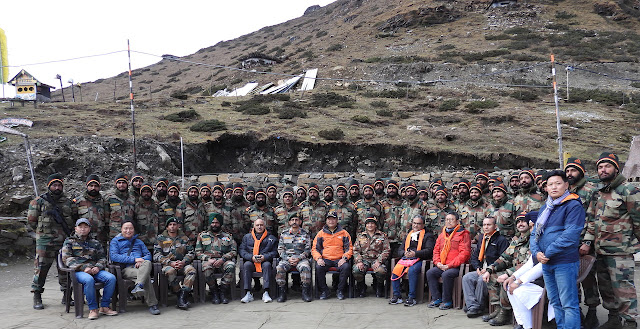
Chief Minister Pema Khandu with Indian Army jawans on the occasion
of 22nd Kargil Vijay Diwas in Tawang

The media has lately reported your visits to forward posts and your interactions with jawans and officers.
Tell us about your motivations. And also about the importance of these visits. Should it be emulated by other CMs in other border states?


My father served in the Indian Army and having been born and lived most part of my life in the border region of Tawang district in India, I have seen the life of our security forces very closely.
Guarding the borders in extreme weather conditions is not easy and most people don't realise it is a very tough job.
By visiting our forces in the forward posts, I am only paying a humble tribute to them for the immense sacrifice they are making for our great nation.
I know many other leaders in our country who too visit border regions.
Visiting my uniformed brothers in forward posts is a very personal motivation and if other leaders and common people in other states too emulate it, would be a wonderful gesture.
I welcome fellow countrymen to come and visit forward posts of Arunachal Pradesh and understand the tough life of security forces and common citizens of the state.

Chief Minister Pema Khandu at Chuna with Indian Army soldiers.

Many in India believe that one should change the narrative of the 1962 War with China, in the sense that India did well in many areas (in the Walong sector for example). Do you plan to do something to change this 'defeat' narrative?

1962 is in the past, We have learned many things and is well prepared for any future eventualities.
I fully agree that the Walong sector triumph of our armed forces is under reported.
No matter what, the people of Arunachal Pradesh stand resolutely behind the armed forces.
Yes, We are developing the sites of the 1962 war as memorials in Tawang as well as the Walong area, it is an emotional feeling just to be present at those sites and experience the valour of the soldiers who fought then.
All these will tell the story, as it happened.

Chief Minister Pema Khandu with movie star Salman Khan.

China is building infrastructure on the other side of the border. For example, a new large airport is coming up in Lhuntse Dzong in Lhoka (Shannan); the train has reached Nyingchi, and the G219 (Aksai Chin road) to Tsari area and all along India's northern border?
What are you doing to counter this? What are Arunachal Pradesh's achievements in this field.


Our Prime Minister Narendra Modiji in the speech at the UN General Assembly had said, 'Democracy can deliver, Democracy has delivered.'
People of India and Arunachal Pradesh don't want to emulate any 'model of development' that tramples the liberty and culture of the local people.
Indian democracy isn't a 'one size fits all' model.
We are working towards providing amenities to the people in the border areas.
We are working aggressively to expand our road, rail and air network, improving communication networks and developing infrastructure to improve health and education status of our people.
The case in point is the Bogibheel bridge and the Dhola-Sadiya bridge which were pending for decades, it used to take hours to cross the Brahmaputra then.
Today because of the initiative of Prime Minister Narendra Modi, the bridges got completed in record pace and can be crossed in minutes.
We will get our first airport in 2022 in Itanagar whose foundation was laid in 2019.
The Trans Arunachal Highway (about 1,600 km) is almost under completion and the Sela tunnel will make year-round travel to Tawang easy.
Eight new ALGs have become functional and around 1,000 new 4G towers are being installed in addition to the ongoing optical fibre projects to enhance digital connectivity.
All foothill areas will be connected with a rail network soon.
Surveys are being conducted to bring rail connectivity to Bame and high altitude areas like Tawang as well.
The list is long, yet our model of Compassionate Governance will have NO Match.

Thursday, December 16, 2021

Indianness of Arunachal is not to be proven to anyone: Pema Khandu

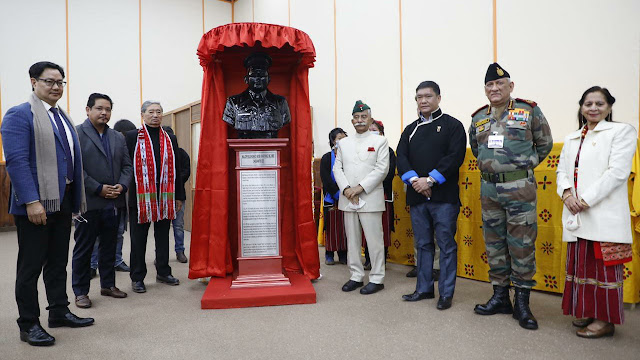
Inaugurating Maj Bob Khating Memorial with the Governor
and the CDS, Gen Bipin Rawat in Tawang and Kiren Rijiju (right)

This is the second part of my interview with Pema Khandu, the Chief Minister of Arunachal Pradesh, Indianness of Arunachal is not to be proven to anyone, the interview was published by Rediff.com.

Here is the link...

'Our love for our great nation -- Bharat is second to none and our patriotism towards our motherland -- India is for the entire nation to emulate.'

In April 2011, Dorjee Khandu, the chief minister of Arunachal Pradesh, died in tragic circumstances in a helicopter crash.
Soon after, his elder son Pema succeeded him as the MLA of Mukto in Tawang district; he was then only 32 years old.
Five years later, on July 17, 2016, after a long period of confusion in the state, Pema Khandu took oath as the chief minister; soon after, he joined the Bharatiya Janata Party.
During the 2019 legislative assembly elections, Khandu won a landslide victory with 41 seats out of 60 for the BJP alone.
Under Khandu's leadership, the border state found badly needed stability which helped putting Arunachal Pradesh on fast track development, while preserving its own genius.
At a time when China social media is buzzing with threats of military action against Arunachal (with various verified or unverified handles releasing videos and photos of People's Liberation Army troops training close to the Indian border), Arunachal Pradesh's dynamic 42-year-old chief minister answers Claude Arpi's questions.
Sponsored

The final segment of an exclusive two-part interview:

China is said to have built more than 600 'model' villages on the border (most of them north of Arunachal). According to Beijing's propaganda, there are two objectives: Poverty alleviation and defence of the border.

Arunachal Pradesh is home to patriotic 26 major tribes and over 100 sub tribes, we are a thriving society where people elect their leaders democratically by elections.
We are empowering our border regions to develop in conjunction with their culture and traditions.
We are running programmes where people decide to stay back out of free will in the border areas because the land, rivers and forests are sacred to us.
We are committed to protecting our environment and preserving it.
This is our model and it is an open source model. Anyone can use this model.

You have been trying to develop Arunachal as a sustainable tourism destination. Does the Bengal Eastern Frontier Regulation, 1873, known as the Inner Line Permit hamper your efforts?
Have you envisaged a sort of 'digital' pass which could remove the idea that Arunachal Pradesh is different from other states in India?


Inner Line Permit is not a restrictive regulation that hampers tourism but meant to conserve the culture and traditions of the indigenous tribal societies.
As the chief minister of the state, I have been talking of 'High Value Low Volume' tourism which is sustainable as well as provides employment to our youth.
We have made the process of granting the Inner Line Permit digital and is seamless.

Many places have been visited by Guru Padmasambhava, Guru Nanak or other saints/lamas/yogis. Do you envisage developing 'spiritual' tourism in Arunachal?

Not many are aware but Guru Padmasambhava and Guru Nanak Dev have travelled through the state.
Arunachal Pradesh is also the land of indigenous faiths and we have developed a temple in Pasighat for indigenous faiths.
Tawang has the largest monastery in the country and second largest in the world after the Lhasa monastery.
There is a beautiful Golden Pagoda in Namsai area of the state.
Malinithan has ancient temples in the Likabali area of the state.
We have the famous Parashuram Kund and a famous Shiva temple in the Ziro region.
There are various Christian denominations and some beautiful churches too in the state.

In March 2021 during the last National's People Congress, a draft of China's 14th Five-Year Plan was presented; it included the first phase for the construction of a mega hydropower plant or plants (thrice the size of the Three Gorges Dam) in the Great Bend area.
In view of the fragility of the Pemakoe area (seismic, landslide, biodiversity, etc) as well as the sacredness of the place, can something be done to put this project on hold?


The Government of India is taking all appropriate actions to secure the interests of her people and terrain of the region.

In 2009 at the conclusion of a two-day meet on environment, the chief ministers of five Himalayan states signed the Simla Declaration.
Do you think that this type of initiative should be repeated?
Would you take the initiative for a greater 'Himalayan' unity as far as environment and culture are concerned?


I have always been advocating that the Mountain States have their unique strength and challenges.
Therefore, the development model of this fragile ecology need a different treatment to take forward development of the area.
The Himalayan landscape and her people's culture calls for unified and sustainable call for development.
We are mindful of taking these aspects very seriously, while taking up our development goals.

'Migration' towards the big cities seems to be a serious problem for your state. Can you elaborate? How are you planning to tackle this issue?

Yes, it is a universal phenomenon. Everyone wants to look for better avenues for a comfortable life for them and their families.
This is also true in Arunachal Pradesh.
While the same is NOT discouraged, the government's endeavour is to provide all the basic facilities of health, education, housing etc in situ to encourage our people to live in the respective villages and ensure they are NOT uprooted from their roots.
We are also empowering our villages in the true sense in which Mahatma Gandhi talked of Gram Swaraj.
We have recently conducted the panchayat elections in the state and are determined to provide the 3Fs -- Funds, Functions and Functionaries to the villages.
There are still too many remote villages in Arunachal Pradesh, with hardly any 'modern' facilities (school, dispensaries, communications, etc)? How do you plan to remedy this?
As I mentioned, we are late starter in our development journey.
However, in the last 6 years, we have added many 'modern' facilities in remote villages -- Saubhagya for electrification, PMAY for housing, UJJAWALA for cooking gas and Jal Jeevan Mission to take potable drinking water to each household to name a few.
The government of Arunachal Pradesh conducted a programme called Sarkar Aapke Dwar or 'Government at your Doorstep' to take essential government schemes to extremely remote villages and benefitted over 4 lakh people.
Yes, we have still a lot of distance to cover and we are working towards this goal.

How does it feel to rule over a state claimed by another country? Do you think that more historical research could highlight the fact that Arunachal has never been part of China?

The Indianness of the People of Arunachal Pradesh is NOT to be proven to anyone.
Our love for our great nation -- Bharat is second to none and our patriotism towards our motherland -- India is for the entire nation to emulate.
Further to state on record that Arunachal Pradesh does not share any direct border with China, but it has a border with Tibet.