Sunday, July 24, 2022

Chinese Panchen Lama visits an 'Indian' Village

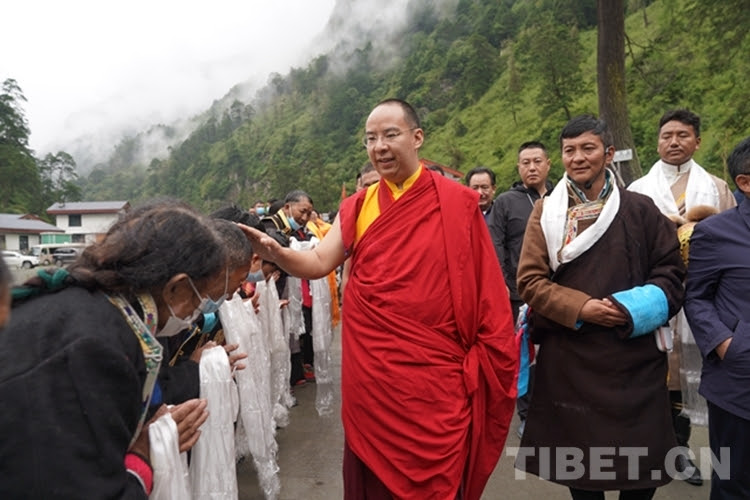
On July 22, China Tibet Network posted an article announcing that the Chinese-selected Panchen Lama (Gyaltsen Norbu) visited a village on the Indian border: “Panchen: Guarding the border is a great cause,” was the title of the article.
It mentioned the name of a 71-year-old Tibetan lady “wearing new clothes, wearing new hats and holding white khatas eagerly waiting, with faithful masses, in the fine rain,” for the arrival of the Lama
The name of the village as given by the article is Lowa.
It is probably a Tibetan translation for Lho(pa)-wa, i.e. Lhopa tribe village.
But the newly-built village is in fact Longju, the site of the first bloody clash between India and China in August 1959.

The line depicted on this map is the approximative LAC in the area.
though Longju is south of the International Border (IB)

For decades, India has considered the place, where the new village is located, to be in Upper Subansiri district of Arunachal Pradesh and not in Tsari Township of Lhuntse county in Lhoka prefecture as mentioned by the Chinese.
"Knowing that Panchen Rinpoche was today going to visit our village for inspection, we waited at the entrance of the village early in the morning, looking forward to seeing Rinpoche as early as possible," said the lady.
The article added: “On July 21 in the morning, the Panchen Erdeni [Chinese name for Gyaltsen Norbu] a member of the Standing Committee of the National Committee of the Chinese People's Political Consultative Conference (CPPCC), Vice-president of the Chinese Buddhist Association and President of the Tibetan branch of the Chinese Buddhist Association, came to Lowa New Village.”
The narrative continued: “The new village lying quietly at the foot of the Himalayas became lively with a strong smell of mulberry smoke in the air; the masses of believers welcomed him, bowed and prayed.”

Gyaltsen Norbu being explained the history of Longju

 Wang Shu [Wangchuk], the secretary of the Party Branch of the new village gave an introduction to the Panchen Lama about the situation in the new village.
According to China Tibet Network, the new village is located on the border at 2,735 meters above sea level, 7 kilometers from the seat of the township government (Tsari/Migytun): “in the village, two-story small buildings are lined up, staggered and greenery is found in front of each house with flowers in full bloom, a vibrant scene.”
The article admitted that the ‘Lowa’ new village is part of the ‘relocation’ scheme and new inhabitants arrived on January 15, 2021. Since then, more than 90 families have moved in.
The village Party Branch Secretary showed the Panchen Lama around and explained the construction of the new village on an exhibition board showing the new village's relocation; the role of the villagers, living in well-off houses, who have to guard the border and improve the rural revitalization conditions as well as the industrial and ecological development of the area.
The local Party Secretary added: “In addition to the high standard construction of well-off houses, the Party and the government also invested in the supply of water, electricity, telecommunications and other infrastructure facilities as well as the construction roads. It is supporting the construction of bamboo processing plant, Tibetan incense plant, greenhouses and other special industries.”

Meeting the 'masses'
Gyaltsen Norbu asked: “How many children do you have? Where do the children go to school? Where are the teachers from?”
He later went into the first floor of the Village Committee House and visited two households “to talk to the masses of relocated households to understand their living situation after relocation.”
"Going around the village, you can see that our current housing, living and other conditions which are particularly good," said the villagers.
The Panchen Lama looked at the happy smile on the face of the border people and told that they were different from others; your tasks to guard the border: “it is a great cause, you should feel the Party's grace, listen to the Party, follow the Party, to do a good job in the new era of garrison people, continue to work hard to guard the territory of the motherland. I believe your future life will be even better.”
The article mentioned that in 2021, the per capita disposable income of the new village of Lowa reached 25,804.08 yuan. It is pure propaganda as the village did not exist a few months earlier.
But in 2022, the villagers' income has doubled and more prosperous days are ahead, said one of the villagers while guarding the border is not only “our unshirkable responsibility, but also our glory, we firmly believe that under the wise leadership of the Party and the State, the new village of Lowa will have a better tomorrow.”

Blessing the 'masses'

At the end of the inspection, Gyaltsen Norbu walked out of the new village on foot, touched the heads of the villagers and gave his blessings to the religious people lined up at the entrance of the village, and presented the religious people in the village with enlightened Vajra knots, dharma photos and medals.”
No photos of the Dalai Lama, of course.
The article concluded that after receiving the blessing from Panchen Lama, “still many religious people who did not want to leave for a long time.”
One of the villagers said: “I didn't expect Rinpoche to travel so far to visit us in the village. Before, I had only occasionally seen Rinpoche on TV, but I never thought I could see him with my own eyes in this life.”
With tears in her eyes, the old lady immediately enshrined the picture of Lama on the altar of her house after returning home.
Probably along with the photo with Xi Jinping.
It is pure propaganda to show that Longju belongs to China, and the Tibetans are given the freedom to practice their religion, but where are the stupa, the gompas, the prayer flags, the prayer mills in the new villages.
Nowhere, but is clearly a provocation in retaliation against the Dalai Lama's visit to Ladakh.
But a poor retaliation, for the Dalai Lama there was a 10-km line-up in Leh, in Longju hardly 20 people, representing the 'masses'.

Friday, July 22, 2022

Hot 'Political' Summer on the Plateau

Wang Yang in Tibetan areas in Qinghai
In the recent months, several ‘important’ visits have taken place in Tibet.
One was of these visits was by Hu Chunhua, a member of the Politburo, a Vice-Premier of the State Council and head of the National Leading Group on Poverty Alleviation.
Last year in August, he had already 'inspected' many sites in Tibet.
Let us remember that at one point, Hu was Xi Jinping’s heir apparent.

In July 2021, Hu, who served several years ago in Tibet, “went deep into the eastern part of Ngari Prefecture, western Nagchu City and other extremely high altitude areas to investigate poverty alleviation and animal husbandry development.”
He had then to give a feedback to the leadership assembled in the seaside resort of Beidaihe for the annual ultra secret conclave.
At that time, it was reported that Hu Chunhua went to the home of herders in the remote Dawa village in Tsochen county in Ngari Prefecture to check the production and conditions of farmers and nomads living in high altitude areas.
It was probably the first time that these neglected populations met a politburo member.
The Chinese media had reported that Hu had 'successively' walked into the most remote counties of Ngari Prefecture; deep into villages while visiting enterprises and grassroots organizations (incidentally, Hu speaks good Tibetan).

Hu's 2022 Visit
According to Xinhua, Hu Chunhua was again on the ground in Tibet Autonomous Region (TAR) from July 1 to 4 “to supervise the work of consolidating and expanding the results of poverty eradication and revitalizing the countryside.”
Hu is said to have stressed the need “to thoroughly implement the spirit of General Secretary Xi Jinping's series of important speeches and important instructions, resolutely and forcefully consolidate and expand the results of poverty eradication, accelerate the comprehensive promotion of rural revitalization, ensure that there is no return to poverty on large scale, and strive to take the people out of poverty at even higher level.”
The ‘important’ speeches of Xi Jinping are leitmotivs in the Chinese official reports. Every officials, high or low has to pay homage to the Emperor.
The report of the news agency continues: “Tibet combines ethnic areas, border areas, high altitude areas in one, the development foundation is relatively weak, the task of consolidating and expanding the results of poverty eradication is very heavy. Hu Chunhua has come to Chamdo City, Biru County, Lhorong County, Pelbar County, Nagchu City, Lhari County, Lhasa City, Meldro Gungkar County.”
It was an in-depth field inspection for studying “poor village households, relocation community, agricultural products processing enterprises, schools and hospitals, etc.”
Hu Chunhua’s objective was to get a detailed understanding “of the employment of the masses out of poverty to increase income, the development of special agricultural and animal husbandry, the rural infrastructure construction and the public service development.”
The Vice Premier stated that “the areas out of poverty should continue to consolidate and expand the results of poverty eradication in the first place, so that the foundation of poverty eradication obtains more solid, more sustainable results.”
He encouraged the local leaders to rely on the plateau characteristic advantageous resources, “for better and stronger modern agriculture and animal husbandry, to speed up the development of agricultural products processing, the rural tourism and in order to realize the integration of the industries and the growth of the county rich people's industry, and promote the sustained income of people out of poverty.”
Hu has probably visited the area of Nagchu City (prefecture) from where large percentage of the population has been removed in order to be relocated South of Lhasa, near Gongkar airport (see our post last week)

The objective of the Chinese government is said to “successively promote the development of ethnic areas, and promote the common unity and struggle of all ethnic groups, common prosperity and development.”
It is what Beijing says…

Wang Yang speaking to the children

Wang Yang Visit to Qinghai
A few days earlier, Wang Yang, a member of the Standing Committee of the Politburo and chairman of the National Committee of the Chinese People's Political Consultative Conference (CPPCC), visited several Tibetan areas in Qinghai Province “to research counterpart aid work for youth.”
During his tour, Wang, No 4 in the Party, stressed the need “to deeply understand the Communist Party's strategy for governing Tibet in the new era, adhere to the main line of casting a firm sense of Chinese national community, to bring innovative ideas for the youth-aid work, to enhance the comprehensive benefits of youth-aid, to help Tibet-related states and counties in their high-quality development, and not fall behind in the overall modernization process of the Chinese nation.”
From June 27 to 28, Wang went to Xining City (which had just come out a severe lockdown), Huangnan Tibetan Autonomous Prefecture; he also visited Shanghai-supported Xining Golok High School, Tianjin-helped Tsim Sha Tsui County Deji Village and other places. He wanted to understand the situation in detail, says the official report.
Wang asserted that since the 18th Party Congress (2012), provinces and cities as well as central state organs and central enterprises have implemented the directives of the Central Committee to support Qinghai: “to build a moderately prosperous society. …In the new journey, more attention should be helping the recipient to develop industries with special advantages as well as develop markets.”
Wang Yang urged the local cadres to make efforts to explore new approaches for ethnic minority areas and march towards modernization and common prosperity.

Learn Chinese and Blend
He also mentioned ‘intellectual support’ and the consolidation of the results of education assistance to Qinghai, i.e. helping people in ethnic areas to master the common language (read Mandarin): “More attention should be paid to encouraging ethnic minority people to go out, providing assistance for them to study, work and start businesses in the central and eastern regions, broadening the channels of income and wealth, and promoting exchanges and blending of ethnic groups.”
Wang Yang visited the Qinghai Tibetan Culture Museum, the Dragon Tree Painting Garden and ancient temples to understand the historical and cultural protection heritage.
The next day, Wang presided over a meeting on supervision and consultation over some key proposals concerning protecting and keeping alive the historical and cultural heritage in the course of planning and construction in urban and rural areas.
On June 29, Wang presided over a meeting for the supervision and consultation of some key proposals concerning protecting and keeping alive the historical and cultural heritage in the course of planning and construction in urban and rural areas.
He wanted that the CPPCC play its role in implementing related decisions and plans of the Central Committee. Wang further stressed that “from the height of enhancing historical consciousness, firm cultural confidence, in-depth understanding of General Secretary Xi Jinping on the protection of historical and cultural heritage heritage and effectively implement the relevant decisions of the Party’s Central Committee.”
Wang recommended that the revision of the Law on the Protection of Cultural Relics and the Law on Intangible Cultural Heritage should be accelerated, and local regulations be formulated to reasonably define the scope of protection and inheritance of cultural objects.
A census of historical and cultural heritage should be carried out and a database of immovable cultural relics should be established, he said and in order to strengthen the study of historical and cultural heritage, “excavate the historical stories, cultural values and spiritual connotations contained therein, to avoid the loss of its form and its essence.”
The Sinicization of Tibetan Buddhism, dear to Xi Jinping, was not mentioned.

Li Zhangshu inspecting an afforestation project

Visit of Li Zhanshu
Two more members of the Standing Committee of the Politburo visited Tibet around the same time that Xi Jinping was in Xinjiang.
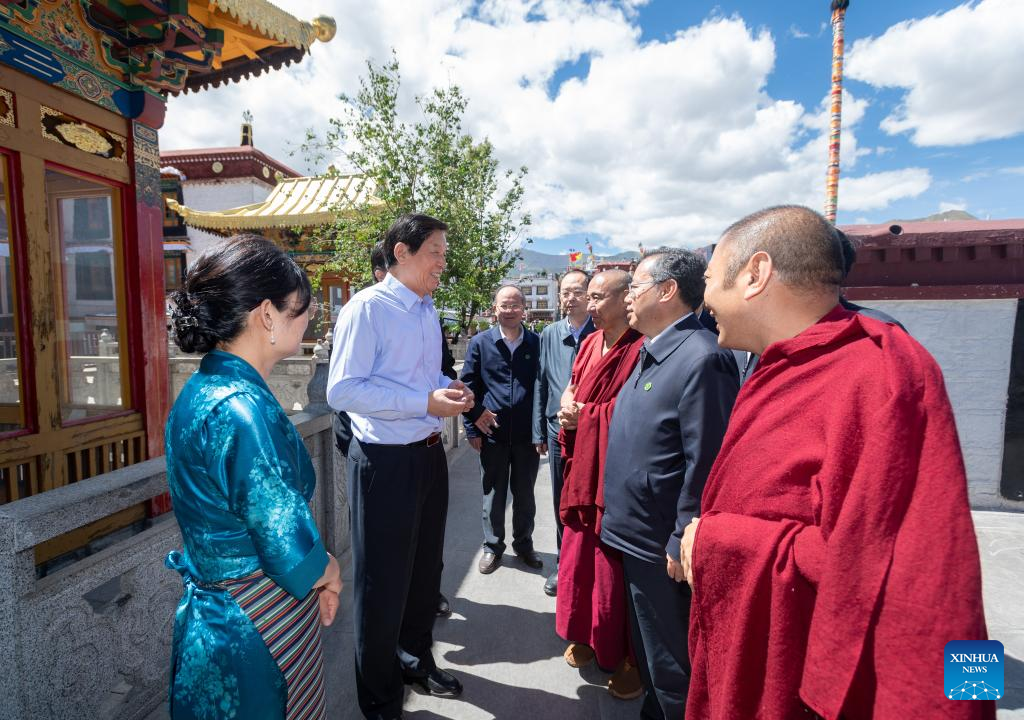
First, Li Zhanshu, member of the Standing Committee of the Politburo and Chairman of the Standing Committee of the National People's Congress was in Tibet from July 12 to 15 “for research on ecological protection legislation on the Qinghai-Tibet Plateau.”
During his visit, he stressed the need to have a legislation to protect the ecology of the Qinghai-Tibet Plateau; his objective is “with Xi Jinping's thought of ecological civilization, to adhere to systematic protection, coordinated protection and special protection, and develop a good law that can stand the test of history and the people in the spirit of science.”

Li Zhanshu in the Tashilhunpo monastery

On July 13, Li Zhanshu went to Shigatse and visited the north bank of the South Woodland Ecological Demonstration Area of the Yarlung Tsangpo to investigate the planting of trees. He was accompanied by Wang Junzheng, the TAR Party Secretary.
Li Zhanshu inspected the protection of wetlands, river mudflats, reforestation projects, water resources protection, mine restoration among other things; during a forum, he listened to the views and suggestions of the stakeholders. He spoke of the great achievements made in ecological environmental protection on the Qinghai-Tibet Plateau, and discussed with everyone the key issues involved in the development of the new law.
Li Zhanshu noted that the Qinghai-Tibet Plateau Ecological Protection Law is a major initiative “to implement the important instructions of General Secretary Xi Jinping on the ecological protection of the Qinghai-Tibet Plateau: "The Qinghai-Tibet Plateau has a special ecological status and value, and plays an extremely important role in the national and even global ecological security."

Li Zhangshu In Tibet
A question could be asked: will tens of millions of tourists visiting the plateau every year conducive to the protection of the environment?


For Li, the Qinghai-Tibet Plateau Ecological Protection Law will be a special regional protection law, but its significance and impact will reach far beyond the plateau to which the law will apply; he said while drafting this law, it was necessary “to have a big picture of the overall situation and the very high altitude; the idea of the legislation is to support ecological protection policy initiatives and also reflect Tibet’s own characteristics.”
Li Zhanshu noted that to implement the new development concept, one should adhere to systemic thinking, in a scientific attitude and problem-solving spirit, in order to strengthen the protection, governance, restoration and risk prevention and control of each important ecosystem, and provide a strong rule of law protection for the ecological protection of the Qinghai-Tibet Plateau.”
Once again it sounds good (despite the verbiage), but what about the high speed development (roads, railway lines, airports) already started.
Li Zhanshu visited the Potala Palace, Jokhang Temple in Lhasa and the Tashilunpo monastery in Shigatse.
He said that “the most fundamental issue lies in the strong leadership of the Party Central Committee with Comrade Xi Jinping as the core, in the scientific guidance of Xi Jinping thought of socialism with Chinese characteristics in the new era, uncompromisingly put into practice the important statements of General Secretary Xi Jinping on the work of Tibet and the party's strategy for governing Tibet in the new era. It is necessary to further implement the strategic thought of "ruling the country must be ruling the border, and ruling the border must first stabilize Tibet", implement the Party's guidelines and policies on ethnic and religious work, make safeguarding the unity of the motherland and strengthening ethnic unity the focus and point of emphasis, achieve long-term peace and stability, and promote high-quality development.”
Li is clearly on Xi Jinping’s side in the power struggle ahead to the 20th Congress in November.
In Beidaihe, he will present a report on the ecological achievements of the General Secretary on the Plateau. The reality might be different.

Vice-Premier Han Zheng in Tibet

Han Zheng’s Visit
Xinhua also reported that Han Zheng, a member of the Politburo’s Standing Committee and Vice Premier of the State Council visited Nyingchi and Yushu in Qinghai province from July 14 to 15.
He stressed to unswervingly take the road of ecological green development and constantly promote high-quality development to achieve new results.
As usual, Han Zheng stressed the need to adhere “to the Xi Jinping thought of socialism with Chinese characteristics in the new era as a guide, in-depth implementation of the new development concept, unswervingly take the ecological priority, green development and solidly promote the construction of major projects and ecological protection, and constantly promote high-quality development to achieve new results.”
On July 14, Han inspection the Sichuan-Tibet Railway presently under construction (only the section between Nyinchi and Lhasa is completed).
Han Zheng went to the Serkhyem La pass at an elevation of 4.567m (14,983ft) above the sea level. The new railway line will go through a tunnel and the line will apparently run parallel China’s National Highway 318 (G318), also known as China-Nepal Highway and the Friendship Highway.
According to a website for tourists: “The road is asphalted. Usually impassable from October to June. The summit offers a breathtaking scenery. The road is long and arduous and crosses several mountain passes through remote areas, so you need to be prepared. Do not take this drive if you have respiratory problems or any type of heart condition. Notorious lack of oxygen that tests the organisms and a high degree of steepness. A major hazard of altitude is the sickness that can indiscriminately affect anyone regardless of age or fitness. The zone is prone to heavy mist and can be dangerous in low visibility conditions.”
This pass links Bayi and Bomi counties; on top of the pass, one gets the incredible view of Namcha Barwa (7756m) …when the weather is clear.
Han Zheng was shown an exhibition explaining the overall situation of the construction of the railway; he conducted a field inspection of the construction of the energy-saving and environmental protection features of the tunnel.
Han said that “the construction of the Sichuan-Tibet Railway will implement the new era of the party's strategy for the governance of Tibet a major initiative to promote the western region, especially the economic and social development of Sichuan and Tibet provinces.”
He added that during the construction of the project, everyone should adhere to the time and quality and to ensure the safety of the project. 

Han Zheng inspects the new railway line between Tibet and Sichuan

Probably more Worrying for India
Han Zheng first came to Milin County in Nyingchi City to “listen to the development of clean energy on the Yarlung Tsangpo River and he was briefed about the construction of the major hydropower development project.
Apparently, this refers to the mega HPP on the Yarlung Tsangpo, which has often been mentioned on this blog.
Han pointed out that “it is necessary to coordinate the rational development and utilization of water resources and protection, and build a national clean energy base. The construction of major projects should adhere to scientific evidence, comprehensive consideration of geological conditions, ecological environment and other multiple factors, and do a solid job in the preliminary work of the project.”
Han clearly bats for the giga project on the Yarlung Tsangpo, which will bring destruction in the Great Bent area ...and in India.
It means that China will go ahead with the project on the transnational river, which becomes the Siang in India and later the Brahmaputra.

The Sanjiangyuan National Park
The Sanjiangyuan (Chinese: Source of Three Rivers) is an area of the Tibetan Plateau in today’s Qinghai province; it is the headwaters of the Yellow, the Yangtze, and the Mekong which originate from this area. They come under the Sanjiangyuan National Nature Reserve (SNNR), or Three Rivers Nature Reserve.
According to Wikipedia: “The reserve consisted of 18 subareas, and each contained three zones which were managed with differing degrees of strictness. In 2015, the Chinese government decided to implement a new national park system, and created Sanjiangyuan National Park, which is set to open officially in 2020.”
To protect the grasslands, pastoralists are not permitted to graze their animals in designated called ‘core zones’ and grazing is supervised in the SNNR. In addition, residents have been resettled from these core zones and other grassland areas of the SNNR, and the rangelands have been fenced; they are in the process of being privatized throughout the Sanjiangyuan Area.
After his visit of the Yarlung Tsangpo, Han Zheng inspected the Yushu Ecological Environment Monitoring Center and was briefed on the ecological protection in Qinghai Province.
Han got a report on the construction of Sanjiangyuan National Park through the remote video monitoring system; he virtually visited the Sanjiangyuan projects, met grassroots cadres, he had a field inspection of the waters of the Tongtian River. He later went to the site of the Sanjiangyuan Nature Conservation Monument.
The Shi Chu (Tibetan) or Tongtian River is 1,012 km long; it flows within Qinghai Province. It is begins at the confluence of Togtog (or Mar chu) River and Dang chu River and flows towards southeast and becomes a Jinsha River near the border of Qinghai and Sichuan. The Jinsha River is a primary and westernmost tributary of the Yangtze River (‘Chang Jiang’).
Han Zheng noted the achievements of the construction of the Sanjiangyuan National Park; he mentioned the benefits of the project for the whole country, as well as for future generations.
He said that “to protect the Sanjiangyuan as the top priority of the construction of ecological civilization in Qinghai, to guard the natural ecology, conservation of natural resources, to protect the Chinese water tower.”
Han Zheng later went to the Qinghai Longbao (National) Nature Reserve where he interacted with the staff of the station.
The Longbao National Nature Reserve was established in 1986 and has an area of about 100 km2 covering wetlands and meadows. The reserve is located about 50 km northwest of Jyekundo, the Yushu County seat, lying just south of the highway connecting Yushu and Ritoe Counties. The reserve’s primary area of ecological importance is a wetland that is approximately 14 km long with a maximum width of about 3.5 km. The maximum depth of the wetland is reported to be about 4 m, but most of the wetland is generally much shallower. This wetland lies at an elevation of about 4,200 m in a broad mountain valley flanked by ridges that typically rise up to 750 m above the wetland. The wetland is fed by groundwater, streams, precipitation, and snow-melt, and it drains into the Yi Chu River to the northwest, a short tributary of the nearby Tongtian River.
Han Zheng stressed again the need “to actively promote the construction of wetlands, strengthen biodiversity protection, reduce human activity interference, promote the harmonious coexistence of man and nature, and continue to build a solid national ecological security barrier.”
The visit of the site of the mega HPP on the Yarlung Tsangpo should worry India.
In the meantime, a lot to discuss in Beidaihe next month...

HPPs on the Yarlung Tsangpo


Sunday, July 17, 2022

Season of Coincidences and Change

Do you believe in coincidences?
Tenzin Gyatso, the 14th Dalai Lama reached Ladakh on July 15.
Two days later, the 16th round of Corps Commander-level meeting between India and China is to be held at Moldo/Chushul, near the Pangong tso (lake). Led by Lt Gen A Sengupta, the Fire and Fury Corps Commander, the Indian side will discuss disengagement from friction points along the Line of Actual Control (LAC) in Eastern Ladakh with the Chinese commander of the Kashgar Sub-Area Command of the Xinjiang Military District (XMD).
Was it a coincidence, but on July 6, Prime Minister Narendra Modi greeted the Dalai Lama over the phone on the occasion of his birthday: “Conveyed 87th birthday greetings to His Holiness the Dalai Lama over the phone earlier today. We pray for his long life and good health," PM Modi tweeted.
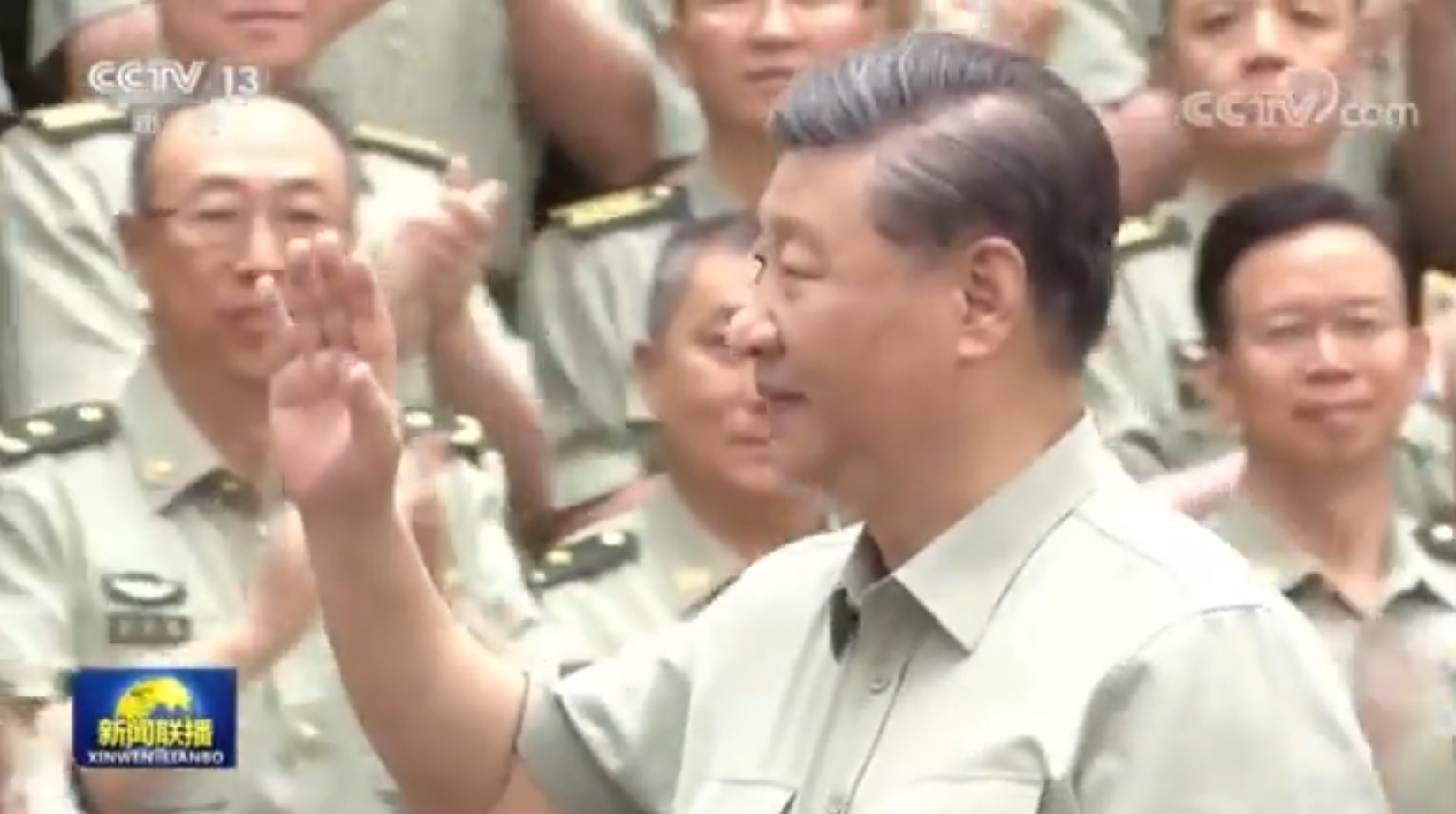
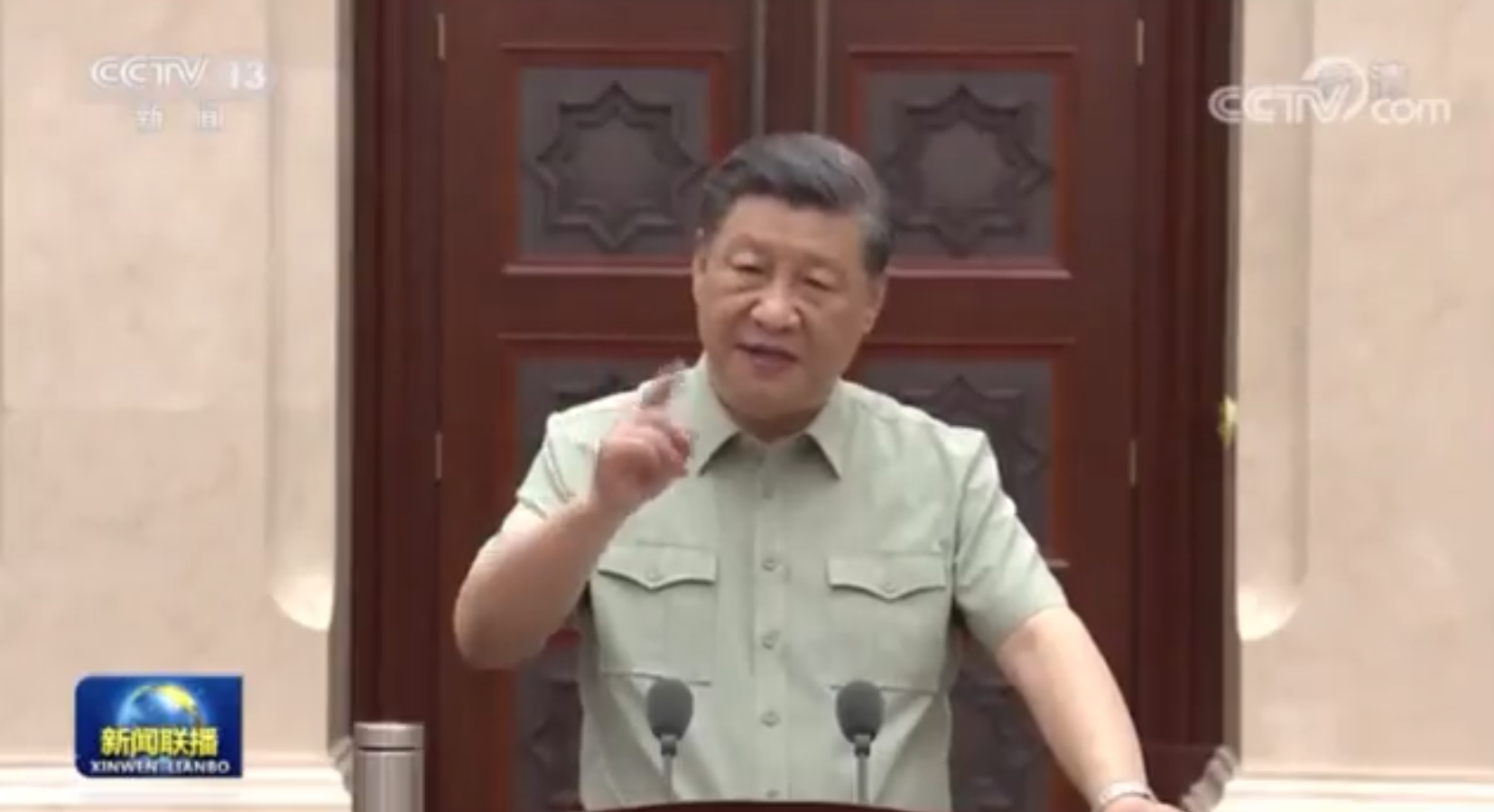
We can’t call everything a coincidence, but President Xi Jinping, General Secretary of the Communist Party of China (CPC) visited Urumqi, the capital of the restive Xinjiang Uygur Autonomous Region (XUAR) two days before the Dalai Lama arrived in Ladakh. According to Xinhua, he inspected a university, an international land port area, a residential community and a museum.

The Dalai Lama in Ladakh
But let us first look at the Tibetan leader’s visit to Ladakh first.
The Chinese are not going to be happy, though they still consider the Union Territory as a ‘disputed territory’ between India and Pakistan and cannot claim it as their as they do for Arunachal Pradesh.
This reminds us the long negotiations for the so-called Panchsheel Agreement in 1954. The discussion was stuck on the issue of Ladakh and more particularly on naming Demchok a landport for the mountainous region.
On April 24, 1954, the Indian Ambassador to China, N. Raghavan, who was himself conducting the talks, informed his Foreign Secretary in Delhi (NR Pillai) that at the suggestion of Zhang Hanfu, the Chinese deputy foreign minister, the plenary sessions on the previous day had been cancelled “he and I carried on informal discussions between 12:00 and 13:00 hours and 19:00 to 23:15 hours.” Raghavan explained that it was ‘royal fight’ from beginning to end: “Zhang took a very recalcitrant attitude but finally gave in on most points,” …except for Demchok.
The Chinese virulently objected to this route been included in the Agreement; they quoted an oral understanding “they would not like in writing even by implication to have any reference to Ladakh.”
For Beijing, the mountainous region was a ‘disputed’ area.
India had taken the stand that Ladakh was part of Indian territory and the route should be mentioned, as its omission would be invidious, but the Chinese remained adamant.
Raghavan finally accepted a compromise which meant that most of the other routes between Ladakh and Western Tibet (particular via Rutok) were abandoned and the trade stopped. This anecdote shows the importance of Ladakh for Beijing (incidentally, the unresolved dispute over Demchok, dates from that day).

The PM’s Birthday Call
With regard to the one-month visit of the Tibetan leader to Leh, the spokesperson of the Ministry of Foreign Affairs of China has so far kept quiet, but Zhao Lijian earlier protested about the Prime Minister’s phone call to the Dalai Lama: “The Indian side also needs to fully understand the anti-China and separatist nature of the 14th Dalai Lama. It needs to abide by its commitments to China on Tibet-related issues, act and speak with prudence and stop using Tibet-related issues to interfere in China's internal affairs."
External Affairs Ministry Spokesperson Arindam Bagchi immediately answered that it was “a consistent policy of the government to treat the Tibetan spiritual leader as an honoured guest and as a respected religious leader who enjoys a large following in India."
The fact that the Dalai Lama will stay for a month in Ladakh is definitively a re-assertion of India’s policy vis-à-vis the Tibetan leader.

Xi Jinping’s visit to Xinjiang and the 16th Round of Talks
Tough low-key, during his visit to Xinjiang, Xi meet with officials of the Xinjiang Production and Construction Corps (XPCC), an organization intimately linked with the PLA. In the past, through its numerous economic activities the state-owned economic and paramilitary organization has not only built towns, farms and provided land and employment for disbanded military units, but also looked after the re-settlement of Han migrants as part of the infamous campaign of sinicization in Xinjiang.
Xi, who is Chairman of the Central Military Commission also met the top brass of the XMD, including Lt Gen Liu Lin, formerly responsible for the talks in Ladakh and now XMD’s Commander, a rising star in the PLA; they are bound to have discussed the forthcoming round of talks in Moldo/Chushul and the XMD has certainly received instructions from the Big Boss.
The 15th round China-India Corps Commander-Level Meeting had been held at the border meeting point on March 11, while the 14th round had taken place on January 12. Earlier, according to media reports, the PLA had pulled back troops from the Galwan valley, PP-15 (Patrolling Point 15) and Hot Springs in Eastern Ladakh area by 2-2.5 kms; the Indian side has consequently pulled back some of its troops and equipment from these areas.
Today it is doubtful if China will agree to a further disengagement from existing friction points in Depsang plains, Gogra and Demchok, especially a few months before the crucial 20th Congress in Beijing; too much is at stake for Xi Jinping. 

Change in India’s Policy?
Many observers see all this as a signal to China of a change in India's Tibet policy.
It is true that in the recent weeks, India has hardened its stance; for example the situation in Eastern Ladakh prominently figured in the talks between External Affairs Minister Dr Jaishankar and his Chinese counterpart Wang Yi in Bali on the sidelines of a conclave of foreign ministers of the G20 nations earlier this month (on July 6, the Dalai Lama’s birthday). During the encounter, Jaishankar strongly conveyed to Wang the need for an early resolution of the outstanding issues in Ladakh.
Back in India, Dr Jaishankar, while attending an interactive session with young voters said that India had explained: “We would like to resolve it on terms that are fair, equitable, mutually agreed upon and do justice to our claims. We can’t resolve it by having one country saying that this is the solution and for us to accept it.” This had been the case in 1954.
Here too, the tone seems to have changed.

The Season of Coincidences and Change
While entering the Season of Coincidences and Change, it is worth mentioning a bill recently introduced in US Congress. According to International Campaign for Tibet, it will be a ‘concrete action’ to resolve China’s decades-long illegal occupation of Tibet by fully recognizing Tibet’s unresolved status and faulting China for violating the Tibetan people’s right to self-determination.
The Act “Promoting a Resolution to the Tibet-China Conflict” affirms that Tibet’s legal status remains to be determined under international law, despite more than six decades of China’s illegal occupation and the Chinese government’s disinformation falsely claiming that Tibet has been part of China since ancient times.
If the legislation is passed by the Congress and the Senate, the official US policy will be that Tibetans have the right to self-determination.
Here again, the spokespersons of the Ministry of Foreign Affairs in Beijing are bound to see red and be displeased.
The new policy would not only reject as ‘historically false’ China’s claim that Tibet has been part of China since ancient times, but also “make clear that Tibet includes not only the so-called Tibet Autonomous Region of China but also Tibetan areas of Gansu, Sichuan, Qinghai and Yunnan provinces.”
It is serious implications for the Tibet-India border too.
It will be interesting to see how Delhi will react in case the bill is passed.
Today, there is no doubt that the poet might have been right, “for the times they are a-changin'.”
Interesting times indeed.
 

Monday, July 4, 2022

Forced Relocation: for what?

Three years ago, we mentioned a large scale relocation program on this blog.
It looks as if the Chinese government has decided for another round.
On June 30, The China Daily published an article announcing “Thousands to be relocated from high altitudes.” 
 Two days earlier, Xinhua had published another article on the same topic with different figures.
The second article reported that some 26,300 rural residents (from 6,306 households) would be relocated to a site named Sinpori in Lhoka prefecture (City) before August 11, 2022.

Sinburi is located in Gongkar (Konggar) county in Lhoka at 29°18′57″N 90°46′55″E; it is also known as Senburi Cun (森布日村) or Shengbore (省波热).

When one looks at the location, it is strikingly close to the Gongkar airport, the main airport  for civil and military use on the plateau.
Why to bring a new town in this strategic area is a mystery.

The China Daily says that thanks to the Tibet Autonomous Region's (TAR's) relocation policy, “started in 2016, many rural residents living at altitudes above 4,800 meters have been moved to lower valleys more suitable for human habitation.”
The rationale for the scheme is that the nomads living in high altitude in Ngachu City can’t breath at altitude above 4,000 or 4,500 meters. But they survived quite well for centuries.
The mouthpiece of the Communist Party further explains: “The latest relocation plan will help residents from 58 villages in 12 townships in the counties of Tsonyi, Amdo and Nyima in Nagchu. With an average altitude above 4,500 meters, Nagchu is one of the region's highest cities. Residents are mainly herders and nomads, most of whom change their dwelling and herding pastures a few times in a year.”
Why to move nomads to sedentary ghettos?

One of the reasons is that it is easier to control  and monitor the nomadic population when they are brought in these new townships, often located at the border with India (and equipped with facial recognition cameras, etc). 

perhaps because nomads are born-free, they are an issue for the totalitarian regime in Tibet.

Scheme Over in August
The China Daily says that the relocation is planned to be over on August 11, 2022: “The first group of families is expected to arrive in their new community by July 15.”
The article adds that being the busiest time for the nomads: “some residents will remain in their original places.”
What is the big hurry in any case …except if the TAR government is planning to immediately re-employ the nomads on some large infrastructure projects near the airport or at the airport.
Finally, the article says that to ensure the safety, smooth traffic, control of the pandemic as well as proper medical rescues and emergencies, “more than 200 government workers from all walks of life have been dispatched to relocation sites to provide support.”
The government of Lhoka was asked to accelerate infrastructure construction, including housing, water and electricity supplies, traffic, schools and clinics.

A First Article
A few earlier, Xinhua had announced that a total of 17,555 people were to be relocated away from Nagchu City, ”thanks to a local program to improve people's living and protect the plateau region's fragile ecosystem.”
Quoting Wu Wei, director of the regional forestry and grassland administration, Xinhua asserted: “The people had lived in places with harsh weather and relatively backward production and living conditions, where the grassland degraded. The relocation scheme reflects a people-centered development thought, taking into consideration both the ecological protection and people's demand for a better life," Wu said.
The fact is that for centuries, it is the nomads and herders who looked after the conservation of the natural environment; it is of course not mentioned (or even taken into account).
The objectives of the relocation scheme is somewhere else, as Xinhua admits: “The region's overall relocation plan will cover more than 130,000 people in Tibet's nearly 100 townships in eight years.”
This is big, and for India, it is a worry, as many of these new township may come near the border.

The Three Counties

It is worth looking at the three counties from where the relocated herders will come from.
The chart below shows the area and the population of the three counties of Nyima, Amdo and Tsonyi of Nagchu City.

What is striking is that ONE-THIRD of the population is being relocated.
Why such large percentage?
What will happen to these already sparsely inhabited areas?
It looks a certain death for these counties?

Tsonyi (Shuanghu) County


Location of Tsonyi Special County

Total Area  =  116,700 km2 (45,100 sq mi)
Elevation = 4,960 m (16,270 ft)
Total Population (2014) =  13,470
Density  =  0.12/km2 (0.3/sq mi)

Simplified Chinese  =  双湖县
Tibetan =   མཚོ་གཉིས་རྫོང

 Amdo County


Location of Amdo County within Tibet Autonomous Region

Total Area  =  43,410.85 km2 (16,761.02 sq mi)
Total Population (2000) =  32,843
Chinese name =安多县
Tibetan name = ཨ་མདོ་རྫོང་།


Nyima County


Location of Nyima County within Tibet 

Tibetan: ཉི་མ་རྫོང་།, Wylie: nyi ma rdzong,
Simplified Chinese: 尼玛县; traditional Chinese: 尼瑪縣; pinyin: Nímǎ Xiàn)
The northern part of the county is within the Changtang area.
With an area of 72,499 km2 (27,992 sq mi) and a population of 29,000 (2012), it has an average population density of less than 0.4 people per square kilometre.

The scheme raises some important questions:

  • Why one third of the population of these three counties are forcibly relocated south of Lhasa.
  • What will the life of the pastoral populations who for generations have lived in the Changthang? 
  • Can they survive in the new ‘urban’ conditions?
  • Why to relocate such a large number of people near the airport?
  • Which type of employment will they be given? 
  • Is there a mega infrastructure in the pipeline? The area is already served by the Expressway to Lhasa, by the railway line (Lhasa-Nyingchi), by different haighways (G318, G4218), etc. 
  • Which type of new infrastructure is China planning?
  • A new airstrip for the dual use airport?
The developments in the area need to be watch carefully.

Saturday, June 25, 2022

Double Standards with Chinese Characteristics

My article Double Standards with Chinese Characteristics appeared in Chanyaka Forum

Here is the link...

June 15 is a special day in the Middle Kingdom; it is the birthday of the Secretary General of the Communist Party of China.
In 2020, probably wanting to please China’s new emperor, an officer of the People’s Liberation Army (PLA) tried to change the boundary in the Galwan sector and advance the Line of Actual Control (LAC).
A day before, some Chinese soldiers led by Col Qi Faobo, erected tents and an observation post on the LAC in contravention of an agreement arrived a week earlier.
Soon after, Colonel Santosh Babu, Commanding Officer (CO) of 16 Bihar regiment was ordered to make sure that the PLA vacate the post which had previously not been under their possession. He was brutally attacked and killed. The jawans of 16 Bihar decided to take revenge; thereafter followed a free for all.
India immediately admitted to 20 casualties while the Chinese did not acknowledge any (later they said four soldiers had been ‘martyred’). According to different sources (Indian and foreign) some 40-45 Chinese died that day (an investigative report by the Australian newspaper The Klaxon recently said that 38 Chinese troops were for sure drowned in the early stages of the face-off).

Do you think that any remorse has been expressed by the Chinese leadership over the incident?
No, and two years later, China still denies the undeniable facts, while Beijing still hides the number of Chinese casualties; Qi Fabao has now become a decorated hero in China. He was one of the torchbearers for the Winter Olympics 2022 and promoted Senior Colonel and Political Commissar of the Ngari Sub-Military District, opposing India in Eastern Ladakh.

China Celebrates
On the occasion of the second anniversary of the Galwan clash, the China Central Television’s military channel released a video of Chen Xiangrong, “one of the martyrs who sacrificed his life for the defense of the Chinese territory during the border standoff with India in 2020.”
The propaganda article says: “Chen Xiangrong died at the age of 19, and the fighting slogan ‘My pure love is only for China’ written by Chen inspires thousands of millions of Chinese people. After two years, many expressed their remembrance for those young heroes.”
On June 15, 2022, the Southern Xinjiang Military District commemorated its four ‘border defense heroes’ in order to “inspire officers and soldiers to train and prepare for war,” says The Global Times.
Wang Zhuoran, another of the martyrs “who sacrificed his life to safeguard national sovereignty and territory in the clash, shared the story of the hero [Chen], inspiring other officers and soldiers to learn from him, practice skills, and fight for the motherland and the people.”
What about the thirty-five or so other casualties? Not a word. The Chinese propaganda does not speak of them; they do not exist.
A reenactment of the battle was even staged showing how the ‘heroes’ defended the country, Beijing reiterating: “Four Chinese officers and soldiers sacrificed their lives, and one was seriously injured during the incident.…In desperation, the border guards resolutely fought back the aggression, achieving major victories and effectively safeguarding national sovereignty and territorial integrity.”
As often in Middle Kingdom, truth is the first casualty.

The Sino-Indian Relations Today
If one was to reduce the Sino-Indian relations to one fundamental issue, it could be that China has (and will) never take the blame for any wrongs it did in 1962, in 2017 or 2020.
On the contrary since two years, Beijing has constantly blamed New Delhi for starting the standoff along the LAC in Eastern Ladakh. It is what China’s Defence Minister, General Wei Fenghe did again at the recently-held Shangri-la Dialogue in Singapore.
Wei, who is also State Councilor, affirmed: “China and India are neighbours. Maintaining a good relationship meets the interests of both countries and that is what we are working on.…But on frictions along the border areas, the merits of the issue is clear.”
General Fenghe went on to say that India and China have held 15 rounds of Corps Commander level negotiations and the two sides are “working for peace” in the region.
‘Working for peace’ without admitting the wrong, is not conducive to a sustainable solution.

About Taiwan
Regarding Taiwan, Wei sent the ‘strongest warning’ to US, saying that Washington’s Indo-Pacific strategy will fail to divide the region; according to The Global Times, “the Chinese armed forces will fight to the very end if anyone dares to split Taiwan from China.”
Wei affirmed that the island was part of China and “the Taiwan question is China’s internal affair. China will definitely realize its reunification.”
Quoting experts The Global Times noted: “it is necessary to send a clear warning to the US, and even if the US ignores the warning and continues its dangerous moves or even crosses the red line, China is ready to solve the Taiwan question once and for all, whether the process is peaceful or by force.”
After his speech at the Shangri-La Dialogue, Gen Wei declared: “Let me be frank. China’s policy on nuclear power is consistent. We use it for self-defense, we will not be the first to use nuclear power.…We develop nuclear capabilities to protect the peaceful hard work of the Chinese people and to protect our country from the scourge of war, particularly nuclear war.”

China is indeed a very peaceful nation!

Preaching for a Global Community with a Shared Future

In recent times, Xi Jinping has repeatedly pleaded for “a global community with a shared future.”
In January 2022, Wang Yi, China’s Foreign Minister asserted: “[Xi] is personally involved in the planning and successful conduct of head-of-state diplomacy. …The endeavor to build a community with a shared future for mankind, a vision radiating the light of truth in a changing world, made progress across the board, from Latin America and the Caribbean to the Middle East, from BRICS to the United Nations (UN), and from ecological conservation to digital governance.”
Incidentally, since 2018, the phrase “a community with a shared future for mankind” is now enshrined in the preamble of the Constitution of the People’s Republic of China.
Those who believe that a quick solution could be found in Ladakh, should think of this; China is constantly engaged in plain double talk.

The Refusal to Admit the Facts

All this does not augur well for the 16th round of talks to be soon held between the Senior Army Commanders in Moldo/Chushul. It is clear that China will not admit its guilt and therefore will refuse to disengage, particularly in Depsang and Hot Springs, especially a few months before the 20th Congress in Beijing which may witness tsunamic changes in China.
The refusal to admit historical facts has another aspect: if China admitted to have crossed the line in Ladakh, the Emperor would lose face and would be forced to acknowledge that he acts contrary to his own preaching about the ‘peaceful rise of China’.

The Case of 1962

Take the 1962 border war with China, which, in a few months, is going to be celebrated in a grandiose way in Beijing, by putting the entire blame on India; it has already been announced that Zhang Xiaokang, the daughter of Gen Zhang Guohua, the commander of the Tibetan Military Region in 1962 is planning to publish a book: One Hundred Questions on the Self-Defense Counterattack on the China-India Border.
The book is based on interviews with veterans who participated in the War; Zhang is said to have collected “first-hand information, reflecting the counterattack in a panoramic manner, especially telling the heroes, meritorious soldiers, martyrs, wounded and other [stories].”
An introduction to the book says: “Although a sixty years has passed since this war, it has not been forgotten with the passage of time, and generations of soldiers and military fans have always been interested in this counterattack. She will explain “how could [China’s] army wipe out more than seven brigades of the Indians’ most elite ace force in just a few days when they did not have much advantage in terms of strength and firepower?”
Unfortunately, the leadership in Delhi does not see the interest for India to highlight the glorious battles fought by the Indian Army on the Namkha chu (2 Rajput), in Walong, Rezang-la or elsewhere.

It probably means another battle won for the Chinese propaganda.

Saturday, May 7, 2022

Xi Jinping will lead China for record third time, but is much weaker than we think

My article Xi Jinping will lead China for record third time, but is much weaker than we think appeared in FirstPost

Here is the link...

Though Xi’s policies have started being questioned within China, it does not mean that he will not be given a third term. A collective leadership, however, may take the place of the present imperial rule

The 20th National Congress of the Chinese Communist Party (CCP) will be held in Beijing in November this year. About 2,300 delegates, representing an estimated 90 million members, will meet in the Great Hall of the People in Beijing and decide the fate of China for the next five years at least.
The CCP Congress will also elect a new Central Committee, which in turn will approve the members of the Political Bureau and its Standing Committee — in other words, the bosses of the Middle Kingdom for five years.
Xi Jinping should be re-elected as the CCP’s Secretary-General, the highest position, for an unprecedented third term. The main reason why Xi will continue is that there are not many candidates for the hot seat with China showing serious signs of crumbling. Let me explain.

How the world sees China?

Today, the situation in the world (and China in particular) is not the same as two or three years ago. Certain events have changed, perhaps forever, the perception that the world has of China. It started with the virus which in all probability originated from the P4 lab of the Institute of Virology in Wuhan. With the tacit support of the WHO, Xi’s administration was able to cover up the facts; it even got the support of the Americans and the French, who had heavily invested in the lab (it was inaugurated by a French prime minister in February 2017).
It remains a fact that the pandemic has shaken the planet. For a long time, China seemed to be ‘exempted’ from the throes of the virus, as the US, Europe or India suffered a great deal and lost millions of their citizens. But now the virus is coming back to the Middle Kingdom with a vengeance, particularly Shanghai, China’s economic hub, which has been paralysed under a strict lockdown policy for the last few weeks.

Xi Jinping’s policy
Today, Xi Jinping's zero-Covid policy has put his reign at risk. Nina Xiang, the award-winning journalist, warns in The Nikkei: “Pandemic containment is increasingly shaping up as Cultural Revolution 2.0.” She observes: “Recent rhetoric on Chinese state media that the current Covid policy is a clash of political systems and civilisations.”
Communism is the perfect system, believes Xi.
Xiang adds: “The conditions now in locked-down Shanghai have created the launching pad for what could morph into China's Cultural Revolution 2.0, in which Xi Jinping's third presidential term and the validity of his entire reign are at stake. …Having declared victory earlier in the pandemic that China's superior systems saved lives and the economy, Xi cannot back down at this critical period before the 20th National Congress …in Beijing's view, (it) is a small sacrifice to maintain the Party's invincibility.”

But is the Party invincible?

The pandemic had (and continues to have) incalculable economic implications, particularly since the recent recrudescence.
TFIGlobal, an Indian Internet platform, warns: “China’s economy is in a deep crisis. Repeated lockdowns, a real estate downturn, and peaking oil prices have hampered Xi Jinping’s economic growth targets.”
The article continues: “So, Xi is going back to the old formula — a major splurge on infrastructure that ramps up growth numbers, attracts foreign investments and boosts the business sentiment in China. Xi will spend $2.3 trillion on thousands of ‘major projects,’ according to a Bloomberg analysis. This is more than double the spending of $1.1 trillion announced by the US Congress last year. However, Xi’s gamble could end up debt-trapping the Chinese economy.”
This is bound to happen, and unemployment will grow larger, with more unrest everywhere.

Evergrande and construction bubble
It is said that the housing construction sector contributes something like 35-40 per cent of Chinese GDP.
It has started crashing, with no revival in sight, as Beijing’s government does not want to jump to the rescue of companies such as Evergrande; it practically means that the savings of millions of people may be wiped out. Consequently, the purchasing power of these people will be greatly reduced.
What option is left to the government to avoid a crash? Can Xi stop the haemorrhage?

China is nervous, very nervous
Chen Yixin, the secretary-general of the Central Political and Legal Affairs Commission and a protégé of Xi Jinping, has recently ordered a new round of inspections to remove potential risks ahead of the Congress. According to The South China Morning Post, Chen Yixin said: “[We] must consistently innovate with our political and legal work to welcome the victorious hosting of the 20th party congress.”
The Commission headed by Chen oversees all of China’s police force, prosecutors, judges and its state security personnel. Quoting from a report, the Hong Kong newspaper said “Chen ordered 10 topics for research to identify and remove likely social and political risks, including legal issues related to foreign entities, smart management and the internet.”

And then came Putin’s War in Ukraine
On 4 February, Xi Jinping and President Vladimir Putin signed a joint statement which spoke of a ‘no limits’ partnership between China and Russia; but that was before Putin sent his troops into Ukraine. Since then, Beijing, through the declarations of its Foreign Minister Wang Yi, started to see ‘limits’ to its friendship with Moscow.
On 18 March, US President Joe Biden had a video call with Chinese President Xi Jinping for nearly two hours. Biden warned Xi of the consequences China would face should Beijing provide any material support to Russia, and Xi described the Ukraine crisis as “not something we want to see.”
According to Chinese state media, Xi said that countries should not meet on the battlefield, and peace and security should be of the utmost importance to the international community. It sounds like pure rhetoric.

Lessons from Ukraine
More importantly, perhaps, are the military lessons of the Russian campaign in Ukraine. The Central Military Commission (and its Chairman Xi Jinping) will probably have to reconsider all the plans for an invasion of Taiwan. The poor show of the Russian Army and the difficulty of swiftly winning the war, have implications for China.
Despite the massive propaganda, the Communist plans to ‘liberate’ Taiwan will have to be postponed for years. An article in The Nikkei gave the example of the sinking of the Moskva, Russia’s flagship, in the Black Sea: “[it] was the first such loss of a Russian fleet flagship during war since the Knyaz Suvorov. Since World War II, there has only been one similar incident. The ARA General Belgrano, an Argentine navy cruiser, sank during the 1982 Falklands War between Argentina and the U.K.” The sinking of the ship has tremendous consequences for the Chinese PLA Navy.
Although not admitted by Russia, the Moskva appears to have sunk after being hit by two Ukrainian Neptune anti-ship missiles. Quoting a Chinese source, The Nikkei said: “If that is true, it means that China's much-vaunted naval power is nothing but a paper tiger."
Why? The Chinese had bought the old aircraft carrier Varyag, which was built at the Black Sea Shipyard in Mykolaiv, south Ukraine (the Moskva was also built at a same shipyard): “The Ukrainians stripped the Varyag of various pieces of equipment and sold it as scrap to a dummy company linked to the Chinese military,” the newspaper explains.
The implications are clear: “If the armour of the Varyag is based on former Soviet standards, the sinking of the Moskva will only make Chinese leaders fret over its vulnerability to incoming advanced missiles.”
Another article in the Japanese newspaper states: “As Russia's invasion of Ukraine drags on, China has begun to re-evaluate its own scenarios for a potential strike against Taiwan and the difficulty of taking a major metropolitan area like Taipei. With a swift, decisive victory looking unlikely, Beijing is expected to explore alternatives like expanding its nuclear arsenal as a way to hold off U.S. military involvement in any clash in the Taiwan Strait.”

Such examples could be multiplied.
For India, the shock had come in May 2020, when the PLA grabbed Indian territory in eastern Ladakh (‘Fingers’ in Pangong tso area, Gogra, Hot Springs, Galwan or Depsang). Even after 15 rounds of talks between the Indian and Chinese local military commanders, only partial Chinese withdrawal has taken place. After the Ladakh confrontation, India certainly understands China better today and its policies are more guarded, especially after Xi Jinping’s propaganda keeps hammering that it is India who attacked China.
Today, many observers conclude that if Xi Jinping wants to survive, it may result in increased military belligerence, which could, in turn, result in an armed conflict which will only aggravate the financial situation, even if it keeps the ‘masses’ temporarily mobilised behind the Party and its new Great Helmsman.
Though Xi’s policies have started being questioned within China, it does not mean that he will not be given a third term. It, however, is certainly a weakened Xi who will rule China after November. A collective leadership may take the place of the present imperial rule.

Saturday, April 23, 2022

Historical Roots of India-China Border Conflict Lie in Mao Zedong’s Conquest Designs in Xinjiang and Tibet: Historian

My interview with The Epoch Times By Venus Upadhayaya: "Historical Roots of India-China Border Conflict Lie in Mao Zedong’s Conquest Designs in Xinjiang and Tibet: Historian".

Here is the link...

Since the bloody clash between Indian and Chinese soldiers in the remote Galwan region of the Himalayas in 2020, border tensions between the two neighbors have shown little sign of easing.
The decades-long border dispute finds its roots in the Chinese regime’s first leader Mao Zedong’s conquest designs in western regions of Xinjiang and Tibet, according to a leading historian on the issue.
Claude Arpi, a French-born Tibetologist now living in India told The Epoch Times that China’s aggression in the western sector in India’s northernmost Ladakh region started not long after Mao came to power in October 1949 when the Chinese Communist Party’s (CCP) People’s Liberation Army (PLA) marched into Tibet and Xinjiang, the two territories that today share a long border with India.


Until then the Chinese were not present on the Indian frontier and it was the Soviets who were “monitoring and controlling” the borders of East Turkestan, a Central Asian satellite state of the Soviet Union that is today known as the western frontier of Xinjiang, with India, according to Arpi.

By December 1949, the PLA, without artillery and with only a few hundred vehicles provided by the Soviets that had to be abandoned a few weeks in due to lack of fuel and spare parts, had descended on Xinjiang by foot.
“The PLA took over the entire Xinjiang and came at the gate of India in two months,” Arpi said.
Arpi, an author of two books on the 1962 India-China war and multiple other books on Tibet and the Sino-India territorial dispute, said that it’s obvious that Soviet leader Joseph Stalin knew of the CCP’s operations in East Turkestan but it’s not clear why the Soviets gave up this territory under their control to the Chinese communists.
“They probably thought that Mao would do the ‘dirty’ work and the Soviet control over these areas could continue as before,” he said.
At this time India had a consulate in Kashgar in East Turkestan that it had to close and its consul general had to escape on foot crossing the Karakoram mountains to reach Leh town in India’s Ladakh. It considered this closure as a fait accompli since a revolution had taken place.
The geopolitical placement of India’s northernmost dominion, Jammu and Kashmir in 1947, two years before Mao Zedong took over Xinjiang and came to India’s border–today that’s China’s western frontier.


Aksai Chin
At the junction between India-, China- and Pakistan- controlled territories today, there’s an uninhabited cold desert called Aksai Chin—also the only land connection between Xinjiang and Tibet.
By the time the CCP finished its conquest of Tibet in 1951 to 1952, Mao realized that Aksai Chin, the desert area in the north of Ladakh was strategically extremely important for the regime’s future.
“It was an uninhabited area, nobody could live there, but the Chinese decided to build a road there because it was the easiest way to connect the two new provinces [of Tibet and Xinjiang],” said Arpi. “That’s how in Aksai Chin today’s Chinese Highway G219 came into being. Was surveyed in 1952-53, China started building it in 1954 and it was inaugurated in July 1957.”
After marking the road in 1952, the CCP didn’t stop there. “In 1956 China agreed to a map that gets more or less half of the Aksai Chin and in 1959 it pushed it further south,” said Arpi.
India was born as a nation in 1947 and was taken unaware of the Chinese Communist Party’s activities in its dominion of Jammu and Kashmir which included the province of Ladakh and hence Aksai Chin.
The Indian administration in New Delhi came to know of G219 on its territory only after an Indian patrol party was detained by the Chinese in Haji Langar in September 1958. Haji Langar was an extreme Indian patrolling point in the north of Aksai Chin; It was also a place where Mecca-bound pilgrims were fed. The 1962 war between India and China ignited after Mao annexed Indian territory and built G219. India was defeated in the conflict and lost the Aksai Chai region in a matter of days.
The Epoch Times has obtained a booklet published by the government of India in 1963 entitled “Chinese Aggression in Maps.” and it’s a cartographic description of how without provocation the CCP entered the uninhabited Indian territory of Aksai Chai and how the Chinese claim lines unilaterally continued to change from 1956 to 1962.
The Indian administration in its booklet said the Chinese were claiming boundary lines in Ladakh according to their “bargaining convenience and progressively increasing extent of occupation of Indian territory through force.”
Arpi said even the international community was taken unaware of the Chinese activities in this desolate part of the world. “The Soviet Union might have known, but by that time, it was no more their ‘business,’” he said.
 “And after that the 1962 war took place, the PLA pushed south and occupied some other places that they have not vacated to date. China vacated some areas and some didn’t vacate. In the end, where is the LAC?” said Arpi, adding that China’s “bargaining convenience” continues untill date.
The Line of Actual Control (LAC) is a notional line of demarcation between India-controlled territory and China-controlled region. The Chinese Premier Zhou Enlai first spoke about the existence of the LAC during his visit to Delhi in 1960.
Arpi said nobody actually knows the specific position of the LAC; Zhou sent a map of what he considered was LAC in 1962 but it didn’t correspond to the reality on the ground in several places.
India and China started the process of exchanging maps only in 2000. Since then they have shared maps only of a central sector called the Barahoti area but nothing has been exchanged on Ladakh where there’s a massive military buildup on both sides today.
 “In 2002, there was a meeting, China brought maps of its own perceptions and India did the same. After 20 minutes China and India took back their maps, probably realizing that the perceptions were too far apart,” said Arpi.
 “It has however to be noted that detailed maps of the western sector have never been exchanged,” he added.
Arpi said the Chinese have continued with the same strategy of “salami-slicing”—encroaching on the territory a bit at a time—until recently when they tried to grab a few miles in the Himalayan Galwan region to gain a better altitude for a view of the strategic road Indians were building there. It ended in the June 2020 clash, a hand-to-hand fight where the PLA attacked the Indians with metal rods wrapped with barbed wire.
The clash killed 20 Indian soldiers and an estimated dozens of Chinese soldiers, though Beijing has only officially acknowledged a small handful of deaths.
“China grabs what it wants or what it ‘needs’, whether in Ladakh or in the South China Sea, and then says: ‘Now let us negotiate’. But later, nothing happens during the negotiations,” said Arpi.


Negotiations Between Armies
The 2020 conflict in Galwan led to heavy military build-up on both sides of the disputed border, and to ease tensions the two countries’ militaries started bilateral talks.
But despite 15 rounds of these talks between commanders on both sides little progress has been made. Arpi said it’s “remarkable” that for the first time the negotiations involve the army because the branch has better ground perception, and this is important in Ladakh, a high altitude plateau where height means gaining a strategic advantage over the other.
 “Modi government did a good thing to give the negotiation to the army, to the 15 Corps Commander in Leh. And of course, there is one additional secretary from the Ministry of External Affairs who has attended all these talks. Modern negotiations need to involve all the stakeholders,” said Arpi.
When Chinese Foreign Minister Wang Yi landed in India on March 24, India’s Foreign Minister S. Jaishankar said the bilateral ties between the two countries can’t be normal until the border tensions persist.
 “Is it not strange that there has been so much coverage about Ukraine; so much criticism of Putin, but nobody has said anything to Xi Jinping when in May of 2020 he started grabbing land in Ladakh. In that case, it is only because of the Indian Army with the Indian government’s support, that the Chinese advances were stopped,” said Arpi.
The historian noted that it would be very difficult for the CCP to concede in this dispute because domestically it has promoted disinformation and propaganda about the Galwan conflict, including pointing to India as the aggressor in the clash and covering up the total Chinese casualties.
“Today, if Beijing gives back some areas in Depsang [a disputed area in Aksai Chin], it’ll be known in China. It will be known by the members of the [CCP’s] Central Committee, the Politburo, it will be known by the media, and Xi Jinping will lose face. Xi Jinping is not in a position to lose face before November’s 20th Congress,” said Arpi, referring to an important CCP meeting where Xi is bidding for an unprecedented third term in power.
The CCP has also been seizing territory in the South China Sea as well where it is building and militarizing islands, Arpi said. While the West can only “make a lot of noise” and “put sanctions,” India is the only country that stood “physically, militarily” against the PLA, he said.
Venus Upadhayaya reports on wide range of issues. Her area of expertise is in Indian and South Asian geopolitics. She has reported from the very volatile India-Pakistan border and has contributed to mainstream print media in India for about a decade. Community media, sustainable development, and leadership remain her key areas of interest.